Specs are compiled from manufacturer listings and verified buyer reviews and can change over time — please confirm the key details on the product page before buying.
You already know the feeling: someone clips your bumper, both cars pull over, and then the story changes. An in-car camera system ends that argument before it starts. It records the road ahead, the traffic behind and, on some models, the cabin — so a scrape, a red-light dispute or a staged collision ends with a video instead of a shouting match. The models below are worth your windshield, sorted by what each one does for you in daily driving.
This guide is built by comparing the manufacturers’ published specifications and the patterns across verified customer reviews, so you get each pick’s real strengths and trade-offs instead of marketing spin.
Two things decide whether a camera earns its place on your glass: whether the plate stays readable at night, and whether the wiring and parking setup actually work without a fight. Here is the shortlist of in-car camera systems that gets both right.
Top Picks
How To Choose The Best In-Car Camera Systems
Buying one of these is not a resolution contest. It is a question of how many angles you want covered, what happens in a dark parking lot at 2 a.m., and whether the footage is still on the card when you need it. Work through the four points below and you will land on the right unit in minutes.
Channels: how many eyes should you buy?
A channel is one camera lens feeding one recording stream. A single-channel unit watches only the road ahead, which covers most rear-end and red-light disputes. A two-channel system adds a rear camera that watches what follows you — often the more useful view, because the car behind you is usually the one that hits you.
Three- and four-channel systems add cabin coverage. For rideshare drivers, food delivery work or anyone who carries passengers, the cabin lens is the one that protects you inside the vehicle. If you drive alone 90% of the time, put your money into the front and rear picture quality instead.
Resolution versus sensor: the number that lies to you
A 4K label describes the amount of detail in the frame — the front camera in the leading pick records at 4K, the top of the current resolution range. Readable plates at night come from a different ingredient: the image sensor and its aperture, the size of the hole light passes through.
Sony’s STARVIS 2 line of sensors is the one that shows up in serious night footage, especially paired with a wide aperture such as F1.5 or F1.6. Some marketing also leans on upscaling, where a camera records at a lower resolution and enlarges it to 4K — honest enough if you read the specs, but it is not native detail. Check which one you are buying.
Power while parked, and the heat that kills batteries
Parking mode keeps recording with the ignition off, but on almost every model here it needs a separate hardwire kit wired into the car’s fuse box. Free interior cameras and a live app over Wi-Fi come with the unit; a permanent power feed does not.
A supercapacitor is a power-storage component that holds a charge without a battery, so it tolerates the oven-like heat a windshield camera bakes in during summer. Battery-powered models can swell and fail there. Every serious unit on this list uses one.
Storage, loop recording and the collision lock
Loop recording means the camera writes over the oldest clip when the card fills, so you never run out of room. A G-sensor, a small motion sensor that feels a bump, locks the clip of any impact so it cannot be overwritten. Together they mean you can leave the card alone for months.
Storage ceilings vary more than you would expect: some cameras accept cards up to 256 GB, several take 512 GB, a few go to 1 TB, and the priciest option supports an external SSD up to 4TB. A 128GB card in the box is a bonus, but check the ceiling too — a 512GB limit is what lets you go weeks without touching the card.
Side-by-Side Comparison
| Model | Best For | Channels | Front Resolution | Max Storage | Amazon |
|---|---|---|---|---|---|
| TERUNSOUl 4K 3-Channel★ Best Overall | All-round first dash cam | 3 | 4K | 512 GB | Amazon |
| BOTSLAB G300H PlusSlimmest Profile | Slim front-and-rear night capture | 2 | 4K | 256 GB | Amazon |
| 70mai T800EBest for Rideshare | Rideshare cabins and Wi-Fi 6 speed | 3 | 4K | 512 GB | Amazon |
| ROVE R2-4K DUAL | Proven long-haul workhorse | 2 | 2.5K upscaled to 4K | 1 TB | Amazon |
| BOTSLAB 4-Channel 360° | Full side-and-rear coverage | 4 | 3K | 512 GB | Amazon |
| Vantrue N4S | Night plate capture plus cabin | 3 | 2.7K | 1 TB | Amazon |
| ROVE R2-4K DUAL PRO | Sharpest front lens on a two-channel | 2 | 4K | 1 TB | Amazon |
| VIOFO A229 Plus | Cabin clarity after dark | 3 | 1440P | — | Amazon |
| VIOFO A329S | Fast 4K 60FPS footage | 2 | 4K at 60fps | 512 GB microSD or 4TB SSD | Amazon |
Detailed Reviews
1. TERUNSOUl 4K Dash Cam
Our pick — 4.5+★ from 450+ verified ratings; the strongest balance of quality and price.
Three views from the start, plus the memory card already sitting in the slot.
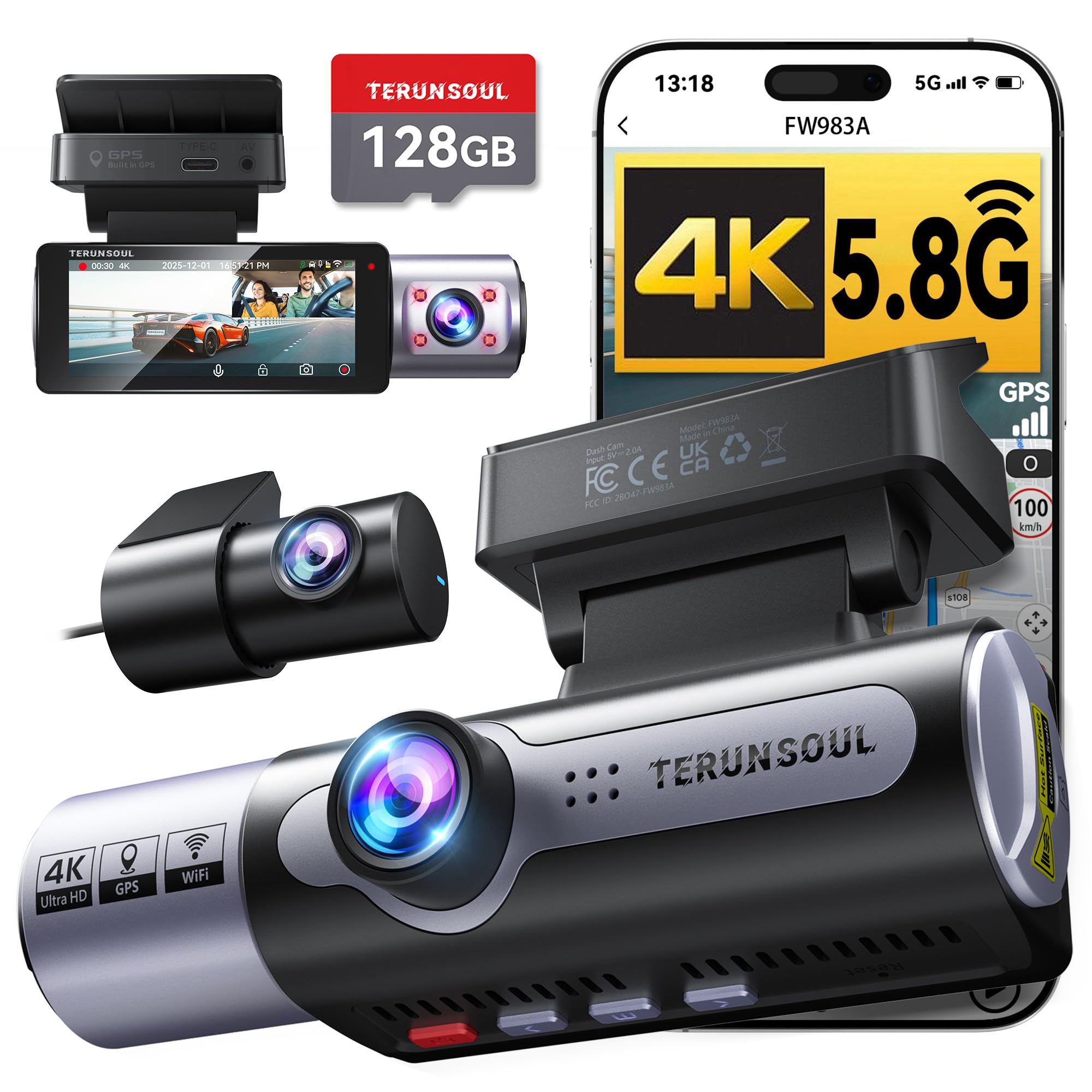
Most people buy a dash cam and then discover the card is extra, the mount is extra, and the rear camera is a separate purchase. Not here. The TERUNSOUl records 4K from the front at the same time as 1080P from the rear and 1080P from the cabin, and a 128GB card ships pre-installed inside the box. Open it, stick it to the glass, and you are recording the same afternoon.
The coverage numbers are the reason it takes the top slot. The front lens is rated at a 170-degree field of view and both the rear and cabin lenses at 165 degrees, so between them you get a near-360-degree picture of what the car is doing and what is happening around it. The 3.16-inch IPS screen lets you check framing without pulling out your phone. Inside, a five-layer starlight lens with an F1.6 aperture and HDR handling pulls detail out of dim streets and lit parking garages.
Where it separates from the cheaper two-channel units is storage and evidence handling. It accepts microSD cards up to 512GB — double the 256GB ceiling of the BOTSLAB G300H Plus, and double the 128GB card it ships with — so a long-haul driver can go far longer before the card cycles. The built-in GPS stamps route, speed, location, compass and timestamp directly into the video, which is the version of the clip an insurer actually wants. A collision sensor locks the clip of any impact so loop recording cannot erase it.
What works in its favour
- Three simultaneous streams — 4K front, 1080P rear, 1080P cabin — for near-360-degree coverage
- A 128GB memory card already installed, so there is no first-week shopping trip
- Accepts cards up to 512GB for drivers who rarely touch the card
- GPS route, speed and location data burned into every clip, readable on Windows, Mac or the app
- 5.8GHz and 2.4GHz WiFi with downloads stated at 20MB/s for quick sharing at the roadside
- 18-month warranty as standard
Where it asks something of you
- Parking mode needs a separate hardwire kit, sold apart from the camera
- A three-camera install is more wiring work than a front-only unit
- The app pairing takes a moment to settle on first setup
Buy it for: the household that wants front, rear and cabin covered in one purchase with the card already inside.
Plan around: a separate hardwire kit if you want it watching while the car sits parked.
2. BOTSLAB G300H Plus 4K Dual Dash Cam
Half an inch of housing that hides behind the mirror and forgets to distract you.
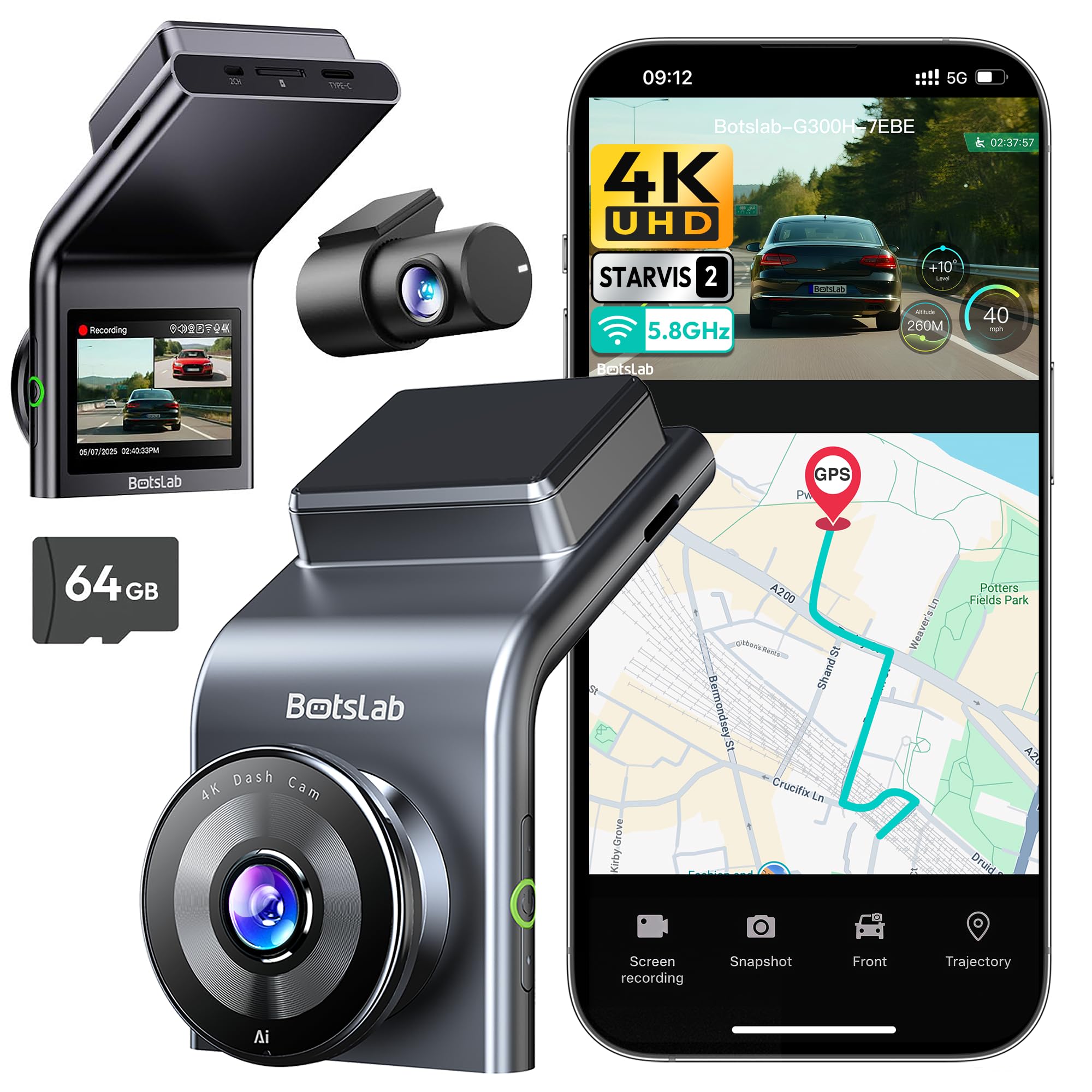
This is a two-channel camera, front and rear only, and it makes the most of the space it does not take. The housing measures 2.28 inches deep by 4.13 inches wide by 0.45 inches high — compare that to the 1.69 by 5.07 by 3.07 inches of the TERUNSOUl above and you can see why this one slides out of your sightline rather than hanging in it. If you have ever been annoyed by a screen glowing in your peripheral vision, that thin profile is the whole pitch.
The night story is genuinely strong for the tier. A STARVIS 2 sensor with an F1.5 aperture and HDR sits behind the front lens, joined by a 170-degree wide angle. That is the combination that lets a plate stay legible when a headlight is blowing out half the frame. Parking mode runs 24 hours, though a hardware kit is required and sold separately.
The thing to know before you buy is the phone connection. iPhones only hold one active Wi-Fi link, and CarPlay uses Wi-Fi, so you cannot be on the dash cam app and CarPlay at the same time. Jump out of CarPlay, pull the clip, jump back in. It is a 30-second inconvenience, not a fault, but it is the sort of detail you want to learn from a spec sheet rather than in a parking lot at night. You can also just talk to it — voice commands for “take photo” or “video start” keep your hands where they belong.
The honest trade: this is front-and-rear only, and the included card is a 64GB unit with a 256GB ceiling. If cabin footage matters to you, the money goes to a three-channel instead.
Reach for this if: your windshield real estate is precious and the car behind you is the worry, not the passengers.
Look elsewhere if: you need cabin coverage for rideshare work or want a bigger card in the box.
3. 70mai 4K Dash Cam T800E
A cabin camera with its own infrared light, built for the passenger who disputes the fare.
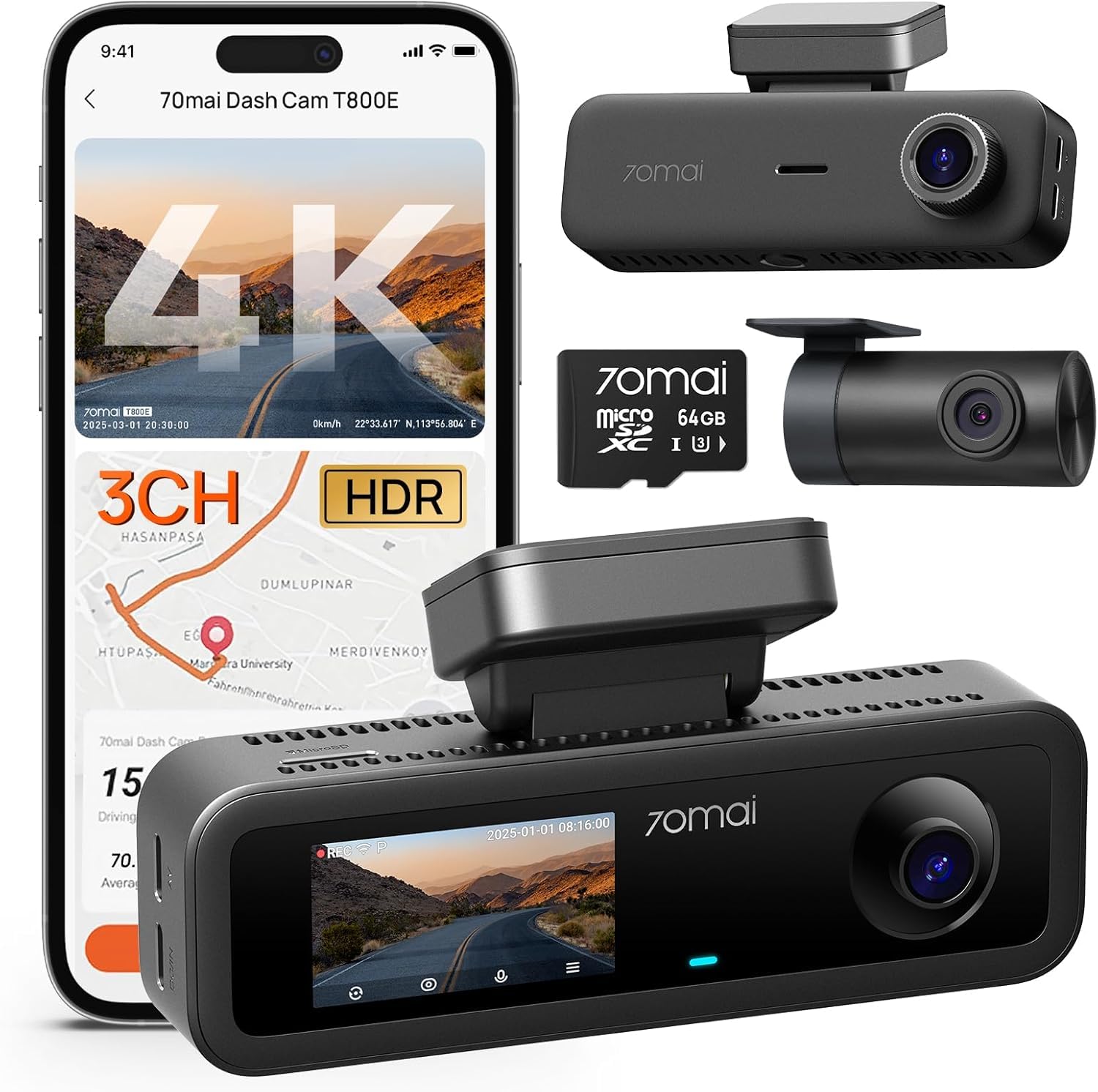
If you drive for Uber or Lyft, the interior view is the one that settles arguments, and this camera treats it as a first-class lens rather than an afterthought. The cabin camera has switchable infrared recording — flip IR on when the car is dark and it captures black-and-white detail inside, flip it off when you do not want it. Front records at 4K, interior and rear at 1080P, and the supercapacitor keeps it running across 14°F to 140°F without a battery to swell.
Connectivity is the other headline. Wi-Fi 6 moves files to the 70mai app at up to 10 MB/s, which the maker describes as up to 5× faster than Wi-Fi 4 — the practical version being that you are not standing in the rain waiting on a transfer. Built-in 5-mode GPS stamps location, speed and route onto the footage. A 64GB card comes included, and the slot accepts cards up to 512GB, matching the TERUNSOUl’s ceiling. Voice control covers photos, starting a recording and locking important clips.
Here is the trade a driver will actually hit. The 402-degree combined field of view keeps the cabin in frame without blocking your own view, and the review pages are clear that the unit is easy to live with — but the connection to the app is the recurring rough patch, and 4G LTE is not supported, so there is no remote check-in on the car from your phone. Parking surveillance needs a hardwire kit (UP06 or UP03). Neither thing breaks the camera. Both are the difference between buying this and buying a remote-monitored system.
Why drivers pick it: switchable infrared in the cabin is genuinely rare at this level, and it is the single feature that makes night footage inside the car worth reviewing.
Set expectations: the app link is the weak link, and no 4G means no checking the car from across town.
Best matched to: rideshare and taxi drivers who need the passenger seat on record.
Think twice if: remote monitoring over cellular is a must-have in your setup.
4. ROVE R2 DUAL Dash Cam
The one your neighbour probably already has, and the track record explains why.
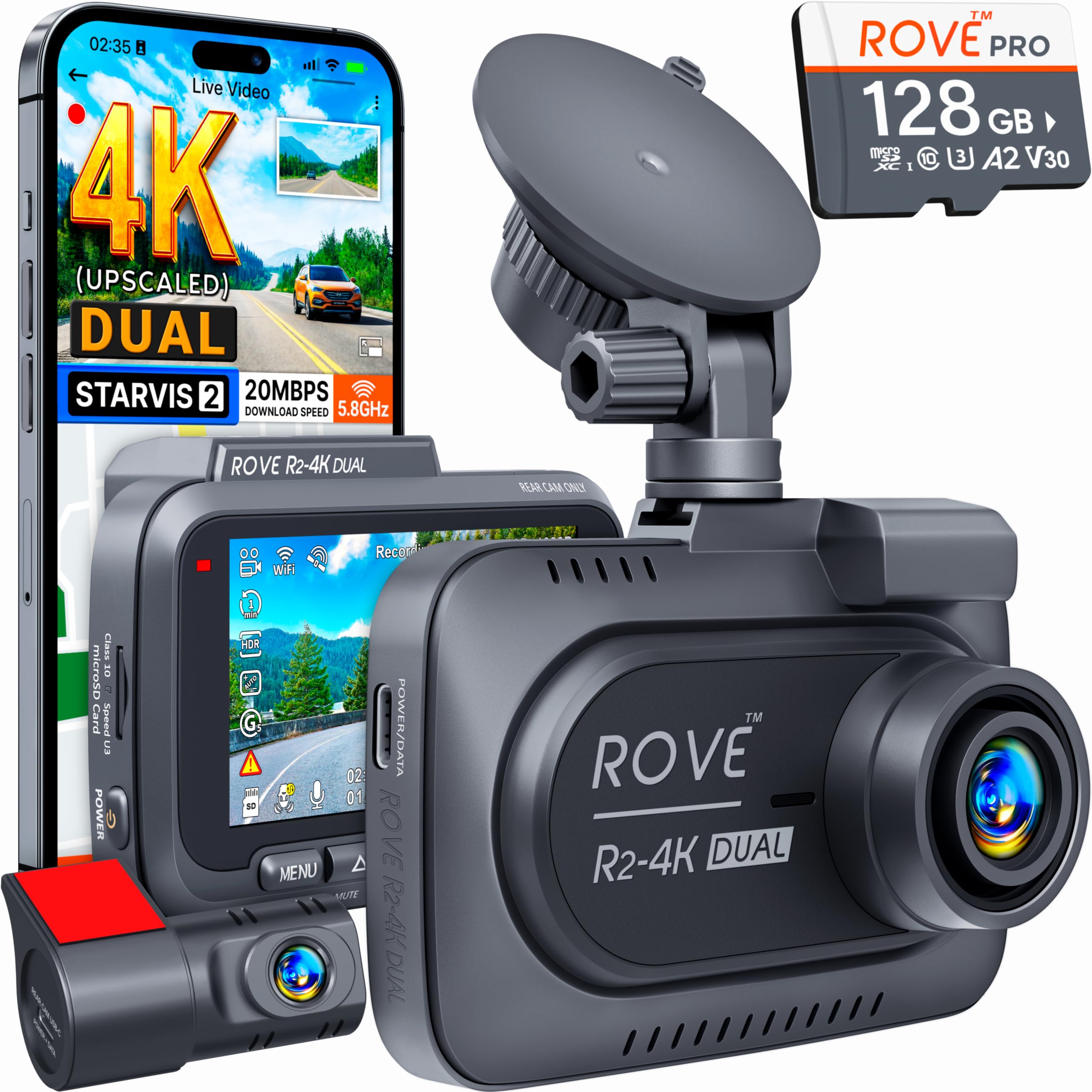
There is one figure that tells you more about this camera than any spec sheet line: the flagship three-channel in this family carries 4.5+ stars across 450+ ratings, and this dual version shares that same buyer trust. The reason so many people land here is not a single headline number. It is that the whole package is complete — a ROVE PRO 128GB microSD card, a dual USB car charger, the rear cam cable, mounts, clips and a wire trim tool all in the box.
Be precise about the resolution, because this is where marketing gets loose. The front camera records at 2.5K (QHD) and upscales to 4K for playback; the rear records at Full HD 1080P. It is not native 4K, and the listing says so plainly. What you do get is a Sony STARVIS 2 IMX675 5MP sensor behind the front lens with an F1.5 aperture and F1.8 at the rear, both with HDR. The card ceiling is the standout practical number: it takes microSD cards up to 1TB, which is the largest card support on this list outside the SSD-equipped VIOFO A329S.
Download speeds are claimed at up to 20MB/s over 5.8GHz or 2.4GHz WiFi, matching the TERUNSOUl’s stated figure. Parking mode offers three options — 1fps time-lapse, motion detection and collision detection — with voice guidance and a reminder alert the next time you start the car. Thermal protection is built in. The honest catch: the phone pairing works smoothly for plenty of drivers and stubbornly for others, so budget a calm ten minutes for the first connection rather than doing it in a hurry.
The case for it
- A 1TB microSD ceiling — the most generous card support of any unit here short of SSD storage
- Full kit in the box including a 128GB card, dual charger and trim tool
- Three parking mode options with a voice alert on your next start-up
- STARVIS 2 front sensor with F1.5 aperture for low-light plate reading
What to weigh
- Front footage is upscaled 4K, not native detail
- First-time phone pairing can be slow to establish
- Hardwire kit for parking mode is not included
The fit: a driver who wants the biggest storage runway and a box that needs nothing else bought.
The caveat: expect 2.5K front detail, not true 4K, despite the label.
5. BOTSLAB 4 Channel 360° Dash Cam
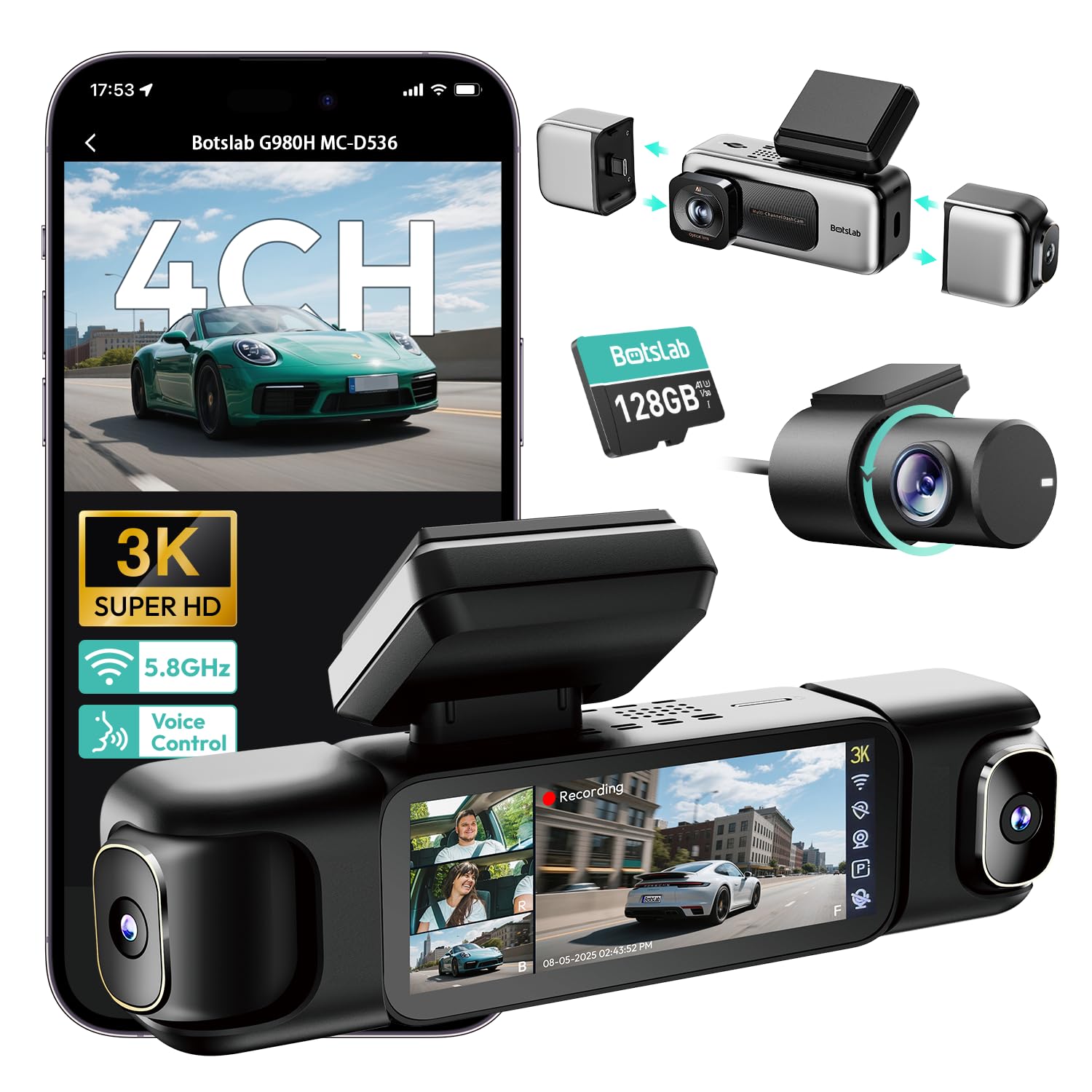
Four lenses watching four directions, including the sides nobody else covers.
Every other camera here watches forward, backward or inward. This one adds the flanks. Four cameras record at once — a 170-degree front lens, two 120-degree side cameras and a 150-degree rear — for a combined 560 degrees of stated coverage. The side cameras sit on magnetic mounts you can detach, which lets you drop from four channels to three (4K plus two 1080P streams) or down to two (4K plus 1080P).
It is the only unit on the list that thinks about the eight seconds before a hit. The G-sensor pre-recording function keeps the 8 seconds of footage leading up to a detected collision, not just the moment of impact — the run-up that often shows who was at fault. A 3.18-inch touchscreen lets you see all four views split on one screen, so you are not cycling between feeds during an argument. There is a free 128GB card, and the slot accepts up to 512GB.
Quality is what wins people over most, and video clarity holds up into darker conditions. But reliability is the most divided topic in the feedback, with some drivers finding it faultless and others hitting problems early. That is not a reason to skip it. It is a reason to buy it for the coverage you cannot get elsewhere, set it up carefully, and test every channel before you trust it with a commute. Note too that the Wi-Fi range is 3-5m, so there is no remote access from inside the house.
What you cannot get elsewhere: side coverage. If someone backs into your door in a lot, this camera has the angle.
What it asks: careful setup and a willingness to verify all four feeds work before relying on them.
Match it to: drivers in tight parking situations or busy city streets where a side impact is the realistic risk.
Not for: anyone who wants a set-and-forget single lens and nothing more to think about.
6. Vantrue N4S 3 Channel Dash Cam

Three STARVIS 2 sensors, and a rear camera that can turn to watch your cargo.
The N4S does something no other three-channel here does: it puts a STARVIS 2 sensor on all three cameras, not just the front. Front records at 2.7K, interior and rear at 2.5K each — and 2.5K rear is a meaningful step over the 1080P rear on the TERUNSOUl and the 70mai. The lenses run 158 degrees up front, 165 degrees in the cabin and 160 degrees at the rear, with HDR balancing the headlights-versus-dark-road contrast that ruins night footage.
PlatePix is the feature to understand. It is Vantrue’s plate-sharpening processing, stated to sharpen license plates by 2X, and it is why night footage here stays useful rather than just present. The rear camera also rotates a full 360 degrees, so it can point backward at traffic or pivot inward to watch luggage, equipment or a pet in the back. The supercapacitor is rated from -4℉ to 140℉, and the card slot takes microSD up to 1TB.
Installation is genuinely friendly for a three-channel: magnetic mount, static cling film and cable clips mean no tools and no drilling. Four parking modes cover motion detection with 10 seconds of pre-event recording, collision locking, and low bitrate or low frame rate options for longer storage. The one wrinkle is the wiring for the rear camera — follow the manual closely, because a loose connection is what causes most malfunctions on this model. Wi-Fi transfers are also the mixed part; some drivers find the 5GHz link quick, others find it fussy.
The number that sells it: 2.5K on the rear camera where most rivals settle for 1080P.
Do this one thing: seat the rear camera cable properly on install — that single step prevents most trouble.
Pick it when: night plate legibility on every angle is worth paying for, and you want the rear lens to double as a cargo watch.
Know before you buy: the rear cable needs careful routing, and the app link is not the fastest.
7. ROVE R2-4K Dual PRO Dash Cam
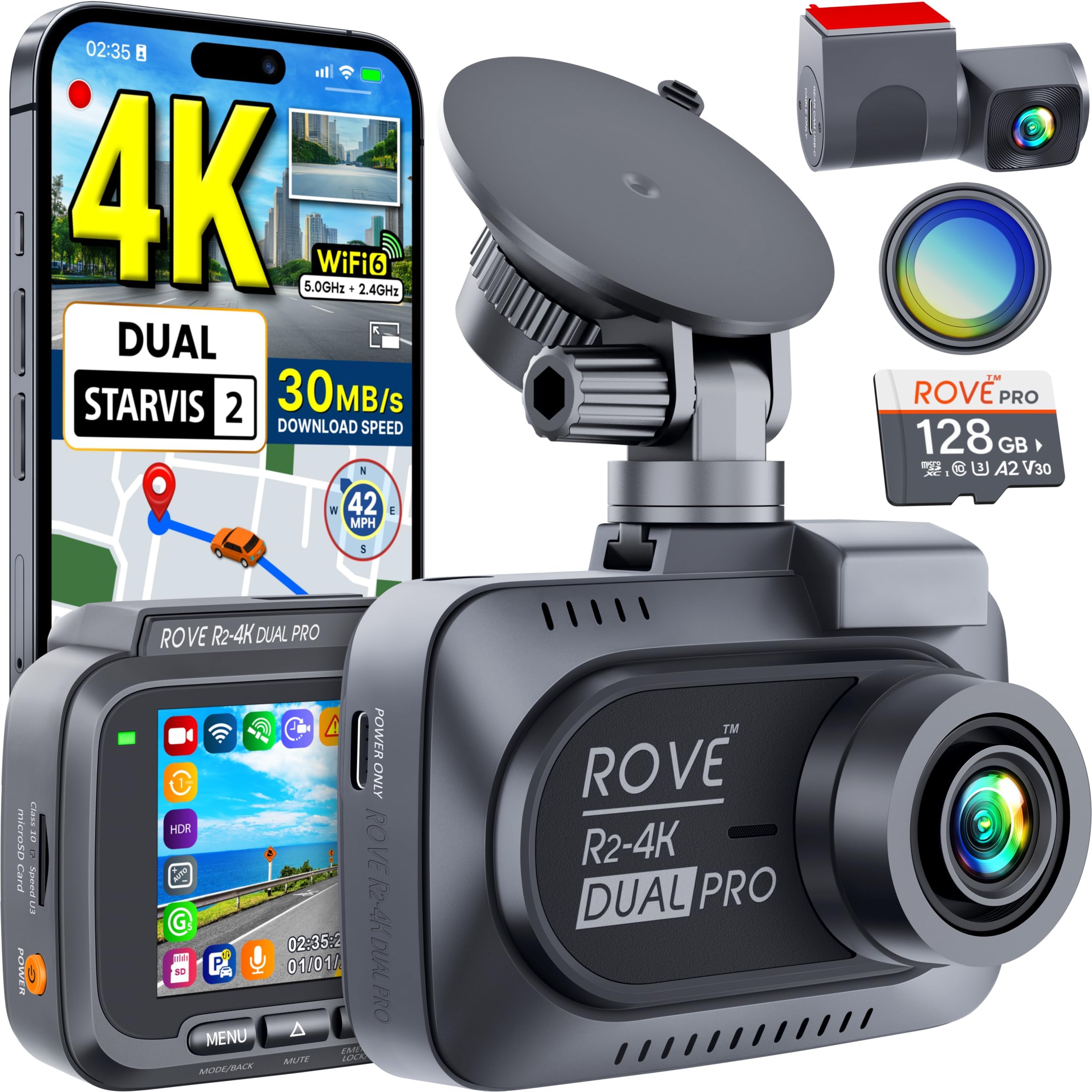
Real 4K up front and real 2K behind — no upscaling in the fine print.
The plainest way to see where this camera earns its keep is against its own sibling. The ROVE R2-4K DUAL records a 2.5K front image and upscales it; this PRO version records 3840x2160P at 30fps natively and pairs it with a 2560x1440P 2K rear at 30fps. Two different cameras, two different levels of detail, and the PRO is the one that captures small objects and signs without enlargement tricks.
Both lenses carry Sony STARVIS 2 sensors — an IMX678 at 8MP in front and an IMX675 at 5MP behind — with HDR and wide apertures of F1.7 front and F1.55 rear. The front glass spans 150 degrees, the rear 140 degrees. WiFi 6 on both 5GHz and 2.4GHz bands pushes downloads at up to 30MB/s, ahead of the 20MB/s stated by the TERUNSOUl and the plain R2-4K DUAL. Quad-mode GPS pulls from GPS, BEIDOU, GALILEO and GLONASS for faster satellite lock and a route overlay you can replay in the free ROVE player.
A CPL filter is included, which cuts windshield reflections out of the picture — the difference between a readable plate and a white smear on a sunny day. You also get a 128GB ROVE PRO card and support for cards up to 1TB. The camera that most needs your attention is the front unit: reliability is the divided topic in the feedback, with the front camera failing for some drivers while others run both cameras without issue. Buy from a seller with a clean return path and test both feeds in week one.
Standout spec: native 4K front plus 2K rear, with STARVIS 2 on both — the sharpest two-channel picture here.
Fair warning: the front camera is the component to verify early, since it is the failure point reported in the feedback.
Right for: detail obsessives who want a clean 4K read on both ends of the car.
Skip if: you would rather trade a little sharpness for a longer, steadier track record.
8. VIOFO A229 Plus 3 Channel Dash Cam
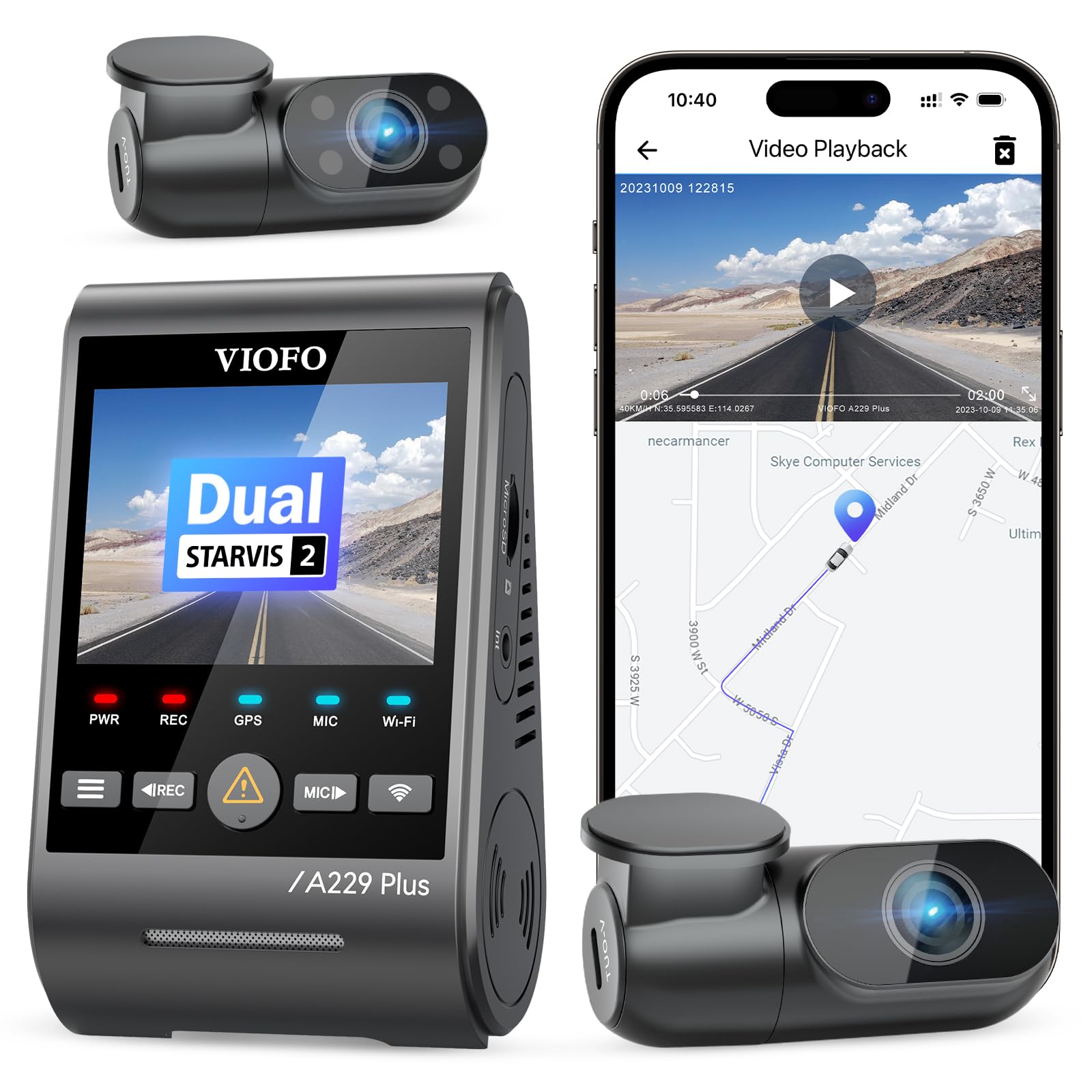
The interior lens that lights up its own LEDs and keeps shooting in pitch black.
Most cabin cameras give you a dark rectangle when the sun goes down. This one has a built-in IR light sensor that switches on four infrared LEDs automatically when the cabin goes dim, then records sharp black-and-white detail in complete darkness. For a taxi driver with a rear passenger, that is the difference between a video that helps and a video that shows a silhouette.
The rest of the stack is deliberate rather than flashy. Front and interior record at 1440P, rear at 1080P, with HDR on all three channels — a rarity, since most systems apply HDR to the front only. Two Sony STARVIS 2 IMX675 sensors sit in the front and rear cameras, a pairing the maker states delivers 2.5 times the dynamic range and 2.5 times the light sensitivity of STARVIS, with less noise and motion blur at night. Ultra-precise quad-mode GPS logs location, speed and time to the footage.
Voice control covers 12 commands, from taking a photo to locking a clip to switching on WiFi, and the camera gives clear notifications when a setting changes or the memory card needs attention — a small thing that saves you from discovering a dead card after an incident. Three parking modes run off a hardwire kit, including a buffered auto event detection that saves 15 seconds before and 30 seconds after a detected movement. Compact interior and rear cameras make flexible mounting easier than on bulkier rivals. The connectivity link is the soft spot, so expect the occasional app disconnect.
Standout strengths
- Four infrared LEDs that auto-activate in low cabin light
- HDR on all three channels, not just the front
- Two STARVIS 2 IMX675 sensors, front and rear
- 12 voice commands with on-screen error notifications
- Buffered parking mode saving 15 seconds before and 30 seconds after an event
Points to consider
- The WiFi link drops out for some drivers
- Hardwire kit needed for parking mode
- Front records at 1440P, not 4K
Suits: night-shift drivers and taxi operators who need the cabin visible, not merely recorded.
Trade-off accepted: you give up a 4K front label in exchange for infrared cabin clarity.
9. VIOFO A329S 4K Dash Cam
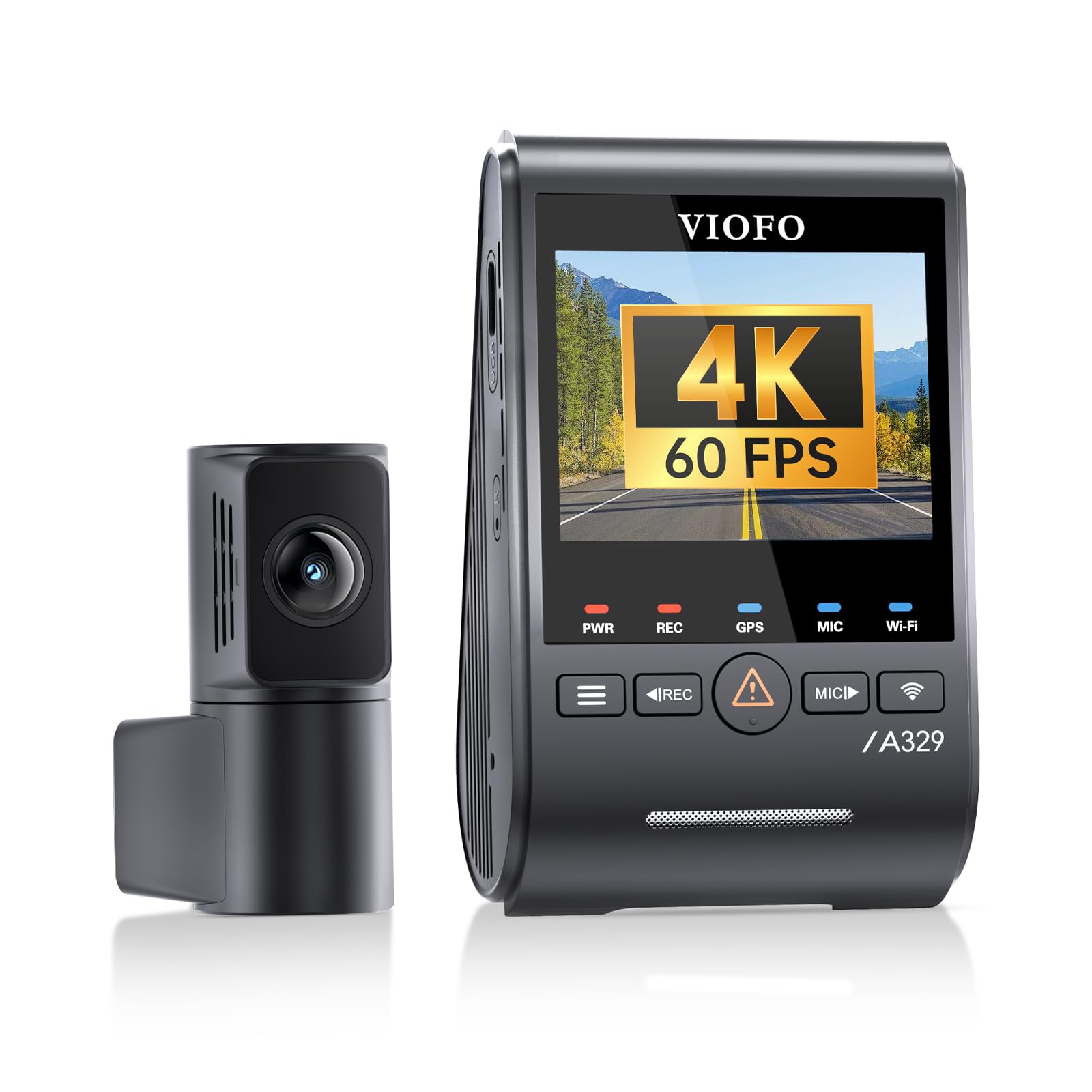
Sixty frames a second up front, and storage measured in terabytes instead of gigabytes.
Two numbers define this camera and neither appears anywhere else on the list. The first is 4K at 60fps on the front camera, against the 30fps most rivals manage — that double frame rate is what keeps a fast-moving plate from smearing into a blur, which is exactly the situation a dash cam exists for. The second is external SSD support up to 4TB, alongside microSD up to 512GB. Neither card nor drive is included, but a 4TB SSD stretches continuous recording past 3 weeks before a single overwrite.
Both ends get STARVIS 2 sensors: an IMX678 at 8MP up front and an IMX675 at 5MP for the 2K rear, with a 2-channel HDR mode that balances blinding highlights against dark road. Wi-Fi 6 pushes up to 30MB/s in the 5GHz band, and the maker states a 1-minute 4K clip downloads in under 10 seconds — the number that decides whether you are pulling footage at the roadside or still standing there. An anti-glare CPL filter comes attached to the front lens, and the 2.8mm coaxial rear cable resists electromagnetic and radio-frequency interference from other car electronics.
All that performance comes with two honest notes. It runs warm and asks a lot of your setup — an effective, low-power parking mode is there, but you need the HK4 or HK6 hardwire kit, and that is not included. And while drivers who own it treat it as the best footager on the market, the value question splits sharply in the feedback: plenty find it worth the outlay, plenty find it overpriced for a two-channel. Its reliability is the most divided topic in its own reviews. Buy this for the 60fps 4K and the SSD runway, and know you are paying for both.
The 60fps argument: double the frames of a 30fps cam means less motion blur when it matters most — a moving plate at speed.
The honest catch: a two-channel at premium money, needing a hardwire kit for parking and a card or SSD you supply yourself.
Worth it for: highway drivers and detail chasers who want the smoothest 4K footage and terabytes of uninterrupted storage.
Not worth it for: anyone who primarily needs cabin coverage — three cheaper cameras here do that job.
Know the Specs
Channel Count and Coverage
A channel is one lens feeding one recording stream. Two channels means front and rear; three adds a cabin camera; four adds the side flanks. More channels is not automatically better — it means more wiring, more storage consumed and more to verify on setup. Pick the number of angles that matches your real risk: rear-end collisions and parking-lot scrapes for most drivers, cabin disputes for rideshare workers, and side impacts for anyone in tight urban parking.
Resolution and Frame Rate
Resolution describes how much detail lands in each frame — 1080P, 1440P, 2.7K, 4K. Frame rate is how many frames the camera captures each second, commonly 30fps or 60fps on the front lens. Higher frame rates reduce blur on fast motion, which matters most for reading a plate on a passing car. Check whether a 4K figure is native or upscaled from a lower resolution — a few cameras enlarge a 2.5K image and label it 4K.
Image Sensor and Aperture
The sensor is the chip that turns light into a picture, and the aperture is the size of the hole light passes through, written as an F-number. A lower F-number, like F1.5 or F1.6, lets in more light. This pairing decides whether a plate is legible at night far more than the resolution number does. Sony’s STARVIS 2 line is the sensor family that appears across the strongest night performers on this list.
Storage, Loop Recording and Parking Power
Loop recording writes over the oldest clip once the card fills, and a G-sensor locks the clip of any impact so it survives the cycle. Card ceilings here range from 256GB up to 1TB, with one unit supporting a 4TB external SSD. Parking mode needs a hardwire kit in nearly every case, and a supercapacitor — a battery-free power store — is what lets a windshield-mounted camera survive summer heat without swelling.
Common Questions
Do I need a hardwire kit for parking mode?
Is upscaled 4K as good as native 4K?
Will a 512GB microSD card work in all of these cameras?
Why does my dash cam lose its Wi-Fi connection?
Will a windshield dash cam survive a hot summer parked in the sun?
How long will the included memory card last before it overwrites?
Can I run a dash cam and CarPlay at the same time?
Is a three-channel dash cam worth it over a two-channel?
What aperture number should I look for in a dash cam?
Do these cameras record sound inside the car?
What does a G-sensor actually do on a dash cam?
The Bottom Line
For most cars, the in-car camera systems winner is the TERUNSOUl 4K 3-Channel, because it covers front, rear and cabin in one purchase and puts the 128GB card in the box — its 4.5+ stars across 400+ ratings back that up. If your concern is the car behind you and you want the housing to disappear behind the mirror, the BOTSLAB G300H Plus is the slimmer, night-capable answer. For anyone carrying passengers, reach for the 70mai T800E and its switchable infrared cabin lens.
One last nudge, and it is a practical one: whatever you buy, install it, then review the footage the same evening. A camera only earns its place on your glass once you have watched a clip and seen a plate you can read — and every pick here is capable of that when it is set up properly.
How we choose
We do not accept paid placement. Every pick is matched to a real buyer and a real use-case; we do not hands-on test units.
Sources
Specifications: manufacturer listings and product documentation. Review insights: verified customer reviews, as of November 2026. Pricing: not shown on this page (it changes often); check the current price via the retailer link.
As an Amazon Associate, Tactical Gear Guy earns from qualifying purchases. This does not affect which products we feature.