Specs are compiled from manufacturer listings and verified buyer reviews and can change over time — please confirm the key details on the product page before buying.
Match airflow to the mess you make, and you buy the right household dust collector. In a small garage where you sand or saw, a compact unit moving 560 to 780 cubic feet of air per minute (CFM — how much air gets pulled through the machine every minute) is plenty. In a bigger shop with a table saw and planer running at once, aim closer to the 1,300 CFM of the top pick below. Two kinds of machines sell under this name: one vacuums chips off a tool, the other scrubs airborne dust out of the room. Picking the wrong kind is the mistake most buyers make.
This guide is built by comparing the manufacturers’ published specifications and the patterns across verified customer reviews, so you get each pick’s real strengths and trade-offs instead of marketing spin.
You will see what each machine actually captures, how much bag capacity you get before you have to empty it, and which one fits a one-car garage rather than a full cabinet shop. My walkthrough of the best Household Dust Collector separates the chip-eaters from the air-scrubbers so you buy the right type first time.
Top Picks


How To Choose The Best Household Dust Collector
The fastest way to waste money here is to buy a powerful chip vacuum when your real problem is a haze of fine dust hanging in the air after you finish sanding. Start by deciding which of the two jobs you need done, then match the airflow number to the size of your workspace.
Do you need a chip collector or an air scrubber?
A chip collector hooks to a tool with a hose and swallows sawdust at the source, so it keeps the floor and the tool table clear while you cut. An air scrubber pulls the dusty room air through a filter box, so it tackles the particles that already escaped into the air. If you can see dust floating when the light hits it, you want a scrubber. If your table saw is throwing chips onto the floor, you want a collector with an inlet port.
Match CFM to your shop and your tools
CFM (cubic feet of air moved per minute) tells you how much dust the machine can pull at once. A small benchtop unit running around 560 to 780 CFM suits a hobby corner and one tool at a time. Bigger units rated for 1,300 CFM can hold two tools on twin inlets, which matters when you keep a table saw and a planer set up side by side.
Watch the micron rating on the filter
The micron number tells you the size of the smallest particle the bag or filter traps. A 5-micron bag traps sawdust down to 5 microns, so the sub-5-micron haze drifts back into the room. A 2.5-micron or 1-micron bag or a MERV-11 filter steps that down, so less fine dust finds its way back into your nose. If you sand a lot, filtration class deserves as much attention as CFM.
Side-by-Side Comparison
| Model | Best For | Airflow (CFM) | Filtration / Bag | Form | Amazon |
|---|---|---|---|---|---|
| WEN DC1300★ Best Overall | Two tools at once, big shops | 1,300 CFM | 5-micron, 50-gallon bag | Mobile canister | Amazon |
| WEN DC3401Best Entry Price | Budget rolling chip collector | 660 CFM | 5-micron, 12-gallon bag | Mobile / wall mount | Amazon |
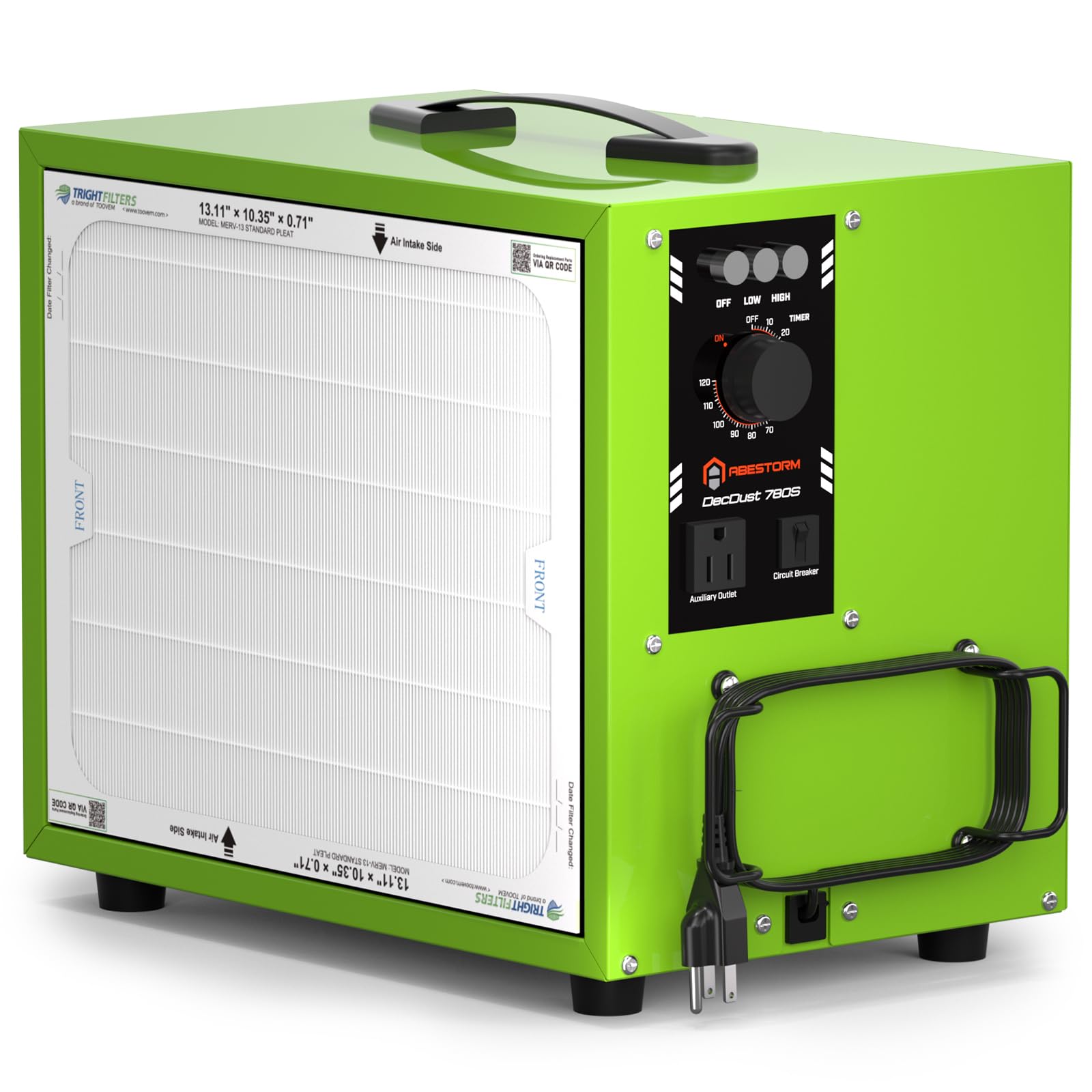
| Tabletop DecDust 780SBest Benchtop Scrubber | Benchtop air scrubbing with timer | 580 / 780 CFM | MERV-13 filter | Tabletop | Amazon |
| VEVOR Wall Mount 560 | Wall-hung chip collection | 560 CFM | 2.5-micron, 21-gallon bag | Wall mount | Amazon |
| ALORAIR Purecare 1350IG | Large room air scrubbing | 1,050 / 1,350 CFM | MERV-11 filter | Hanging / bench | Amazon |
| PSI DC725 | Tabletop carving and turning | 725 CFM | 2″ x 10″ x 20″ filter | Tabletop | Amazon |
| Abestorm DecDust 1350IG | Fine-dust air scrubbing | 1,050 / 1,350 CFM | MERV-11, 4 filters included | Hanging / bench | Amazon |
| BUCKTOOL DC50 | Auto-start with your tool | 750 CFM | 2-micron upper bag | Mobile canister | Amazon |
| DEWALT DWXAF101 | HEPA ceiling air scrubbing | — | H11 HEPA + pre-filter | Hanging / bench | Amazon |
| POWERTEC DC5371 | Small shops, wall-hung | 560 CFM | 1-micron bag | Wall mount | Amazon |
| SHOP FOX W1727 | Big airflow for small shops | 800 CFM | 2.5-micron bag | Portable canister | Amazon |
Detailed Reviews
1. WEN DC1300 1,300 CFM Dust Collector
Our pick — 4.5+★ from 200+ verified ratings; the strongest balance of quality and price.
The dual-inlet workhorse that swallows two tools’ worth of sawdust at once
This one earns its spot with 1,300 CFM — the volume of air it pulls each minute, roughly double the 660 CFM of the WEN DC3401 below. That gap lets it feed two tools at once through dual 4-inch inlets, so a table saw and a planer stay hooked up without unplugging hoses. A 14-amp motor spins the 10-inch steel impeller up to 3450 RPM to keep airflow steady. The vertical bag holds up to 50 gallons before you empty it — 50 gallons versus 12 gallons on the DC3401 means far fewer bag swaps.
What wins people over is plain effectiveness at cleaning up the mess; assembly is easy and it moves a lot of air without the roar you brace for. The durable build is where opinions split — treat the machine well and it holds up, but some units have given trouble, so buy it as a long-term tool and store it sensibly. A 5-micron cartridge catches chips and coarser dust, which suits a shop where heavy debris is the main battle. The mobile base on four swivel casters lets you roll it to whichever machine is making dust that day.
Where this machine earns its keep
- 1,300 CFM airflow gives two-tool capacity on the twin 4-inch inlets
- 50-gallon bag cuts down how often you empty it versus 12-gallon rivals
- Four swivel casters on the mobile base make it easy to reposition
- Easy assembly and surprisingly moderate noise for its airflow
What to keep an eye on
- The 5-micron bag stops chips but passes the finest airborne haze
- Build durability is the one mixed spot across long-term feedback
Reach for this if: you run two machines in a larger shop and want a rolling collector that keeps them both clear.
Look elsewhere if: the fine sanding haze is your real problem — a MERV-rated air scrubber handles that job better.
2. WEN DC3401 Woodworking Dust Collector
The starter reel for miter-saw and table-saw chips, with a bag you can zip off
This is the low-entry ticket into a real chip collector. Its 5.7-amp motor and 6-inch impeller move up to 660 cubic feet of air per minute, and a 4-inch port lets you plug a hose straight into a table saw or miter saw. In use it is the machine that takes the bulk of the mess rather than the fine haze — think sawdust flying while you cut. A 12-gallon 5-micron zippered collection bag catches what comes through.
Where it slots into the lineup is convenience. Lockable swivel casters roll it where you need it, an onboard carry handle lets you lift it up and out of the way, and you can hang it on a wall if you’d rather save floor space. The compact footprint means it tucks under a bench between jobs. That portability plus a two-year warranty is the case for buying it as a first collector.
The honest ceiling is suction and durability. Feedback on long-term durability is the weaker spot — run it within reason and keep the bag emptied, and it earns its keep as a hobby-tier unit rather than a heavy-production workhorse.
The realistic fit: a hobbyist or small shop who wants chip collection off a single tool and values the ability to roll it or hang it, not a full two-tool production setup.
The weak link to weigh: reported durability issues mean you should treat it as a light-duty machine and not push it past what 660 CFM can comfortably handle.
Worth it when: you need an affordable, movable collector for one saw at a time in a compact workspace.
Skip the ladder if: suction power for fine dust is your priority — spend up for stronger airflow.
3. Tabletop Dust Collector with Timer
A sit-on-the-bench air scrubber with a timer that cleans up after you leave
At 19.96 pounds and small enough to sit on a workbench, this is an air scrubber rather than a chip collector — it does not hook to a tool. It runs two speed settings, 580 CFM and 780 CFM, and pulls the dusty room air through a MERV-13 filter, a rating that traps a high share of the fine particles a plain 5-micron bag lets slip. The filter is rated to last up to 6 months before replacement.
The feature that makes it practical is the timer, which runs up to 120 minutes so the unit keeps cleaning after you’ve walked away from the bench. A piano-key switch (a flat set of buttons like a keyboard) gives quick on and off. A circuit breaker shuts the power down automatically if the current climbs past a safe level, and an auxiliary outlet lets you daisy-chain another unit in the same family under the control panel. The 11.5 ft cord and side cord wrap keep the cable tidy between sessions.
The trade-off is scale. This is for a bench, a carving station, or a small renovation corner, not a whole shop floor — a larger room will outrun a 780 CFM box. How quiet it is splits opinion, so mount it where the hum won’t bother anyone nearby.
Best matched to: a carver or hobbyist at a single bench who wants fine dust pulled from the air while they work and after they stop.
The size caveat: it scrubs a corner, not a warehouse, so pair it with a proper chip collector on bigger days.
4. VEVOR Wall Mount Dust Collector 1 HP
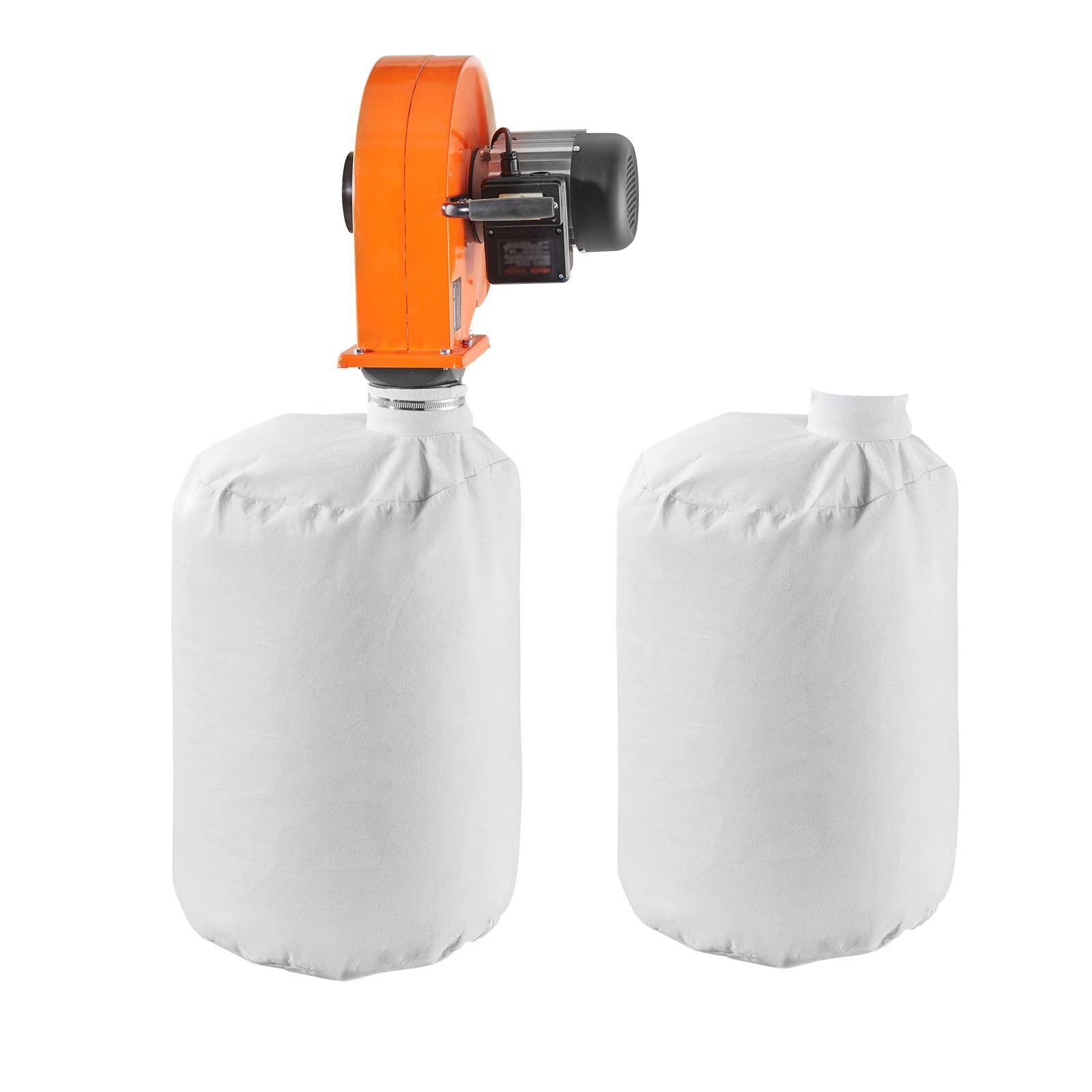
Hangs on the wall, holds 21 gallons, and unzips to dump the chips
Here’s the wall-hung answer for a shop short on floor space. It delivers 560 CFM of suction from a 1 HP induction motor, enough to pull coarse sawdust and finer sanding dust off a tool without eating a footprint. The 21-gallon (80L) non-woven bag holds a big load of debris before you empty it. Emptying is the clever part: a bottom zipper lets you unload the chips without unhooking the bag or reaching for tools.
The induction motor is rated to run at 90 dB or under and is built to resist overload, so long sessions don’t strain it. For a medium or small project schedule, that means fewer cleaning breaks and steadier airflow. The 120-volt power (versus 115 volts on some benchtop rivals) matches a standard shop circuit.
Why it earns the wall: 560 CFM and a 21-gallon zippered bag in a body that mounts off the floor — a strong space-saving bargain for a compact shop.
The one honest question: 560 CFM suits one tool at a time, so a big two-machine setup still wants the higher-airflow DC1300.
Made for: a hobbyist or small shop that wants chip collection off the floor and a bag that empties in seconds.
Not the pick for: a busy shop running several tools together where more airflow is needed.
5. ALORAIR Purecare 1350IG Air Filtration System

A 360-degree air intake that covers a whole workshop in a swirl of moving air
When the dust is already floating, this is the machine that hunts it down. It pulls air in from all 360 degrees, moves it at up to 1,350 CFM, and cycles the air in a room up to 1,700 square feet. A two-speed vortex fan (a fan shaped to spin air hard outward) keeps a strong static pressure even as the filter loads up with chips. A MERV-11 filter traps 90% of 3-to-10 micron particles and 85% of 1-micron particles.
Setup flexibility is real: a hook and chain let you hang it from the ceiling, or you can set it on a workbench. A timer-cycle controller shuts the fan down automatically after 1 to 9 hours, and an infrared remote runs it without wiring. It also carries a built-in ionizer for odors. Buyers report it cleans the air in workshops and garages effectively and is easy to install.
The catch is noise. It is the loudest complaint on this scrubber, and at 60 to 69 dB it is a machine you schedule rather than leave running in your ear. Mounting hardware gets mixed notes too — the brackets can be the fiddly part. Note that it cannot ship to California, since it does not meet the state’s regular requirements.
Why it clears a big room
- 1,350 CFM and 360-degree intake covers up to 1,700 sq ft
- MERV-11 filter catches 85% of 1-micron particles
- Timer cycles 1 to 9 hours and an IR remote keep it hands-off
The parts that ask patience
- Noise is the loudest recurring gripe — 60 to 69 dB is noticeable
- Mounting brackets are the weak hardware link
Suits you if: your workshop air is hazy and you want a ceiling-hung scrubber covering a big floor area.
Think twice if: you work beside the unit and noise matters — schedule it to run when you step away.
6. PSI Woodworking DC725 Tabletop Dust Collector
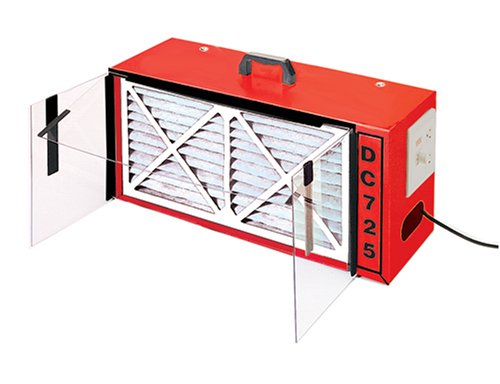
Three quiet fans and a clear hood that aim airflow right at small work
The detail that wins tabletop crafters is the adjustable clear polycarbonate top hood and side doors — you angle them to direct suction exactly where the dust flies. Behind that are three computer-grade fans that draw dust in at a maximum airflow of 725 CFM, all maintenance-free. A variable-speed control knob on the side panel dials the pull up or down for the job.
It is built for carving, sanding, grinding, woodburning, and small tabletop turning projects, not for hooking a hose to a table saw. At a 23″ x 8″ footprint and 10.5″ tall, it sits on the bench where you work. Two grounded 115V outlets on the side panel let you power a small hand tool from the same unit. A 2″ x 10″ x 20″ filter captures the dust, and one is included.
What buyers like is the combination of quiet running and effective dust removal — the fans are built to be gentle on the ears. The limit is that this is a capture-at-the-bench machine: it does not move shop-scale volumes or attach to big tools. Total running amps are 1.29, so it is easy on a circuit.
Pitched at: carvers, turners, and detail sanders who make fine dust at a bench and want it pulled away quietly.
Not for you if: you need a hose-inlet collector for a table saw — the DC725 works by local capture, not tool hookup.
7. Abestorm DecDust 1350IG Air Filtration System

Four spare MERV-11 filters in the box turn a scrubber into a long-haul investment
What sets this scrubber apart is what’s in the box: four replaceable MERV-11 micron filters, each rated to run 2 to 4 months before you swap it. That is a stack of spares covering a long stretch of shop time. Airflow runs 1050 to 1350 cubic feet per minute, and the unit covers rooms up to 1,700 square feet. Fine sawdust is exactly what it targets — the feedback keeps coming back to how well it pulls the fine particles out of the air.
Mounting is flexible three ways: hang it on chains from the ceiling, set it on a bench on four anti-slip rubber pads, or screw it straight into the ceiling. Dual control means a touch panel plus a remote that reaches up to 27 feet, so you can fire it up from across the shop. A built-in ionizer generates positive and negative ions to treat particles and odors. At 27 pounds it is manageable to hang.
The drawback shows up twice in the feedback: noise and the remote. Volume is the loudest complaint, and the remote drew mixed notes for reliability. Electrical draw is 115V, 60 Hz, 1.5A. Note it cannot ship to California, since it does not meet the state’s air cleaner requirements.
The spare-filter advantage: four MERV-11 filters included and rated for 2-4 months each is the reason to pick this over a scrubber that ships with one.
Where it stumbles: noise stays the big recurring gripe, and the remote is the less-trusted control of the two.
Choose it when: you want a large-room scrubber with spares stocked and flexible ceiling, bench, or screw mounting.
Weigh the noise: if you work right beside it, plan to run it on a schedule rather than constantly.
8. BUCKTOOL 750 CFM Auto-Start Dust Collector
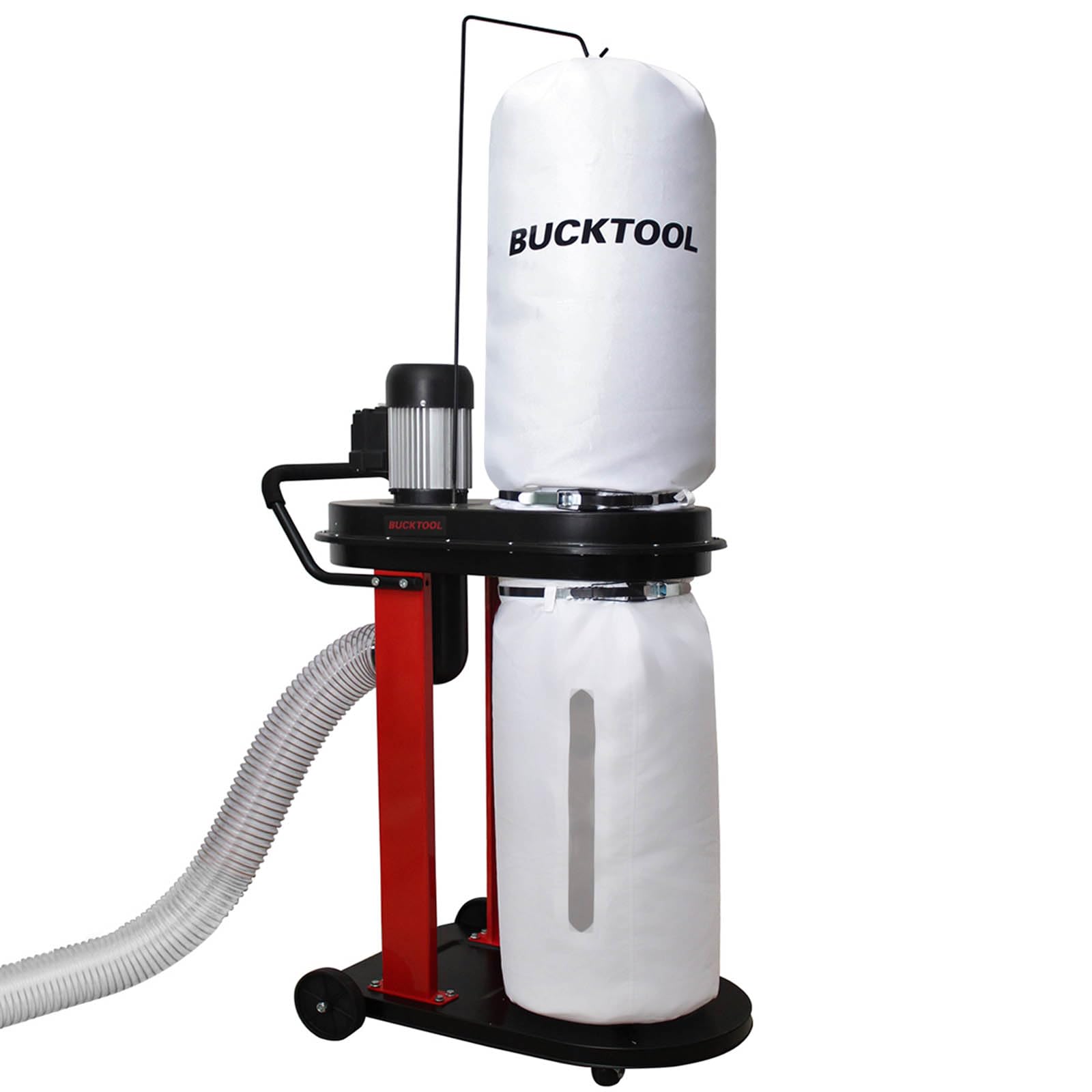
Fires up the moment you switch on your tool, so you never forget the collector
You get one-switch convenience from the auto-start outlet. Plug your tool into the collector’s power outlet, and the collector kicks on with the tool and shuts off after — no more flipping two switches or hunting a free socket. It can drive a tool drawing up to 7A. Behind it sits a 1.2 HP, 120V motor at 3450 RPM moving 750 CFM. Collection capacity is 13 gallons, split across a plastic lower bag and a cloth lower bag, with a 2-micron cloth upper bag for the fine stuff.
The bag system is thoughtfully built. Soft PET bag clamps (a pliable clip ring) hold the bags without slicing your hand, and a well-designed clasp makes bag swaps quick. A 5-foot 4-inch flexible hose plus five reducer pieces in the box connect it to a range of tool ports. The caster-wheel base measures 16-1/2 x 26-3/8 inches, letting it work as a mobile or stationary unit and free up floor space.
Quality is the split point. Some units feel great, others hit quality-control snags, and assembly drawn out as irritating and confusing for some buyers. Suction and value land mixed, so treat it as a capable tool for the auto-start convenience rather than a guaranteed-consistent build. Line up the metal leg holes carefully at assembly.
The auto-start draw
- Auto-start outlet drives a tool up to 7A and turns on with it
- 2-micron upper bag plus soft PET clamps that are easy on hands
- 5-ft hose, five reducers, and a mobile caster base in the box
The build to budget for
- Quality control is mixed across units
- Assembly trips up some buyers and leg holes can misalign
Best for the forgetful shop: anyone who wants the collector to switch on with the tool and skip the second plug.
Inspect on arrival: check the bag clamps and leg alignment early, since consistency varies unit to unit.
9. DEWALT DWXAF101 Air Filtration System

Two-stage HEPA filtration that hangs from the ceiling and runs itself
For the buyer who wants the finest dust out of the air, the two-stage filter is the draw. A static cotton pre-filter catches the bigger debris, then an H11 HEPA filter (a high-efficiency class that traps very small particles) captures over 95% of 0.3-micron particles. That is the smallest dust class in this lineup, well below the 5-micron bags on the chip collectors. It hangs from the ceiling on the included hooks and chains, so it wastes no floor space.
Four working modes cover how you want it to run: HI, MID, LO, and an AUTO mode that senses air quality and switches gears for you. A built-in timer shuts off after 1H, 2H, 4H, or 8H, so it keeps cleaning while you’re away. The included remote adjusts it from across the shop, and a filter-replacement indicator plus a washable pre-filter cut down on upkeep cost. It is backed by a three-year warranty — the longest coverage of the picks here.
The one soft spot is the remote: it needs to be close and in direct line of sight, which limits the convenience the remote was meant to add. Everything else — quiet running, easy install, effective dust clearing — leans the other way, which is why it holds up as a strong ceiling scrubber for the money.
The filtration lead: an H11 HEPA stage (a high-efficiency filter rated to catch fine particles) traps over 95% of 0.3-micron particles — the tightest filtration in this guide — and a washable pre-filter keeps running costs down.
The remote catch: the remote only works up close and in direct sight, so plan to set modes at the unit.
Ideal for: a shop that wants maximum fine-dust filtration hung overhead with a set-and-forget timer.
Hands-on if: you expect to work the remote from across the room — that is where it falls short.
10. POWERTEC DC5371 Wall Mount Dust Collector

A 1-micron bag on a wall-hung body, so fine dust stays out of the room
Most chip collectors stop at 5 microns; this one runs a 1-micron bag, which traps far finer dust and stops it from drifting back out. It is built to keep a workshop free of woodchips and sawdust while it cuts the fine haze from table saws, planers, jointers, sanders, band saws, and routers. The 1 HP induction motor handles dual voltages, 120V and 240V, and pulls 560 CFM. A 4-inch inlet port takes a hose straight to whatever machine you’re using.
The Vortex Base design (a shaped base that guides airflow in a controlled path) reduces turbulence and the maker rates it up to 10% more efficient than a comparative model. A built-in window on the bag lets you watch the dust level, and a zipper makes emptying easy with no extra tools. Hanging it on the wall frees floor space in a compact pro or hobby shop.
Two things to know. Suction is the one divided topic — some find it great, others want more, so match it to one tool at a time. And the 4-inch port has a built-in grate to protect the impeller; debris collects there over time, so pull the hose and clear the port now and then. Noise sits around 80 dB.
Pick it for: a small shop or hobbyist who wants the finest bag filtration on a wall-hung, floor-saving chip collector.
Keep it maintained: clear the grate-protected port regularly so airflow doesn’t drop.
11. SHOP FOX W1727 Portable 1 HP Dust Collector

The strongest airflow of the portables, prewired for a plain wall outlet
This one leads the portables on raw airflow at 800 CFM, ahead of the 750 CFM BUCKTOOL and the 660 CFM WEN DC3401 above. A 1 HP, single-phase motor is prewired for 110V (and can run on 120V/240V at 9A/4.5A), and a standard 2.5-micron bag holds the dust. For small shops working table saws and band saws, that extra pull is what keeps the tool table clear.
The feedback leans strongly toward good work, easy assembly, and quieter-than-expected running. Its value holds up in a hobby or small-shop setting. The portable base measures 15-3/4″ x 39-3/4″, and the whole unit weighs 55 pounds, so it sits in place more than rolls around.
Where it asks patience: dust collection and suction power split opinion, and a heap of fine chips can overwhelm it or fling dust during use. That makes it a solid chip-hauler for regular work, but treat heavy, continuous debris as beyond its comfort zone. Size is its charm — compact enough for a small shop that wants real airflow without hogging the room.
The airflow argument: 800 CFM tops every portable pick here and keeps a small shop’s table saw and band saw cleared.
The workload line: mixed reports on suction under heavy chip load mean it shines on routine debris, not a nonstop production run.
Right for: a small shop or serious hobbyist who wants the most airflow in a compact portable body.
The weight note: at 55 pounds it is a set-in-place unit, so don’t count on pushing it around mid-project.
Know the Specs
CFM: how much air the machine moves
CFM stands for cubic feet per minute — the volume of air pulled through the machine each minute. Higher CFM means more dust moved at once and the ability to feed more tools. A 560 CFM unit suits one tool; a 1,300 CFM unit can hold two. Match CFM to how many machines you run at the same time and how big the mess is.
Micron rating and MERV class: how fine a particle it traps
A micron is a tiny unit of particle size, and the micron number on a bag tells you the smallest dust it holds. A 5-micron bag holds sawdust down to 5 microns but passes finer particles. A 2.5-micron or 1-micron bag or a MERV-11 filter catches finer particles that would otherwise float. HEPA-class filters go finer still. The lower the micron number, the cleaner the air stays after you finish cutting.
Bag capacity: how often you empty it
Capacity is measured in gallons on chip collectors. A 12-gallon bag needs emptying sooner than a 50-gallon bag, so a bigger capacity means fewer interruptions. A zippered bottom speeds the dump. For a busy shop, large capacity saves real minutes over a week.
Mounting: floor, wall, or ceiling
Where you put the unit shapes your shop. A rolling canister can follow the tool making dust. A wall-hung collector frees the floor for a small shop. A ceiling-hung scrubber spreads airflow across a big room without eating working space. Choose the mounting that fits how your shop is laid out.
Common Questions
Will a dust collector work with my table saw’s port?
Do I need a chip collector or an air scrubber?
What micron rating do I need for fine sanding dust?
Can I hang a dust collector from the ceiling?
How often do I empty the collection bag?
summary>How loud are these dust collectors?
Can both a dust collector and a scrubber run at the same time?
How often do I replace the filter on an air scrubber?
Will a wall-mounted collector save floor space in a small shop?
Does a bigger CFM number always mean a better collector?
The Bottom Line
For most shops, the household dust collector winner is the WEN DC1300 because its 1,300 CFM airflow and 50-gallon bag let it clear two tools at once without constant emptying. If your real problem is the fine dust hanging in the air, reach for the DEWALT DWXAF101 — its H11 HEPA stage catches over 95% of 0.3-micron particles from the ceiling. And for a small shop that wants a wall-hung chip collector with fine filtration, the POWERTEC DC5371 and its 1-micron bag is the one to reach for. If you only need a light-duty rolling starter, the WEN DC3401 gets you in for less.
Buy well here by matching the machine to your mess first and your budget second. Chase airflow for chip control, chase filtration for clean air, and hang whatever you can to give the floor back.
How we choose
We do not accept paid placement. Every pick is matched to a real buyer and a real use-case; we do not hands-on test units.
Sources
Specifications: manufacturer listings and product documentation. Review insights: verified customer reviews, as of November 2026. Pricing: not shown on this page (it changes often); check the current price via the retailer link.
As an Amazon Associate, Tactical Gear Guy earns from qualifying purchases. This does not affect which products we feature.