Specs are compiled from manufacturer listings and verified buyer reviews and can change over time — please confirm the key details on the product page before buying.
The right heavy duty TV wall mount is the one rated for a real weight number and bolted into studs — not the cheapest bracket that claims “heavy duty” in the title. If you own a 75-inch or larger screen, the mount is the only thing standing between a very expensive panel and your floor. This guide covers nine brackets that publish real load ratings, so you can match your TV’s size, weight, and VESA hole spacing to a mount built for it. The top pick holds 4.5+ stars across a deep base of verified owner reviews.
This guide is built by comparing the manufacturers’ published specifications and the patterns across verified customer reviews, so you get each pick’s real strengths and trade-offs instead of marketing spin.
Start with your TV’s VESA pattern and stud spacing before anything else, because a mount that misses either one will not hang. Below you’ll find the picks ranked, the specs that actually matter explained, and answers to the fit questions buyers ask most before ordering a heavy duty tv wall mount.
Top Picks

How To Choose The Best Heavy Duty TV Wall Mount
Three numbers decide whether a mount works in your room: your TV’s weight, your TV’s VESA pattern, and the distance between your wall studs. Get all three right and the install is a couple of hours with a drill and a friend. Get any one wrong and you’re either returning steel or drilling new holes.
Weight Rating Is a Ceiling, Not a Target
A mount rated for 264 lbs does not need a 264 lb TV. That number is the maximum load the bracket is built and tested to carry. Buy comfortably above your screen’s actual weight — a 98-inch panel often lands somewhere in the 100 to 130 lb range depending on the model — and leave yourself headroom. A bracket working near its limit flexes more over time than one with room to spare.
Measure VESA Before You Read Anything Else
VESA is simply the rectangle of four threaded holes on the back of your TV, measured center-to-center in millimeters, written as width by height. A 400×400 pattern means the holes sit 400mm apart both ways. Mounts list a range like 200x200mm to 900x600mm, and your TV must fall inside that range. Measure yours with a tape before ordering — this single step prevents most returns in this category.
Stud Spacing Rules Out Half the Field
Most homes have wood studs every 16 inches on center, but 24-inch spacing shows up in newer construction and 32 or 48-inch spans exist in some walls. A mount with a wide wall plate covers more of those layouts. Drywall alone will not hold a large TV — every mount here requires wood studs, concrete, or brick, and several say so in plain language on the listing.
Fixed, Tilting, or Full Motion
A fixed mount pins the screen nearly flush to the wall and costs the least. A tilting mount adds a downward angle to kill glare from windows or a fireplace. A full-motion arm swivels and pulls the screen out into the room, which matters if your seating wraps around or the TV lives in a corner. Each step up adds depth, weight, and money.
Side-by-Side Comparison
| Model | Best For | Max TV Size | Load Rating | Motion Type | Amazon |
|---|---|---|---|---|---|
| ECHOGEAR MaxMotion EGLF2★ Best Overall | Most living rooms | 90 inches | 125 lbs | Full motion | Amazon |
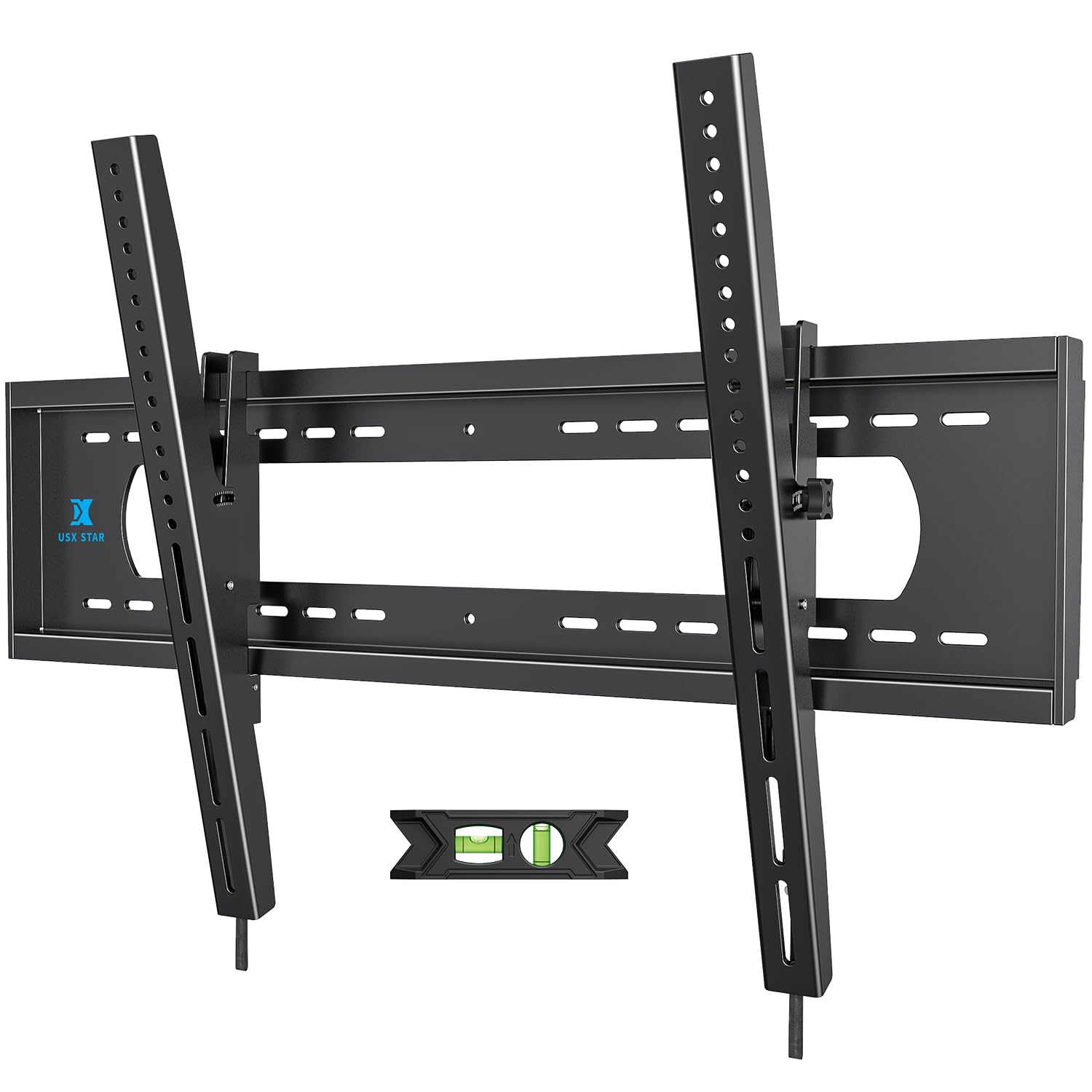
| USX STAR 65-120″ Tilt MountBest Value | Wide stud bays | 120 inches | 220 lbs | Tilt | Amazon |
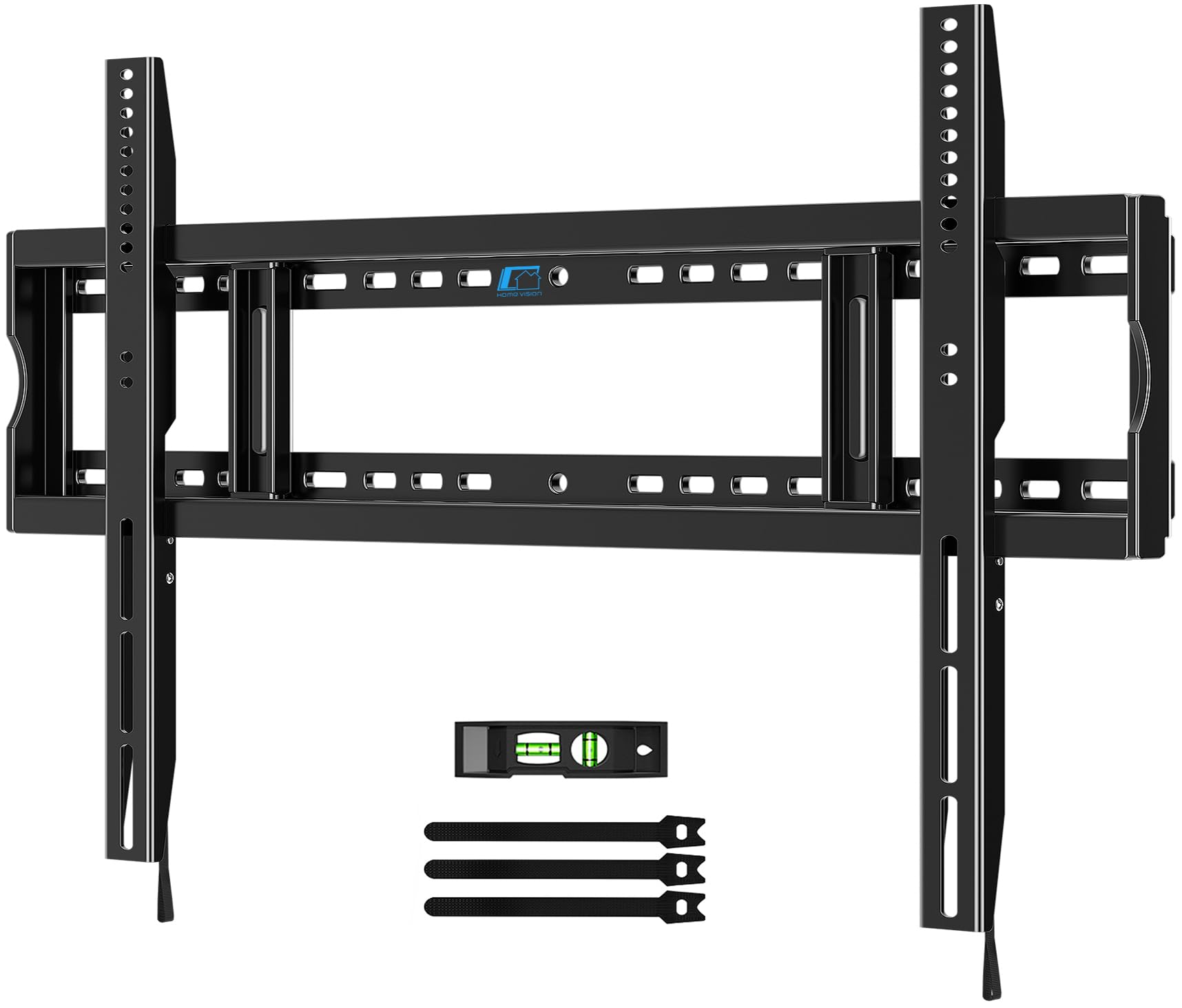
| HOME VISION HV8121Highest Capacity | Giant 98-150″ panels | 150 inches | 364 lbs | Fixed | Amazon |
| Perlegear PGXLF02-N1-US | Corner and cabinet installs | 97 inches | 150 lbs | Full motion, 40.1″ arm | Amazon |
| MOUNTUP 250 lb Slim Bracket | Bedrooms and offices | 110 inches | 250 lbs | Full motion | Amazon |
| monTEK HW1277BK | 100-inch-plus home theaters | 120 inches | 265 lbs | Full motion | Amazon |
| Mount-It! MI-14010 | Slotted VESA coverage | 120 inches | 264 lbs | Full motion | Amazon |
| Sanus 42-90″ Tilt Mount | Above-fireplace angles | 90 inches | — | Tilt | Amazon |
| Mount-It! The Beast MI-394 | Heaviest 98-110″ screens | 110 inches | 275 lbs | Full motion | Amazon |
Detailed Reviews
1. ECHOGEAR MaxMotion TV Wall Mount
Our pick — 4.5+★ from 20,000+ verified ratings; the strongest balance of quality and price.
A full-motion arm that swings 130 degrees and tucks back to 2.4 inches when the movie starts.
If your TV sits in a living room where people watch from a sofa, a kitchen island, and a hallway, this is the bracket that ends the argument about angle. The arm pulls your screen up to 22 inches off the wall, swivels 130 degrees to face any seat in the room, and then pushes back to 2.4 inches for a near-flush look when you’re done. It holds TVs from 42 to 90 inches and up to 125 lbs, and it works with VESA patterns across the major brands.
What wins people over is the build quality — the steel frame and the joint feel are the strongest part of the story, followed closely by how quickly it goes up. ECHOGEAR includes a drilling template and a hardware kit, and the brand claims a 30-minute install. The tilt adds 15 degrees of downward angle so you can kill window glare without tools. Cable clutter stays hidden behind the arm.
Here is the honest limit: 125 lbs is the lowest ceiling on this list, so a very heavy 85-inch or 90-inch panel may need one of the higher-capacity brackets below. The adjustability also draws some mixed notes — a full-motion arm has more joints to snug than a fixed plate, so budget a few minutes to set tension. For the overwhelming majority of 55 to 75-inch installs, none of that matters. It holds 4.5+ stars across a deep base of verified owner reviews.
What earns the top spot
- 130-degree swivel and 22-inch extension cover an open-plan room from one wall position
- Retracts to 2.4 inches, so it reads as a low-profile mount once you stop moving it
- Drilling template and full hardware kit are in the box — no trip back to the store
- Tilts 15 degrees by hand for glare control above a fireplace or facing a window
Where it stops short
- 125 lb capacity rules out the heaviest 85 to 90-inch panels
- More joints to tension than a fixed bracket, so the first setup takes some patience
Buy it for: a 42 to 90-inch TV in a room with seating spread across more than one wall.
Pass if: your panel is a genuinely heavy 85-inch or larger — go up a capacity tier instead.
2. USX STAR 85 86 98 100 inch TV Wall Mount
One wall plate, four stud widths, and 220 lbs of headroom for a 98-inch panel.
Most mounts assume your studs land neatly 16 inches apart. This one doesn’t care — the extra-wide wall plate reaches 16, 18, 24, and 32-inch wood stud spacing without adapters, which makes it the practical answer for a wall with irregular framing. It carries TVs from 65 to 120 inches at up to 220 lbs, and the 900x600mm VESA ceiling covers the giant-format sets that trip up narrower brackets.
The durability story is what people talk about most in their feedback, along with the general build quality, and both track back to the reinforced steel frame. Setup is handled with a one-piece design, an included level, a template, and video guidance. Once it’s up, the tilt runs tool-free across a +5° to -12° range so you can dial out glare from a bed, a sofa, or a desk. At 2.6 inches from the wall it stays out of the way, and the open back gives your cables somewhere to go.
The catch is fitment on smaller screens: 65 inches is the floor, so a 55 or 50-inch TV has no business here. It’s also a tilt-only mount, meaning no swivel — if you need the screen to swing toward a second seating area, look at the full-motion picks instead. A 10-year manufacturer warranty backs it, and the wide plate makes it the sensible middle pick for a big TV on an awkward wall.
Why the wall plate matters: 16, 18, 24, and 32-inch stud coverage means you’re not fighting your home’s framing — a real advantage over brackets that only span 16 inches.
The trade-off to know: tilt only, no swivel, and a 65-inch minimum that shuts out mid-size panels.
Right answer for: a 75 to 100-inch TV on a wall where the studs are 24 or 32 inches apart.
Keep looking if: you need the TV to pivot toward a second row of seating.
3. HOME VISION TV Wall Mount 65-150″
364 lbs of rated steel for the 115-inch screen most brackets won’t touch.
Nothing else on this list goes as big. This mount carries screens from 65 to 150 inches at 364 lbs, and the 1200x600mm VESA ceiling handles 1000×600 and 1100×600 patterns that stop other brackets dead. It’s built for the TCL 98 and 115, the Samsung 98, and the Sony 100 and 110 — the kind of panel where the mount is genuinely structural. For scale, the ECHOGEAR tops out at 90 inches and the USX STAR at 120; this one clears both.
The construction choice is the interesting part. Instead of a two-piece wall plate that can drift out of alignment, HOME VISION welds a single 2mm-thick reinforced steel plate with fully welded supports to cut flexing and sagging. The plate also spans 16, 18, 24, 32, 36, 42, and 48-inch wood stud spacings, so odd framing isn’t an obstacle. Mounting quality is what buyers bring up most in their reviews, and it lines up with a plate that centers your TV horizontally even when the studs sit off-center. The 1.45-inch profile is the slimmest here, keeping a giant screen close to the wall.
Fixed means fixed — no swivel, no tilt. If your seating wraps around the room or the screen hangs above a fireplace, this isn’t the one, and some buyers do find the tilt story confusing since it’s a flush bracket. Installation and drywall are also non-negotiable: wood studs, concrete, or brick only. For a dedicated home theater where the screen never moves, that’s a fair trade for the highest load rating in the group.
The case for the big plate
- 364 lb rating and 150-inch ceiling are the highest on this list
- Single-piece 2mm welded plate resists the flex a two-piece design can show
- Stud coverage from 16 all the way to 48 inches covers nearly any wall
- 1.45-inch depth keeps a massive screen looking built-in
What you give up
- Zero swivel and zero tilt — a flush panel you aim by where you sit
- Wood studs, concrete, or brick only; drywall alone is out
Built for: a 98 to 150-inch panel in a theater room where the viewing angle never changes.
Not your bracket if: the room needs the screen to pivot or angle down toward the sofa.
4. Perlegear Long Arm TV Wall Mount
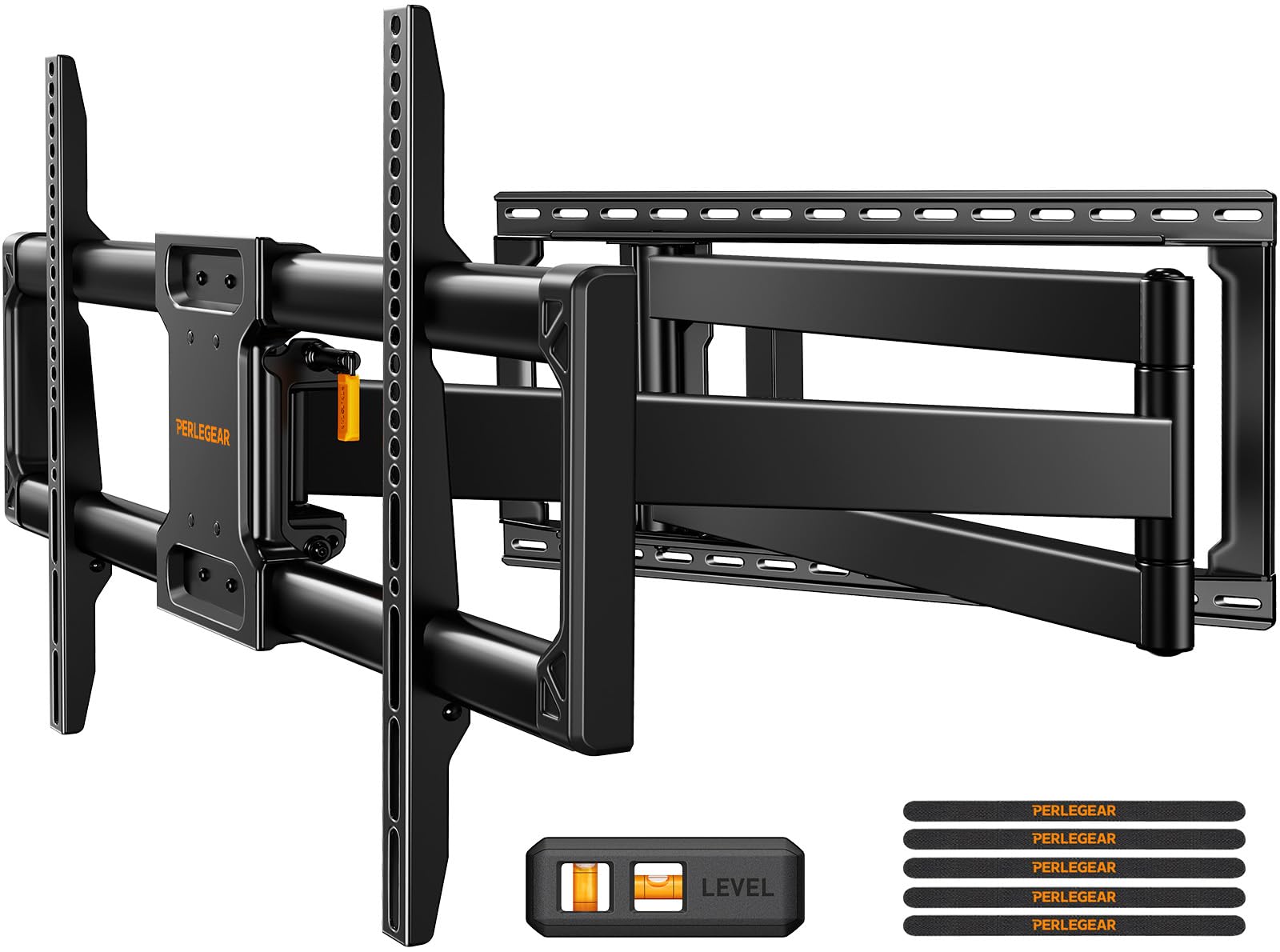
Forty inches of arm that pulls a corner-mounted TV out into the room.
Corner walls and built-in cabinets are where most mounts give up. This one extends 40.1 inches, the longest reach here, then retracts to 3.7 inches when you’re not using it. That travel lets you clear a side wall or a cabinet face and view the screen from multiple zones. It fits 42 to 97-inch flat or curved TVs up to 150 lbs with VESA patterns from 200x100mm to 800x400mm, and it installs on 8, 12, 16, or 24-inch wood studs as well as concrete or brick.
Cold-rolled steel and a wide wall plate back the 150 lb rating, and the arm is load tested to four times its 150 lb rating and cycled 6,000 times through its full motion range. On adjustability the arm swivels ±90 degrees, tilts +5° to -15° for glare, and levels ±4 degrees after the TV is already hanging. Setup is a three-step job with a pre-assembled bracket, a drilling template, and a bubble level in the box. Sturdiness and quality are the two things owners bring up most, and 85-inch installs are a common report.
Weight is the honest caveat: this is a substantial piece of steel, and a two-person lift is the sensible plan. It’s also not a budget bracket, so if your TV sits flat against a single wall with seating right in front, a cheaper tilt mount does the same job. The long arm earns its keep only when the geometry of your room demands it.
The room that needs it: a corner, a recessed cabinet, or a wall where the sofa sits off to one side — 40.1 inches of extension solves a problem a fixed plate can’t.
Plan for the lift: the steel is heavy enough that a second set of hands makes the hang far easier.
Your mount if: the TV has to reach out past a wall, a cabinet edge, or a corner to be seen properly.
Overkill when: the screen sits flat on an open wall with seating directly opposite.
5. MOUNTUP TV Wall Mount 50-110 inch
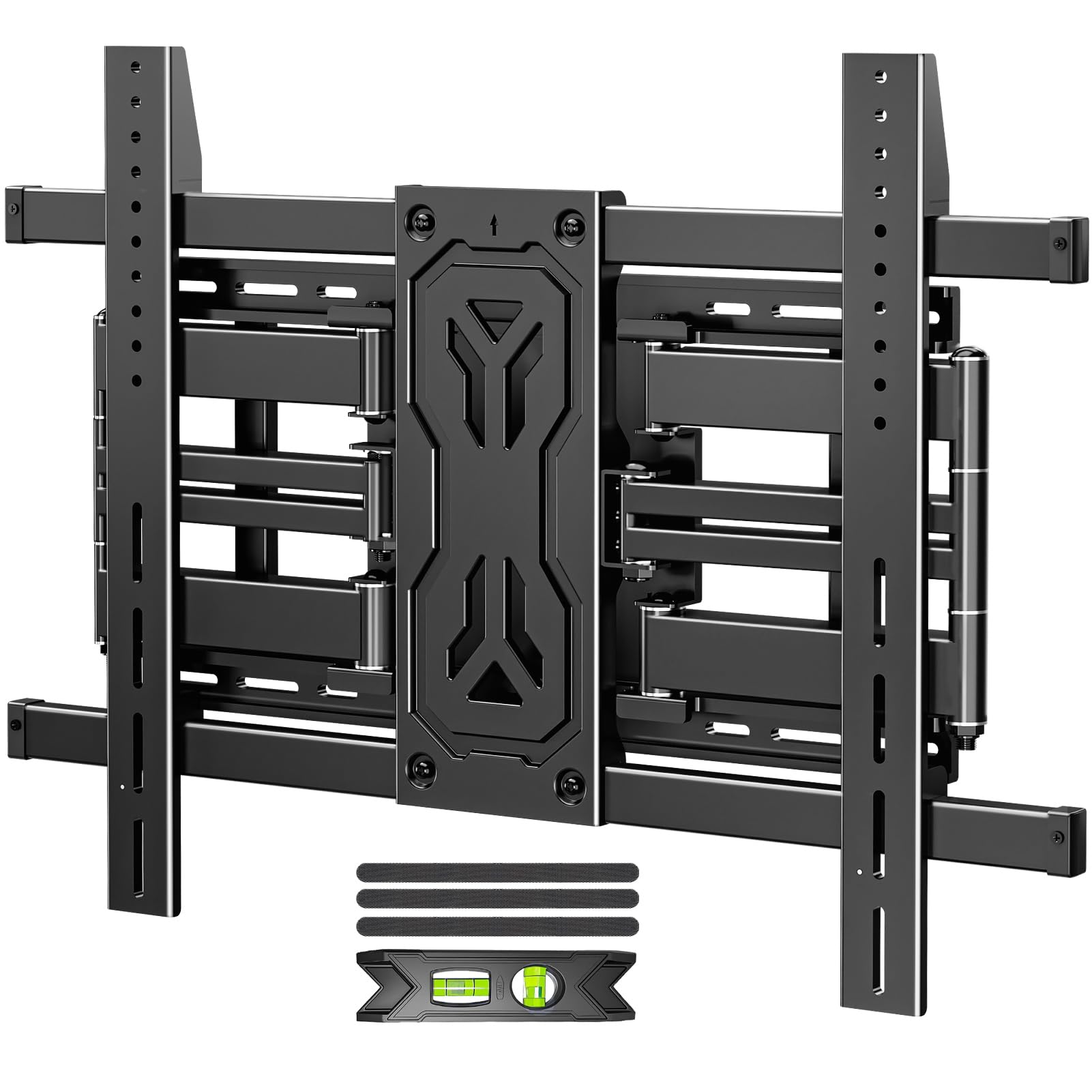
A moving bracket that still hangs just 1.65 inches off the wall.
Full-motion mounts usually mean a chunk of hardware sticking out behind the screen. MOUNTUP got the retracted depth down to 1.65 inches while still offering swivel, which is the trick most buyers want for a bedroom or a modern living room where the TV should look like part of the wall. It handles 50 to 110-inch LED, OLED, and flat or curved panels up to 250 lbs, with VESA from 200x100mm to 800x600mm and support for 12, 16, 18, and 24-inch wood studs.
The bracket relies on a reinforced alloy-steel six-arm design for stability across the bigger screen sizes — 75, 80, 85, 86, 90, 98, and 100-inch panels all fall inside its range. You get ±45 degrees of swivel, a +15° to -15° tilt to fight glare, and dual arms that extend 19.9 inches for flexible viewing. Cable ties and a bubble level come in the box, and the wall plate arrives pre-assembled. Owners describe the movement as smooth in every direction and the hold as secure on large panels.
Two things to check before you buy. The 12-inch minimum stud spacing is wider than some brackets accept, so measure carefully if your walls are tight. And like nearly every mount here, it will not work on drywall alone — wood studs, concrete, or brick only, with concrete anchors requested separately. The tilt spec is listed as a 30-degree maximum angle in the technical details, so confirm your target angle with the listing if you need a steep downward push.
Why it stands out
- 1.65-inch retracted depth with full swivel — rare combination for a moving mount
- 250 lb rating covers 98 and 100-inch panels comfortably
- Six-arm reinforced alloy steel frame for stability at full extension
- Pre-assembled plate, labeled hardware, bubble level, and cable ties included
Check before ordering
- Drywall-only walls are out; concrete anchors must be requested separately
- 12-inch minimum stud spacing needs verifying on tighter walls
Made for: a 75 to 100-inch screen that needs to tilt and swivel but still sit nearly flat when parked.
Think twice if: your studs sit closer than 12 inches apart or you’re mounting to drywall only.
6. monTEK TV Wall Mount 60-120 Inch
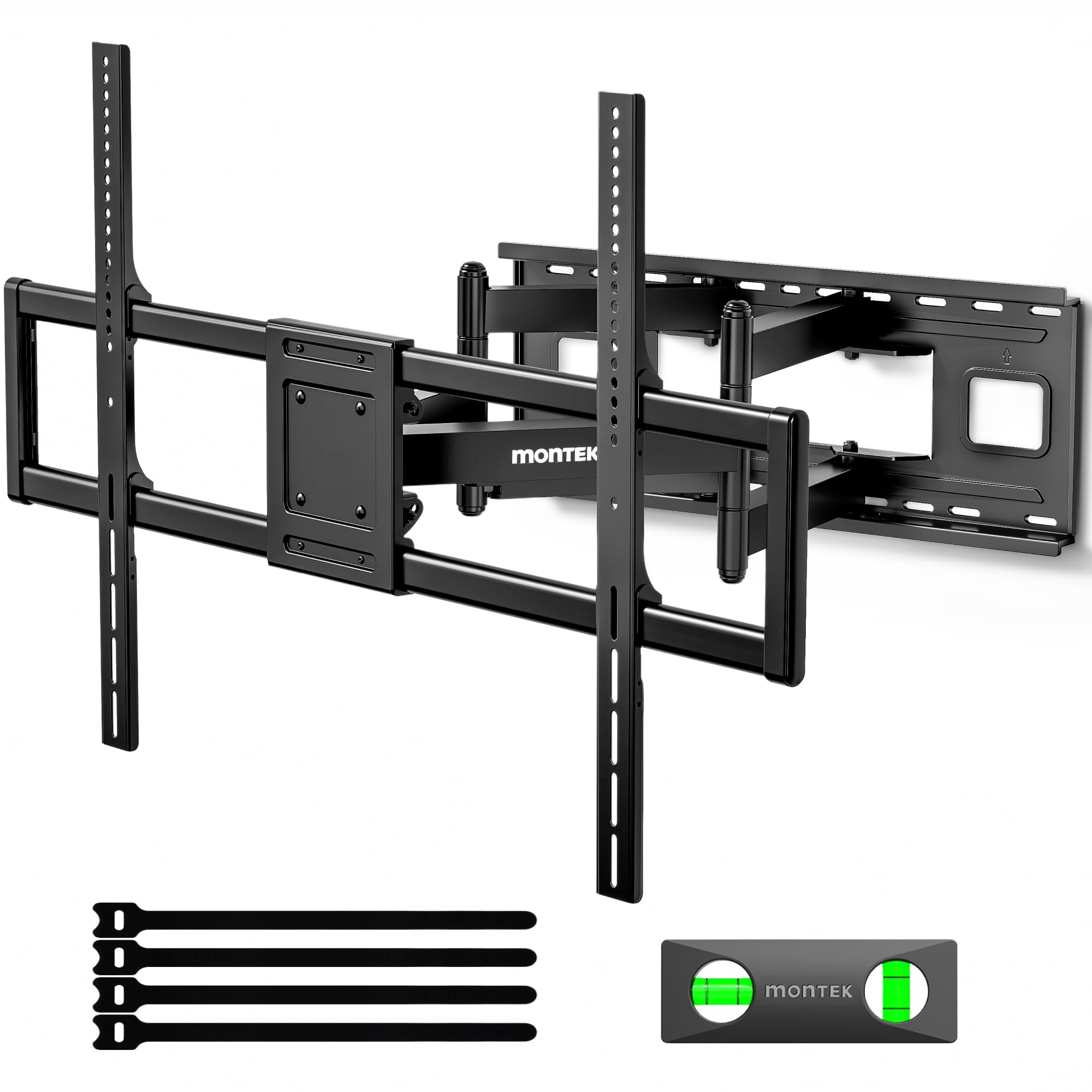
Dual arms rated for 265 lbs, built to keep a 100-inch screen from sagging at full stretch.
The hard part of a full-motion mount for a giant screen is holding the panel steady when the arm is fully extended. monTEK answers with a reinforced dual-arm structure and a 265 lb rating, and the mount has passed 4x load-bearing tests. It fits 60 to 120-inch LED, LCD, OLED, QLED, 4K and 8K panels with VESA from 200×200 to 900x600mm, and it mounts to 12, 16, 18, or 24-inch wood studs, concrete, or brick.
Motion is the reason to pick this one over a fixed bracket. The arm extends 27.7 inches, swivels ±60 degrees, and tilts +5° to -15° with no tools required — you reach up and move it by hand. When you push it back, the TV sits 2.95 inches from the wall. Sturdiness is the quality owners come back to again and again, and 100-inch installs hold up in their accounts. The pre-assembled frame plus a quick lock and release feature lets you snap the TV on or off in seconds for maintenance or upgrades.
Weigh the practical side before ordering: this mount is 34.6 lbs of steel on its own, and monTEK recommends two people for the install. That’s a fair ask for a bracket at this capacity. It’s also a premium pick in the group, so a smaller TV on a simple wall doesn’t need this much mount.
The stability payoff: a 265 lb rating and dual arms mean a 100-inch panel can hang fully extended without the droop that single-arm designs can develop.
Round up a helper: at 34.6 lbs the mount itself is a two-person lift before your TV even joins the party.
Pick this when: a 98 to 120-inch screen needs to swing and stretch without losing its level line.
Skip the upgrade if: your TV is under 65 inches and stays put on one wall.
7. Mount-It! 100 Inch TV Wall Mount

Slotted rails that swallow odd VESA patterns other brackets leave you stranded on.
Some TVs come with VESA layouts that don’t land on whole numbers — 600x500mm is a real example. Fixed-hole plates miss those, but this mount uses slotted rails that cover VESA continuously from 200×200 to 900x600mm, so the holes will line up. It holds 60 to 120-inch displays at 264 lbs and is load tested to four times that rating before it ships.
Motion is generous: dual articulating arms stretch from 3 inches at the wall out to 27.7 inches, swivel a full 120 degrees, and tilt +5° to -15°. A ±5 degree screen adjustment lets you level the TV after the weight is already hanging — a real convenience when the panel is heavy. Mounting hardware, a template, a bubble level, and an illustrated English guide are all included, and it fits 16, 18, or 24-inch stud spacing. Mount quality and sturdiness are the two things that come up most in owner feedback, and 98-inch installs are a common note.
Two people for the lift is the guidance here too, and the mount isn’t compatible with metal studs or drywall-only walls. It’s a premium option, so if your VESA pattern is a standard round number and your TV sits on one wall, the savings elsewhere are real. The slotted rail design is the reason to pay up — it’s about fit certainty, not extra features.
What the slotted rails buy you
- Continuous VESA coverage from 200×200 to 900x600mm catches odd patterns like 600×500
- 120-degree swivel and 27.7-inch extension for wide viewing arcs
- ±5 degree leveling after the TV is hung, no re-drilling required
- 4x load tested against the 264 lb rating
Worth knowing first
- Not compatible with metal studs or drywall-only walls
- Two people recommended for the lift given the steel weight
Best fit for: a 60 to 120-inch TV with an unusual VESA pattern that standard brackets can’t reach.
You can save elsewhere if: your TV’s four holes are a plain 400×400 or 600×400 square.
8. SANUS Tilting TV Wall Mount for 42″ to 90″ TVs

For the screen that hangs high, tilts down 12 degrees, and still looks flush.
A TV above a fireplace needs two things a flat plate can’t give: a downward angle and enough standoff to clear the mantel. This SANUS mount extends up to 6.8 inches from the wall, tilts up to 12 degrees to kill glare from a high placement, and adds 15 degrees of swivel for cable access and side seating. It fits 42 to 90-inch flat screens from Samsung, LG, Vizio, Sony, and other brands, and it tucks back to 2.1 inches when you’re done adjusting.
You get a three-step install: the top comes pre-assembled, a drilling template shows where to drill, and a full hardware pack is included. The open wall plate design lets you mount directly over an electrical outlet or media box, so cables have somewhere to land. Buyers mention quality and ease of installation most often. A 65-inch LG C1 at roughly 50 lbs is the kind of load people report moving with the adjustment setup.
One honest note: because this is a tilting mount rather than a full-motion arm, it won’t swing into a second room or pull way out from the wall. The swivel is enough for cable work and minor angle changes, not for a wraparound seating arrangement. If you need that reach, look at the long-arm picks above.
The fireplace answer: 6.8 inches of standoff and a 12-degree downward tilt let you clear a mantel and still see the picture from a low sofa.
Reach for this if: your TV hangs above a fireplace, a media cabinet, or any spot where a slight downward angle matters.
Look elsewhere if: you need the screen to swing far out from the wall into the room.
9. Mount-It! The Beast Heavy Duty TV Wall Mount, 60-110″

The mount for the 100-inch panel that has to swing out and hold without a flinch.
This one earns its name on paper: 275 lbs of rated capacity for 60 to 110-inch screens, and the arm extends 39 inches. It’s built from reinforced coated steel with stainless steel hardware and abrasion-resistant copper gaskets, and it’s load tested to four times its 275 lb rating. VESA coverage runs from 100x100mm up to 800x600mm, and it fits 16 and 24-inch stud spacing.
Where a big screen usually betrays a mount is at full extension, and The Beast is designed to avoid that. The build quality is the thing owners talk about most — no flexing of metal, even with the TV swung wide. The sliding wall plate centers your screen when studs aren’t perfectly aligned, and the integrated cable management hides every cord behind the mount. The swing and push-back feel easy according to the reports, and lock clips keep the screen locked in place once you’ve set it.
Two real limits. It’s 43.7 lbs on its own, so it is a two-person job before the TV even arrives at the wall, and it’s the premium buy in this lineup. The tilt range is 10 degrees, the narrowest angle here, so a high or fireplace placement needs one of the tilt-focused mounts instead. For a dedicated theater or a commercial install with a 98 or 100-inch display, the capacity and the 39-inch reach make it worth the cost.
Why the capacity shows
- 275 lb rating with 4x load testing behind it
- 39-inch extension reaches far out from the wall
- Sliding wall plate centers the TV on off-center studs
- Integrated cable management hides cords for a floating look
The honest limits
- 43.7 lbs of steel means a two-person lift, no way around it
- 10-degree tilt is the shallowest angle on this list
- Wood studs or solid concrete only, not drywall-only walls
Built for: a 98 to 110-inch display that needs to swing out 39 inches and hold rock steady.
Not the one for: a high fireplace install that needs a steep downward tilt.
Know the Specs
Load Rating (in lbs)
The load rating is the maximum weight a bracket is built and tested to carry. A 264 lb mount does not need a 264 lb TV — that’s the ceiling, not a target. Buy above your screen’s actual weight so the steel isn’t working at its limit. Two of the mounts here go further and say they’re load tested to four times the rated figure, which is a reassuring margin if your screen is heavy.
VESA Pattern (in mm)
VESA is the rectangle of four threaded holes on the back of the TV, measured center-to-center in millimeters and written as width by height. A 400×400 pattern means 400mm apart both horizontally and vertically. Each mount lists a range, and your TV must fall inside it. Measure with a tape from hole center to hole center before ordering — this is the single check that prevents most mistakes.
Stud Spacing (in inches)
Most homes have wood studs 16 inches apart on center, but 24, 32, and 48-inch layouts exist. A mount with a wide wall plate covers more of these layouts, and you fasten through the plate into the studs. Drywall alone will not carry a heavy TV — every mount in this guide requires studs, concrete, or brick.
Extension and Retraction (in inches)
Extension is how far the arm pulls the screen out from the wall for viewing; retraction is how thin it sits when pushed back. A mount that goes from 3 inches to 27.7 inches is flexible for a corner, while a fixed plate that sits at 1.45 inches looks tucked in but never moves. Choose based on where people actually sit.
Tilt and Swivel (in degrees)
Tilt angles the screen down to fight glare from windows or a fireplace; swivel turns it side to side. A 12 or 15-degree tilt handles most glare, while a full 120 or 130-degree swivel lets one mount serve multiple seating zones. Tool-free tilt means you adjust it by hand.
Profile Depth (in inches)
Profile depth is the gap between the back of the TV and the wall. Slimmer profiles look cleaner and save space, but leave less room for hands and cables. A 1.45-inch fixed mount is nearly flush; a full-motion arm resting at 2.4 or 2.95 inches is a normal parked depth.
Common Questions
Can a heavy duty TV wall mount hold a 100 inch TV?
How do I know which VESA pattern my TV uses?
Will a heavy duty mount work on a wall with 24 inch stud spacing?
Can I mount a heavy duty bracket on drywall only?
What is the difference between a tilting and a full motion mount?
How much weight can a heavy duty TV mount really hold?
Do I need two people to install a heavy duty TV wall mount?
Will a full motion mount sag when the arm is fully extended?
Does the tilt angle matter if my TV is above a fireplace?
Can I mount over an electrical outlet or media box?
The Bottom Line
For most rooms, the heavy duty tv wall mount worth hanging is the ECHOGEAR MaxMotion. It gives you 130 degrees of swivel, 22 inches of reach, and a 125 lb rating that covers the vast majority of 55 to 75-inch panels. If your screen is a giant 98 to 150-inch panel that never moves, the HOME VISION HV8121 carries 364 lbs on a single welded plate and stays 1.45 inches off the wall. And for an awkward wall where the studs sit 24 or 32 inches apart, the USX STAR reaches all four widths at 220 lbs.
Before you click anything, spend two minutes with a tape measure: your TV’s weight, its VESA hole spacing in millimeters, and the distance between your studs. Those three numbers narrow nine mounts down to one or two every time. Everything else — tilt, swivel, extension depth — is preference once the fit is right.
How we choose
We do not accept paid placement. Every pick is matched to a real buyer and a real use-case; we do not hands-on test units.
Sources
Specifications: manufacturer listings and product documentation. Review insights: verified customer reviews, as of November 2026. Pricing: not shown on this page (it changes often); check the current price via the retailer link.
As an Amazon Associate, Tactical Gear Guy earns from qualifying purchases. This does not affect which products we feature.