Specs are compiled from manufacturer listings and verified buyer reviews and can change over time — please confirm the key details on the product page before buying.
You want a crisp line where your lawn meets the sidewalk, and you want it without dragging out a trimmer and freehanding a wobbly path. A walk-behind gas edger does that job by rolling on wheels and holding a steel blade at a fixed depth, so the cut follows the curb instead of your arms. Below you get three real machines, each matched to a different yard, plus the plain-English notes on cutting depth, blade size and engine size that decide which one you should actually own.
This guide is built by comparing the manufacturers’ published specifications and the patterns across verified customer reviews, so you get each pick’s real strengths and trade-offs instead of marketing spin.
Power, depth control and wheel stability are the three things that decide whether edging takes you ten minutes or an hour, so every pick below is judged on those. Read on for the breakdown of the best gas yard edger for your own curb line.
Top Picks
How To Choose The Best Gas Yard Edger
The first thing to settle is how much soil you are cutting, not how big the engine sounds on the listing. A weekly touch-up along a curb needs far less torque than a first cut through matted roots. Match engine size to that job and the other specs matter far less.
Cutting depth is the number that decides your job
Depth control sets how deep the blade bites. Shallow settings skim the surface for weekly upkeep, while a deep setting cuts a real trench that slows regrowth for weeks. If your yard has never been edged, you want a machine with a wide spread of depths so you can start shallow and step down as the soil gives way. All three picks here run a 4-cycle engine, which means you fill the tank with plain gasoline and check the oil separately instead of mixing a fuel-oil blend.
Blade size and steel type change the line quality
A larger blade sweeps a wider arc and clears turf faster along a long straight run. Blade steel matters just as much: hardened spring steel holds an edge and resists the chipping that dulls a cheap blade on rocky ground. Look at the blade tooth count too, since a two-tooth or tri-tip design feeds through roots differently than a flat bar. A dull blade tears the turf and loads the engine, so each pass feels sluggish.
Wheels, weight and handle set your control
Four wheels track straighter than three, which tend to wobble on uneven pavement and leave you fighting the machine. Weight is a trade: a heavier unit stays planted through hard soil but wears you out on slopes and long borders. Handle height positions let you stand comfortably upright rather than hunching over the machine for an hour. A variable-speed throttle is the other control worth having, because it lets you ease into a fresh cut instead of lurching forward at full pace.
Side-by-Side Comparison
| Model | Best For | Engine Size | Blade Size | Cutting Depths | Amazon |
|---|---|---|---|---|---|
| EARTHQUAKE 41273 79cc Walk-Behind Edger★ Best Overall | Hard soil and root-filled borders | 79cc | Tri-tip steel | 10 depths | Amazon |
| Wild Badger Power 31cc Walk-Behind Edger | Assembly-friendly first edger | 31cc | 9.5 inches | 5 depths | Amazon |
| McLane 9 Inch Gas Walk Behind Edger | Long curb runs and clean lines | 5.50 gross torque | 9 inches | Single-lever control, 7 positions | Amazon |
Detailed Reviews
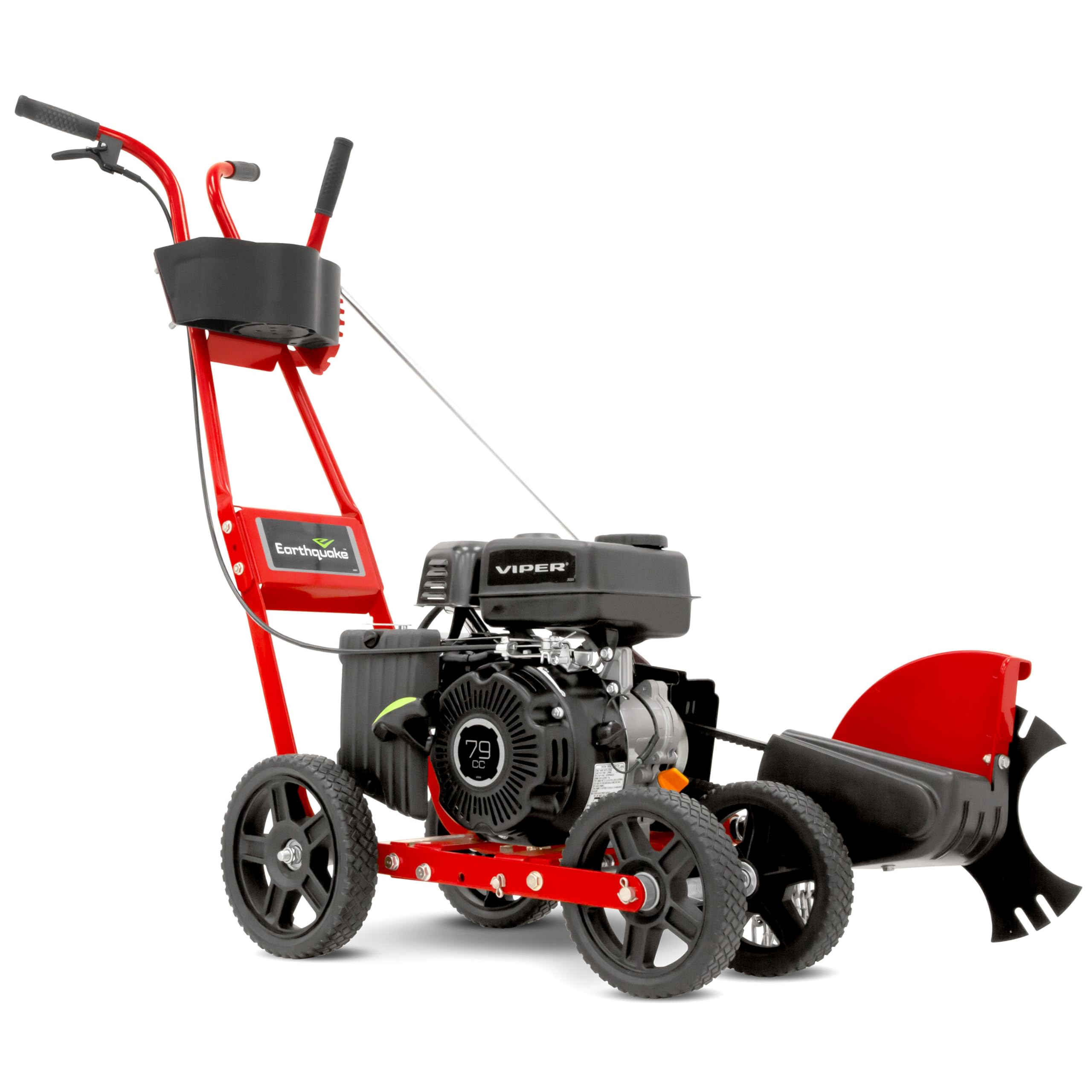
1. EARTHQUAKE 41273 79cc 4-Cycle Walk-Behind Edger, Red/Black
Our pick — 4.5+★ from 100+ verified ratings; the strongest balance of quality and price.
The heavy hitter that chews through overgrown borders and never needs a can of mixed fuel.
The engine is the argument for this one: a 79cc 4-cycle Viper unit that runs on plain gasoline with no oil blending. For scale, that is 79cc versus the 31cc engine in the Wild Badger below. More displacement means more torque at the blade, so you are not stalling out where the roots are thick. Across 100+ ratings it holds a 4.5+, the highest score in this lineup.
What wins people over is how it handles the actual work. Cutting depth runs across 10 settings, and at the lowest you can go as deep as 2.5 inches into roots to slow regrowth. The blade pivots up to 20 degrees either side, so you can hold a straight line along a sidewalk or tilt it for a beveled decorative cut around mulch beds. A tri-tip high-strength steel blade is meant to hold a cleaner line than a bar-style blade. Four wheels keep it planted, which is a real advantage over three-wheel machines that wander.
The catch is weight. At 57 pounds this is the heaviest pick here, and it is 57 pounds against the Wild Badger’s 29.8 pounds. On a big slope or a long run that heft will let you know it. Value opinions split among owners, and the height-adjust lever can creep during a pass, so check it is locked before you start cutting. For a once-a-month yard the weight never becomes a problem, and the five-year limited warranty backs the build.
Where It Delivers
- 79cc 4-cycle engine gives you torque to spare on tough soil
- 10 depth settings, down to 2.5 inches into roots
- Pivoting blade tilts 20 degrees for beveled or straight cuts
- Four-wheel design stays stable along long curbs
What To Weigh First
- 57 pounds is a real load to push over sloped ground
- Depth lever can shift mid-pass unless you seat it firmly
Built for the tough yard: homeowners with hard, root-choked borders who want one pass to do the job.
Think twice on slopes: at 57 pounds the push gets tiring on a hilly lot.
2. Wild Badger Power 31cc Gas Lawn Edger
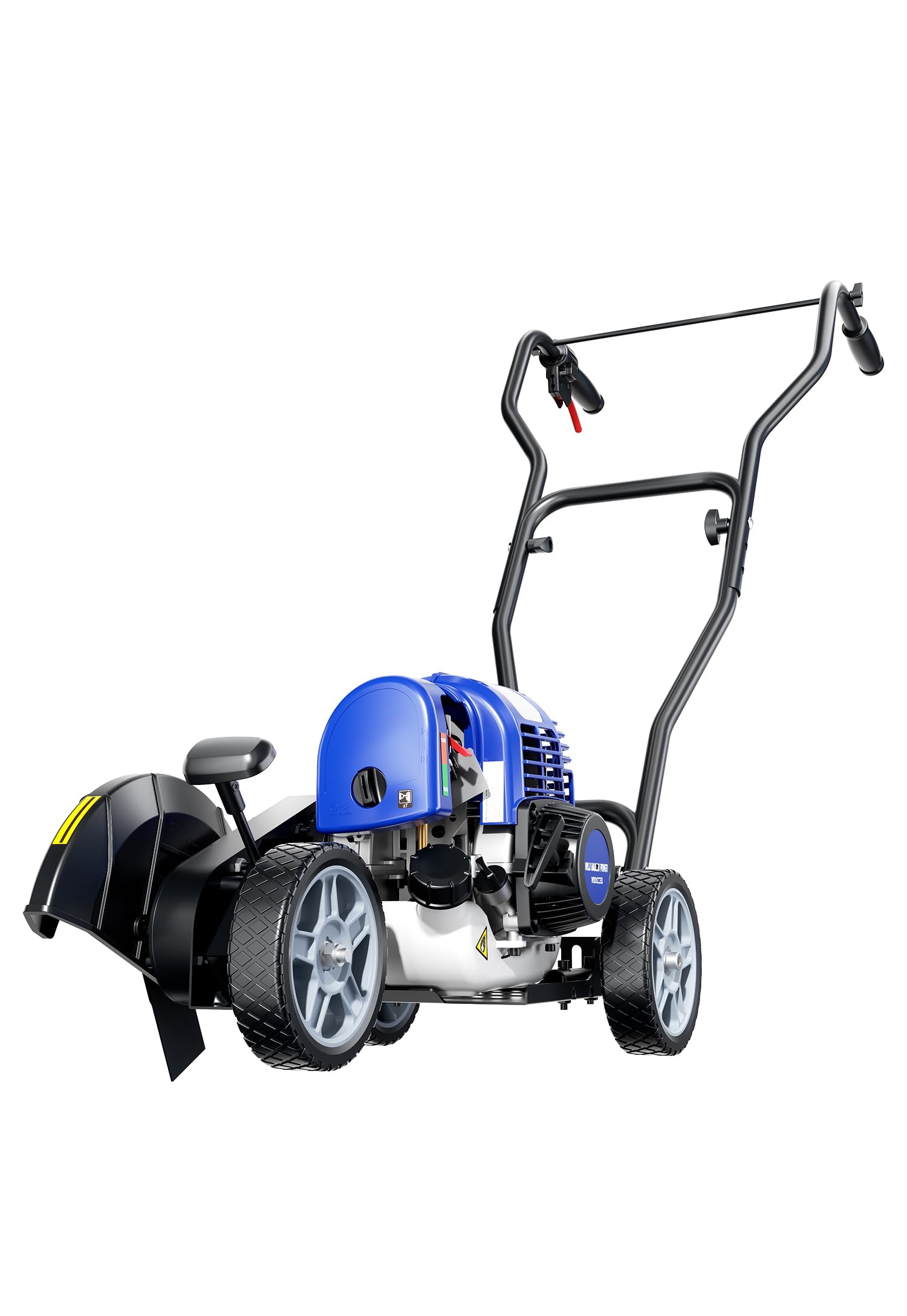
The light push that still spins a wide blade fast enough to leave a sharp line.
Start with the weight, because it reframes the whole machine. At 29.8 pounds versus the Earthquake’s 57 pounds, you are pushing a lighter machine across the lawn. A homeowner with a long border or a slope will feel that difference by the second pass. Weight is the single best thing owners talk about here, and it is why this one feels far easier to live with than a big-displacement unit.
The engine is a 31cc 4-cycle full-crank unit that turns the blade up to 9,800 RPM. Compared with the Earthquake’s 79cc, that is 31cc against 79cc, so the Wild Badger trades raw grunt for a lighter, faster-spinning head. The 9.5-inch two-tooth steel blade is a touch larger than the 9-inch blade on the McLane below, which means it sweeps a slightly wider arc along long straight runs. Five cutting depths cover routine touch-ups up through deeper seasonal edging, and a tool-free air filter makes regular upkeep simpler.
Here is the honest part of the story. Performance earns the loudest praise and ease of assembly runs right behind it, but durability is the mixed note: a share of buyers report trouble within the first few uses. Given a 3.5+ rating across 250+ ratings, the machine clearly satisfies a lot of people, but treat it as a lighter-duty tool. Start shallow on hard soil or heavy roots instead of forcing a deep first pass, and it will reward patience. A three-year limited warranty cushions the purchase.
Lighter on the arms: 29.8 pounds and a 9,800 RPM blade make short work of borders without wearing you down, which is why weight is the trait owners land on most.
Size your expectations: a 31cc engine and a 3.5+ rating mean this is a homeowner-grade unit for upkeep, not a machine built for reclaiming an overgrown yard.
Reach for this if: you want a light, easy-to-assemble edger for regular weekly trimming along a normal lawn.
Look elsewhere if: your borders are neglected and thick, since the smaller engine will make you work for it.
3. McLane 9 Inch Gas Powered Lawn Edger

The curb-rider built to hold a perfect line along every long driveway and border.
The defining trait is the cutter head. It rides on a 2″ x 9″ spring steel blade mounted with sealed precision ball bearings, and it is built to sit on most curbs while still making a clean cut. That 9-inch blade runs slightly smaller than the 9.5-inch blade on the Wild Badger, but the real difference is in the assembly behind it. Sealed bearings keep the head spinning true instead of wobbling, so a long straight run stays straight from end to end.
A single lever controls both the blade clutch and the depth, which lets you dial the exact cut without hunting for a second control. The blade tilts to almost any angle and will trim flat at any height, so the same machine handles a vertical sidewalk cut and a flat bed trim. Wide rubber tires with ball-bearing wheels carry the frame over uneven ground, and the 7-position setup gives you flexibility along the way. Owners rave about the fit and finish: quality is the trait that earns by far the most praise, and the starting reel backs it, with the engine said to catch on the first pull.
Durability is the note that splits opinion, so plan on sensible upkeep rather than treating it as indestructible. The engine spec here is given as 5.50 gross torque rather than a cc figure, so a direct displacement match with the other two is not possible. What you are buying is precision: a machine that meets established safety standards, powders coats the finish, and gives you a blade head built to repeat a clean cut. If your priority is a straight edge over raw brawn, this is the one.
Why Owners Keep Praising It
- Sealed ball bearings on the cutter head hold a truer line
- Single lever runs both blade clutch and depth
- Blade tilts to almost any angle, trims flat at any height
- Grabs on the first pull according to owners
Where It Asks For Care
- Durability splits opinion, so keep up with maintenance
- Spec lists 5.50 gross torque, not cc, so cross-shopping engines is harder
Ideal for the long curb line: a homeowner with a big driveway or extended border who wants a machine that repeats a precise cut.
Fair warning: it pays you back in line quality, so budget time for upkeep rather than expecting a beat-it-and-forget-it tool.
Know the Specs
Engine displacement (cc) and torque
CC stands for cubic centimeters, the measure of how much air-fuel mixture the engine can pull through in one cycle. A higher number tends to mean more torque at the blade, which is the twisting force that lets the machine push through hard soil without stalling. Some makers quote gross torque instead of cc, which is a pull figure rather than a size figure. Neither number alone tells you the whole story, so read it alongside blade size and weight.
Cutting depth and blade angle
Depth controls how far the blade drops into the soil. Shallow settings skim the surface for weekly upkeep, while deep settings cut a real trench that keeps regrowth down longer. A pivoting head that tilts to an angle lets you choose a straight vertical cut along pavement or a beveled cut around beds. More depth positions give you finer control between those extremes.
4-cycle versus 2-cycle engines
A 4-cycle engine separates the oil from the fuel, so you fill the tank with plain gasoline and check oil on its own. A 2-cycle engine requires you to pre-mix oil into the gas every time you refuel. All three machines here run 4-cycle engines, which makes day-to-day fueling simpler and avoids the mixing chore.
Blade steel and RPM
RPM is revolutions per minute, the speed the blade spins at. Steel type matters just as much as speed: hardened spring or high-strength steel holds an edge longer against rocky ground, while softer steel dulls fast. A tooth pattern like a two-tooth or tri-tip design feeds through roots differently than a flat bar. A sharp blade on a true-running head cuts cleaner and loads the engine less.
Common Questions
Do gas walk-behind edgers need mixed fuel like a string trimmer?
How deep can a gas edger cut into roots and hard soil?
Is a 4-wheel edger better than a 3-wheel design?
What is the difference between straight and beveled edging cuts?
Can a gas edger also handle light trenching jobs?
How heavy is a walk-behind gas edger to push?
Do I need to change the engine oil on a 4-cycle edger?
What is blade RPM and does it matter for edge quality?
Will a gas edger work along a curb that has a raised lip?
The Bottom Line
For most yards, the gas yard edger worth starting with is the EARTHQUAKE 41273, because its 79cc engine and 10 depth settings give you the torque and control to cut a clean line through tough soil. If you want the easiest machine to assemble and push, the Wild Badger Power 31cc brings 29.8 pounds and a 9.5-inch blade to lighter upkeep work. And for a long, precise curb run, the McLane 9 Inch with its sealed-bearing spring steel cutter head is the one to reach for.
How we choose
We do not accept paid placement. Every pick is matched to a real buyer and a real use-case; we do not hands-on test units.
Sources
Specifications: manufacturer listings and product documentation. Review insights: verified customer reviews, as of November 2026. Pricing: not shown on this page (it changes often); check the current price via the retailer link.
As an Amazon Associate, Tactical Gear Guy earns from qualifying purchases. This does not affect which products we feature.