Specs are compiled from manufacturer listings and verified buyer reviews and can change over time — please confirm the key details on the product page before buying.
If you want the short answer: buy the Echo PB-580T backpack if you have a real yard, and buy the Husqvarna 125B handheld if your lot is small and you want one hand free. Everything else here is a different trade-off between engine size, backpack or handheld, and how much weight you are willing to carry. The trick to buying a gas yard blower is matching the machine to the job: a 32.8-pound backpack is a chore on a small lawn, and a 410 CFM handheld means hours of extra passes on a big one.
This guide is built by comparing the manufacturers’ published specifications and the patterns across verified customer reviews, so you get each pick’s real strengths and trade-offs instead of marketing spin.
You will see the cubic-feet-per-minute figure (CFM, the volume of air the machine pushes) and the miles-per-hour figure (MPH, how fast that air leaves the tube) side by side for every pick. Here is the honest breakdown of the gas yard blower market.
Top Picks

How To Choose The Best Gas Yard Blower
Before you look at any single number, answer one question: how big is the area you clear, and how often do you clear it? A gas yard blower is a machine you carry for the whole job, so the size of the job decides if you want a backpack unit with a big engine or a handheld that hangs off one arm. Get that choice wrong and no spec sheet saves you.
Backpack or handheld comes first
A backpack blower sits the engine on your back and sends the air down a long tube you steer with your hands. That layout is what lets a heavy engine feel manageable, because the weight spreads across your shoulders instead of your wrist. A handheld unit is lighter and quicker to grab, which suits a patio, a short driveway, or a garage floor. The honest trade-off: handheld engines are typically smaller, so they move less air per pass.
CFM is the number that clears volume, MPH is the number that clears stubborn debris
CFM stands for cubic feet per minute — the total volume of air the blower pushes. MPH stands for miles per hour, and it describes how fast that air travels out of the nozzle. A high CFM number helps you move a wide carpet of dry leaves across a lawn in fewer passes. A high MPH number helps you dislodge wet leaves and grit stuck to concrete. You want both, but the CFM figure is the one that tells you how big a job the machine is built for.
2-stroke versus 4-stroke engines
A 2-stroke engine needs oil mixed into the gasoline, and it is the lighter, simpler design that most backpack blowers use. A 4-stroke engine has a separate oil sump, so you pour straight gasoline in and skip the mixing step. That convenience is a real difference on a Saturday morning, and it is why one pick here is a 4-cycle unit.
Side-by-Side Comparison
| Model | Best For | Airflow (CFM) | Max Speed (MPH) | Weight | Amazon |
|---|---|---|---|---|---|
| Echo PB-580T★ Best Overall | All-round backpack for a full yard | 510 cfm | 215 miles_per_hour | 22.6 pounds | Amazon |
| SENIX 4QL-HNo Mixing Required | No-mix fuel convenience | 410 CFM | 125 miles_per_hour | 12.6 pounds | Amazon |
| Milkiwai MX-660Budget Backpack | Budget backpack entry point | 665 CFM | 205 miles_per_hour | 19 pounds | Amazon |
| Camplist 72CC | Raw airflow on a budget | 760 CFM | 230 mph | — | Amazon |
| Sarkoyar 84CC | Big-yard volume on a mid budget | 1060 cfm | — | 25.4 pounds | Amazon |
| PROYAMA PBB72 | Pro-style backpack for serious cleanup | 880 cfm | 275MPH | 21 pounds | Amazon |
| Husqvarna 125B | Small yards and one-handed work | 470 cfm | 170 miles_per_hour | 9.4 pounds | Amazon |
| Echo PB-2620 | Quiet handheld clearing | 456 cfm | 172 MPH | — | Amazon |
| PRORUN PBB2884 | Maximum airflow, big properties | 1020 CFM | 240 miles_per_hour | 32.8 pounds | Amazon |
| Echo PB-580T OEM Backpack | Crew-grade backup for heavy leaves | 510 cfm | 215 mph | 22.7 pounds | Amazon |
Detailed Reviews
1. Echo PB-580T Back Pack Blower
Our pick — 4.5+★ from 500+ verified ratings; the strongest balance of quality and price.
The backpack that made the tube throttle the reason you never let go.
The Echo PB-580T pushes 510 cubic feet of air per minute — the CFM figure that sets how much volume you can shove per pass — and delivers it at 215 miles per hour, which is the speed that lifts wet leaves off pavement. The number that actually changes how the day feels, though, is 22.6 pounds sitting on your back rather than in your hand. A tube-mounted throttle means the trigger rides on the blower tube itself, so you adjust power without reaching behind you or letting go of the handle.
What wins people over is simply how much work it does: 34 separate owner mentions of performance, the highest single count anywhere in this machine’s review pages, plus 18 for value. It starts in two or three pulls for most people, and the 58.2 cc engine clears leaves and pine needles without bogging down. The crowd favorite here sits at 4.5+ stars across 500+ owners, which is the strongest blend of score and volume on this list.
The catch is assembly. The directions split the room — a batch of buyers found them unclear and needed a second pass to get the tubes seated right. Durability gets a mixed reading too, so treat the straps and tube joints as things to check over at the start of each season rather than abuse. If you want a machine that arrives fully sorted and never needs a wrench, this is not the one; if you want the balanced backpack the rest of this list keeps getting compared to, it is.
What earns the top spot
- 510 CFM at 215 MPH handles both volume and stuck-on debris
- Tube-mounted throttle keeps your hand on the work
- 22.6 pounds in backpack form is far easier than any handheld of similar power
- Reliable two-to-three-pull starts and a strong performance record
Where it asks for patience
- Assembly instructions are the most common frustration
- Mixed durability feedback means seasonal checks are smart
- It costs real money compared to the entry-level backpacks below
Built for: the homeowner with a full yard, mature trees, and a driveway that fills up every October.
Look past it if: you want a blower that works straight from the box with zero setup, or your lot is a small patio.
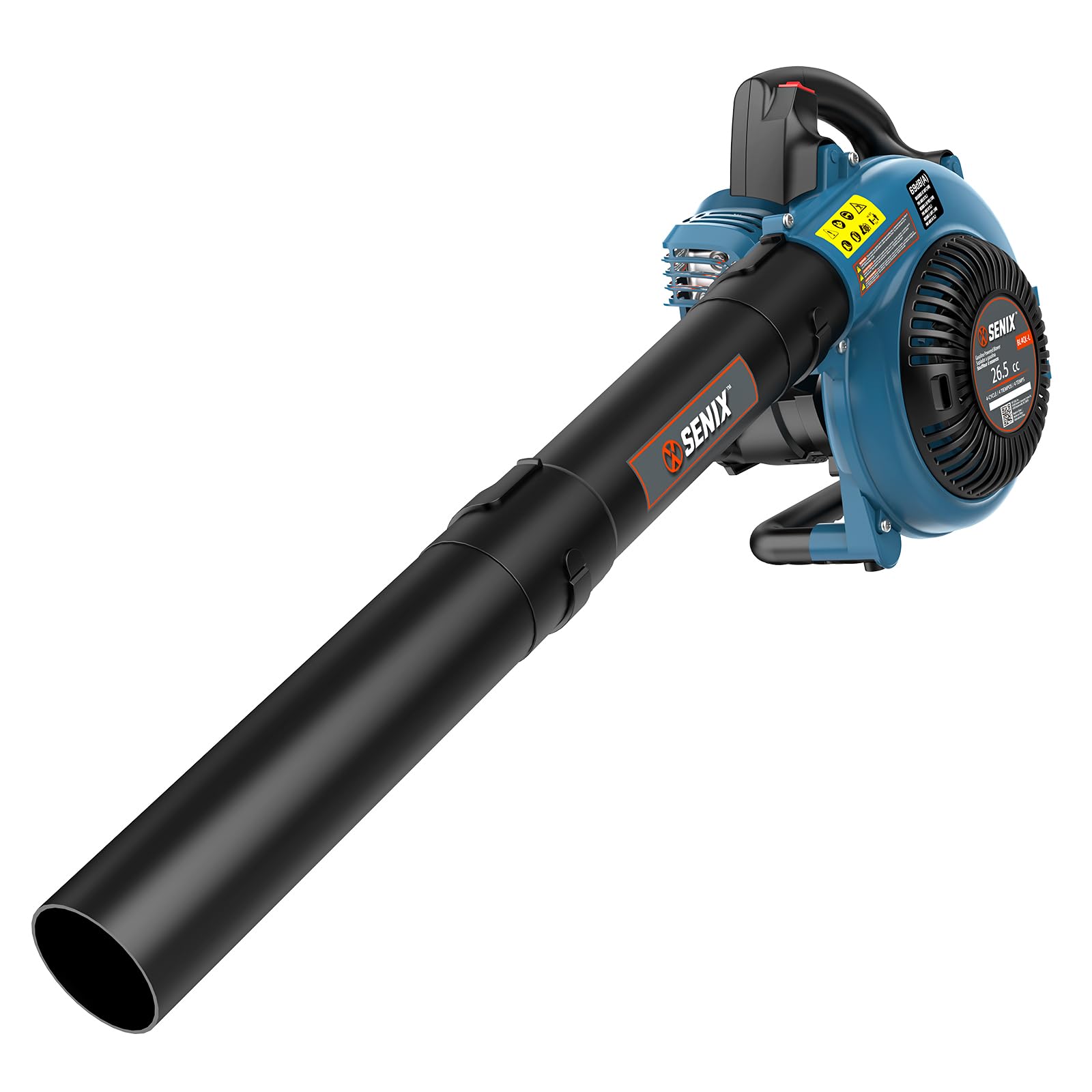
2. SENIX 4 Cycle 26.5cc Gas Powered Leaf Blower, 410CFM, 125MPH
Pour straight gasoline in and go — no oil can, no measuring cup, no guesswork.
This is the only 4-cycle pick on the list, and that is the whole point. A 4-cycle engine keeps its oil in a separate sump, so you fill the tank with plain gasoline instead of mixing oil into the fuel the way every 2-stroke engine here demands. If the mixing ritual is the reason you have avoided gas equipment, this removes it entirely. The engine is 26.5 cc and produces 410 CFM at 125 MPH — modest airflow numbers, but enough for a sidewalk, a deck, and a driveway.
Compare that to the Sarkoyar 84CC backpack in this same guide: 410 CFM against 1060 CFM, and 12.6 pounds against 25.4 pounds. Those are two very different machines for two very different jobs, and the SENIX wins the weight fight outright. It starts easily every time and the 4-stroke exhaust note is noticeably softer than a 2-stroke’s bark. The dual-grip handle spread across both hands, which takes the strain off a single forearm during long sweeps.
Here is the honest limit: 410 CFM at 125 MPH is a light-duty combination. Dry leaves on a walkway, grass clippings on a patio, sawdust in a garage — all fine. A soaked leaf mat under a maple, or a full autumn cleanup across a large lawn, will have you making pass after pass. At 26.5 cc it is the smallest engine in this guide, which is why it weighs 12.6 pounds and why it tops out at 410 CFM.
The honest read: a genuinely light handheld at 12.6 pounds with a dual-grip handle, priced in the budget-friendly tier, that trades raw airflow for the convenience of never mixing fuel. That trade is worth it for a small property and a sore shoulder.
Reach for this if: your cleanup is a patio, a deck, and a short walk, and you would rather not own a fuel-mixing routine.
Think twice if: you have large trees and a big lawn — the airflow here is the smallest on the page.
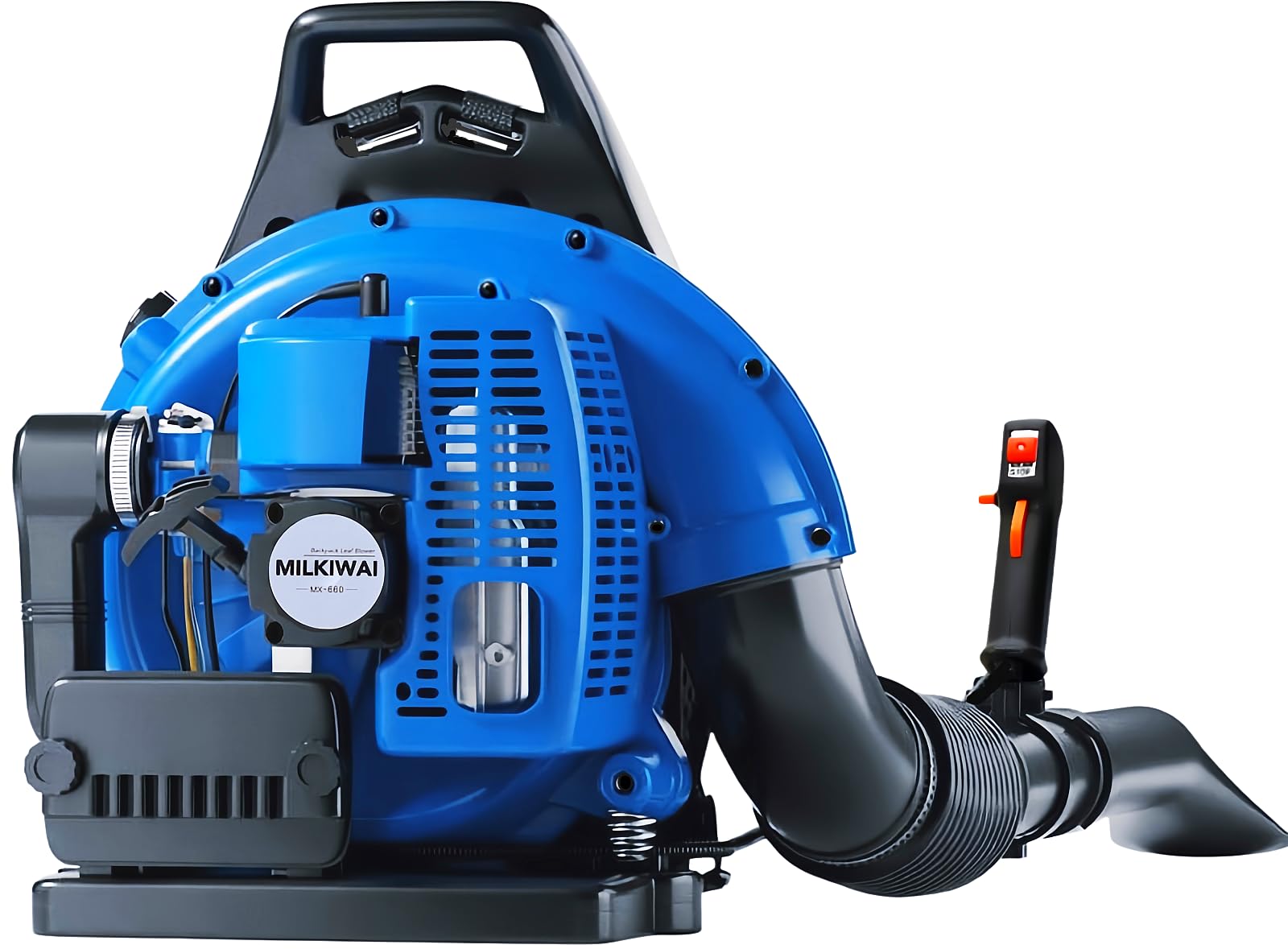
3. 63CC Gas Backpack Leaf Blower
Backpack power at a handheld price — as long as it fires up when you pull.
That is more volume than the Echo PB-580T puts out, and it sidesteps the handheld limit of a tired forearm. The 19-pound frame carries on padded shoulder straps, and a 3-point spring stabilization system cuts the vibration that normally leaves your hands buzzing after twenty minutes.
The tank is quoted at up to 50 minutes at full throttle, enough for a full leaf-clearing session before a refuel. A variable speed throttle with cruise control lets you lock a setting and keep sweeping instead of feathering a trigger. The listing also includes a concentrator nozzle and an extension nozzle, so you can switch between a wide sweep and a focused blast for gutter lines and flower beds.
The thing to go in with open eyes about is starting. That is the most-discussed topic in the feedback on this machine, and the verdict splits: plenty report it fires right up, and a portion fight with it. Buyers still rate it a strong value more often than anything else, but this is a blower that rewards fresh fuel, a clean plug, and a proper starting sequence. If you want set-and-go simplicity and no troubleshooting, a 4-cycle handheld is the safer bet.
Value math: 665 CFM at 205 MPH for a budget-tier backpack beats the 510 CFM Echo PB-580T on airflow, and 19 pounds is light for a backpack.
Best fit: a homeowner who wants backpack capacity without a premium price and does not mind learning a starting routine.
The trade-off to accept: if a machine that refuses to start ruins your morning, this is the risk you take.
4. 72CC Backpack Blower
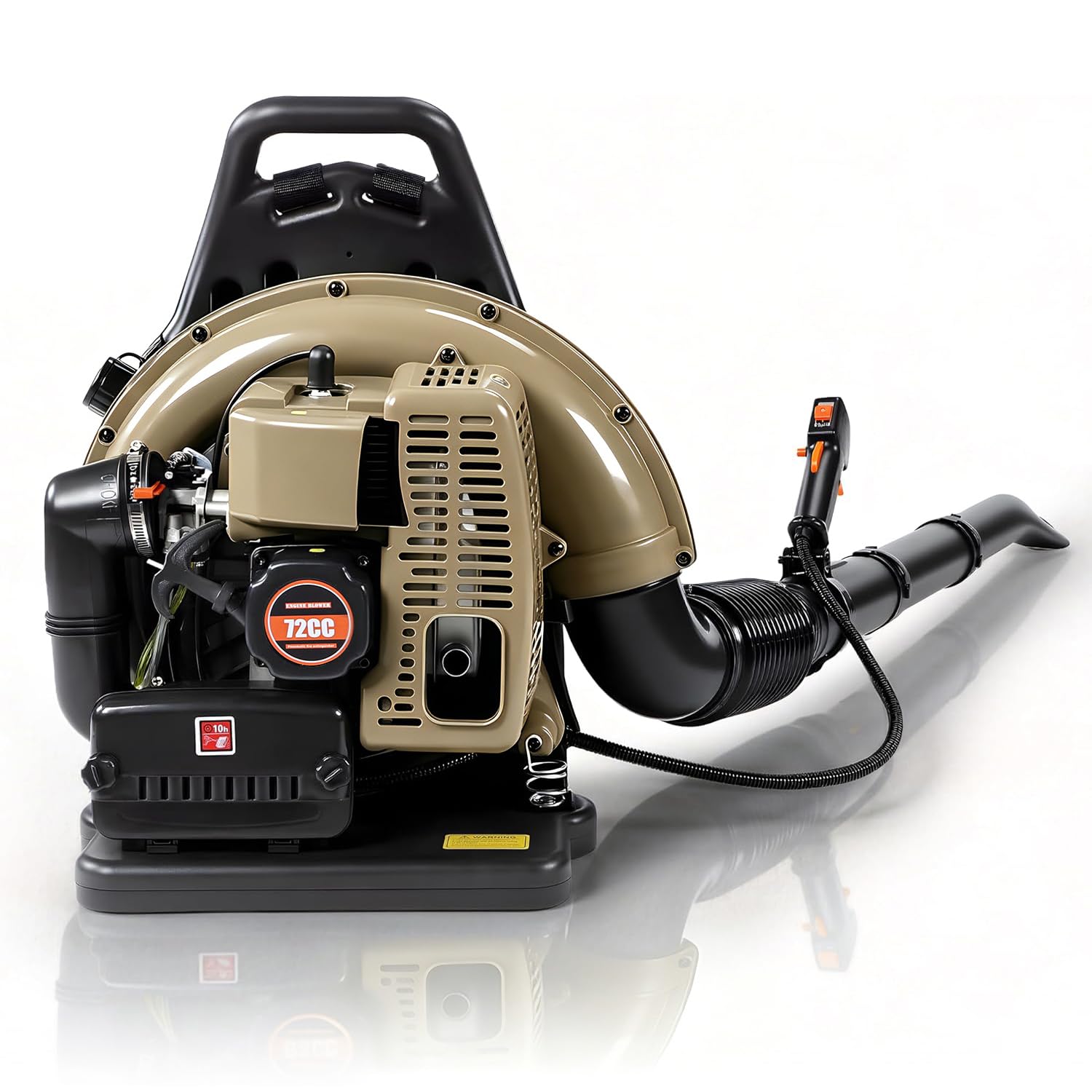
A 72 cc engine and 760 CFM aimed squarely at wet leaves and winter snow.
A 72 cc engine driving 760 CFM at 230 MPH puts this in genuinely serious territory — it pushes 760 cubic feet of air a minute, which is a lot of volume per pass. That is the sort of output that moves a pile of soaked leaves rather than nudging them, and the listing calls out light snow removal as part of the job. A 1.8-liter fuel tank keeps refueling stops apart on a large property.
The comfort engineering is where the design effort went: fully adjustable padded shoulder straps, vibration-dampening mounts, and a contoured handle. A variable speed control lets you dial the airflow down for a flower bed, and cruise control locks it in so your hand does not have to hold the trigger through a whole driveway. There is a recommended 25:1 fuel-to-oil ratio during break-in, so read the manual before you fill it the first time.
Performance and power are the two things buyers agree on most — 15 mentions each — and assembly and starting both land on the positive side of the ledger. The honest wrinkle is overall quality: that topic draws a mixed verdict, with some describing a strong machine and others unhappy with the build. That split is why you get a sizeable airflow figure for a mid-tier price, and why you should inspect the unit thoroughly when it arrives rather than discovering a loose screw in November.
Where it shines: 760 CFM and 230 MPH from a 72 cc engine is real clearing capacity for fall leaves and light snow, and the cruise control makes long sweeps easier on your hand.
Worth knowing: quality feedback is genuinely split, so open the box early and check the fasteners and tube joints.
Pick this when: you want big airflow numbers without stepping up to premium pricing, and you clear more than just leaves.
Pass if: you expect out-of-box fit and finish to match a premium brand’s — this one asks for a quick inspection.
5. Sarkoyar Gas Backpack Leaf Blower
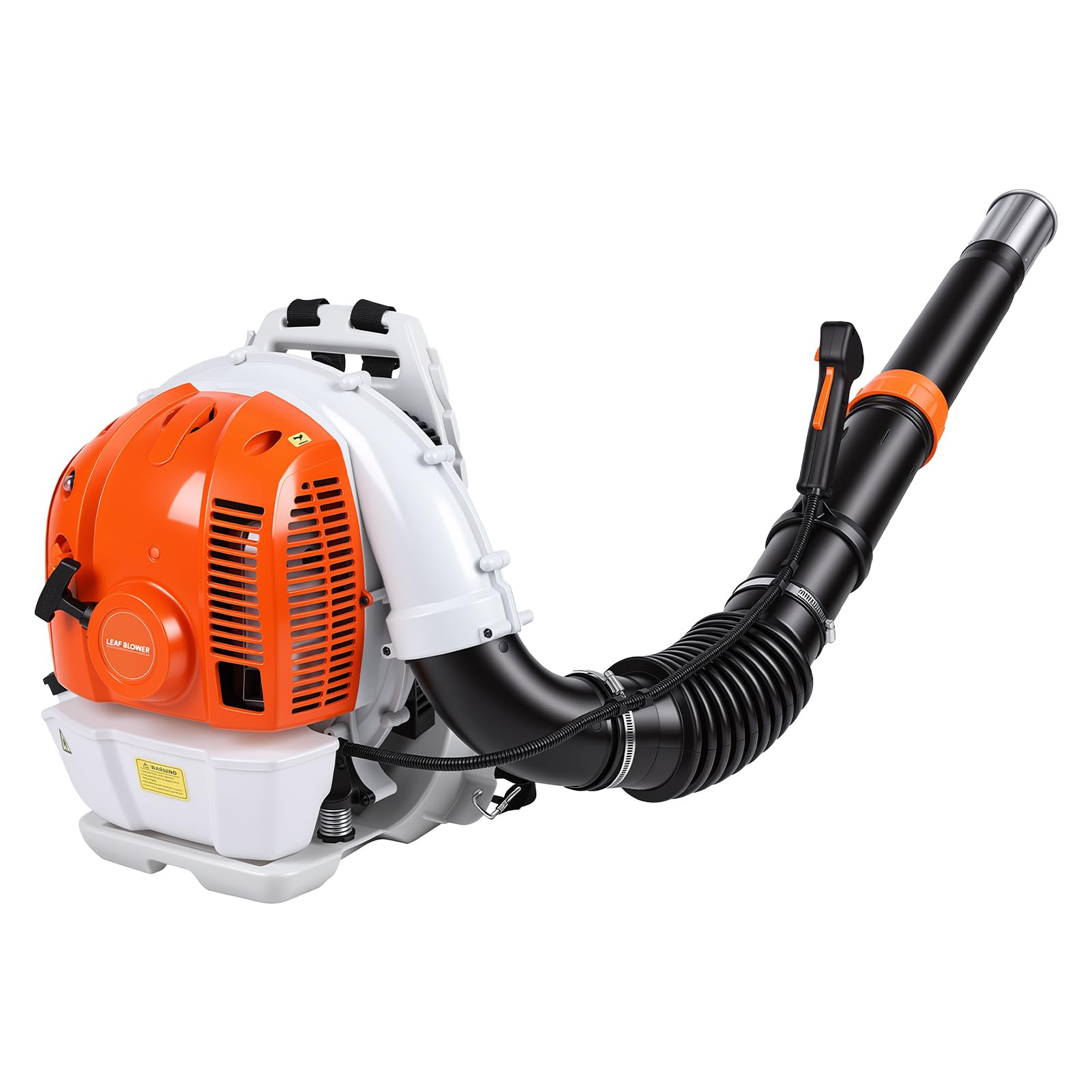
1060 CFM from an 84 cc engine, at mid-tier money rather than flagship money.
Read the airflow number twice: 1060 CFM from an 84 cc two-stroke engine. The SENIX handheld in this guide produces 410 CFM, so the Sarkoyar is working at a completely different scale — this is the volume tier that turns a long driveway into a two-pass job instead of a ten-pass one. A 2800-7000 rpm speed range lets you drop to a gentle setting for dry grass clippings and then open it up for dense leaf piles.
What wins people over is the build and the value, the two things owners bring up most about this machine. It feels solid, works extremely well, and does it for mid-tier money rather than flagship money. A 2.5-liter tank supports longer sessions between refuels, and the long flexible outlet tube is the reason you can steer airflow into corners and along a gutter line without contorting yourself. The stainless steel outlet section keeps a firm path for the air at the end of that tube.
The physical reality: 25.4 pounds on your back. Compared to the SENIX at 12.6 pounds, this is double the load, and you will feel the difference by the end of a big cleanup — adjustable shoulder straps spread it, but they do not erase it. Starting is the second wrinkle; that topic draws a split response, so keep the fuel fresh and the plug clean. But buy it understanding the weight and this is the airflow bargain of the page.
Standout spec: 1060 CFM at mid-tier money is the highest airflow-per-dollar figure in this article, and the long flexible tube lets you aim it into corners and gutter lines.
The trade: at 25.4 pounds it is a two-hands-on-the-straps carry, and starting is occasionally fussy.
Made for: a large property with real leaf volume and a buyer who would rather carry weight than make extra passes.
Second thoughts if: you have back issues or a tiny lot — the SENIX or the Husqvarna is the wiser carry.
6. PROYAMA 72CC Gas Backpack Leaf Blower
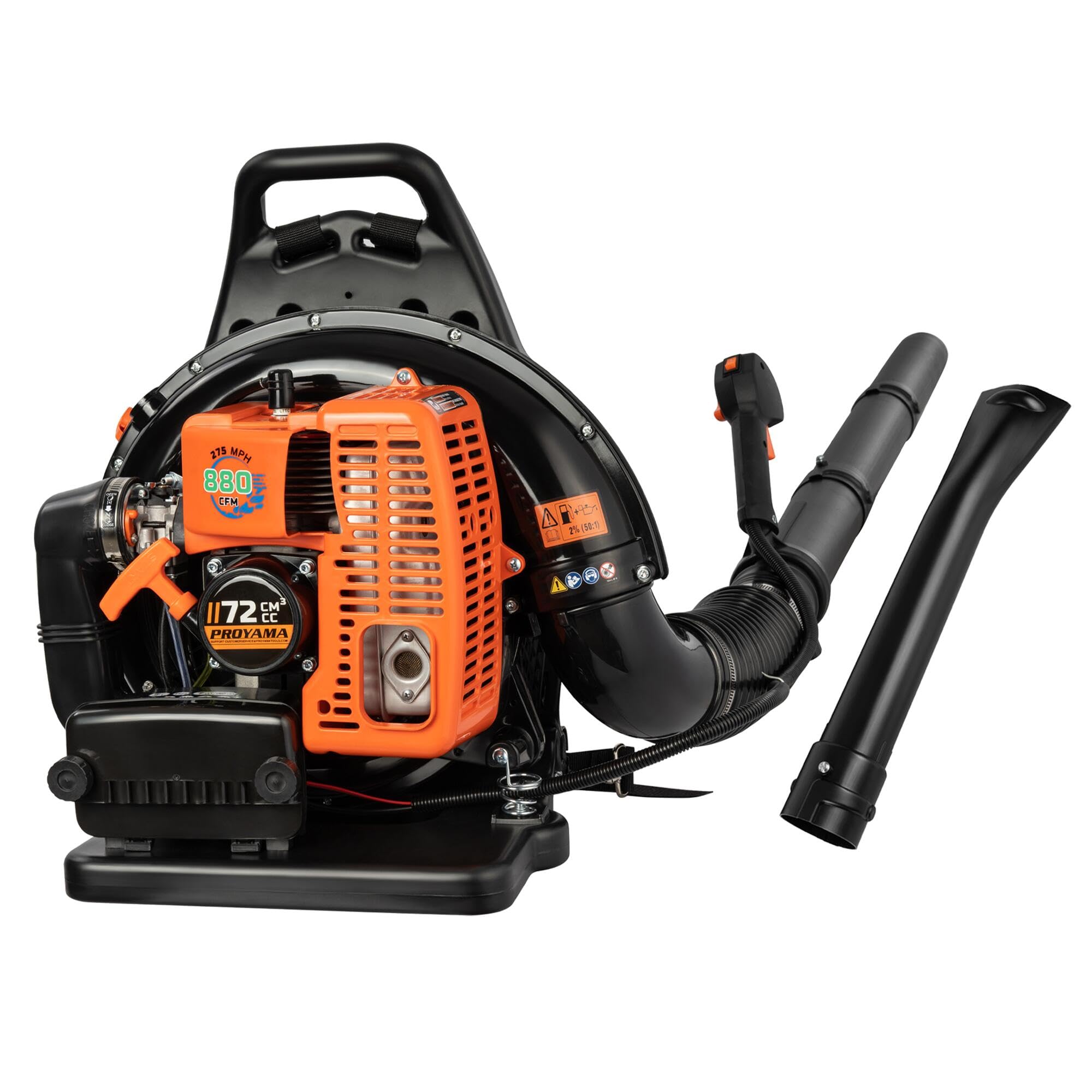
880 CFM and a 3.7 HP engine, with a backrest that blocks engine heat.
This is the pick that reads most like a landscaper’s tool. A 72 cc two-cycle engine makes 3.7 HP and pushes 880 CFM up to 275 MPH — 275 miles per hour is the fastest airstream on this entire list except the PRORUN’s 240, which it beats. That speed is what scatters wet leaves clinging to asphalt rather than pushing them along in a wet clump.
Two design details matter here. The dual-tube setup gives you a flat nozzle and a round nozzle — wide-open terrain gets the flat one, tight corners get the round one. And the thickened backrest is built to isolate the engine’s running heat from your back, which is the sort of thing you only appreciate after an hour in July. Shock-absorbing straps and a balanced weight distribution at 21 pounds keep it doable for a full session.
Performance and functionality are the runaway themes — 48 and 42 mentions respectively — with value, power, and starting time all landing positive. It starts on the first or second pull for the bulk of buyers and runs smoothly. Durability is the one honest asterisk, drawing mixed notes even as some owners describe the machine as incredibly strong. Weigh that against the 1-year warranty before you decide how hard to push it.
Why it earns premium-tier placement
- 880 CFM at 275 MPH is genuine professional-grade airflow
- Dual nozzles let you switch from wide sweep to precision
- Heat-isolating backrest and shock-absorbing straps for long sessions
- Cruise control and variable throttle reduce hand fatigue
What to weigh before buying
- Durability is the one mixed signal in otherwise strong feedback
- 72 cc 2-stroke means mixing oil into every tank of fuel
- 21 pounds is comfortable but still a loaded carry
Top choice for: a big, demanding yard where you want commercial-style airflow and a nozzle for every surface.
Not the one if: you want the convenience of straight gasoline and no oil mixing.
7. Husqvarna 125B Gas Leaf Blower
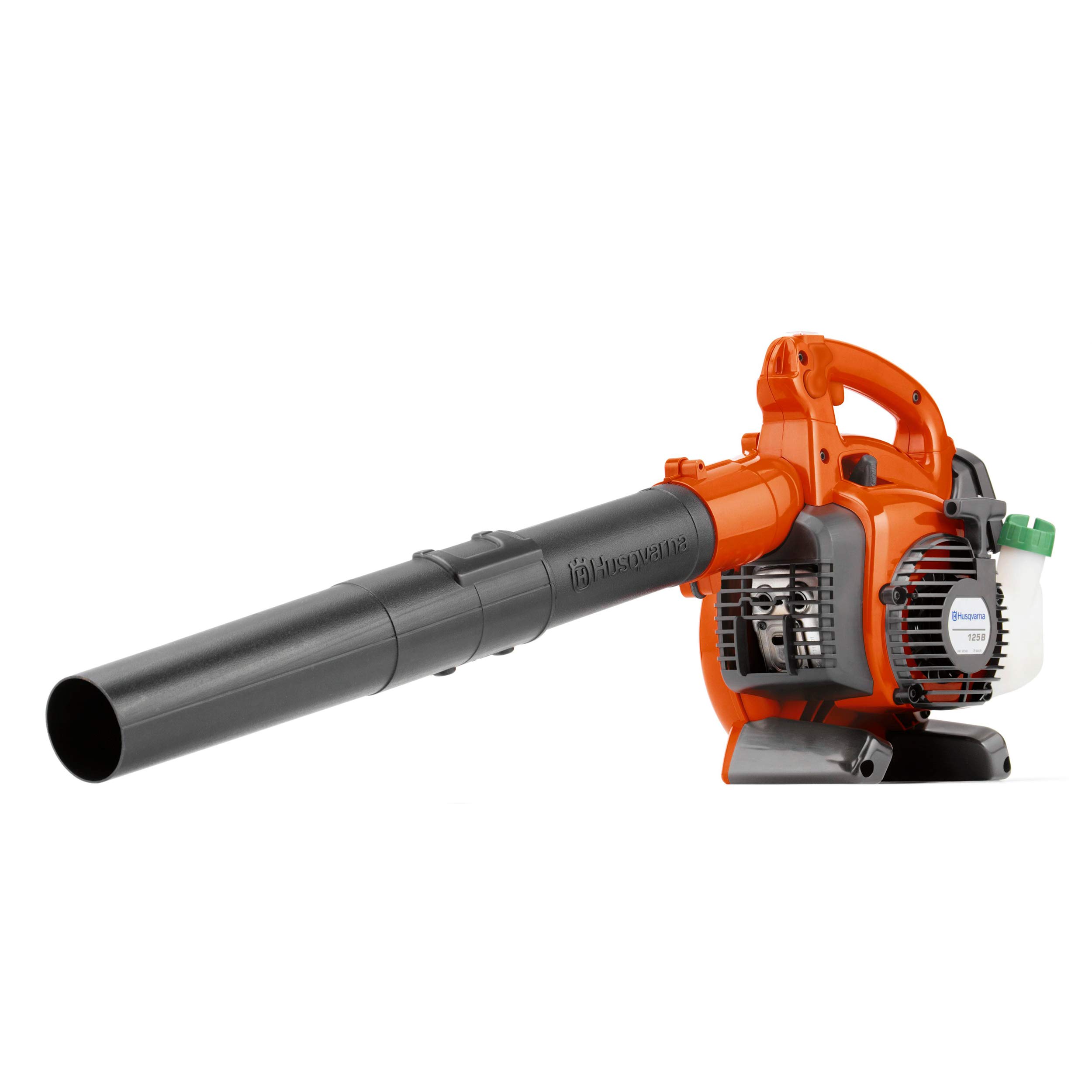
9.4 pounds you can swing with one hand — the lightest serious option here.
Husqvarna’s 125B is the handheld that answers a different question than the backpacks above. At 9.4 pounds it is the lightest machine on this page, and buyers describe it as light enough to steer with one hand. A 28-cc, 1.1-HP two-cycle engine delivers 470 CFM at 170 MPH — enough to move leaves, grass, and trash even on wet pavement, which is the kind of surface that stops weaker handhelds cold.
The quality reputation is the reason it holds a premium-tier handheld slot, and the volume behind that reputation is enormous — this is the most-reviewed machine in the article by a wide margin. It starts with an air purge system, which clears air out of the carburetor and fuel lines before ignition, plus an auto-return stop switch that resets to the on position. A cruise control function is there for the long sweeps, and the adjustable soft-grip handle works with the tube for balance in your hand.
Be clear-eyed about two things. The handheld form means less airflow than a backpack — 470 CFM against the PROYAMA’s 880 CFM — so a huge leaf load takes more passes. And durability and reliability both draw negative notes in the feedback, with starting experience mixed. For a compact yard worked in short bursts, neither matters much. For a full-day cleanup on a large property, a backpack is the right tool.
The case for it: 9.4 pounds, 470 CFM, and one-handed maneuverability make it the easiest machine here to grab for a quick fifteen-minute tidy-up.
Suits you if: you have a small lot, a short driveway, or you want to clear the patio without strapping anything to your back.
Keep walking if: you are clearing a big lawn every fall weekend — the airflow ceiling will frustrate you.
8. Echo PB-2620 Handheld Leaf Blower
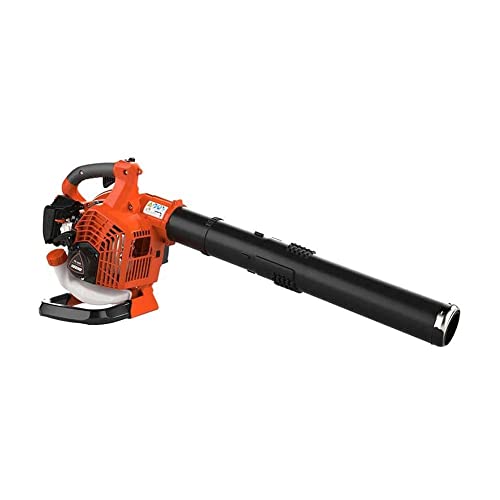
456 CFM handheld that runs at 69 decibels — the polite one on the block.
Noise is the spec nobody lists until the neighbor complains. This Echo runs at 69 dB, which is quieter than the 70 dB Echo backpack later in this article and a meaningful difference on an early Sunday morning. A 25.4 cc two-stroke engine produces 456 CFM at 172 MPH, and owners describe it as extremely powerful for its class — it clears wet leaves and debris and blows leaves out from around rock walls and bushes where a wide sweep cannot reach.
Starting is where this machine earns its keep. It fires on the first pull for most buyers, which is the single most common praise for any gas blower and the thing that decides whether the tool stays in the shed. The review pages sum it up as one of the best handhelds buyers have used, with build quality called out as fantastic and the money described as well spent.
Two caveats worth your attention. The manufacturer lists no warranty for this model, so understand that going in — this is a tool you maintain yourself. And the airflow, while strong for 25.4 cc, tops out at 456 CFM; on a full lawn it trails the backpack machines by a wide margin. For a garage, a walkway, or a quick pass around the rock garden, it is exactly enough.
Numbers that matter: 69 dB and 456 CFM at 172 MPH in a handheld is a quiet, punchy combination, and a first-pull start is the feature that keeps you using it.
Going in informed: the spec sheet lists no warranty, so factor self-maintenance into the decision.
Choose it for: a smaller cleanup where noise matters and you want the reliability of an easy start.
Skip the upgrade if: you need backup coverage — the spec sheet shows no warranty on this model.
9. PRORUN PBB2884 Backpack Leaf Blower

1020 CFM and 240 MPH — the biggest engine on this page, at the biggest carry.
A 75.6 cc two-cycle engine pushing 1020 CFM at 240 MPH is the flagship specification of this guide. The Sarkoyar’s 1060 CFM edge in raw volume is the only place this machine gets beaten, and the PRORUN answers back with 240 MPH against the Sarkoyar’s unlisted speed. For a large property with mature trees, that combination means fewer passes and less time standing in the cold.
It is built for commercial duty, and the comfort hardware reflects it: padded backpack straps, anti-vibration mounts, an instant-start system, and a throttle lock that holds your chosen rpm. Owners talk most about performance and power, and the money question lands positive too. The 75.6 cc displacement gives it reserve airflow for wet leaves and heavier debris that smaller engines have to grind through.
Now the cost of all that: 32.8 pounds. Functionality and weight both draw mixed notes in the feedback, and durability is the weakest topic — a pull cord that fails after a few months and screws working loose are the sort of reports that show up. A 3-year residential warranty is the counterweight to that.
The flagship pitch: 1020 CFM at 240 MPH from a 75.6 cc engine is the most raw airflow capacity in this article, and the 3-year residential warranty backs it.
The weight reality: at 32.8 pounds, this is a machine you commit to carrying, not one you grab for a quick pass.
Right for: a large property and a buyer who wants commercial-grade airflow and accepts the heaviest carry on the list.
Wrong for: anyone with a small lot, a bad back, or a low tolerance for tightening fasteners.
10. Echo PB-580T OEM Backpack Blower, Gas, 510 cfm, 215 mph

The same 510 CFM backpack, quieter at 70 dB, sold as a genuine OEM part.
Look at the spec sheet next to the Echo at the top of this list and you will see the same bones: a 58.2 cc engine, 510 CFM through the pipe, 215 MPH at the nozzle, 70 dB(A) of noise, and 22.7 pounds dry. This version is sold as a genuine OEM part, which matters if you are replacing a worn unit or buying a backup you know will fit the same tubes and harness you already own.
The noise figure is the quiet detail worth naming. At 70 dB(A) it is close to the handheld Echo PB-2620’s 69 dB, which is unusual for an engine this size — most backpacks in this class are louder. It handles heavy wet leaves and sweetgum seeds, the sort of stubborn debris that makes a smaller handheld give up. Assembly is simple enough to be a non-event, and it fires on one or two pulls.
Weight and comfort both give a mixed reading in the feedback, so expect the 22.7 pounds to feel like real weight on a long job — the backpack harness spreads it, but a full afternoon still registers. Treat this as the crew-grade backup: the same proven platform as the top pick, at a premium price point, with the OEM-parts provenance as the reason to choose it over the standard retail version.
Why it is here: identical 510 CFM and 215 MPH capability to the best overall pick, plus 70 dB(A) operation and genuine OEM-parts sourcing.
Buy it when: you need a replacement or backup that matches the Echo backpack platform you already trust, with the OEM part number on the box.
Go with the top pick instead if: you are buying your first blower and would rather not pay flagship money for the same engine.
Know the Specs
CFM and MPH
CFM (cubic feet per minute) is the volume of air the blower pushes — think of it as the size of the invisible broom. MPH (miles per hour) is how fast that air leaves the tube, which is the force that breaks leaves free from wet pavement. A machine like the PROYAMA at 880 CFM and 275 MPH has both a big broom and a fast one. A handheld at 410 CFM and 125 MPH has a smaller broom moving slower, and it will need more passes on a big lawn.
Engine Displacement and Fuel Mixing
Displacement, measured in cc, is the size of the engine’s cylinder. Bigger cc usually means more airflow but also more weight, which is why the 75.6cc PRORUN weighs 32.8 pounds while the 25.4 cc Echo handheld stays portable. A 2-stroke engine requires oil blended into the gasoline at a set ratio, and one pick in this guide — the SENIX with its 4-cycle engine — uses a separate oil sump so you pour plain gasoline instead. That is the single biggest convenience difference in the category.
Common Questions
What is the difference between a 2-stroke and a 4-stroke gas leaf blower?
How many CFM do I need for wet leaves?
Is a backpack blower better than a handheld for a big yard?
Can a gas leaf blower clear light snow?
Why does my gas blower struggle to start after sitting all winter?
What ratio do I mix oil and gas for a 2-stroke leaf blower?
How long can a gas leaf blower run on one tank?
Do I need ear protection when running a gas yard blower?
What is the difference between 510 CFM and 1060 CFM in real use?
Does a heavier backpack blower mean better performance?
The Bottom Line
For most buyers, the gas yard blower to start with is the Echo PB-580T — 510 CFM at 215 MPH, 22.6 pounds in backpack form, and a tube throttle that keeps your hand on the work. If raw airflow is the priority, the Sarkoyar 84CC delivers 1060 CFM for mid-tier money, and the SENIX 4QL-H is the one for anyone who wants to skip oil mixing entirely. And if noise and one-handed control matter most, the Husqvarna 125B at 9.4 pounds is the easy grab.
The one honest nudge: the Echo PB-580T carries 4.5+ stars across 500+ owners, and that blend of a high score with real volume is why it holds the top slot over picks with bigger airflow figures.
How we choose
We do not accept paid placement. Every pick is matched to a real buyer and a real use-case; we do not hands-on test units.
Sources
Specifications: manufacturer listings and product documentation. Review insights: verified customer reviews, as of November 2026. Pricing: not shown on this page (it changes often); check the current price via the retailer link.
As an Amazon Associate, Tactical Gear Guy earns from qualifying purchases. This does not affect which products we feature.