Specs are compiled from manufacturer listings and verified buyer reviews and can change over time — please confirm the key details on the product page before buying.
The whole point of a floating pool thermometer is to know the water temperature before you commit to getting wet. A unit that fogs up, drifts into the skimmer, or dies in three weeks leaves you squatting at the pool edge with your hand in the water like everyone else. The picks below solve that in different ways: some beam the reading to a receiver inside your house, some use a jumbo angled screen you can read from the deck, and some simply refuse to leak.
This guide is built by comparing the manufacturers’ published specifications and the patterns across verified customer reviews, so you get each pick’s real strengths and trade-offs instead of marketing spin.
You will see where each unit earns its keep and where it stumbles, from sensor accuracy to how long the solar cell keeps it alive. Here is the honest breakdown of the best floating swimming pool thermometer options for your water.
Top Picks


How To Choose The Best Floating Swimming Pool Thermometer
Start with where you will actually read the number. If you want to know the water temperature while sitting in the kitchen, a floating sensor alone will not help you — you need a wireless unit that pairs with an indoor receiver. If you are fine walking to the pool edge, a standalone floater with a big angled screen does the job for less.
Waterproofing is the whole ballgame
A floating thermometer sits in water 24 hours a day, so the seal is the part that decides whether it survives the season. Look for an IPX8 or IP68 rating — those are the highest water-ingress protections for a unit that gets submerged. A fused, non-removable casing keeps fog from forming behind the lens, which is the failure mode that kills most of these devices.
How the reading reaches you
Digital floaters split into two camps: standalone units you read on the water, and wireless units that transmit to a receiver panel inside. Wireless range figures like 230 feet or 500 feet describe an open-air signal, so expect real-world reach that depends on walls and distance. A rope or tether hole matters too, because an untethered unit drifts straight into the skimmer.
Solar power and what it really buys you
Solar charging means no battery swaps, but the panel needs light to keep the internal battery topped up. Some units pair a solar panel with AAA batteries for backup. Read the claimed runtime on a full charge, and remember a shaded pool or a long rainy stretch will test that number.
Side-by-Side Comparison
| Model | Best For | Power | Waterproof | Reading Style | Amazon |
|---|---|---|---|---|---|
| TempPro TempAir★ Best Overall | Checking temp indoors | Solar + 2 AAA | IPX8 | Wireless receiver | Amazon |
| Pircaath Next-GenBest Value | Night readability | Solar | IP68 | Backlit on-unit | Amazon |
| PoolPrime Dual ScreenBest Readability | Reading from the deck | Solar | Leakproof seal | Dual jumbo screens | Amazon |
| LuxBlue LCD | Precision readings | Solar | IP68 | Tilted LCD | Amazon |
| Circrane Solar | Long battery life | Solar | IPX8 | Angled LCD | Amazon |
| Sinbyuer SD911 | Low-light use | Solar | IP68 | Inclined LCD | Amazon |
| Sinbyuer Light Show | Evening ambiance | Solar | IP68 | Angled LCD + lights | Amazon |
| U UNNI Wireless | Long-range monitoring | Battery sensor + receiver | IPX8 | Wireless 4.5″ LCD | Amazon |
| FirstE Wireless | Big backyard range | Solar + Type-C receiver | Waterproof sealed | Wireless backlit | Amazon |
Detailed Reviews
1. TempPro TempAir Solar Pool Thermometer
Our pick — 4.5+★ from 150+ verified ratings; the strongest balance of quality and price.
The one that puts your pool temperature on a screen inside your house.
If the reason you want a floating thermometer is so you never have to walk outside and squint at the water, this is the pick. The sensor transmits over wireless RF (radio frequency, a signal that passes through walls better than most short-range wireless) up to 500 feet to an indoor receiver with a backlit display. That range covers a large backyard and a two-story house, so you can check the water from the living room before you commit to the swim trunks.
Accuracy lands at ±0.9°F across a 32°F to 140°F water range, and the floating sensor refreshes every 5 seconds. That is twice as fast as the PoolPrime’s 10-second cycle, which means the number you see is essentially live. It runs on a solar panel paired with 2 AAA batteries for the receiver, so the float keeps itself topped up while the indoor panel still has backup power. At 7.9 inches long, it is a genuinely substantial float — far larger than the 2-inch Next-Gen and Sinbyuer units — and that extra body houses the solar cell and the internals.
One catch to plan for: it can wander. The float comes with a rope, but with no anchor it will drift into an automatic skimmer (the built-in unit that sucks debris off the surface). Buyers of solar floaters report this regularly. Tie it off at the pool edge and it stays where you want it. Also know that the accuracy claim is a sensor spec, not a guarantee. A floater sitting in direct afternoon sun can read a touch warm at the surface, so park it in a shaded corner if you want the most honest number.
Where it earns its keep
- 500-foot wireless range sends the reading to an indoor backlit receiver
- ±0.9°F accuracy with a 5-second refresh — the fastest update in this lineup
- Solar charging plus 2 AAA batteries means the receiver never goes dark
- IPX8 sealing with ultrasonic welding keeps water out of the sensor
What to plan around
- The float drifts if you do not tether it to the pool edge
- Surface heat can nudge the reading above the deeper water temp on a hot day
Reach for this if: you want the pool temperature on a nightstand, not a walk to the water.
Think twice if: a cordless standalone float is all you need — the receiver adds one more thing to charge.
2. Next-Gen Solar Pool Thermometer
The night owl that lights up its own screen when the sun goes down.
The trick here is a light sensor: when the surroundings go dark, the backlit display switches itself on. That means a midnight soak check without a flashlight, and it is the reason this float earns a spot for anyone who swims after sunset. The maker claims the largest solar panel in its class and an 18-day runtime on a full charge — enough to ride out a cloudy week without touching a battery.
What wins people over is the display quality, and the readability is a close second. The screen is 25% larger than similar models, the sensor sits 5 inches underwater, and the reading updates every 10 seconds. It covers a 32°F to 158°F range, so it handles a hot tub and an ice bath with the same unit. At 2 inches long and 3.2 ounces, it is a compact float you can toss in a bag.
Here is the honest part, and it is the one thing to weigh before buying. The reliability and durability feedback is genuinely split — some units last seasons, and others take on water and go dark. Amazon’s own read flags water resistance as a negative aspect. The IP68 rating and integrated seal are sound on paper, but a bad gasket on an individual unit is the recurring failure. If yours fogs, the fix is a warranty claim, not a repair. Treat the seal as the weak point and keep the rope on so it does not get banged around by the skimmer.
The seal is the story: this is the cheapest way into a big backlit solar display, but the waterproofing is what separates a happy owner from a return.
One nudge: buy it for the auto-backlight, and tether it so it survives the season.
Best fit: evening swimmers who want a readable number after dark without carrying a light.
Look elsewhere if: you want the longest track record on sealing — the TempPro’s ultrasonic-sealed body is the safer bet there.
3. PoolPrime Pool Thermometer
Two screens angled at 45° so you can read the number from any spot on the deck.
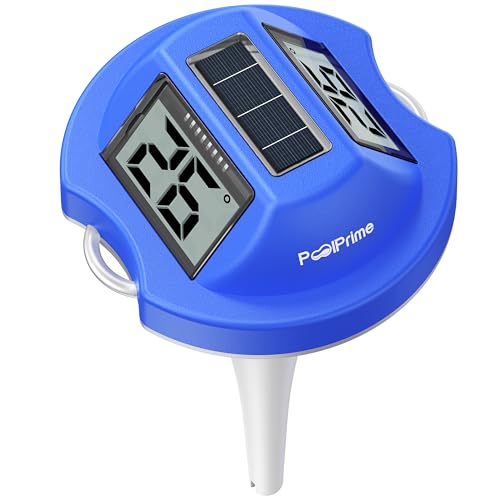
Most floaters put the display on top, which means you are craning over the water or reading upside-down digits. This one solves that with two 1.8-inch screens tilted at 45°, visible from 20+ feet. It also drops the decimal — you get 84° instead of 84.2°F — which is the right call for a quick call on whether to jump in. A rounded whole number is easier to act on than a precise one you have to squint at.
You get a reading even on grey days, because the solar panel works in rain or shade. The casing is a smooth fused design with a non-removable screen, which is the structural answer to the fogging that plagues this category. The sensor refreshes every 10 seconds at ±1.8°F (about one degree either side of the true temperature). That is the loosest accuracy figure in this lineup, and it is why the display rounds to whole degrees: the electronics are not chasing tenths. It sits 7 inches deep in the water.
Owners praise the readability and the build feel, but reliability is the honest wildcard. Some units run a full summer without a hitch, and a few stop working early or show a constant reading. That split shows up consistently enough to mention, so buy this one for the deck-reading convenience and keep the tether on. The lack of a backlight is the other gap — the screens are big, but they need daylight.
Deck-side champ: the 45° duel between screens and the whole-number display make this the easiest read from a distance.
The honest gap: no backlight means an evening check requires a porch light or a phone.
Pick this when: you check the water from a lounge chair or the kitchen window and want the number to be obvious.
skip it if: you swim at night — without a backlight the big screens go dark with the sun.
4. LuxBlue Floating Solar Pool Thermometer
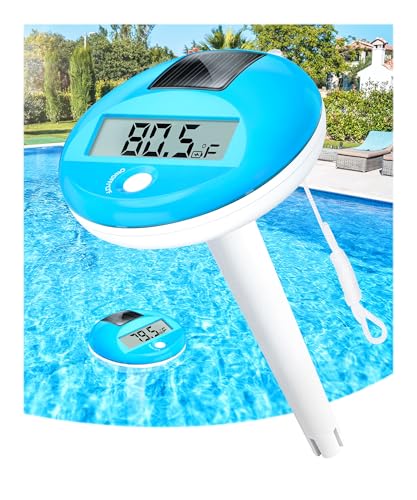
The tighter sensor spec — ±0.5°F, roughly three times finer than the PoolPrime’s ±1.8°F.
If you run a heat pump and want to know exactly how close the water is to your target, the sensor is the spec that matters. This float uses a PT100 sensor (a temperature probe known for stable, repeatable readings) with ±0.5°F precision and a 5-second refresh. Against the PoolPrime’s ±1.8°F, that is the difference between knowing the water is 84° and knowing it is 84.2°F. The probe sits 5 inches underwater, and the tilted LCD at 35° lets you read it without bending over.
The IP68-rated high-strength ABS body resists fading, fogging, and cracking, and the solar panel keeps the internal battery charged in rain or shine. A button swaps between °F and °C. The tether hole and included rope are the practical fix for skimmer drift — this is the kind of float that needs the cord, and the maker builds the attachment point in.
Where it gets real: the sealing is the recurring question mark. Some units run for months, and a smaller group reports water getting in within a couple of weeks. That is the nature of a solar float with an exposed probe — the sensor has to touch the water, so the seal around it is the part to watch. If long-term waterproofing is your top priority, the TempPro’s fully sealed sensor body is the more conservative pick. If accuracy is what you are after, this is the sharper instrument.
Instrument-grade read: the ±0.5°F PT100 sensor and 5-second update make it the most precise standalone float here.
The trade-off: an exposed probe is exposed to the seal risk, so a unit that lasts is not a guaranteed unit.
Suits: heat-pump owners and anyone who wants the water temp to the tenth of a degree.
Prefers: a swimmer who would rather trade a little precision for a fully sealed sensor body.
5. Circrane Solar Digital Pool & Spa Thermometer
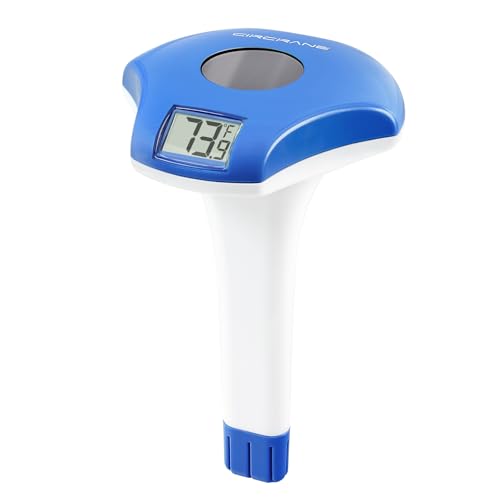
A low-voltage chip that stretches a full charge into a claimed 270 days.
Circrane’s pitch is endurance: a built-in rechargeable battery, a solar panel, and a low-voltage power-saving chip that the maker claims runs more than six months on a full charge. The title figure is 270 days of battery life. For anyone who has watched a digital float go dark mid-season, that claim is the reason to look here. The reading is 0.1°F resolution with a 10-second measuring cycle, and a button flips between Fahrenheit and Celsius.
The case is IPX8 and made from UV-resistant ABS, and each unit is leak-tested before it ships, with a free exchange offered for leak issues. The LCD is angled 35° for reading from a distance, and the float measures 7.8 inches long. It runs indoors too, which matters if your pool is in a covered enclosure and the solar panel sees less direct sun.
The catch is durability in the real world versus the claim. Amazon’s read flags functionality, accuracy, and durability as mixed, and the durability signal is the strongest of the three. Some units keep working for a month and beyond; others go blank within weeks or show moisture behind the display. That is the honest risk with any solar float, and Circrane is not immune. If you want the longest claimed runtime with a leak-test guarantee behind it, this is your float — just keep the warranty in reach and tether it.
Why owners stick with it
- Claimed 270 days of battery life on a full solar charge
- 0.1°F resolution for precise pool and spa readings
- IPX8 case with a pre-ship leak test and free exchange policy
- Angled 35° LCD readable from a few feet away
Where it can fall short
- Durability is the mixed signal — some units go blank early
- Moisture behind the display is the failure to watch for
Ideal for: a spa owner who wants to forget about charging for most of the year.
Risky for: a buyer who cannot handle a warranty swap if the seal gives out.
6. Sinbyuer Solar Digital Pool Thermometer
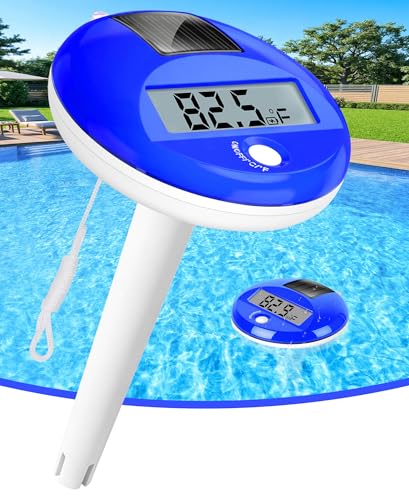
A ±0.5°F sensor on a float that claims 15 days of runtime after a full charge.
This is the same accuracy claim as the LuxBlue, but the pitch is simpler: one button, a 35° inclined LCD, and a solar panel the maker says captures 20% more sunlight than standard panels. Hold the button for 3 seconds to power on or off, tap once to swap °C and °F. The claimed 15-day runtime on a full charge covers a cloudy stretch without fuss.
An integrated IP68 gasket blocks water intrusion, and the included rope lets you anchor the float at the pool edge. The LCD numbers are large enough to read from outside the pool, and the 35° tilt keeps them legible in strong sun. The sensor error is held to ±0.5°F, which beats what ordinary floaters claim and puts it in the same league as the LuxBlue.
What wins people over here is reliability and build feel, with readability close behind. The size note is the one to know: the float is short at 2 inches, and some owners find it smaller than expected. That compact body is easier to carry and tuck away, but it bobs lower in choppy water. A few also report the solar charge fading after a season, so keep it in direct sun when the pool is idle.
Simple and tight: one-button control, a ±0.5°F sensor, and a 35° angled screen make this a no-fuss float.
Size reality: at 2 inches it is a small float, and a small float rides lower when the water gets rough.
Good match: someone who wants accuracy without learning a menu system.
Less ideal: a choppy pool or windy deck where a bigger body floats more visibly.
7. Sinbyuer Floating Solar Pool Thermometer
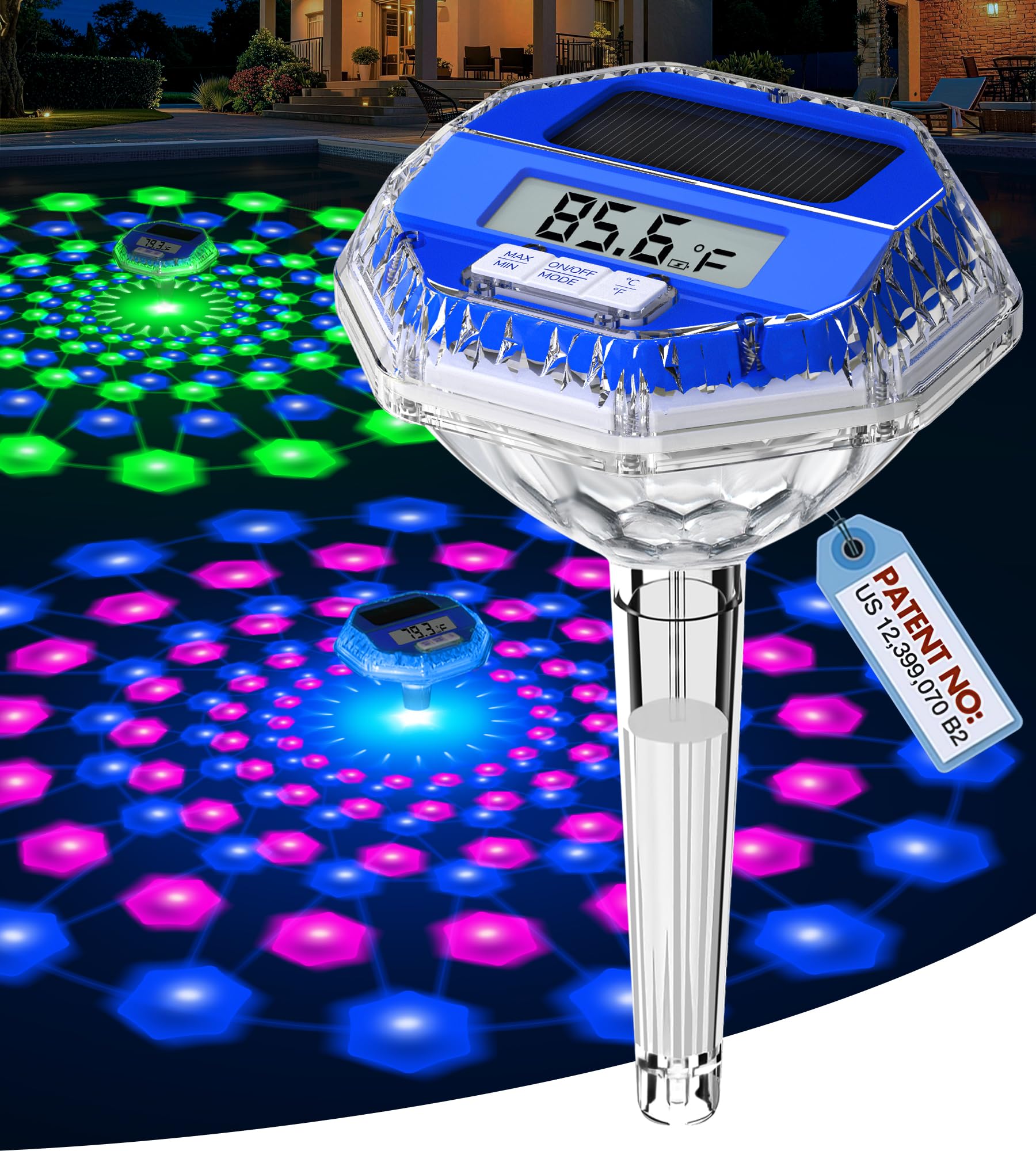
A thermometer that doubles as a color light for the pool after dark.
Most pool floats are invisible at night. This one is not — it cycles through colors and lights the water, which makes it a genuinely different kind of purchase. If you host evening swims or just like the look of a lit pool, the light show is the feature you are buying. It runs 5–8 hours per solar charge, so it covers an evening and then some.
The temperature side is real too: ±0.5°C accuracy, a range of -20°C to 70°C (-4°F to 158°F), a 35° angled LCD, and a 3-inch immersion depth. It tracks daily high and low temperatures, and the IP68 seal is designed to keep water out of the internals over long-term use. The maker holds patents on the design in the US, EU, and China.
The honest read is that the lighting is the mixed part. Some owners find it bright and fun for the kids; others say the lights are dimmer than expected or fade quickly. The temperature function holds up, and the display reads clearly from across the pool. If you want the light show, this delivers it; if you mainly want a thermometer, you are paying for lights you may not use. That is the trade.
The case for the lights
- Color light show that runs 5–8 hours on a solar charge
- ±0.5°C accuracy with a -4°F to 158°F range
- Tracks daily high and low water temps
- 35° angled LCD readable in direct sun
What to weigh first
- Light brightness is the split feedback — dim is the recurring note
- You are paying a premium for ambiance, not just the sensor
Buy it for: the pool-party look and a readable temp on the same device.
Pass if: you want a plain thermometer and no interest in colored lights.
8. U UNNI Wireless Pool Thermometer
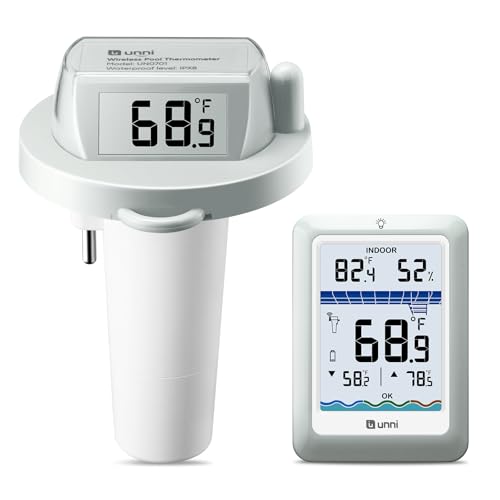
A 4.5-inch backlit receiver that tracks pool temp, highs, and lows from inside.
This is the monitor-style pick: a floating sensor transmits to a large indoor display within a 230-foot radius every 60 seconds. The accuracy is ±0.5°F for temperature and ±2% for humidity, with an indoor range of +14.2°F to +122°F and a sensor range of -40°F to +158°F. The 4.5-inch LCD has a 10-second backlight so you can read it in the dark, and it also tracks a 24-hour high and low so you know how cold the water got overnight.
The seal pairs an integrated ring with a waterproof gasket, giving two barriers instead of one bonded seam. The UV- and corrosion-resistant body holds up in sun and saltwater, and the maker lists it for ice baths, hot tubs, cold plunges, hot springs, fish tanks, ponds, and aquariums. A dual-sided reading means you can check the temp from the poolside or from the water.
One practical note: unlike the FirstE and TempPro units, this setup runs on battery power in the sensor rather than a solar panel, so plan on a battery change when the reading stops updating. The 60-second refresh is slower than the TempPro’s 5-second cycle, which matters if you are watching the number climb as the heater runs. For steady monitoring, though, a minute between readings is plenty.
Monitor, not just a float: the 4.5-inch backlit receiver and 24-hour high-low tracking make this feel like a small weather station for your water.
Battery reality: no solar panel here, so a battery swap is part of ownership.
Fits best: a koi pond or hot tub owner who wants indoor readout plus high-low history.
Not for: someone who wants solar charging and never to think about batteries again.
9. FirstE Solar Powered Wireless Pool Thermometer
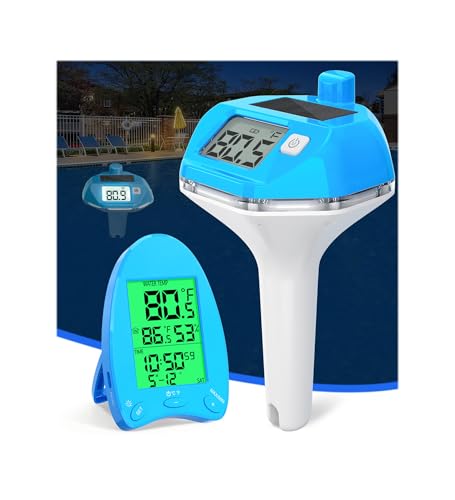
650 feet of wireless reach — the longest range in this lineup, by a wide margin.
The TempPro reaches 500 feet and the U UNNI reaches 230 feet. This one claims 650FT, which the maker says covers a spacious backyard and a two-story home. If your pool is at the far end of the property and your kitchen is at the near end, that extra range is the whole reason to pick this unit over the cheaper wireless options. The sensor updates every second, which is faster than the U UNNI’s 60-second cycle and the PoolPrime’s 10-second cycle.
The indoor receiver charges over Type-C in 2 hours and then runs up to 15 days, with a backlit screen that doubles as a room temperature, humidity, and clock display. The float itself is solar-powered with an extra-large panel the maker claims converts 25% more efficiently. The sensor reads 32°F to 158°F with a 5-inch immersion depth, matching the LuxBlue’s reach into the water.
Here is the part to know going in: the display on the float has been the weak point for a small number of owners, with reports of the screen going dim or blank after a season. That is a durability caveat, not a reason to avoid the unit — the temperature function and the range are the draw. The receiver’s battery does need a top-up now and then, and if it dies you have to reset the date and time on the indoor panel. Keep the charger handy.
Range champion: 650FT of wireless reach beats the TempPro’s 500FT and the U UNNI’s 230FT, so no corner of a large yard is out of range.
The caveat: a few float screens have gone dark after a season, so the indoor panel is the more durable half.
The right call for: large properties where the pool and the house are far apart.
Overkill for: a small backyard where the TempPro’s 500FT already reaches everything.
Know the Specs
IP Waterproof Ratings
The IP rating tells you how well the case keeps water out. IPX8 and IP68 are the highest levels for a unit that sits in water — the “X” means dust is not rated and the 8 means it is protected against continuous immersion. For a floating thermometer, that seal is the whole game: a unit with a weak gasket will fog behind the lens or die outright. A fused, non-removable screen is the structural fix to look for.
Wireless Range and Update Speed
Wireless range figures describe the signal in open air, so a 500-foot or 650-foot claim shrinks once walls and distance get in the way. Update speed tells you how fresh the number is: a 5-second refresh like the TempPro feels live, while a 60-second cycle like the U UNNI is fine for steady monitoring. Match the range to your property and the refresh to how closely you watch the heater climb.
Accuracy and Resolution
Accuracy (±0.5°F vs ±1.8°F) is how close the reading is to true temperature; resolution is the smallest step the display shows. A ±0.5°F sensor paired with a whole-number display gives you a rounded figure you can act on quickly. A ±1.8°F sensor rounds to whole degrees on purpose — it is not chasing tenths, and that is fine for a quick swim decision.
Power: Solar, AAA, or Both
Solar floaters avoid battery swaps but depend on light to keep the internal cell topped up. Some units pair the panel with AAA batteries for backup, which is the more forgiving setup for a shaded pool or a cloudy stretch. Read the claimed runtime — 15 days, 18 days, or 270 days on a full charge — and treat it as a best-case figure on a sunny day.
Common Questions
Will a floating pool thermometer work in a hot tub or cold plunge?
Does the tether rope actually stop it from drifting into the skimmer?
How often do I need to charge or replace batteries on these?
What is the difference between IPX8 and IP68 for a pool thermometer?
Can I read the temperature from inside the house?
Why does the display show a whole number instead of a decimal?
Will a solar thermometer keep working on cloudy days or in shade?
Is a wireless thermometer more accurate than a standalone float?
Do I need to take the thermometer out of the pool in winter?
Why do some floating thermometers fail within weeks?
The Bottom Line
For a truly hands-off pool setup, reach for the TempPro TempAir — the 500-foot wireless range and 5-second refresh mean the water temperature greets you on a backlit screen inside. If you want the most readable standalone display, the PoolPrime Dual Screen float’s 45° tilted panels are the easiest number to see from a deck chair. And if beach-worthy wireless range is the priority, the FirstE Wireless stretches 650 feet to cover a large yard without walking back and forth.
One last honest note: these floats live in a tough environment, and the seal is the part that decides whether a unit survives the season. Read the warranty, tether your float, and buy from a brand that stands behind the leak claim. The TempPro’s 4.5+ star rating across 180+ owners and the Circrane’s pre-ship leak test both point the same way: buy the seal, not the screen.
How we choose
We do not accept paid placement. Every pick is matched to a real buyer and a real use-case; we do not hands-on test units.
Sources
Specifications: manufacturer listings and product documentation. Review insights: verified customer reviews, as of November 2026. Pricing: not shown on this page (it changes often); check the current price via the retailer link.
As an Amazon Associate, Tactical Gear Guy earns from qualifying purchases. This does not affect which products we feature.