Specs are compiled from manufacturer listings and verified buyer reviews and can change over time — please confirm the key details on the product page before buying.
You want tender stew without standing over the stove, and a pot that holds pressure and comes up to heat on its own. That is the whole job. Before you buy, know this: a 6-quart (roughly six servings) electric pressure cooker lives or dies on its lid seal and control panel, not its preset count. Below you get six pots, ranked by what actually works in a kitchen, plus the plain-English version of every spec you will see on a box. The Cosori 9-in-1 is the pick most people should start with.
This guide is built by comparing the manufacturers’ published specifications and the patterns across verified customer reviews, so you get each pick’s real strengths and trade-offs instead of marketing spin.
Some pots vent steam out the back at an angle so your hand stays clear, and some put a ceramic pot inside so rice releases without scraping. Vent direction and pot material decide more of your daily happiness than any preset count. Here is how to pick the right electric pressure cooker for your own counter and your own dinners.
Top Picks
How To Choose The Best Electric Pressure Cooker
Start with the seal and the vent, because that is what makes a pressure cooker a pressure cooker. A pot that will not lock on the first try turns a ten-minute dinner prep into a wrestling match. Look for an outer lid with a clear alignment mark — a dot on the lid that lines up with a dot on the base — so you know at a glance whether it is seated. Then check where the steam comes out. A vent angled away from your hand keeps the release moment calm instead of making you flinch.
Match the quart size to the number of people you feed
Six quarts is the size most households land on, and the makers here agree on it. One brand states plainly that 6 quarts covers up to 6 servings, which is a family dinner plus leftovers. Go bigger only if you batch cook for a crowd; a larger pot takes longer to come up to pressure for a two-person meal.
Decide between stainless steel and ceramic nonstick inside
The inner pot is the surface your food touches, and the two common types behave differently. A stainless steel pot with a layered, three-ply bottom (a base built from stacked metal layers) is meant for searing and sautéing and will not scratch when you use metal tongs. A ceramic nonstick pot releases rice and sticky sauces cleanly with a wipe. Neither is wrong — one is for browning, the other for easy cleanup.
Read the safety list, not the preset count
Every pot on this list carries the basics: a locking lid, overheat protection, and a pressure release you control. What separates them is the small stuff — a double-layer anti-scald lid, a seal button placed away from the vent, or an automatic shutoff. Those are the features you actually touch on a Tuesday night.
Side-by-Side Comparison
| Model | Best For | Capacity | Functions | Weight | Amazon |
|---|---|---|---|---|---|
| Cosori 9-in-1 Ceramic Pot★ Best Overall | Most kitchens | 6 quarts | 9-in-1 (12 safety features) | 11.9 pounds | Amazon |
| Fullwill 12-in-1 Dual PotsBest for Big Families | Two-pot flexibility | 6 quarts | 12-in-1 (dual pots) | 10.9 pounds | Amazon |
| Midea 10-in-1 Stainless Pot | Stovetop-to-oven searing | 6 quarts | 10-in-1 (16 presets) | 13.4 pounds | Amazon |
| Instant Pot Duo Plus 6 Qt | Recipe app users | 6 quarts | 9-in-1 (15 programs) | 12.4 pounds | Amazon |
| Instant Pot Duo 6 Qt | First-timers, low fuss | 5.68 liters | 7-in-1 (13 programs) | 14.6 pounds | Amazon |
| Ninja HyperHeat PC201 | Big families, fast sear | 6 quarts | 9-in-1 (1200W) | 15.9 pounds | Amazon |
Detailed Reviews
1. Cosori Pressure Cooker 6QT
Our pick — 4.5+★ from 7,500+ verified ratings; the strongest balance of quality and price.
A steam vent angled 30 degrees backward, so your hand never gets the blast.
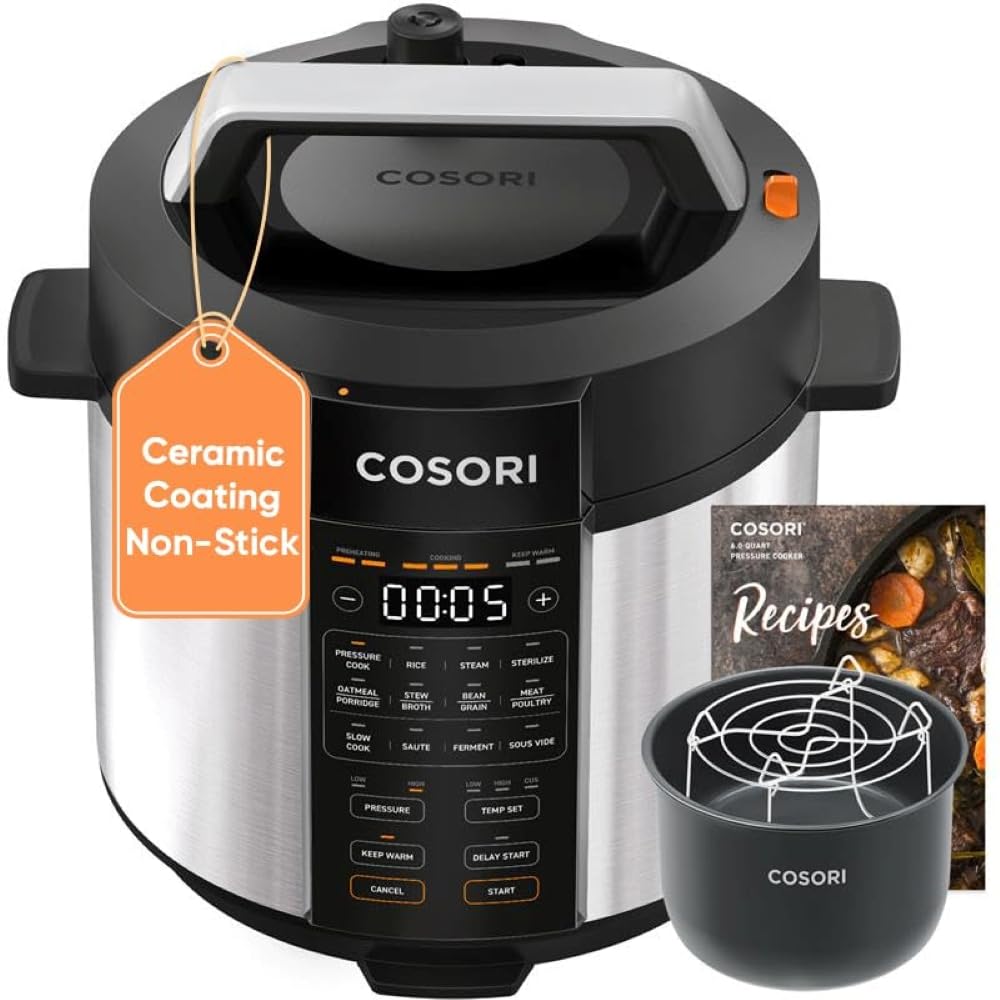
The Cosori earns the top spot for one safety detail you will only appreciate after your first manual release: the steam release is angled 30 degrees backward, and the seal/vent button sits away from the vent itself. That means your hand is never in the path of the steam. It runs nine cooking functions — pressure cook, rice, steam, sterilize, oatmeal, stew, bean and grain, meat and poultry, plus slow cook, sauté, ferment, sous vide and keep warm — in a 6-quart pot that weighs 11.9 pounds, light enough to lift out of a cabinet with one hand.
The ceramic coating on the inner pot is the second reason it lands here. Rice and sticky sauces release with a wipe, and the lid, inner pot and accessories all go in the dishwasher. Because it is a 6-quart pot, it holds dinner for a family of four plus leftovers for tomorrow. As owners put it, they can boil meat in 30 minutes, and it does the same job as the better-known brand for less.
You line up the orange dot on the lid with the orange dot on the base and twist clockwise — miss the dots and you will stand there turning it. Nothing dangerous, just a mild learning curve on night one. Nine functions and 12 safety features is a lot of pot for a mid-range buy, and the crowd favorite here — 4.5+ stars across 7,000+ owners — backs that up.
What earns it the crown
- Steam vent angled 30 degrees backward keeps your hand clear of the release
- Ceramic inner pot wipes clean and is dishwasher-safe along with the lid
- Fingerprint-resistant stainless housing and a 0.5-inch widened pot gap for easy wiping
- Double-layer anti-scald lid plus overheat protection among the 12 safety features
Where it asks patience
- Preheating before pressure builds runs longer than you would like
- Lid must be dot-aligned and twisted clockwise, which takes a try or two
- No second inner pot in the box, so you cannot cook two dishes back to back without washing
Your match if: you want one pot that vents safely, cleans easily, and covers rice, stew, and yogurt in a single 6-quart body.
Look past it if: you refuse to spend the first dinner learning the dot-and-twist lid close.
2. Fullwill Electric Pressure Cooker 6QT
Two pots in one box — steel for braising, ceramic for rice — and a 24-hour delay timer.
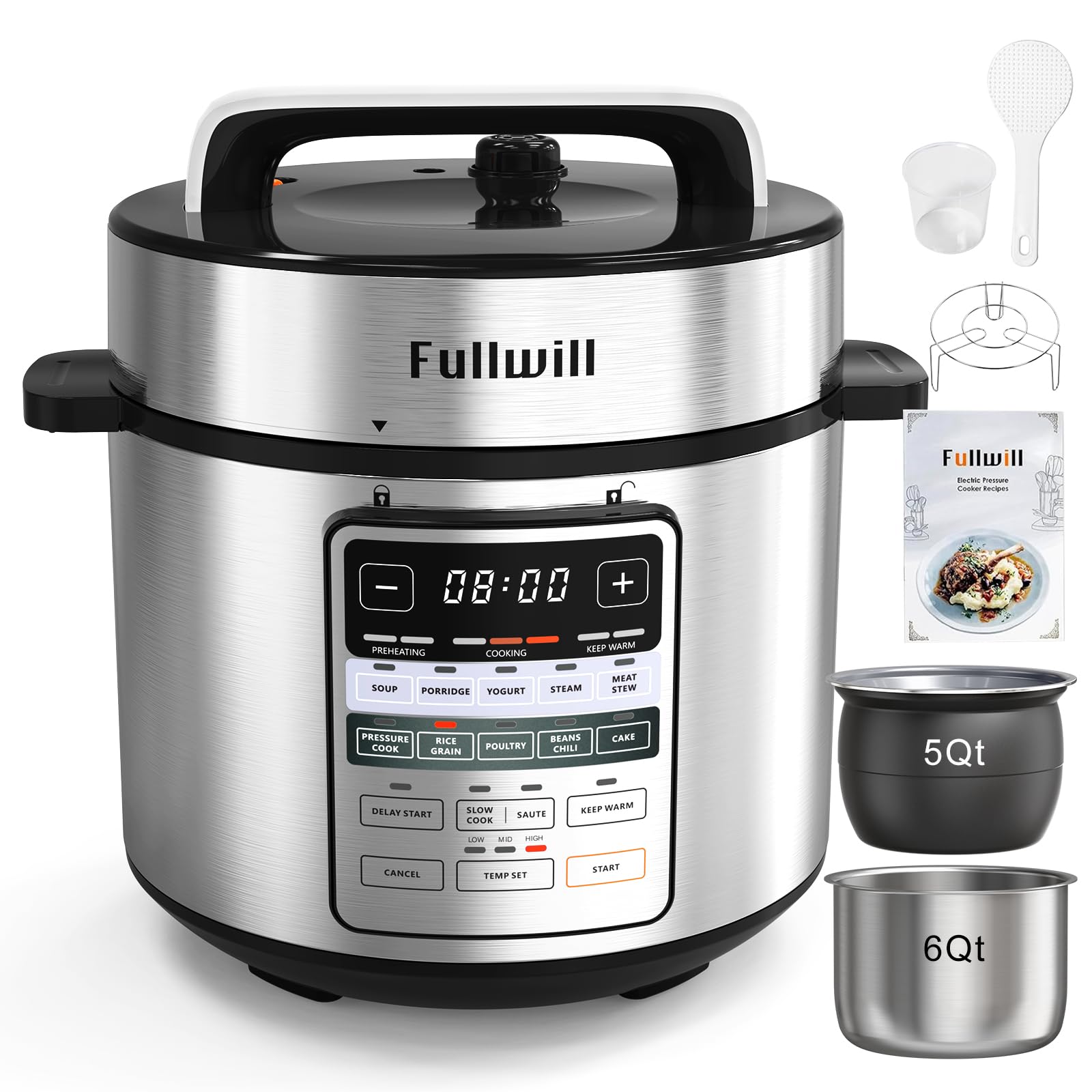
This is the one pot that hands you a second inner pot in the box: a 304 stainless steel pot for hearty braises and a ceramic nonstick pot for delicate dishes like rice and custard. Both go in the dishwasher, and so does the lid. At 10.9 pounds it is lighter than the Midea 10-in-1, which weighs 13.4 pounds — a difference you notice every time you lift it off the counter. It is also the smaller footprint of the two, at 12″D x 12″W x 13″H against the Midea’s 13″D x 12.4″W x 12.9″H, so it tucks into a tighter cabinet gap.
The 24-hour delay start is the feature that changes a workday. Load the pot in the morning, set the timer, and come home to a finished meal. Twelve functions cover pressure cook, meat stew, rice, sauté, bake, and more, so a single appliance can take the place of several. Buyers report it cooks large roasts to pull apart tender in 50 minutes or less, and the dual inserts mean you are not washing one pot twice to cook rice after a stew. Quality draws the most praise — the build feels solid, not flimsy.
Here is the trade-off to weigh honestly. The lid does not always seal on the first attempt; a few owners have found they need a second try before the steam locks in and they can walk away. Nothing that breaks the pot, but it means you cannot always set the timer blind and leave the house. If you want the flexibility of two pots more than you want a perfect first-time seal, this is the pick.
The dual-pot payoff: two dishwasher-safe inner pots — one steel, one ceramic — let you braise and then make rice without washing in between, which is the real reason buyers choose this over a single-pot cooker.
The seal caveat: a lid that sometimes needs a second attempt to lock in steam is the one thing to expect, so plan a moment to check it before you walk away.
This is your pick when: two inner pots and a 24-hour delay timer beat a single pot with a perfect seal on the first try.
Think twice if: you want to set it and leave the house without a glance at the lid.
3. Midea Electric Pressure Cooker 6 Quarts
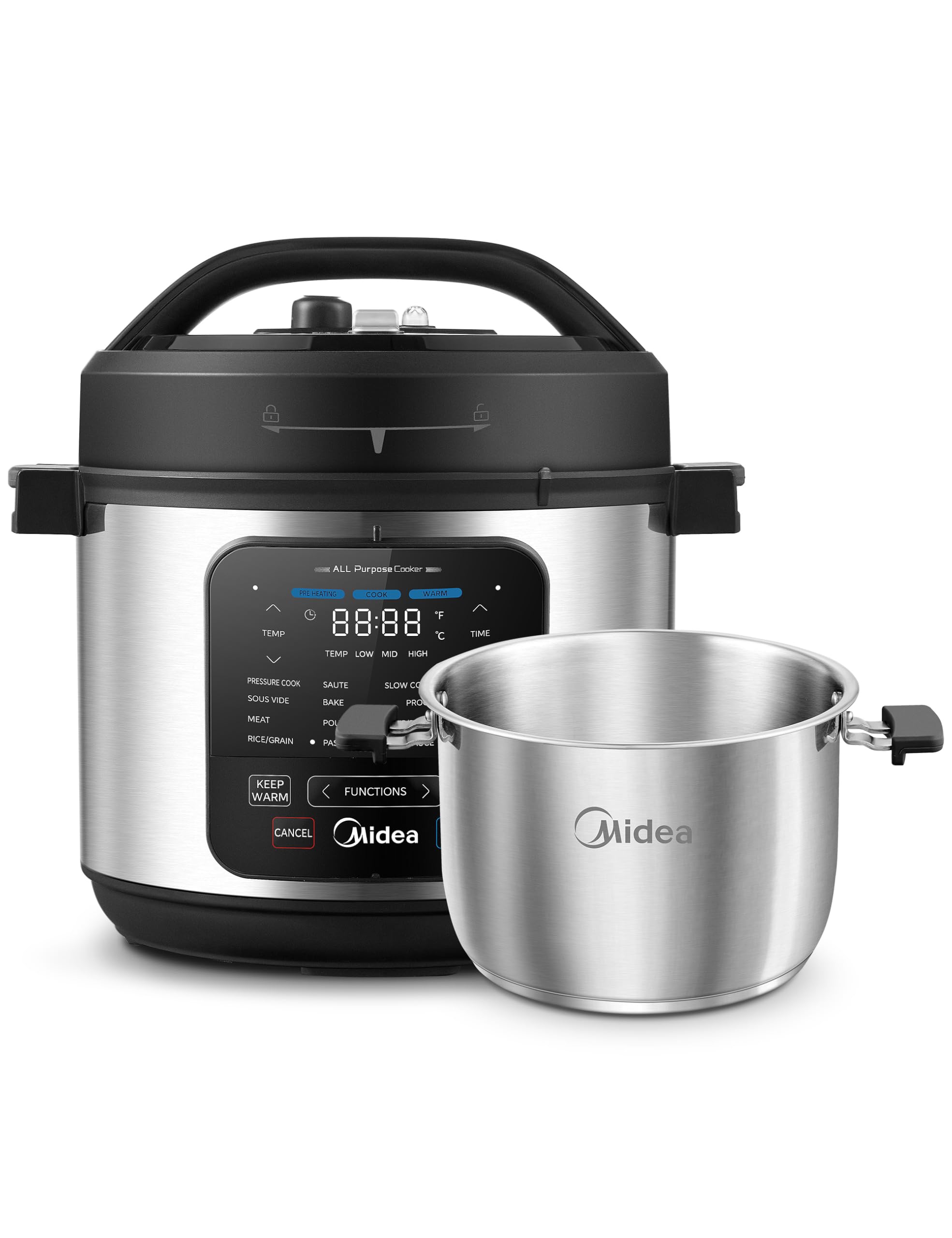
The inner pot leaves the cooker entirely — stovetop for a sear, oven up to 500°F for a crust.
Most pressure cookers keep their inner pot inside the base. This one does not. The stainless steel inner pot can go on any stovetop for a high-heat sear, then transfer straight into the oven up to 500°F for a crispy finish, then come back to the cooker for pressure. That is a genuinely different way to build flavor, and it eliminates the extra pan. It runs 10 functions — pressure cook, slow cook, steam, sauté, sous vide, bake, rice, yogurt and more — with 16 preset functions on a push-button panel.
You will pay for that flexibility in weight: 13.4 pounds, heavier than the Fullwill at 10.9 pounds. It is also the larger footprint of the pair, at 13″D x 12.4″W x 12.9″H against the Fullwill’s 12″D x 12″W x 13″H. Both the inner pot and lid are dishwasher safe, and the steel handles come with the durability of a metal utensil-friendly surface — no worrying about scratching a coating. Owners who have owned three electric pots before call this the best of them, and the stainless insert is a recurring reason: any utensil works.
The thing to know going in: this is a smaller pool of buyers than the big-name pots, and the stainless pot does require more seasoning attention than a nonstick one. It also carries a premium-tier outlay. If you sear in a skillet first, this is the pot that gives you that extra step in one vessel.
Why it stands out: a stainless pot that goes stovetop-to-oven up to 500°F gives you a true sear and a crispy finish that a ceramic nonstick pot simply cannot match.
The cost of the flexibility: it is the heavier of the two stainless picks at 13.4 pounds, so lifting it in and out of a low cabinet is more of a chore.
Go here if: you want to sear on the stovetop and finish in the oven without dirtying a second pan.
Pass if: the pot staying put inside the base is exactly what you want and 13.4 pounds is more than you care to hoist.
4. Instant Pot Duo Plus 6 Qt
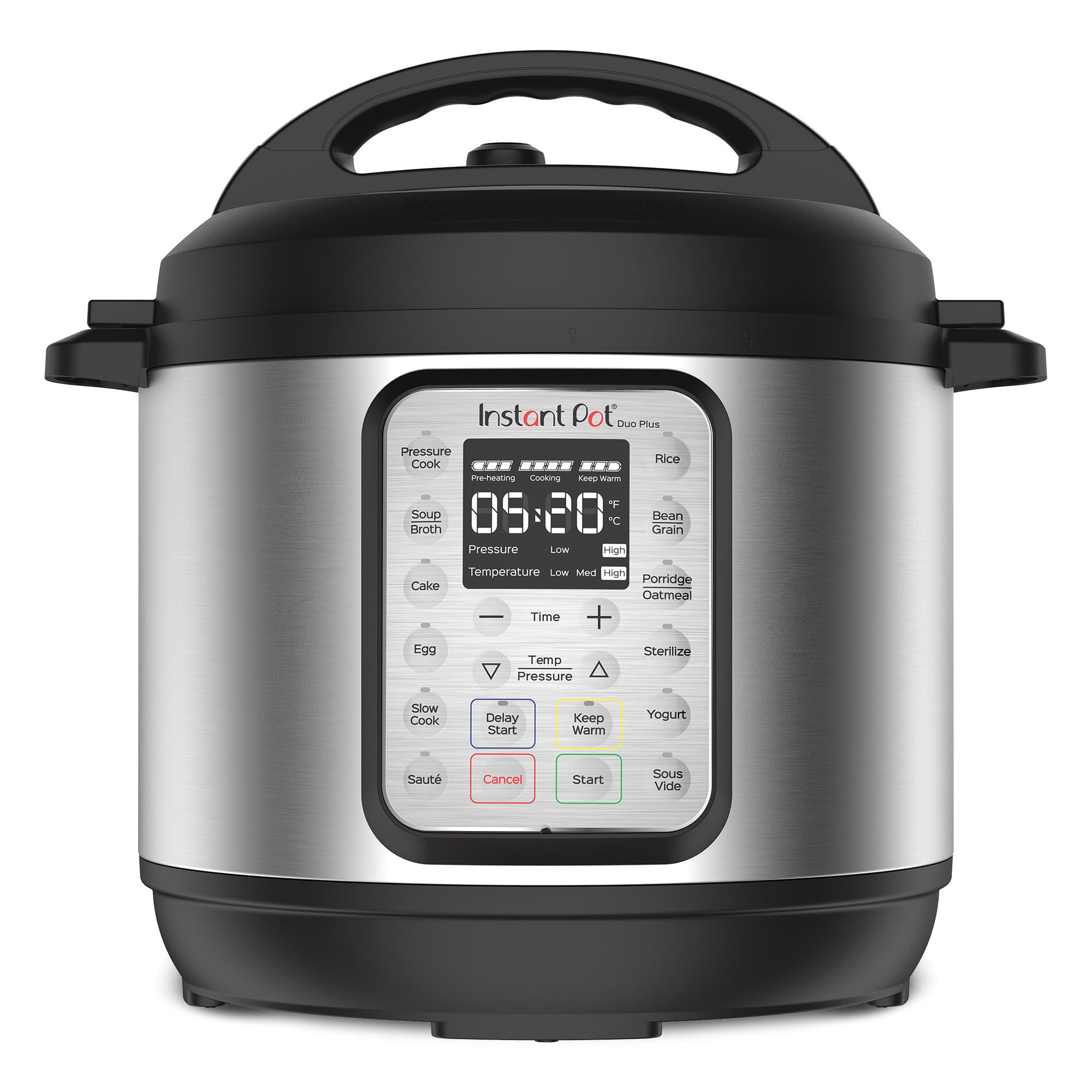
Fifteen one-touch programs and an app with 800+ recipes, so you never guess a setting.
Instant Pot built its name on the app — an iOS and Android library with 800+ recipes that tells you which button to press. That is the real value here for anyone who is new to pressure cooking and does not want to translate a stovetop recipe into a program. The Duo Plus gives you 15 one-touch options, plus a display that shows cooking time, temperature, and pressure in real time. Nine functions cover pressure cook, slow cook, sauté, sous vide, steam, sterilize, keep warm, rice, and yogurt.
The inner pot is 18/8 stainless steel with an anti-spin, tri-ply bottom — a stacked-metal base that resists spinning while you stir and is meant for searing. Dishwasher-safe lid and pot, an Easy-Release steam switch, and a detachable power cord all make storage and cleanup simpler. At 12.4 pounds it sits between the Cosori’s 11.9 and the Ninja’s 15.9. Owners lean on the saute feature hard; some report a vegetable medley done in 6 minutes once pressure builds. It covers 6 quarts, which one listing describes as enough for up to 6 servings.
Keep an eye on the durability angle. The handle is the recurring weak point — the plastic handle has broken after as few as 8 uses in some reports — so treat that handle with care and do not swing the pot by it. Water pooling around the base after use is also worth wiping dry. Buyers love the performance and ease of use; the plastic handle is the one piece to watch.
What the app gives you
- 800+ recipes in a free iOS and Android app that removes the guesswork
- 15 one-touch programs across 9 cooking functions
- 18/8 stainless inner pot with anti-spin tri-ply bottom for searing
- Detachable power cord for easier storage
What to watch
- Plastic handle has broken prematurely on some units
- Water can pool around the base and needs wiping
- Steam release is a switch, not an angled back vent, so keep your hand clear
Reach for this if: the 800+ recipe app and 15 one-touch programs are how you want to learn pressure cooking.
Look elsewhere if: a pot you can grab by the handle without thinking twice matters more than an app library.
5. Instant Pot Duo 6 Qt

The original workhorse — seven functions, 13 programs, and a fan base that will not quit.
This is the model that made the category famous, and the buyer data reflects it. What wins people over is reliability at scale: this is the pot people buy, use twice a week, and come back to say it is still going. It gives you seven functions — pressure cook, slow cook, rice, yogurt, steam, sauté, and keep warm — plus 13 customizable Smart Programs and a food-grade stainless steel inner pot with a tri-ply bottom (three bonded metal layers that spread heat evenly). The PFOA/PTFE-free cooking surface (no PFOA or PTFE, two common nonstick coatings) is stated plainly on the listing. It cooks for up to 6 people, which is the balance for a family or a week of meal prep.
Where it differs from the Duo Plus: this one has fewer one-touch programs (13 versus 15) and no sous vide or sterilize function, but it is the simpler, more ruggedly proven version. The power cord is permanently attached and cannot be detached, which is one less connection to fail but one more cord to manage during storage. Owners routinely report it handles batch cooking for a family of four, and many have used theirs for years without issue.
The catch worth knowing: a few units have simply quit turning on, so if you buy, register the warranty and keep the receipt. The steam release is manual, which is normal for this design but means you stay near the pot at release time. It is also the heaviest of the stainless Instant Pots at 14.6 pounds, so a permanent counter spot beats a cabinet shelf.
The long-haul case: 13 Smart Programs, seven functions, and a stainless tri-ply bottom make this the least fussy way into pressure cooking — the panel is simple enough to learn in one dinner.
The honest limit: a permanently attached cord and a 14.6-pound body mean you want to park this pot on the counter, not stash it in a drawer.
Best first pot for: a household that wants the most proven name in pressure cooking with the simplest panel to learn.
Not for you if: you want sous vide or sterilize built in, or you need a detachable cord for tight storage.
6. Ninja HyperHeat Pressure Cooker PC201
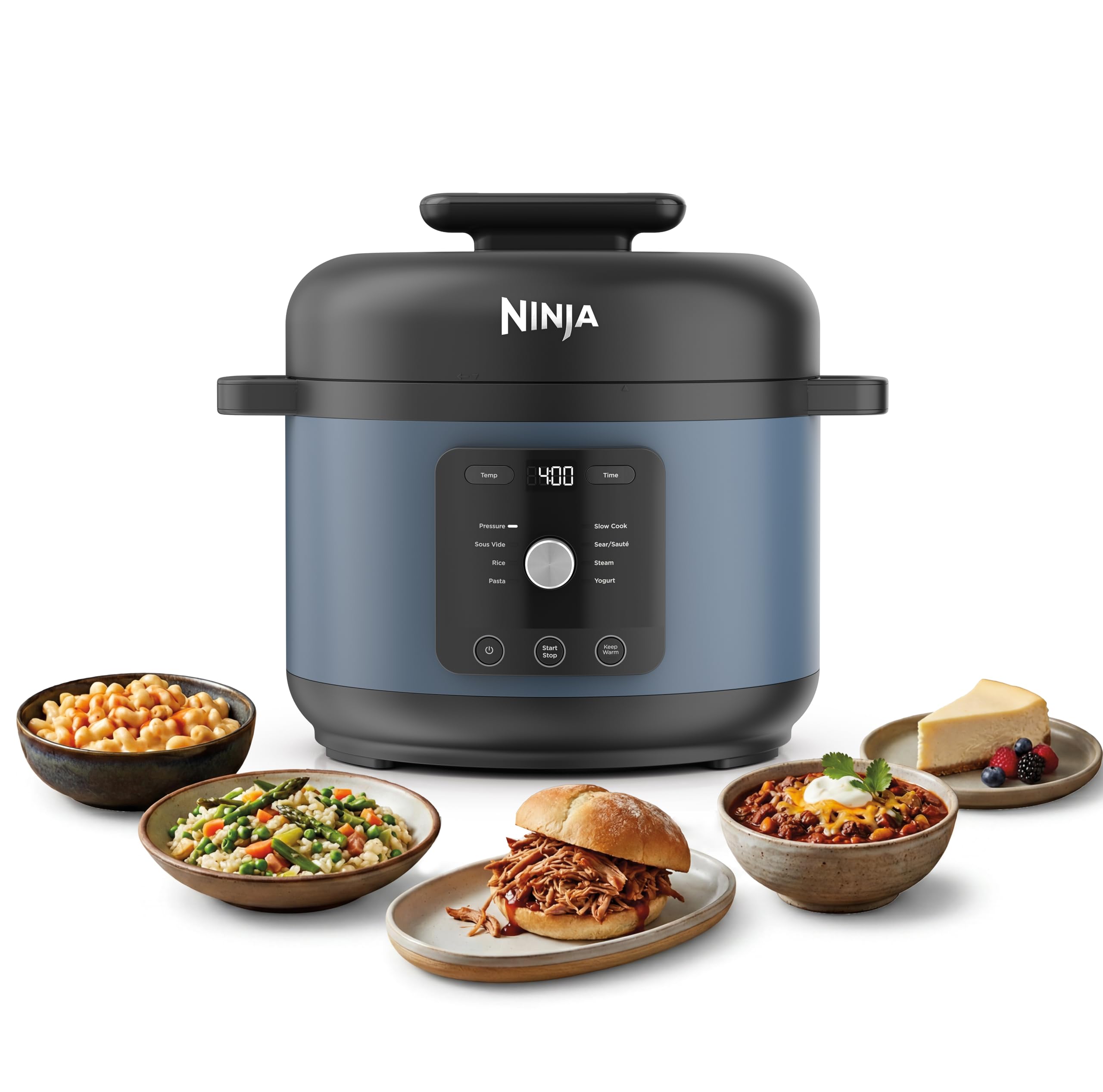
A 1200-watt heating base and a 6.5-quart pot that fits up to a 4-lb chicken.
The number that matters here is 1200 watts — the heating system on this base, which the manufacturer states delivers more powerful cooking performance than the Instant Pot Duo. That power shows up as a wider 9.5-inch cooking surface, so you can sear a batch of meat without crowding the pan, and pressure builds quickly. It runs nine functions — pressure cook, slow cook, rice, sous vide, steam, sear/sauté, yogurt, and more — in a 6.5-quart pot that the listing says feeds 8 to 10 people.
Cleanup is where this one stands out: the inner pot is a removable ceramic nonstick SimpliServe pot made 100% PFAS-free (no PFAS, a group of synthetic coatings), meant to wipe clean even after high-heat searing. Because the pot lifts out, it can go straight to the table for serving, which cuts down on dishes. The maker quotes white rice at as little as 8 minutes and quinoa at as little as 5 minutes — though the maker notes that excludes the time to build and release pressure, so add that to your mental clock. Owners lean on the sear-then-pressure combo to save a step.
Two things to weigh. First, at 15.9 pounds it is the heaviest pot here, and it is also the largest footprint at 13.89″D x 14.76″W x 12.24″H, so measure your counter before you commit. Second, the box does not include a steamer, which some owners would like. Beyond the missing steamer, the options, pot, and results are a genuine step up on older designs.
The power advantage
- 1200-watt HyperHeat base for quick pressure buildup
- Wide 9.5-inch cooking surface for un-crowded searing
- Removable PFAS-free ceramic nonstick pot wipes clean and serves at the table
- 6.5-quart capacity fits up to a 4-lb chicken or 5-lb roast
The size tax
- Heaviest pot on this list at 15.9 pounds
- Largest footprint, so check your counter space first
- No steamer included in the box
Pick this up if: you want the most powerful heating base, the largest sear surface, and a pot that goes straight to the table.
Skip if: your counter is tight or you want a lighter pot to lift in and out.
Know the Specs
Quart Capacity
Quarts measure the volume inside the inner pot. Six quarts is the common family size, and one maker states it covers up to 6 servings. A larger pot like 6.5 quarts can feed 8 to 10 people and fit a whole 4-lb chicken, but it also takes longer to come up to pressure for a smaller meal. Match the pot to how many people you cook for most nights.
Wattage and Heat-Up
Watts measure how much heating power the base puts out. A 1000-watt or 1100-watt base is standard for a 6-quart pot. The Ninja PC201 runs 1200 watts, which is higher, and the maker ties that to faster pressure build. Higher wattage means less waiting at the start, but the trade-off is often weight and size.
Inner Pot Material
A stainless steel pot with a tri-ply bottom — stacked metal layers — is built for searing and will not scratch. A ceramic nonstick pot releases rice and sauce with a wipe but needs gentler handling. A dual-pot cooker hands you both, which is why the Fullwill carries two inner pots in the box.
Safety and Steam Release
Every pot here locks its lid and protects against overheating. Look at where the steam exits: the Cosori angles it 30 degrees backward so your hand stays clear. Others use a manual switch or button. The release method determines how comfortable that moment feels — it is a detail you live with every cook.
Common Questions
How many servings does a 6-quart electric pressure cooker make?
Is stainless steel or ceramic better for the inner pot?
Why does my pressure cooker lid not seal on the first try?
How long does it take to come up to pressure?
Can I put the inner pot and lid in the dishwasher?
Do I need a delay-start timer on a pressure cooker?
What should I check before searing meat in the pot?
Is the Instant Pot Duo Plus better than the Instant Pot Duo?
How do I know when it is safe to open the lid?
Are the pots PFOA-free or PFAS-free?
The Bottom Line
For most kitchens, the electric pressure cooker to start with is the Cosori 9-in-1 — a 30-degree angled steam vent that keeps your hand clear, a ceramic pot that wipes clean, and dishwasher-safe parts, all in a 6-quart body that weighs 11.9 pounds. If you want two inner pots and a 24-hour delay timer, grab the Fullwill 12-in-1; its steel-and-ceramic pair covers both braising and rice. And for stovetop-to-oven searing, the Midea 10-in-1 lets the inner pot go from burner to oven up to 500°F. Its 4.5+ stars across 7,000+ owners back that up: a rare blend of safety engineering and easy cleanup.
How we choose
We do not accept paid placement. Every pick is matched to a real buyer and a real use-case; we do not hands-on test units.
Sources
Specifications: manufacturer listings and product documentation. Review insights: verified customer reviews, as of November 2026. Pricing: not shown on this page (it changes often); check the current price via the retailer link.
As an Amazon Associate, Tactical Gear Guy earns from qualifying purchases. This does not affect which products we feature.