Specs are compiled from manufacturer listings and verified buyer reviews and can change over time — please confirm the key details on the product page before buying.
If you want earphones that never need charging and never drop the connection, the answer is simple: buy a wired set with a 3.5mm plug and spend your money on the drivers instead of a battery. Everything below plugs straight into your phone, laptop, or audio interface. The real decision is not whether to go wired — it is how much isolation and how much bass you actually want.
This guide is built by comparing the manufacturers’ published specifications and the patterns across verified customer reviews, so you get each pick’s real strengths and trade-offs instead of marketing spin.
The picks break into two clear camps: hybrid driver sets tuned for detail, and sealed designs built to block a room full of noise.
Top Picks


How To Choose The Best Earphones with Jack
A wired earphone is only as good as the seal in your ear canal. If the tip does not sit snug, you lose the bass first and the outside noise creeps in second — no driver count saves that. So the practical order of decisions is: seal and fit, then isolation, then tone, and only then the driver recipe on the spec sheet.
Match the tip to your ear, not the marketing
Every set here ships with multiple tip sizes for a reason — a gap between tip and canal leaks sound both ways. Silicone tips are the default and give you a quick seat. Foam tips expand to fill the canal and generally quiet a noisy room better, which is why stage-focused sets include both.
Decide how much outside world you want gone
Deep-insertion designs bury the tip further into the canal and score the highest isolation numbers in this group. Shallower, rounded-shell designs are easier to live with all day but let more ambient noise through. If your commute or your stage is loud, isolation is the spec to chase first.
Check what your phone can actually drive
A set with high sensitivity (how loud it goes for a given amount of power) and low impedance (how hard it is to push) will play loud straight from a phone. A lower-sensitivity set can still sound fine, but you may run out of volume on quieter sources. If you already own a small DAC dongle, this matters much less.
Side-by-Side Comparison
| Model | Best For | Driver Type | Isolation | Plug / Cable | Amazon |
|---|---|---|---|---|---|
| AFUL Explorer★ Best Overall | Balanced everyday listening | 1DD+2BA Hybrid | Sealed silicone, 6 tip pairs | 3.5mm, detachable 0.78mm 2-pin | Amazon |
| Letshuoer S12 PROPlanar Specialist | Planar detail on a phone | 14.8mm Planar Magnetic | Multi-vent pressure relief | 2.5mm / 3.5mm / 4.4mm swappable | Amazon |
| BASN Bmaster5Stage Ready | On-stage monitoring | 1DD+4BA Hybrid | Sound isolation design | 3.5mm, two detachable cables | Amazon |
| SIMGOT SuperMix 4 | FPS gaming and detail | 1DD+1BA+1Planar+1PZT | Resin shell, sealed fit | 3.5mm, detachable 0.78mm 2-pin | Amazon |
| Etymotic ER3XR | Maximum noise blocking | Balanced Armature | 35–42dB rated | 3.5mm, detachable MMCX | Amazon |
| Etymotic ER2SE | Flat studio reference | Dynamic Driver | 35+ dB rated | 3.5mm, detachable cable | Amazon |
| Shure AONIC 215 | All-day comfort and calls | Single Balanced Armature | Up to 37 dB | 3.5mm, detachable MMCX | Amazon |
| 7Hz Timeless II | Tunable planar soundstage | 14.5mm Planar Magnetic | Sealed shell, rounded tips | 3.5mm, detachable 2-pin | Amazon |
| AFUL Performer 5+2 | Seven-driver detail chase | 2DD+4BA+1 Micro Planar | Air-pressure balance vents | 3.5mm or 4.4mm, 0.78mm 2-pin | Amazon |
Detailed Reviews
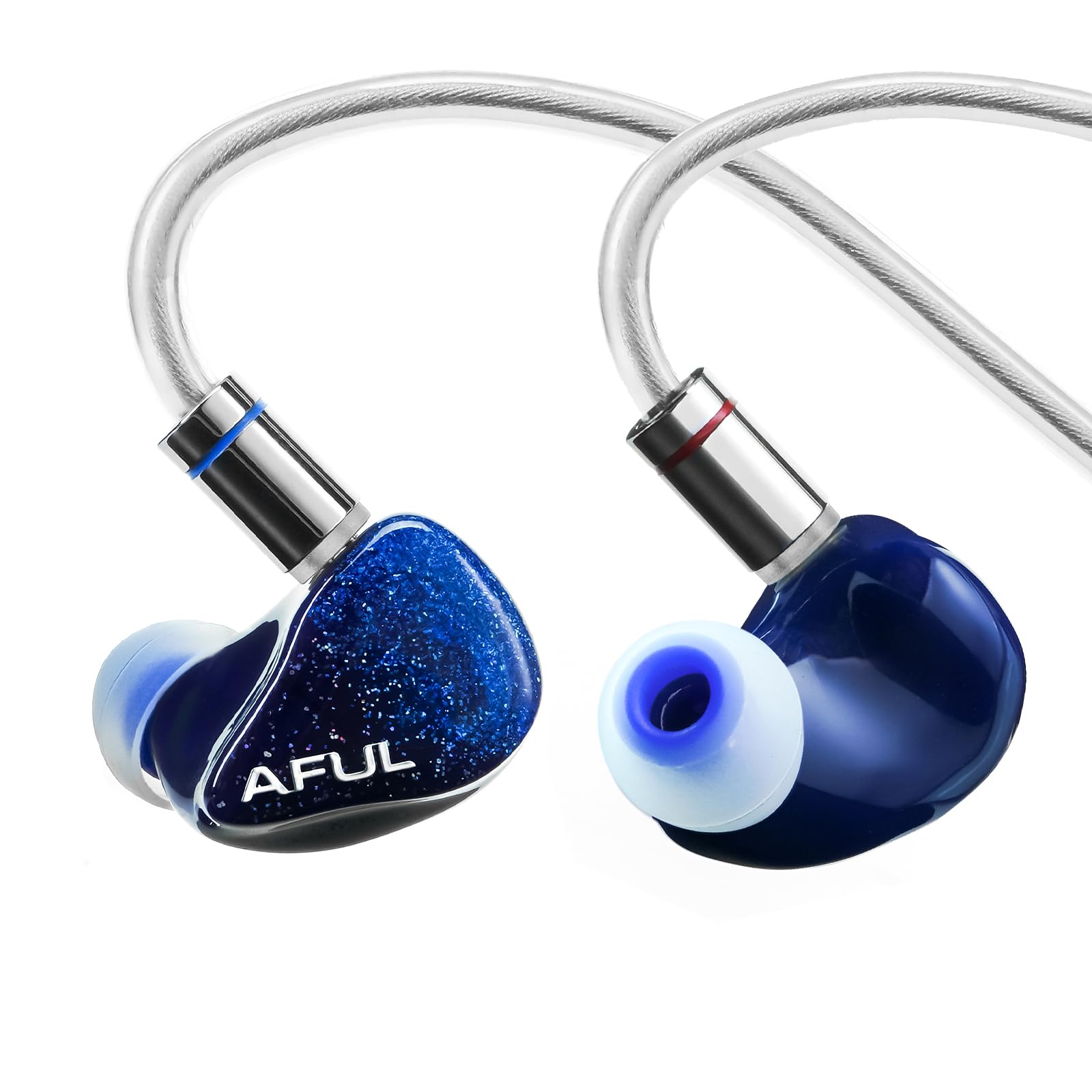
1. AFUL Explorer 1DD+2BA Hybrid In-Ear Monitors
Our pick — 4.5+★ from 150+ verified ratings; the strongest balance of quality and price.
Two drivers and a vent system that makes long listening sessions feel easy.
The Explorer runs one dynamic driver for the low end plus two balanced armatures for mids and highs, and that mix is why it lands here first. You get controlled bass without the boom that swamps vocals, and realistic mids that keep a singer out front. Treble stays smooth rather than sharp, so acoustic and jazz tracks do not turn brittle at volume.
Comfort is where this set quietly wins. Each shell weighs 4.43g, so a two-hour commute does not end with sore ears, and the 3D air pressure balancing system (small vents that relieve pressure inside your ear canal) keeps the seal from feeling tight. Six pairs of silicone tips in S, M, and L are in the box, which is the difference between hearing the bass and losing it to a leak.
Your phone can drive it. At 26Ω impedance and 108dB sensitivity, these high-sensitivity earphones reach proper volume straight from a handset with no amplifier. They edge the Letshuoer S12 PRO on that metric — 108dB against 102dB — so a weaker phone output is less of a concern here. What wins people over most is the tuning; the mixed note is the cable, which some find short, so plan on a replacement if you like slack. Here is a set rated 4.5+ stars across 100+ owners, and the balance is the reason. It is the pick that suits almost anyone who wants one wired pair to do everything.
What earns its place
- Balanced tone with controlled bass and smooth treble that does not fatigue
- 4.43g per side keeps long sessions comfortable
- 26Ω / 108dB means a phone drives it without a DAC
- Detachable 0.78mm 2-pin cable so you can swap or upgrade later
Where it asks patience
- Some listeners find the stock cable short
- Demands a proper tip seal or the bass thins out
Go for this: you want one wired pair for commuting, desk work, and casual gaming without tuning fuss.
Think again if: you need a long cable run to a desktop rig — buy a replacement cable alongside it.
2. Letshuoer S12 PRO 14.8mm Planar Magnetic
A big planar diaphragm in an aluminium shell, with a cable that fits three different jacks.
The number to know is 14.8mm — the size of the planar magnetic diaphragm inside, and it is a large slab of driver that pulls detail out of a recording. Bass lands punchy and treble stays clear. Compare that to the BASN Bmaster5 at 8mm and the gap is obvious once you listen: this set retrieves more fine texture in cymbals and string decay.
The cable is the practical selling point. One stock cable terminates in 0.78mm dual pins on the ear side and gives you swappable 2.5mm, 3.5mm, and 4.4mm on the source side, so the same earphones work on a phone today and a balanced amp later. Sensitivity sits at 102dB, and the 14.8mm driver is easy to drive to volume from a handset or a small dongle DAC. Vent holes on both sides also relieve pressure in the canal, which helps over a long session.
The honest catch is comfort and long-term confidence. Feedback splits on whether the shell sits kindly on ear lobes and whether it stays put during movement, and a minority have had a unit stop working after about a month. The five-axis CNC aluminium shell itself is sturdy and smooth-edged, and the sound quality is the aspect that clearly leads. If you want planar texture and one cable that covers 2.5mm, 3.5mm, and 4.4mm jacks, this is a strong shout.
Value read: Three swappable jacks and a 14.8mm planar driver in one package is a lot of hardware for the tier, and the sound quality leads all feedback by a clear margin.
The caveat worth knowing: fit and staying power are the divisive points — try the included tips before you judge the shell.
Pick it when: you want planar detail and a jack that adapts to a balanced source down the road.
Reconsider if: you have small ears or move around a lot — the shell shape is the recurring gripe.
3. BASN Bmaster5 1DD+4BA Hybrid In-Ear Monitors
Built for a drummer who needs the click track louder than the room.
Five drivers sit inside the Bmaster5 — one 8mm liquid silicone dynamic for bass, plus four balanced armatures for mids and treble. That is a genuine step up in driver count from the AFUL Explorer’s single dynamic plus two armatures, and the extra armatures dig out more high-frequency resolution on cymbals and vocal breath. The isolation design blocks outside noise so a live band mix stays legible on stage.
What comes in the box is unusually complete for a wired monitor. You get two cables — a four-core silver-plated OFC cable for monitoring and a mic cable with in-line volume control for your phone. Twelve pairs of ear tips cover silicone and memory foam, and adjustable ear hooks hold the shell in place once you find your angle. A 1/4 adapter, cleaning brush, MMCX clip, and aluminium case round out the kit.
The recurring gripe is durability — shell caps coming off and wires that resist removal are the pattern to know before you buy. Treat the connectors gently and swap cables rarely rather than nightly. Buyers keep coming back for the sound and the top-notch build, and functionality feedback is clean. Singers and drummers who need one reliable monitor for rehearsals will get plenty out of this.
For stage and studio: Two cables, twelve tip pairs, and a 1/4 adapter mean this set is ready for a monitor system and a phone without buying extras.
Handle with care: The MMCX connectors and shell caps are the wear point — disconnect the cable gently and it lasts.
Best home for it: drummers, singers, and band players who need isolation and a full accessory kit on day one.
Not the one if: you plan to detach and reattach the cable constantly — that is where failures cluster.
4. Linsoul SIMGOT SuperMix 4 Hybrid IEM

Four driver types crammed into one shell, and FPS footsteps are the payoff.
This is the most unusual driver recipe on the list: one 10mm dynamic driver, one balanced armature, one micro planar magnetic, and one PZT piezoelectric transducer. A PZT is a ceramic element that adds air and sparkle at the very top of the range. An RC four-way crossover splits the work so each driver handles its own slice without smear. Detail is the headline, and gaming suitability is one of the few aspects where owner feedback lands unanimously positive — positional cues in shooters are the reason.
The 10mm dynamic uses a high-polymer nano-diaphragm and a long-stroke design for the low end, so bass stays textured instead of one-note. A detachable 0.78mm 2-pin oxygen-free copper silver-plated cable comes in the box. The shell is black translucent resin with a matte metal faceplate, and the fit is reported as secure in the ear.
Durability is the real question mark here. Reliability feedback is genuinely split, with a share of owners reporting one side failing within a few months. That is not universal, but it is the most common concern to weigh against the sound. The detail retrieval and the gaming chops are excellent. Buy this for the four-driver tuning and treat it as a careful-use set, and you will hear why it carries a strong following.
Why gamers pick it
- Four driver types with a four-way crossover for sharp separation
- Consistently praised for FPS positional audio
- 10mm dynamic gives textured low end rather than bloat
- Detachable 2-pin silver-plated copper cable in the box
The honest risk
- Channel failure after a few months is the most-cited problem
- Comfort splits depending on the ear tip you land on
Made for: competitive gamers and detail-chasers who want a wired set that reveals footfalls and small mix moves.
Weigh this first: if you want one set to survive years of daily pocket life, the reliability pattern is the concern.
5. Etymotic ER3XR Extended Response Earphone

It blocks 35 to 42dB of noise, which is why flight crews and drummers reach for it.
No other set here states a noise-isolation figure like the ER3XR’s 35–42dB with the assorted ear tips fitted. That is the whole pitch: push it in deep and the world goes quiet. A single balanced armature micro-driver handles the sound, tuned with extended bass response over the standard tuning, and the machined metal body feels like a tool rather than a toy.
Power is easy. Sensitivity is 102dB at 0.1v, impedance is 22Ω, and max output reaches 120dB, so a phone drives it without complaint. Frequency response runs 20 Hz to 16 kHz. The 4ft reinforced detachable cable terminates in a 3.5mm gold-plated plug with MMCX connectors, so a replacement cable is a straightforward purchase.
Now the part you need to hear honestly: that deep insertion is a fit decision, not a flaw. Some ears take to the triple-flange tips instantly and find the comfort fine; others feel it immediately and dislike it. The same split runs through the sound — you either hear the extended bass and neutrality, or you want more warmth. Reliability feedback is also the least settled of this group. If you need the quietest wired earphone here and you know you tolerate deep triple-flange tips, nothing on this list comes close.
Isolation is the reason: 35–42dB of blocked noise with a 102dB / 22Ω drive requirement makes this a genuine commuter and stage tool.
Fit is the fork in the road: deep-insertion tips are the entire design — audition the tip sizes before deciding you like the sound.
Choose it for: loud commutes, drum practice, or anywhere you need silence more than comfort.
Say no if: you already know deep-insertion tips bother your canal within minutes.
6. Etymotic Research ER2SE Studio Edition Earphones

The studio sibling — flat response, 35+ dB isolation, and zero bass boost.
A dynamic driver tuned flat is the ER2SE’s entire identity, and it is the opposite of the boosted sets on this list. Frequency response is the aspect owners single out as its strong suit, because a flat curve is what a mix engineer needs to hear a track honestly. Passive isolation rates 35+ dB, putting it right alongside its ER3XR sibling for shutting out a room.
The kit is generous. Metal earpieces with an anodized finish hold a detachable 4ft cable with a 3.5mm gold-plated stereo plug. Eartips come in 4 dual-flange silicone pairs (S, M, L, XL), 2 triple-flange pairs, and 2 foam pairs. A filter removal tool and replacement filters are included to protect the drivers from ear wax, plus a shirt clip and zippered case.
Be clear about what you are buying: a neutral set with light low end. If you want punch on hip-hop or electronic music, this is the wrong tuning and you will hear it in the first track. Comfort is also a mixed bag, with the deep fit bothering some listeners and suiting others. For reference listening, tracking, and hearing a recording as it actually is, this flat-tuned dynamic is the most honest earphone on the page.
For reference ears: Flat tuning plus 35+ dB isolation is a combination built for mixing, not for bass cravings.
Know the trade: A flat curve means thin-sounding modern pop — that is the design, not a defect.
Right for you if: you record, mix, or want to hear music uncoloured and quiet.
Look elsewhere if: your playlist is bass-forward and you want a warm, full low end.
7. Shure AONIC 215 Wired Sound Isolating Earbuds

The smallest shell in its line, made for people who forget they are wearing earphones.
Shure’s pitch is a compact, low-profile body with one vented balanced armature inside. That is the lowest driver count on this list, and it is deliberate — a single armature keeps the shell slim enough to sit flush in the ear for hours. Sound isolating technology blocks up to 37 dB of ambient noise, so a noisy commute or a loud gym floor gets pushed back.
The cable does double duty. A 3.5mm communication cable carries an in-line remote and mic for calls and volume control, and MMCX connectors let you swap to another Shure cable down the line. An over-ear wireform keeps the cable behind your ear where it will not snag on a jacket zipper. A fit kit and carrying case come with it.
Where this earns its keep is the isolation and the form factor rather than outright sound polish. Bass is reported flat unless you add it at the source, and some find the low end underwhelming. Durability is the aspect to watch, with cable and shell failures showing up more than on the sturdier metal sets here. For calls, flights, and exercise where a discreet fit matters, it is a natural choice.
Where it shines
- Up to 37 dB isolation in a slim, flush-fitting shell
- In-line remote and mic handle calls and playback
- MMCX connectors open up cable upgrades
What to accept
- Flat low end unless you boost it at the source
- Cable and shell wear show up sooner than on metal designs
Good match for: commuters, gym-goers, and call-heavy days where a discreet earphone wins.
Pass if: you expect thumping bass straight from the start with no source EQ.
8. Linsoul 7Hz Timeless II 14.5mm Planar Magnetic IEM

Three nozzle options let you retune the treble without buying another earphone.
Most wired earphones give you one sound and you live with it. The Timeless II ships with a tunable nozzle concept borrowed from speaker phase plugs, offering a standard copper nozzle, a stainless steel cone nozzle, and a copper cone nozzle. Each shifts the ultra-high extension, so you can dial in a brighter or smoother top end for your library. That flexibility is unique in this group.
The driver is a 14.5mm planar diaphragm using a dual-sided coated design driven by a dual-sided N52 magnet array, and it is a different animal from the 14.8mm planar in the Letshuoer S12 PRO above. The cable is a 4-core 7N single-crystal copper with detachable 2-pin connectors, chosen to add body and warmth. A seven-layer driver enclosure with double rear venting keeps the tuning stable and the shell rigid.
The soundstage and planar tone are what sell it, and the fit and comfort feedback is strongly favourable. Portability is the honest limit — a few owners find it a desk set rather than a pocket one because of the shell bulk. If you want to shape your own tone and do most of your listening at a desk, this set gives you more control than anything else here.
Tuning on tap: Three nozzles mean one purchase covers three treble profiles, which no other set on this list offers.
Desk-first: Shell bulk makes it a stationary companion more than a throw-in-your-pocket set.
Built for: listeners who want to shape treble by swapping nozzles and mostly listen at a desk.
Skip if: you need a slim earphone that vanishes into a jeans pocket.
9. HiFiGo AFUL Performer 5+2 IEM

Seven drivers, each with its own printed acoustic tube, for detail that never smears.
This is the most complex earphone on the page: two dynamic drivers for bass, four balanced armatures for mids and highs, and a micro planar driver extending treble from 10kHz to 30kHz. What keeps it coherent is the four-way electronic crossover combined with 3D-printed acoustic tubes, giving every driver its own sound path. The result is bass that stays out of the vocal range and treble that never overpowers the mix.
Drive requirements are friendly. Impedance is 15Ω and sensitivity is 109dB, so a phone or laptop runs it cleanly. The RLC network and air-pressure balance system reduce resonance peaks and vent ear-canal pressure for longer sessions. In the box you get an 8-strand, 144-core silver-plated copper cable with 0.78mm 2-pin connectors, nine pairs of silicone and foam tips, and a carrying case. Both 3.5mm and 4.4mm terminations are offered.
Build quality is what the praise centres on, along with the detail and a slight bass boost that keeps it musical rather than clinical. The recurring snag is fit — the shells are snug and the ear tips take some effort to seat, so getting the right pair in place matters. With seven drivers and a detachable cable, it is the most capable wired set here for critical listening, provided you have the patience to dial the fit.
Detail champion: Seven drivers across three driver types with dedicated acoustic tubes is the deepest technical spec on this list.
The fitting tax: Snug shells and stubborn ear tips mean you will spend time finding your seal.
Made for: critical listeners who want a phone-drivable set that separates every instrument in a dense mix.
Not your set if: you want to seat the tips once and be done — this one rewards a tuning session.
Know the Specs
Impedance and Sensitivity
Impedance measures how hard an earphone is to drive, and sensitivity measures how loud it gets for the power you feed it. Low impedance with high sensitivity — like the Performer 5+2 at 15Ω and 109dB — means a phone can push real volume without a separate DAC. If a set sits at higher impedance or lower sensitivity, a small dongle DAC usually fixes any shortfall. Check these two numbers together, not in isolation.
Driver Types
A dynamic driver (DD) uses a moving diaphragm for bass and warmth. A balanced armature (BA) is a tiny piston that handles mids and highs and can be stacked for detail. Planar magnetic drivers use a flat diaphragm for speed and texture. PZT is a ceramic element that adds treble air. Sets that combine several driver types rely on a crossover to hand the right frequencies to the right driver, so the crossover matters as much as the count.
Noise Isolation
Isolation is how much outside sound the earphone blocks, drawn mostly from the seal the tip makes in your canal. Deep-insertion designs push the tip further in and rate the highest — up to 35–42dB on the Etymotic models here. Shallower designs block less but sit more comfortably during long sessions. If your commute or workspace is loud, isolation is the spec that changes your day more than the driver recipe.
Detachable Cables and Plugs
A detachable cable lets you replace a worn cable instead of replacing the whole earphone, which is why it is common at this tier. Connector types differ — 0.78mm 2-pin and MMCX are the two here — and cables are not interchangeable across them. On the source end, 3.5mm works with almost every phone, laptop, and interface, while 2.5mm and 4.4mm balanced plugs suit dedicated audio gear. Match the plug to the gear you own.
Common Questions
Do these earphones work with a phone that has no headphone jack?
Will a high-ohm earphone sound quiet on my phone?
What is the difference between balanced armature and dynamic drivers?
How much noise will these block on a plane or train?
Can I replace the cable if it breaks?
Are the ear tips interchangeable between earphones?
Do planar magnetic earphones need an amplifier?
How long should a wired earphone last?
Is a flat-sounding earphone better than a bass-heavy one?
Do I really need different ear tips to get good bass?
The Bottom Line
For most people, the earphones with jack winner is the AFUL Explorer because it nails the balance every wired buyer wants: controlled bass, smooth treble, a comfortable 4.43g shell, and 26Ω / 108dB that a phone drives with no amp. If maximum silence is the goal, the Etymotic ER3XR blocks 35–42dB and is the quietest wired option on the page. And for detail-hungry listeners who want seven drivers and a phone-friendly 15Ω load, the AFUL Performer 5+2 is the one to reach for. If you have been putting off going wired because you assume a battery is a requirement, the Explorer and its well-reviewed balance are proof the old plug still delivers.
How we choose
We do not accept paid placement. Every pick is matched to a real buyer and a real use-case; we do not hands-on test units.
Sources
Specifications: manufacturer listings and product documentation. Review insights: verified customer reviews, as of November 2026. Pricing: not shown on this page (it changes often); check the current price via the retailer link.
As an Amazon Associate, Tactical Gear Guy earns from qualifying purchases. This does not affect which products we feature.