Specs are compiled from manufacturer listings and verified buyer reviews and can change over time — please confirm the key details on the product page before buying.
Twenty minutes into a climb, a sealed shell turns into a sauna and ends up stuffed in a rear pocket anyway. The fix is a shell with the right rain rating, real pit vents, and a packed weight you will not notice on your back. This guide explains what each number on the label means in plain English, then lines up nine cycling windbreakers so you can match one to your riding style.
This guide is built by comparing the manufacturers’ published specifications and the patterns across verified customer reviews, so you get each pick’s real strengths and trade-offs instead of marketing spin.
From fluorescent shells that read like a beacon in traffic to ultralight packable layers that disappear into a jersey pocket, here are nine cycling windbreakers worth riding behind.
Top Picks

How To Choose The Best Cycling Windbreaker
A cycling windbreaker is a thin shell that blocks the breeze and light rain while you ride. New buyers often treat it like a raincoat — heavy, sealed, and sweaty — when it should be a thin, vented shell. A good windbreaker lets body heat escape while blocking wind, and packs small enough to stow when the sky clears.
Waterproofing and breathability are two different dials
The waterproof figure — measured as the height of a water column the fabric can hold — tells you how much rain the shell shrugs off. The breathability figure in grams tells you how much sweat vapor can pass through in a set period. A jacket can be strong on one and weak on the other, so ask which matters more to your ride. Commuters in steady drizzle lean on waterproofing; fast riders on a climb lean on breathability and vents.
Ventilation wins on the warm days
Under-arm zippers and back vents do more for comfort than any breathability number, because they let air flow straight through the shell. If you ride in mild weather or run hot, prioritise pit zips and back vents over a higher waterproof rating you will rarely test.
Read the size chart, then size accordingly
This category has no standard fit. Some shells run true to size, some run large, and some run unavoidably small. Check the maker’s chart and fit notes before ordering, because a jacket that gaps at the hem or pinches the shoulders is the most common reason a good shell gets returned.
Side-by-Side Comparison
| Model | Best For | Waterproofing | Breathability | Packability | Amazon |
|---|---|---|---|---|---|
| Bikewa Rain Jacket★ Best Overall | All-round commuting | 5000mm | 3000g/m2/24hr | Packable, back pocket doubles as pouch | Amazon |
| Bikewa Winter ThermalCold-Weather Workhorse | Cold-weather riding | DWR finish | Breathable membrane | — | Amazon |
| INBIKE Fleece LinedFleece-Lined Warmth | Crisp temperature rides | Water resistant | Composite shell, polar fleece lining | — | Amazon |
| 33,000ft Women’s | Women riders | 10000mmH2O | 10000g/m²/24hr | Self-packing design | Amazon |
| baleaf Winter Jacket | 20-50℉ riding | DWR finish | Stretchy panels | — | Amazon |
| Little Donkey Andy | All-season layering | 3000mm | 3000mm | Lightweight | Amazon |
| GOREWEAR Spinshift | Ultralight packable layer | DWR finish | Low air permeability | Packs into jersey pocket, 4.3 oz | Amazon |
| Dooy Detachable Sleeves | Jacket-to-vest versatility | Water resistant | Ventilation holes, mesh fabric | Easily packable | Amazon |
Detailed Reviews
1. Bikewa Men’s Cycling Rain Jacket
Our pick — 4.5+★ from 550+ verified ratings; the strongest balance of quality and price.
The do-everything shell that handles drizzle, wind and a climb without turning into a sauna.
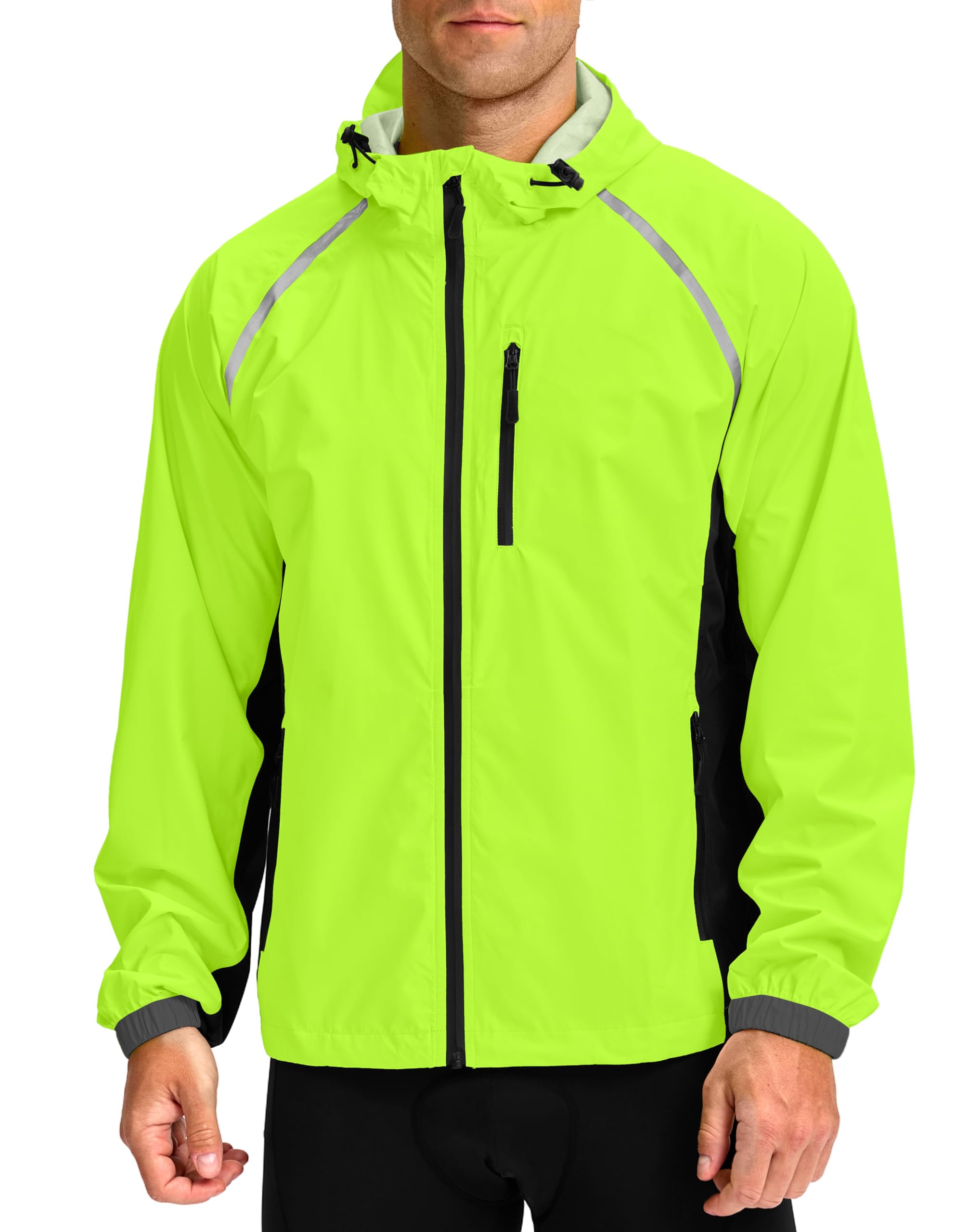
For most riders, the Bikewa is the one to buy. It covers the practical middle ground: a laminated TPU membrane (a thin waterproof film bonded inside the fabric) rated to hold a 5000mm column of water, so you stay dry in steady rain rather than just a passing shower. Breathability sits at 3000g/m2/24hr, a figure that tells you how much sweat vapor can escape through the fabric in a day — decent for a commuter shell, though vents do the heavy lifting on warm climbs.
That is where the under-arm zips and back vents earn their place. Open them on a climb and hot air dumps straight out; close them on a windy descent and the shell holds rank. The fluorescent yellow/black colourway is not just loud for its own sake — reflective elements on the front, back, and hood throw light back from every direction, so a car catches you at dusk. The back zipper pocket is the clever bit: it doubles as a storage pouch, so the ultralight fabric folds into itself when the sky clears.
Fit is regular and owners describe it as true to size, with enough room to fit over a helmet thanks to the adjustable drawcord hem and roomy hood. The catch is breathability: 3000g/m2/24hr is modest, so if you ride fast and hot in summer you will be reaching for those vents; it also runs no stretch, so size for layers rather than expecting give. Still, for year-round commuting and weekend rides this is the most balanced shell in the group.
What earns it the top spot
- 5000mm waterproof rating keeps you dry in real rain
- Under-arm zips plus back vents dump heat on climbs
- Front, back and hood reflective elements for dusk visibility
- Back pocket doubles as a self-storage pouch for easy packing
Where it asks a little of you
- 3000g/m2/24hr breathability is modest on hot, hard efforts
- No stretch fabric, so allow room when layering
Reach for this if: you want one shell that covers a rainy commute and a windy weekend ride without a fuss.
Look elsewhere if: you ride hard in summer heat and want maximum breathability over waterproofing.
2. Bikewa Men’s Winter Cycling Jacket Thermal Warm Windproof
Built for the morning you ride to work at forty degrees and the wind is already biting.
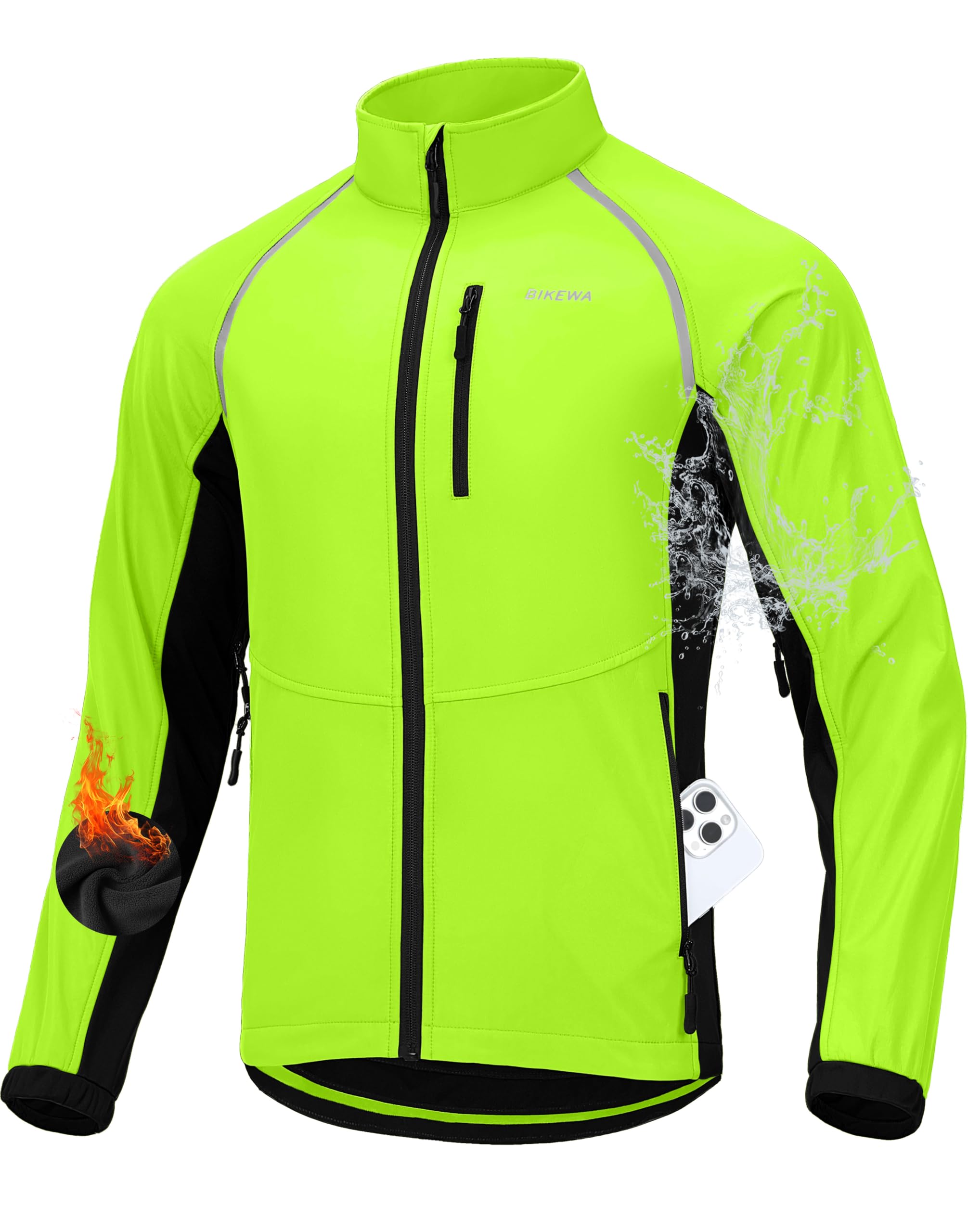
Where the Bikewa rain shell above is thin and packable, this one is a genuine thermal layer. It stacks three fabrics: a windproof outer, a breathable membrane film in the middle, and a soft fleece inner, so cold air stops at the surface while warmth stays close to your body. The mild-weather shell will not cut it below a certain temperature; this one is designed to.
The storage is unusually generous for a cycling jacket — two side zipper pockets, a chest zipper pocket, two inner pockets, and three rear pockets big enough for winter gloves or a water bottle. A high band collar seals the neck, and a silicone waist grip on the long bottom catches the jacket so it does not ride up. Reflective elements front and back keep you seen in low light.
The honest limit is weight and warmth: this is a medium-weight, cold-weather shell, so it is the wrong pick for a humid summer commute. It also runs no stretch, and fit sentiment is neutral, so measure rather than assume. If you ride through winter, it is the warm choice in the group.
Winter-ready detailing: the three-layer construction with a fleece inner is why this jacket keeps you warm without the bulk of a winter coat, and owners ride it in genuinely cold conditions.
Trade to weigh: it is medium weight and cold-weather focused, so it is a poor match for mild months and summer rides where the thin Bikewa shell wins.
The fair-weather verdict: buy it if your riding calendar runs through the cold and you want warmth plus eight pockets of storage.
The honest caveat: it is heavy for summer — keep a lighter shell for the warmer months.
3. INBIKE Cycling Jacket Fleece Lined Cold Weather Windbreaker
The fleece-lined shell for riders who head out in crisp air and want warmth without bulk.
This is a composite build: a wind-resistant shell outside, a polar fleece inner layer for thermal warmth, and it is stretchy enough to move with your body over the bars. Ride in crisp temperatures and the fleece keeps you warm while the shell keeps the penetrating wind off. The fabric is treated to resist water, so light rain and snow roll off without soaking through.
A smooth YKK zipper at the front helps block cold air, and the stand-up collar shields your neck from the chill. Reflective logos and stripes on the front and back throw light back in low light, and the bright green side panel boosts visibility further. Elastic cuffs keep the cold out at the wrists, and an elastic band at the bottom holds the jacket against your hips so it does not slip.
Two zippered hand pockets keep your essentials secure, and sizing runs S to 3XL with the maker recommending hand or machine wash below 40 degrees Celsius, not dry clean. The one thing to read carefully is the size chart — as with any fleece-lined shell, a close fit is what traps the warmth best.
Why cold riders like it
- Polar fleece inner layer adds real thermal warmth
- Water-resistant shell sheds light rain and snow
- Reflective logos and stripes on front and back for low light
- Sizes S to 3XL with a smooth YKK front zip
Before you add to cart
- Hand or machine wash only below 40 degrees Celsius, no dry clean
- Fleece lining makes it a cold-weather piece, not a summer shell
Best for: a rider who wants warmth from the fleece without giving up wind protection on crisp mornings.
Skip if: your rides run warm and humid — you want a thinner, vented shell instead.
4. 33,000ft Women’s Cycling Running Jacket

The women’s shell that bets on rain: a 10000mm waterproof rating beats every other pick here.
On paper this is the toughest weather protection in the group. The 10000mmH2O waterproofness (the height of water column the fabric holds before it leaks) is double the Bikewa rain shell’s 5000mm, and the breathability matches at 10000g/m²/24hr. In a steady downpour, those numbers mean the difference between damp and dry over a long ride.
Detachable sleeves convert the shell to a vest as the day warms, five pockets hold ride essentials, and reflective strips front and back keep you visible. A stand collar with thumb holes and an elastic hem round out the details, and the self-packing design folds the jacket into its own pocket for the trip home. Sizing lands true to fit for most women.
The obvious caveat is colour accuracy — some buyers find the shade differs from the listing photo, so order with that in mind.
Rain that stays out: the 10000mmH2O waterproof rating is the headliner — twice the 5000mm of the Bikewa rain jacket above, which makes this the pick for wet commutes and long days out.
Fit note to plan for: sizing runs true but colour can differ from the product photo, so match it to your kit before you commit.
For: women riders who log miles in wet or changeable weather and want the strongest rain protection on the list.
A fair caution: if exact colour matching to your kit matters, verify the shade before ordering.
5. baleaf Men’s Running Jacket

A cold-weather shell rated for twenty to fifty degrees with a grippy hem that stays put.
Baleaf puts the temperature range right on the spec: recommended for 20-50℉ rides. The DWR finish (a durable water-repellent coating that beads water on the surface) repels drizzle and road spray, and stretchy hybrid panels help the jacket move with you. A high stand collar keeps wind and chills off the neck, and elastic cuffs seal the wrists.
The detail that matters on the bike is the silicone gripper at the hem, which holds the jacket in place while you ride instead of letting it ride up. Warmth is the standout — riders report it keeps you warm in cold weather and blocks wind effectively, which is exactly what the 20-50℉ rating sets you up for.
Two things to know. The fit runs large by the maker’s own advice, so size down from your usual.
Cold blocks, warm holds: the 20-50℉ rating and wind-blocking shell are the reason this feels at home on frosty commutes, and the silicone hem keeps everything locked down.
The honest wrinkle: breathability is divisive — fine for steady winter miles, but you may overheat on hard, hot efforts.
The winter-commuter pick: right for you if your rides fall in the 20-50℉ range and you want warmth that holds.
Think twice if: you run hot — the breathability here will not keep pace with a fast summer effort.
6. Little Donkey Andy Men’s Removable Cycling Jacket
Sleeves off, hood off — one jacket that shifts shape as the weather changes mid-ride.
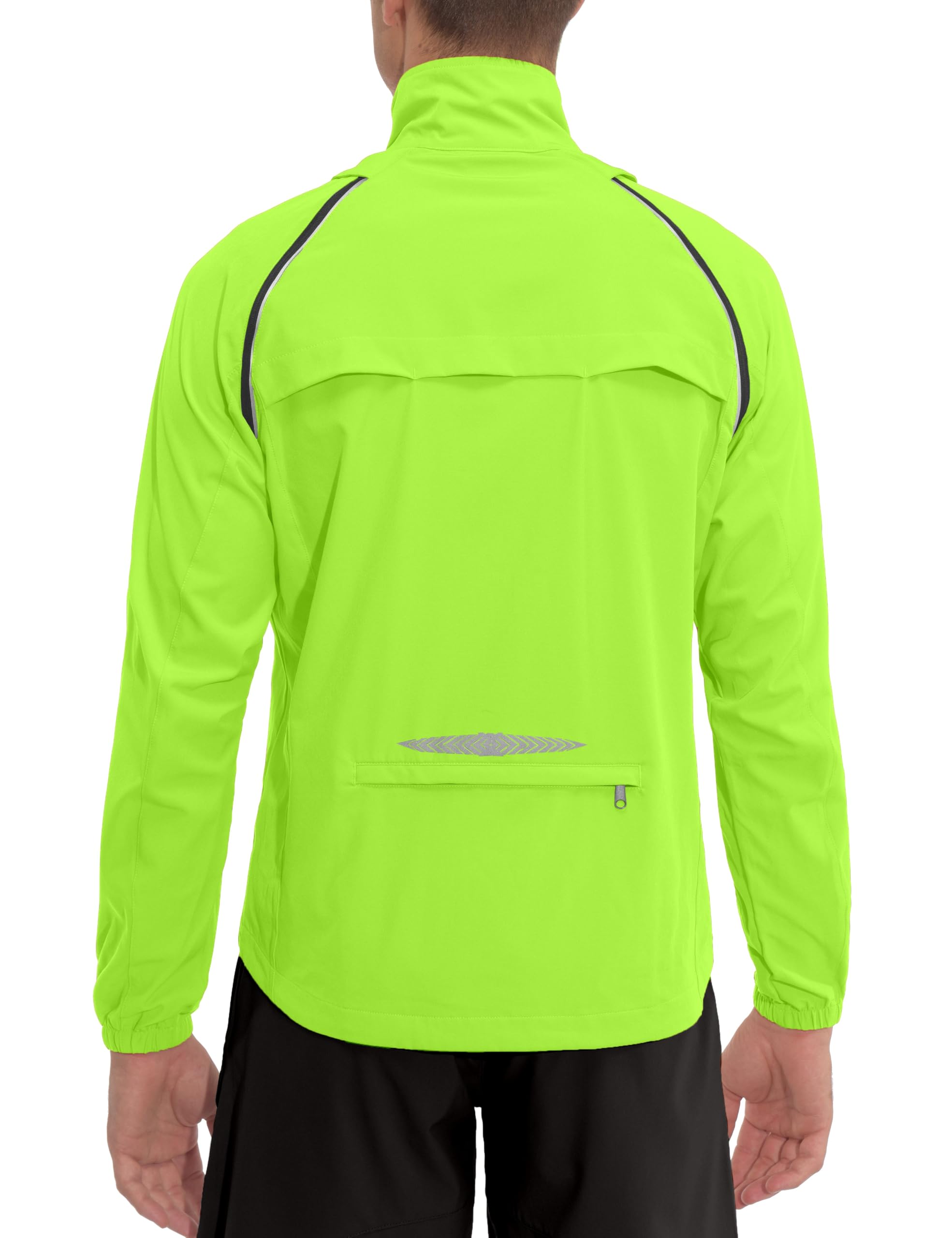
Flexibility is the angle here. Removable sleeves and a removable hood let you turn a full jacket into a vest when the sun comes out, so you cover more conditions with one piece. The fabric is 4-way stretch, which gives you mobility over the bars, and a breathable mesh panel plus a concealed opening on the upper back help hot air escape.
You get 3000mm waterproofness and 3000mm breathability in a technical build meant for all-season cycling or running. Reflective printing front and back keeps you visible in low light, and two slant zippered pockets hold your phone and keys securely.
Sizing runs large according to buyers, so plan to size down; the zipper quality is also a mixed point, so treat it with care when pulling it on. For the rider who wants one jacket that adapts rather than two, it is a smart value.
Changeable weather, one shell: removable sleeves and hood plus 4-way stretch let you adapt on the fly instead of carrying a second jacket.
Ordering note: it runs large and the zipper is a mixed point, so size down and pull gently.
Good match if: you ride in shifting conditions and want one jacket that turns into a vest.
Downsize before you commit: this one runs large, so your normal size will likely be roomy.
7. GOREWEAR Spinshift Men’s Cycling Windbreaker Jacket
At just 4.3 oz it vanishes into a jersey pocket, then blocks the chill on a breezy descent.
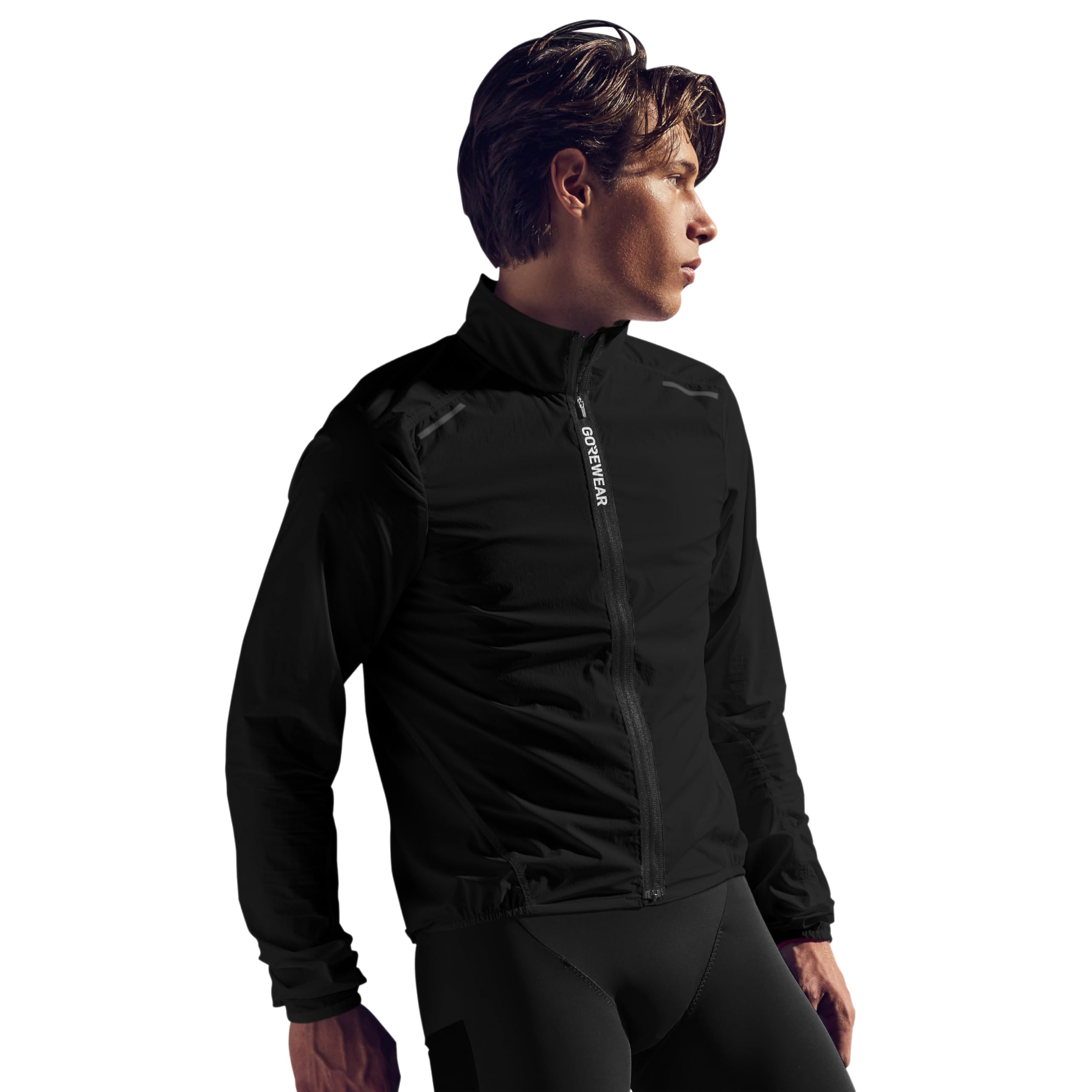
The number that defines this jacket is weight: 4.3 oz, light enough to forget you packed it. A rear pocket doubles as a stow pocket, so the whole jacket folds down to jersey-pocket size when conditions improve. That makes it the layer you carry for cool mornings, mid-50s to low-60s rides, and long descents where the wind bites.
Gore’s approach is a double-woven main fabric with low air permeability — it stops windchill without cooking you on a climb. A 3D anti-cling interior keeps the shell off bare skin, and pre-shaped elbows, ergonomic shoulders, and elastic cuffs give an aerodynamic no-flap fit in the forward-leaning position. A silicone hem grip holds it in place, reflective details at the cuffs, shoulders, and back keep you visible, and a DWR finish sheds drizzle and road spray.
The trade-off is storage and simplicity: there is no side pocket and no two-way zipper, so it is built as a minimal wind layer rather than a cargo shell. It is also the most premium pick here by build quality, which suits a rider who values low weight over pocket count.
The ultralight argument
- 4.3 oz packs into a jersey pocket
- Low air permeability blocks windchill without overheating
- DWR finish sheds drizzle and road spray
- Pre-shaped elbows and silicone hem for a no-flap fit
What you trade away
- No side pockets for extra storage
- No two-way zipper option
Made for: the weight-conscious rider who wants a wind shell that packs away and disappears on a climb.
Not your pick if: you want multiple pockets and a two-way zip for extra storage.
8. Dooy Men’s Cycling Jacket

A zip-off sleeve jacket that becomes a vest, built for riders who want options on a budget.
The convertibility is the selling point: detachable sleeves let you swap between jacket and vest as the weather or your effort changes. The 100% polyester build is lightweight and easily packable, and ventilation holes with mesh fabric keep cool air moving when you are working hard. An adjustable hood and hem help hold off the wind, and reflective elements front and back boost night-riding safety.
Zippered side and back pockets store keys, cards, and small items, and the yellow-and-grey combo keeps you visible in low light. It handles windproof, quick-drying, water-resistant, and breathable duties in one light shell. The one thing to plan for is sizing: this runs small by the maker’s own advice, so choose a size up from your normal to get the right fit.
The zipper is a mixed point across reviews, so pull it gently and it should serve you well. For a low-cost jacket that switches between shell and vest, it earns its place in the kit bag.
Two jackets in one: detachable sleeves let you ride as a jacket or a vest, which stretches a single purchase across more conditions.
Size up: the maker says this runs small, so ordering your normal size will likely feel tight.
Worth a look if: you want a packable jacket that doubles as a vest without spending much.
Add a size if: you order your usual fit — this one runs small.
Know the Specs
Waterproof Rating in Millimeters
This figure, written as a number like 5000mm or 10000mm, describes the height of a water column the fabric can hold before moisture pushes through. A higher number means more rain protection — 10000mm handles a steady downpour better than 5000mm — but it often comes with less breathability or more weight.
Breathability in Grams per Square Meter
Written as g/m2/24hr, this measures how much sweat vapor can pass through the fabric in a day. A higher number means you stay drier on hard efforts, and vents like under-arm zips add to that airflow. Match it to your ride: commuters can live with a lower figure, while fast riders want more.
DWR Finish Explained
DWR stands for durable water-repellent, a coating on the outer fabric that makes water bead and roll off. It handles drizzle and road spray rather than a full downpour and is what most wind shells rely on for light weather. Reapply it when water stops beading.
Packability and Weight
A packable shell folds small enough to stow in a pocket, and some even pack into their own back pocket. Weight matters on long rides, so lighter is easier to carry, but very light shells tend to trade away pockets and warmth.
Common Questions
Will a cycling windbreaker keep me dry in real rain?
What does the mm number on a waterproof jacket mean?
How do I decide between a jacket and a vest for cycling?
My jacket feels clammy on a climb — is that normal?
Will these jackets fit over a bike helmet?
Do I need a windbreaker if I already own a rain jacket?
Can I wash a DWR-coated cycling jacket in a machine?
What temperature range can a winter cycling jacket handle?
Why do so many cycling jackets run small or large?
Are reflective elements on the front and back worth having?
The Bottom Line
For most riders, the best cycling windbreaker is the Bikewa Rain Jacket: a 5000mm waterproof rating, under-arm zips, back vents, and reflective elements on the front, back, and hood make it the most balanced shell for year-round riding. If winter miles are your reality, reach for the Bikewa Winter Thermal with its three-layer fleece-lined build and eight pockets. And if you want a layer that disappears into a jersey pocket, the GOREWEAR Spinshift at 4.3 oz is the ultralight choice — one honest nudge to grab it while it fits your kit bag.
How we choose
We do not accept paid placement. Every pick is matched to a real buyer and a real use-case; we do not hands-on test units.
Sources
Specifications: manufacturer listings and product documentation. Review insights: verified customer reviews, as of November 2026. Pricing: not shown on this page (it changes often); check the current price via the retailer link.
As an Amazon Associate, Tactical Gear Guy earns from qualifying purchases. This does not affect which products we feature.