Specs are compiled from manufacturer listings and verified buyer reviews and can change over time — please confirm the key details on the product page before buying.
Buying cross-country ski boots goes wrong for one reason: binding mismatch. A boot that fits your foot perfectly is useless if its sole does not click into the binding already screwed to your skis. The three families you will meet here are 75mm (the old three-pin standard), NNN (a narrow bar-and-groove system), and NNN-BC (a wider version built for off-trail touring). Match the sole to your binding and warmth, walkability, and fit become the only variables left to sort out. Get it wrong and the boot will not click into your binding at all.
This guide is built by comparing the manufacturers’ published specifications and the patterns across verified customer reviews, so you get each pick’s real strengths and trade-offs instead of marketing spin.
Below you will find ten boots sorted by what they actually do on snow, from budget touring models to full-leather backcountry builds. Every pick below is a genuine Nordic boot, and this breakdown of the cross-country ski boots worth your money starts with the one most trail skiers should buy.
Top Picks
How To Choose The Best Cross-Country Ski Boots
Start with the binding on your skis, not with the boot. Checking your binding system first eliminates every incompatible boot in one pass. Everything else — insulation, cuff height, sole stiffness — is a comfort and control question you can fine-tune afterward.
Match the sole to your binding system
A 75mm boot (also called a three-pin) has a flat sole with two holes the binding pins drop into. NNN uses a metal bar under the toe that slides into a rail. NNN-BC is that same rail idea but wider, which gives you more sideways leverage for off-trail turns. These are not interchangeable, and forcing a boot into the wrong binding is how people damage both.
Treat sizing as a guess, not a guarantee
Ski boot lasts vary by brand and by model, and several Nordic boots here are explicitly flagged as running small. Order with a return window in mind and expect to size up rather than down. A snug heel with a little toe room is what you want — a boot that pinches the toe box will turn every kilometer into a chore.
Decide how warm you need to be
Insulation is measured in grams here, and 100 grams of Thinsulate lining is the figure shared by several touring models. That amount suits cold-weather touring at an easy pace. If you plan to ski hard and build up heat, a lighter fleece-lined boot breathes better and stops your feet from stewing.
Side-by-Side Comparison
| Model | Best For | Binding System | Insulation | Listed Size | Amazon |
|---|---|---|---|---|---|
| Whitewoods 301★ Best Overall | All-round trail touring | 75mm / 3-Pin | 100 g Thinsulate | 40 | Amazon |
| Fischer Women’s XC ProWomen’s Pick | Women’s fitness skiing | Turnamic touring sole | Fleece lining | 41 | Amazon |
| Whitewoods 302Narrow Fit | Budget NNN touring | NNN | 100 g Thinsulate | 43 | Amazon |
| Rossignol XC-2 | Men’s trail cruising | Sport Sole | — | 43 | Amazon |
| Rossignol XC-5 | Cold-day trail skiing | Sport Sole | Leather lining | 45 | Amazon |
| Alpina Snowfield | Light backcountry | NNN-BC | Thinsulate | Euro 40 | Amazon |
| Fischer Men’s XC Pro | Beginner-friendly fitness | Sport Fit sole | Lace cover | 44 | Amazon |
| Alpina Alaska | Serious backcountry touring | NNN-BC | Thinsulate | — | Amazon |
Detailed Reviews
1. Whitewoods Unisex Adult 301 75mm XC Touring Boots
Our pick — 4.0+★ from 350+ verified ratings; the strongest balance of quality and price.
The old-standard three-pin boot that still wins on price and warmth
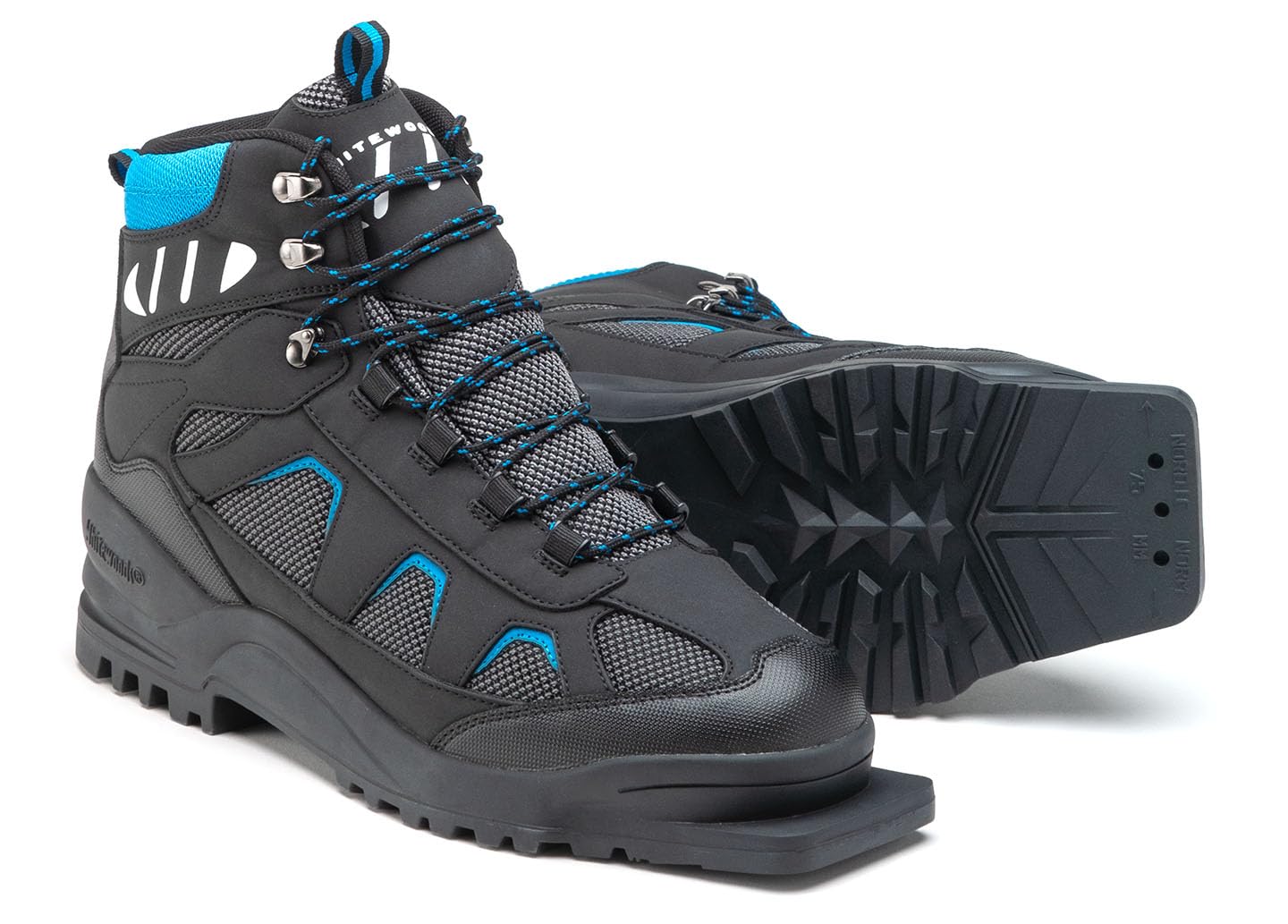
The 301 is the boot to buy if your skis already carry 75mm bindings — the classic three-pin setup where two metal pins drop into holes in the sole. That compatibility is why it tops this list: it works with any standard 75mm system, no adapter, no guesswork. You get 100 grams of Thinsulate lining, a quick-dry liner, and a metal lace guide set that spreads lace pressure evenly instead of digging a groove across the top of your foot.
The upper is built to shed water and wind while still letting moisture escape, which matters because a sweaty foot turns cold fast on a long tour. A removable insole lets you swap in your own arch support, and a toe protector takes the scrapes that trail debris throws at you. What wins people over most is build quality — it is the thing this boot is known for, and the fit follows close behind.
Here is the honest catch, and it comes in two parts. Sizing splits opinion: plenty of skiers find it true to size, while others find it runs small, so check the brand’s sizing chart in the product images before you commit. The 75mm interface is also the older standard — the pins sit in the sole rather than locking into a rail, and a few skiers report the pins pulling free of the rubber. Treat the binding fit as something to verify, not assume. At 4.0+ stars from a large body of owners, this is still the crowd favorite for a reason.
What earns it the top spot
- Works with any standard 75mm three-pin binding — no adapter needed
- 100 grams of Thinsulate lining plus a quick-dry liner for cold days
- Water-proof, wind-proof upper that still breathes
- Removable insole and metal lace guides for a dialed-in fit
Where it asks for care
- Sizing feedback is split — use the brand’s chart in the images
- Some skiers find the pins work loose from the 75mm sole
Reach for this if: your skis run 75mm bindings and you want a warm, proven touring boot without overspending.
Check first: the sizing chart in the images — this is not a boot to order blind in your street size.
2. Fischer Women’s XC Pro Nordic Fitness Boots
Built on a women’s last, so the heel actually stays put
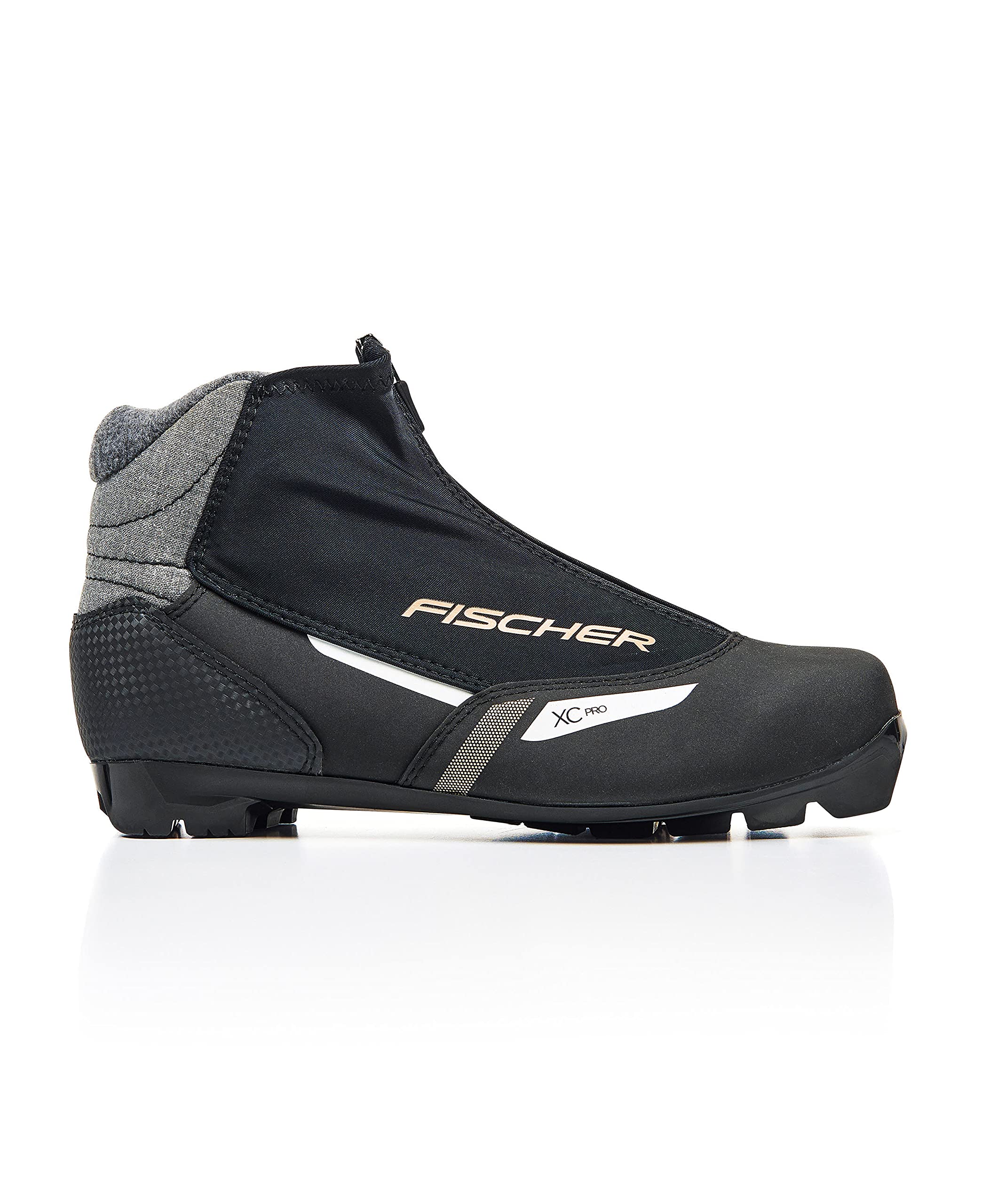
Most women’s Nordic boots are a men’s shell with a different label. This one is not. Fischer builds it on its Ladies Boot Fit Concept with special lasts, which means reduced volume and a shape drawn around women’s foot geometry rather than scaled down from a men’s block. If you have ever felt your heel lift on every kick, that design choice is the fix.
The sole is a Turnamic touring model with flex grooves and a soft flex that supports a smooth kick, plus a non-slip, self-cleaning profile for the walk from the car to the track. Extra-soft fleece lining adds insulation, and lace covers block snow and slush from working in through the lacing. Fischer Fresh treatment keeps the inside smelling reasonable between outings, which sounds minor until you leave a pair in a warm car.
Inside sits an internal molded heel cap — a light, anatomically shaped cup you can thermoform to your own heel. Few Nordic boots at this price include a thermoformable heel cup. The trade-off is simply that fleece-lined boots run warm, so this is a cool-to-cold-weather pick rather than something for hard spring skiing. It is a lighter-duty option in this lineup, with a smaller owner base than the top pick, but the quality and warmth signals are both strong.
Fit-first design: The women’s-specific last and thermoformable heel cap give you a locked-in heel — a bigger deal on the kick-and-glide than any spec sheet suggests.
Warmth trade: Fleece lining and lace covers suit cold trail days; on a mild spring tour they can feel like too much.
Buy it for: women who want a proper women’s last under a fitness-oriented Nordic boot.
Look elsewhere if: you ski in mild conditions and want maximum breathability over insulation.
3. Rossignol XC-1 Cross Country Touring Boots for Women
The NNN touring boot that asks you to size up before you even lace it
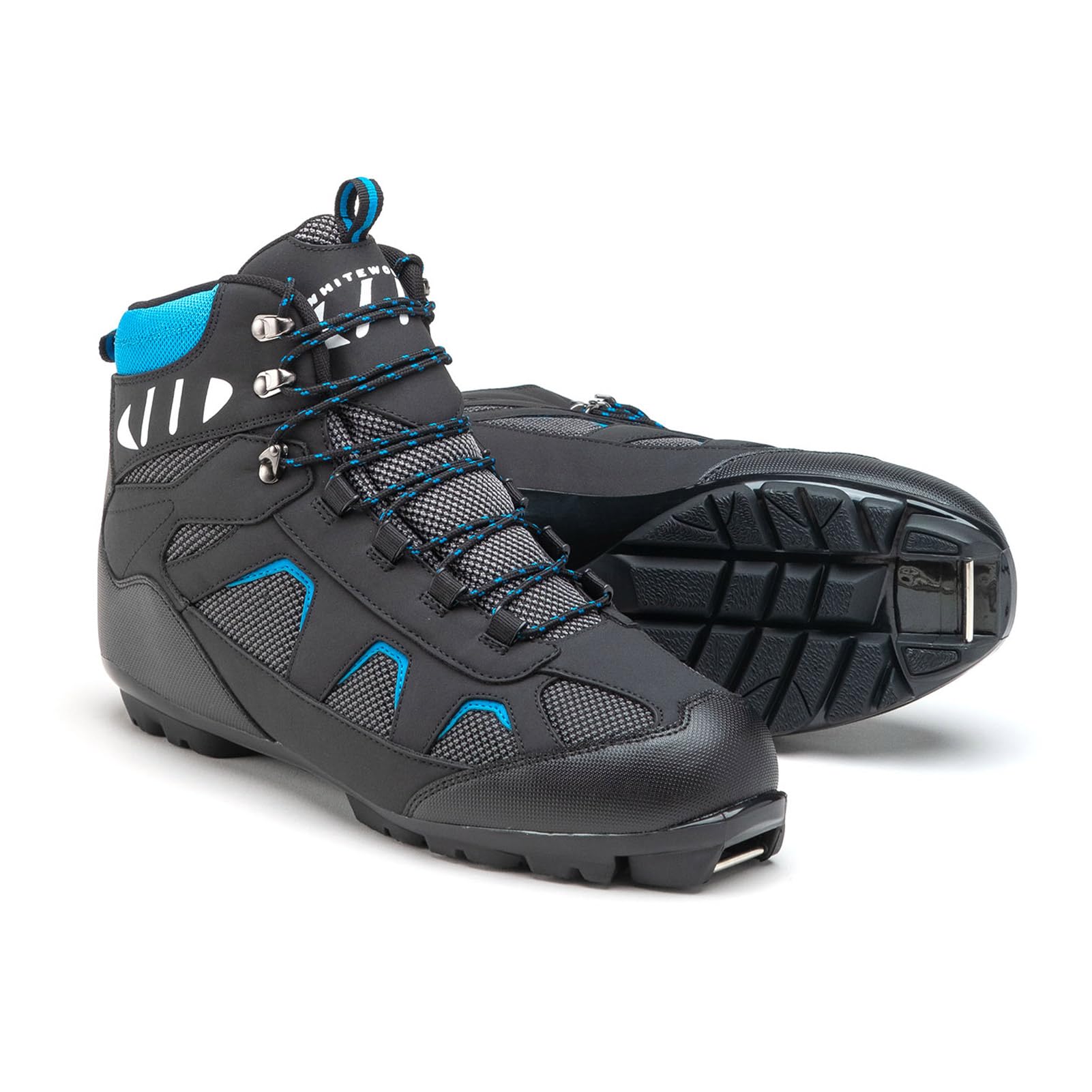
If your skis wear standard NNN bindings, the 302 slots straight in — no adapter, no harness. Whitewoods builds in a composite mid sole with a steel shank for support and ski control, layered with 100 grams of Thinsulate and a quick-dry liner for warmth. A Dintex membrane acts as the waterproof barrier against snow and wind, and metal lace guides plus a removable padded footbed let you tune the fit.
The extras are sensible for touring: a gaiter D-ring to clip on a snow cuff, a reinforced heel counter, and a reinforced toe box that takes the abuse of kicking through crust. Package weight lands at 1.38 kg, a touch heftier than the Rossignol women’s boot at 1.16 kg — a fair trade for the extra insulation and reinforcement on a cold-weather touring boot.
The main thing to know is the sizing. Whitewoods states plainly that these may run small and suggests going up a size, and that warning earns real weight — fit is the loudest conversation around this boot, and not everyone lands on a comfortable result. Some skiers report heel slip and blisters if they guess the size wrong, and the boot can feel oversized if they overcorrect. Get the size right and it is a warm, functional touring boot at a modest price.
What you get for the money: A genuine NNN touring boot with a Dintex waterproof membrane, 100 grams of Thinsulate, a steel shank, and a reinforced toe box.
The sizing gamble: Whitewoods tells you to size up, and the fit feedback backs that it matters — order with a return plan in place.
Worth picking up if: you run NNN bindings and want insulated touring boots without stretching the budget.
Plan around: the sizing — go up if you are between sizes, and keep the return window open.
4. Rossignol XC-2 Cross Country Touring Boots for Men

Heat-moldable liners in a men’s touring boot — the fit is yours to shape
Thermoadjustable liners are the reason to look at the XC-2. You warm them, put them on, and the liner takes the shape of your foot — a real customization step that most boots in this price zone skip. Add lateral heel support for stability on all-around trail skiing and you have a men’s touring boot that prioritizes the two things that ruin a ski day: a shifting heel and an unpadded pressure point.
The Sport Sole carries Tech Grip for walking and central insert cleats for precision on the ski, same platform idea as the XC-1. The shell is polyvinyl chloride with a leather outer, and it ships as a compact package — 13.58 x 13.07 x 4.69 inches, roomier packing than the women’s XC-1 at 10.91 x 10.79 x 4.8 inches. Nothing meaningful hangs on that difference; both stow easily. What owners consistently rate is quality, with comfort right behind it.
The catch is that a heat-moldable liner only helps if you actually mold it, and some shops charge for the service. Do it once and the fit reward is genuine; skip it and you are wearing a stock liner that may still need breaking in. This is a comfortable, well-regarded men’s touring boot — just plan the molding step into your first week rather than your first tour.
Custom fit, standard price: Thermoadjustable liners and lateral heel support make this the most adaptable men’s boot in its tier.
Do the molding: The liner’s advantage only shows up if you heat-mold it — treat that as part of the purchase, not an optional extra.
Go for it when: you want a men’s touring boot you can shape to your own foot instead of hoping the stock fit works.
Factor in: the molding appointment — either do it yourself or budget for a shop to handle it.
5. Rossignol XC-5 Cross Country Touring Boots for Men

A taller cuff and a lace cover for skiers who ski through real winter
The XC-5 makes its case with two features you will not find on the cheaper Rossignol models: a tall cuff and a lace cover. Together they seal out snow, which is the whole game on a deep, cold trail day. The tall cuff and lace cover keep snow out on deep, cold trail days. The Sport Sole with Tech Grip and central insert cleats carries over, and the liner is leather.
Thermoadjustable liners are here too, so you can heat-mold the fit to your foot rather than settling for the stock shape. The boot closes with a pull-on design — no laces to fiddle with in cold weather. Owners rate the quality highly and consistently single out the fit, which tells you the construction holds up on the snow rather than just on paper.
What you give up is a lighter, lower-cut feel. The taller cuff adds protection but takes away some of the ankle freedom of a low touring boot, so if you like the loose, walkable feel of a low-cut shell, this is not that boot. It is the pick for the skier who would rather be warm and covered than airy and free. Ratings here rest on a modest owner base, but the quality signal is strong and specific.
Built for cold: Tall cuff and lace cover keep snow out, and the heat-moldable liner lets you set the fit once and forget it.
Ankle freedom cost: The extra coverage comes with a less flexible ankle — a fair trade for winter skiers, a compromise for mild-weather ones.
Reach for this if: you ski through snow and cold and want sealed-in warmth over a low-cut feel.
skip it if: you want maximum ankle mobility on mild days.
6. Alpina Sports Snowfield Backcountry Boots

The backcountry boot that does not assume you already know what you are doing
Alpina positions the Snowfield for light touring and beginning backcountry skiers, and the build matches that intent. Synthetic uppers give ample support without over-stiffening the walk, and an anatomic foot bed with a stiff midsole creates the ski control a newer backcountry skier needs. A Rottefella NNN-BC sole clicks into all NNN-BC system bindings, manual or automatic — a real convenience when you are swapping setups.
Thinsulate brand insulation keeps the cold out, and the leather lining handles moisture. It weighs 2.9 pounds, so it is not a featherweight, but that mass buys you support on uneven off-trail snow. The leather, rubber, and textile outer holds up to branches and crust without complaint, and the lace-up closure lets you tension the whole boot for a firmer descent feel.
The honest limit is stiffness and cost. If your skiing is all groomed track, this boot is more support than you need — the stiff midsole that helps off-trail will feel like too much on easy cruising. If light backcountry and variable snow are your plan, it is a sensible match with a solid, well-regarded build.
Forgiving entry point: Rottefella NNN-BC compatibility and a supportive stiff midsole make light backcountry touring approachable for newer skiers.
Overkill on the track: That same support is extra weight and stiffness if your skiing stays on groomed snow.
Buy this if: you are moving into light backcountry and want an NNN-BC boot built to teach you the ropes.
Hold off if: you only ski groomed tracks and would prefer a lighter, flexier boot.
7. Fischer Men’s XC Pro Nordic Fitness Boots

Fischer’s men’s fitness boot, tuned for beginners who want to ski more than they want to fiddle
The men’s counterpart to the women’s XC Pro, and it carries the same Fischer fit along with an internal molded heel cap you can thermoform to your own heel. The Sport Fit Concept is designed to serve comfort, customization, and power transfer at once, which is the reason Fischer markets it to skiers across ability levels. Lace covers block snow and wet, and Fischer Fresh odor management keeps the inside from turning into a locker room over a season.
Fischer lists the skill level as beginner and the sport type as recreational, so take that as the design brief: a comfortable fitness boot for someone getting their kilometers in rather than chasing a race result. The package weight is 1.27 kg, lighter than the Whitewoods 306 at 1.24 kg only by a hair — the same ballpark, both easy to carry from car to trailhead. The balanced sole is meant to support a smooth stride rather than an aggressive kick.
The trade-off is that a recreational-focused boot will not give you the precision a driven skier wants. If you are already pushing hard on the track, this boot will feel soft and forgiving rather than responsive. For a newer skier who wants comfortable, odor-controlled, snow-sealed boots, that softness is exactly the point.
Beginner-friendly by design: Fischer codes this boot to beginner and recreational skiers, so the heel cap and lace covers are built for comfort over all-out stiffness.
Not a racer: The forgiving flex that helps a newer skier will feel soft to someone chasing speed.
Matches you if: you are new to Nordic skiing and want a comfortable fitness boot you can mold to your heel.
Look past it if: you want a firm, responsive boot for hard trail skiing.
8. Alpina Alaska Backcountry Ski Boots
Full grain leather, an Alpitex membrane, and the most support in this lineup
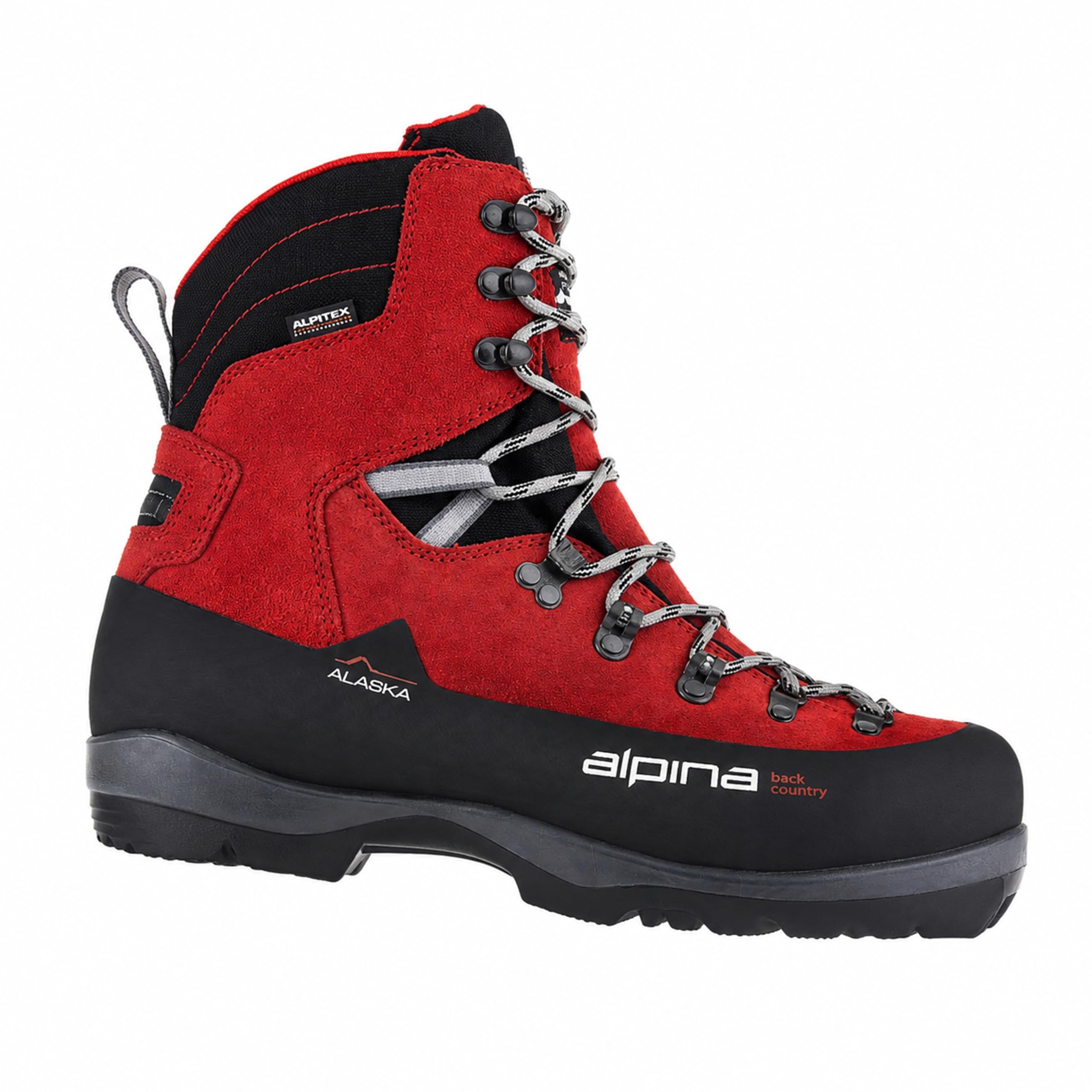
The Alaska is the boot you buy when the backcountry is the destination, not the detour. Full grain leather uppers give durability and support that synthetic shells cannot match, and the leather takes on a patina with each season rather than breaking down. A Rottefella NNN-BC sole works in all NNN-BC system bindings, manual or automatic, and an Alpitex waterproof breathable membrane plus Thinsulate insulation handles wet snow and cold.
At 3.8 pounds it is the heaviest boot here — noticeably more mass than the 2.9-pound Alpina Snowfield. That weight is doing work: it stiffens the shell for real off-trail control and keeps the leather structure from collapsing on long tours. The ankle-high cut and lace-up closure give you a firm, supportive feel that skilled backcountry skiers tend to prefer over a soft touring boot.
What wins people over is quality and comfort, with fit and ankle support close behind. But be prepared for break-in: full grain leather boots need time before they feel like they are yours, and the price tier is the steepest here. Some skiers also find the sizing needs attention, so confirm it before you commit. Once broken in, the full grain leather holds up for many seasons of backcountry touring.
The case for the Alaska
- Full grain leather uppers for durability and real support
- Alpitex waterproof breathable membrane plus Thinsulate insulation
- Rottefella NNN-BC sole fits all NNN-BC bindings, manual or automatic
- Ankle-high cut and firm lace-up for confident off-trail control
The trade you make
- Heaviest boot here at 3.8 pounds
- Leather needs a break-in period before it feels right
- Sizing needs confirming before you order
Best for you if: serious backcountry touring is the plan and you want a leather boot built to last.
Think twice if: you want a light, immediately comfortable boot for groomed tracks.
Know the Specs
Binding Systems: 75mm, NNN, and NNN-BC
A 75mm (three-pin) sole relies on two metal pins dropped into holes in the sole — an older, mechanical interface that works with any standard 75mm binding. NNN uses a bar-and-groove rail that clicks the boot onto a rail under the toe for a cleaner connection. NNN-BC is a wider version of that rail idea, giving more sideways leverage for off-trail turns. These systems do not cross over, so the binding on your skis decides which boots you can even consider.
Insulation and Liners
Insulation is stated in grams — 100 grams of Thinsulate lining shows up across several touring models here, and it suits cold-weather touring at moderate effort. Fleece linings add softness and warmth, while leather linings manage moisture and stiffen over time. Heat-moldable (thermoadjustable) liners are shaped by warming them and wearing them, so the boot takes your foot’s shape instead of the factory’s.
Common Questions
Will these boots fit the bindings already on my skis?
Why do so many cross-country ski boots run small?
What is the difference between NNN and NNN-BC bindings?
Are heat-moldable liners worth it?
How much insulation do I need for cold-weather touring?
Should beginners choose 75mm or an NNN system?
How long does a leather cross-country ski boot last?
Can I use backcountry boots on groomed trails?
Do I need a gaiter with cross-country ski boots?
How should I store my ski boots between seasons?
The Bottom Line
For most skiers, the cross-country ski boots winner is the Whitewoods 301 because it fits any standard 75mm binding, keeps your feet warm with 100 grams of Thinsulate, and holds a strong 4.0+ star score from a large body of owners. If you ski groomed tracks and want a moldable men’s fit, grab the Rossignol XC-2. And for serious off-trail days, the Alpina Alaska is the leather boot built to last.
How we choose
We do not accept paid placement. Every pick is matched to a real buyer and a real use-case; we do not hands-on test units.
Sources
Specifications: manufacturer listings and product documentation. Review insights: verified customer reviews, as of November 2026. Pricing: not shown on this page (it changes often); check the current price via the retailer link.
As an Amazon Associate, Tactical Gear Guy earns from qualifying purchases. This does not affect which products we feature.