Specs are compiled from manufacturer listings and verified buyer reviews and can change over time — please confirm the key details on the product page before buying.
Your counter backs up when a soft serve machine is slow to refreeze between customers, not when its wattage or brand looks wrong. A machine that freezes the first batch fast but crawls on refills will have a queue at your counter by noon. Every pick below is a business-grade freezer, not a kitchen toy. The standouts keep serving while the compressor (the pump that chills the mix) works.
This guide is built by comparing the manufacturers’ published specifications and the patterns across verified customer reviews, so you get each pick’s real strengths and trade-offs instead of marketing spin.
You will see the differences that actually matter on a service counter: hopper volume, refreeze time and flavor count. This breakdown of the commercial ice cream machine market focuses on how each unit behaves during a rush, not on the spec sheet alone.
Top Picks

How To Choose The Best Commercial Ice Cream Machine
The wrong way to shop this category is to start with the wattage on the box. Wattage tells you how hard the compressor can pull, but it says nothing about how many cones you can hand out in an hour. Start with your busiest hour instead: how many servings do you actually sell between 1pm and 3pm? That single answer rules out half the machines on this list before you read a single spec.
Match the hopper to your rush, not your freezer
The hopper is the tank that holds your unfrozen mix. A dual 5.5L setup holds far more than a single 4L hopper, which means fewer refill stops mid-service. If you run two flavors, you need two hoppers — a single-hopper machine forces you to empty and swap between vanilla and chocolate mid-service, and that downtime costs you sales.
Refreeze time is the number nobody advertises loudly
The first freeze is the figure on the spec sheet. The second and third batches are what your customers actually wait through. Machines that pull a fresh batch in around four to six minutes keep a line moving. Units that need half an hour for two quarts will stall a queue, and that inconsistency shows up in owner feedback far more often than compressor brand does.
Hard serve or soft serve changes everything downstream
Soft serve is pushed out of a handle and eaten immediately. Hard ice cream needs a freezing cylinder and a different draw, and it holds up for scooping and takeaway tubs. Pick hard serve or soft serve based on what your menu actually sells before you compare wattage, because the two machine types are not interchangeable.
Side-by-Side Comparison
| Model | Best For | Hourly Yield | Hopper Capacity | Freeze Style | Amazon |
|---|---|---|---|---|---|
| Commercial Ice Cream Maker, UL & ETL Listed★ Best Overall | High-traffic shops and events | 32-36 QT/H | Dual 5.5L | Soft serve, 3 flavors | Amazon |
| FOHERE 3-Flavor Countertop Soft ServeBest Value | Small counters and cafés | 20-28 L/H | 4L x 2 | Soft serve, 2+1 flavors | Amazon |
| PioneerWorks Commercial Ice Cream MachineMost Compact | Multi-flavor menus | 20-28 L/H | 7L x 2 | Soft serve, 3 flavors | Amazon |
| VEVOR 21 QT/H 3-Flavor Soft Serve | Drink bars and small stalls | 20L/5.3 gal per hour | 4L x 2 | Soft serve, 3 flavors | Amazon |
| VEVOR 10.6 QT/H Single Flavor | Single-flavor snack bars | 10L/10.6 QT per hour | 4L | Soft serve, 1 flavor | Amazon |
| EKway 28 QT/H Vertical Soft Serve | Floor-model setups with volume | 20-28 quarts per hour | 6L x 2 | Soft serve, 2+1 flavors | Amazon |
| GSEICE 3-Flavor Commercial Soft Serve | Dual-system flexibility | 26-32 L/H | 6L x 2 | Soft serve, 2+1 flavors | Amazon |
Detailed Reviews
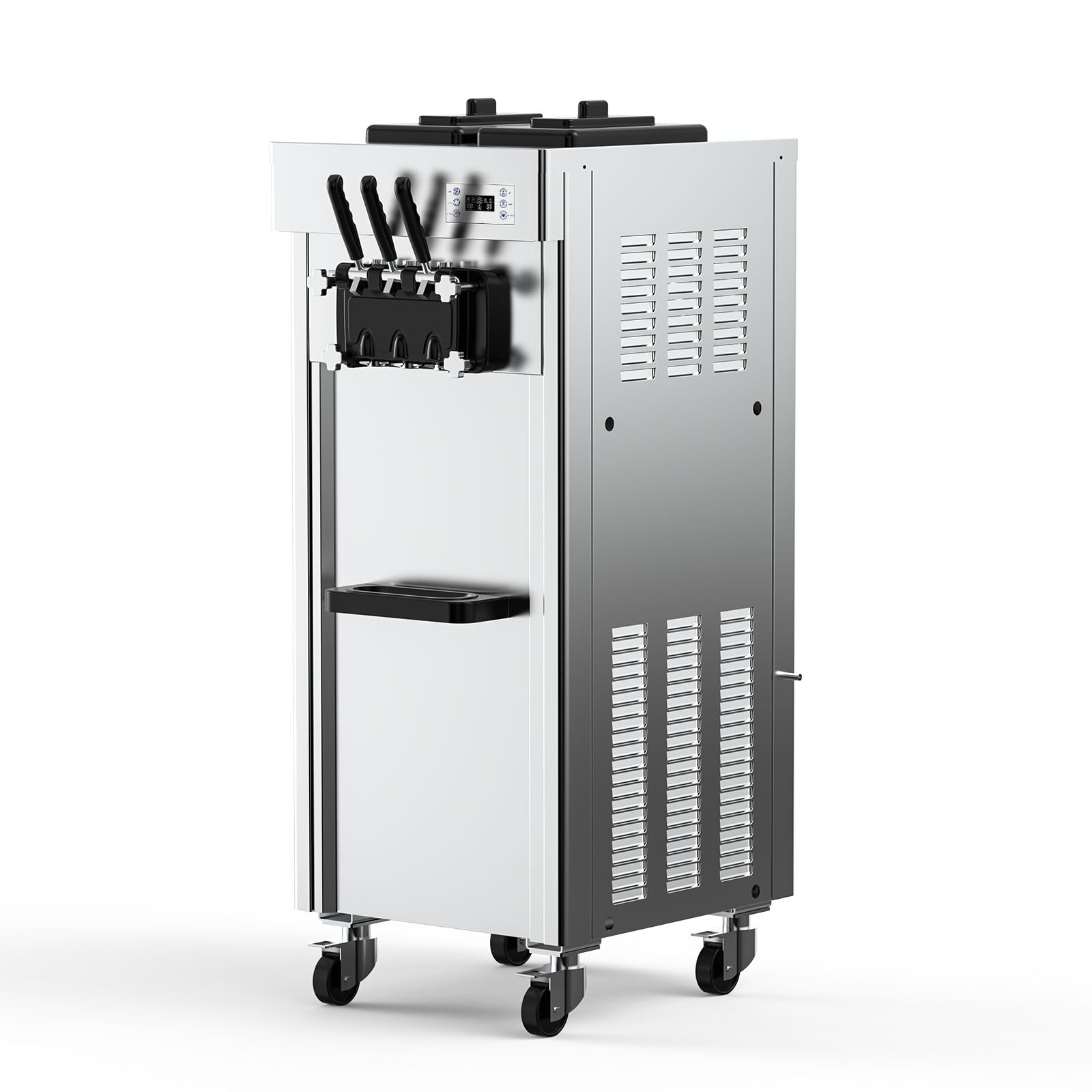
1. Commercial Ice Cream Maker 32-36 QT/H
Our pick — 4.0+★ from 20+ verified ratings; the strongest balance of quality and price.
Thirty-two quarts an hour, and it reloads a batch in four minutes flat.
The number that earns this machine the top spot is the refreeze window: under four minutes for every batch after the first. That is the difference between a line that moves and a line that stares at you. The first freeze lands in about ten minutes, which means you can open the doors and be serving before your coffee goes cold.
Output sits at 32-36 QT per hour in ambient conditions from 41 to 89.6°F — roughly 8 to 9 gallons when a summer afternoon pushes your kitchen hot. Dual 5.5L stainless hoppers feed 6-8 cups non-stop, and with three dispensers you can run vanilla on one side and chocolate on the other while the middle handle pulls a twist. That third handle matters: a single-flavor machine forces you to empty and swap hoppers between rush hours, and that downtime costs sales.
What closes the deal for a commercial kitchen is the paperwork. This unit is UL and ETL Listed (two independent safety-certification marks), so it meets commercial food equipment inspection requirements — exactly what a health inspector or landlord wants to see on the spec sheet. It runs on a 115V/60Hz motor (standard US wall power) with R290 refrigerant (a low-global-warming coolant). It weighs 245 pounds, so plan for two people and a dolly on delivery.
What earns it first place
- Batches reload in under four minutes after the first freeze, so service keeps moving.
- 32-36 QT (8-9 gal) hourly output covers peak hours in a shop or event setup.
- Dual 5.5L hoppers with three dispensers give you two flavors plus a twist.
- UL and ETL Listed with R290 refrigerant — compliant for commercial food service.
- One-touch wash and overnight mode take the sting out of closing time.
Where it asks a little more
- At 245 pounds it is a fixed installation, not something you shuffle around a stall.
- It is the heaviest unit here — 245 pounds against the 236.3 pounds of the FOHERE, so check your floor and doorway first.
- Premium-tier pricing means you want steady volume before it earns its place.
The confident call: Buy this if your counter sees real rush traffic and you need two flavors plus a twist without refill stalls.
One caveat: A 245-pound footprint is a permanent install — a food truck operator who sets up and tears down daily should look at a smaller frame.
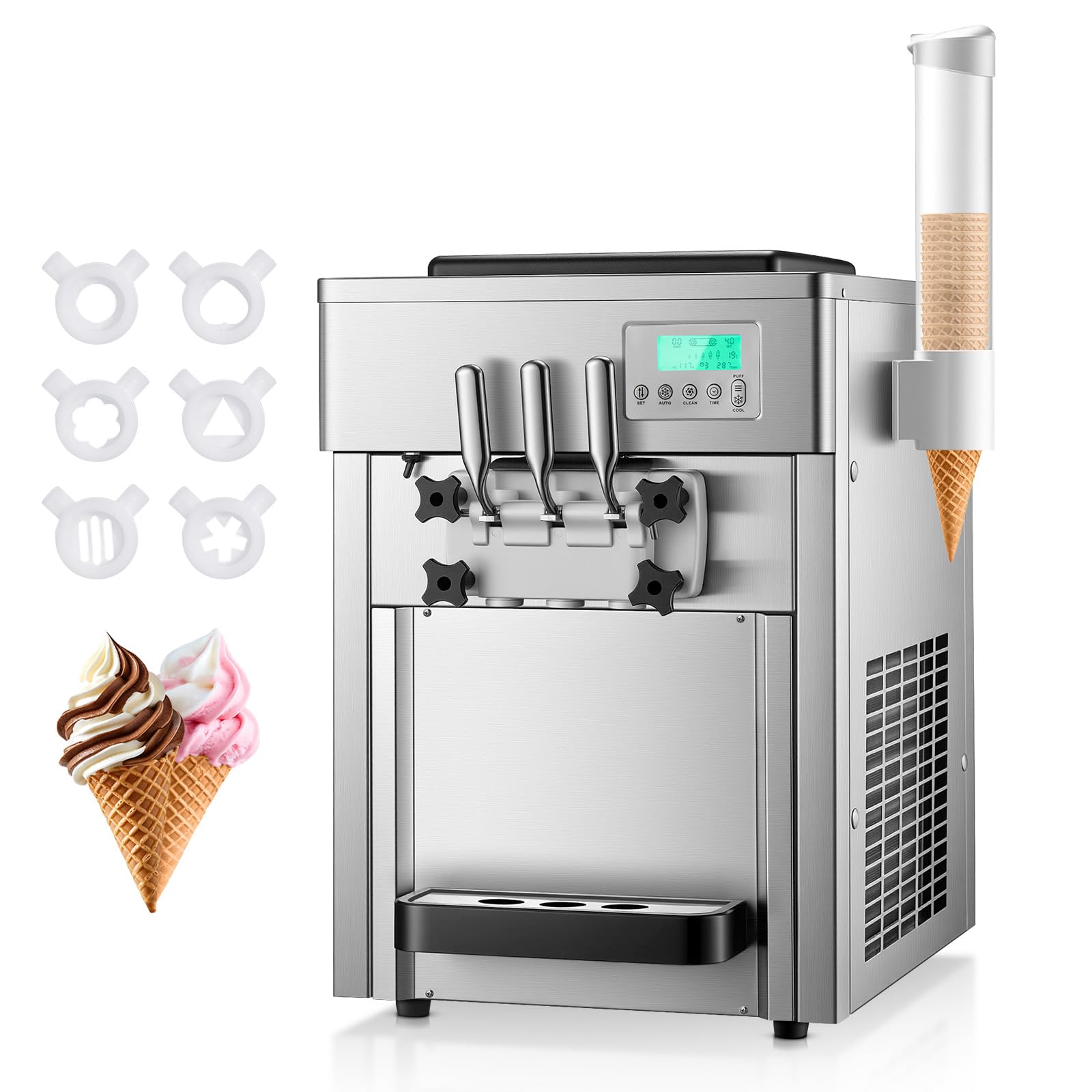
2. FOHERE Commercial Ice Cream Machine 5.3-7.4 Gal/H
Two flavors plus a twist, from a mid-range counter unit that freezes fast.
For a first commercial machine, aim for 20-28 liters an hour, three dispensers (spigots for different flavors) and a 25-minute first freeze that drops to six minutes or less for every batch after. That refreeze figure is the one to hold onto. In a café selling a couple of dozen cones an hour rather than hundreds, six minutes between batches never leaves anyone waiting.
The 4L x 2 stainless hoppers give you vanilla on one side, chocolate on the other, and the third handle mixes them — the standard two-single-one-mixed setup that covers most menus without a third tank. Pre-cooling keeps the mix chilled between services, which is what lets you load up the night before and open without dumping product. It also runs quietly and sits on an anti-slip base.
Two things to know before you buy. First, this is a large frame at 30.71 inches long and 236.3 pounds — it needs a dedicated counter run, not a fold-down table. Second, alcohol is off the table: the manufacturer is explicit that you must not add it to the mix. Build your spiked-shake menu somewhere else.
What the counter gets: A 25-minute first freeze, sub-six-minute reloads, and a 2+1 flavor setup that covers the standard menu.
The size tax: 236.3 pounds and 30.71 inches of length means you measure your counter before ordering.
Best fit: cafés and snack shops moving a steady but not crushing volume of soft serve.
Think twice if: your counter run is under three feet — this frame needs the space.
3. PioneerWorks Commercial Ice Cream Machine 20-28L/H
The biggest hoppers in the mid-range bracket, and the wattage to match.
Raw muscle is the story here. The 2200W motor sits well clear of the 1000W in the compact VEVOR single-flavor unit, and those twin 7L hoppers hold 14 liters of mix between them — more than double the 4-liter hopper on that same VEVOR. If your problem is constantly topping up tanks during a double shift, that is the spec that solves it. The machine also produces 20-28 liters an hour, so the hopper volume is matched to the output.
The control side is built for staff who do not want to think about it. The LCD display shows production time and remaining quantity, so anyone on shift can see when a tank is running dry. Adjustable hardness lets you dial the texture — a stiffer pour for cones, a softer one for cups — and the auto-clean function means closing takes minutes rather than a full breakdown.
The trade-off is the frame. This unit stands 59.45 inches tall, which makes it a floor-standing machine rather than a countertop one. You need height clearance and a spot where the top of the panel is reachable. Get that right and it delivers a serious flavor range without a premium-tier outlay.
Why the tanks win
- Twin 7L hoppers hold 14 liters of mix — the largest fill volume in its bracket.
- 2200W motor drives 20-28 L/H output without straining.
- Adjustable hardness lets you set cone-stiff or cup-soft texture.
- Auto-clean keeps daily shutdown short and hygienic.
What to plan around
- At 59.45 inches tall it is a floor-standing install, not a countertop drop-in.
- 247.6 pounds of machine needs a level floor and a planned delivery route.
- LCD and hardness controls are useful, but they add a learning step for staff.
Lock it in if: you want maximum mix capacity per tank and can give it floor space with headroom.
Keep looking if: your only option is a standard countertop run — this one is 59.45 inches tall.
4. VEVOR Commercial Ice Cream Machine 21 QT/H
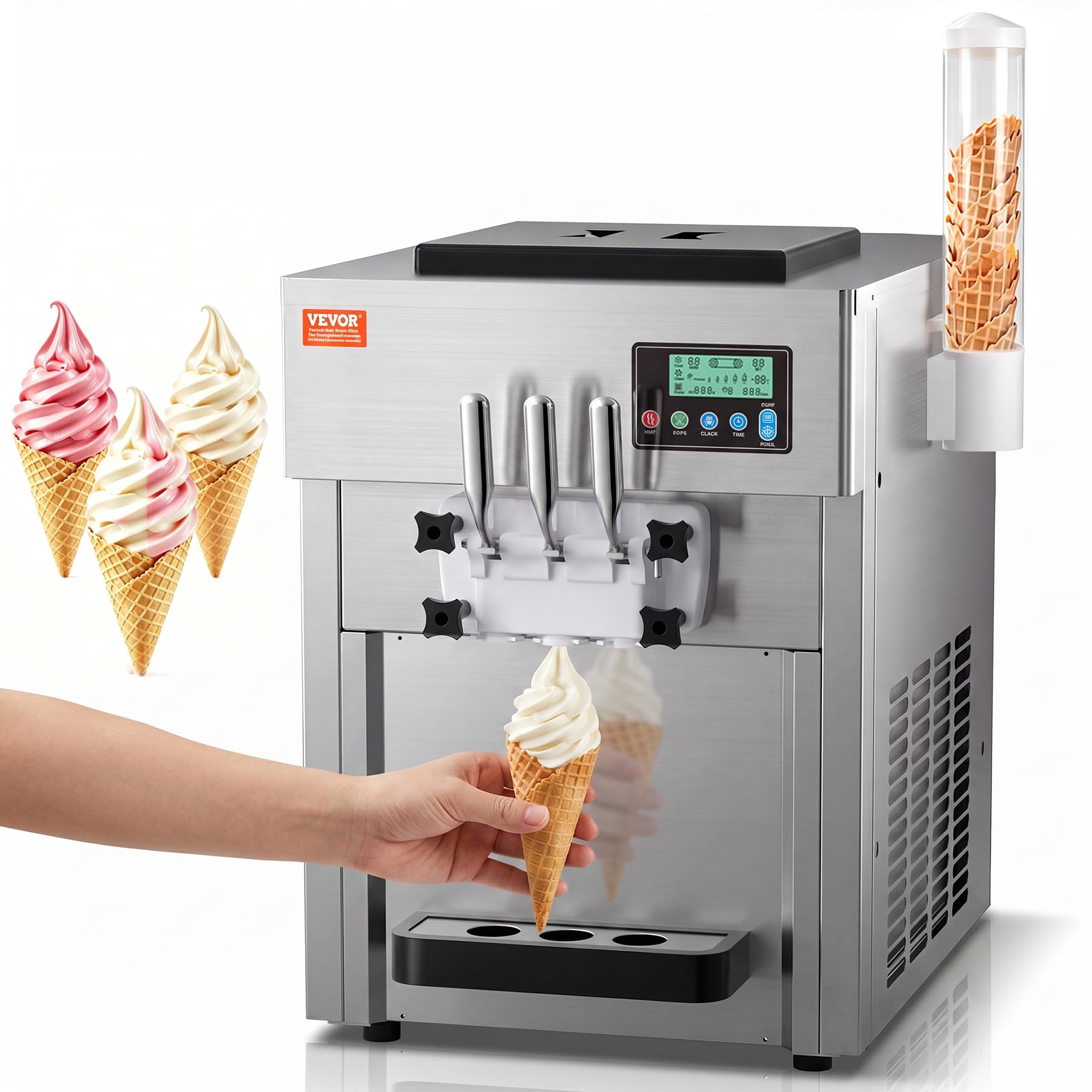
A 15-minute first freeze and a raised panel you can read without stooping.
The daily grind of running a soft serve machine is bending and squinting. VEVOR solves both: the LCD panel is set high so staff read it standing up, and it shows production time and remaining quantity at a glance. Automatic cooling, one-click cleaning and a timer live on the same panel.
Output is 20L/5.3 gal per hour across ambient temperatures of 41 to 89.6°F, with two 4L hoppers feeding three dispensers. First freeze takes 15 minutes, then six minutes or less per batch. That is well within the six-minute refreeze window you want on a small counter. The SUS304 stainless cylinder and SUS201 body keep it rust-resistant and easy to wipe down at close.
Reliability is where you should set your expectations realistically. The machine earns strong marks for function and simplicity, but there is a mixed signal on long-term durability that shows up across this whole desktop category. Buy it for a low-to-moderate volume slot and treat the six-minute refreeze figure as the benchmark it was designed to meet.
The daily-use win: Raised LCD, one-click clean, and pre-cooling all live in one panel you read standing up.
Set expectations: It is a small-counter machine built for steady volume — this is not the pick for a demanding high-traffic window.
Suits you: if your machine shares counter space with coffee and food, and staff need to run it without a manual.
Not your machine: if you serve hundreds of cones a day — go bigger.
5. VEVOR Commercial Ice Cream Machine 10.6 QT/H
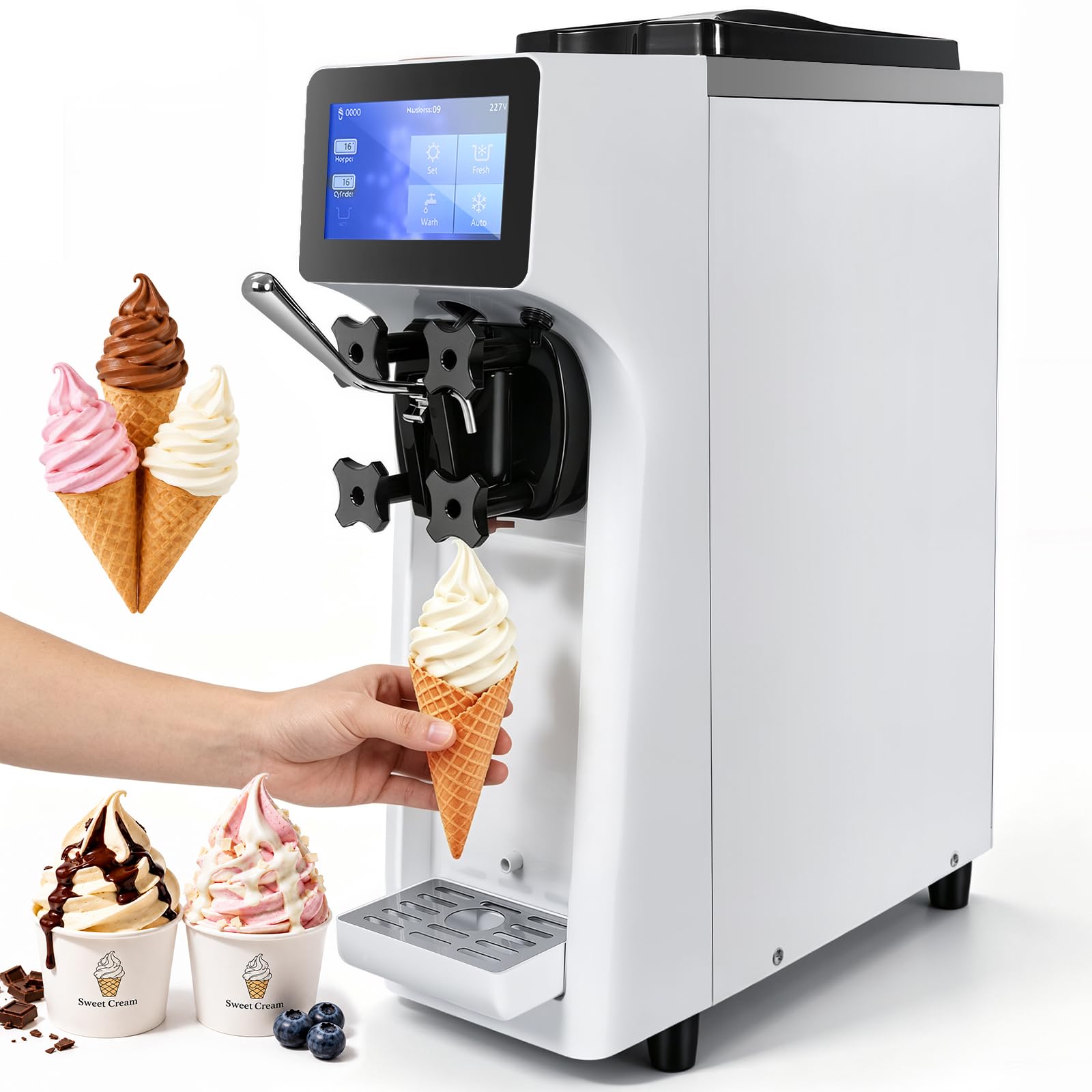
One flavor, one hopper, and a narrow 8.3-inch frame that slips into tight spots.
Not every business needs three handles. If you sell one signature flavor — a vanilla soft serve that is the whole reason people stop — this single-hopper unit does that job and keeps the menu simple. It turns out 10L / 10.6 Qt an hour and continuously serves 4-6 portions of 80g each, which is plenty for a beverage bar or a small stand that never gets slammed.
The physical footprint is the real selling point. At 8.3 inches wide, it fits a counter slot that no other unit here will touch. That narrow body is a genuine advantage in a tight trailer or a walk-up window. The touch panel handles automatic cooling, one-touch cleaning and a timer, and it clearly shows production time and remaining quantity. The 4L / 4.2 Qt hopper and SUS304 cylinder follow the same durable build logic as the rest of the VEVOR line.
Two honest limits shape the decision. The first freeze runs about 15 minutes and subsequent batches need six minutes or less — fine on a slow counter, slow if a crowd forms. And the freezing-time and functionality feedback splits down the middle: the machine performs for most, but a real share of buyers hit stalls or malfunction. Buy this for a modest, predictable volume and you are in the zone it was designed for.
The narrow-frame advantage: 8.3 inches wide means it fits where nothing else will.
Honest split: Freezing time and overall function get mixed feedback — this unit rewards light-to-moderate use, and heavy rush traffic is not what it was built for.
Pick it when: one signature flavor in a tight space is exactly your business model.
Skip it when: you plan to sell two flavors or push volume through a lunch rush.
6. EKway Soft Serve Ice Cream Machine 28 QT/H
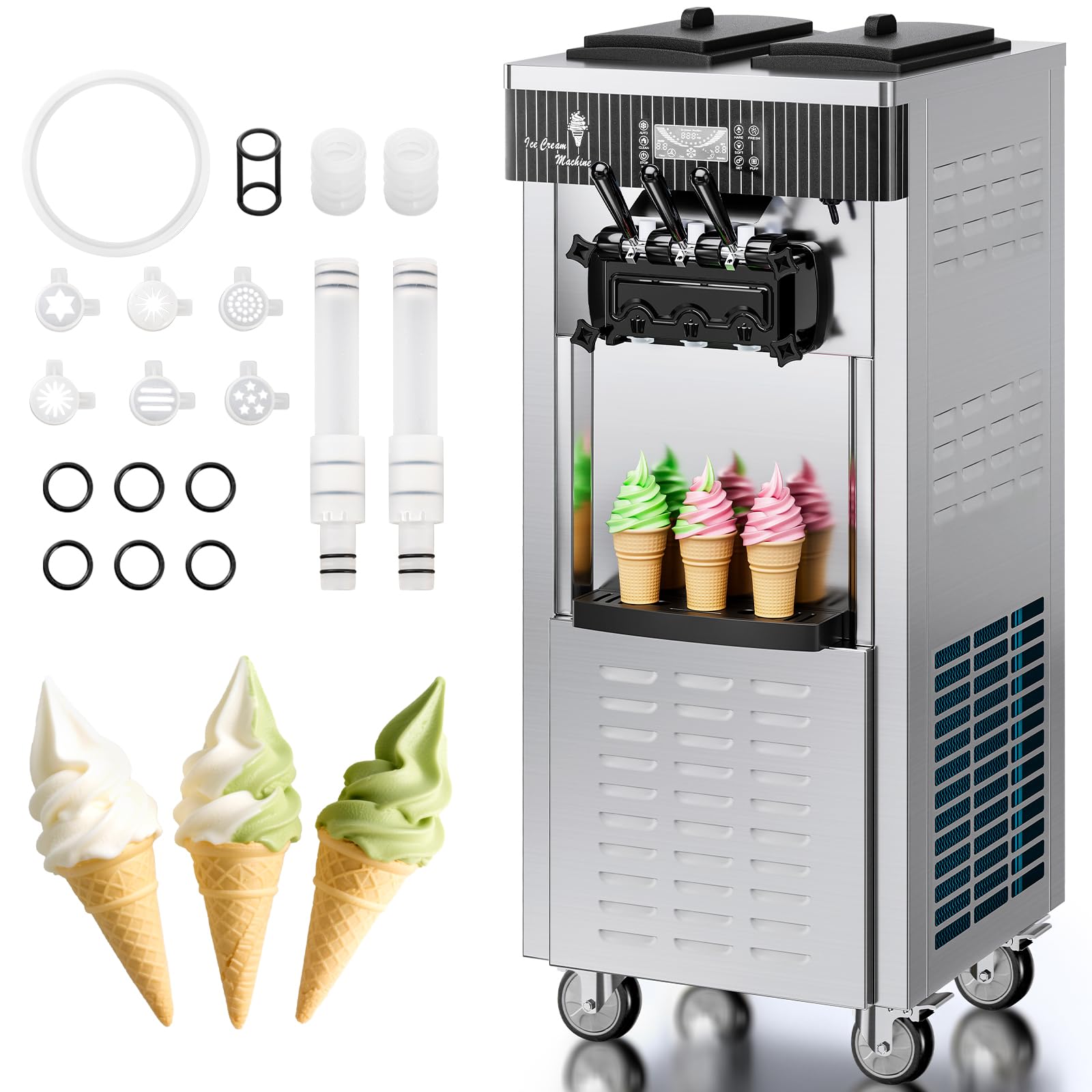
Twin 6L hoppers, a 2450W compressor and casters to move the whole thing.
The twin hoppers here hold 2 x 6L of mix, and the machine turns that into 20-28 quarts an hour — 150-200 servings if you are pushing 3.5oz portions. That is a serious floor model with a 2450W compressor driving a copper condenser, and the expansion tubes are engineered to boost yield. For a venue with a fixed spot on the floor, it is a volume machine.
The dual-circuit compressor design is the smart engineering. The two compressors start staggered so they do not spike your power grid at once — a real thing to care about if your building has tight service. There is also an overnight pre-cooling mode that keeps the mix fresh till morning, plus a self-cleaning cycle on a single press of the LCD panel.
The frame is upright at 234 pounds and comes with universal fixed casters, so you can roll it into position and lock it down rather than wrestle it. Two flavors plus a mixed draw cover the menu, with 6L stainless hoppers and a food-grade 304 steel cylinder. The main thing to plan for is the floor space and the power draw of a 2450W unit — a dedicated circuit beats chaining it to a busy line.
The volume case
- Twin 6L hoppers and 20-28 quarts an hour handle 150-200 servings in a push.
- 2450W compressor with a copper condenser for fast, sustained cooling.
- Staggered compressor start avoids a power-grid surge at startup.
- Universal fixed casters let you reposition a 234-pound frame.
The practical read
- Floor model with a 234-pound body — plan the install before delivery day.
- 2450W of compression wants a dedicated circuit in most kitchens.
- More machine than a low-volume snack bar will ever use.
Your match if: you have a fixed floor spot and enough daily volume to keep twin 6L hoppers moving.
Not for you if: you are a weekend pop-up with no dedicated power drop.
7. GSEICE Commercial Soft Serve Ice Cream Machine 3 Flavor

Two independent systems in one body — run one tank at midnight and leave the other off.
Most dual-hopper machines are one system feeding two tanks. This GSEICE runs two genuinely separate systems, each with its own hopper and freezing cylinder. The practical upshot: on a slow evening you switch on one side, sell your vanilla, and leave the other side dark. On a busy day you run both and mix a third flavor between them. Nobody else here offers that flexibility, and it is why this one sits at the premium end.
The output backs it up: 26-32 L an hour, which the maker puts at up to 300 servings, from double 6L mixing hoppers and 1.2L freezing cylinders in SUS304 steel. The 10-inch LCD sits on a 42-degree angled panel, so your staff read the quantity standing straight rather than crouching. You can set soft, medium or hard texture and use adjustable pre-cooling overnight so tomorrow’s mix is ready to serve.
What the premium buys beyond the twin systems is the quiet and the running cost. The worm gear reducer drops the noise level to 68 decibels, and the frequency conversion setup reduces electricity consumption compared with an ordinary machine. The worm gear and R290 refrigerant also mean faster, cleaner cooling. The honest caveat: this is the biggest outlay on the list, and the value question is a live debate in the feedback — it is a machine for operators selling enough daily volume to amortize it.
The case for premium: Two independent systems mean you never run a tank you do not need, and the 68-decibel run keeps a small shop livable.
What you feel daily: The 10-inch angled LCD and adjustable pre-cooling turn a fiddly machine into a two-minute check-in.
The honest caveat: This is the top-tier buy, and value gets debated in the feedback — it pays off on volume, not on a slow weekend stand.
The right call for: operators who want to run one tank when business is quiet and two when it is not.
Weigh hard if: your daily volume is modest — the twin-system premium only earns its keep on real throughput.
Know the Specs
Hopper capacity (liters)
The hopper is the tank that holds unfrozen mix. A 4L hopper means you refill sooner than a 6L or 7L one, and a dual setup doubles the total. If you run two flavors, you need two hoppers. Match the total liters to your expected servings per shift, not to the freezer size.
Refreeze time and hourly yield
Refreeze time is how long it takes to pull a fresh batch after the first one. Fast units do it in four to six minutes; slower ones push a quarter hour. Hourly yield tells you the ceiling — 10.6 Qt for a compact single-flavor unit, 32-36 QT for a high-traffic twin. Read both together before you buy.
Wattage and compressor style
Wattage is the pull of the cooling motor. 1000W is a light countertop unit, 1800W handles steady service, and 2450W pushes serious volume. If your building has tight electrical service, check the draw before you install — a high-wattage unit wants its own circuit.
Flavor count and pre-cooling
Two single flavors plus one mixed draw is the standard 2+1 setup. Pre-cooling keeps the mix chilled between services so you can load overnight and open ready. Auto-clean is the other daily-use feature worth prioritizing — it is the difference between a ten-minute close and a full breakdown.
Common Questions
How many servings per hour can a commercial soft serve machine actually produce?
Do I need a dedicated electrical circuit for a commercial ice cream machine?
What is the difference between a hard serve and a soft serve machine?
Can I leave the mix in the hopper overnight?
How long does it take to freeze the first batch of ice cream?
Is a 3-flavor machine harder to run than a single-flavor one?
What maintenance does a commercial soft serve machine need daily?
Will a UL and ETL listed machine pass a health inspection?
How much space does a countertop commercial ice cream machine take up?
Can I add alcohol to the ice cream mix?
The Bottom Line
The machine worth starting with is the UL & ETL Listed 32-36 QT/H Soft Serve. Its four-minute refreeze and 32-36 QT/H output (quarts per hour) turn a queue into a rhythm, and the UL listing gives you the compliance paperwork a commercial kitchen wants. If your menu is scoops rather than cones, reach for the Kolice hard-serve unit, which weighs a compact 110 pounds. For a tight counter where one flavor is all you sell, the 8.3-inch VEVOR fits where nothing else will.
Match the machine’s hourly yield to your busiest hour and its wattage to your available circuit, and it will earn back the counter space it occupies.
How we choose
We do not accept paid placement. Every pick is matched to a real buyer and a real use-case; we do not hands-on test units.
Sources
Specifications: manufacturer listings and product documentation. Review insights: verified customer reviews, as of November 2026. Pricing: not shown on this page (it changes often); check the current price via the retailer link.
As an Amazon Associate, Tactical Gear Guy earns from qualifying purchases. This does not affect which products we feature.