Specs are compiled from manufacturer listings and verified buyer reviews and can change over time — please confirm the key details on the product page before buying.
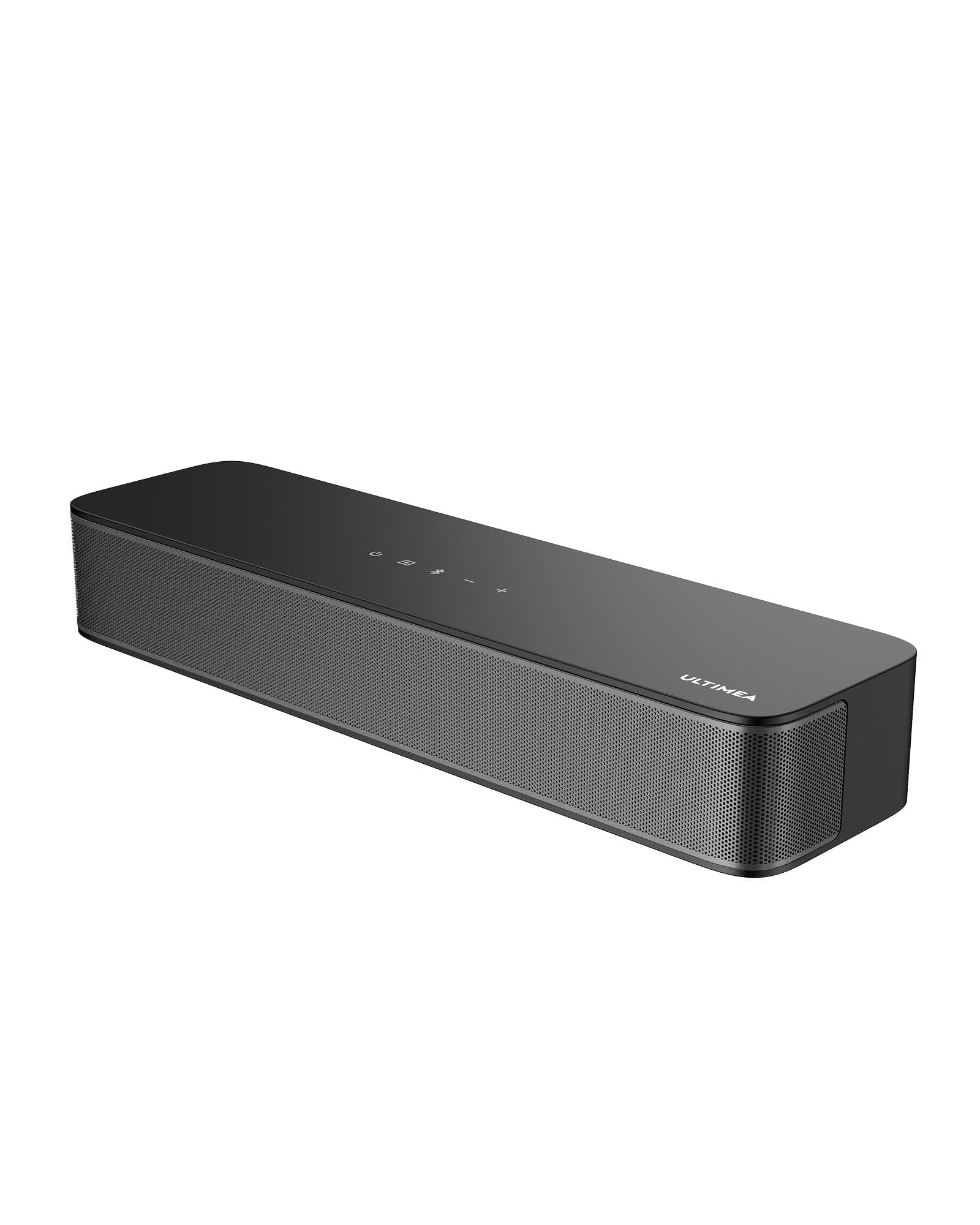
Here is the short answer first: if you want the best mix of bass and clarity for the money, buy the ULTIMEA 2.1ch Soundbar with the built-in subwoofer. Its built-in 3-inch subwoofer and side-firing bass ports deliver real low-end rumble from a single 4.4-pound bar, with no separate floor box to place or power. If dialogue is your main gripe with your TV’s built-in speakers, the TCL S45H is your pick. Everything else below is a variation on those two ideas.
This guide is built by comparing the manufacturers’ published specifications and the patterns across verified customer reviews, so you get each pick’s real strengths and trade-offs instead of marketing spin.
A cheap soundbar is mostly about one decision: subwoofer or no subwoofer, and a few small details decide the rest. The picks below cover both paths, from a compact all-in-one to a 3.1 setup with a dedicated center channel, so you can weigh a cheap soundbar against your room and your budget instead of guessing.
Top Picks

How To Choose The Best Cheap Soundbar
The single biggest thing that separates a good cheap soundbar from a disappointing one is whether it has a subwoofer — a dedicated speaker that handles low, rumbling frequencies. Your TV speakers physically cannot move enough air to make an explosion feel like an explosion. A soundbar with a sub, built in or wireless, fixes that. A 2.0 bar without one raises clarity and volume but leaves the bass thin.
Subwoofer: built in, wireless, or none
A built-in subwoofer packs the bass driver inside the bar itself. That keeps your setup to one box and one power cable, which is a real advantage in a small room or a rental where you cannot mount things. A wireless subwoofer gives you a separate box you place on the floor, and it usually delivers deeper, harder-hitting bass because the cabinet has room to move air. The trade-off is one more thing to plug in and one more thing to find space for.
Channel count, and what 3.1 buys you
Channels are the separate audio streams the bar can play at once. A 2.0 bar has left and right. A 2.1 adds a subwoofer channel. A 3.1 adds a center channel — a speaker dedicated to voices — and that is the one upgrade that most directly fixes mumbling dialogue in action scenes. If you watch a lot of dialogue-heavy drama or sports commentary, a center channel is worth more than a few extra watts.
Connections your TV actually has
HDMI ARC (Audio Return Channel) sends sound from the TV to the bar over one cable and lets your TV remote control the volume. It is the cleanest option, and it is what you should use if your TV has the port free. Optical is the reliable fallback on older sets. Bluetooth is for streaming from your phone and for TVs that have nothing else. Check which ports your TV offers before you buy, because a bar without an input you can use is a paperweight.
Fitting it under the screen
Measure the clearance under your TV and the width of the surface it sits on. Many bars here are around 31 inches wide, and one is nearly 24 inches deep, which will not fit on a shallow cabinet. A bar that sits too tall blocks your TV’s infrared sensor or covers the bottom of the picture. A bar mounted on the wall solves that, and most of these include a wall-mount kit.
Side-by-Side Comparison
| Model | Best For | Channels | Rated Power | Inputs | Amazon |
|---|---|---|---|---|---|
| ULTIMEA 2.1ch Built-in Subwoofer★ Best Overall | Bass on a tight budget | 2.1 | — | Optical, AUX, Bluetooth, USB | Amazon |
| TCL S45H 2.0Best for Dialogue | Clear voices, no sub box | 2.0 | 100 W | HDMI ARC, Optical, Bluetooth, AUX, USB | Amazon |
| ULTIMEA with Wireless SubwooferMost Powerful | Big-room rumble | 2.1 | 240 W peak | HDMI ARC, Optical, Bluetooth | Amazon |
| TCL S55H 2.1 | Atmos plus a real sub | 2.1 | 220 W | HDMI eARC/ARC, Optical, Bluetooth, AUX, USB | Amazon |
| JBL Bar 2.0 All-in-one (MK2) | Front-of-TV footprint | 2.0 | — | Bluetooth | Amazon |
| Samsung HW-B550F | Dialog boost with Bass Boost | 2.1 | — | HDMI, Bluetooth | Amazon |
| LG S60T | Center-channel dialogue | 3.1 | — | HDMI, Bluetooth, Optical | Amazon |
| Amazon Fire TV Soundbar Plus | Fire TV households | 3.1 | — | Bluetooth, HDMI | Amazon |
Detailed Reviews
1. ULTIMEA 2.1ch Soundbar Built-in Subwoofer
Real bass from a single box you can sit straight under the TV.
This is the one to buy if you want a subwoofer but have nowhere to put a subwoofer. The 2.1 channel design puts a 3-inch subwoofer inside the bar itself, backed by side-firing bass ports — openings on the ends that let low frequencies escape. So a car chase gets a physical thump, and you never step over a second box on the floor. The whole thing weighs 4.4 pounds and measures 15.75 inches deep, 2.76 inches wide and 4.25 inches tall, which is genuinely small for what it does. That size matters: it slides under a monitor or onto a narrow shelf where most soundbars will not go.
Where it pulls ahead of the pricier bars here is control. The ULTIMEA app gives you a 10-band equalizer — ten separate sliders for frequency ranges, so you can cut the boomy frequencies your room exaggerates — plus 121 preset EQ matrices split across Bass, Pop, Classical and Rock. There are also 6 named modes on top of that: Movie, Music, Voice, Sport, Game and Night. Night mode is the underrated one, because it compresses the loud explosions and lifts quiet dialogue so you can watch at low volume without waking the house. Connections cover optical, AUX, USB and Bluetooth 5.4, and there is a “SUB OUT” port so you can add a powered subwoofer later if you want more.
One honest catch up front: this bar does not have HDMI. If your TV only offers HDMI as an output, you will be running optical instead, and you will lose the one-cable convenience and the TV-remote volume control. The second catch is that built-in subwoofers, by physics, will not match a separate cabinet on pure low-end extension. Buyers broadly land on clear sound and strong value, and what wins people over most is how the audio holds up at low volume for calls and music as much as movies. Setup is quick and the size surprises people — it fills a bigger room than the footprint suggests.
What earns it first place
- A 3-inch built-in subwoofer plus side-firing bass ports give genuine low-end without a second box to place or power.
- 121 preset EQ matrices and a 10-band equalizer in the app, with 6 listening modes including Night.
- Compact 4.4-pound body at 15.75 inches deep, so it fits shelves and cabinets most bars will not.
Where it asks you to compromise
- No HDMI input at all — optical is your only wired TV option, so your TV remote will not control volume.
- Built-in bass has a ceiling that a separate wireless subwoofer cabinet clears.
Reach for this if: you want rumble without floor space, or a second room setup where one box is the whole point.
Look elsewhere if: your TV is HDMI-only and you refuse to add an optical cable.
2. TCL S45H 2.0 Sound Bar for Smart TV
No subwoofer, no problem — this is the dialogue fixer of the group.
If the complaint at your house is “I can’t hear what they’re saying,” start here. This is a 2.0 channel bar with up to 100 W of output and no subwoofer, which sounds like a downgrade until you consider what it buys you: nothing to place on the floor, nothing extra to plug in, and a slim 31.89-inch wide, 2.36-inch tall body that tucks under a TV without crowding it. Dolby Atmos and DTS Virtual:X both simulate height and surround effects without rear speakers, so a game or a film spreads out past the edges of the screen. Treat that as a subtle widening effect rather than a true overhead speaker setup.
The feature that justifies the price is AI Sonic auto room calibration — the bar listens to your room’s layout and listening position once, through the TCL app, and rebalances the sound. Run it once through the TCL app and the bar rebalances its output to your room’s layout and listening position, which matters because an uncalibrated bar sounds boomy in a corner. You also get HDMI eARC/ARC, optical, Bluetooth, AUX and USB, so this works with old TVs and new ones. Setup is genuinely a couple of minutes. As buyers put it: “The product is easy to set up, taking only 1-2 minutes to download and install, and connects easily to LG Smart TVs.” A low 60 hertz frequency-response floor means it digs lower than its no-subwoofer spec suggests.
The trade-off is volume headroom. This bar is built for apartments, bedrooms and small-to-medium rooms, and it will run out of steam before a dedicated subwoofer system does on a loud action scene. Clarity is where it shines — voices come through clean, music holds together, and it beats expectations given the lack of a bass box. A few buyers find the top end of the volume dial gets thin; that is your cue to match it to room size rather than treat it as a party speaker.
Clarity over thump: a 100 W 2.0 bar with AI Sonic room calibration and a 60 hertz low end, for people whose number-one problem is mumbling dialogue.
The honest limit: no subwoofer means the deepest rumble is missing, and the volume ceiling suits a bedroom or apartment better than a big open living room.
Who this beats: any bar without room calibration — the AI Sonic tuning is the reason this holds clear voices in awkward corners.
Who it does not suit: anyone who wants to feel an explosion in their chest rather than just hear it.
3. ULTIMEA Sound Bar with Wireless Subwoofer
240 watts, a subwoofer you can hide behind a chair, and bass you feel in the floor.
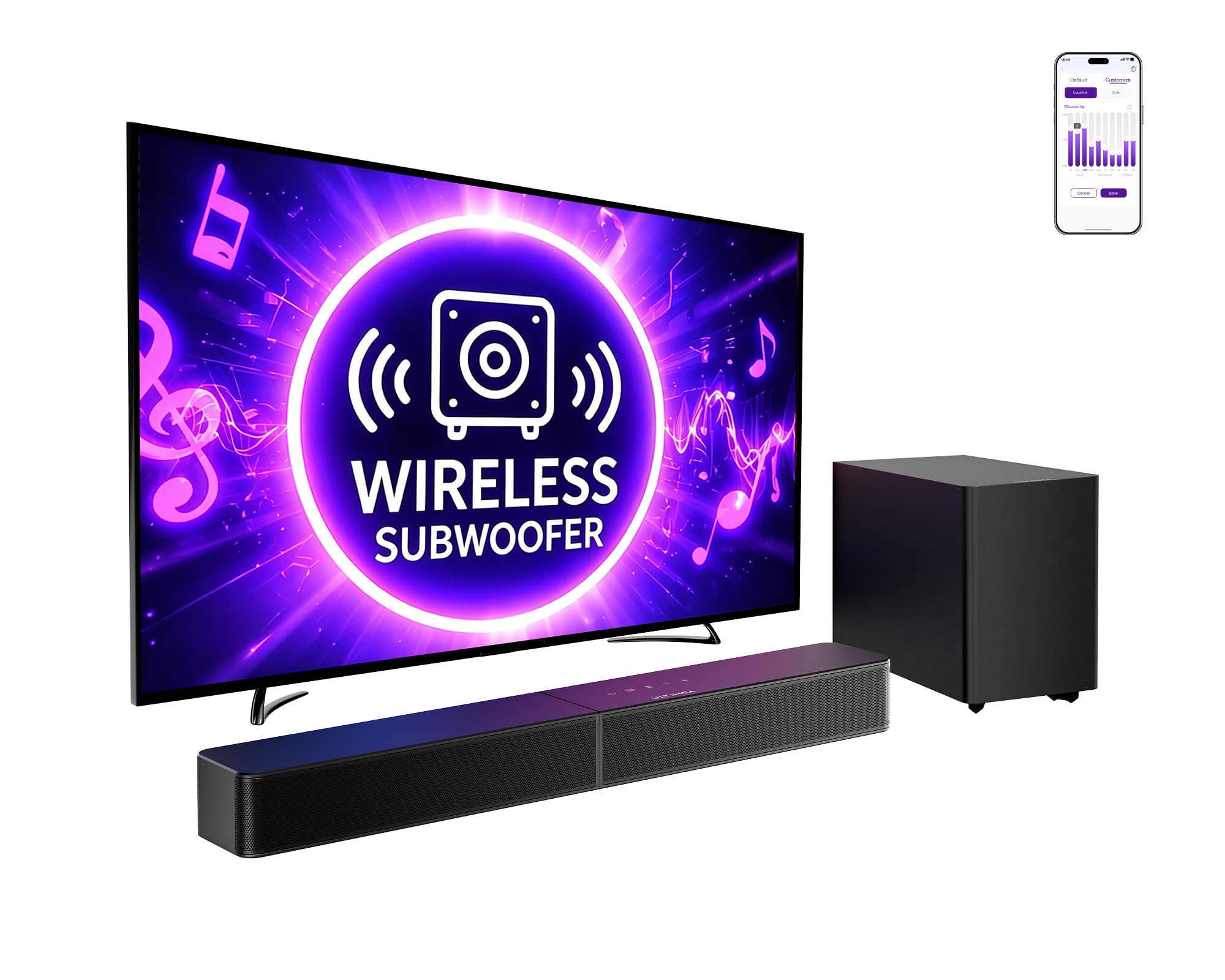
The headline number is 240 W of peak output across a 2.1 channel system with a dedicated wireless subwoofer. That is a big jump over the TCL S45H’s 100 W, and the practical result is headroom you can hear: dialogue stays clean while bass hits, instead of the whole mix compressing as you turn it up. This is the setup for a living room where movie night actually means volume. The subwoofer connects wirelessly, so you place it wherever it sounds best — behind the sofa, beside the couch, in the corner — without running a cable across the floor.
Two audio details do the real work here. VoiceMX is a DSP (digital signal processing) routine that isolates and lifts the 120 Hz to 6 kHz vocal range in real time, so dialogue stands proud of a loud soundtrack. And the mica-reinforced drivers are stiffer diaphragms — the maker claims up to 30% more rigidity and up to 20% less distortion, which in practice means cleaner mids at high volume. The frequency response bottoms out at 45 hertz, and the maximum loudness is 95 dB, so it fills a room rather than straining at it. Smart App control adds a 10-band equalizer and 121 preset EQ matrices, with OTA (over-the-air) updates to keep the firmware current.
Check the footprint before you commit. The bar measures 23.62 inches deep and 2.76 inches wide, so it is one of the deeper bars in this lineup and wants a cabinet that can actually hold it. There is no USB or HDMI passthrough beyond HDMI ARC either, so plan on ARC or optical. It lands third because sound quality is the star and value close behind: owners call it great for bedrooms and smaller living rooms, and setup is a breeze. A few buyers report reliability issues over time, which is worth knowing before you buy.
Strong at
- 240 W peak output with a wireless subwoofer you can position anywhere in the room.
- VoiceMX keeps dialogue clear at volume, and the 45 hertz floor is the lowest deep-end spec between it and the TCL S45H’s 60 hertz.
- App control with a 10-band equalizer and 121 preset EQ matrices.
Watch out for
- At 23.62 inches deep it needs a deeper cabinet or a wall mount — a shallow TV stand will not work.
- No USB input, and ARC is your only HDMI route.
The case for it: the most power per pound in this list, and a subwoofer you can hide anywhere because it never needs a cable.
The one check: measure cabinet depth before ordering — 23.62 inches is more than most TV consoles offer.
4. TCL S55H 2.1 Sound Bar with Wireless Subwoofer

Atmos with an actual subwoofer cabinet — the upgrade over TCL’s own 2.0 bar.
If the TCL S45H interests you but you cannot live without bass, this is the same family with the missing piece added. The S55H runs 220 W through a 2.1 channel setup with a wireless subwoofer in its own cabinet (7.68 inches wide, 12.60 inches tall, 7.68 inches deep), and that cabinet is the reason the low end hits harder. It is a decisive step up on power from the 2.0 model’s 100 W. Dolby Atmos and DTS Virtual:X both come along, plus the same AI Sonic auto room calibration through the TCL app, which tunes the system to your specific room and seat once at setup and then stays put.
The 5.5-inch driver in the bar gives the mids room to breathe, and the metal-and-plastic enclosure feels sturdier than the usual cheap plastic shell. HDMI eARC/ARC, optical, Bluetooth, AUX and USB are all present, and the Bluetooth range is listed at 10 meters — enough to leave your phone on the sofa and still stream. Setup is a plug-and-play job. It pairs cleanly with TCL Roku TVs, and it is a huge upgrade over any TV’s built-in speakers. The separate subwoofer cabinet takes the low frequencies off the bar’s 5.5-inch driver, so dialogue stays crisp up front while the rumble comes from the floor.
Two honest notes. Volume control draws complaints — a handful of owners find the level jumps or lags between the bar and the TV remote. And the performance feedback is split: plenty of buyers call it fantastic, a smaller group hits repeated working issues. If long-term stability is your priority, the ULTIMEA wireless-sub model is the safer bet. For a first Atmos setup with a real subwoofer, though, this is a strong buy.
Where it earns the money: 220 W and a separate subwoofer cabinet, with Atmos, DTS Virtual:X and AI Sonic room calibration in one box — the meaningful step up from the S45H’s 100 W.
Fair warning: the subwoofer adds a floor box and a second power outlet, and volume control is the recurring grumble.
Best fit: a TCL Roku TV owner who has been living with tinny built-in speakers and wants Atmos plus real bass in one purchase.
Not your bar: if you cannot give up floor space for a subwoofer cabinet, go back to the built-in option above.
5. JBL Bar 2.0 All-in-one (MK2)

A low-profile bar that sits in front of the TV and disappears from view.
JBL’s angle here is simplicity and a low-profile body designed to tuck right in front of your TV. It is a 2.0 all-in-one with no subwoofer, no separate cabinet, and a single connection path: Bluetooth. That last point is the one thing to think through carefully. If your TV has no Bluetooth transmitter, this bar cannot take a wired feed from it. So the buyers this suits best are people who mostly stream music from a phone or tablet and want a bar that doubles as a music speaker, plus anyone whose TV does output over Bluetooth.
Within those limits it is pleasant. JBL Surround Sound spreads the mix beyond the bar’s edges, built-in Dolby Digital lends movies a cinematic feel, and the 6.35 centimeter drivers handle everyday TV audio without fuss. Bluetooth range is listed at 10 meters, so you can walk around with your phone and keep the music going. Value for money and setup are the two things it does best — buyers consistently find it easy to connect, and there is a remote and wall bracket in the box. It is a fair pick as a first upgrade for a bedroom TV.
Now the honest part, and it is the reason this sits mid-list rather than higher. The sound quality feedback is genuinely mixed. Some buyers find it great; others specifically say it does not sound like a surround sound system, and a few hit reliability problems. That is a mismatch of expectations, not a defect: a 2.0 bar with no subwoofer will not deliver 2.1 low-end slam. JBL Surround Sound is a widening effect, not discrete rear channels, and a 2.0 bar with no subwoofer will not deliver the low-end slam that a 2.1 system will. Expect a clear, tidy improvement over TV speakers, and no more.
What you are really buying: a compact, low-profile JBL bar with built-in Dolby Digital and 10 meters of Bluetooth range, priced as an entry point.
Set your expectations: Bluetooth is the only connection, and the surround effect is simulated rather than discrete.
Choose this when: your TV streams over Bluetooth and you mainly want a better music speaker than a full home-theater rig.
Pass on it when: you need a wired optical or HDMI connection, or you want a subwoofer in the box.
6. Samsung HW-B550F 2.1 ch Soundbar with Subwoofer

Samsung’s Voice Enhance lifts dialogue without you touching a slider.
Samsung builds this one around two things people actually complain about: muffled dialogue and weak bass. Voice Enhance automatically amplifies voices so they sit above the soundtrack — no menu-diving, no equalizer fiddling, it just does it. Bass Boost adds a second, deeper layer of low end on top of the included wireless subwoofer, so the rumble is there when the scene calls for it. And Adaptive Sound watches what kind of content you are playing and adjusts the audio to fit, clearing up voices in a drama and leaning into dynamics in an action scene.
The surround side is what Samsung calls multi-directional spatial audio with DTS Virtual:X, which moves effects around you without rear speakers. There is also a real upgrade path most bars here do not offer: optional rear speakers connect wirelessly for true surround, with extra modes like Private Rear Sound and Sound Grouping. That makes this a bar you can grow into rather than replace. Connectivity is Bluetooth and HDMI, controlled by the included remote. It pairs smoothly with Samsung TVs, which is the intended pairing.
Here is the caveat worth knowing before you buy. The integration story splits: Samsung TV owners tend to get a clean handshake, while others hit frequent disconnections over Bluetooth. If you own a Samsung TV, this is one of the smoothest paths in this list. If you do not, go in expecting to use HDMI and treat Bluetooth as a bonus. Beyond that, movie-theater-style sound and 2.1 quality are what buyers talk about most, and the value read is solid for a bar with a wireless sub and bass boost built in.
The standout: automatic Voice Enhance plus Bass Boost and Adaptive Sound, with an optional path to wireless rear speakers for true surround.
The catch: Bluetooth reliability is uneven on non-Samsung TVs, and the remote is the only control method.
Buy it because: you want dialogue handled automatically and you value a future rear-speaker upgrade.
Think twice if: you are not on a Samsung TV and you plan to lean on Bluetooth rather than HDMI.
7. LG S60T 3.1 ch. Soundbar with Wireless Subwoofer

Three channels, one of them dedicated entirely to making voices clear.
This is the first pick in the list with a genuine center channel, and that is the whole argument for it. A 3.1 system splits audio into left, right, center and subwoofer, where the center speaker is reserved for dialogue. The result is that loud effects on the left and right do not crowd out voices in the middle — the clarity you get in a live sports broadcast or a fast-talking drama is noticeably better than a 2.1 bar can manage. A wireless subwoofer handles the low end, and Dolby Audio covers the detail work.
LG’s ecosystem features are the other draw. WOW Orchestra uses your LG TV’s own speakers alongside the bar to widen the soundstage, WOW Interface lets one remote run both the bar and an LG TV, and AI Sound Pro adapts the output — clear vocals for live sports, heavier bass for live music, dynamics for action. The LG Soundbar App gives you a 3-band equalizer for the bar and the rear speakers. There is a metal grill keeping dust and debris out of the drivers, and the design is more considered than most of this list. Setup is easy enough that installation is one of the things people mention most favorably.
The catch is genuinely about matching. The special remote restriction is real — this bar wants its own remote, and WOW Orchestra and the interface tricks only fully arrive when you pair it with an LG TV. Some owners also report the subwoofer cutting out. If you already own an LG OLED, that combination is what this bar was built for, and audio clarity plus value are what buyers praise. If you do not, you are paying for features you cannot use, and a cheaper bar will serve you just as well.
Why it makes the list
- A true 3.1 layout with a center channel built for dialogue clarity, plus a wireless subwoofer.
- WOW Orchestra and WOW Interface turn an LG TV and this bar into one controlled system.
- AI Sound Pro adapts to sports, music and action automatically, and the metal grill keeps drivers clean.
What it demands
- Only works with its own special remote, and the deep LG features need an LG TV to open up.
- Subwoofer dropouts come up often enough to be worth knowing about.
Made for this: an LG TV owner who wants the center-channel dialogue fix and the one-remote control that comes with the ecosystem.
Wrong tool for: a mixed-brand setup where WOW Orchestra will never switch on.
8. Amazon Fire TV Soundbar Plus with Subwoofer

A dedicated center dialogue channel, plus a subwoofer with real weight behind it.
This is the Fire TV household’s obvious move, and it is the only bar here that pairs a 3.1 layout with both Dolby Atmos and DTS:X at the top of the range. The dedicated center channel is the practical highlight — it sharpens conversation so you catch every line of a show without riding the volume. The wireless subwoofer delivers the bass that makes an action scene feel physical, and the low-end response is the thing it does best. Height and depth effects from Atmos and DTS:X spread the mix around the room rather than flat across the front.
Getting it running is deliberately simple. You plug the subwoofer into power, it connects to the bar wirelessly, and the room fills with bass. If your TV is a Fire TV, one remote controls both the TV and the bar, and the Fire TV audio settings menu lets you tune the sound without hunting for a separate app. Movie, Music, Sports and Night modes tailor the audio to what you are watching, and Night mode is worth knowing for late viewing. Bluetooth streaming handles your phone playlists, and it works with smart TVs and TVs connected to streaming players.
The honest trade-off is that the Fire TV features are only fully realized on Fire TV hardware — the single-remote control and in-menu tuning both depend on it. Owners of other brands get a capable 3.1 bar with Atmos, but you lose the integration. Around the edges, connectivity and reliability are the recurring notes. What buyers rave about is the performance itself, including bass with enough force to rattle windows and dialogue that stays clear above it, plus a subwoofer with genuinely impressive low-frequency response.
The core of it: 3.1 channels with a dedicated center dialogue speaker, Dolby Atmos and DTS:X, and a wireless subwoofer that connects with one power plug.
Where it stops short: the one-remote control and audio-settings tuning only fully work on a Fire TV, and connectivity is the weak spot for some owners.
Ideal pairing: a Fire TV in the living room, where the remote and settings merge into one system and the center channel fixes the dialogue.
Not worth it for: someone on a different smart TV platform — a same-price bar without the Fire TV handshake does more for you.
Know the Specs
Channels (2.0 vs 2.1 vs 3.1)
Channels count the separate audio streams the bar can play at once. A 2.0 bar has left and right. A 2.1 adds a subwoofer channel for the low, rumbling frequencies. A 3.1 adds a center channel dedicated to dialogue, which is the clearest fix for muffled voices in action scenes. If your main complaint is “I can’t hear them talking,” the channel count matters more than the wattage.
Rated power in watts
Watts measure how much power the amplifier can deliver, and more watts usually mean more volume headroom before the sound starts to distort. A 100 W bar is fine for a bedroom or apartment; a 220 W or 240 W system has more room to stay clean at higher volume. Watts are not a measure of sound quality — a well-tuned 100 W bar can sound clearer than a sloppy higher-wattage one.
Dolby Atmos and DTS:X
Both are audio formats that place sounds in a 3D space — above and around you — rather than just left to right. On a cheap soundbar without extra speakers, they tend to simulate that effect by widening the soundstage. That is still a real improvement over plain stereo, but treat the effect as a widening and heightening, not as true overhead speakers.
HDMI ARC, optical and Bluetooth
HDMI ARC sends audio from the TV to the bar over one cable and lets your TV remote adjust volume. Optical is the reliable wired fallback when HDMI is taken or missing. Bluetooth is a wireless connection for streaming from a phone or tablet, but it depends on your TV having Bluetooth output — many older sets do not. Match the bar to the ports you actually have.
Common Questions
Will a cheap soundbar work with my older TV?
Is a 2.0 soundbar enough, or do I need a subwoofer?
Does Dolby Atmos on a cheap soundbar actually sound like overhead audio?
How do I fix muffled dialogue on a soundbar?
Will a soundbar block my TV’s remote sensor or the picture?
Can I add rear speakers to a cheap soundbar later?
What is the difference between a built-in subwoofer and a wireless subwoofer?
Do I need HDMI ARC or will optical sound just as good?
Can I use a soundbar for music from my phone?
How wide is a soundbar, and will it fit my TV stand?
The Bottom Line
For most people shopping a cheap soundbar, the winner is the ULTIMEA 2.1ch Soundbar, because it gives you a real built-in subwoofer, 121 preset EQ matrices and a 10-band equalizer in a 4.4-pound body that fits almost anywhere — no spare floor space required. If dialogue is your complaint rather than bass, the TCL S45H delivers clean voices with AI Sonic room calibration and a 60 hertz low end, no second box needed.
Want the most power in this list? The ULTIMEA wireless-subwoofer model runs 240 W with a subwoofer you can hide anywhere. And if you already own an LG OLED, the LG S60T is the one that open up WOW Orchestra and puts a dedicated center channel on dialogue duty. My one nudge: the ULTIMEA 2.1ch built-in-sub pick carries the highest rating of the built-in-sub options here, so start there.
How we choose
We do not accept paid placement. Every pick is matched to a real buyer and a real use-case; we do not hands-on test units.
Sources
Specifications: manufacturer listings and product documentation. Review insights: verified customer reviews, as of November 2026. Pricing: not shown on this page (it changes often); check the current price via the retailer link.
As an Amazon Associate, Tactical Gear Guy earns from qualifying purchases. This does not affect which products we feature.