Specs are compiled from manufacturer listings and verified buyer reviews and can change over time — please confirm the key details on the product page before buying.
You already know the sinking feeling: your bike is strapped to the back of the car, and every highway bridge joint sends it rocking harder than it should. The fix is not more bungee cord — it is choosing the right mount style for your car and your bike’s weight. A hitch platform rack carries a heavy e-bike without frame contact, a trunk rack saves you from ever installing a hitch, and a roof rack frees up your rear hatch. Get that match wrong and you will fight your rack every trip. Get it right and the rack goes on in seconds and stays quiet at 70 mph.
This guide is built by comparing the manufacturers’ published specifications and the patterns across verified customer reviews, so you get each pick’s real strengths and trade-offs instead of marketing spin.
Below you will find nine racks sorted by how they mount and what they carry, with the honest catch on each one spelled out. Every pick here solves a specific loading problem, and this guide to the best car bike rack weighs receiver fit, per-bike weight capacity, and how the bikes stay put at speed.
Top Picks


How To Choose The Best Car Bike Rack
Start with the vehicle, not the rack. A hitch platform rack bolts into a receiver under your bumper and never touches your paint. A trunk rack hangs on straps over your rear hatch and needs no hardware at all. A roof rack clamps to crossbars and lifts bikes over your head. Each style solves a different problem, and buying a platform rack for a car with no receiver is the most common mistake in this category.
Match the mount style to your car and your garage
If your vehicle already has a 2-inch receiver, a platform hitch rack gives you the sturdiest carry and the most clearance from your bodywork. Trunk racks suit sedans and hatchbacks that never had a hitch fitted, and they store flat when the trip is done. Roof racks keep your hitch and rear hatch free but demand a lift overhead every time — fine for a road bike, awkward for a heavy e-bike.
Read the per-bike weight rating, not just the total
A rack rated for two bikes at 35 pounds each is built differently from one rated at 80 pounds per bike. E-bikes and fat-tire models load the frame, the wheel trays, and the hitch joint far harder. Check the per-bike figure against your heaviest bicycle before anything else, because a total capacity number can hide a much lower limit on each tray.
Decide how much frame contact you accept
Racks that clamp the frame with hooks or ratchets are quick to load but press hardware against your paint. Wheel-hold designs grip the tires instead and leave the frame untouched — better for carbon frames and glossy finishes. Both styles work; the question is how much you care about scratches and how much time you want to spend padding contact points.
Look for the small parts that decide the ride
An anti-wobble hitch tightener pulls the rack hard against the receiver so it cannot rock in the slop of the hitch opening. Locking hitch pins and keyed-alike clamps protect your hardware at a trailhead. A tilt or fold mechanism lets you reach your trunk without unloading. A tightener, a locking pin, and a tilt lever are what keep a rack from rattling loose on the highway.
Side-by-Side Comparison
| Model | Best For | Mount Type | Bike Capacity | Per-Bike Weight | Amazon |
|---|---|---|---|---|---|
| Hollywood Racks Sport Rider★ Best Overall | Heavy e-bikes on a 2-inch hitch | Hitch platform (2″) | 2 bikes | 80 lbs each | Amazon |
| Allen Sports Deluxe+ 2-BikeNo-Hitch Solution | Hitch-free sedan and hatchback trips | Trunk mount | 2 bikes | 70 lbs load | Amazon |
| Swagman Standard Fork MountRooftop Single | One road or hybrid bike up top | Roof, fork mount | 1 bike | 35 lbs | Amazon |
| Saris Bones 3-Bike | Three bikes with no hitch installed | Trunk mount | 3 bikes | 35 lbs each | Amazon |
| TANX Fat Tire Hitch Rack | Fat tires and e-bikes on a budget | Hitch platform (2″) | 2 bikes | 160 lbs total | Amazon |
| RockyMounts Tomahawk | Wheel-hold carry with zero frame contact | Roof, upright | 1 bike | 35 lbs | Amazon |
| Swagman Dispatch | RV, trailer, and 5th wheel duty | Hitch platform (2″) | 2 bikes | 45 lbs per bike | Amazon |
| Thule Outpace 2 | Dual hitch size and tight storage | Hitch platform (1.25″ or 2″) | 2 bikes | 110 lbs total | Amazon |
| Kuat Transfer V2 | Frame-free grip with built-in locks | Hitch platform (2″) | 2 bikes | 60 lbs per tray | Amazon |
Detailed Reviews
1. Hollywood Racks Sport Rider 2″ Hitch Bike Rack
Our pick — 4.5+★ from 900+ verified ratings; the strongest balance of quality and price.
Two e-bikes at eighty pounds apiece, held still enough that the hitch never argues back.
This is the rack you buy when your bikes stopped being light. Each tray handles up to 80 lbs, so a pair of electric bikes rides as if the platform was built around them — because it was. The wheel holders take tires up to 5 inches wide, which covers fat bikes and standard tires with the same hardware. Everything rides on an alloy steel frame that sits flat against the car when the trip ends.
The hitch joint is where most racks lose their nerve, and this one does not. A wobble-free tightening system pulls the rack hard against the receiver so it stops rocking in the slop of the hitch opening. Hollywood also keys the hitch pin, the frame clamps, and the security cable to the same key, so one key gets you loaded, locked, and rolling. Assembly is a short job — buyers report roughly 15 minutes to get it on the vehicle, and the review pages keep returning to the same theme: this thing is built like equipment, not like an accessory.
What wins people over most is simply the build — the construction is the single thing owners bring up more than anything else, and sturdiness trails just behind it. That is what the 80 lb per-bike rating and the wobble-free hitch joint buy you: no flex and no rattle when the road turns rough. The catch is real, though. At 56 lbs it is a two-hand lift to install, and it outweighs the 9 lb Allen trunk carrier by a wide margin — that weight is the price of the 80 lb per-bike rating. Hollywood also says no front hitches, no bike covers, and no adapter sleeves, so check your setup before you commit.
What Earns Its Place
- 80 lbs per bike covers nearly any e-bike you can buy
- Wobble-free hitch tightening kills the rattle at the receiver
- Matching keys for hitch pin, frame clamps, and cable
- Folds flat against the vehicle between trips
- Tilts back so you reach the trunk with bikes loaded
Before You Bolt It On
- 56 lbs makes solo installation a real chore
- Not cleared for front hitches, bike covers, or adapter sleeves
- Step-through frames need the extra top-bar accessory
Buy it for: a two-e-bike household with a 2-inch receiver who wants a platform that never asks for attention.
Think twice if: you need to lift the rack on and off by yourself every weekend — the 56 lb frame will wear you down.
2. Allen Sports Deluxe+ 2-Bike Trunk Mounted Carrier
The rack you keep in the trunk and forget about until Saturday morning.
No hitch, no wrench, no installation appointment. At 9 lbs this carrier weighs less than most grocery runs, and the patented quick snap design lets it unfold ready to hang the moment you pull it from the trunk. Allen builds it for sedans, hatchbacks, minivans, and SUVs, with a padded lower frame that sits against your paint and side straps that pull the whole thing laterally tight. Dual tie-downs hold each bike individually rather than sharing one strap across two frames.
Fit is the reason people pick it — matching the rack to a specific vehicle body is what comes up most in owner feedback, and the fact that it avoids the cost and hassle of a hitch install is the recurring theme. It holds up on the road, too: owners mention it performing well on the highway at 65 mph. Storing it takes seconds, since it collapses flat enough to live in the trunk between rides.
Here is the honest limit. Stability and sturdiness split opinion — with a light road bike the straps pull everything snug, but a load that creeps toward the 70 lb load capacity asks more of a strap-on carrier than it can give, and an occasional owner has dinged a vehicle with it. Keep the load well under 70 lbs and recheck the side straps before each highway leg, and it does exactly what a trunk rack should. It will never feel as planted as a 56 lb hitch platform, and that is the trade for skipping the hitch entirely.
Where it shines: a two-bike weekend for a sedan owner who wants zero permanent hardware and a rack that disappears into the trunk.
The honest trade: strap tension is everything — check the side straps before every highway leg and keep the load light.
Reach for this if: your car has no receiver and you want to be riding fifteen minutes after the box arrives.
Look elsewhere if: you plan to haul an e-bike regularly — that job belongs to a hitch platform.
3. Swagman Standard Fork Mount Roof Bike Rack
Sixteen ounces of aluminum that turns your crossbars into a bike mount.
Front wheel off, fork drops onto the 9mm quick release skewer, rear wheel straps down — that is the whole routine. The aluminum body weighs 16 ounces, so it adds almost nothing to your roof load, and it clamps onto square, round, or oval bars up to 3 inches wide. No tools are needed to assemble it, and the 35 lb load capacity covers a road or hybrid bike comfortably. Because it holds the fork, the bike stands upright and takes up less roof space than an upright carrier.
Value is the headline — it does the job of roof mounts that cost far more, and the review pages bear that out. One long-distance road rider reports the bike never shifted across a 2,000-mile trip, and a Highlander owner describes the Schwinn going on easily from the front fork to the rear tire strap. Stability at highway speed holds up: customers note covering stretches around 70 mph and through heavy rainstorms with no issues.
Two honest notes before you buy. The materials are on the thin side — a few owners have bent brackets while tightening, so snug it down rather than cranking on it — and the metal feet can mark your crossbars unless you slip rubber padding underneath. It is also a one-bike carrier, so a two-bike household needs a second unit or a different style entirely.
Why riders keep it: the lightest, simplest way to get one bike on the roof — assemble by hand, load in seconds, and it disappears into the silhouette of the car.
Worth knowing: thin brackets reward a gentle hand, and rubber pads under the feet protect your crossbars.
It suits: a solo rider with factory or aftermarket crossbars who wants one bike overhead without spending much.
Not for: anyone hauling two bikes — this carrier holds exactly one, at 35 lbs maximum.
4. Saris Bones 3-Bike Trunk Rack

Three bikes on a trunk, split onto separate levels so nothing fights for space.
The arc-based shape is the clever part. By curving up and over the rear of the car, the Bones clears most spoilers and separates each bike onto its own level, so frames and handlebars do not clang into each other. It carries up to three bikes at 35 lbs each, holds them with anti-sway straps, and folds down to a compact 22 x 20 x 9 inches for storage. The injection-molded arms and legs are built for repeated on-and-off use, and the whole thing is made from 100% recyclable materials.
It fits a wide range of vehicles: a minivan and a Suburban for one family, an ’07 Malibu and a ’23 RAV4 for another, a Lexus CT200H and a Honda CR-V elsewhere in the feedback. It rides solid on the highway, and the rear window wiper on a CR-V still functions with the rack in place.
The catch sits in the straps. Long-term durability is the weak spot, with a few owners reporting a strap letting go after a run of uses, so inspect the webbing each season and replace anything frayed. Three full-size bikes also take patience to arrange — two go on easily, the third needs deliberate spacing. Hatchback owners should plan on the extra hatch huggers to protect the glass edge.
The Good
- Three bikes at 35 lbs each, split across levels
- Arc design clears most rear spoilers
- On and off in under a minute
The Fine Print
- Strap wear is the recurring weak point — check the webbing
- Third bike needs careful spacing to fit cleanly
- Hatchbacks benefit from the optional hatch huggers
Pick this when: your family needs three bikes on a car with no hitch, and fast installs matter more than heavy-bike muscle.
Skip it when: the load leans toward e-bikes — 35 lbs per bike is the ceiling here, and straps deserve a careful eye.
5. TANX Fat Tire 2-Bike Hitch Rack

Fat tires, e-bikes, and a tilt lever — the platform that punches above its class.
Two wheel trays that slide apart to cradle anything from a wide fat tire to a lean road frame, up to 59 inches long. An integrated anti-wobble tightener works alongside a locking hitch pin to pull the rack firm against the receiver, so the platform stays quiet over bumps and highway seams. Fold the frame down for storage between seasons, or release the tilt mechanism to swing the loaded rack backward and reach your trunk without unloading. It mounts to a standard 2-inch receiver on SUVs, trucks, and sedans alike.
For a rack that sits well below the priciest platforms here, the build earns real confidence — sturdiest-at-the-price is a recurring note, and an owner with a rad electric bicycle was openly surprised how solid it felt. Long trips are covered too: reviewers point out logging well over 3,000 miles while protecting an expensive e-bike. Padded, adjustable cradles keep contact points off your paint.
The honest friction is in assembly and hardware. A small number have found missing screws or expected a lock that was not included, so sort through every bag before you start. Step-through frames also need care to sit the way the trays expect. None of that changes the value; you just do the assembly at a table with daylight, not in the driveway at dusk.
The case for it: fat-tire and e-bike capability plus fold-and-tilt convenience, delivered well below the premium platforms.
Do this first: inventory the hardware bags and follow the video before touching a wrench.
Best for: a fat-tire or entry e-bike owner on a 2-inch receiver who wants platform stability without premium-tier pricing.
Look past it if: you do not want to work through picture-only instructions to get set up.
6. RockyMounts Tomahawk Upright Roof Rack

Ratchet the hook over the front tire and never lay a clamp on your frame.
This is the answer for carbon and glossy frames: the aluminum arm grabs the front wheel, not the tubes. Hook it down, strap the front and rear wheels, and the bike stands upright with zero frame contact. It takes 20 to 29-inch wheels and big rubber up to 5 inches straight from the start, with two wheel-strap extensions included. The swingarm swings for driver-side or passenger-side mounting, and it clamps onto round, square, factory, or aero crossbars without special hardware.
Build quality leads the feedback, with installation right behind it. Owners move from fork mounts to this because it makes hauling a fat bike simpler, and it holds a 26-inch fat bike alongside a 27.5-inch MTB without the extenders on the narrower bike. One Subaru Crosstrek install ran about 45 minutes on factory crossbars — reasonable for a roof mount that never needs a wheel pulled.
Two things to plan around. The arm only clears bikes without front fenders, and some stability feedback is mixed at highway speed — overtaking big rigs is where you will notice side-to-side movement most. A small number of units have arrived with a stripped thread, so inspect the assembly hardware before the first install. Treat it as an 18-lb roof fixture and give it a firm hand on the ratchet.
Why it earns the spot: wheel-hold grip keeps your frame untouched — a genuine draw for carbon frames and fresh paint.
Plan around: no front fenders, and expect a little sway in crosswinds and passing trucks.
Choose it if: you roof-mount a fat bike or MTB and refuse to clamp the frame.
Pass if: your bike runs a front fender or you want a single rack that also carries a second bike.
7. Swagman Dispatch Hitch Mount Bike Rack

Built for the back of a camper, where a rack takes far more punishment.
Trailers and motorhomes throw strain at a rack that a sedan never will, and the Dispatch is approved for exactly that duty. It carries two bikes at up to 45 lbs each on a 2-inch receiver, with padded ratchet hooks that clamp the frame and wheel ratchet straps that lock the tires down. A locking hitch pin protects the rack at the receiver, an adjustable design fits most frame shapes, and the whole carrier folds for storage or easier rear access.
Stability behind a camper is where it separates itself. Shoppers say hauling two mountain bikes hundreds of miles on the rear of an RV with no movement at all, and describe the clamps holding bikes solidly even on bumpy roads. The build quality is the most-praised trait, with sturdiness next — owners who have tried other carriers behind a camper say this one stops the sway the others could not.
The trade is weight. At 53.2 lbs the Dispatch is a heavy piece of hardware, and owners call that out plainly — it is not the rack you casually hang on and off between weekends. Mount it once on the camper’s 2-inch receiver, leave it, and the padded ratchet hooks hold two 45 lb bikes without sway. If you move your rack between vehicles constantly, that heft will be the first thing you notice.
Where It Earns Trust
- RV-approved build for trailer and 5th wheel duty
- Padded locking ratchet hooks clamp bikes solidly
- Wheel ratchet straps hold tires through rough roads
- Foldable for storage and rear access
Where It Pushes Back
- 53.2 lbs makes it a permanent fixture, not a quick-swap rack
- 45 lbs per bike is well below e-bike platform ratings
Made for: campers, travel trailers, and 5th wheels where bikes need to stay planted behind a moving rig.
Not the pick if: you need to move the rack between vehicles — the heft works against you.
8. Thule Outpace 2 Bike Hitch Rack
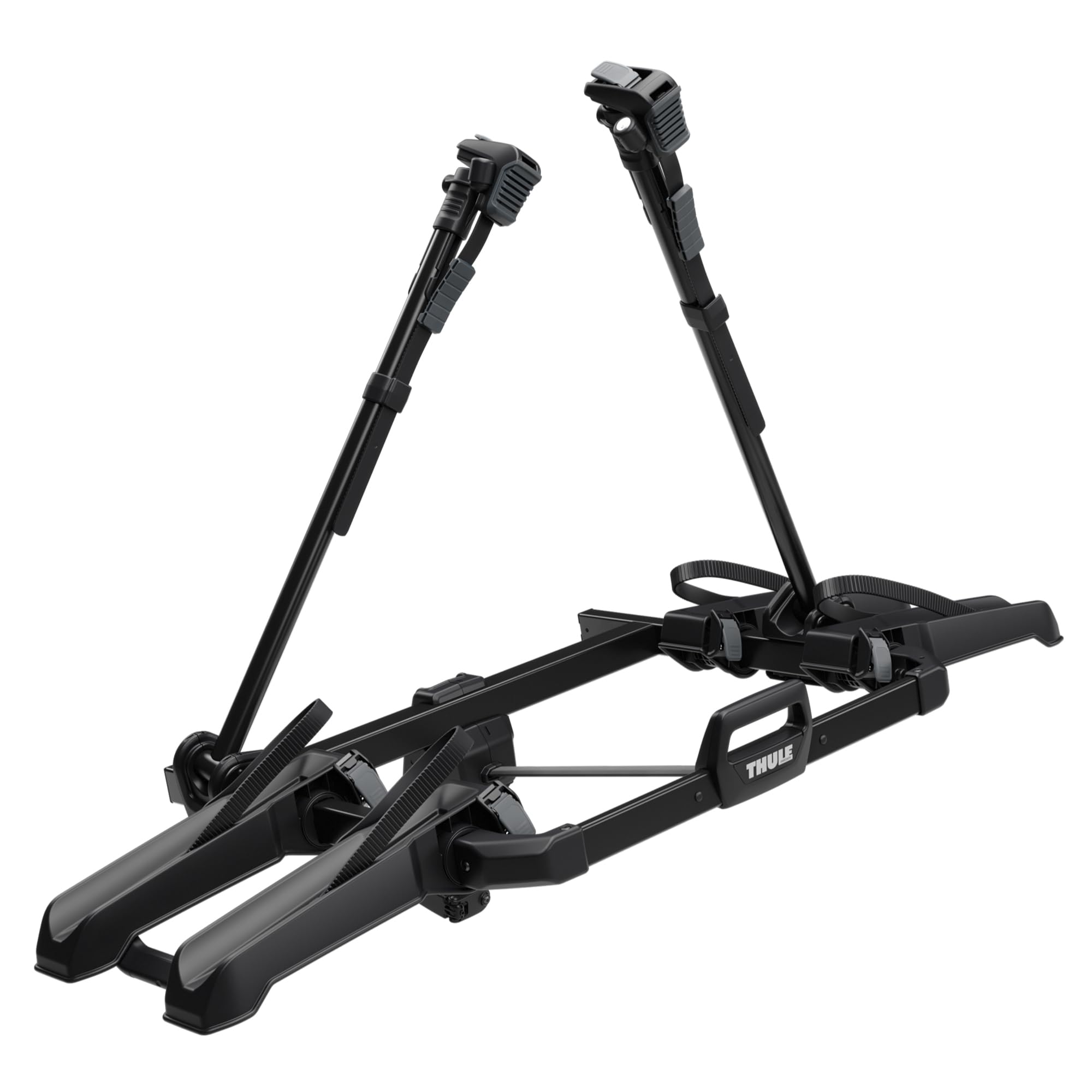
One rack that fits a 1.25-inch receiver or a 2-inch, then disappears into the trunk.
Most hitch racks lock you into one receiver size. The Outpace ships with a 2-inch adapter and works on both 1.25-inch and 2-inch hitches, so it can follow you from one car to the next. The moveable head rotates, slides, and adjusts to grip frame tubes from 0.8 to 3.5 inches wide, which means it finds a hold on almost any bike geometry. Load two bikes in any order — no fighting to sequence them — and it folds down to a compact unit that stores in tight spaces when the trip ends.
Build quality and ease of use are the two things that carry this rack, and both get heavy praise. It feels planted on the road at speed, buyers report running it at 80 mph with minimal movement, and it comes with locks for both the hitch and the bike holders so you can step away. At 33 lbs it is light for a hitch platform — owners note it stores easily because of that. One small-sedan driver tucked it into a trunk without trouble.
The catch is where your money goes. A few owners find it expensive for what it is, and a well-used one can let bikes shift a touch more than expected once loaded. Push against its 110 lb total capacity only with bikes that add up comfortably, since heavier loads are not what this one is tuned for.
The draw: dual hitch fit plus a compact fold — the rack that adapts when your car changes.
The caveat: some bikes move more than ideal once loaded, and premium pricing is part of the deal.
Fits you if: you have a 1.25-inch hitch today and might upgrade to a 2-inch later — this rack covers both.
Better options exist if: you are hauling heavy e-bikes and want a stiffer hold at load.
9. Kuat Transfer V2 2-Bike Hitch Rack
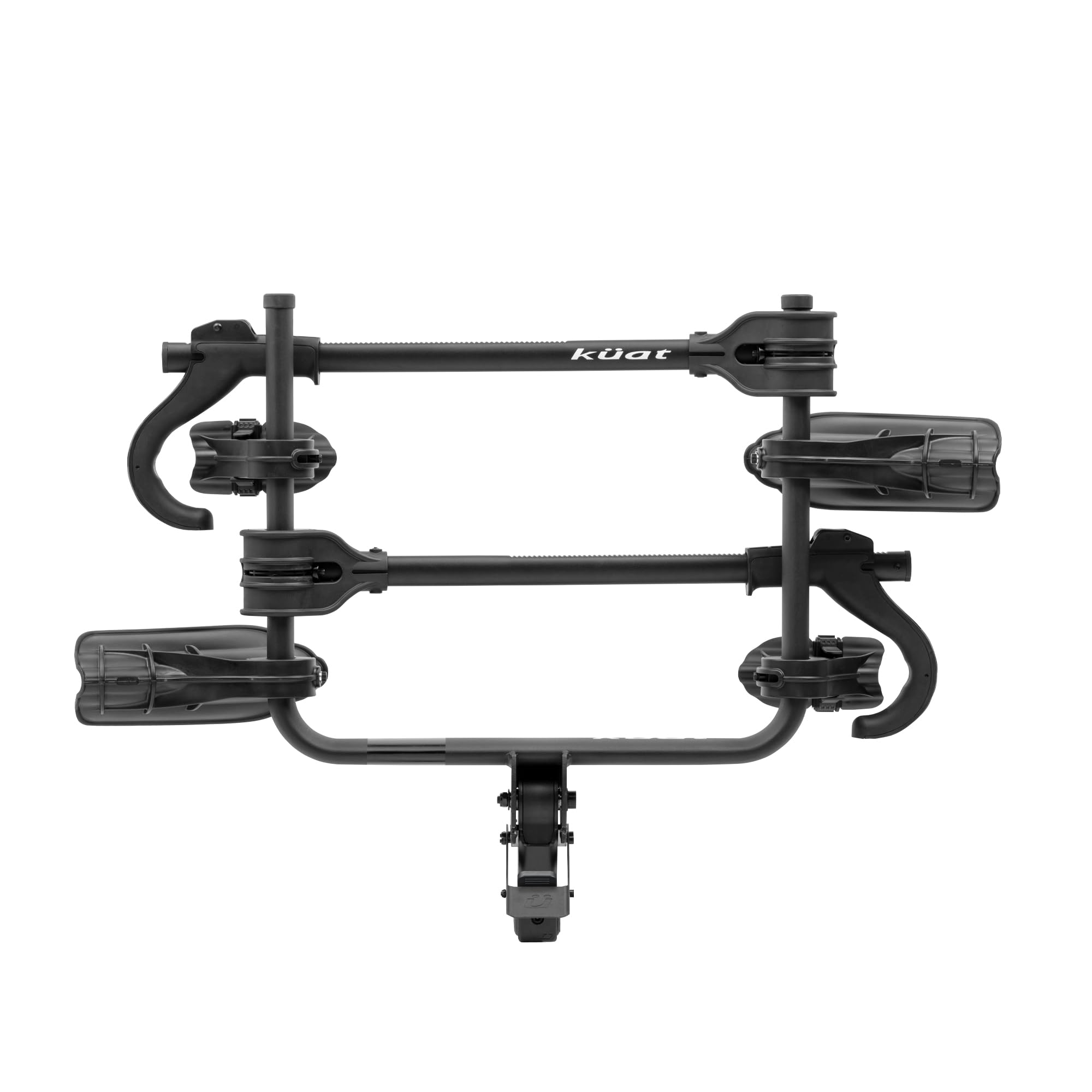
The arms grip the tires, your paint stays untouched, and the hitch cam kills the wobble.
Kuat takes the frame out of the equation entirely. The arms grab the tires instead of the tubes, so a glossy frame and a fresh paint job never see a clamp. Each tray carries 60 lbs in a 2-inch receiver, wheelbases run up to 50 inches, and wheels go from 18 to 29 inches with tires as large as 5 inches when you add the accessory strap. The patented FlatLock hitch cam pulls the rack firm against the receiver, and a semi-integrated cable lock plus tamper-resistant hitch security let you walk away with confidence. Heavy-duty steel and automotive-grade hardware hold it together. Kuat lists it at 37 lbs in the description and 52 lbs in the spec sheet — plan on the heavier end.
An e-mountain bike gets held steady enough to ride out four-wheel terrain, which is the kind of real-world test that matters. Assembly is straightforward, and the rack takes three separate positions that owners use all of them. Long trips and short trips both hold up — one owner runs it twice a week and pulls it off after every use, and the anti-wobble system keeps the joint tight through it all. The dedicated 2-inch version mounts on campers and trailers, provided the receiver is chassis-mounted.
Two things to accept at this tier. You will want to check the tire straps and pull them hard every load — a loose strap is what lets a bike drift in the tray. The step-through frame question also comes up: a bike with a low top tube and an uninterrupted frame may not cradle exactly the way a traditional triangle does, so plan for how the arms reach. Neither is a flaw, just part of learning your rack.
What earns it: frame-free tire grip plus a hitch cam that stops the wobble at the receiver — the combination that makes it feel planted.
What to watch: snug the tire straps every time, and confirm your step-through frame sits the way the arms expect.
Go here if: you want tire-hold security and paint protection on a 2-inch receiver, with locks built in.
Consider another pick if: your budget is fixed at a lower tier or your bike runs a low step-through frame.
Know the Specs
Receiver Size and Hitching Up
The receiver is the square tube under your bumper. A 2-inch receiver accepts most platform racks and carries the load more rigidly; a 1.25-inch receiver is lighter-duty and limits your choices. Some racks ship with an adapter so they work on both. Always check the hitch class before buying a platform rack, because a heavy e-bike rack on an undersized receiver is the wrong match from the start.
Per-Bike Weight versus Total Capacity
A total capacity number can hide a much lower limit on each tray. A rack rated for 160 lbs total may spread that across two bikes at 80 lbs each, or it may assume lighter bikes. Read the per-bike figure and compare it to your heaviest bicycle. For e-bikes, per-bike ratings around 60 to 80 lbs are what you want; trunk racks typically top out far lower.
Anti-Wobble Tighteners and Hitch Cams
Even a snug hitch has slop in the opening, and a loose rack rocks with every bump. A wobble-free tightener or hitch cam pulls the rack hard against the receiver so it cannot shift. This is the difference between a silent highway ride and constant rattle, and it also protects the joint from working loose over many trips.
Frame Contact and Wheel-Hold Designs
Hook-and-ratchet racks clamp the bike frame; wheel-hold racks strap the tires. Frame clamps load faster but press hardware against your paint, while wheel holds leave the frame untouched and suit carbon and glossy finishes. Padded contact points on frame-clamp racks reduce scuffing, and wheel trays sized for wide tires handle fat bikes without extra parts.
Common Questions
Will a hitch bike rack fit my car if I do not have a 2-inch receiver?
Can a trunk rack carry an electric bike?
How do I stop my hitch rack from wobbling?
What is the difference between a platform rack and a hanging rack?
Do I need a front fender on my bike for a roof rack to work?
Is a roof rack or a hitch rack easier for a heavy bike?
Can I use a bike rack on the back of an RV or travel trailer?
Do these racks come with locks for the bikes and the hitch?
How much does a car bike rack weigh once it is installed?
Will a fat tire bike fit on these racks?
The Bottom Line
For most people buying a car bike rack, the Hollywood Racks Sport Rider is the safest call, because 80 lbs per bike covers nearly any e-bike you will own and the wobble-free hitch system keeps the platform quiet on the highway. If your car has no receiver and you want to be riding today, the Allen Sports Deluxe+ hangs on in seconds and stows in the trunk. And for the camper crowd, the Swagman Dispatch is RV-approved at 45 lbs per bike — the one built to stay planted behind a moving rig.
How we choose
We do not accept paid placement. Every pick is matched to a real buyer and a real use-case; we do not hands-on test units.
Sources
Specifications: manufacturer listings and product documentation. Review insights: verified customer reviews, as of November 2026. Pricing: not shown on this page (it changes often); check the current price via the retailer link.
As an Amazon Associate, Tactical Gear Guy earns from qualifying purchases. This does not affect which products we feature.