Specs are compiled from manufacturer listings and verified buyer reviews and can change over time — please confirm the key details on the product page before buying.
You press the shutter button by hand and the frame moves a hair — that hair becomes a blurred star trail or a soft macro shot. A release cable fixes that by putting the trigger on a cord so your hand never touches the camera. The catch is that these cables are not interchangeable: the plug on the camera end must match your exact model, or it will not fire at all. Below you get the compatibility lists, cord lengths, and button setups that decide which one actually works on your camera.
This guide is built by comparing the manufacturers’ published specifications and the patterns across verified customer reviews, so you get each pick’s real strengths and trade-offs instead of marketing spin.
Compatibility is the whole ball game here, so every pick below is checked against a named camera list before it earns a spot. This breakdown of the camera release cable market separates the plugs that fit your body from the ones that will sit in a drawer.
Top Picks

How To Choose The Best Camera Release Cable
The single decision that makes or breaks a release cable is the connector on the camera end. Every other feature — cord length, button count, shutter lock — is worthless if the plug does not seat in your camera’s remote socket. Match the plug first, then choose the extras around how you shoot.
Match the plug to your camera body, not the brand name
Camera makers use several different remote sockets even within one brand, so a cable listed for one Nikon body may not fit another. The Foto&Tech CS-205 is built around the Pentax CS-205 socket, for example, while the Nikon MC-DC2 cord fits a separate set of Nikon bodies. Read the compatibility list on the listing and find your exact model before anything else.
Decide between half-press autofocus and simple fire
A cable with half-press support lets you lock focus with a light touch before you fire, which is how the Pixel RC-201 and the Nikon cord work. A single-button cord like the Foto&Tech fires the shutter without that focus step. If you shoot subjects that move between focus and fire, half-press matters; for star trails and product stills it usually does not.
Think about cord length against your shooting position
A short cord keeps things tidy but pins you close to the tripod. A long cord lets you stand back and watch the frame, which helps when you are waiting out a long exposure in cold air. The trade-off runs both ways: a cable that is too long can snag, and one that is too short forces you to hunch over the camera.
Side-by-Side Comparison
| Model | Best For | Cord Length | Buttons | Shutter Lock | Amazon |
|---|---|---|---|---|---|
| Nikon 25395 MC-DC2★ Best Overall | Nikon DSLR shooters | 1 meter | 1 | Yes | Amazon |
| PIXEL RC-201/E3Best Value | Canon and Fujifilm bodies | 120 cm | 1 | Yes | Amazon |
| Foto&Tech CS-205 | Pentax shooters | 1.1 meters | 3 | Yes | Amazon |
| PROMASTER 20″ Cable Release | Older mechanical-shutter cameras | 20 in | — | Yes | Amazon |
| R RSS TypeC-2.5mm | DJI gimbal and Panasonic bodies | 25 cm | — | — | Amazon |
| Pixel Shutter Release (Nikon MC-30A) | Nikon pro bodies | 120 cm | 2 | Yes | Amazon |
| Sony RM-VPR1 | Sony camcorders and cameras | — | 2 | Yes | Amazon |
Detailed Reviews
1. Nikon 25395 MC-DC2 Remote Release Cord (1 Meter)
Our pick — 4.5+★ from 3,500+ verified ratings; the strongest balance of quality and price.
One button, one meter of cord, zero batteries — the Nikon cord that simply fires.
If you shoot a Nikon DSLR and want a release you never have to think about, this is the one that keeps earning the nod. It runs a single button that copies your camera’s own shutter button, so there is no new set of controls to learn. There is also a shutter lock for long exposures, which means you can hold the shutter open without keeping your thumb pressed down. It draws its power from the camera, so there is no battery to die mid-shoot.
Function is what wins people over here — buyers report it firing every single time, with no lag between the press and the shutter. Quality is the second thing owners keep coming back to; the plug seats solidly and the cord holds up to regular tripod work. Cold weather is not a problem either — owners mention it firing reliably at -15°C. For astrophotography, stacked star trails, and product stills where any shake ruins the frame, it does the job without fuss.
The honest catch is the cord itself — at 1 meter it is shorter than some shooters would like, and that is the one recurring gripe. You will be standing fairly close to the tripod when you fire. That said, the 1.55″L x 6″W x 2.59″H body stays out of the way on a crowded tripod head.
What earns it the top spot
- Battery-free design — powered straight from the camera, so nothing to charge before a cold shoot
- Built-in shutter lock for bulb mode and long exposures
- Consistent, lag-free firing across a wide range of Nikon bodies
Where it falls short
- 1 meter of cord runs out fast — you shoot close to the tripod
- Nikon-fit only, so verify your exact body before ordering
Go for it if: you own a compatible Nikon DSLR and want a no-battery release that fires without fail for long exposures.
Look elsewhere if: you need to stand well back from the camera — a longer cord serves you better.
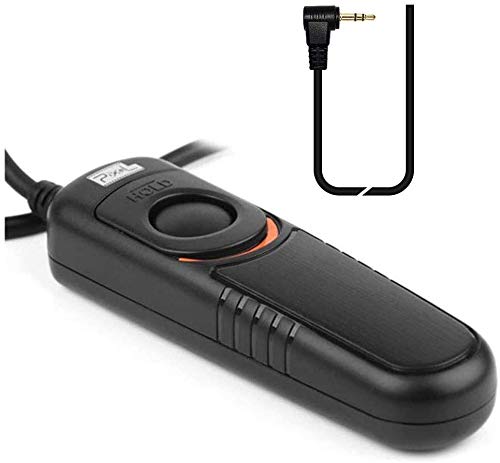
2. PIXEL RC-201/E3 Remote Switch
A Canon-friendly cord that supports half-press focus and gives you 120 cm of breathing room.
Canon EOS and Rebel owners get the most from this one. The compatibility list is unusually broad — it covers EOS R bodies, the Rebel T-line, the 90D and 80D, the M-series mirrorless bodies, and even several Fujifilm, Olympus, and Pentax models on the same plug. At 120 cm the cord is 4.8 times longer than the 25 cm RSS gimbal cable, so you can step back and watch the frame rather than hover over the tripod.
This is a single-button controller that supports half-press to start autofocus, full-press to fire, and a shutter lock for long exposures. That half-press step is the difference between a cable that just fires and one that lets you confirm focus before the shot.
Functionality is the praise that dominates — it fires cleanly through astrophotography sessions and pairs smoothly with bodies like the D7000. Value is the second thread: buyers keep noting the price is right for what it delivers. The trade-off is that it is Canon-and-friends specific — if you shoot a body outside that list, the plug will not fit.
The half-press payoff: locking focus with a light touch before you fire is exactly what you want on a moving subject or a tight macro frame.
The fit check you must do: scan the listed bodies for your exact model — this is not a universal plug.
Reach for this if: you shoot Canon EOS or Rebel and want half-press focus plus a long cord for the mid-range spend.
Pass if: your camera body is not on the compatibility list.
3. Foto&Tech Wired Remote Shutter Release Control CS-205

Three buttons, 2.08 ounces, and a Pentax-specific plug for older bodies.
Pentax shooters with legacy bodies — the 645Z, 645D, K1, K3, K5, and the K100D family — finally get a cable built for their socket. It packs three buttons into a 2.08-ounce body — 3.1 times lighter than the 6.4-ounce Sony RM-VPR1, with three times the button count of the single-button Nikon cord. You get control over autofocus and shutter triggering, plus continuous or single exposures and a shutter lock for extended shots. It runs on camera power, so no battery to carry.
Compatibility is what carries this one — it is the top praise, and the fit with older bodies like the K100D and the K-3 is what keeps buyers coming back. Quality follows close behind. When it works, it works simply: plug it in, turn on the camera, shoot.
The mixed feedback is worth knowing up front. The shutter can stick in the down position and prove hard to release, and the wire lead runs short for some shooters. Value splits down the middle — some call it a bargain against the official Pentax release, others feel you get what you pay for. If you want a Pentax-fit cord without paying the maker’s premium, it earns its place; just treat the button travel gently.
The Pentax advantage
- Three-button layout gives you autofocus, shutter, and lock control
- 2.08 ounces keeps it invisible on the tripod
- No battery — powered from the camera body
The honest caveats
- Shutter can stick in the down position for some units
- Wire lead runs short for shooters who like to stand back
Worth it for: Pentax owners on older bodies who want a multi-button remote without the OEM price.
Think twice if: you need a long reach from the tripod or a feather-light shutter throw.
4. PROMASTER 20″ CABLE RELEASE
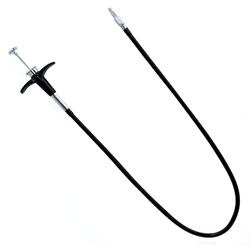
A screw-in plunger cable for cameras old enough to have a mechanical shutter socket.
This one is a different animal from the electronic cords on this list. It is a 20-inch manual cable release that screws into the threaded shutter socket of older film and mechanical cameras — no plug, no electronics, no battery. The heavy-duty build is meant to fire the shutter with minimal vibration, and there is a locking mechanism for time exposures. At 5 ounces it has real heft, which is part of why it feels planted in your hand.
Because it is purely mechanical, it works independently of your camera’s electronics — you screw it in, press the plunger, and the lock holds the shutter open for as long as you need. That makes it a straightforward option for a vintage body or a large-format camera with a mechanical socket.
The catch is scope: it will not fit a modern DSLR or mirrorless body with an electronic remote port. If your camera has no threaded cable socket, this cable has nothing to screw into. For the right mechanical camera, though, it is the simplest release you can own.
Who it serves: shooters running a mechanical-shutter camera who want a no-electronics plunger with a locking screw for long exposures.
Grab it if: you shoot an older camera with a threaded mechanical release socket.
Skip if: your camera uses an electronic remote port — this screws in, it does not plug in.
5. R RSS Control Cable TypeC-2.5mm for DJI Ronin SC

A 25 cm control cable that links a Panasonic body to a DJI gimbal, not a handheld remote.
This is not a shutter remote you hold in your hand — it is a short control cable that plugs your camera into the control port of a DJI RSC 2 or Ronin SC gimbal. It lets the gimbal trigger your camera’s video recording and photo functions, and fire autofocus, so you can run the whole rig from the gimbal handle. The 25 cm length is 4.8 times shorter than the 120 cm Pixel cord — right for a gimbal, where the camera sits inches from the handle.
It is built for Panasonic bodies — the GH3, GH4, GH5, GH5S, G6, G7, and G9 — and made from PVC with a lightweight, durable feel that travels well. Because it is so short, it stays out of the way on a moving gimbal rather than looping and snagging.
The practical limit is the short cord and the narrow fit: it is a gimbal-to-camera link, so if you want to stand back and fire a tripod-mounted DSLR, this is not that cable. For gimbal work with a compatible Panasonic body, it does exactly one job cleanly.
Made for: Panasonic GH-series shooters running a DJI gimbal who want camera control from the handle.
Not for: tripod shooters wanting a long handheld remote — 25 cm will not reach.
6. Pixel Shutter Release Remote Controls MC-30A

Built for Nikon’s pro bodies — the Z8, Z9, and D850 — with a 120 cm reach and two buttons.
Nikon’s high-end bodies use a different remote socket from the entry-level cameras, and this Pixel cord is built around the MC-30A plug to match them. It covers the Z8, Z9, D850, D810, D700, D500, D300, and the D-series pro bodies, plus the Fujifilm S5 Pro and S3 Pro. Two buttons support half-press or full-press firing, and the 120 cm cord is 4.8 times longer than the 25 cm RSS gimbal cable — real stand-back distance on a tripod.
Single shooting, continuous shooting, and long exposure all work through the cable, and RC-201’s brushed pattern gives it a more substantial feel in the hand than plain plastic. Build quality gets close to the official Nikon release, and the price keeps it well under it.
Functionality leads the praise — it fires the shutter without you touching the camera on the tripod, which is exactly the point. The one small gripe is the plug alignment: there is no white dot to guide the connection the way the original has, so you line it up by feel. For Nikon pro-body shooters, the reach and the feel make it a strong mid-range choice.
The reach advantage: 120 cm of cord beats the 1-meter Nikon MC-DC2 for stand-back tripod work.
Minor annoyance: no alignment dot on the plug — you seat it by feel rather than sight.
Pick this if: you shoot a Nikon Z8, Z9, D850, or another pro-body Nikon and want long-cord shutter control.
Look on if: you run an entry-level Nikon body that uses the MC-DC2-style socket instead.
7. Sony RM-VPR1 Remote Control

A Sony remote with an 80-meter range — the longest reach on this list by a wide margin.
Sony owners who want to fire from far away get something no other pick here offers: an 80-meter maximum range versus the 1.1 meters of the Foto&Tech CS-205. That 72.7x gap over the 1.1-meter Foto&Tech cord is the whole reason this one sits at the premium end. It hooks into most Sony cameras and camcorders through the Multi-Terminal cable, and two buttons handle the capture and zoom controls. The lithium battery gives it power independent of the camera.
What wins people over is functionality — it pairs with bodies like the Sony DSC-HX80 and the HX300 and fires reliably. Button responsiveness is the other standout: the motion-free activation lets you shoot extreme macro close-ups and long telephoto shots where even a tiny nudge would ruin the frame. For video, the zoom control gives you a slow creep with a light touch and a faster zoom with a heavier one.
The trade-offs are real and worth weighing. The 6.4-ounce body is bigger and bulkier than the older wired remote, and the plastic feels cheaper than the price would suggest. Value draws mixed feelings, and the wire length is the one thing owners wish were longer. In fairness, it does the job — you are paying for that 80-meter reach and Sony-specific fit, not for a premium feel.
Why Sony shooters want it
- 80-meter range lets you fire from well off the camera
- Motion-free capture for macro and telephoto
- Zoom control for smooth video pulls
The trade-offs to accept
- 6.4 ounces and bulkier than older wired remotes
- Plastic build feels less premium than the price
Best for: Sony camera and camcorder owners who need long-range firing and video zoom control.
Only if: you actually need that range and shoot Sony — otherwise a cheaper short-cord cable does the job.
Know the Specs
Plug compatibility
The plug on the camera end is the make-or-break spec. Camera makers use different remote sockets even within one brand, so a cable for a Nikon Z8 will not fit an entry-level Nikon. Read the compatibility list and find your exact model first.
Cord length and range
Cord length decides how far you can stand from the tripod. A 25 cm gimbal cable keeps the camera close to the handle, while a 120 cm cord lets you step back. Some remotes list an 80-meter range that reaches far beyond any cord.
Shutter lock and bulb mode
A shutter lock holds the shutter open without you keeping a finger pressed down, which is what long exposures and bulb mode need. Look for a lock feature if you shoot star trails or night scenes that run past the camera’s timed limit.
Half-press autofocus
A cable with half-press support locks focus with a light touch before firing. Single-button cables skip that step. If your subject moves between focus and fire, half-press earns its keep; for stills on a tripod it usually does not matter.
Common Questions
Will a Nikon release cable fit my Canon camera?
Do release cables need a battery?
What does shutter lock actually do?
Why do some release cables have half-press and others do not?
Can I use a release cable for astrophotography?
What is the difference between a mechanical cable release and an electronic one?
How long is a typical release cable cord?
Can a release cable work with a gimbal?
Will a release cable drain my camera battery?
The Bottom Line
For most shooters, the release cable that earns the nod is the Nikon MC-DC2 because it fires without lag, runs on camera power with no battery, and includes a shutter lock for long exposures — just confirm your Nikon body uses that socket. If you want half-press focus and a longer cord, the PIXEL RC-201/E3 covers a wide Canon list for a value spend. And for Sony owners who need to fire from across the room, the Sony RM-VPR1 brings the longest range on the list.
How we choose
We do not accept paid placement. Every pick is matched to a real buyer and a real use-case; we do not hands-on test units.
Sources
Specifications: manufacturer listings and product documentation. Review insights: verified customer reviews, as of November 2026. Pricing: not shown on this page (it changes often); check the current price via the retailer link.
As an Amazon Associate, Tactical Gear Guy earns from qualifying purchases. This does not affect which products we feature.