Specs are compiled from manufacturer listings and verified buyer reviews and can change over time — please confirm the key details on the product page before buying.
Your phone in a handlebar bag is a poor speedometer — it lags, the screen washes out in sun, and a bump can send it flying. A dedicated Bluetooth cycling speedometer locks onto satellites in seconds and holds a steady number you can read without squinting. The picks below range from featherweight units that vanish on the bar to color-screen navigators that reroute you when you wander. Most riders are happiest with a light, honest GPS unit that shows speed, distance and time clearly — that is exactly where this list starts.
This guide is built by comparing the manufacturers’ published specifications and the patterns across verified customer reviews, so you get each pick’s real strengths and trade-offs instead of marketing spin.
Weigh the screen size against the waterproofing since those two numbers decide where a unit feels at home, and the best bluetooth cycling speedometer is the one whose button layout never forces you to look down twice.
Top Picks


How To Choose The Best Bluetooth Cycling Speedometer
The common mistake is assuming a bigger screen always means a better speedometer. Plenty of riders buy a huge color navigator and then find the map is useless without a wifi sync routine they never set up. Pick by your ride length and whether you follow routes, not by screen inches alone.
Match screen size to your reading habit
If you glance down for a second at a time, a 1.8-inch to 2.3-inch LCD is plenty and keeps the unit light on the bar. If you plan routes and want turn prompts, a 2.8-inch or 2.9-inch color display earns its weight. Each extra inch of glass adds grams on the bar and battery draw.
The satellite count behind the number
A GPS receiver that talks to more satellite constellations locks your position faster and holds a steadier reading under tree cover. Units that support five systems grab a fix quicker on a cold morning than a dual-system unit. More constellations mean a quicker cold-start fix at the trailhead.
Battery hours that survive a long ride
An endurance rider on a four-hour loop wants headroom well past the endurance number — 25 hours of rated life from a 500mAh battery leaves nothing to chance. A 20- to 25-hour unit still covers commutes and lunch rides. Check whether the charge port is USB-C, since the older micro USB standard is slower to top up.
Side-by-Side Comparison
| Model | Best For | Display | Battery | Waterproofing | Amazon |
|---|---|---|---|---|---|
| iGPSPORT BSC100S★ Best Overall | Everyday GPS tracking | 2.6 in LCD | 40 hours | IPX7 | Amazon |
| XOSS G+Best Value | Strapper on a budget | 1.8 in LCD | 25 hours | IPX7 | Amazon |
| XOSS G Gen2Featherweight Pick | Featherweight daily rider | 2.2 in LCD | 28 hours | IPX7 | Amazon |
| COOSPO BC26 | Entry-level road riders | 2.3 in LCD | 25 hours | IPX7 | Amazon |
| CYCPLUS M1 | Long-range endurance | 2.9 in LCD | 60 hours | IPX6 | Amazon |
| GEOID CC700 | Route navigation first | 2.8 in color | — | IPX7 | Amazon |
| Magene C506SE | Indoor trainer plus road | 2.4 in color | 24 hours | IP54 | Amazon |
| COOSPO CS600 | Touchscreen navigator | 2.4 in touch | 36 hours | IPX7 | Amazon |
| iGPSPORT BSC300T | Offline map touring | 2.4 in touch | 20 hours | — | Amazon |
Detailed Reviews
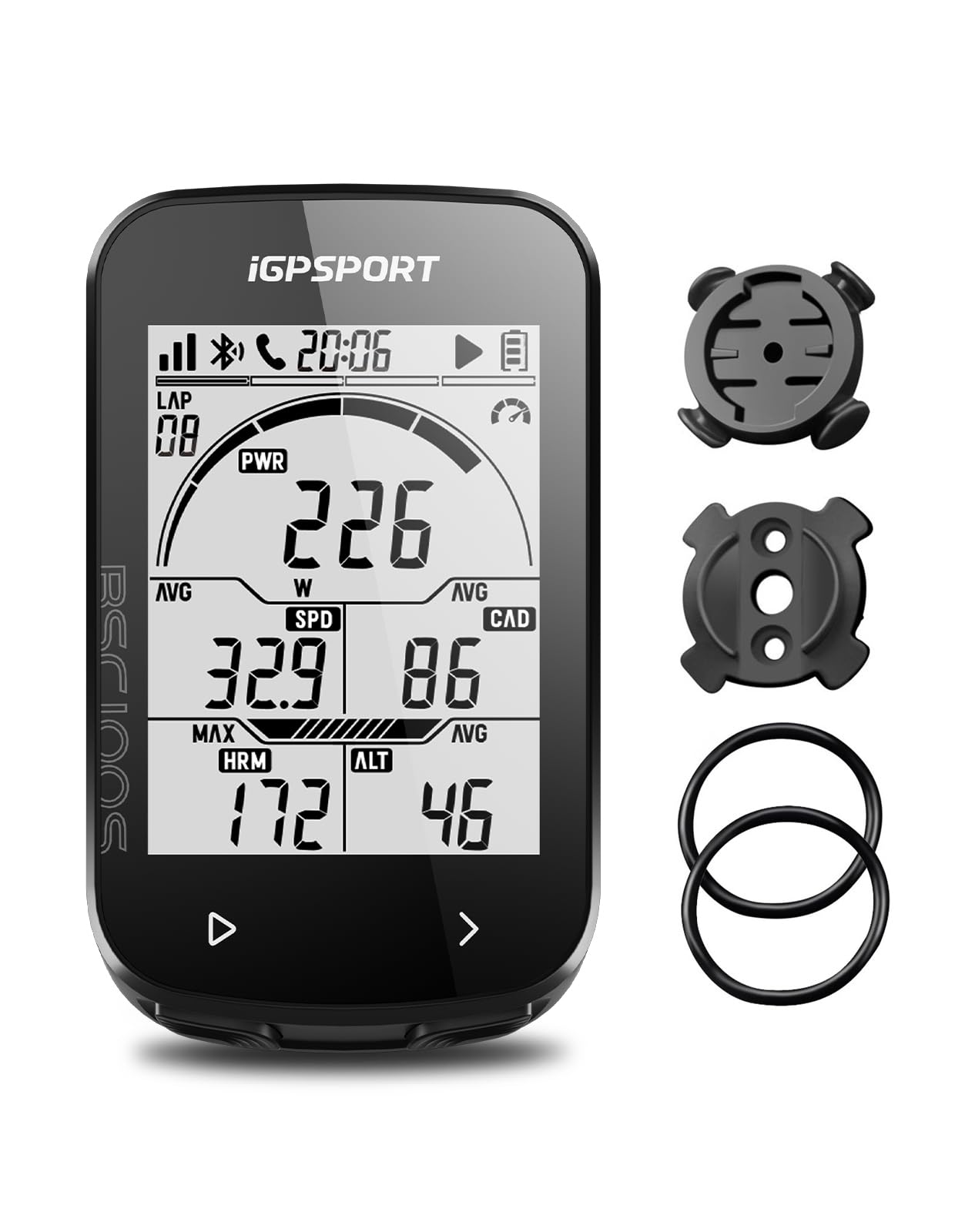
1. iGPSPORT BSC100S GPS Bike Computer
Our pick — 4.0+★ from 700+ verified ratings; the strongest balance of quality and price.
A big anti-glare screen with 40 hours of juice and a satellite lock that grabs fast.
What earns the BSC100S the top spot is the anti-glare glass: sunlight stops washing out your speed read, and riders who wear sunglasses report they can still read it mid-climb. It is a 2.6-inch LCD, so the number sits large enough that a half-second glance tells you everything. Behind that screen sits a receiver that talks to five satellite constellations, which helps it lock on quicker than a dual-system unit when you roll out cold.
The battery is the practical story here — a 600mAh cell rated for 40 hours of riding, and it recharges over USB-C rather than the older micro USB port. On a three-hour weekend loop you will charge it roughly every couple of weeks. IPX7 waterproofing means heavy rain is not a reason to stop riding or pack it away.
Then there is the data. The BSC100S tracks more than 40 riding metrics including speed, distance, grade, cadence and calories, and it pushes everything to the iGPSPORT app for Strava and Komoot sync. Weigh it against the CYCPLUS M1, which holds a slightly larger 2.9-inch screen — the BSC100S trades a fraction of screen for a lighter 120g body on the bar. If you want the lightest rig possible, the XOSS G Gen2 at 42g will feel invisible by comparison.
reliable mount and battery
- Anti-glare 2.6-inch screen stays legible with sunglasses on
- 40 hours of rated battery life off a 600mAh cell
- Five-constellation GPS locks fast under tree cover
- More than 40 data fields plus Strava and Komoot sync
basic screen contrast
- Type-C charging cable is not in the box
- At 120g it is noticeably heavier on the bar than a featherweight unit
the straightforward buy: commuters and weekend distance riders who want a bright, honest speed display without a map screen to learn.
bring your own cable: the box ships without a Type-C cord, so budget for one before your first charge.
2. XOSS G+ GPS Bike Computer
The small-screen, small-spend unit that hands your ride straight to Strava.
The G+ nails the basics: a 1.8-inch HD LCD with auto-backlight, 25 hours off a 500mAh battery, and IPX7 sealing for rain. It pairs with the XOSS app and auto-syncs your ride data to Strava once you bind your account. For the rider who mostly wants distance and speed pushed to a feed, that covers the job.
Where the G+ asks you to be patient is setup and signal. The GPS connection and initial pairing get mixed reactions — plenty of riders get a quick lock, others wrestle with the first-time connection. The fix is the same one the maker suggests: connect to the XOSS app right from the start and check for firmware updates before you ride. The 25-hour rating is shorter than the iGPSPORT BSC100S at 40 hours, so charge more often on long days.
What wins people over is value — it is one of the cheapest ways onto a GPS speed read with heart-rate and cadence sensor support (sensors sold separately). It reads current, max and average speed plus distance and time, and the auto-backlight handles a pre-dawn start.
compact fit for bars: the commuter or casual weekend rider who wants speed, distance and time synced to Strava without spending much — it is a genuinely affordable entry point.
slow satellite lock: the small 1.8-inch screen is the least generous here, so leave it to riders who glance rather than plan routes. Update the firmware before your first ride and the setup gripes mostly fade.
reach for this: if you want a light, affordable speed read and a Strava sync without a learning curve.
look elsewhere: if you want a big readable display or plan on multi-hour unsupported rides where 25 hours starts to feel tight.
3. XOSS G Gen2 GPS Bike Computer
42 grams on the bar — you will forget it is mounted until you glance down.
Weigh it against the iGPSPORT BSC100S and the gap is dramatic: 42g here versus 120g there. On a road bike where every gram on the bars counts, that is a real difference you feel in the steering. The 2.2-inch LCD is easy to read in bright daylight, showing up to 11 data fields with five visible on a single screen at once.
The 500mAh battery is rated for 28 hours, and the port is USB-C, which is the current charging standard — you can top it up from the same cable as your phone. GPS now covers GPS, Beidou and QZSS. Off the bike the XOSS app uploads your ride and pushes it to Strava.
The catch is first-fix patience. The GPS takes around a minute to connect on a cold start, so give it that minute while you snap your helmet on. Quality control shows up in a few reports too — a handful of units arrive with issues, so buy with the one-year support route in mind. Otherwise this is a slim, light speedometer that does the core job cleanly.
the weight-obsessed rider: anyone who counts grams and still wants a clear speed read.
give it a head start: a minute of patience for the first satellite fix is the price of the slim body.
4. COOSPO BC26 Cycling Computer

A sunlight-readable 2.3-inch LCD and dual GPS that quietly uploads your route to Strava.
This unit is built around one job: showing your speed and distance clearly to a newer rider. The 2.3-inch segment FSTN glass screen stays readable in direct sun, and the auto-backlight kicks in as the light drops. Dual GPS positioning tracks your map and can push it to Strava, and it supports current, max and average speed plus total distance, trip distance, cycling time and altitude.
The BC26 is deliberately simple — it does not pair with sensors, which means no heart-rate or cadence input and no indoor riding. That is a fair trade for the clean setup. The CoospoRide app handles device settings, route loading and firmware updates from your phone, and you can set a max-speed alarm that sounds when you overspeed (off by default).
The 25-hour battery covers long adventure days, though the battery life is the topic of mixed feelings — some find it excellent, others report it falling short, so keep an eye on the gauge. On speed readability, buyers report: “Speed display feedback is mixed, with one customer noting it reverts to current speed after about five seconds.”
the newer road rider: someone who wants speed, distance and altitude on a bright screen with minimal setup.
a voided feature: no sensor pairing means no cadence or heart rate — fine for basic tracking, not for data-driven training.
5. CYCPLUS GPS Wireless Bike Computer M1

A 1200mAh tank rated past 60 hours, fronted by the largest LCD on this list.
Endurance is the headline here. The M1 packs a 1200mAh battery rated for more than 60 hours of sustained working time, and it sits behind a 2.9-inch FSTN backlit screen that is size for size the biggest LCD in this group — the XOSS G+ shows just 1.8 inches by comparison. Tempered glass covers the display, so a fingernail drag or a knocked handlebar does not leave a permanent mark.
The screen auto-lights based on sunrise and sunset in your time zone, so it dims for a daylight ride and glows for a night commute. Do set the time zone first on the initial power-up — the maker flags this, because the functions key off it. GPS positioning runs on an imported Swiss chipset, and after a Bluetooth connection to your phone the ride syncs to the CYCPLUS app, with Strava account linking available.
Accuracy is the honest limit worth naming. Speed tracking gets mixed feedback, so treat the number as a solid guide rather than a lab-grade figure — plenty of riders find it close enough for training reads. The M1 cuts no corners on waterproofing either, rated IPX6 to shrug off rain spray on the bar.
long ride battery
- Over 60 hours of rated battery from a 1200mAh cell
- 2.9-inch FSTN screen is the largest LCD here
- Tempered glass resists scratches
- Two-year warranty plus 7/24 support
clunky button feel
- Accuracy feedback is mixed, so treat speed as a guide
- Set the time zone first or the auto-backlight misreads
for the mileage monster: riders who go out for hours and cannot spare a charge.
set the zone first: skip the time-zone step at first power-up and the backlight timing will misfire.
6. GEOID CC700 Bike/Cycling Computer
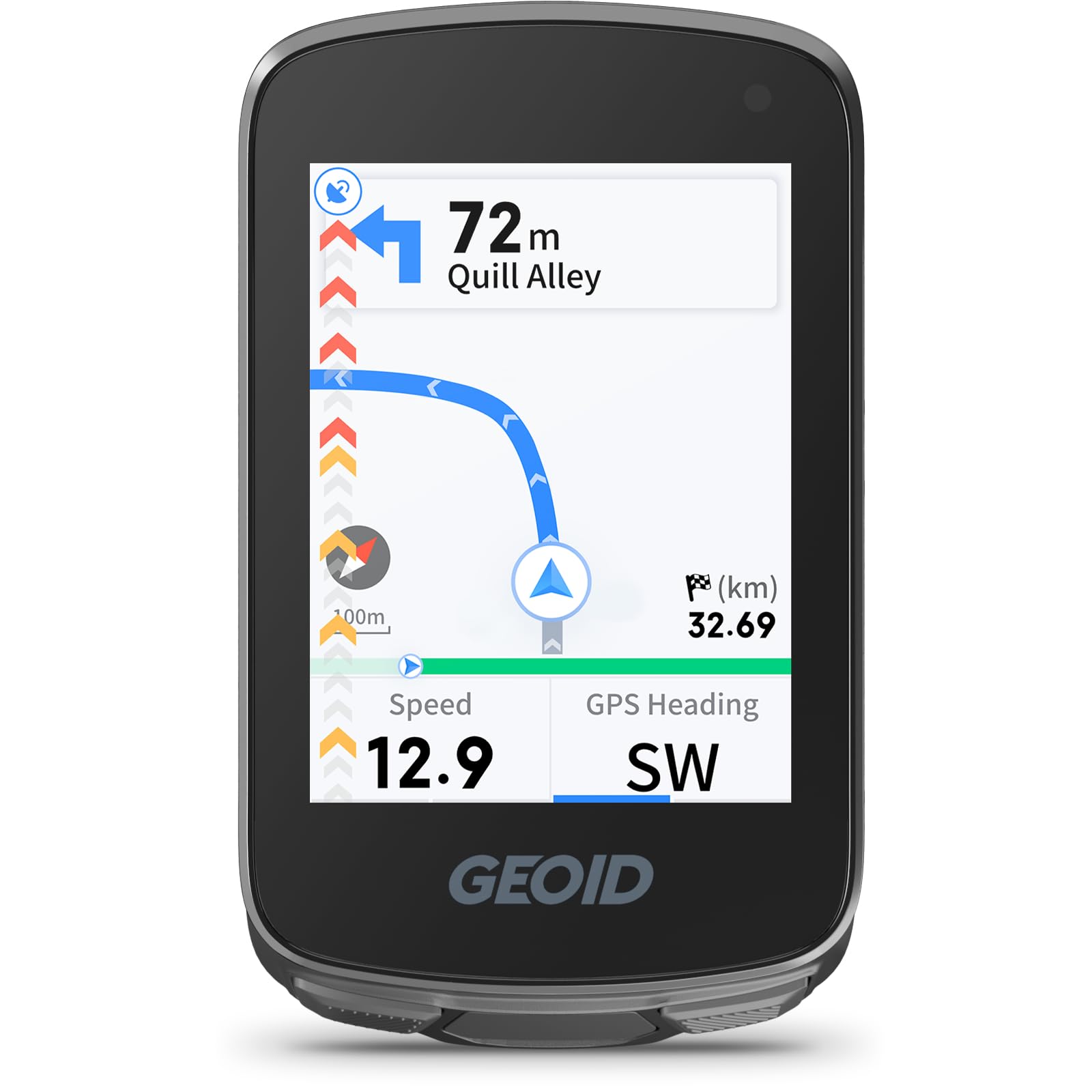
A 2.8-inch color screen that pops a turn reminder and reroutes you when you wander off course.
This is where the list shifts from speed readout to route planning. The CC700 runs a 2.8-inch color display under durable Asahi glass, with a three-button layout you can learn in a minute. Upload a GPX route through the phone app and it gives you turning reminders, zoom on the fly and automatic re-routing when you miss a turn. The display supports numerical charts, circular dials, line graphs and bar charts across up to 10 pages.
WiFi and Bluetooth dual transmission handles AGNSS sync and firmware updates directly on the unit, and the maker says WiFi transfer speeds improve on Bluetooth. Positioning runs five satellite systems with AGNSS claiming a 5-second location fix, and the AGNSS data holds for 14 days. Data-wise it covers 29 display layouts and 108 supported data items, then exports FIT files to Strava and TrainingPeaks.
The maker is upfront that the AGNSS sync must be current and you should power on and off near the same location for the fastest fix — that is the honest upkeep of a navigator. Riders who also train indoors get smart-trainer support with power targets, resistance and gradient control. Note the mapping feature gets mixed feedback — some want fuller on-screen maps — so treat it as route guidance rather than a full topographic atlas.
the route follower: riders who set a course in advance and want turn prompts on a color screen.
keep agnss fresh: a stale AGNSS cache slows the first fix, so sync before you head out.
7. Magene C506SE Wireless GPS Bike Computer

A 74g color unit that talks to nine device types and serves as an indoor trainer brain.
What sets the C506SE apart is connectivity breadth. It pairs via ANT+ and Bluetooth to nine types of devices — speed sensors, cadence sensors, heart-rate monitors, power meters, smart trainers, radar tail lights, smart tail lights and electronic shifting systems. The 2.4-inch color screen shows circular dials, line graphs and bar charts across 108 data items in 14 categories, and the whole thing weighs 74g for easy one-handed handling.
Navigation is the color-screen highlight: upload GPX files or build custom routes through the OnelapFit app, and get off-course alerts with route re-planning and detailed turning road names. Positioning uses a high-precision Airoha chipset that claims a 5-second fix with AGNSS help, and the offline AGNSS stays valid around 14 days. Bluetooth and WiFi dual protocols mean AGNSS syncs and ride uploads happen over WiFi, which the maker says transfers far faster than Bluetooth.
For indoor training it connects to a smart trainer and lets you set power target, resistance and gradient. The one spec to weigh before you buy is the IP54 rating — that stops splashing but is the lightest weather sealing on this list, so consider a different unit if you ride hard in steady rain. Quality feedback on the unit itself is strongly positive.
flexible sensor pairing
- Pairs with nine device types over ANT+ and Bluetooth
- 108 data items with dials, graphs and bar charts
- Indoor trainer support with power, resistance and gradient
- 74g body with a 2.4-inch color screen
rain-sealed ports
- IP54 is the lightest rain sealing on this list
- Most navigation features need the OnelapFit app connected
the data-first trainer: riders who split time between road and smart trainer and want every sensor to connect.
fair-weather friend: IP54 handles splashes, so leave it inside on a steady downpour day.
8. COOSPO Color Touchscreen GPS Bike Computer CS600
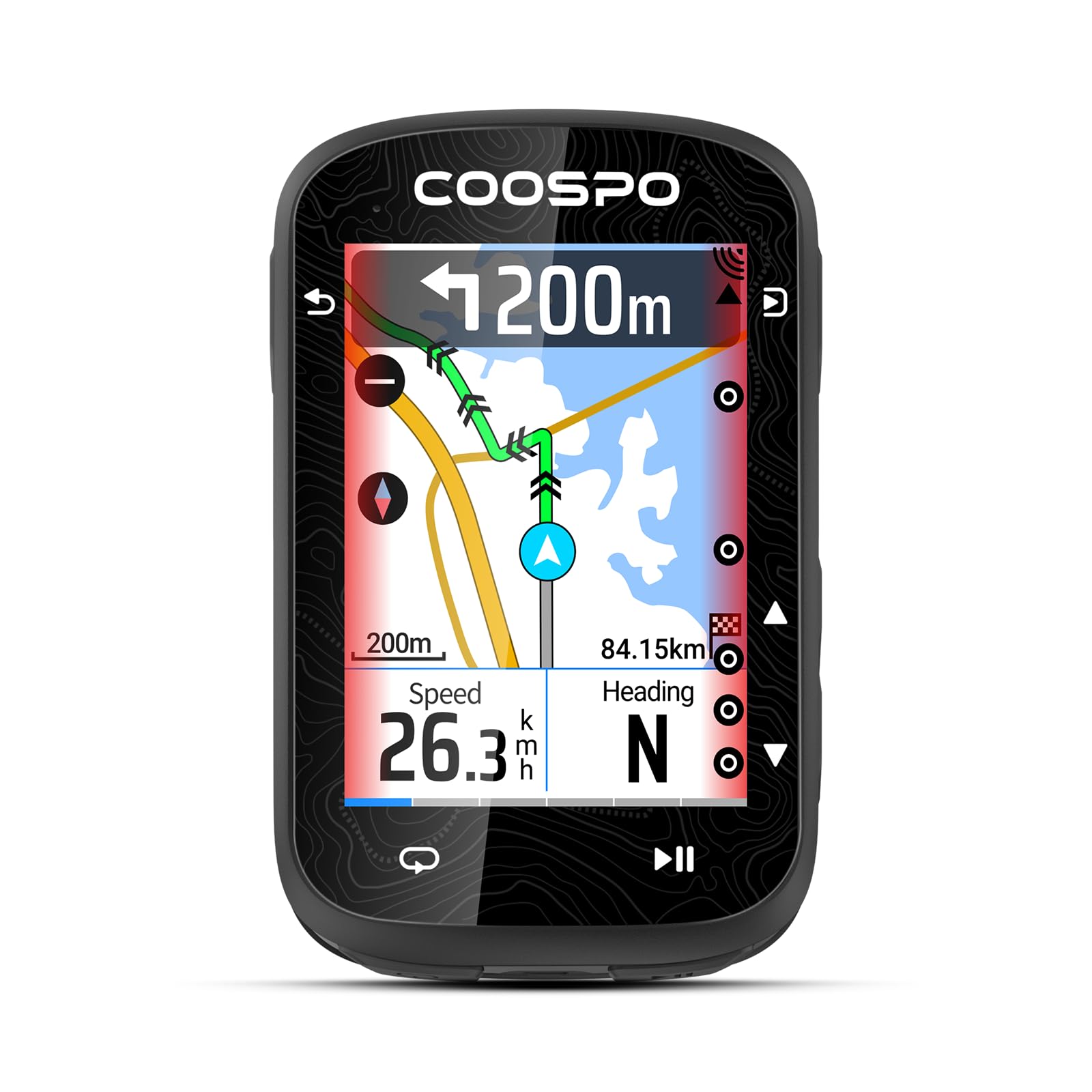
A glass touchscreen navigator with 36 hours of sealed, rain-proof battery.
The 2.4-inch high-resolution color touchscreen is the draw here — auto-backlight adjusts to ambient light, and touch control means no fumbling with buttons for menus. GPS and GLONASS handle tracking of speed, distance, time and route, and you can upload a route or use the breadcrumb trail to follow your path. The screen shows a map view so you know where you are heading.
Battery life runs 36 hours with 2-hour Type-C charging, which covers a multi-day tour without a wall outlet in sight. IPX7 sealing means a full downpour does not stop it, and the data runs to 150+ in-depth metrics for post-ride review. The COOSPORIDE app syncs rides to Strava and TrainingPeaks and pushes custom workout plans to the device. Ecosystem pairing extends to smart bike lights, radar tail lights, e-bikes, electronic shifters and indoor trainers.
Build quality is where the touchscreen earns its keep — it is solid in the hand and the customization is deep. The catch: cadence, heart rate and power need compatible accessories sold separately, and the package does not include an extension mount. So budget for those extras if you want the full training picture, not just speed.
the full-dashboard rider: someone who wants a touchscreen, map view and long battery in one sealed unit.
plan the extras: cadence, heart rate and power sensors are sold separately, so the accessory kit is an added step.
9. iGPSPORT BSC300T Wireless Bike Computer GPS

Offline maps, off-course warnings and 130+ data fields on a touch-and-button screen.
What makes the BSC300T the touring specialist is offline map download. You can save multiple routes, preview them and get turn prompts anywhere on the planet without a phone signal. Cross off course and it warns you until you are back on track. The 2.4-inch touchscreen pairs with six physical buttons, so you can operate it by tap or by click, whichever you prefer in the moment.
It supports five satellite systems for a faster, more accurate fix, and more than 130 riding data fields for deep analysis. Real-time tracking shows teammates’ locations so a group ride does not splinter. Ebike support is a genuine differentiator — it displays power level and other Ebike data, which most units in this list do not carry. It also connects to sensors, Ebike and smart trainer over ANT+ and Bluetooth 5.0.
The catch is battery. At 20 hours it is the shortest-rated unit here, so multi-day touring without a charge is a stretch. Also, the package does not include a Type-C cable, so bring one. At 67g it is one of the lighter touchscreen units though, so those two limits are its honest trade-off.
the adventure tourists: riders who want offline maps and Ebike data rather than the longest battery.
plan the charge: 20 hours of rated life means a power bank on any multi-day trip.
Know the Specs
GPS Constellations
Each satellite system — GPS, Beidou, GLONASS, GALILEO, QZSS — is a separate network of satellites. A receiver that talks to more of them locks your position faster and holds a steadier read under trees or between buildings. The five-system units here are the quickest to grab a fix on a cold start. Some entry units run just two systems, which is fine for open roads but slower at the trailhead.
IPX Ratings Explained
IPX7 means the unit can survive being submerged briefly in water, while IPX6 handles strong water jets and rain spray. For cycling the difference shows up in a downpour: an IPX7 unit keeps working through heavy rain, an IPX6 unit handles rain but not full submersion. IP54, seen on one pick here, means splash resistance only — fine for dry rides, risky in steady rain.
Battery Capacity and Hours
Milliamp-hours (mAh) measure the battery’s energy storage — a 1200mAh cell holds roughly more endurance than a 500mAh one. The listed hours are projected runtime, so a 40-hour rating on a 600mAh battery tells you it draws power efficiently. Match this to your longest ride: a 3-hour loop only needs a fraction of a 25-hour unit, while a multi-day tour wants the higher hours and a USB-C port for quick top-ups.
ANT+ versus Bluetooth
Bluetooth pairs the unit with your phone and the maker’s app for syncing rides and changing settings. ANT+ is the low-energy protocol sensors use to talk to the computer — heart-rate straps, cadence sensors and power meters. A unit that supports both (many here do) can sync with your phone and read your sensors at once. A unit that only pairs with sensors over ANT+ still works, you just manage it from the computer rather than the app.
Common Questions
Will a Bluetooth cycling speedometer pair with my heart-rate chest strap?
How accurate is GPS speed compared to a wheel magnet sensor?
Can I use these speedometers on an Ebike?
How long does the battery last on a long ride?
Do I need the phone app to use these on the bike?
Are these units waterproof enough for rain rides?
What is the difference between a GPS computer and a plain wheel speedometer?
Can I download offline maps for riding without a phone signal?
Which screen size is readable with sunglasses on?
Do these speedometers work with Strava automatically?
The Bottom Line
If you want one unit that is simply right for most riders, the iGPSPORT BSC100S is the pick — a 2.6-inch anti-glare screen, a 40-hour battery off a 600mAh cell, and 40+ data fields with Strava sync. Its 4.0+ star rating and the balance of anti-glare readability and 40-hour battery are what separate it from the cheaper picks. Riders who want a featherweight bar setup should grab the XOSS G Gen2 at 42g. And if route navigation is the priority, the GEOID CC700 earns the reach with its 2.8-inch color screen and automatic re-routing.
One honest nudge: the biggest battery here is the CYCPLUS M1 with its 1200mAh cell rated past 60 hours — if your rides run long and you would rather not think about charging, that is the one to weigh against the BSC100S. Either way, you get a speed read that stays legible long after a phone screen would have dimmed.
How we choose
We do not accept paid placement. Every pick is matched to a real buyer and a real use-case; we do not hands-on test units.
Sources
Specifications: manufacturer listings and product documentation. Review insights: verified customer reviews, as of November 2026. Pricing: not shown on this page (it changes often); check the current price via the retailer link.
As an Amazon Associate, Tactical Gear Guy earns from qualifying purchases. This does not affect which products we feature.