Specs are compiled from manufacturer listings and verified buyer reviews and can change over time — please confirm the key details on the product page before buying.
Buying black work boots is not about picking the toughest-looking pair on the shelf. It is about matching three things to your actual job — what protects your toes, what keeps your feet dry, and what still feels bearable at hour eleven of a twelve-hour shift. Get those three right and the boot lasts through the seasons instead of failing at the seams. Get them wrong and a tight toe box or a slick sole will end your shift early.
This guide is built by comparing the manufacturers’ published specifications and the patterns across verified customer reviews, so you get each pick’s real strengths and trade-offs instead of marketing spin.
Below you will find steel toes, composite toes, pull-ons and lace-ups, sorted by what each one is genuinely best at. The right pair of black work boots for men starts with the toe rating your site requires, the outsole your floor demands and the width your foot needs.
Top Picks


How To Choose The Best Black Work Boots for Men
Most people buying their first proper pair of work boots focus on how the boot looks and how thick the leather feels. That is the wrong order. Start with the safety rating, then the outsole, then the fit — because a boot with a great toe cap and a slippery sole is a boot that will put you on the floor.
Toe protection comes in two materials, and they are not the same
A steel toe is a metal cap built into the front of the boot that takes the impact when something heavy drops. A composite toe does the same job with a non-metal material, which matters if you walk through a security scanner at a plant gate.
Look for the ASTM F2413 rating printed on the boot or the listing. That rating is the safety standard covering impact resistance, compression resistance and electrical hazard protection. If a boot says it is EH rated, it is built to reduce the risk of a shock from accidental contact with live circuits.
Slip resistance lives in the outsole compound, not the tread depth
A deep lug pattern helps on mud and gravel, but the real test is an oily concrete floor. Outsole materials like TPU and rubber blends are chosen for how they grip when there is a film of oil or water between them and the ground. If your job involves coolant, grease or wet tile, put slip resistance ahead of every other feature.
Waterproofing is a construction method, not a leather type
Seam-sealed construction and direct-attached soles are what actually stop water reaching your socks. Leather that has been treated will shed rain for a while, but water finds the seams first. On a boot that lists waterproof construction, that tells you the seams were dealt with at the factory rather than left to the leather alone.
Width is the fit problem that bites hardest
A work boot that is right in length but tight across the ball of the foot will hurt more than a boot that is slightly long. Steel toe boxes eat into interior room, so buyers with wide feet should look for boots that sell in wide sizing or that owners describe as roomy across the toes.
Side-by-Side Comparison
| Model | Best For | Toe Type | Safety Rating | Construction | Amazon |
|---|---|---|---|---|---|
| Timberland PRO 8″ Direct Attach MaxTRAX★ Best Overall | Cold, wet outdoor sites | Steel | ASTM F2413-18 M/I/C EH | Direct attach, seam-sealed waterproof | Amazon |
| Timberland PRO Pit Boss 6″Premium Pick | Electrical hazard environments | Steel | ANSI safety standards | Nylon shock-diffusion plates | Amazon |
| ARIAT Rebar Lift 6″Best Cushioning | Cushioning over long outdoor days | Composite | — | Waterproof, lightweight build | Amazon |
| KAM-LITE Slip On Chelsea Safety Boot | Quick on-and-off around the shop | Steel | — | Chelsea slip-on, elastic sides | Amazon |
| NINGO Waterproof Steel Toe | Long shifts on mixed surfaces | Steel | ASTM F2413-24 I-75 / C-75 EH | Direct attach, full-grain leather | Amazon |
| Hunthor Steel Toe Rubber Boot | Mud, water and washdown work | Steel | — | Full rubber, steel shank, puncture-proof | Amazon |
| BOIWANMA Heavy Duty Safety Boot | Wide feet, hot surfaces | Steel | — | Leather and nylon, oil/slip/heat resistant | Amazon |
| CAT Second Shift Steel Toe | An everyday boot that crosses over | Steel | — | Leather upper, rugged build | Amazon |
| ARIAT Work Sierra Steel Toe | Barn, farm and high-heat work | Steel | ASTM F2413-11 M/I/75 C/75 EH | Goodyear welt, Duratread outsole | Amazon |
Detailed Reviews
1. Timberland PRO 8″ Direct Attach MaxTRAX Steel Toe
Our pick — 4.5+★ from 800+ verified ratings; the strongest balance of quality and price.
The eight-inch shaft, the sealed seams and the winter lining that make cold outdoor shifts far more bearable.
If your job puts you outside in wet and cold conditions, this is the pair to start with. The upper is waterproof leather with seam-sealed construction, which means the seams — the first place water gets in — were treated at the factory. A breathable, moisture-wicking lining sits inside to move sweat away from your foot over a long shift.
The 200 grams of Thermolite insulation is the detail that separates it from the lace-ups further down this list. That is a thin synthetic layer built to trap warmth without turning the boot into a sauna, so it suits cold mornings and unheated warehouses. Underneath, the TPU outsole carries the patented SR Max MaxTrax tread — a tread design made specifically to grip where oil and water sit on the floor. It is also nonmarking, so it will not scuff a finished floor.
Comfort is held up by the Timberland PRO 24/7 comfort system and a PU midsole, both aimed at reducing foot fatigue across a full day standing on hard ground. The steel toe carries an ASTM F2413-18 M/I/C EH rating — impact, compression and electrical hazard protection in one line. The catch is the shape: the fit runs narrow, and buyers with wide feet regularly find the toe box tight. The other thing to weigh is price — this sits in the premium tier, and a few owners feel the durability does not stretch far enough to justify it. Quality is what wins people over by a wide margin, though, and it is the most-praised single trait of any boot here.
What earns its place up top
- Seam-sealed waterproof leather plus a moisture-wicking lining — dry feet even through a wet shift
- 200 grams Thermolite insulation for cold sites where an unlined boot leaves you numb
- SR Max MaxTrax slip-resistant TPU outsole built for oily and wet floors
- ASTM F2413-18 M/I/C EH rating covering impact, compression and electrical hazard
Where it asks something of you
- The fit runs narrow, so wide-footed buyers should plan on sizing up or looking elsewhere
- Premium-tier build, and a handful of owners feel the longevity falls short of the outlay
Take this one: if you spend your day outdoors, on wet ground, in cold weather, and you want a steel toe with real winter insulation behind it.
Measure first: the narrow last — if your feet run wide, try a half size up or pick a boot sold in wide widths.
2. Timberland PRO Pit Boss 6 Inch Steel Safety Toe
A six-inch steel toe with a roomier toe box than most, built for people who are on their feet all day.
Where the eight-inch Timberland above leans on insulation and a tall shaft, the Pit Boss goes the other way — shorter, lighter, and shaped around a wider toe box. Timberland’s own description says the steel toe meets ANSI safety standards and leaves more room across the toes than other steel caps. For anyone who has bruised a toe on the inside of a tight steel cap, that is the spec worth paying attention to.
Traction is the other headline. The outsole is described as giving an unsurpassed grip on wet or slippery surfaces, and the boot carries electrical hazard protection against accidental contact with live circuits. Inside, a removable sock liner means you can swap in your own orthotic and keep the boot, and nylon shock-diffusion plates add support and torsional rigidity — the stiffness that stops the boot twisting underfoot on uneven ground.
The honest part: durability splits opinion. Some owners get years out of a pair, others see them come apart within months, and that inconsistency is the real risk on a boot at this tier. There is also the weight question — the listing shows 1.83 pounds, which is light for a steel toe industrial boot and part of why people reach for it as an everyday work shoe rather than a heavy-site boot.
The roomier toe box: a steel cap that does not press on your toes changes how a twelve-hour shift feels, and this is the Timberland model built around that idea.
What to accept: the sole-to-upper bond is the weak point in some pairs, so it is not the boot to buy if you need guaranteed years of service.
Suits you if: you want a lighter steel toe with toe room to spare and you work around live circuits.
Think twice if: you need a boot that will reliably last multiple seasons — the durability record here is uneven.
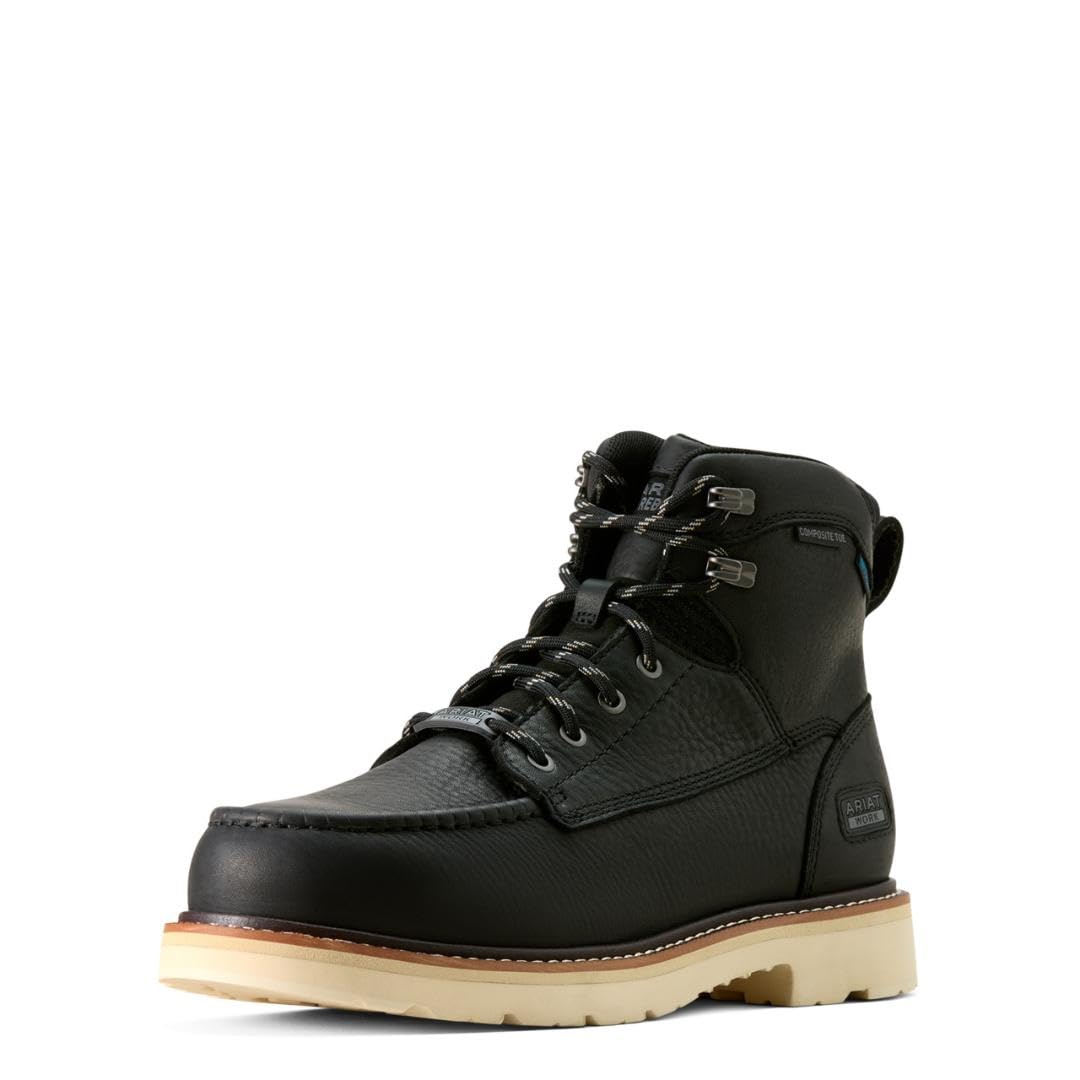
3. ARIAT Men’s Rebar Lift 6″ Waterproof Composite Toe Work Boot
The only composite toe on this list — no metal cap, and cushioning aimed squarely at long days.
Composite toe versus steel toe is the decision that sends people to this boot. A composite cap is built from non-metal material, so it will not set off a metal detector at a plant gate and it does not conduct cold the way a steel cap can. Ariat describes the Rebar Lift as lightweight yet durable, with cushioning and stability tuned for long work days and built to handle outdoor conditions.
The support is what owners talk about most, and there is a specific detail behind it: the elastic at the ankle lets you squat down without the boot fighting you. That is the kind of thing that matters if your job has you kneeling, crouching or climbing in and out of equipment all shift. Appearance and foot support both get consistent praise, and the waterproof build covers you on wet ground.
Now the warning. Durability is the one aspect where the feedback turns genuinely negative — soles peeling apart and boots coming apart after a couple of months are the recurring report. That is a serious caveat on the most expensive boot here, and it means this is a pick for someone who values the composite toe and the cushioning enough to accept the risk. If you need a boot that will take years of abuse without a thought, this is not the one.
Reach for it when: you need a metal-free toe for scanner gates and you want the most cushioned ride on this list for long outdoor days.
Fair warning: sole separation is the specific failure buyers report — inspect the bond early and keep your receipt.
4. ARIAT Work Sierra Steel Toe

A pull-on steel toe built for barnyard acids, oils and heat, with a Goodyear welt holding it together.
Some jobs are not about concrete floors at all. If you work around livestock, feed, fertilizer or high-heat surfaces, the materials have to resist things that eat ordinary soles. The Duratread outsole here is described as oil- and slip-resistant and highly resistant to barnyard acids and oils, which is a different brief from a warehouse boot.
The construction is old-school in the best way — a Goodyear welted build with a 90-degree heel, plus Ariat’s ATS technology and a gel-cushioned footbed for comfort through a full day at the barn. The steel safety toe carries an ASTM F2413-11 M/I/75 C/75 EH rating, so impact, compression and electrical hazard protection are all covered. Owners consistently describe these as durable and long-lasting, and the leather keeps looking new with care.
The trade-off is weight and break-in. At 4 pounds with a welted leather build, this is a substantial boot, not a light sneaker-style work shoe. And because it is a pull-on with no laces, the fit is what it is — there is no tightening across the instep to rescue a loose fit. Buy the right size the first time.
Built for the yard, not the office: acid and oil resistance plus a 90-degree heel is a combination made for farm and ranch work.
The straight answer on fit: no laces means no adjustment, so get the sizing right or you will live with the slip.
Your boot if: you work around animals, chemicals or heat and you want a welted leather pull-on that shrugs off the mess.
Not your boot if: you want a light, laced fit you can tune — this one is heavy and fixed.
5. CAT Men’s Second Shift Steel Toe

The boot that has been on job sites for years and still gets bought for both work and weekends.
There is a reason this one shows up on so many feet. Cat’s Second Shift is a steel toe leather work boot styled to look fine off the clock, which is why people buy it as their only pair. The leather holds its appearance and the build is described as rugged, so it does not look beaten up after a month of site work.
Where it wins is the crossover — comfortable enough to wear out of the house and tough enough to earn its keep. Fit runs narrow for some buyers and right-out-of-the-box for others, and the sole separating from the upper is the durability issue that comes up. Size runs are the single complaint that shows up as outright negative in the feedback, so order the size you actually measure rather than the size you think you wear.
Compared to the Pit Boss above, the Second Shift is the boot you pick when you want sound construction and a leather look without paying premium-tier money. It is a genuine everyday compromise, and for a lot of buyers that is exactly right.
Pick it for: one boot that does site work and Saturday errands without looking out of place.
Check the size chart: sizing is the recurring complaint, so measure your foot rather than guessing.
6. BOIWANMA Heavy Duty Steel Toe Leather Safety Boot

Available in wide sizing and rated for heat, oil and slip — the pick for broad feet on hot surfaces.
Heat resistance is the spec that rarely gets listed and often matters most. This BOIWANMA boot is built to resist oil, slips and heat, with a crazy horse leather and nylon cordura upper that takes abrasion without turning brittle. It comes in both medium and wide widths, which is not something many boots on this list offer.
The EVA and rubber outsole carries a rubber toe reinforcement for extra wear at the front, and the brand’s own sizing note is worth repeating — if your foot length sits between two sizes, move up. Quality and appearance get the most praise by a distance, and both are the reasons people keep coming back to this model.
What you need to know before buying: durability is split. Some owners call them dependable, others report them falling apart inside 60 days, and traction draws disagreement with some saying they are not slip-resistant at all. Fit is also mixed, with the toe box too small for some. This boot earns its slot on the strength of the quality and the wide sizing, not on a guarantee of long service.
Go for it if: you have wide feet and need heat and oil resistance on the sole — that combination is scarce at this tier.
Go in aware: traction and long-term durability do not hold up for every buyer, so treat this as a working boot rather than a buy-once pair.
7. NINGO Waterproof Steel Toe Work Boots
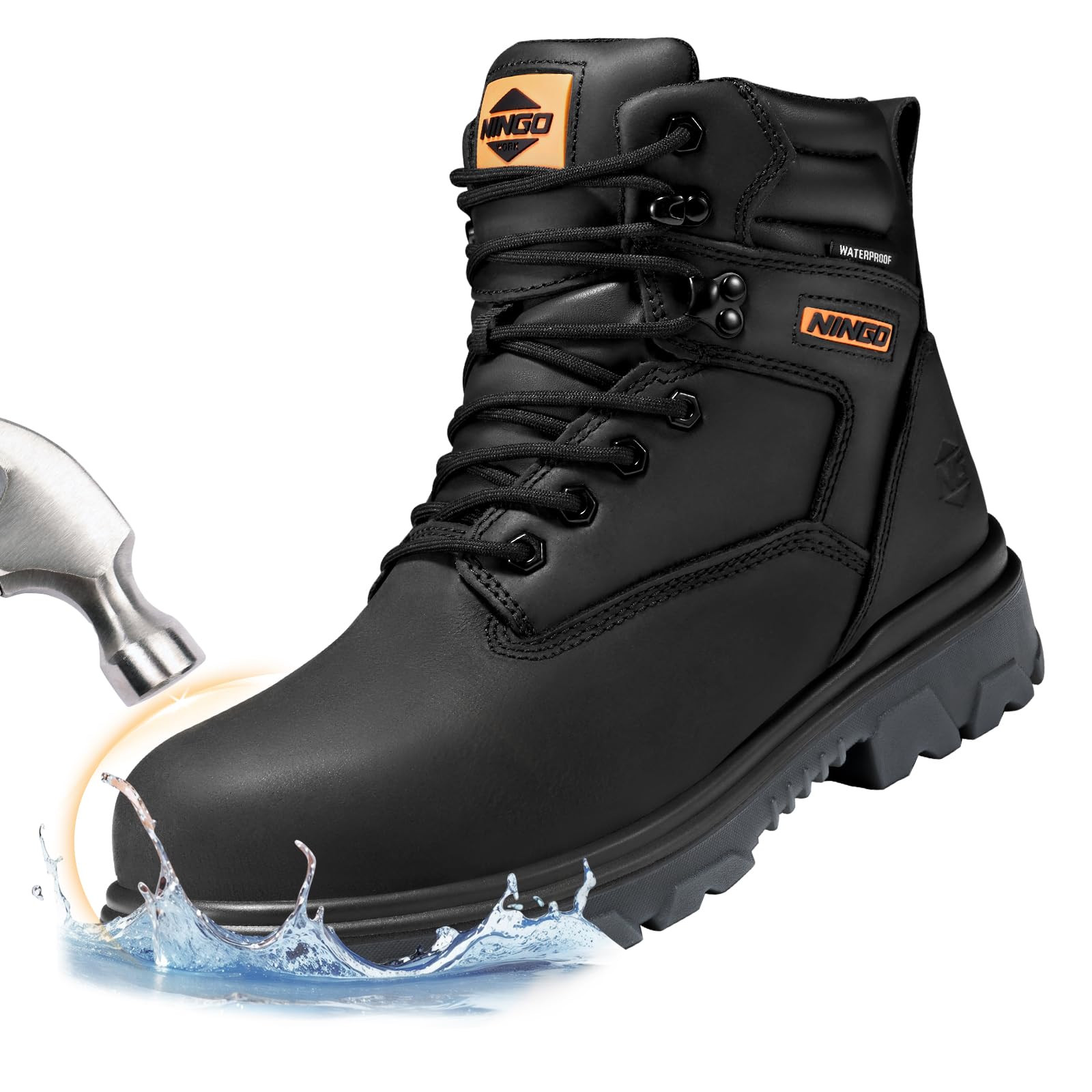
The one that needs no breaking in — comfort first, with a steel cap rated to the current standard.
This NINGO boot sits in the middle tier and does the most important thing a mid-range work boot can do: it feels comfortable from day one. The full-grain leather upper resists abrasion and holds its look, and direct attach construction bonds the outsole to the upper so it resists separation over time — a real concern on boots that get wet and dry out repeatedly.
The steel safety toe meets ASTM F2413-24 standards for impact at I-75, compression at C-75, and electrical hazard protection. That is a current-generation rating, and it covers the three hazards that most often put people on the injury list. Underneath, the TPU SR lug outsole grips on wet, oily and uneven ground — the maker states TPU delivers up to three times the abrasion resistance of traditional rubber outsoles.
Inside, a removable high-rebound insole with gel heel padding takes the shock out of standing and walking on hard surfaces, and it comes out if you wear your own inserts. Comfort is what this boot is known for, and value for money runs a close second. Weight is the one thing owners disagree on, so if a light boot is essential, try to handle one before committing.
Why it earns the mid-range slot
- Comfort with no break-in period — the standout trait, ahead of everything else
- ASTM F2413-24 steel toe at I-75 and C-75 with EH protection
- Removable gel-padded insole you can swap for your own orthotic
- TPU SR lug outsole built for wet, oily and uneven ground
Where the picture gets murky
- Weight is a genuine split — some find it heavier than expected for an all-day boot
- It sits in the middle tier, so it gives up some of the premium leather feel above it
Buy this if: you want to walk from the start and onto the floor without a two-week break-in, with a current-standard steel toe.
Hold off if: you want the lightest possible steel toe — weight is the point of disagreement here.
8. Hunthor Steel Toe Rubber Work Boots

Full rubber, a steel shank underfoot and a rear kick tab — the boot for mud and washdown.
Leather boots are great until you are standing in a foot of water. This Hunthor boot is rubber through and through, with a puncture-proof steel shank running under the foot to stop nails and debris from pushing up through the sole. If your work involves mud, hose-downs, slurry or standing water, rubber is the correct material, and leather is the wrong one.
The practical details are well thought through. The back gusset adjusts to different calf sizes, so it fits over trousers or bare leg without flapping. A kick tab at the heel lets you pull them off without bending — handy at the end of a wet shift. The anti-slip outsole also wipes clean of mud easily, which keeps the tread working instead of packed solid.
Waterproofing, warmth and keeping feet dry are the strengths, and the rubber shell does both jobs. The honest limitation is the material itself: cracked rubber is the durability issue reported, and the boot is heavy, which is the nature of a full rubber build. It is also over-the-calf height, so it is a dedicated wet-weather boot rather than one you wear for everything.
The material is the feature: rubber plus a puncture-proof steel shank is the combination you want when the ground is wet and full of debris.
What you give up: a rubber boot is heavy and will eventually crack, so it is a wet-weather tool rather than a daily driver.
Get these if: your shift involves standing water, mud or hose-downs and you need a steel toe with a puncture-proof sole underneath.
Leave them if: you want one boot for every day — heavy rubber is not what you want on dry concrete.
9. KAM-LITE Slip On Steel Toe Chelsea Safety Boots

Elastic sides, no laces, and the cheapest way onto a steel-toed site.
This is the entry-level pick, and it earns that label by doing one thing better than the lace-ups: it goes on and off in a second. The Chelsea design uses elastic side panels instead of laces, which is exactly what you want if you are stepping in and out of boots several times a shift or if bending to tie laces is a chore.
It is also waterproof and easy to clean — the surface repels water and stains, which keeps the boot looking presentable and dry inside. Lightweight and good-looking are the two things owners praise most. The steel toe gives you the protection you need to get through the gate, and the slip-resistant outsole is designed for grip on hard floors.
Here is the fair picture on comfort: it splits cleanly. Some people find it super comfortable; others report it rubbing hard on the lower shins and back of the ankle while it is new. The same split shows up on width and on long-term durability. Read that the way it should be read — this is a lighter-duty boot with a shorter expected life. For light site work, warehouse shifts or a backup pair, it does the job.
The case for the entry tier
- Elastic Chelsea sides mean zero lacing — on and off in seconds
- Water-resistant surface wipes clean and keeps socks dry
- Lightweight for a steel toe, which keeps fatigue down on a lighter shift
What the price asks back
- Break-in rubs some owners on the shins and back of the ankle
- Durability is a mixed field — plan for a shorter working life than the leather boots above
Right match for: light site work, warehouse shifts or a second pair you keep by the door.
Wrong match for: heavy-duty daily abuse — the build is not sized for years of concrete.
Know the Specs
ASTM F2413 — The Safety Line That Matters
ASTM F2413 is the standard a work boot is tested against, and the letters after it tell you what it survived. Impact (the I number) measures resistance to a falling object on the toe. Compression (the C number) measures how much a steady load the toe can take. EH means electrical hazard protection, built to reduce shock risk if you contact a live circuit. If a boot lists no rating, ask the seller for one before you buy.
Steel Toe vs Composite Toe
Steel caps are metal, so they do not set off nothing — they do set off metal detectors and they conduct cold. Composite caps use non-metal material and skip the detector, which matters at plant gates and secure sites. Both types are tested to the same impact and compression standards. Pick composite if you pass through scanning; pick steel if you want the most established option and weight is not the deciding factor.
Outsole Compound and Slip Resistance
TPU, rubber and EVA each behave differently underfoot. TPU is chosen for abrasion resistance and grip on oily surfaces. Rubber is the choice for wet and muddy ground. EVA is a midsole material, lighter and softer, which is why it often appears in the cushioning layer rather than the outsole. Match the outsole to the surface you actually stand on, not to the one in the photo.
Waterproof Construction Methods
Direct attach means the outsole is bonded straight to the upper, which reduces the number of places water can enter. Seam sealing treats the stitching lines specifically, and those seams are the first failure point on a wet boot. A Goodyear welt stitches the sole to the upper instead, which is repairable and very durable but adds weight. All three work; they fail in different ways.
Insulation Weight in Grams
Insulation is measured in grams, and the number tells you how much warmth the boot traps. Higher grams suit colder conditions; lower grams suit active work where you would overheat. A boot with no insulation listed is an unlined boot, which is the right call for warm shops and summer sites. Buy insulation for the coldest shift you work, not the average day.
Shank and Support
A steel shank is a stiff strip running under the arch that stops the boot folding underfoot and blocks punctures from below. Nylon shock-diffusion plates do a similar job with less weight and add torsional rigidity — resistance to twisting on uneven ground. If you work on ladders, scaffolding or rocky ground, a shank or plate is the spec to look for. Flat boots without one flex more and tire your arches faster.
Common Questions
Will black work boots fit my wide feet?
Do I need a steel toe or a composite toe for my job?
What does EH rated actually mean on a work boot?
How long should a pair of black work boots last?
Are waterproof work boots really waterproof or just water resistant?
Can I wear black work boots as everyday shoes?
Do steel toe boots need breaking in?
What is the difference between direct attach and Goodyear welt?
Are slip-resistant soles safe on oily concrete?
The Bottom Line
For most people shopping the black work boots for men, the Timberland PRO 8″ Direct Attach MaxTRAX is the pick to beat — it combines seam-sealed waterproof leather, 200 grams of Thermolite insulation, a steel toe rated to ASTM F2413-18 and a slip-resistant TPU outsole in one boot. Quality is the most-praised trait on this entire page, and it is the crowd favourite at 4.5+ stars across 800+ owners. If you need the lighter, roomier steel toe for electrical work, the Timberland PRO Pit Boss carries the biggest following of the whole group. And if you want to skip the break-in and get straight onto the floor, the NINGO Waterproof Steel Toe is the comfortable all-rounder with a current-standard rating behind it.
Match the toe type to your security gate, the outsole to your floor surface and the width to your own foot — do those three and the boot lasts past spring.
How we choose
We do not accept paid placement. Every pick is matched to a real buyer and a real use-case; we do not hands-on test units.
Sources
Specifications: manufacturer listings and product documentation. Review insights: verified customer reviews, as of November 2026. Pricing: not shown on this page (it changes often); check the current price via the retailer link.
As an Amazon Associate, Tactical Gear Guy earns from qualifying purchases. This does not affect which products we feature.