Specs are compiled from manufacturer listings and verified buyer reviews and can change over time — please confirm the key details on the product page before buying.
A 65-inch LED TV hangs on your wall for years, and a weak backlight or a dim panel shows up every night. The good news: at 65 inches every panel is 4K, so the real differences come down to dimming zones, peak brightness, refresh rate, and whether the smart software stays out of your way. One honest note before you scroll — this list uses flexible, human-like matching for “about 65-inch screen,” so not every pick is the exact number you typed, though each one is the same standard 65-inch class and serves the same purpose. Below, each spec is explained in plain English by what it does to the picture on your wall.
This guide is built by comparing the manufacturers’ published specifications and the patterns across verified customer reviews, so you get each pick’s real strengths and trade-offs instead of marketing spin.
Big screens are a long-term buy, so the specs that matter are the ones you notice after the box is gone: motion handling on sports, glare in a sunny room, and enough HDMI ports for a console, a soundbar and a streaming stick. This breakdown covers all thirteen picks, with dimming zones, nits and refresh rate noted for each, so you can match one to your room instead of a spec sheet.
Start with the backlight type and its peak brightness, not the brand badge, and this list of 65-inch led tv options sorts itself out fast.
Top Picks

How To Choose The Best 65-Inch LED TV
A 65-inch panel fills most living-room walls, so the buying decision depends on how the TV lights that panel and how it handles motion. The short version: edge-lit versus Mini-LED and the peak nits it can hit matter more than any logo on the bezel. Here is what each decision point actually does for you while you are sitting on the couch.
Backlight type: plain LED, Mini-LED, or full-array
A standard LED TV lights the screen from the edges, which keeps the set thin and the price lower. Mini-LED packs thousands of tiny LEDs behind the screen instead — on the Hisense U8 Series that means up to 5600 local dimming zones — so dark scenes stay dark next to bright highlights instead of washing grey. If you mostly watch daytime TV and news, an edge-lit set is fine. If movie nights matter, zones are the spec to chase.
Brightness and HDR formats explained
Nits measure brightness, and a brighter panel beats glare from windows and makes HDR highlights (a streetlight, a sun glint) actually pop. Pair brightness with the right HDR formats — Dolby Vision, HDR10+, HDR10 and HLG are the four names you will see — and the TV can read each scene and adjust contrast frame by frame. A set without those formats still looks good; it just clips the brightest moments.
Refresh rate, VRR and game features
Refresh rate in Hz is how many times per second the screen redraws — 60Hz is the baseline, and 120Hz or 144Hz pans smoother during a fast ball game or a racing title. VRR (Variable Refresh Rate) matches the screen to a console’s frame output so you stop seeing torn frames, and ALLM (Auto Low Latency Mode) drops the TV into its fastest picture mode the moment you pick up a controller. If you game, check these three together.
Side-by-Side Comparison
| Model | Best For | Backlight | Refresh Rate | Smart Platform | Amazon |
|---|---|---|---|---|---|
| Roku 65-Inch Plus Series★ Best Overall | Everyday streaming | Mini-LED / QLED | — | Roku TV | Amazon |
| Toshiba 65″ M450 SeriesBudget Champion | Budget QLED | QLED | 60Hz | Fire TV | Amazon |
| Sony BRAVIA 2 II (K-65S20M2)PlayStation Pairing | PS5 owners | LED | — | Google TV | Amazon |
| TCL T7 Series (65T7) | Motion-smooth sports | QLED | 144Hz | Google TV | Amazon |
| Hisense 65″ E7 Cinema (65E7SF) | Dark-room movies | Mini-LED / Hi-QLED | 144Hz | Fire TV | Amazon |
| Toshiba 65″ Z670R | Console gaming | Mini-LED / QLED | 144Hz | Fire TV | Amazon |
| Philips 7985 Series Ambilight | Ambience and wall glow | QLED | 120 PMR | Roku TV | Amazon |
| Samsung QN70H Neo QLED | Color volume | Quantum Mini-LED | — | Tizen | Amazon |
| Samsung QN70F Neo QLED | Bright-room picture | Quantum Mini-LED | 144Hz | Tizen | Amazon |
| Hisense 65″ U8 Series (65U8QG) | Peak brightness | Mini-LED / QLED | 165Hz | Google TV | Amazon |
| TCL QM8L Series (65QM8L) | Halo-free contrast | SQD-Mini LED | 144Hz | Google TV | Amazon |
| Sony BRAVIA 5 (K-65XR50) | Creator-accurate picture | Mini-LED | — | Google TV | Amazon |
Detailed Reviews
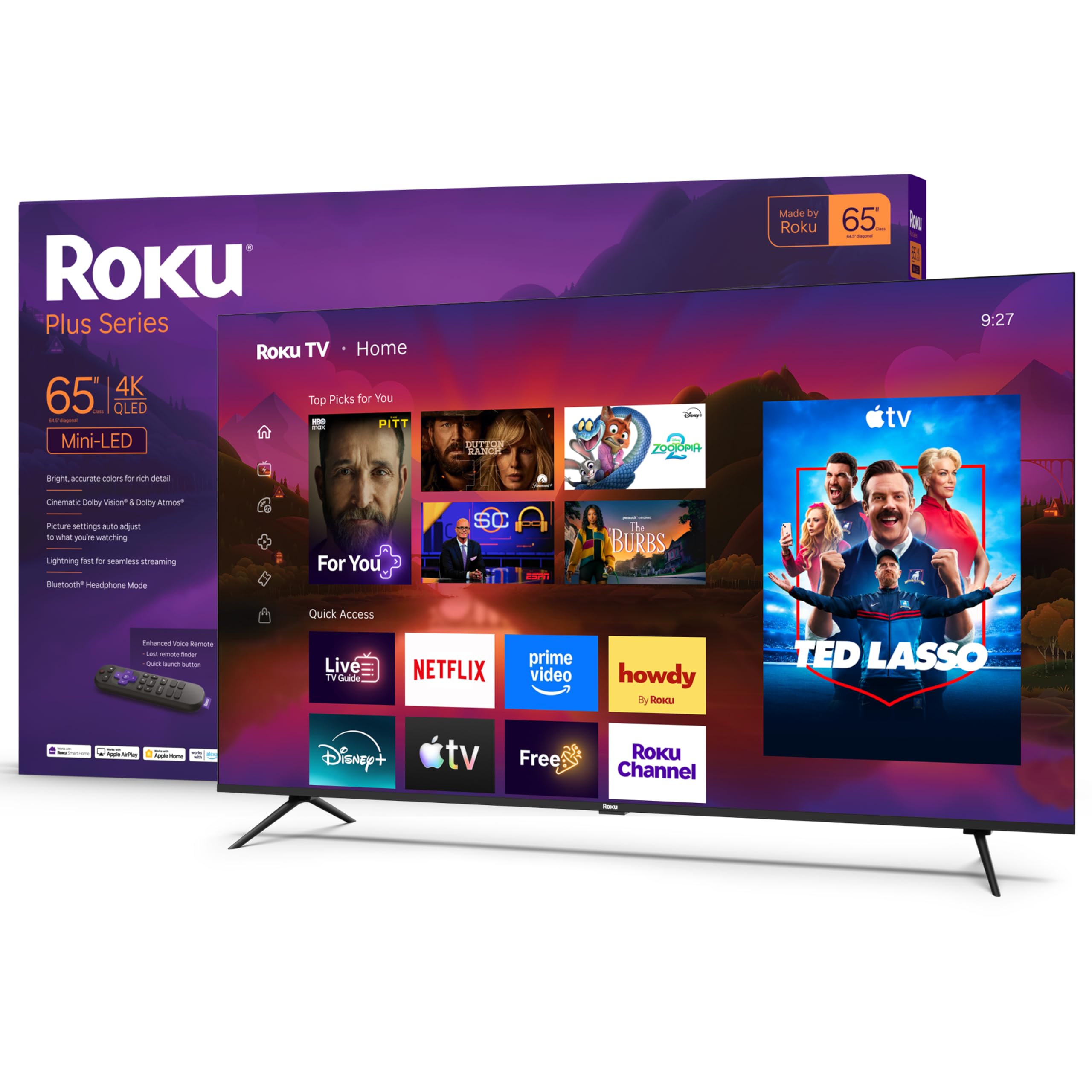
1. Roku 65-Inch Plus Series Smart TV — 4K QLED Mini-LED RokuTV
Our pick — 4.0+★ from 800+ verified ratings; the strongest balance of quality and price.
Mini-LED zones and a built-in subwoofer, without the flagship sticker shock.
The Roku Plus Series earns the top spot by putting the two specs that matter most into one set: a Mini-LED backlight (thousands of tiny LEDs behind the screen rather than a few at the edges) paired with a QLED layer, so dark scenes stay deep and colors stay rich at the same time. Add Dolby Vision, which reads each scene and adjusts brightness and contrast frame by frame, and a bright sunset on screen stops looking washed out. It is the crowd favorite here — 4.0+ stars across 800+ owners — and quality is what wins people over most, with picture quality right behind it.
Sound is the sleeper feature. A built-in subwoofer gives dialogue some weight without you buying a soundbar on day one, and Dolby Atmos processing spreads effects around the room. Bluetooth Headphone Mode lets you watch a late movie without waking the house, and the star key on the remote turns the display off while the audio keeps playing. Roku’s own Home Screen keeps your apps where you left them, and the enhanced voice remote can find itself when it slides under a cushion.
The catch is long-term reliability — most sets tick along exactly as promised, but the review pages carry a real minority whose panel gave out early, including one that quit after 32 days. Buy from a seller with a clean return window and register the set on day one. The other trade-off is that this is Roku’s own picture engine doing the upscaling work, not a premium-brand processor, so older cable content looks good rather than flawless.
Where it pulls ahead
- Mini-LED backlight plus QLED color on a mid-range budget
- Built-in subwoofer and Dolby Atmos carry movie audio without extra gear
- Roku interface is the least confusing smart platform for a household with mixed tech comfort
- Bluetooth Headphone Mode and the lost-remote finder solve real nightly annoyances
What to weigh first
- A minority of units fail early — check the return window before mounting it
- Roku’s picture processing is workmanlike next to Sony’s, so low-bitrate cable channels show their age
- Audio upgrades still help; the built-in sub is a starter, not a home theater
Best for: A family that wants one good-looking 65-inch set, one remote, and no soundbar shopping.
Look elsewhere if: You demand the most accurate processing on older sources or you want the longest factory warranty in this lineup.
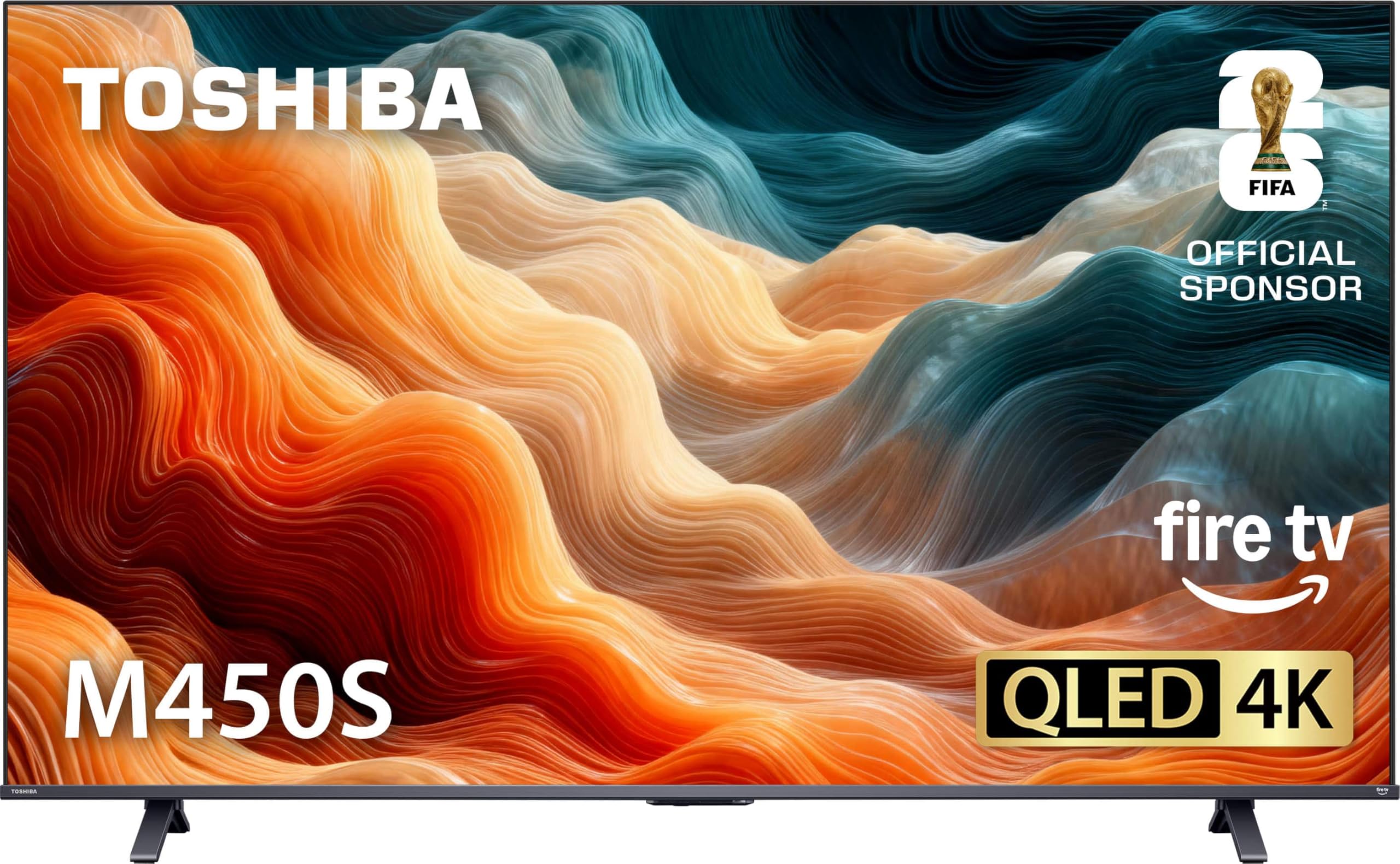
2. TOSHIBA 65″ Class M450 Series QLED 4K UHD Smart Fire TV
The cheapest way into QLED color and a screen that takes voice commands.
If your ceiling is entry-level, the M450 is where the money goes furthest. QLED color (a quantum-dot layer that widens the range of shades the screen can show) makes sports and nature footage look richer than a plain LED panel, and the REGZA engine upscales older channels to near-4K sharpness so your old sitcoms do not look soft. The 60Hz refresh rate is the honest limit — fine for most shows and casual gaming, not the panel you buy for competitive shooters. Quality and picture quality are what buyers warm to, and setup is quick enough that the box is gone before the popcorn finishes.
Fire TV does the heavy lifting on the software side: Alexa is on the remote, so you press and ask for a show instead of typing it, and the Home Screen mixes live channels with your apps. Dolby Vision and Dolby Atmos are both on board, which is unusual at this tier and makes movie night look and sound better than the price suggests.
The trade-off is connectivity. Bluetooth pairing draws complaints more than any other topic on this set, so plan on the wired or Wi-Fi route for anything that must stay connected. Color also skews hot — reds and pinks can glow more than they should until you dial the saturation back in the picture menu. Neither is a reason to walk away; both are ten-minute setup fixes.
Value read: This is the pick for a guest room, a first apartment, or a kitchen-adjacent wall where the TV is on all day and nobody is counting dimming zones. skip it if a console with 120Hz output is in your near future.
Reach for this if: You want QLED color and Alexa voice search without stretching the budget.
Pass if: Bluetooth headphones or a wireless soundbar are central to how you watch.
3. Sony BRAVIA 2 II 65 Inch
Sony’s processing brain in the most affordable BRAVIA body, tuned for a PS5.
The thing that separates this set from the cheaper picks above is the 4K Processor X1. It is Sony’s picture engine, and it does the unglamorous work that makes a TV feel expensive: Motionflow XR smooths fast pans so a football throw does not smear, and 4K XR-Reality PRO rebuilds detail in older HD content until it sits close to 4K. Setup is a genuine ten-minute job on Google TV, and the color quality is the part that buyers consistently like.
If a PlayStation 5 lives under your screen, this is the pairing to beat. Auto HDR Tone Mapping and Auto Genre Picture Mode let the console tell the TV what it is playing, and the TV switches picture modes on its own — no menu diving before a boss fight. The Game Menu gathers those settings in one place, and the Eco Dashboard keeps the energy settings together if you care about the electricity bill.
The trade-offs are real but specific. Sony’s own sound is thinner than a subwoofer-equipped rival, so budget for a soundbar if movie audio matters. Wi-Fi connectivity draws the most consistent criticism — several sets drop the signal — so a wired Ethernet run is the smarter install if your router is anywhere close.
The case for it: You are buying Sony’s motion handling and console integration, not a brightness war.
The honest limit: An entry-level LED panel here, so dark-room contrast cannot touch the Mini-LED picks further down.
Buy it if: A PS5 is your main source and you want the TV to keep up automatically.
Skip if: You watch mostly in a dark room and want inky blacks.
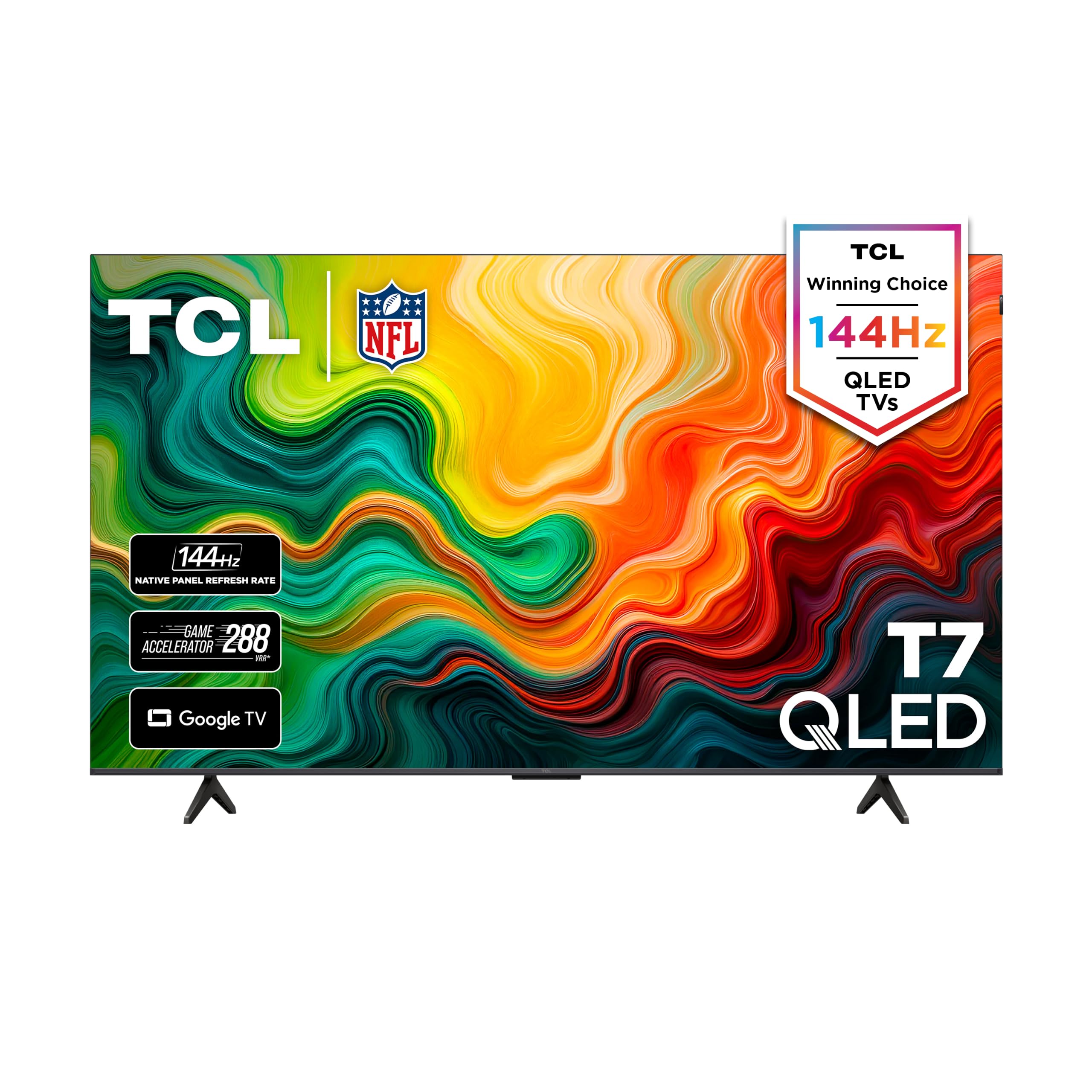
4. TCL 65 Inch T7 Series 4K 144Hz QLED Smart Google TV (65T7)
A 144Hz panel at a mid-range tier, built for people who flinch at motion blur.
Sports fans and gamers share one enemy: blur. TCL’s answer here is a 144Hz panel refresh rate — the screen redraws 144 times a second, more than twice the 60Hz baseline — so a sweeping camera shot or a fast break stays sharp instead of smearing. Motion Rate 480 with MEMC frame insertion fills the gaps between frames, and the result is the smoothest sports picture in this article’s cheaper half.
The panel itself is QLED, with the quantum-dot layer covering nearly the entire DCI-P3 color space (the range of shades the set can reproduce), and the TCL AIPQ Pro processor tunes color, contrast and clarity scene by scene. HDR PRO+ supports Dolby Vision, HDR10+, HDR10 and HLG together, so whichever format a streaming service sends, the TV can read it. Four HDMI inputs — one with eARC for a soundbar — mean a console, a cable box and a stick all stay plugged in at once, and the bezel-less FullView 360 design with height-adjustable feet lets a soundbar slide underneath.
What to know before buying: reliability is the mixed topic, with a portion of long-term owners reporting a set that stopped working entirely. Most units run fine, but treat the return window as part of the purchase. Sound is the other mild letdown — Dolby Atmos processing helps, but the speakers are ordinary, so a soundbar is the natural upgrade.
Why motion lovers pick it
- 144Hz refresh rate plus MEMC frame insertion handles live sports cleanly
- Four HDMI ports with eARC keep every source connected
- Full HDR format support across Dolby Vision, HDR10+ and HLG
- Adjustable feet clear space for a soundbar underneath
The fine print
- A segment of buyers report early failure — test all inputs during the return period
- Built-in audio is adequate, not cinematic; the eARC port is there for a reason
- Upscaling of very old SD channels is competent rather than remarkable
Fits best in: A living room where the TV is tuned to football and racing more often than film.
Choose another if: You want the deepest black levels in a dark theater room.
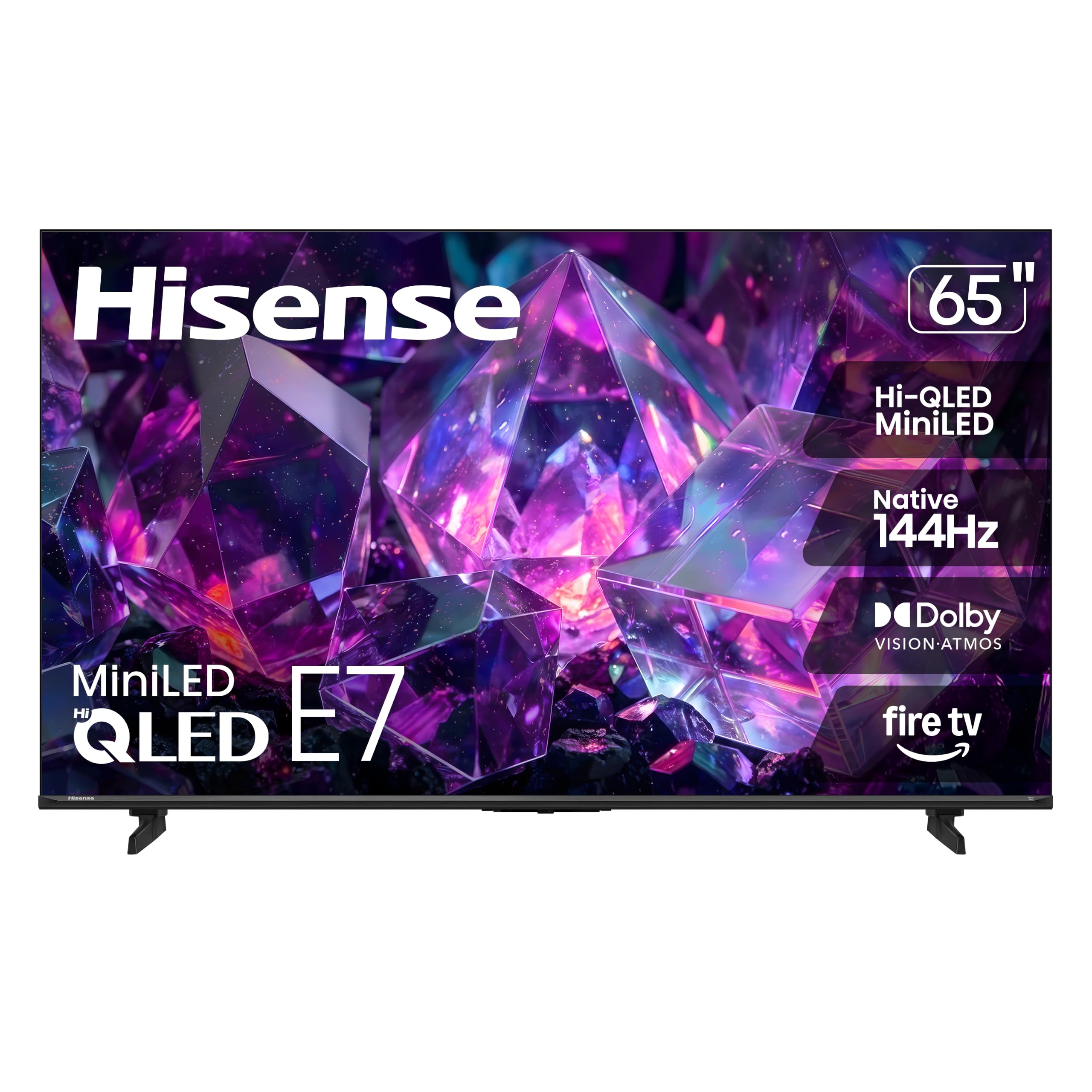
5. Hisense E7 65″
Thousands of Mini-LED zones and an anti-glare screen that survives a lit room.
The E7 Cinema is the moment Hisense’s picture tech gets serious. Mini-LED backlighting divides the screen into thousands of precise light zones, so a night scene keeps its shadows while a lamp in the frame stays punchy — the contrast control that a plain LED panel cannot match. Add Dolby Vision and the total HDR spread (Dolby Vision IQ, HDR10+ Adaptive, HDR10 and HLG all together) and the set reads whatever a service throws at it. Deep contrast, popping colors and the anti-glare screen are what buyers call out most.
The native 144Hz mode is the other headline. Fast camera pans in action films and rapid motion in games stay fluid, and AI Smooth Motion with MEMC sharpens fast scenes without the soap-opera ghosting lesser processors leave behind. Gamers get reduced blur and quicker response the moment a controller wakes up. The AI Light Sensor also reads your room and adjusts the backlight on its own, so a bright afternoon and a dim evening both look right without you touching a slider.
One thing to size correctly: reliability is the divided topic here — most sets run as promised, and a minority cut out unexpectedly. Handle the return window like the safety net it is. Otherwise the honest knock is that the Fire TV interface nudges you toward sponsored rows more than some rivals; switch to the apps-only view and it disappears.
What wins people over: The zone count relative to the price — this is genuine Mini-LED contrast, not a marketing badge on an edge-lit panel.
The follow-up question: Will it outlast the last TV? Cover the early-window risk with the seller’s policy and you have done all a buyer can.
The right call for: A dark or mixed-light living room where contrast matters more than the badge on the bezel.
Not the one if: You refuse to deal with an early exchange or you strongly dislike Fire TV’s home screen.
6. Toshiba Z670R 65″
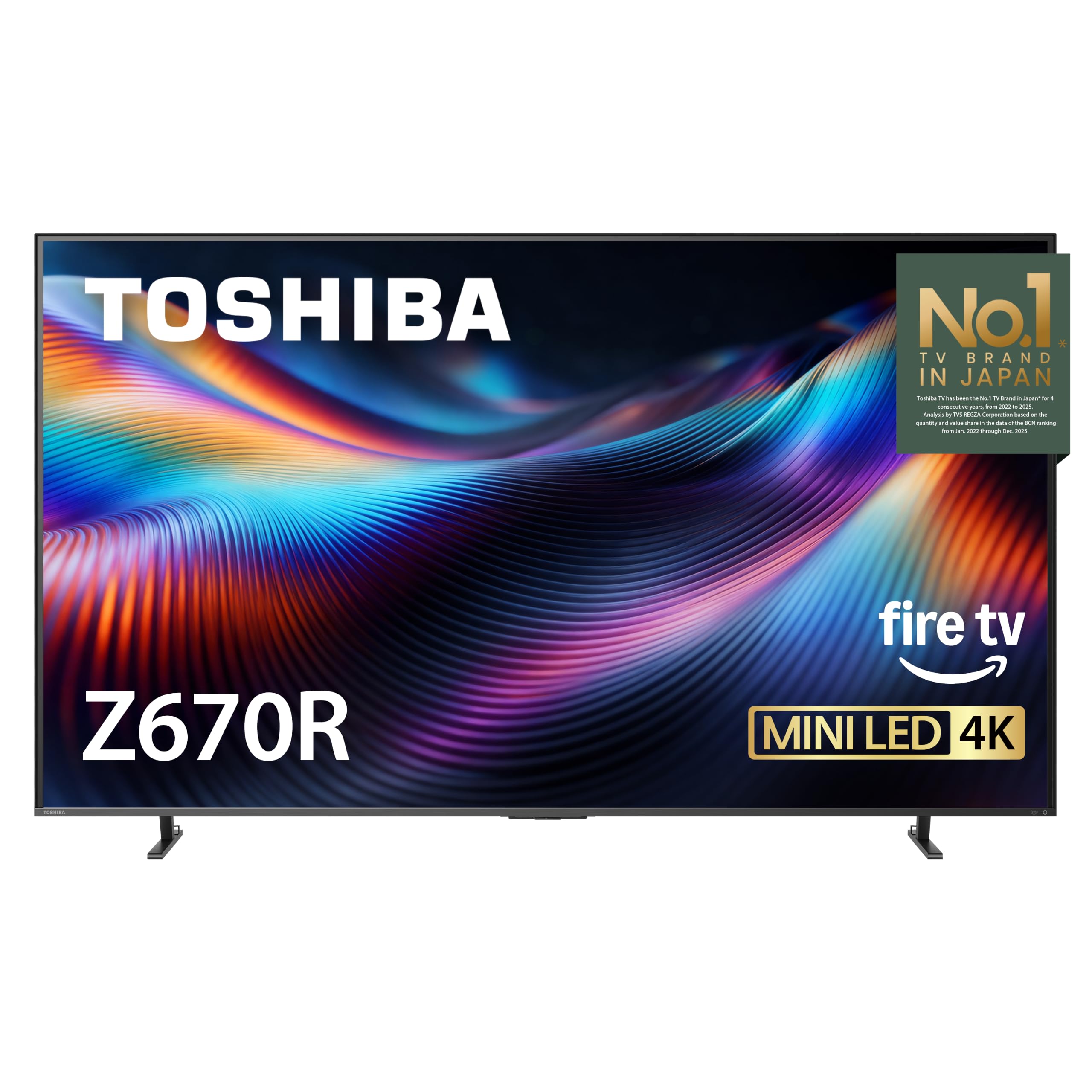
Full array dimming, a bass woofer, and a game mode built for next-gen consoles.
Toshiba’s Z670R takes the M450 formula and pushes it up a tier. Mini LEDs with Full Array Local Dimming spread light across the whole back panel instead of the edges, so blacks stay black next to bright highlights and colors hold their accuracy across the entire screen. The REGZA Engine ZRi Gen3 handles the processing — clarity, contrast and audio, adjusted scene by scene — and the QLED layer produces over a billion shades. Quality and picture quality are what draw the praise, and the set earns its spot near the top of the mid-range.
Gaming is where it makes its claim. A native 144Hz refresh rate pairs with AMD FreeSync Premium, VRR at 144Hz and ALLM, so a next-gen console or a gaming PC delivers a tear-free frame stream, and Game Mode Pro takes over the moment a controller connects. The native 144Hz panel, as opposed to a 60Hz panel with a fake smooth-motion badge, is the difference you feel in a racing title. For audio, a dedicated REGZA Bass Woofer adds low-end weight to the Power Audio Pro speakers, so explosions have some thump without an outboard bar.
The nuance worth knowing: dark-room contrast is excellent, but color accuracy from the start leans energetic rather than studio-neutral, so film buffs may want to switch to Filmmaker mode for movies. Reliability is the divided topic, with most sets running without issue and a minority reporting a failure after about a month. The AI Light Sensor also adjusts brightness on its own, which is helpful in a mixed room and a bit opinionated if you like a fixed picture.
Standout strengths
- Full Array Local Dimming plus Mini LEDs for real black levels
- FreeSync Premium, VRR 144Hz and ALLM make it a genuine PC and console screen
- REGZA Bass Woofer gives built-in audio some weight
- Total HDR Solution Pro covers Dolby Vision IQ, HDR10+ Adaptive and HLG
Points to consider
- Default color runs vivid; use Filmmaker mode for a neutral film look
- A minority report failures inside the first month
- Fire TV’s home screen takes some rearranging to feel like yours
Right fit for: A PC or console player who wants 144Hz and FreeSync in a TV, not a monitor.
Look elsewhere if: You want a plain, unfussy menu system or you mostly watch films in a pitch-black room.
7. Philips 7985 65-Inch
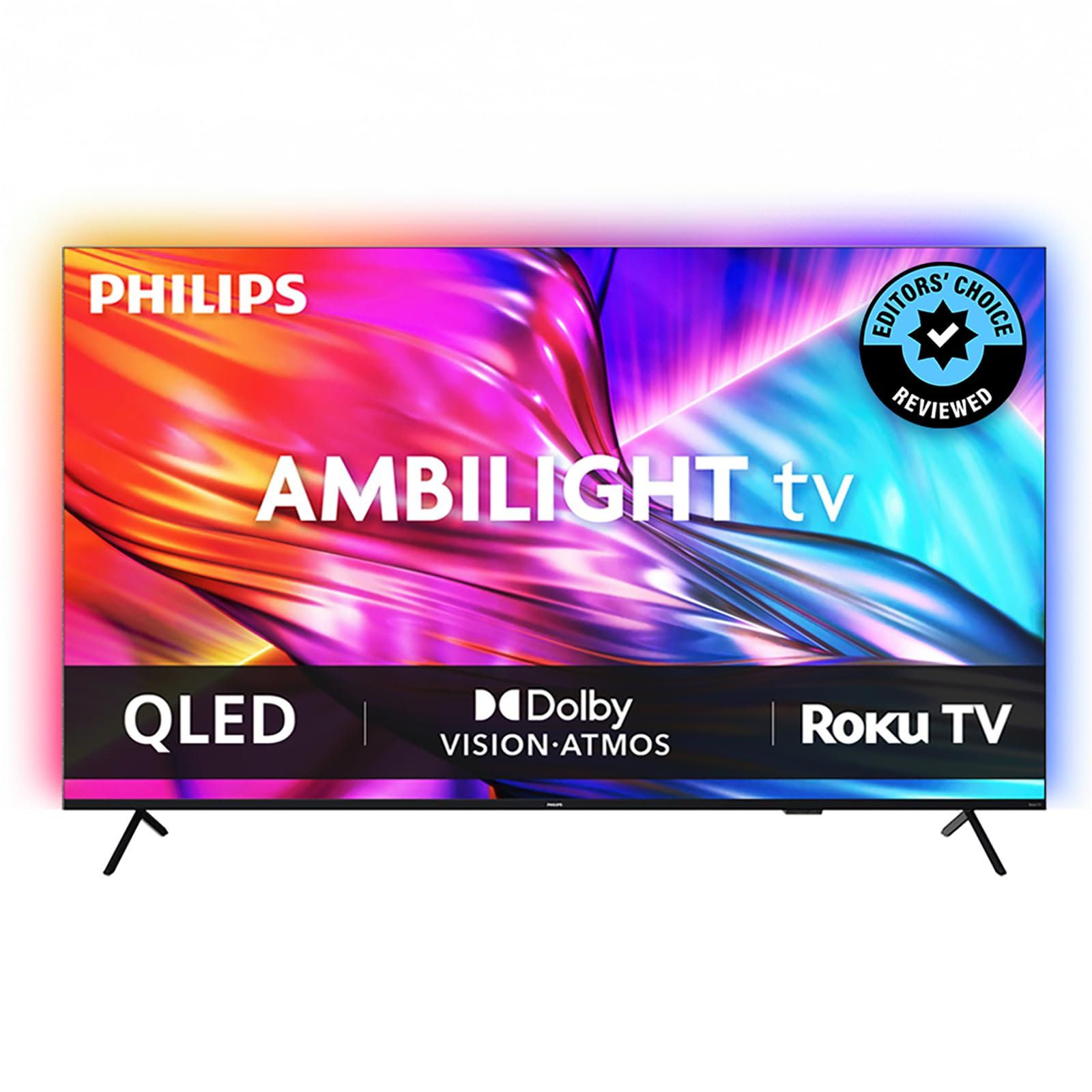
The only set here that paints light onto your wall behind the screen.
Ambilight is the reason this Philips exists, and it is not a gimmick. LED strips on the back of the set read what is on the 65-inch screen and project matching color onto the wall behind it, so the picture feels wider than the panel. Follow Audio pulses that light with your music, and a static glow stays on after the TV is off, turning a dark wall into a soft lamp. Picture quality is what wins people over — a bright, clear QLED image with Dolby Vision, HDR10 and HLG all supported — and the built-in rear lighting is the second thing buyers are drawn to.
The rest of the package is built for a living-room hub. Quantum dot color widens the range of shades, and the 120 PMR figure smooths motion for sports. Dolby Atmos over the two built-in speakers keeps dialogue and commentary clear without extra gear, and HDMI 1 carries eARC for a soundbar or AV receiver. Four HDMI inputs mean a cable box, a console, a soundbar and a streaming stick all stay connected, and the set mounts on a 400 x 300 mm VESA bracket if you are wall-mounting.
The practical catch: Ambilight wants a flat, light-colored wall behind the TV to look its best. Mount it in a corner or against a dark cabinet and you lose much of the effect. Brightness is also good rather than reference-level, so a room with a wall of uncovered windows can wash the picture out during the day.
What it is really for: Movie night as an event — the wall glow does more for atmosphere than another hundred nits of brightness.
Where it stumbles: The ambience disappears without a plain wall behind it, and peak brightness trails the Mini-LED picks down the list.
Pick this one when: You want the room to feel like a home theater and you have a bare wall behind the screen.
Stick with Mini-LED if: Bright-room punch and dark-scene fidelity top your wish list.
8. Samsung QN70H 65-Inch
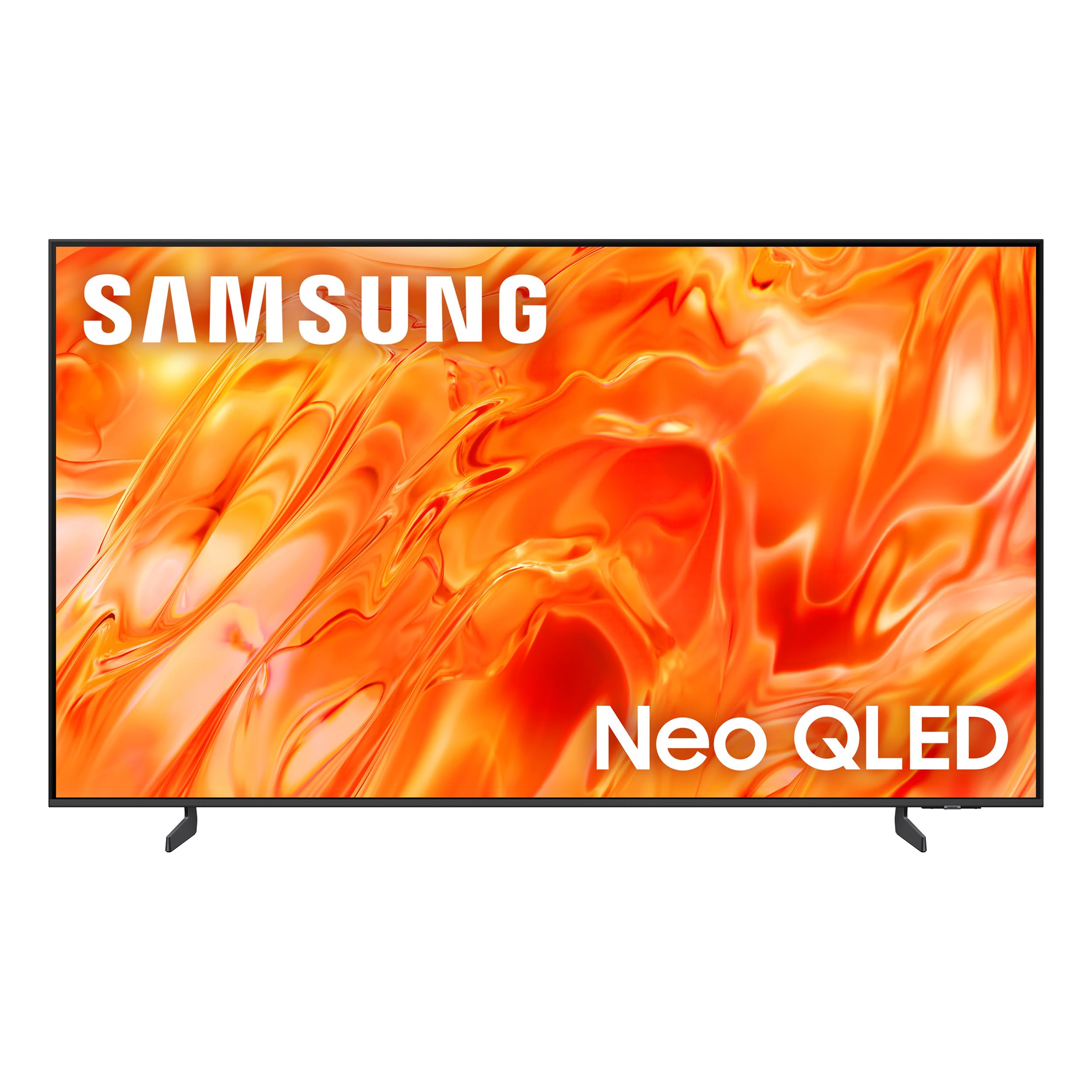
Quantum dots that hold full color at any brightness, from pitch black to a sunlit field.
Samsung’s edge is color stability. Quantum Mini LEDs sit behind the panel to control contrast, and the nano-sized quantum dots (particles small enough to render individual shades) mean the set can show the entire color spectrum at any brightness level — so a bright sky keeps its blue rather than bleaching toward white. Picture quality and overall quality are the strong suits; the NQ4 AI processor upscales lower-resolution sources toward 4K and brightens each scene as it analyzes it, and Color Booster Pro pushes hues in real time to keep drama and live sports looking rich.
HDMI, USB, Wi-Fi and Bluetooth 5.3 are all on deck for connecting a console, a phone or a speaker, and the slim build suits a wall or a low cabinet. For a bright room, the color volume is the reason to choose this over a cheaper QLED — the picture holds together in daylight where lesser panels wash out.
The honest wrinkle is the remote. It draws more criticism than anything else on this set — several describe it as confusing to use — and navigation menus take some learning. Usability and reliability both split opinion, so slide the remote into a drawer and use the phone app if the clicker frustrates you. It is not a picture problem; it is a small daily friction.
Made for: Buyers who prize color accuracy that survives a sunny room and a slim, wall-friendly body.
Consider the alternative if: A straightforward remote and menu system is high on your list.
9. Samsung 65-Inch Class Neo QLED QN70F 4K Mini LED Smart TV

Twenty AI networks working the picture and 144Hz VRR working the games.
The QN70F is the flagship end of Samsung’s Neo QLED Mini-LED lineup, and it shows in the processing. The NQ4 AI Gen2 processor runs 20 neural networks to upscale content toward 4K and tune sound, and the precision-controlled Mini LEDs keep contrast sharp scene by scene. Quality and picture quality are the top positives — crisp clarity with vibrant colors and inky blacks in brighter scenes — and setup is quick for a set this loaded.
Motion and gaming are sorted properly here. Motion Xcelerator 144Hz keeps sports and action smooth, and the set supports VRR gaming up to 4K 144Hz, so a PS5 or Xbox sends a tear-free picture at the top of what a console can output. Samsung Vision AI handles picture and sound tuning, Alexa is built in for voice search, and the platform gives you a big stack of free channels — including 400+ Samsung TV Plus channels among more than 2,700 free options — so you are not forced into another subscription.
What tempers the enthusiasm is setup friction in the ecosystem: HDMI-CEC handshakes with soundbars and consoles can take a second attempt, and the picture settings reward a bit of tuning before they look their best. Sound is fine for a news broadcast and thin for a blockbuster, so a soundbar is the natural companion. Reliability splits opinion as on most bright Mini-LED sets; most run well from day one.
Where it earns its keep: The AI upscaling genuinely rescues older cable content, and 4K 144Hz VRR makes it a proper console screen.
The follow-up: Does the smart platform get in the way? Sponsored rows can be muted; the picture is the payoff.
An easy yes if: Your living room is bright and a current-gen console is part of the setup.
A harder sell if: You want a set-and-forget picture with no tuning and no soundbar.
10. Hisense U8 65″
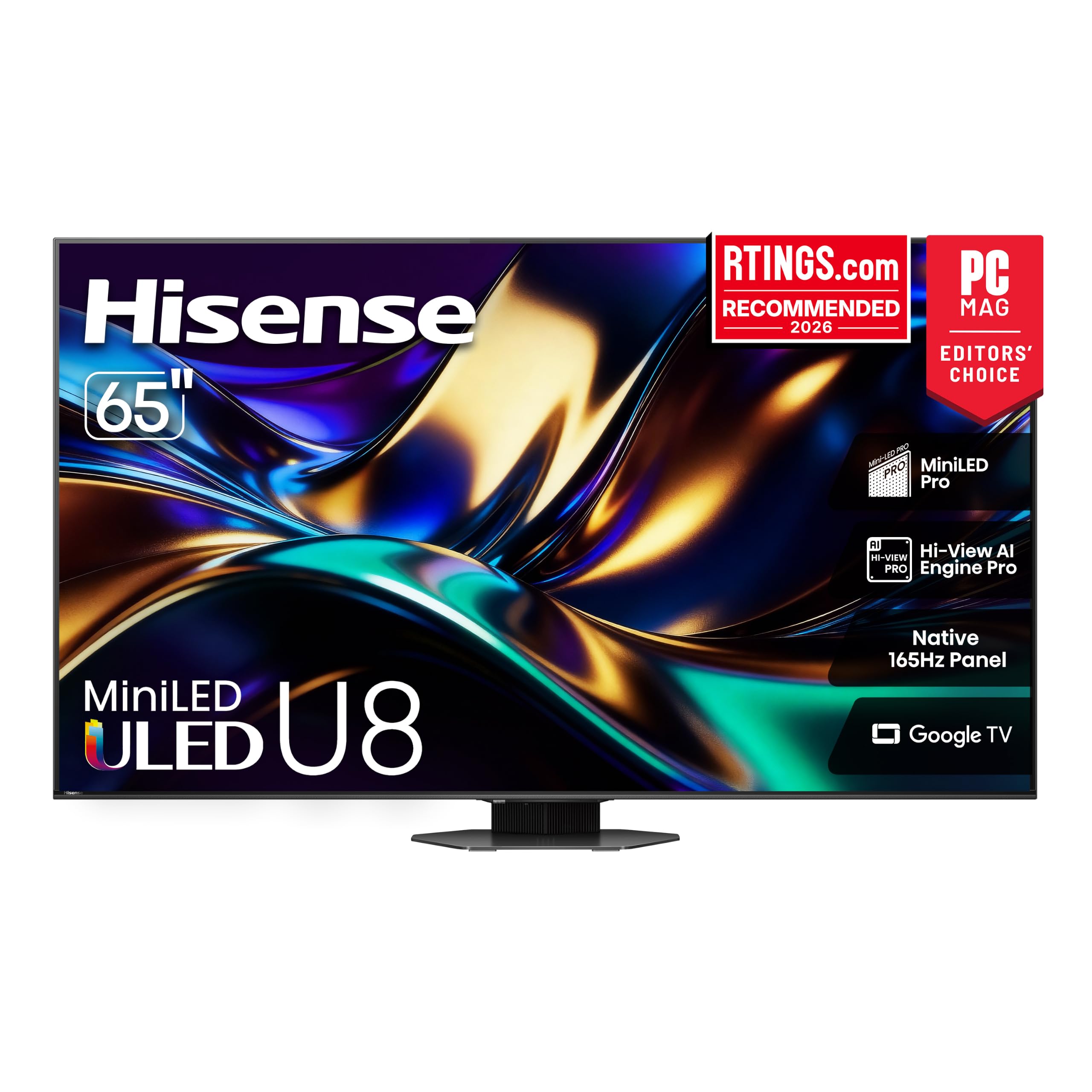
Up to 5000 nits and 5600 dimming zones — the spec sheet that ends glare arguments.
This is the brightest set in the article, and the numbers are the story: up to 5000 nits of peak brightness and up to 5600 local dimming zones mean a sunlit living room stops being a problem. Nits are a brightness unit — 5000 nits is bright enough to fight a window behind you without the picture going flat — and thousands of dimming zones let the panel close off light in dark areas so blacks stay black next to highlights. Quality and picture quality dominate the praise, with brightness and vivid color close behind, and the anti-reflection coating on the panel cuts glare further.
The gaming spec sheet is even more aggressive. A native 165Hz panel with a Variable Refresh Rate range of 48Hz to 165Hz, plus AMD FreeSync Premium Pro, ALLM and Low Latency MEMC, keeps a fast game tear-free and responsive. The Enhanced Game Bar lets you adjust settings from the remote while you play. For movie night, the 4.1.2 channel audio with Dolby Atmos adds two up-firing speakers and a built-in subwoofer, so sound comes from above and below rather than straight ahead. IMAX Enhanced content and Dolby Vision IQ round out the HDR line-up.
The one caution is reliability. It is the mixed topic on this set — most run beautifully, but a minority report a unit that stops working periodically or will not power on. Buy with a return path and register for the full warranty. Google TV’s home screen also collects recommendations aggressively; the apps-only option tidies it up.
Why it leads the brightness race
- Up to 5000 nits peak brightness defeats a sun-facing room
- Up to 5600 dimming zones keep dark scenes deep alongside bright ones
- Native 165Hz panel with VRR 48Hz-165Hz for top-tier gaming
- 4.1.2 channel sound with up-firing speakers and a built-in subwoofer
Worth knowing
- A segment of owners hit power or reliability failures — keep the receipt handy
- The aggressive brightness can look harsh in a dark room until you lower it
- Google TV’s recommendation feed needs pruning
The clear pick if: You watch with the sun on the screen and refuse to draw the curtains.
Not for you if: You mostly watch at night in a dim room where lower brightness would be gentler on the eyes.
11. TCL QM8L 65 Inch
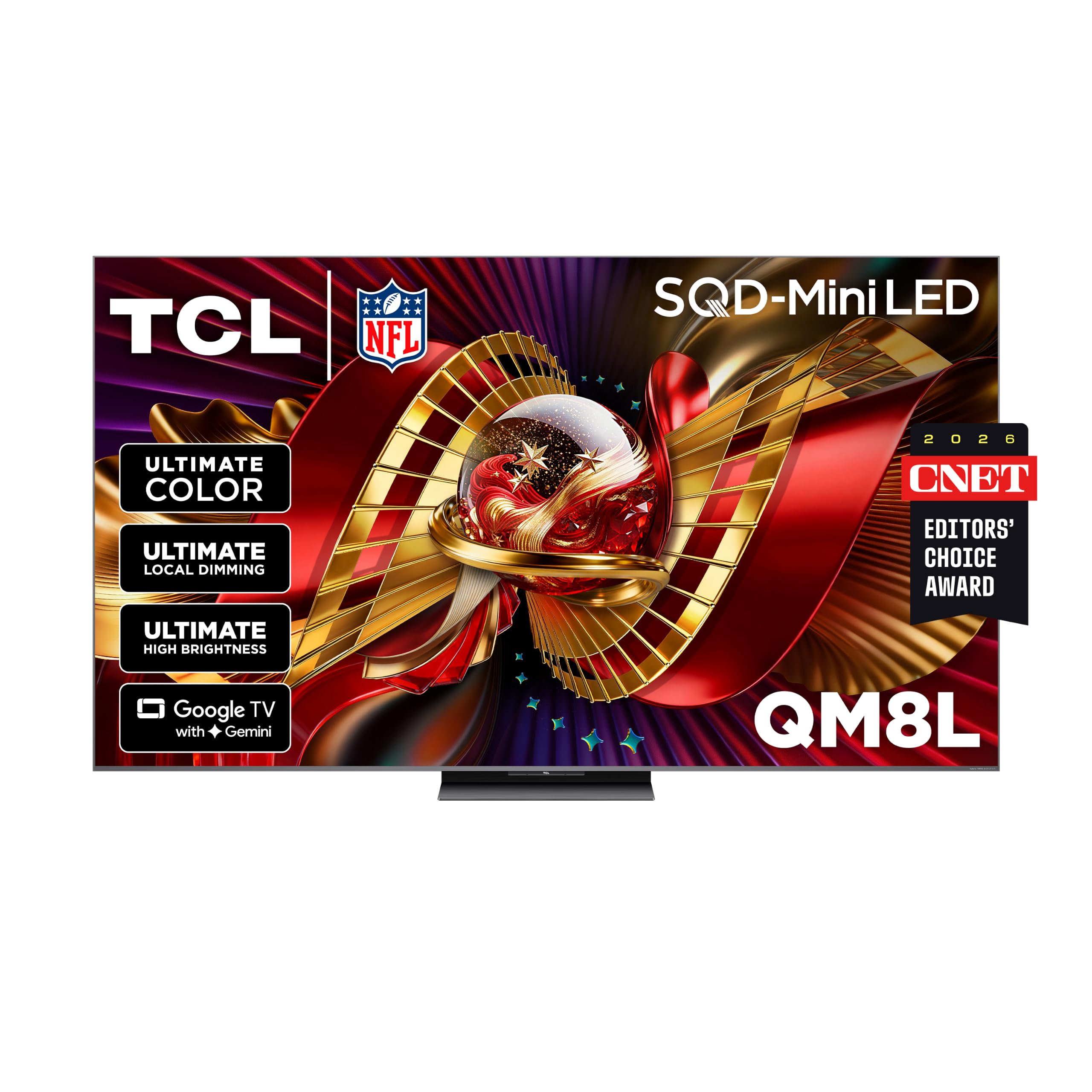
A halo-free Mini-LED picture with Bang & Olufsen audio doing the talking.
TCL’s QM8L attacks the one weakness of cheap Mini-LED sets: bloom, the pale halo that bleeds around a bright object on a dark background. Its Halo Control System combines a Super High Energy LED microchip, a condensed micro lens and a 26-bit dynamic dimming engine, so up to 4000+ discrete dimming zones and up to 6000 peak nits work in tight little windows rather than smearing light across the panel. A high 7000:1 static contrast ratio gives the light-and-dark boundary genuine snap. Quality and picture quality carry the praise, with screen brightness and the premium look close behind.
Color is the other engineering story. The TCL Ultra Color Filter uses fine 5 nanometer particles instead of standard 60 nanometer particles, which sharpens color accuracy down to the pixel, and the SQD-Mini LED system pairs the Deep Color System with that halo control for pure, saturated frames. Audio comes courtesy of Bang & Olufsen, with an optional wireless subwoofer and satellite speakers to build out a full surround setup. Dolby Vision IQ reads the room and adapts, and Google TV with Gemini lets you ask for a show by description instead of scrolling.
Gamers get the TCL Game Pack — Game Accelerator 288 VRR, a Game Bar and AMD FreeSync Premium Pro — on a 144Hz panel, so consoles and PCs both get smooth, low-latency output. The catch is that the picture leans vivid and bright by default, which is spectacular for sports and games but can feel intense for a dim-room film; drop into a calibrated or movie preset and it settles down. Sound from the start is well-regarded, though the optional sub and satellites are the real upgrade path.
Well suited to: Someone who wants top-tier Mini-LED contrast and doesn’t mind paying for the halo-control engineering.
Probably overkill if: Your room is dim and your sources are mostly older cable channels.
12. Sony BRAVIA 5 65 Inch

Thousands of Mini LEDs controlled by Sony’s XR processor — picture as the creator intended.
At the top of the premium tier, the BRAVIA 5 justifies itself with control rather than raw brightness. Thousands of Mini LEDs are governed by XR Backlight Master Drive, which dims and lifts individual zones with precision, and the XR Processor with AI boosts color, contrast and clarity in real time as you watch. XR Triluminos Pro open up billions of real-world shades, so a sunset or a football pitch keeps the subtle gradations that a cheaper panel flattens. Studio calibrated picture modes are tuned for Netflix, Prime Video and Sony Pictures Core, and picture quality and clarity are exactly what buyers rave about.
Motion is where Sony’s reputation holds. XR Motion Clarity keeps fast-moving sports and action films blur-free, and XR Clear Image restores detail in older HD content so upscaled shows do not look soft. The movie package is deep — Dolby Vision, Dolby Atmos, IMAX Enhanced and DTS:X all play nice — and if a PlayStation 5 is your console, Auto HDR Tone Mapping and Auto Genre Picture Mode make the TV follow the game automatically. Google TV gathers apps in one place, with AirPlay 2 and Google Cast for casting from a phone.
The honest trade-off is value. It costs more here than any other set and it is not the brightest or the most zone-heavy on paper — you are paying for Sony’s processing and studio calibration, not a spec-sheet race. Reliability and brightness draw split opinions, so a dim-room film buff may want to compare against a brighter Mini-LED before committing.
Where the money goes: Processing and calibration — the out-of-the-box picture is the most film-faithful in this article, and the motion handling is the least distracting.
The blunt truth: You can spend less and get a brighter, zone-heavier panel; you will just not get Sony’s tuning.
Choose it for: Film-first buyers who want the picture to look like the director signed off on it, plus smooth PS5 integration.
Leave it if: Peak brightness or zone count is your priority, or your budget cannot stretch to the premium end.
Know the Specs
Mini-LED vs standard LED backlight
A standard LED TV lights the panel from the edges, which keeps it thin and costs less, but a bright object can bleed into dark areas. Mini-LED uses thousands of tiny LEDs behind the screen, and with Full Array Local Dimming the set can dim those zones independently — the number in the spec (“up to 5600 zones,” for example) tells you how finely it can do that. More zones mean less halo around a bright object on a dark background. If you watch a lot at night, zones are the number to check first.
Refresh rate, VRR and motion clarity
Refresh rate in Hz is how many times a second the screen redraws the image. 60Hz is the baseline, while 120Hz, 144Hz or 165Hz redraw more often, so a fast pan looks smoother and a game feels more responsive. VRR (Variable Refresh Rate) matches the screen’s refresh to a console’s output to eliminate screen tearing, and ALLM (Auto Low Latency Mode) switches the TV into its fastest picture mode when a controller connects. If you play action games or watch live sports, these three specs work together.
Brightness in nits and HDR formats
Brightness is measured in nits, and a brighter panel fights window glare and makes HDR highlights (a sun glint, a streetlight) genuinely bright rather than clipped. Format support matters just as much: Dolby Vision, HDR10+, HDR10 and HLG are the four main HDR formats, and a set that reads all four will adapt its contrast scene by scene whatever the service sends. A panel without them still looks good; it just cannot deliver the full range on offer.
HDMI ports, eARC and smart platforms
Four HDMI inputs let you keep a console, a cable box, a soundbar and a streaming stick connected at once, and eARC on one port carries high-quality audio out to a soundbar or receiver. The smart platform — Roku TV, Fire TV or Google TV — decides how you find things. Roku is the simplest to navigate, Fire TV leans on Alexa voice search, and Google TV is best at recommendations. Pick the one that matches how you already search.
Common Questions
Is a 65-inch TV too big for a standard living room?
Do I need Mini-LED or is a standard LED TV good enough?
What refresh rate should I look for on a 65-inch TV?
Does Dolby Vision matter on a 65-inch LED TV?
Will my soundbar work with a 65-inch TV through eARC?
Is a 120Hz or 144Hz TV better for a PS5 or Xbox?
How many HDMI ports do I need on a 65-inch TV?
Do 65-inch LED TVs suffer from glare in a bright room?
Should I upgrade to 4K on a 65-inch screen?
What should I check first when the TV arrives?
The Bottom Line
For most people, the 65-inch led tv winner is the Roku 65-Inch Plus Series because it puts a Mini-LED backlight, QLED color and a built-in subwoofer into one set that any household can navigate. It is the pick that satisfies the most people who buy it, and it sits at the friendlier tier of the market for the picture it delivers. The upgrade worth considering is the Hisense U8 Series if your living room is bright and glare has beaten every TV you have owned.
If you want Sony’s film-faithful processing and PS5 integration, the Sony BRAVIA 5 is the premium choice. And for the movie night that needs atmosphere more than nits, the Philips 7985 Ambilight turns your wall into part of the picture — match the backlight and brightness to your room, and you will not need to shop again for years.
How we choose
We do not accept paid placement. Every pick is matched to a real buyer and a real use-case; we do not hands-on test units.
Sources
Specifications: manufacturer listings and product documentation. Review insights: verified customer reviews, as of November 2026. Pricing: not shown on this page (it changes often); check the current price via the retailer link.
As an Amazon Associate, Tactical Gear Guy earns from qualifying purchases. This does not affect which products we feature.