Specs are compiled from manufacturer listings and verified buyer reviews and can change over time — please confirm the key details on the product page before buying.
Buying a 4K 120Hz TV is mostly a fight against fake numbers. Plenty of sets advertise a “120” motion figure that is really a 60Hz panel inventing frames it never received. The picks below all run a genuinely fast panel that accepts a real high-frame-rate signal from a PS5, an Xbox Series X, or a gaming PC. Start with the Hisense 55U7SG if you want the strongest all-round package for the money.
This guide is built by comparing the manufacturers’ published specifications and the patterns across verified customer reviews, so you get each pick’s real strengths and trade-offs instead of marketing spin.
You will see which panels are native, how bright each one gets, and where the honest trade-offs sit. Every set here earns its place, so the job is matching one to your room and your console.
Top Picks
How To Choose The Best 4K 120Hz TV
The first spec to check is whether the panel is native 120Hz or a 60Hz panel using interpolation. A native 120Hz screen physically refreshes 120 times a second, so a game console can feed it 120 real frames. A 60Hz panel with a big “motion rate” number is guessing at the missing frames, and the guess shows up as soap-opera smoothness and lag in fast games.
Native refresh rate versus the motion-rate badge
Look for the word “native” next to the number, then confirm the set lists VRR (variable refresh rate — the screen matching its speed to the console’s output). The Hisense 55U7SG runs a native 165Hz panel, the TCL 75T7 and Hisense 75U6SF Pro run native 144Hz, and the Roku Pro Series 55 runs 120Hz. All of those are real. A phrase like “Motion Rate 480” describes extra processing on top, not the panel itself.
Bright room or dark room changes everything
Mini-LED sets push very bright highlights and hold up against afternoon sun through a window. OLED sets switch individual pixels off for true black, which wins in a dark room but can look dimmer near a bright window. Match the panel type to your room’s light: Mini-LED for a sunlit room, OLED for a dim one.
Console features worth confirming
ALLM (auto low latency mode — the TV switches itself into fast game mode when a console starts) and FreeSync Premium or G-Sync support both matter. So does HDMI 2.1, because that is the connection that carries a full 4K high-frame-rate signal. Check the port count too — the TCL 75T7 lists four HDMI inputs including one with eARC for a soundbar.
Side-by-Side Comparison
| Model | Best For | Screen Size | Native Refresh | Panel Type | Amazon |
|---|---|---|---|---|---|
| Hisense 55″ U7 Series (55U7SG)★ Best Overall | All-round pick | 55 inch | 165Hz | Mini-LED | Amazon |
| Roku Pro Series 55Simplest To Live With | Simple streaming | 55 inch | 120Hz | QLED Mini-LED | Amazon |
| TCL 75″ T7 Series (75T7)Big Screen Value | Big-screen value | 75 inch | 144Hz | QLED | Amazon |
| Hisense 55″ U8 Series (55U8QG) | Peak brightness | 55 inch | 165Hz | Mini-LED | Amazon |
| Roku Pro Series 65 OLED | Dark-room contrast | 65 inch | 120Hz | OLED | Amazon |
| TCL 65″ QM8L Series | Mini-LED flagship | 65 inch | 144Hz | SQD-Mini LED | Amazon |
| Samsung 77″ OLED S84F | Big OLED room centrepiece | 77 inch | 120Hz | OLED | Amazon |
| LG 65″ OLED evo AI C6 | Fastest gaming motion | 65 inch | 120Hz panel, VRR to 165Hz | OLED | Amazon |
| Samsung 98″ DU9000 | Largest affordable wall | 98 inch | 120Hz | Crystal UHD LED | Amazon |
| Toshiba 100″ Z670 | Home-cinema wall | 100 inch | 144Hz | Mini-LED | Amazon |
Detailed Reviews
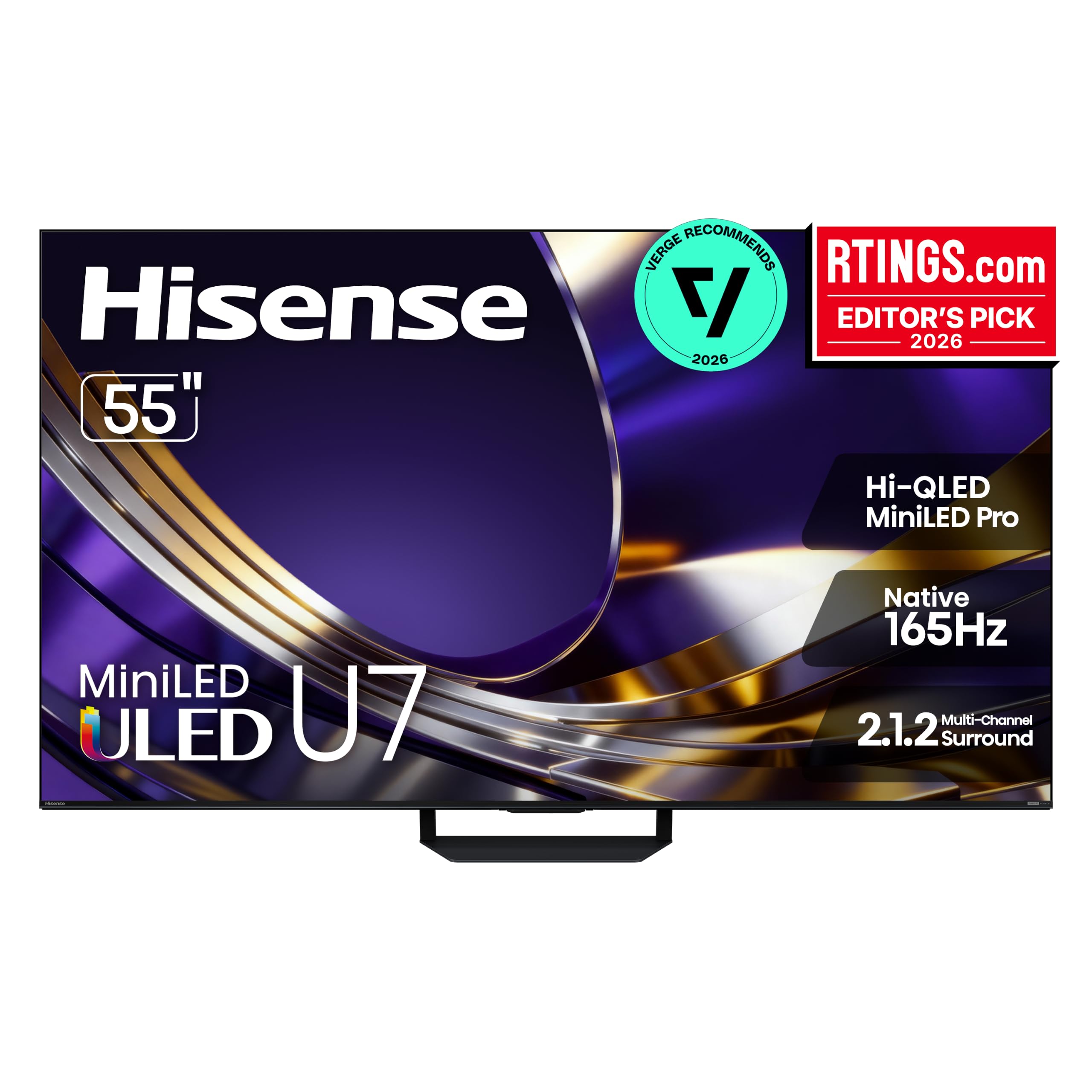
1. Hisense 55″ U7 Mini-LED ULED 4K UHD Smart Google TV (55U7SG)
Our pick — 4.0+★ from 450+ verified ratings; the strongest balance of quality and price.
The 165Hz panel that makes every other 120Hz set on this list look like it is jogging.
If you want one screen that handles a PS5, a bright living room, and a movie night without a compromise you will notice, this is the one to start with. Its 165Hz native panel refreshes faster than the 120Hz standard most consoles target, so 4K 120fps gameplay has headroom to spare and no interpolation needs to fill the gap.
The brightness story is the reason it tops this list. Up to 3000 local dimming zones (the small patches of backlight that switch independently) and up to 3000 nits peak brightness mean window glare and overhead lamps stop washing out the picture. An anti-reflection layer with a dual-layer screen treatment takes care of the rest, so a daytime football game stays readable with the curtains open.
Sound is handled by a 2.1.2 channel Dolby Atmos layout, and the Hi-View AI Engine Pro keeps adjusting color and contrast scene by scene. The gap against the Roku Pro Series 55 is real in the numbers: this set runs 165Hz versus that set’s 120Hz, and Bluetooth 5.4 versus 5.2. If you want the smoothest motion of the two, the Hisense leads.
What wins you over
- Native 165Hz panel gives console and PC gamers motion no 60Hz set can match.
- Up to 3000 nits with anti-reflection coating holds up in a sunlit room.
- 2.1.2 channel Dolby Atmos audio means you can skip a soundbar at first.
- Dolby Vision IQ and HDR10+ both covered for streaming apps.
Where it asks a little patience
- 55 inches is the smallest screen here — a big room will want more.
- Google TV’s menus take a first-week adjustment if you are used to simpler platforms.
Go for this: you are a gamer or sports watcher who needs one TV to fight glare and run high frame rates without stepping into flagship money.
Think twice: your wall is sized for 75 inches or more — the larger Hisense U6 Pro is the same platform grown up.
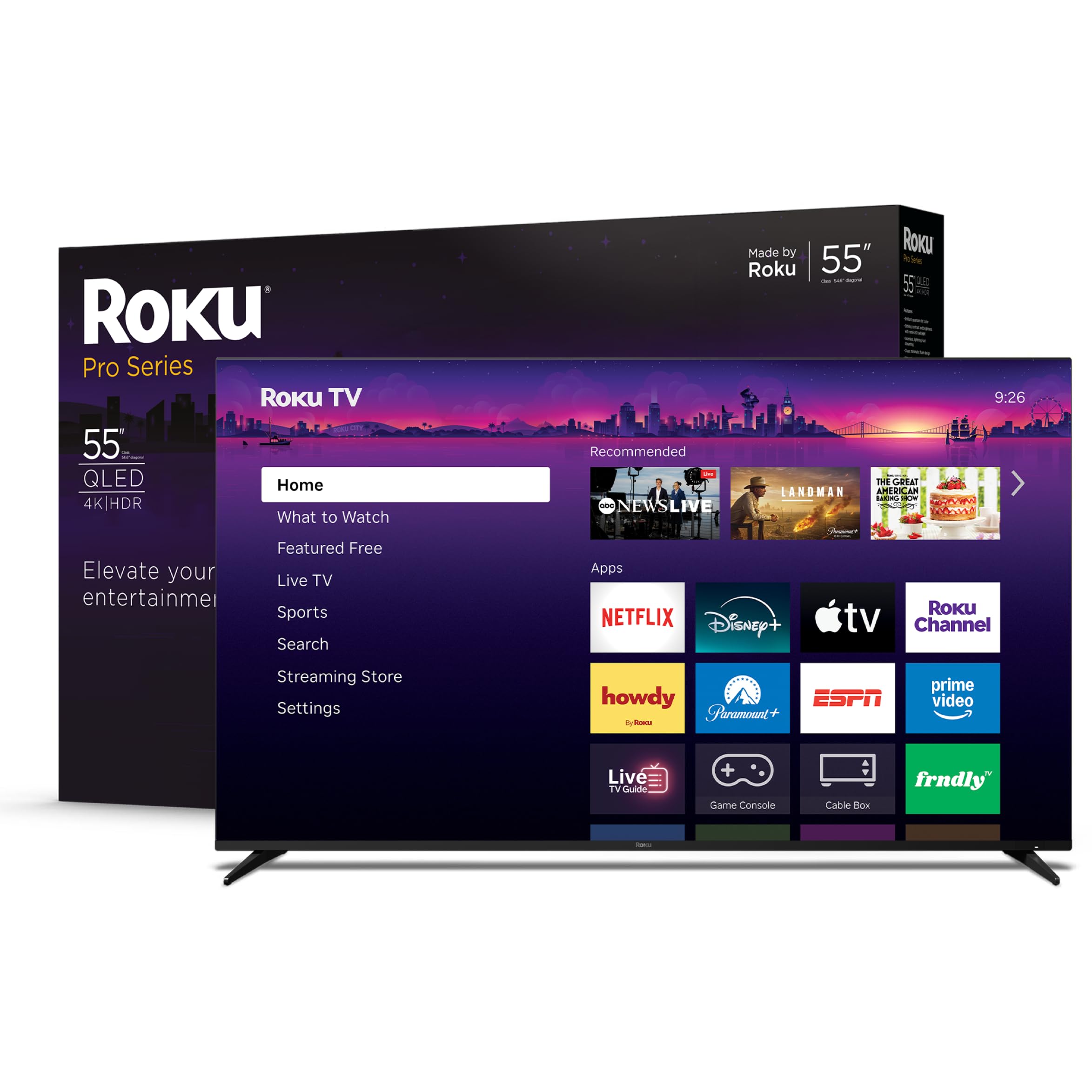
2. Roku Smart TV 55-Inch Pro Series 4K QLED RokuTV
A 120Hz QLED that nobody in the house will need a tutorial to use.
Roku’s whole pitch is that the TV disappears behind the software. Setup runs quickly, the home screen is a clean row of inputs and apps, and the included remote is rechargeable with backlit buttons plus hands-free voice — a genuine help when you are fumbling in a dark room for a channel change during a night game.
Under that friendly shell is a QLED panel lit by thousands of mini-LEDs with local dimming, running a 120Hz refresh rate. Forza and live sports get FreeSync Premium Pro, ALLM, and VRR, so the console and the TV agree on frame timing and the tearing stops. Dolby Vision IQ handles HDR, and Dolby Atmos audio comes through side-firing speakers rather than straight at your knees.
The one thing to go in knowing is long-term reliability. Most buyers report a positive experience, but a handful report a set quitting unexpectedly, so buy with a warranty you trust and register it. That is a rare report, not the norm — the interface and picture are why this set sits so high.
The daily-use win: a backlit rechargeable remote and a menu system that needs no explaining make this the easiest TV here to hand to a babysitter or a grandparent.
Fair warning: a small number of units have failed early, so keep the receipt and let the warranty do its job.
Right call for: a household that values a frictionless remote and easy setup as much as the 120Hz panel itself.
Look elsewhere for: the ultimate in motion speed — the Hisense 55U7SG runs 165Hz to this set’s 120Hz.
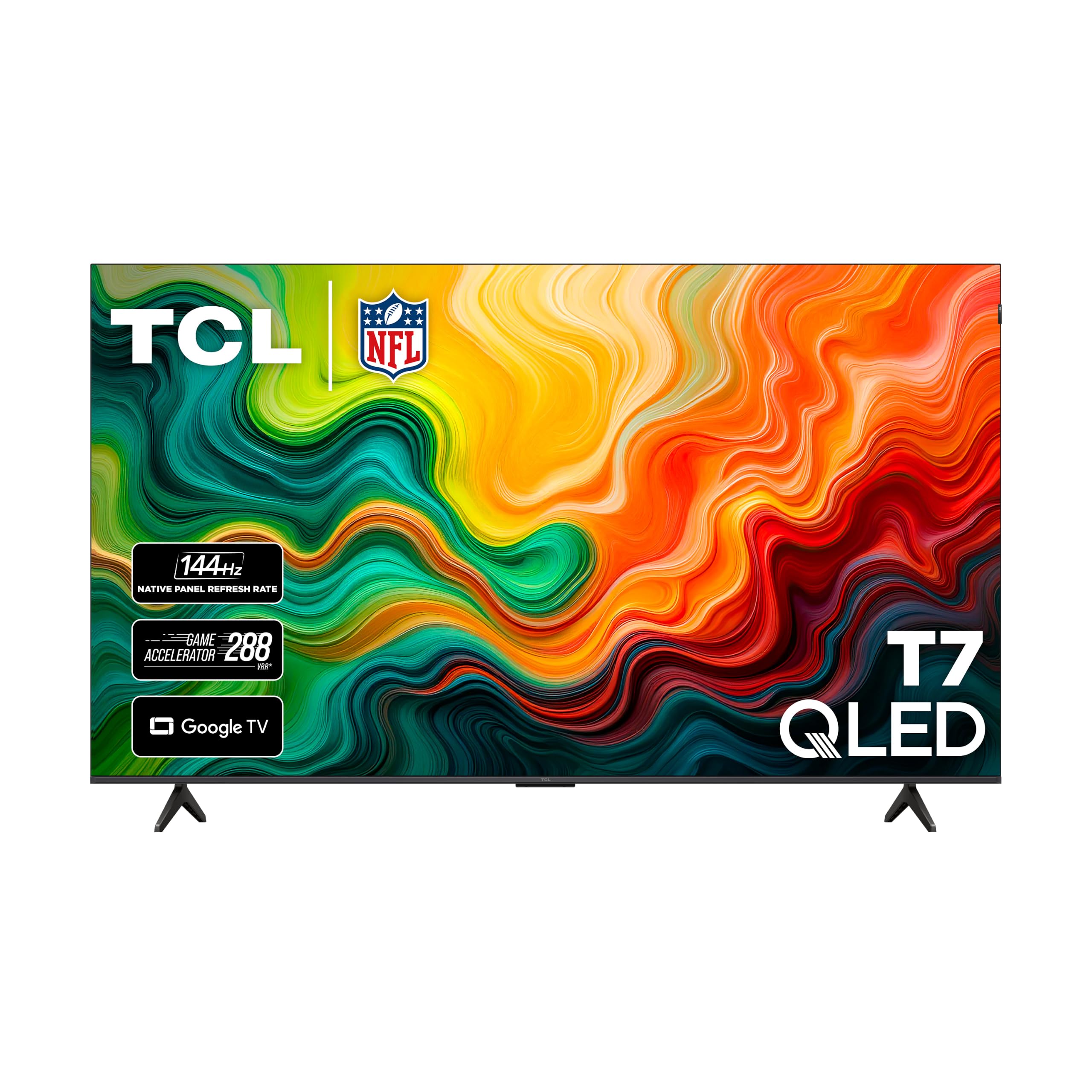
3. TCL 75 Inch T7 Series 4K 144Hz QLED Smart Google TV (75T7)
Seventy-five inches of 144Hz QLED for people who measure a TV by wall coverage.
Four times the resolution of 1080p across a 75-inch diagonal is the headline, but the panel speed is what earns this spot. A 144Hz native refresh rate with a 288Hz variable gaming refresh rate keeps fast camera pans and racing games clean, and the TCL AIPQ Pro processor handles the upscaling for older cable and streaming content.
Connections are unusually generous: four high-speed HDMI inputs, one of them with eARC so a soundbar gets the full audio return channel without eating a gaming port. Wi-Fi 5 handles streaming and the set works with Alexa, Google Assistant, and Apple HomeKit for voice control. FullView 360 metal bezel-less design with width-adjustable feet means it fits a wider range of furniture than fixed-leg sets.
Color coverage reaches nearly the entire DCI-P3 color space, and HDR PRO+ supports Dolby Vision, HDR10+, HDR10, and HLG. Sound is Dolby Atmos through the built-in speakers. Owner reports on reliability are mixed — most sets are fine, some are not — so keep the receipt and the warranty.
Why it earns a spot: four HDMI ports on a 144Hz 75-inch panel is the kind of headroom a console, a PC, and a streaming stick all fighting for inputs actually needs.
The trade-off: it is the biggest panel here without Mini-LED dimming, so dark-scene contrast will not match the Hisense 75U6SF Pro.
Pick this when: you want maximum inches with genuine 144Hz and enough ports to leave everything plugged in.
Reconsider if: deep black levels in a dark room are your priority over screen size.
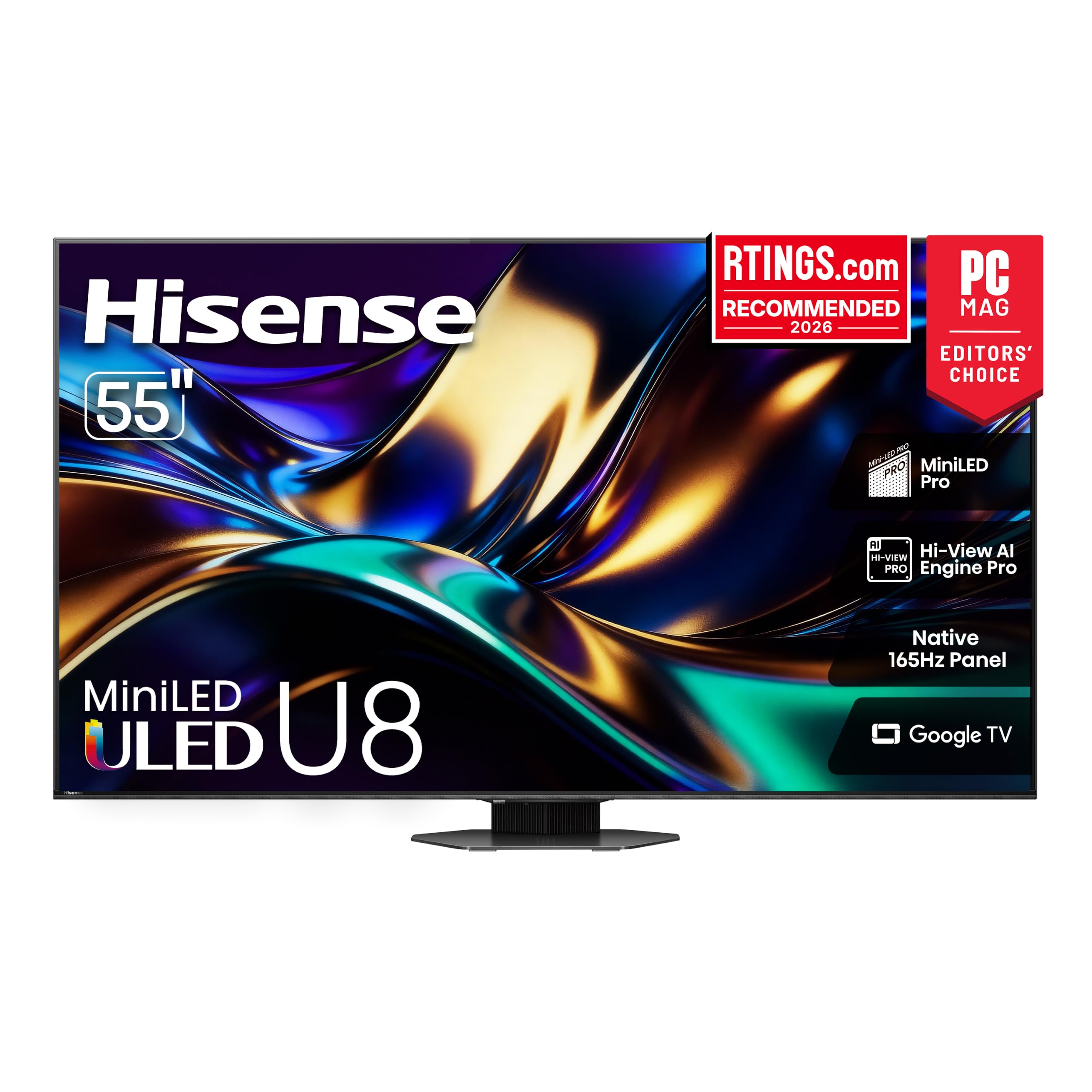
4. Hisense 55″ U8 Series ULED Mini-LED 4K Google TV (55U8QG)
Five thousand nits in a 55-inch frame — this is the set that wins a sunlit room outright.
Brightness is where this model separates itself. Up to 5000 nits peak brightness and up to 5600 local dimming zones mean highlights punch through ambient light and halos around bright objects stay controlled. If your sofa faces a window and every other TV has looked gray by 3 p.m., this is the spec that fixes it.
Gaming gets equal attention: a native 165Hz panel with variable refresh rate running 48Hz to 165Hz, AMD FreeSync Premium Pro, auto low latency mode, and a Game Bar you control from the remote. A 4.1.2 channel Dolby Atmos array with a built-in subwoofer and two up-firing speakers pushes sound above you, so a racing game has height as well as width.
Pantone-validated QLED color and the full HDR spread — Dolby Vision IQ, HDR10+ Adaptive, HDR10, HLG, and Advanced HDR by Technicolor — cover every format. Filmmaker Mode strips the processing back for movies as the director framed them. The honest caveat is long-term stability: most owners are delighted, but some units have stopped working periodically, so buy with a solid warranty.
The brightness argument: 5000 nits next to the Roku Pro Series 55’s more modest output is the difference between a watchable daytime picture and a genuinely vivid one.
Honest caveat: a minority of units have developed periodic failures, so register it and keep the coverage handy.
Choose it for: a bright room where picture punch and 165Hz gaming both matter.
Pass if: you want the least possible reliability risk — the trade-off for this much brightness is a small failure rate.
5. Roku Pro Series 65-Inch 4K OLED 120Hz RokuTV
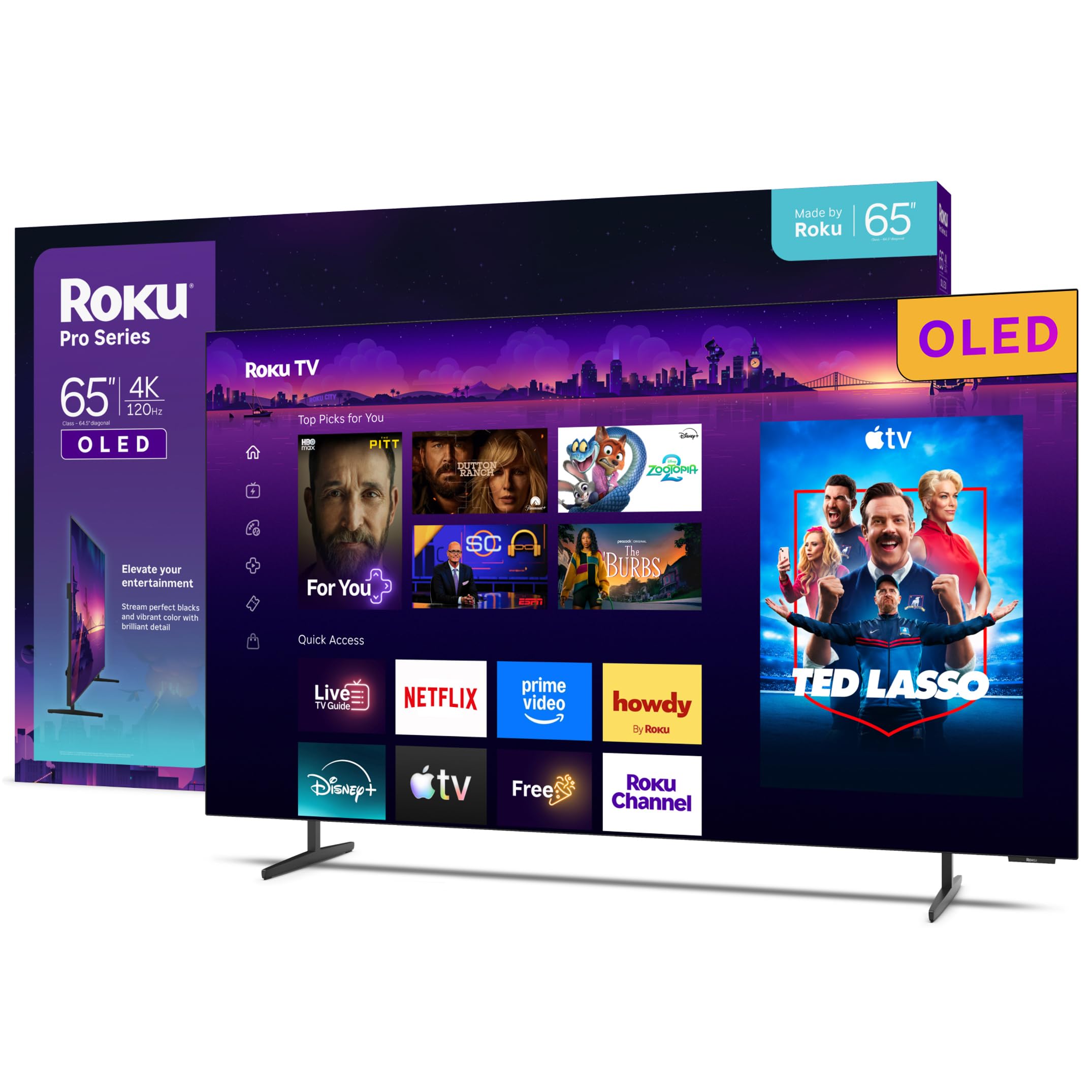
Sixty-five inches of OLED where the black bars around a movie are genuinely black.
OLED works differently from every Mini-LED set here: each pixel makes its own light and switches fully off, so a night scene has no glow bleeding into the shadows. The 65-inch panel runs 120Hz with FreeSync Premium, ALLM, and VRR, which is exactly the spec a console gamer needs and enough to make sports look clean.
Roku’s remote has a finder button on the side of the TV that makes it chirp when it vanishes into the couch, and Bluetooth Headphone Mode lets you watch a late film without waking anyone. Tool-less stands at two heights and a cable management channel mean the back stays tidy even when the set sits on furniture rather than a wall.
Be realistic about brightness. An OLED cannot hit the peak nits of a Mini-LED, so a room with direct sun will look dimmer here than on the Hisense 55U8QG. Connectivity also gets mixed reports, so plan to rely on the wired Ethernet port if Wi-Fi in your room is patchy.
The dark-room case: self-luminous pixels and Dolby Vision give contrast that backlit sets spend thousands of dimming zones trying to imitate.
Plan around it: pick this for a room you can dim, and use wired networking if your router is far away.
Perfect for: a dedicated dark viewing room where black levels matter more than peak brightness.
Skip if: the TV faces a bright window all afternoon.
6. TCL 65 Inch QM8L Series QLED 4K Google TV
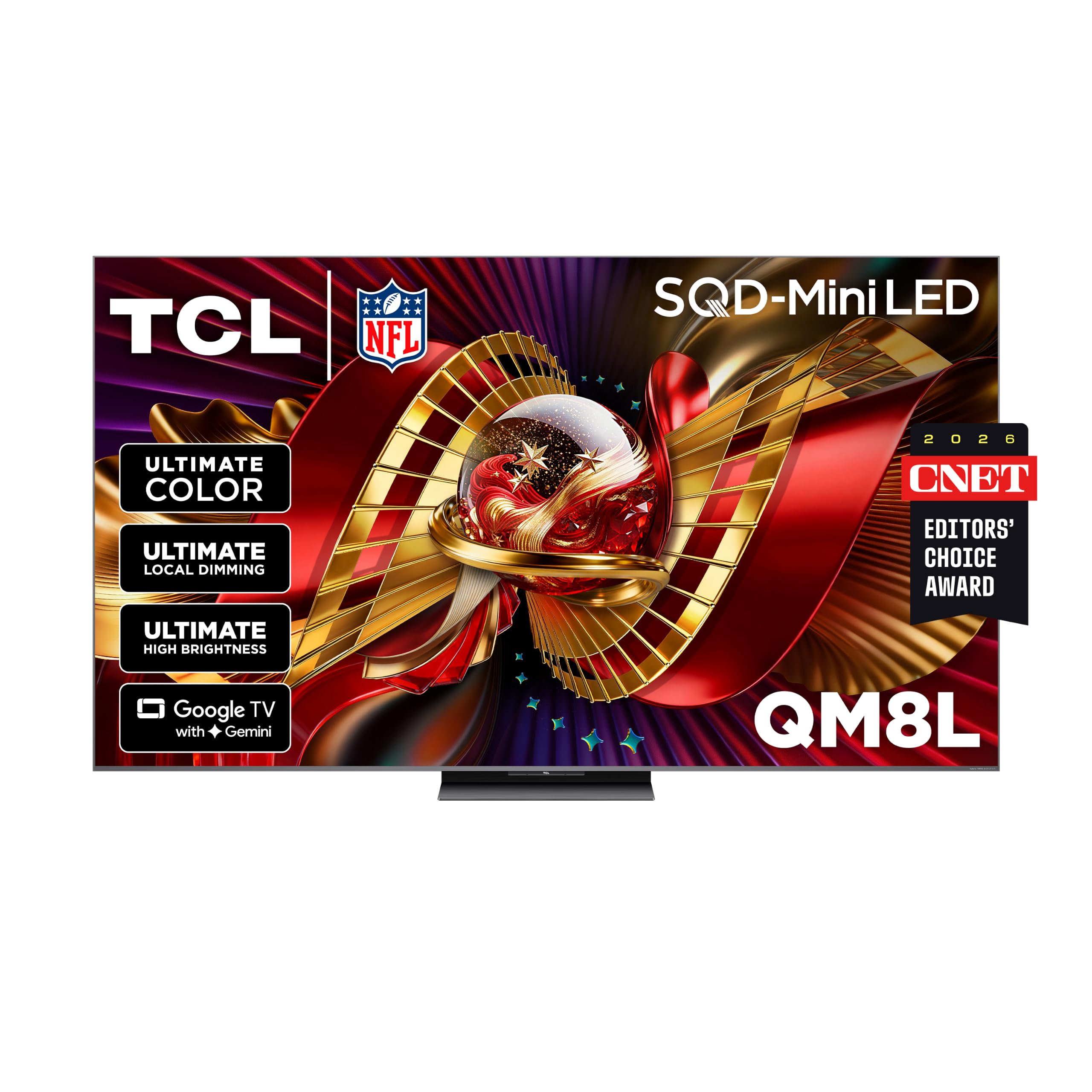
Up to 6000 nits and 4000+ dimming zones, with Bang & Olufsen tuning the speakers.
This is the Mini-LED set that goes past the Hisense U8 on brightness. Up to 4000+ discrete dimming zones and up to 6,000 peak nits combine with a 7000:1 static contrast ratio and TCL’s Halo Control System to keep bright objects from bleeding into dark ones. The Ultra Color Filter with 5 nanometer particles handles color accuracy at the pixel level.
Motion is handled by a 144Hz panel paired with Game Accelerator 288 VRR, a Game Bar, and AMD FreeSync Premium Pro. AI processing touches color, contrast, clarity, motion, upscaling, and sound individually. Google TV with Gemini lets you ask for something to watch rather than scrolling a grid, which by itself improves an evening.
Audio comes from Bang & Olufsen-tuned built-in speakers, with optional wireless subwoofer and satellite speakers sold separately if you want a fuller surround setup. Dolby Vision IQ adapts brightness to your room. The main thing to weigh is that 65 inches is the smallest this level of Mini-LED gets here — a larger room wants more diagonal.
What owners rave about
- Up to 6,000 nits is the highest peak brightness figure on this list.
- Bang & Olufsen audio tuning gives the built-in speakers a real chance.
- 7000:1 contrast ratio keeps light and dark scenes clearly separated.
- Google TV with Gemini answers a spoken request instead of making you scroll.
The honest limits
- Wireless surround add-ons are separate purchases, not included.
- 65 inches means this much brightness costs you screen size versus the 75-inch picks.
Worth it when: you want the brightest, most colorful Mini-LED picture and 144Hz gaming in one 65-inch package.
Not for you if: the room demands 75 inches or more of wall.
7. Samsung 77-Inch OLED S84F Series Smart TV
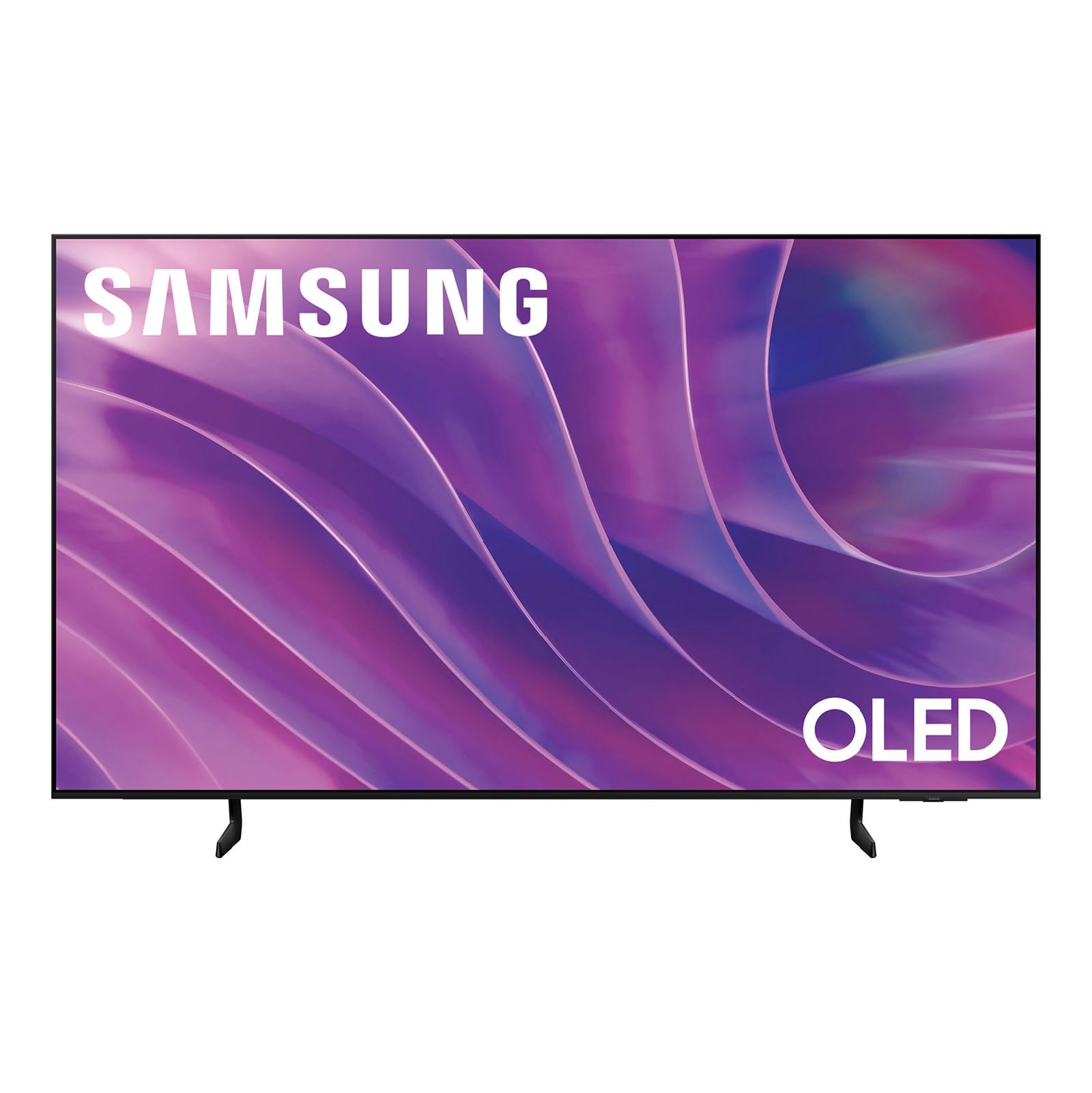
A 77-inch OLED with self-illuminating pixels and 4K 120Hz for sports and games.
Seventy-seven inches of OLED is a big jump in wall coverage over the 65-inch sets, and the self-illuminating pixels give the deep blacks OLED is known for. The NQ4 AI Gen2 processor upscales regular content toward 4K, and Pantone-validated color keeps skin tones realistic rather than orange.
Motion Xcelerator 120Hz covers the gaming and sports requirement, so a basketball fast break stays crisp. Virtual 3D surround sound follows the action across the screen, and AI audio analysis lifts dialogue out of the mix so you stop reaching for subtitles at night. Samsung’s platform also carries 2,700+ free channels plus 400+ Samsung TV Plus channels, which is genuinely useful if you are tired of subscription math.
Reliability is the honest concern here. Several owners have had a set fail within three weeks, and brightness plus sound get mixed feedback — OLED does not go as bright as the Mini-LED options. That is a real risk worth weighing against the picture quality, so buy with coverage you can lean on.
The big-OLED appeal: a 77-inch self-luminous panel with 4K 120Hz is the combination that makes a living room feel like a cinema.
Weigh carefully: the failure reports are few but serious enough that extended coverage is the right call.
Pick this for: a dimmable room and a 77-inch wall where OLED black levels are the goal.
Choose another path if: you want the lowest reliability risk or the brightest daytime picture.
8. LG 65 inch Class OLED evo AI C6 4K Smart TV

A 0.1ms response time that makes a controller feel wired straight into the screen.
For a competitive gamer, this is the spec sheet that matters. A 0.1ms response time means the pixel has finished changing before your thumb registers the press, and VRR up to 165Hz with NVIDIA G-Sync and AMD FreeSync Premium support keeps the frame pacing locked to whatever the console or PC is sending. A 120Hz native panel runs beneath it.
Picture-wise, over 8.3 million self-lit pixels with Perfect Black and Perfect Color do the OLED work, and the a11 AI Processor Gen 3 handles Brightness Booster and AI Super Upscaling. Compared to the LG a9 AI Processor Gen8, LG claims 5.6x greater AI neural processing, 50% faster operation, and 70% improved graphics — manufacturer figures worth knowing, not a substitute for your own eyes.
Dolby Vision, Dolby Atmos, and Filmmaker Mode with Ambient Light Technology cover movie night, and OLED Care is designed to protect the panel over time. The smart platform is webOS 26 with Google Gemini, plus over 400 LG Channels. The catch is brightness: an OLED will not match the 5000-nit Hisense U8 or the 6000-nit TCL QM8L in a sun-flooded room.
The gaming verdict: 0.1ms response plus G-Sync and FreeSync is the most responsive motion package on this list.
Know the limit: peak brightness trails the Mini-LED sets, so a bright room will soften the picture.
Made for: a serious gamer who wants the lowest input lag and smoothest motion available.
Not ideal if: the TV lives in a bright, window-heavy room.
9. Samsung 98-Inch 4K Crystal UHD DU9000 Series Smart TV

Ninety-eight inches of wall with Motion Xcelerator 120Hz for the price of a 65-inch OLED.
Nothing else here covers a wall like this. A 98-inch panel with the Supersize Picture Enhancer, which reduces noise and increases sharpness at large sizes, means the size does not come at the cost of a soft picture. PurColor widens the spectrum past traditional RGB models, and 4K Upscaling lifts older shows toward the panel’s resolution.
Motion Xcelerator 120Hz delivers a 120 frames-per-second picture for sports and games, and Mega Contrast adjusts brightness and contrast automatically so objects stand out from the background. Q-Symphony lets the TV speakers pair with a Q-Series or S-Series soundbar as one system, and the Game Bar adds Virtual Aim Point and a mini map for shooters.
Crystal UHD means an LED backlight, not Mini-LED, so black levels are the weakest of the large-format picks here. A few owners have also received units with cracked screens in transit, so inspect before you sign for delivery. At this size, arranging the delivery and the wall mount is half the purchase.
Why the size sells itself
- 98 inches is the biggest screen here short of the 100-inch Toshiba.
- Motion Xcelerator 120Hz gives real high-frame-rate sports and gaming.
- Tizen OS carries every major streaming app and a Game Bar.
- Q-Symphony folds a matching soundbar into one system.
Plan ahead for this
- LED backlighting rather than Mini-LED means shallower blacks.
- Oversize delivery needs a clear path and a careful inspection on arrival.
Go big with: a home theater wall that wants maximum diagonal and genuine 120Hz without OLED money.
Think again if: black-level depth matters more to you than sheer size.
10. Toshiba 100″ Z670 Series Mini-LED 4K Smart Fire TV
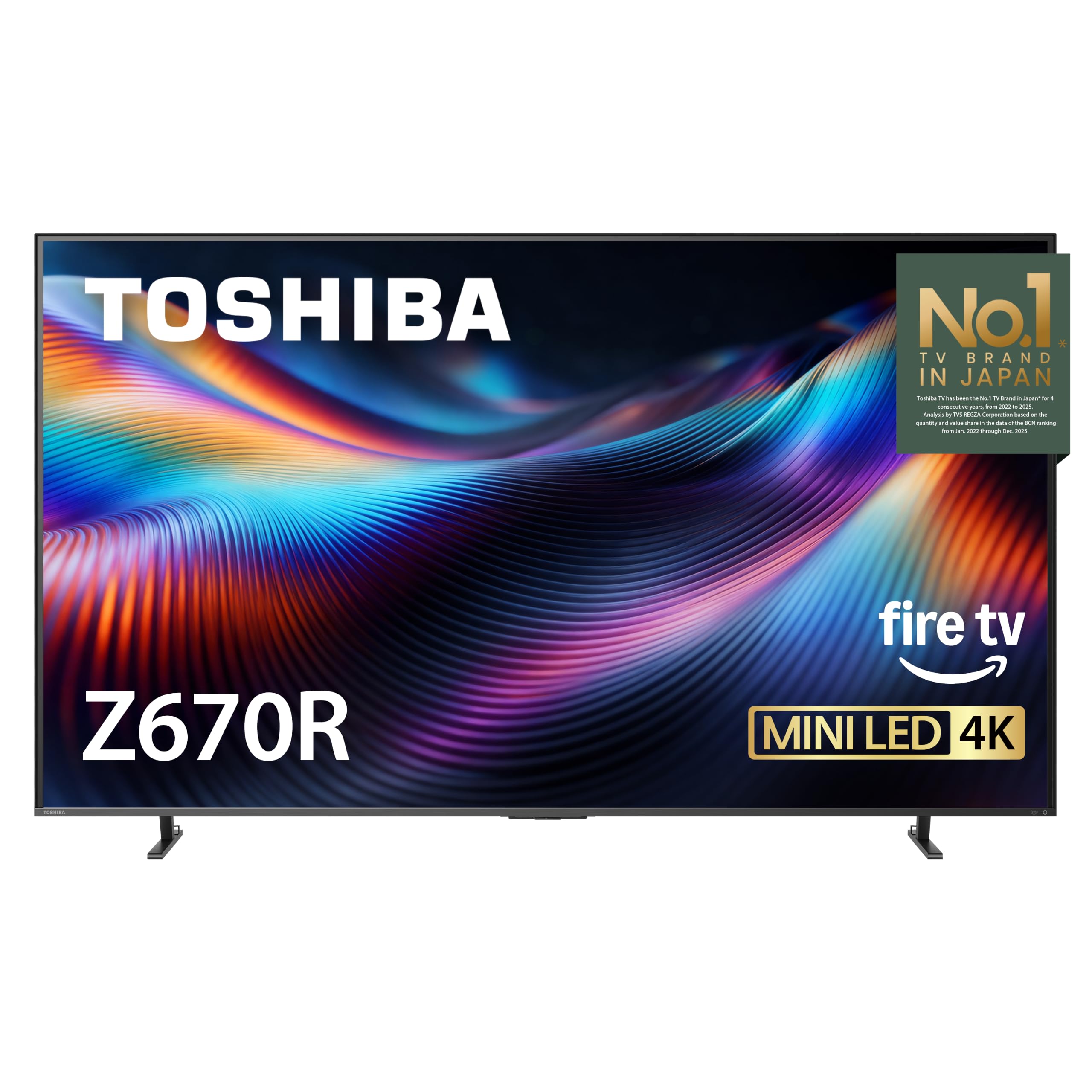
A hundred inches of Mini-LED at 144Hz — the screen that turns a wall into a cinema.
This is where the list peaks in diagonal and combines it with the panel quality to back the size up. Mini-LED with full array local dimming deepens blacks and brightens highlights across the huge surface, and the REGZA Engine ZRi Gen3 handles picture and sound processing scene by scene.
Gaming is not an afterthought: native 144Hz with AMD FreeSync Premium, VRR at 144Hz, and ALLM gives a console or PC a fast, tear-free feed. QLED color covers over a billion shades, and the total HDR set includes Dolby Vision IQ, HDR10+, HDR10+ Adaptive, and HLG. The REGZA Power Audio Pro with Bass Woofer gives the built-in audio real low-end, so an explosion lands before you add a soundbar.
Fire TV with Alexa built in handles streaming, and the AI Light Sensor Pro adjusts brightness and color to the room’s lighting. The realistic caution is delivery and installation at this size — a 100-inch panel needs a clear path and considered mounting. Wall coverage of this scale also exposes any weak source, so upscaling quality matters more here than on a 55-inch set.
The installation reality: at 100 inches the delivery route and mounting become as important as the picture quality you are buying.
What you get: Mini-LED contrast, native 144Hz gaming, and a bass woofer in the biggest panel here.
Best for: a dedicated home-cinema room that can take a 100-inch panel and wants Mini-LED quality behind the size.
Look elsewhere if: you cannot plan the delivery, the wall mount, and the viewing distance this needs.
Know the Specs
Native refresh rate vs. motion rate
A native refresh rate is how many times per second the panel physically redraws — 120Hz or 144Hz means it accepts a real high-frame-rate signal from a console. Motion rate numbers like Motion Rate 480 describe extra processing that guesses at in-between frames. Always confirm the native figure, because a native panel is the only one that truly earns a 120Hz badge.
Nits and dimming zones
Nits measure brightness, and dimming zones are the separate patches of backlight that brighten or darken independently. More zones and higher nits mean stronger contrast and a picture that survives ambient light. The Hisense 55U8QG lists up to 5000 nits and 5600 zones; the TCL QM8L lists up to 6,000 nits and 4000+ zones; the Hisense 55U7SG lists up to 3000 nits and 3000 zones.
VRR, ALLM, and FreeSync
VRR (variable refresh rate) matches the screen’s redraw speed to whatever the console outputs, so frames never tear. ALLM (auto low latency mode) switches the TV into its fast game setting when you start a game. FreeSync Premium and G-Sync are two names for that same smoothness support, so confirm your console or graphics card lists one.
OLED vs. Mini-LED
OLED pixels make their own light and switch fully off, giving perfect black and near-instant response. Mini-LED uses thousands of small LEDs behind the panel, which reaches far higher peak brightness for daytime viewing. A dark room favors OLED’s per-pixel blacks; a bright room favors Mini-LED’s higher peak brightness.
Common Questions
Does a 4K 120Hz TV actually make a PS5 or Xbox Series X look smoother?
How much brightness do I need if the TV sits opposite a window?
Is OLED or Mini-LED better for watching movies at night?
What is the difference between a 120Hz and a 144Hz panel for gaming?
Will a 4K 120Hz TV fit on an ordinary wall mount?
Do I need HDMI 2.1 to get 4K at 120Hz?
Is a 120Hz TV worth it for sports if I never play games?
What does VRR do when a game drops below 60 frames per second?
How long will a 4K 120Hz TV last before it needs replacing?
Can I get away without a soundbar on these TVs?
The Bottom Line
For most people buying the best 4k 120hz tv, the winner is the Hisense 55″ U7 Series because it puts a native 165Hz panel, up to 3000 nits, and a 2.1.2 channel Dolby Atmos array into one screen that handles glare. If you want cheap, simple streaming with a backlit rechargeable remote, grab the Roku Pro Series 55. And for a wall that needs maximum diagonal with genuine high refresh rate, the Toshiba 100″ Z670 is the one to reach for.
How we choose
We do not accept paid placement. Every pick is matched to a real buyer and a real use-case; we do not hands-on test units.
Sources
Specifications: manufacturer listings and product documentation. Review insights: verified customer reviews, as of November 2026. Pricing: not shown on this page (it changes often); check the current price via the retailer link.
As an Amazon Associate, Tactical Gear Guy earns from qualifying purchases. This does not affect which products we feature.