Specs are compiled from manufacturer listings and verified buyer reviews and can change over time — please confirm the key details on the product page before buying.
Your 42-inch screen has to do everything — morning news, the game, a movie after the kids are down — and most sets this size skimp somewhere. Here is the short answer: the Roku Select Series 43-inch is the safest pick for most people, and the Samsung S90F is where you go if picture depth matters more than value. One thing to know before you scroll: this list matches an “about 42-inch screen” flexibly, so it accepts the nearest size actually sold, which in most cases is 43 inches. Most of these models are not sold in a true 42-inch, so the nearest same-type size does the same job and fits the same wall or stand.
This guide is built by comparing the manufacturers’ published specifications and the patterns across verified customer reviews, so you get each pick’s real strengths and trade-offs instead of marketing spin.
Below you will find how panel type, HDR format support, and refresh rate change what you actually see, plus which sizes are genuinely sold. A bedroom, dorm, or small living room is exactly where a 42 inch smart tv earns its keep.
Top Picks

How To Choose The Best 42 Inch Smart TV
At this size, the television is usually a second screen — a bedroom set, a dorm room, a kitchen counter, or a small den. That changes the priorities. You are not chasing a cinema wall; you are chasing a panel that looks good from a few feet away, boots fast, and does not fight your Wi-Fi.
Panel type: LED, QLED, or OLED
A standard LED backlight (the light behind the screen) is the value workhorse and handles bright rooms fine. A QLED adds a quantum dot layer that boosts color volume, so shades stay saturated instead of washing out — useful if the sun hits the screen. An OLED lights each pixel individually, so black areas go truly dark, which is why dark movie scenes look deeper. QLED panels here claim contrast ratios like 1200:1, while OLED sets do not need a backlight at all. Pick OLED if you watch a lot of film at night; pick LED or QLED if the room is bright and the budget is tighter.
HDR formats: what your apps actually send
HDR (high dynamic range) is what makes highlights pop and shadows hold detail. The formats differ by source: Dolby Vision is used by a lot of premium streaming, HDR10+ by others, HLG by live broadcasts. A set that supports all of them means you are not hunting for the right picture mode when you switch apps. Sets with only HDR10 still look good — you just get less scene-by-scene tuning.
Refresh rate and motion handling
A 60Hz refresh rate (how many times per second the picture redraws) is standard at this size and perfectly fine for shows and casual games. Higher rates plus motion processing (marketing names like Motion Rate 240 or Motion Xcelerator 144Hz) smooth out fast pans in sports and reduce blur in games. If you mostly watch dialogue-driven TV, 60Hz is plenty. If you game on a console, look for ALLM (auto low-latency mode) and VRR (variable refresh rate), which cut lag and screen tearing.
Ports, Wi-Fi, and the remote
Count your HDMI inputs before you buy. A cable box, a console, and a soundbar can eat three ports fast, so four inputs (as on the Philips) give you breathing room. Built-in Wi-Fi handles streaming, but an Ethernet port is a nice backup if your router is close. And a voice remote that finds itself when lost is a small thing you will appreciate weekly.
Side-by-Side Comparison
| Model | Best For | Panel & Resolution | Refresh Rate | Smart Platform | Amazon |
|---|---|---|---|---|---|
| Roku Select Series 43″★ Best Overall | Most people | LED, 4K HDR10 | — | Roku TV | Amazon |
| Westinghouse QLED 43″Budget Color Punch | Budget color punch | QLED, Full HD | — | Roku TV | Amazon |
| Hisense E6SR 43″Dolby Vision Value | Dolby Vision on a budget | Hi-QLED, 4K UHD | — | Roku TV | Amazon |
| Philips Ambilight 43″ | Ambient wall glow | LED DLED, 4K UHD | 60Hz | Roku TV | Amazon |
| TCL F7D 43″ | Full HDR format support | QLED, 4K UHD | 60Hz | Fire TV | Amazon |
| VIZIO V-Series 43″ | Cast from your phone | LED, 4K UHD HDR | — | Vizio SmartCast | Amazon |
| TCL S5 43″ | Google TV interface | LED, 4K UHD | — | Google TV | Amazon |
| LG UT75 43″ | Long software support | LED, 4K UHD | — | webOS 24 | Amazon |
| Sony BRAVIA 2 II 43″ | PS5 owners | LED, 4K HDR | — | Google TV | Amazon |
| Samsung S90F 42″ | Deep blacks | OLED, 4K | 144Hz | Tizen | Amazon |
| Samsung S90H 42″ | Gamers and glare haters | OLED, 4K | 165Hz | Tizen | Amazon |
Detailed Reviews
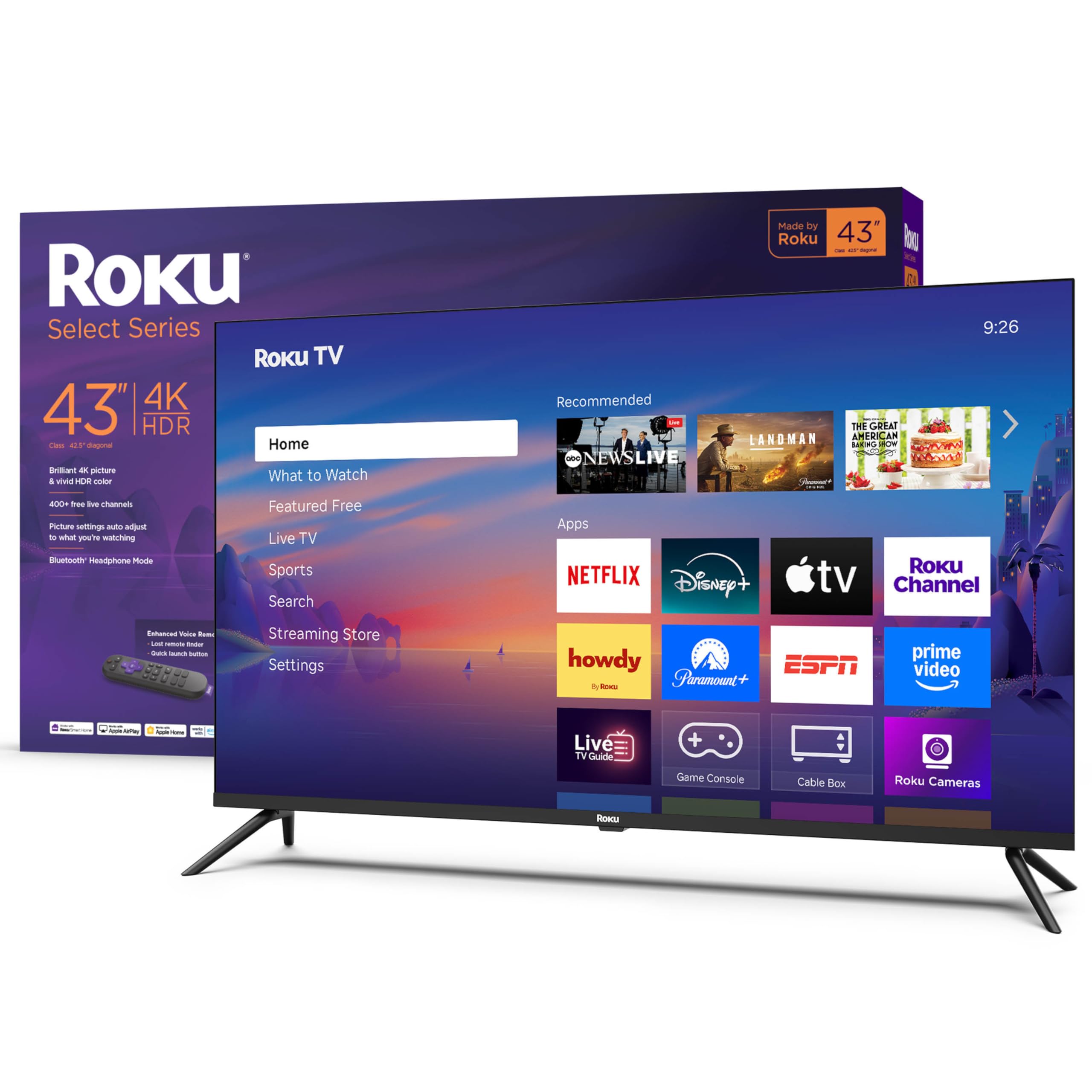
1. Roku Smart TV – 43-Inch Select Series, 4K HDR
Our pick — 4.5+★ from 900+ verified ratings; the strongest balance of quality and price.
The one most people should just buy: 4K detail, Roku’s simple home screen, and a remote that beeps.
Text in menus and faces in close-ups stay crisp from across a small room, because 4K resolution on a 43-inch panel gives you four times the pixel count of a 1080p set. Add HDR10 (the baseline high-dynamic-range format, which widens the range from dark to bright) and bright scenes hold their highlights instead of blowing out to white. The Roku Smart Picture feature then reads whatever signal is coming in and sets the picture mode for you, so you are not fiddling with sliders on day one.
What wins people over most is how little friction there is between turning it on and watching something. The home screen puts your apps where you put them, and voice search reaches across thousands of apps from the remote. That remote also has a lost-remote finder, so a set buried in a den or a kid’s room does not swallow the clicker for a week.
You can watch late without waking the house, because Bluetooth Headphone Mode pipes the audio to wireless headphones. Console play stays smoother with Game Mode plus VRR (variable refresh rate, which matches the screen’s redraw to the console’s output). AirPlay and Chromecast-style casting handle phone-to-TV sharing. This is the crowd favorite of the group, holding 4.5+ stars from 900+ ratings — and it earns that on ease rather than raw hardware muscle.
What sells it
- 4K HDR10 picture with Roku Smart Picture auto-tuning the mode
- Roku Voice plus Siri, Alexa, and Google Assistant control
- Bluetooth Headphone Mode for quiet late-night viewing
- Lost remote finder and a customizable home screen
Where it gives ground
- One HDMI input is listed as an audio input, so plan your ports carefully
- Frameless design shows dust along the edges more than a thick bezel
- No Dolby Vision or HDR10+ in the listed format support
Buy it if: you want a bedroom or dorm set that boots fast, streams everything, and asks nothing of you.
Think twice if: you need multiple HDMI devices connected at once and want four inputs sitting ready.
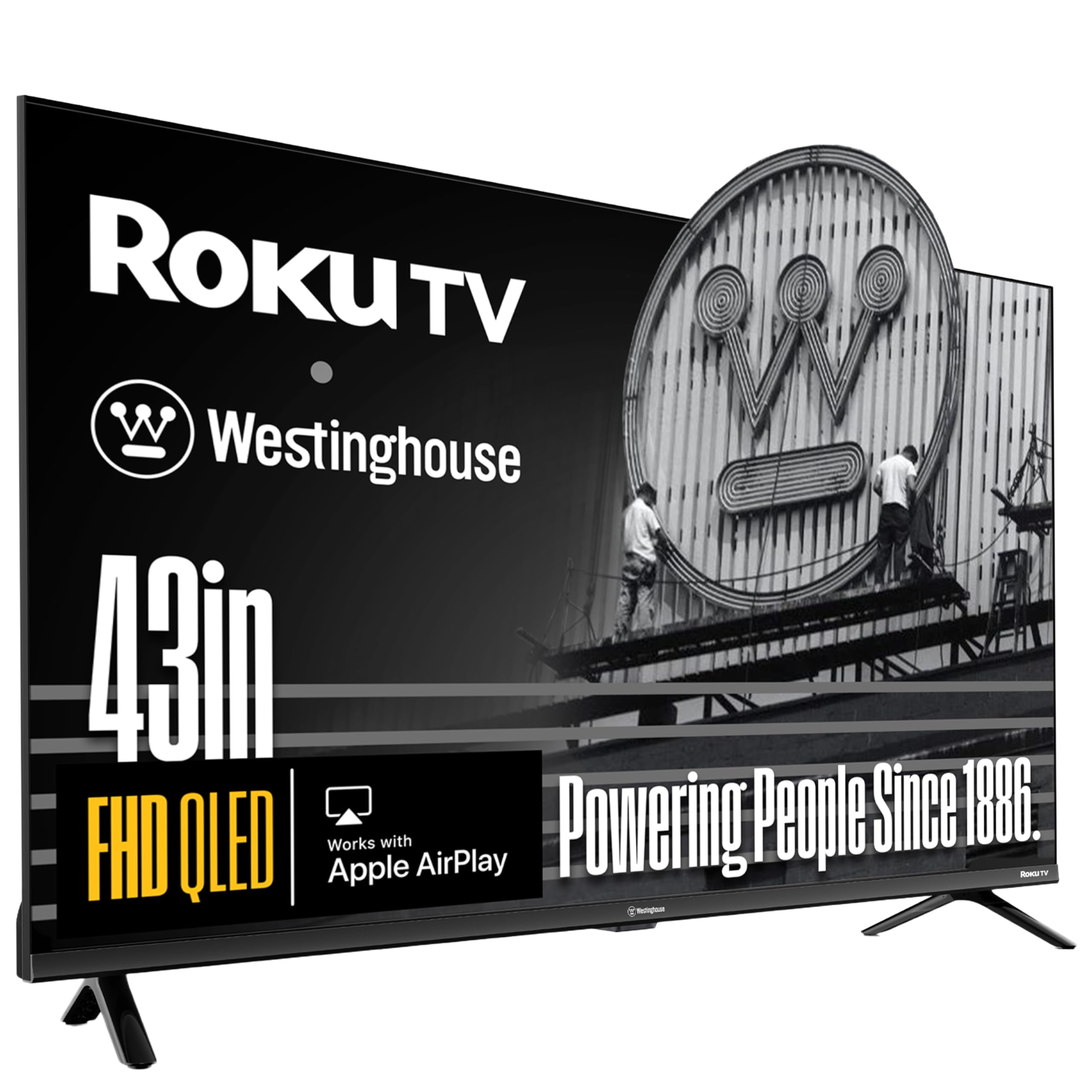
2. Westinghouse QLED Roku 43 Inch Smart TV
Quantum dot color at an entry-level ask — but you are watching Full HD, not 4K.
Westinghouse puts a quantum dot layer behind a Full HD panel, and the result is a 1200:1 contrast ratio with the richer, more saturated color QLED is known for. What it is not is a 4K set — the resolution tops out at Full HD, so a Netflix 4K stream gets downscaled. That trade-off is the whole story of this television, and it is a fair one if you sit several feet back and mostly stream series rather than study fine detail.
The connectivity punches above the panel: three HDMI ports with ARC (audio return channel, which sends sound to a soundbar over the same cable), optical audio, USB, and Bluetooth 5.2 for pairing headphones or a speaker. Edgeless bezels stretch the image to the frame, and AirPlay 2 plus the Roku Mobile App handle casting. Roku TV OS itself brings the same 350+ free live channels and the apps you already know.
Owners say quality is what carries this set, and the price-to-performance read is strong — but this is the pick for someone chasing color and a low entry cost, not the sharpest detail. Pair it with a soundbar through ARC (the audio return channel, which sends TV sound out to the bar over one cable) and the picture-versus-sound gap closes quickly.
The real trade: QLED color and a 1200:1 contrast ratio at an entry-level position, versus Full HD resolution where the Roku Select Series above gives you true 4K.
Sound pairing: Bluetooth 5.2 and ARC over HDMI mean headphones or a soundbar connect without a dongle.
Reach for it if: color pop and a low entry cost matter more than 4K detail.
Look elsewhere if: you sit close enough to notice the difference between Full HD and 4K.
3. Hisense 43″ Class E6SR Series Hi-QLED 4K UHD Smart Roku TV
Dolby Vision, a Hi-QLED panel, and game-ready VRR — the mid-range set that covers every format.
If you want the premium HDR format without a premium tier, this is the one. Dolby Vision tunes contrast scene by scene, which is why dark shows and moody films look richer here than on a plain HDR10 set. The Hi-QLED panel handles color, and AI 4K upscaling sharpens older, lower-resolution content so a sitcom from years ago does not look soft.
Gaming gets real attention: Game Mode Plus reduces input lag the moment you pick up a controller, and support for VRR (variable refresh rate) and ALLM (auto low-latency mode) keeps fast play fluid with less tearing. DTS Virtual:X handles the audio side, aiming for clearer dialogue and a wider sense of surround from the built-in speakers. Setup is genuinely quick — the Roku TV interface is ready to log in and stream right away.
The honest caveat is reliability. Some buyers report the set working fine for the long haul, while a few describe it stopping; brightness also draws mixed notes, with some finding it bright and others wanting more. Neither is a reason to write off the model — it is a reason to buy from a seller with a clean return path and to check the panel in the first week.
Why it earns the spot
- Dolby Vision plus HDR10 and HLG across the formats that matter
- Game Mode Plus with VRR and ALLM for consoles
- AI 4K upscaler sharpens older content
- DTS Virtual:X and Apple AirPlay with Apple Home support
The caveats to weigh
- Reliability draws mixed reports in owner feedback
- Brightness divides opinion — fine for some rooms, tight for bright ones
- Annual energy draw listed at 145 kwh
Best for: the buyer who wants Dolby Vision and console-ready motion without stepping into premium territory.
Hold off if: you need maximum brightness for a sun-drenched room.
4. Philips 43-Inch Class 4K UHD Ambilight Smart Roku TV
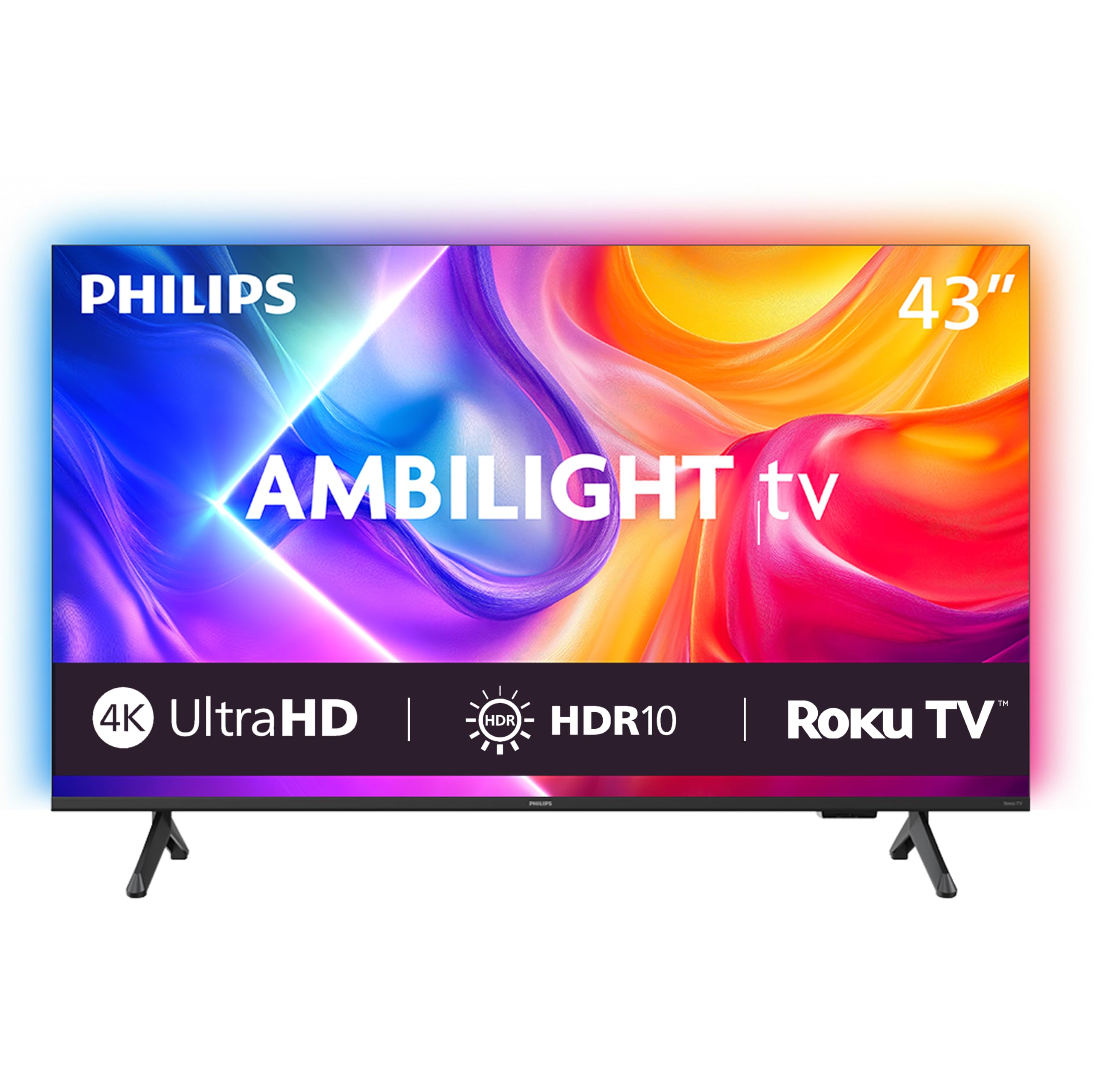
Lights behind the panel throw the on-screen color onto your wall — nothing else in this group does that.
Ambilight is the headline and it is not a gimmick: rear LEDs read the 43-inch screen and project matching color onto the wall behind it, so a sunset scene spills warm light past the frame. A Follow Audio mode pulses the light with music, and a static glow stays on after the TV is off, turning the screen into a low lamp. It is the kind of feature you notice nightly, not on a spec sheet.
The picture side is solid 4K UHD at 3840 x 2160 — four times the detail of Full HD — with HDR10 adding contrast and color to compatible content. A 60Hz panel with 120 PMR (picture motion rate) keeps fast sports and action from smearing. Dolby Audio from two built-in speakers keeps dialogue and commentary clear, and HDMI 1 carries eARC so a soundbar or AV receiver gets clean audio over one cable.
Ports are where this set quietly wins: four HDMI inputs swallow a cable box, a console, a soundbar, and a streaming stick without a switcher. There is USB, antenna, Ethernet, optical audio, and a headphone jack too. Picture quality is what buyers talk about most, and setup is quick — the recurring gripe is minor, mainly that Ambilight shines best on a plain wall rather than a busy one.
The glow effect: rear LEDs project on-screen color onto the wall, with a static mode that stays lit when the TV is off.
Port reality: four HDMI inputs plus eARC make it the most device-friendly set here for a cable box, console, and soundbar together.
Pick this one if: your TV sits against a bare wall and you want the room to change color with what you watch.
Pass if: the set is going in a cabinet or against a busy patterned wall where the glow gets lost.
5. TCL 43-Inch F7D Series QLED 4K UHD HDR Smart Fire TV

A QLED panel that speaks every HDR dialect — Dolby Vision, HDR10+, HDR10, and HLG all at once.
Quantum dot technology here pushes over a billion shades, and the format list is the longest in this group: Dolby Vision, HDR10+, HDR10, and HLG all supported. In plain terms, whatever your app sends, this screen has a picture mode built for it. Motion Rate 240 with MEMC (motion estimation, which inserts frames to smooth fast movement) targets the blur that ruins a fast break or a hockey rush.
Audio covers both major spatial formats — Dolby Atmos and DTS:X with DTS Virtual:X — so a compatible soundbar or the built-in speakers can place effects around the room. Auto Game Mode with ALLM switches to low latency automatically, and a Game Bar overlay lets you tune settings without leaving the game. Alexa, AirPlay 2, and HomeKit mean the TV joins whichever smart home you already run.
Two honest notes sit alongside the color praise: audio quality draws criticism from some owners, and reliability splits — some sets run clean, others arrive troubled. A soundbar through the HDMI input fixes the first; buying from a seller with a return window covers the second. At 4.0+ stars from 300+ ratings it is the most polarizing pick here, so go in with eyes open.
Format advantage: Dolby Vision plus HDR10+ plus HDR10 plus HLG covers every major HDR source in one panel.
Gaming kit: ALLM and a Game Bar overlay fine-tune settings mid-session, with Motion Rate 240 handling pans.
Buy-with-care: audio and reliability both draw mixed owner feedback, so plan for a soundbar and a clean return path.
Matches you if: you switch between Dolby Vision movies and HDR10+ shows and want one screen to handle both.
Not ideal if: you want a set that arrives flawless with no follow-up — this one asks for a soundbar and a careful first week.
6. VIZIO 43 Inch 4K Smart TV, V-Series UHD HDR

A 4K panel with AirPlay and Chromecast built in — but read the reliability notes before you commit.
VIZIO’s V-Series brings 4K UHD with HDR to a 43-inch frame, and the thing buyers keep coming back to is the picture itself: beautiful is the word that recurs. The panel handles high contrast, and AirPlay plus Chromecast built in mean you can throw a video from an iPhone or Android phone straight to the screen without a stick.
The smart-home hooks are real — Alexa and HomeKit controllers are listed — and setup lands on the simple side. An LED backlight, a 165 kilowatt-hour-per-year energy draw, and a plain remote round out the package. It is a set built for someone who wants a big, sharp picture and does not plan to fiddle with expert calibration menus.
Here is where the honesty comes in: this is the most reliability-questioned pick in the group. Quality and value draw mixed feedback, and reports of signal loss or early failure show up in the owner record more than they do on the other sets here. If you buy it, buy it where a return is easy. The picture is the reason to consider it; the service record is the reason to weigh it against the Roku or Philips instead.
The picture case: a 4K UHD HDR panel with the color and contrast that owners rate highest, plus AirPlay and Chromecast built in.
The reliability question: quality, value, and reliability all draw mixed-to-negative owner feedback, so the return policy matters more than usual.
Consider it if: casting from your phone is a daily habit and the picture is what you care about.
Weigh it against others if: long, uneventful ownership tops your list — the Roku Select Series above is the steadier bet.
7. TCL 43-Inch Class S5 4K UHD LED Smart TV with Google TV

Google TV, a high-brightness backlight, and a processor that cleans up the picture in real time.
Resolution here is 4K UHD — four times the pixels of a 1080p Full HD set — and a high-brightness LED backlight means it holds up in a room with lamps and windows rather than washing out. The TCL AIPQ processor with deep-learning AI handles color, contrast, and clarity on the fly, and Motion Rate 240 with MEMC frame insertion smooths fast scenes the same way it does on the F7D above.
Google TV puts your apps in one place with Google Assistant built into the voice remote, and it plays nice with Alexa and Apple HomeKit too. HDR PRO+ covers Dolby Vision, HDR10+, HDR10, and HLG, so premium streams get their full treatment. Dolby Atmos audio, an Enhanced Dialogue Mode for hearing speech clearly, and DTS Virtual:X round out the sound side, and Bluetooth 5.2 lets you pair headphones for private listening.
Performance draws a split verdict: plenty of sets run flawlessly, a few do not power on from the start. That is a small slice against the whole, but worth a careful unboxing. Size and appearance get consistent praise — the bezel-less design and saturated colors make it look more expensive than its station in the lineup.
Strengths worth noting
- High-brightness LED backlight for lit rooms
- HDR PRO+ with Dolby Vision, HDR10+, HDR10, and HLG
- Dolby Atmos, Enhanced Dialogue Mode, and DTS Virtual:X audio
- Bluetooth 5.2 private listening and Google Assistant on the remote
Small print
- A few units reportedly fail to power on from the start
- Brightness draws a mixed read in some owner reports
- Physical port layout leans sparse compared with the Philips
Go with it for: a Google TV household that wants Dolby Vision and bright-room performance in one set.
Reconsider if: you need to connect four HDMI sources at once.
8. LG 43-Inch Class UT75 Series LED Smart TV 4K

Five years of software refreshes — the set that keeps getting updates after the box is recycled.
Software longevity is the underrated spec, and LG leads here: the webOS Re:New Program promises new updates and feature refreshes for 5 years. For a bedroom or den TV you plan to keep through the decade, that beats a slightly better panel in year one. The a5 AI Processor Gen7 sharpens brightness, sound, and detail in real time, and FILMMAKER MODE strips out extra processing so a movie looks the way the director graded it.
webOS 24 puts all the streaming apps in one strip, and LG Channels adds 300+ free channels of sports, fitness, and cooking. HDR10 Pro extends contrast on compatible content, and the LG Game Optimizer collects gaming settings in one screen, with GeForce NOW included for streaming games without a console. Bluetooth 5.1, Ethernet, HDMI, and USB cover the wiring side.
Picture quality is the clear strength — the thin bezel boost the viewing area, and setup lands on the easy side. Two recurring notes: the remote divides opinion, and value for money draws a mixed read, with some owners feeling the panel is priced above its station. The screen itself is the part nobody disputes, so this is a pick for someone who values long support over the newest trick.
Support promise: the webOS Re:New Program delivers new software updates and feature refreshes for 5 years.
Owners agree on: crisp picture quality and a thin bezel that leaves more screen and less frame, with quick setup.
Two honest notes: the remote divides opinion and value-for-money draws a mixed read against its position in the lineup.
Fits you if: you want a set that stays current with updates for years and has a picture that holds up.
Look past it if: the remote matters a lot to you and value is your number one filter.
9. Sony 43 Inch BRAVIA 2 II LED 4K HDR Smart Google TV
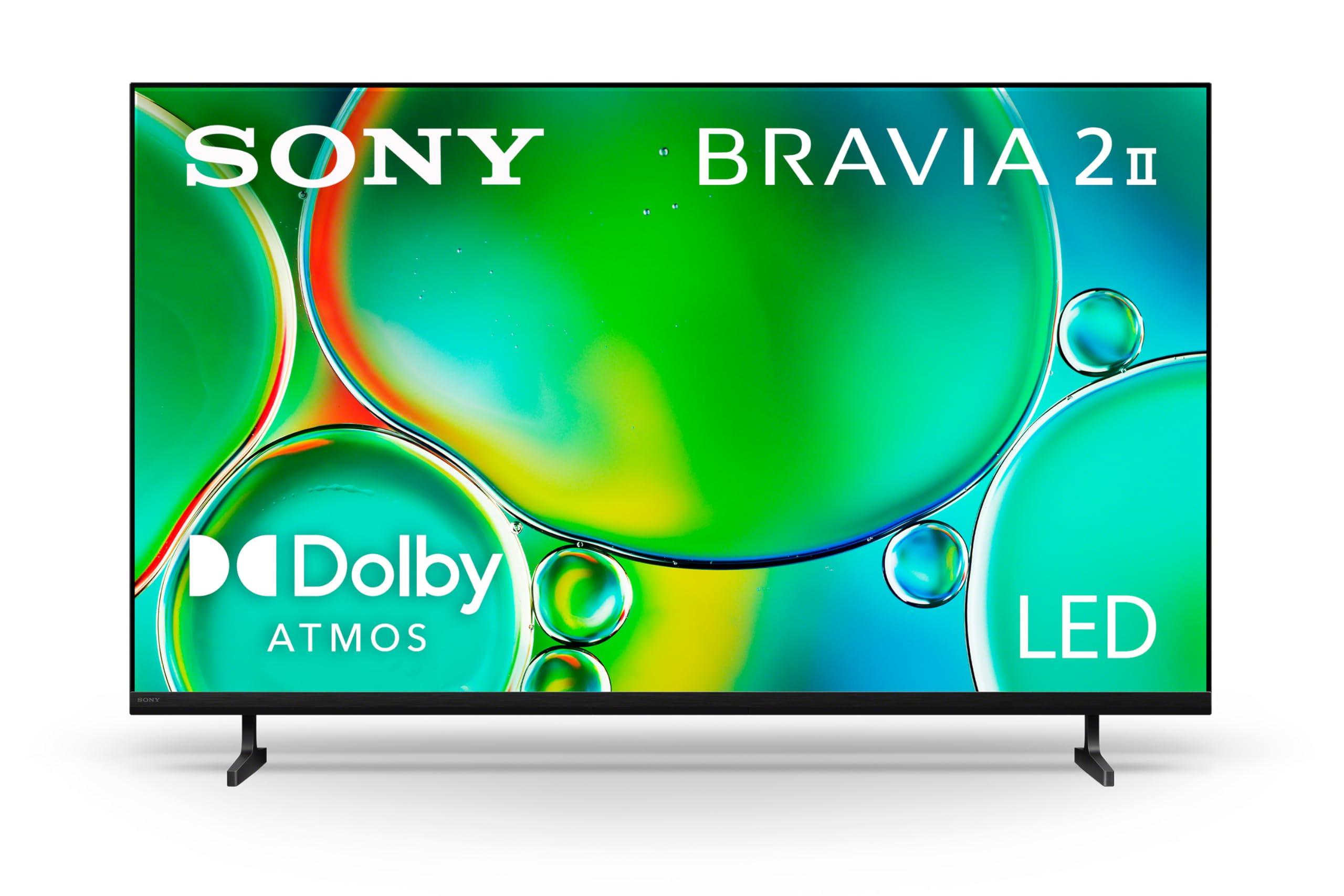
A processor-first television that makes old movies and PS5 games look better than their source.
The 4K Processor X1 is the reason this set exists. It handles color and detail in a way that pulls texture out of soft footage, and 4K XR-Reality PRO upscales everything you watch toward near-4K. That upscaling is the part you notice on older content — a faded film gains sharpness it did not have, which is exactly the kind of thing the picture-quality praise here centers on.
Sony leans into PlayStation: Auto HDR Tone Mapping and Auto Genre Picture Mode tune for PS5, and a Game Menu collects all the gaming settings in one place. Google TV backs the interface, with Apple AirPlay 2 and Google Cast for phone-to-TV streams, plus the Sony Pictures CORE app for included movies. Motionflow XR handles the blur in fast sports and action scenes.
Energy use is modest at 95 watts annual, and setup is quick — many owners are watching within about 10 minutes. The honest trade-off is a split reliability record: most sets run clean from day one, and a subset fail early. Sound and Wi-Fi connectivity also draw mixed notes, so a soundbar and a steady router help. At 4.0+ stars from 700+ ratings it sits a step below the top picks on consistency, but the processing is genuinely special.
Where it shines
- 4K Processor X1 with XR-Reality PRO upscaling for soft sources
- PS5-exclusive Auto HDR Tone Mapping and Auto Genre Picture Mode
- Google TV with AirPlay 2 and Google Cast
- Motionflow XR keeps sports and action blur-free
The honest catches
- Reliability draws mixed reports — some early failures appear in owner feedback
- Sound and Wi-Fi connectivity get mixed notes, so a soundbar is worth budgeting
- The remote is not the crowd-pleaser here
The match for: PS5 owners and anyone who watches older, softer content that benefits from strong upscaling.
Think again if: you want bulletproof consistency over processing polish.
10. Samsung 42-Inch Class OLED S90F 4K Smart TV

The first pick here where blacks are truly black — a 42-inch OLED built for film nights and fast games.
This is the smallest set in the group, a true 42-inch OLED, and OLED means each pixel lights itself. That is why contrast looks different here: black areas go genuinely dark because there is no backlight bleeding through, and whites stay clean next to them. The NQ4 AI Gen3 processor runs 128 neural networks to upscale everything to 4K and boost brightness scene by scene.
Gaming is a genuine strength: Motion Xcelerator supports VRR (variable refresh rate) at up to 4K 144Hz, so a compatible console or PC gets smooth, tear-free play. The AI processor also smooths the motion of fast-moving balls and on-screen text, which keeps a bouncing puck or a rolling scoreboard readable. Auto HDR Remastering lifts standard dynamic range content toward HDR-like quality, so older shows and films brighten up instead of looking flat.
Owners are near-unanimous on the picture — the color and the deep blacks are what the set is bought for, and setup is easy. The trade you accept is brightness headroom: OLED panels do not push the same peak brightness as a bright QLED in a sunlit room, so this is a set for a controllable-light space. It holds 4.0+ stars from 600+ ratings, and for dark-room viewing it is the deepest image on this list.
The OLED payoff: per-pixel lighting produces true black and clean whites, with the NQ4 AI Gen3 processor upscaling everything to 4K.
Gaming headroom: Motion Xcelerator handles VRR gaming at up to 4K 144Hz.
Choose it for: dark-room movie nights and console gaming where contrast and motion matter most.
Look past it if: your room floods with daylight and you need maximum brightness.
11. Samsung 42-Inch Class S90H Series OLED 4K Smart TV
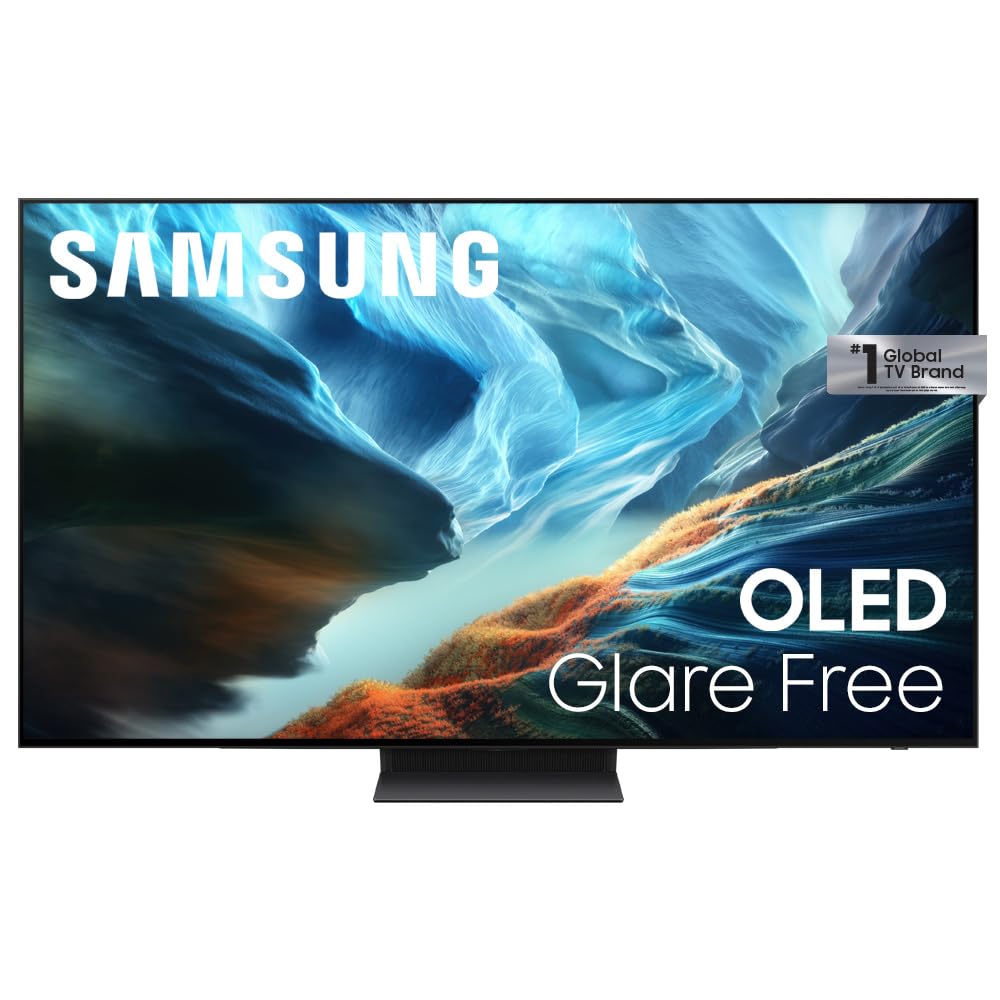
An OLED that fights reflections — Glare Free coating kills the window smear most glass panels show.
Reflections are the quiet problem with glossy screens, and this set attacks it directly with Glare Free technology that dampens the bright patches a lamp or window throws across the picture. Combine that with OLED’s per-pixel contrast, and you get deep blacks without a mirror finish. OLED HDR+ with advanced AI enhancement pushes detail and brightness into the same frame.
Gaming is the headline spec: Motion Xcelerator hits 165Hz with NVIDIA G-SYNC or AMD FreeSync Premium Pro support, which is a step past the 144Hz S90F above. In practical terms that means ultra-smooth, tear-free play with real-time responsiveness — the kind of motion a competitive gamer notices. The same NQ4 AI Gen3 processor with 128 neural networks handles 4K upscaling, auto HDR remastering, and AI Motion Enhancer Pro smoothing for fast balls and text.
It sips power next to the LED sets at 68 kwh annually, and the anti-glare screen is among the most-praised traits here, alongside the picture and color. The one honest note is the same as on most OLEDs (organic light-emitting diode panels) — occasional early failures turn up in owner feedback — so a careful first week is wise. Colors, blacks, and that glare-free surface are what make it a top-end pick.
Why it holds up
- Glare Free screen tames reflections from windows and lamps
- Motion Xcelerator at 165Hz with G-SYNC and FreeSync Premium Pro
- OLED HDR+ with AI enhancement for depth and color
- Low annual energy draw at 68 kwh
Small print
- Occasional early failures show up in owner feedback, so check it early
- Premium-tier position, so weigh it against the S90F’s strengths
- DTS audio support sits behind the Sony and Hisense here
The set for: a bright room where glare is the enemy and you game at the top end.
Not for you if: glare-free glass is a minor concern and saving the premium matters more.
Know the Specs
Resolution: 4K versus Full HD at 42 inches
4K UHD runs 3840 x 2160 pixels, which is four times the pixel count of a 1080p panel. At 42 to 43 inches, the difference shows up mostly in fine text, faces in close-up, and the crisp edges of games. A Full HD panel at this size still looks good a few feet back, but it cannot render the detail a 4K stream carries. Sitting within a few feet, you will see the extra detail 4K carries.
Panel type: LED, QLED, OLED
An LED backlight lights the whole panel from behind, and it is the value workhorse. A QLED adds quantum dots for stronger color, and the sets here quote contrast ratios like 1200:1. An OLED lights each pixel on its own, so dark scenes go truly dark without backlight bleed. A sunlit room favors a bright LED or QLED; a dark room favors OLED.
HDR formats and why they matter
HDR is what makes highlights glow and shadows keep detail. Dolby Vision tunes contrast frame by frame and is used by a lot of premiumstreaming; HDR10+ does something similar for other services; HLG is used for live broadcasts. A set that supports Dolby Vision, HDR10+, HDR10, and HLG at once covers every source without a manual mode switch. Sets limited to HDR10 still look good — you just lose some scene-by-scene refinement.
Refresh rate and motion processing
The refresh rate is how many times per second the picture redraws. A 60Hz panel is standard at this size and handles shows and casual games without complaint. Marketing names like Motion Rate 240, Motion Xcelerator 144Hz, and 165Hz describe higher rates plus frame smoothing that reduces blur on fast pans. For console gaming, look for ALLM (auto low-latency mode) and VRR (variable refresh rate), which cut input lag and screen tearing respectively.
Smart platform: Roku, Google TV, Fire TV, webOS
The platform decides how you find things to watch. Roku TV keeps a simple, customizable home screen with apps where you place them. Google TV bundles Google Assistant and pulls recommendations from your subscriptions. Fire TV leans on Alexa, and webOS brings LG Channels and a clean app strip. All four stream the major services; the real difference is the home screen layout and which voice assistant answers you.
Ports, casting, and connectivity
Count your HDMI inputs against your devices: a cable box, a console, a soundbar, and a streaming stick can fill them fast. ARC or eARC sends audio to a soundbar over the same HDMI cable. AirPlay 2 and Chromecast built in let a phone cast straight to the screen, and Bluetooth lets you pair headphones for quiet listening. An Ethernet port is worth having if the router sits nearby.
Common Questions
Why are most TVs on this list 43 inches instead of 42 inches?
Will a 43-inch TV fit on my existing 42-inch stand or wall mount?
Is OLED worth the jump over a QLED or LED set at this size?
Do I need Dolby Vision if I mostly stream from Netflix and Prime Video?
What refresh rate do I need for a game console on a 42-inch TV?
Can I use wireless headphones with these TVs at night?
Is a 4K TV worth it at this size or should I buy a bigger 1080p set?
How many HDMI ports do I need on a small smart TV?
Do these TVs need a soundbar or are the built-in speakers enough?
Which smart platform is easiest for someone who is not tech-savvy?
The Bottom Line
For most people, the 42 inch smart tv winner is the Roku Select Series 43-Inch because it pairs true 4K HDR10 with the friendliest interface in the group — and a remote that finds itself. If you want deep OLED blacks and top-end gaming motion, grab the Samsung S90F. And for a bright room where glare is the real enemy, the Samsung S90H is the one to reach for.
One nudge worth taking: the Roku Select Series carries a 4.5+ star score from 900+ ratings, which is the steadiest confidence signal on this list for a set that just works. Whichever you pick, check the panel in the first week and keep the box until you are sure — that habit covers you on any of these.
How we choose
We do not accept paid placement. Every pick is matched to a real buyer and a real use-case; we do not hands-on test units.
Sources
Specifications: manufacturer listings and product documentation. Review insights: verified customer reviews, as of November 2026. Pricing: not shown on this page (it changes often); check the current price via the retailer link.
As an Amazon Associate, Tactical Gear Guy earns from qualifying purchases. This does not affect which products we feature.