Specs are compiled from manufacturer listings and verified buyer reviews and can change over time — please confirm the key details on the product page before buying.
You want to shoot first and pick the angle later — that is the whole promise of a 360 camera. It only works if the stitching (the software that joins the two lenses into one smooth sphere) hides the seams and the stabilizer holds the horizon while you run. If you are buying one, the short answer is this: the Insta360 X5 is the pick most people should make. Its dual 1/1.28″ sensors (the light-gathering chips behind each lens) capture 8K30fps 360 video with the least grain in dim light of anything here. Everything below explains who should buy something else instead.
This guide is built by comparing the manufacturers’ published specifications and the patterns across verified customer reviews, so you get each pick’s real strengths and trade-offs instead of marketing spin.
A 360 camera records a full sphere and lets you reframe it later, so the spec that decides your buy is the resolution the sphere is captured at — and the lens quality behind it. Here is how each 360 vr camera on this list handles that job, plus where each one stumbles.
Top Picks

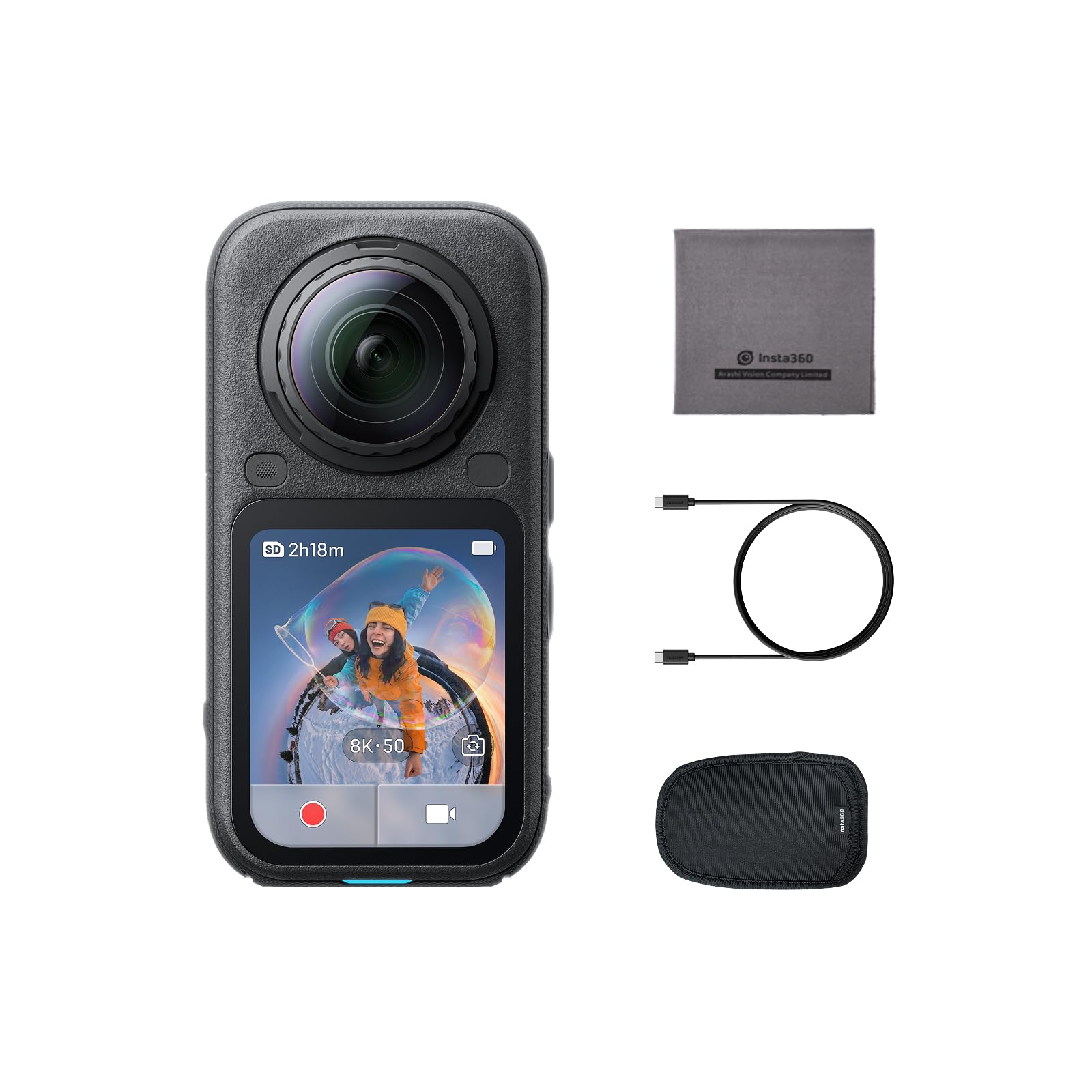
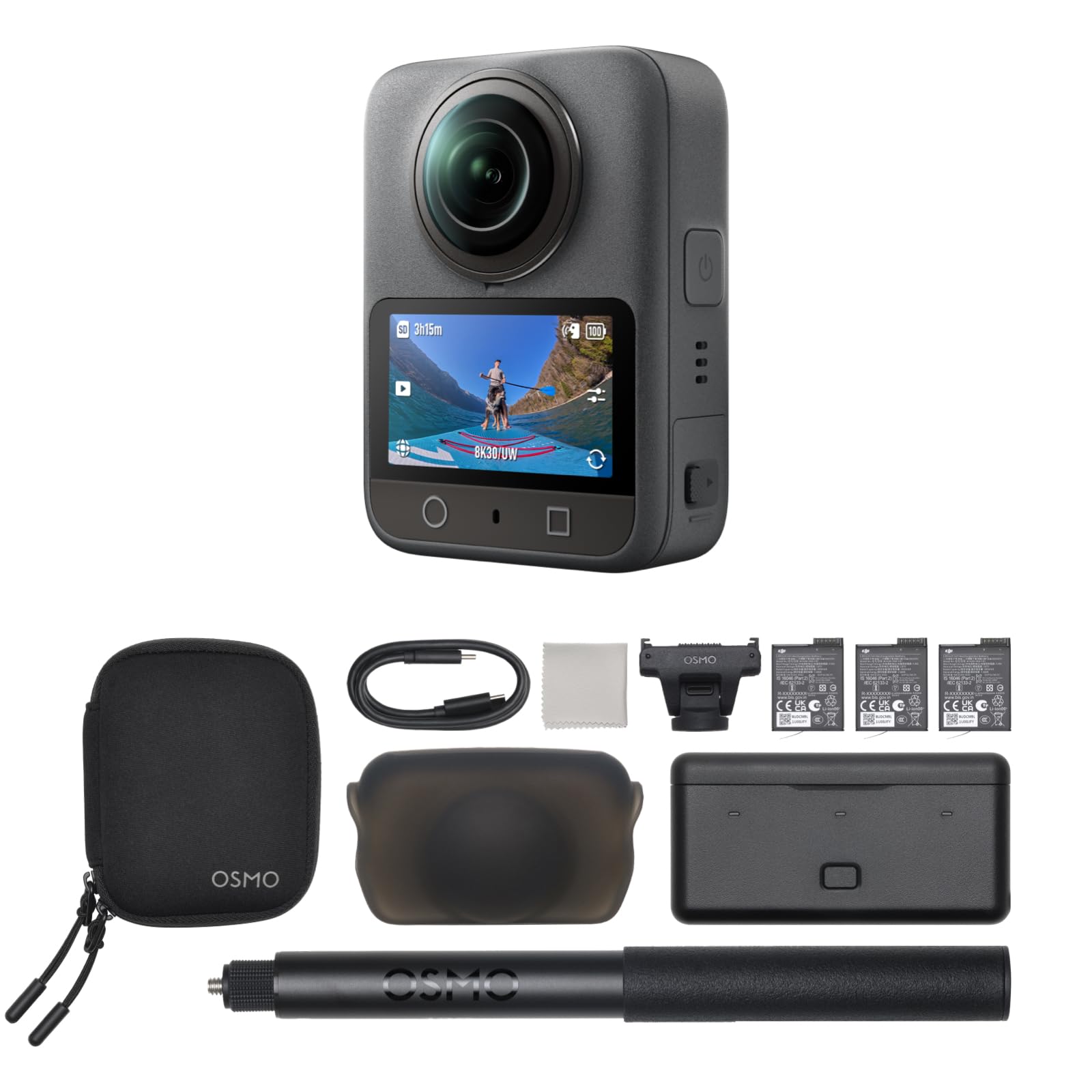
How To Choose The Best 360 VR Camera
A 360 camera is not a normal action camera with a wider lens. It shoots in every direction at once, then you choose the frame afterwards on your phone. That single difference changes which specs actually matter to you.
Capture resolution decides how much you can crop
Because you reframe later, you are always cropping a slice out of the full sphere. A 5.7K sphere leaves you less to work with than an 8K one. If you plan to pull flat, forward-facing clips for social media, go as high on capture resolution as your budget allows.
Sensor size is the low-light number
Two sensors, one behind each lens, each grab half the world. A larger sensor collects more light, which shows up as cleaner night footage and less grain in a dim room. The 1-inch sensors on the DJI Osmo 360 and the Ricoh Theta Z1 sit at the top of this list for that reason.
Stabilization and horizon lock keep it watchable
Shooting a sphere while running means the whole image rolls. Horizon lock holds the horizon level no matter how you tilt or spin the camera, and stabilization smooths out the bumps. Look for both named explicitly in the specs.
Battery, heat, and the invisible stick
Recording both lenses at once pulls power fast, and a sealed, waterproof body traps heat. Check the stated runtime and whether the battery is swappable. The invisible stick effect — where a mounted pole is stitched out of the footage — is the shot people buy these for, so confirm the camera supports it.
Side-by-Side Comparison
| Model | Best For | 360 Video | 360 Photos | Stated Battery | Amazon |
|---|---|---|---|---|---|
| Insta360 X5★ Best Overall | Most buyers | 8K30fps | 72 mp | 208 minutes | Amazon |
| Insta360 X6Highest Frame Rate | Highest frame rate | 8K50fps | 120 mp | 140 minutes | Amazon |
| DJI Osmo 360 Adventure ComboBest Battery Kit | All-day shooting | 8K30fps | 120 mp | 190 minutes | Amazon |
| GoPro MAX2 | Replacing scratched lenses | 8K 360 | 29 mp | — | Amazon |
| DJI Osmo 360 Essential Combo | First-time Osmo owners | 8K30fps | 120 mp | 190 minutes | Amazon |
| Ricoh Theta X | Still photography | 5.7K30fps | 11K / 60 mp | — | Amazon |
| Ricoh Theta Z1 51GB | Built-in storage | 4K | 23 mp | — | Amazon |
| Ricoh Theta Z1 USA Model | RAW editing | 4K30fps | 23 mp | 60 minutes | Amazon |
| AKASO 360 Creator Combo | Budget entry | 5.7K | 72 mp | — | Amazon |
| GoPro MAX | Budget GoPro | 5.6K30fps | 16.6 mp | 2 hours | Amazon |
Detailed Reviews
1. Insta360 X5
Our pick — 4.5+★ from 4,000+ verified ratings; the strongest balance of quality and price.
The sphere shooter that hands you an 8K frame and then vanishes the pole from it.
If you only read one line: 8K30fps 360 footage from dual 1/1.28″ sensors is what puts the X5 at the top. That resolution matters because you crop into the sphere after the fact — the more pixels the camera captured, the more you have left when you punch in on a flat clip. The 1/1.28″ sensors (each image chip behind the two lenses) are what pull clean footage out of a dim street at night. The triple AI chip design inside runs the noise cleanup that makes that possible. Its 72 mp 360 stills sit next to the GoPro MAX’s 16.6 mp, so a wide scene keeps far more detail when you zoom in.
Stabilization is the other half of the story. FlowState Stabilization (the software that irons out bumps) plus 360° Horizon Lock (which keeps the horizon level through full rotations) means you can run, cycle, or tumble and the footage still looks deliberate. The invisible selfie stick effect stitches the pole out of the sphere, giving you a third-person, drone-like angle with no crew. The new 4-mic array carries a Wind Guard that pulls voices forward and pushes wind noise back — the practical difference is vlog audio you can actually use without a separate recorder. Lenses are now fully replaceable and scratch-resistant, so a scuff on a rock costs you a lens swap rather than a camera.
Where it asks something of you: the stated 208-minute battery is the strongest runtime figure on this list. Even so, battery is the most discussed trade-off among owners and the one thing people grumble about after a long day of shooting. Durability chatter runs mixed too, mostly in the direction of wanting a case — the body is rugged, but the lenses are exposed optical glass. The editing app is where the X5 wins people over again, since you reframe on a phone and the AI tools do most of the cut-down work for you. If you shoot action and want the least fuss between raw sphere and finished clip, this is the one — it holds 4.5+ stars from 4,300+ owners, the largest owner base here.
Where it pulls ahead
- 8K30fps 360 video from dual 1/1.28″ sensors — more pixels to crop into later
- FlowState Stabilization plus 360° Horizon Lock keeps the frame level through spins
- 4-mic array with Wind Guard for clean voice capture outdoors
- Replaceable, scratch-resistant lenses — swap one in seconds instead of buying a camera
- 72 mp stills versus the GoPro MAX’s 16.6 mp
What to plan around
- Battery is the most contentious point with owners despite the 208-minute rating
- Exposed lenses want a case or pouch in a pack
- Highest price tier of the mainstream 360 group
Buy this one when: you want the most complete 8K 360 toolset with replaceable lenses and the best stabilization here.
Consider another: if you shoot in a climate where you cannot recharge mid-day, the DJI Adventure Combo ships with three batteries.
2. Insta360 X6
Eight-K 360 at fifty frames a second — the number that turns fast action into smooth slow motion.
Native 8K50fps 360 video is the reason to look here. Frame rate is how many still images the camera captures each second. More frames per second means the sphere holds together when you slow the footage down or whip the camera around. Behind that sits dual 1/1.1″ sensors (large image chips that gather more light) plus a triple AI chip system built around a 4nm flagship chip (a processor built on a 4-nanometer manufacturing process). In practice, that means less grain in indoor shots and cleaner color in a dim parking garage. 10-bit color records over 1.07 billion color shades, so a sunset gradient shades smoothly instead of banding. Its 120 mp effective still resolution puts its 360 photos in the same class as the DJI Osmo 360, and ahead of the X5’s 72 mp.
InstaFrame 2.0 covers the person who never wants to open an editor. Tap a subject — a person, pet, or object — and the camera tracks it, then hands you 4K flat video straight from the start. If you would rather not touch a timeline at all, the in-house AI model runs Auto Edit 2.0 while the camera charges. When you want a traditional wide action cam, 5K60fps and 170° FOV mode (an ultra-wide framing) is there, plus up to 4K120fps. The 2600mAh Xtreme Battery ships installed and is rated at up to 140 minutes at 8K30fps. Replaceable Lenses 2.0 are more scratch-resistant and cheaper to swap as a result.
Picture quality is what the review pages keep coming back to, and it is the strongest thing this camera has going for it. What costs people a second thought is the price tier — a recurring honest grumble that it is a lot to spend on a compact body. The practical reply is that the X6 packs higher frame rate, higher photo resolution, and the AI cutting tools into something that fits in a jacket pocket. If you shoot motorsport, downhill runs, or anything where slowing the clip down matters, the frame rate here beats the X5’s 8K30fps.
The frame-rate case: 8K50fps native 360 plus 4K120fps wide mode gives you slow motion without a second camera — that is the one number that separates the X6 from everything else here.
Room to weigh: the compact body limits how much heat it can shed, and the price sits in the premium tier; neither is a defect, just a reason to know what you are buying.
Right pick if: your clips live or die on smooth slow motion and 8K50fps 360 is worth the premium.
Not for you if: you mainly shoot slow still-style pans and care more about battery swaps than frame rate.
3. DJI Osmo 360 Adventure Combo
Three batteries, a charging case, and 1-inch sensors — for the trip where you cannot stop to charge.
What you are actually buying here is a day of shooting without a power cord. The kit bundles three Osmo Action Extreme Battery Plus units (1950 mAh each) in a multifunctional charging case, and each one is rated at up to 190 minutes of recording. For a full day on a mountain or a festival, that is the difference between packing it in at lunch and still rolling at dusk. The camera itself shoots 8K30fps 360 video off a groundbreaking 1-inch 360° imaging sensor — 1-inch is large by 360-camera standards, and it is why the night footage holds together in city streets and dim interiors. 120MP 360 photos take a full sphere in one tap.
The invisible selfie stick effect comes included as a 1.2m stick, so the third-person, follows-you-properly angle is a wire-once proposition. A magnetic quick-release flips you from 360 selfies to single-lens vlogs fast, and the 1/4″ thread plays nicely with older tripods and mounts. Built-in 105GB storage means you can shoot on day one without buying a microSD card. Four microphones capture audio from all directions and can pair straight to two DJI mic transmitters over OsmoAudio — no receiver box needed. Stabilization holds steady on 4K/120fps for the ski and cycling shots.
The honest catch is heat. Overheating and random shutdowns are a recurring, specific theme in owner feedback — a sealed, waterproof, 8K-processing body has limited places to dump heat. The other mixed note is usability: the menus and editing land well with some buyers and feel unfamiliar with others. Neither is a reason to skip it; both are reasons to understand your climate and your patience for a learning curve before you commit. The battery case and three included packs mean you can swap out and keep going, which turns a hard stop into a two-minute break.
Value read: three 1950 mAh batteries plus the charging case plus the 1.2m invisible stick is a lot of the accessory bill already paid for.
One honest caution: 8K 360 is heat-heavy work in any sealed body — break up long takes rather than running a single continuous clip.
Reach for this if: you shoot all day away from an outlet and overheating risk in long takes is something you can plan around.
Look elsewhere if: your work is long, uninterrupted single-clip recording where heat buildup in a sealed body becomes the limiter.
4. DJI Osmo 360 Essential Combo
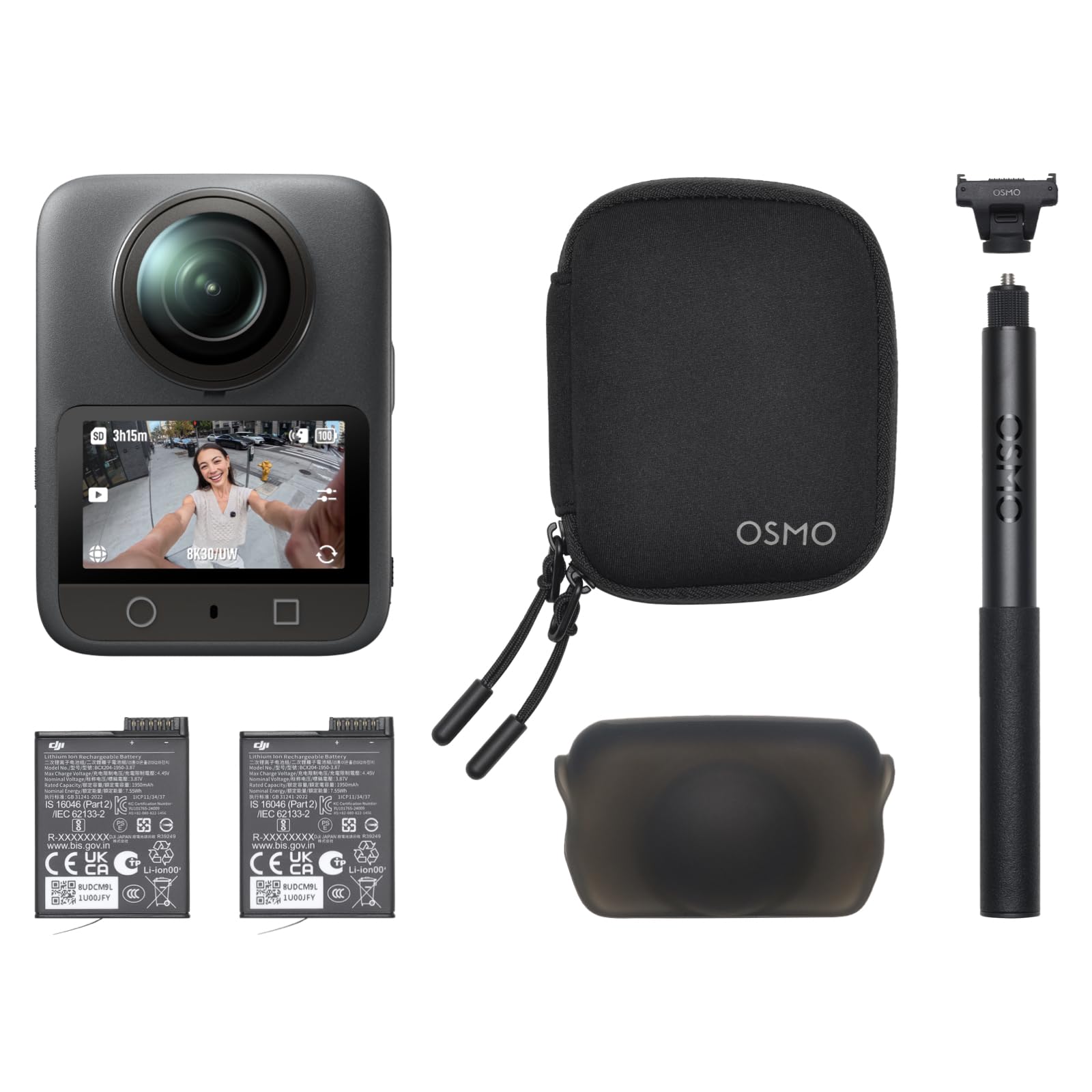
The same 1-inch 360 sensor and 105GB of onboard storage, with one battery instead of three.
Same camera core as the Adventure Combo, different kit math. You get the 1-inch 360° sensor, 8K30fps 360 video, and 120MP stills, plus the 1.2m invisible selfie stick and a single 1950 mAh battery rated at up to 190 minutes. If you shoot in sessions rather than marathons, one battery and a USB-C top-up is enough, and you keep the larger sensor without the extra packs on your belt. The 105GB of built-in storage carries you on day one without a memory card purchase — a genuinely useful head start when you are trying to figure out where the sphere ends and the reframe begins.
Four microphones pick up sound from all directions and pair directly to two DJI mic transmitters (sold separately) through OsmoAudio, so you can add clean voice later without a receiver. The magnetic quick-release switches you to single-lens vlogging in seconds, and the 1/4″ thread keeps it on a standard tripod. The DJI Mimo app handles Pano Dewarp (which un-warps the sphere into a flat frame), Pano Pro Color Grading, and Pano Camera Movement — that is the whole reframe workflow in one place.
One practical note before you buy: the DJI Mimo app has been removed from Google Play due to platform compatibility, so Android users need to grab it from DJI’s site. That is an admin step, not a barrier, but it is worth knowing. Reliability and editing both drew mixed reactions from owners — some find the workflow intuitive, others less so. The small review pool compared to the big Insta picks makes it a lean toward the known quantity if you want a lot of owner history behind a decision. If the Adventure Combo is more batteries than you need, this is the straightforward way to stay in the Osmo ecosystem.
The shortcut argument: 105GB of built-in storage and the 1.2m invisible stick are already in the box — that removes two purchases before you shoot a single frame.
The one snag: the Android app situation means you download DJI Mimo from DJI’s site rather than Google Play.
A good match if: you want the Osmo 360’s big sensor, 120MP stills, and built-in storage without the three-battery kit.
Different pick needed if: you plan multi-day trips where the charging case and spare batteries in the Adventure Combo payoff.
5. GoPro MAX2
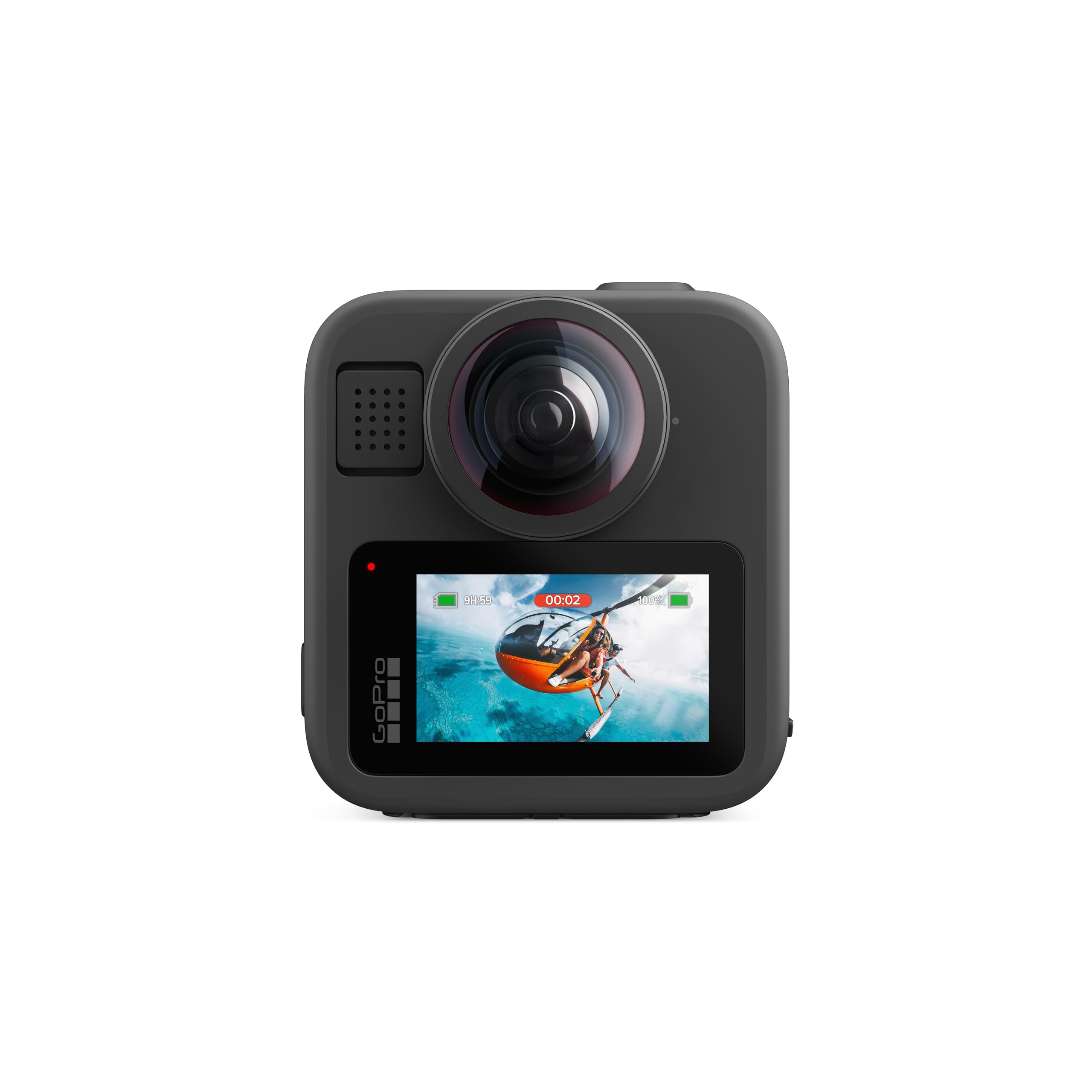
Glass lenses you can swap out, and a sphere that reframes down to 4K in the GoPro app.
GoPro’s answer to the fragile-lens problem is the smartest physical feature on this pick. The replaceable lenses are made from super strong optical glass with a water-repelling coating, so a scratched lens is a swap rather than a dead camera. The 8K 360 capture mode (True 8K per GoPro’s listing) gives you a full sphere to crop into, and 29MP 360 stills sit near the middle of this list for photo resolution. Six microphones spread around the body catch sound wherever it comes from.
The invisible mounting trick works through the 1/4-20 mounting threads on the base — attach to an extension pole and the pole is automatically stitched out of the frame. Then in the GoPro Quik app you reframe the 360 footage into traditional 4K videos in a few taps. Stabilization and Horizon Lock can be adjusted after the fact, which is unusual: if a shot came out shaky, you can dial the correction later instead of losing it. The 1960mAh Enduro Battery ships in the box. The case, adhesive mount, and protective lens caps come included.
What to weigh: video quality feedback splits here, with a mix of owners finding it excellent and others disappointed in certain conditions. The 29MP still resolution is also behind the DJI Osmo 360’s 120MP for photos. That split isn’t a defect so much as a fit question — if you shoot mostly action stills, the higher-resolution options on this list pull ahead. If you want the replaceable-lens insurance and the GoPro app ecosystem, this is the sensible move, and the four-sport audience (sports, drone work) it draws is real.
What earns its place: super strong optical glass lenses that swap out in the field — the standout physical feature for anyone near hazards.
The honest split: video feedback is mixed across the owner base, so try the reframe workflow in the GoPro app before committing if you have been burned before.
Best suited to: riders and drone pilots who value replaceable glass over max still resolution.
Think twice if: your priority is 360 photo resolution — the DJI and Insta options are higher on that number.
6. Ricoh Theta X

An 11K still camera that shoots video on the side — and knows exactly where it is.
Still photography comes first here. 11K high-resolution 360-degree still images (up to 60 megapixels) from a dual 48MP lens system with an f/2.4 aperture (the size of the lens opening, which controls how much light comes in) put the Theta X in a different league for panos and architectural shots than the action cameras on this list. HDR-DNG 16-bit RAW recording (a high-detail file format that keeps extra brightness data) means you can pull detail back out of a window and a shadow in the same frame later. Video is 5.7K30fps at 5760 × 2880 pixels, which is capable but a step behind the 8K action cams. If you are shooting rooms, real estate, or a wide scene you intend to print or crop hard, the still resolution is what matters.
Built-in GPS with QZSS and A-GPS compatibility embeds location data right into the photos, so you can build Google Blue Line tours without any add-on. The large color OLED touchscreen lets you frame, shoot, and review everything without touching a phone. Both the battery and the memory card are swappable, so long days are a matter of swapping cells and cards. An interchangeable battery means you are not tethered to a charger — you carry a second one.
The catch is image quality at the edges: the review pages split between buyers who love the 11K resolution and a few who found the image unusable in their particular conditions. That is a real caveat, and it usually depends on shot selection and lighting rather than the camera itself. Build quality drew mixed reactions too, and with 90+ reviews the sample is small compared to the big action picks. For stills-first work, this is a professional tool; for action video, the action cams elsewhere here are more natural.
Where it shines: 11K stills and HDR-DNG RAW with embedded GPS make it a location and property tool that only happens to also shoot 5.7K30fps video.
Honest trade-off: some buyers report image-quality disappointment, so try it on your own subject matter before you commit.
The right tool for: photographers who want 11K 360 stills with HDR RAW and location tags.
Not the pick for: action video — the 5.7K30fps capture lags the 8K action cams here.
7. Ricoh Theta Z1 51GB

Fifty-one gigs on board, so you never hunt for a memory card again.
Storage is the headline feature here: Its 51GB of internal memory is about 2.7 times the previous model’s capacity, so you shoot without a memory card. Ricoh’s listing maps that to roughly 6350 JPEG stills, 900 RAW plus stills, or 110 minutes of 4K video — all without a memory card. That is a real convenience for architectural work or an extended trip where you do not want to fumble with tiny SD cards in the field. Two 1-inch back-illuminated CMOS sensors (large sensors that catch light from behind the circuit layer for better dim-light sensitivity) sit behind a newly developed lens unit that suppresses ghosting, flare, and fringing. 23MP stills (6720 × 3360, 7K) come out of a high-precision stitching process. 4K 360° video with image stabilization and a four-channel mic rounds it out.
Enhanced HDR (high dynamic range, meaning the camera can hold detail in both bright and dark areas) handles the wide brightness range of a real estate interior — bright window, dark hallway — in one shot. The new image processing suppresses overexposure in bright outdoor scenes. USB 3.0 Type-C gives faster transfers. RAW development works through Adobe Photoshop Lightroom Classic with the dedicated RICOH THETA Stitcher plug-in, and YouTube livestreaming is supported. A magnesium alloy body gives it a solid feel. The low-light capability with 1-inch sensors is a genuine upgrade for indoor shooting.
The honest note is the battery: several owners mention the battery stops charging after a month, which is the most concrete negative in this block. There is also a mixed reliability signal — some units have been glitchy. Buy from a seller with a good return policy, and treat the battery as a wear item. The image quality consensus is on the positive side and the 51GB storage genuinely removes a purchase. It is a good pick for the property and walkthrough crowd.
Why it holds up: 51GB of internal memory and two 1-inch back-illuminated sensors are the two numbers that make it a serious stills camera.
What to know: battery complaints are a real pattern — budget for a spare or a charger-friendly return window.
Ideal for: real-estate and virtual-tour shooters who want 1-inch-sensor 23MP stills with no card management.
Second thought if: long life between charges is a priority — the battery has a recorded track record of charging issues.
8. Ricoh Theta Z1 USA Model

The editing-focused Theta — RAW files, a svelte 24mm body, and a 3-axis stabilizer for video.
If you plan to treat a 360 camera like a DSLR, this is the door. 23MP stills from two 1.0-inch back-illuminated CMOS sensors can be saved in RAW (Adobe DNG) as well as JPEG, and the RICOH THETA Stitcher plug-in for Adobe Photoshop Lightroom Classic stitches the sphere so the seams disappear. Details like zenith correction, directional correction, and stitch distance are all adjustable — that is the kind of control a compositor wants and a vlogger does not. The tri-fold lens structure keeps the body down to 24mm thick despite the large sensor. ISO6400 high-sensitivity shooting is a strong point for night and indoor shots.
Video is 4K 360° at 3840 × 1920 pixels and 30 FPS, with 3-axis rotational stabilization added so handheld pans are smoother. Exposure modes include aperture priority automatic exposure (AV), shutter priority automatic exposure (TV), ISO automatic exposure (IS), and manual (M) — the same set you would expect on a regular camera. It runs on Qualcomm’s Snapdragon chipset and an Android-based operating system, so firmware updates can add features over time. HDR Rendering, interval composite for star trails, and multi-bracket shooting up to 19 settings round out a real photography kit.
The one number that will get your attention is the 60-minute battery average life. That is a short window, and the battery is the most-discussed thing about this camera for that reason. Plan on spare cells and shorter sessions rather than a full-day run-and-gun. The software also drew mixed feedback — some find the workflow janky. The trade for that is a magnesium-bodied, 1-inch-sensor stills camera with serious RAW workflow support, which is why it earns a spot for the editorial photographer.
Stills-first case: RAW (Adobe DNG) files, a Lightroom stitch plug-in, and a 1-inch sensor make it a proper photography tool, not a toy.
Plan around this: 60 minutes rated battery average life means you carry a spare, not hope for a full day.
Pull the trigger if: you want RAW spherical stills and manual exposure control in a compact body.
Keep looking if: you need long single-charge sessions — 60 minutes rated is a short leash.
9. AKASO 360 Action Camera Creator Combo
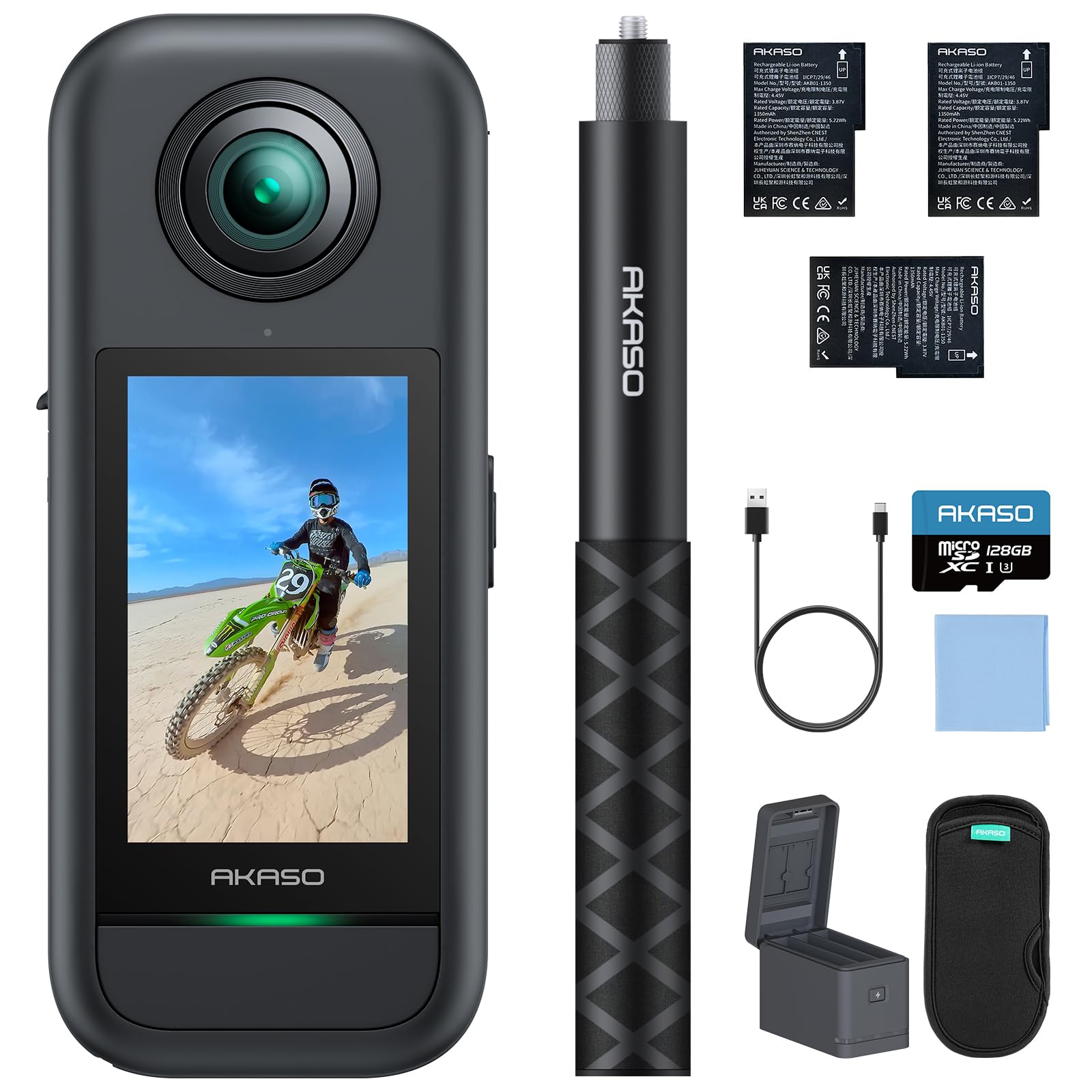
The beginners’ 360 kit that already includes the invisible stick and a charging case.
For a first 360 camera, what you get in the box matters as much as the spec sheet. The Creator Combo ships with the invisible selfie stick and a charging case alongside the battery and USB-C cable, so you are not immediately shopping for accessories. Capture is 5.7K 360 video — lower than the 8K cams here, but usable for social clips where you do not need to crop deep into the sphere. Its 5760-pixel 360 video sits next to the GoPro MAX’s 5.6K30 output, leaving more detail in the sphere for reframing. Dual 1/2″ 48MP sensors and 72MP 360 photos push detail further than most entry cameras at this tier, and DNG8 RAW photo mode helps in low light.
AI subject tracking keeps a person or moving subject centered, and the 360° Horizon Steady keeps footage level through spins. In-app stabilization smooths shakes without a gimbal. Shoot-first, reframe-later is the workflow, and the AKASO 360 Studio editor handles the cut-down. The camera and app are widely described as easy to use — video quality and ease of use are what owners come back to most. For a rider, a biker, or a traveler on a first 360 setup, the included stick and case are the difference between shooting on day one and not.
Where you feel the budget tier is in the stabilized low-light work — performance at night is where the 5.7K resolution and smaller sensors show limits, and that is the mixed note that shows up most. Weather resistance is also only rated as mixed, so treat the body as splash-resilient rather than fully submersible unless you confirm the rating. For daylight clips and beginner practice, this is an honest entry kit. You are trading low-light punch for a lower price and an included accessory bundle, which is a fair deal if night footage is not your main goal.
Starter value: 5.7K 360 video, a 72MP photo mode, the invisible stick, and a charging case — a complete kit from the start.
What you give up: low-light performance is the mixed note; daytime footage is where this camera earns its place.
A sensible first camera: for bikers, riders, and travelers who want the 360 workflow without jumping straight to 8K.
Look upmarket if: your shooting is primarily after dark — the 1-inch-sensor cameras here are the low-light answer.
10. GoPro MAX

One camera that shoots a 5.6K sphere or a plain single-lens clip, whichever the day calls for.
The dual-mode design is the flex here. In 360 mode you get 5.6K30 spherical video — 1080p live streaming, and a sphere you can reframe to any angle after the fact. But flip to single-lens HERO mode and it acts like a regular action camera, recording 1080p for widescreen or 1440p for taller POV footage. For someone who wants both a 360 camera and a normal point-and-shoot in one body, that flexibility is worth the trade on top-end resolution. Stabilization smooths the ride, and the 2x digital zoom gives you a closer look in single-lens mode.
The invisible pole trick works through the 1/4-20 mounting threads on the base: attach to a grip or extension pole and the pole disappears from your shots. The GoPro Quik app does reframing on the phone, with object tracking that keeps arider or subject centered as it moves through the frame. You also get single-lens photos and time-lapse in HERO mode, so one body covers stills, video, and time-lapse. The Enduro Battery, curved adhesive mount, two protective lens caps, and microfiber bag all come in the box.
The trade you are making is resolution. The 5.6K 360 capture is lower than the 8K cams here, and its 16.6MP 360 photos sit below the 72MP the Insta360 X5 captures — so if you intend to crop hard into a still, this is the weakest pick on that number. Video quality feedback is mixed across the owner base as well, and reliability drew mixed notes too. That said, the two-hour battery average life is solid for a budget camera, and the dual-mode flexibility is real. For a first 360 setup where you also want a plain wide clip sometimes, it does the job.
Why it earns its spot: 5.6K30 360 plus a genuine 1080p and 1440p single-lens mode — two cameras in one body for a budget price.
What to accept: 16.6MP 360 stills are the lowest on this list, and owner feedback on video quality is mixed.
A smart buy if: you want 360 and standard action-cam footage from one camera and photos are secondary.
Go elsewhere if: high-resolution 360 stills are the point of the purchase — the 72MP and 120MP options lead here.
Know the Specs
Capture resolution (5.7K vs 8K)
Capture resolution is how many pixels the camera records across the whole sphere. Because you always crop into that sphere to make a flat clip, higher capture resolution leaves you more pixels to work with. An 8K sphere gives you more headroom for a tight crop than a 5.7K one. If you plan to punch in on a subject or publish a sharp forward-facing clip, go as high as your budget allows.
Sensor size and low light
Sensor size is the physical area of each image chip behind the two lenses. A larger sensor collects more light, which shows up as cleaner night footage and less grain indoors. A 1-inch sensor sits at the large end for consumer 360 cameras, while 1/1.28″ and 1/2″ sensors are smaller. If most of your shooting happens after dark or in dim rooms, sensor size matters more than the tick-box features.
Stabilization and horizon lock
Stabilization is the software that smooths bumps and shakes. Horizon lock is the part that keeps the horizon flat even when you tilt or spin the camera. Together they keep a sphere watchable when you run, cycle, or tumble. Both are named in the specs of the top picks here, and the GoPro MAX2 even lets you adjust the correction after recording.
The invisible selfie stick effect
This is the signature 360 trick: mount the camera on a pole, and the camera stitches the pole out of the footage. The result looks like a drone or a second cameraman is following you. It works through the camera’s stitching, not a special pole — but the pole itself is often sold separately, so check whether it is included in the kit you pick.
Common Questions
What is the difference between a 360 camera and a normal action camera?
Do I need to buy a microSD card for a 360 camera?
How long can a 360 camera record on one battery?
Will a 360 camera overheat during long recording?
What resolution do I need for 360 video?
Which app do I edit 360 footage in?
Can I use a 360 camera underwater?
Is a 360 camera good for stills or only video?
What is horizon lock on a 360 camera?
Does a 360 camera come with the invisible selfie stick?
The Bottom Line
If you want the best all-round 360 vr camera, the Insta360 X5 is the safe pick — 8K30fps 360 footage from dual 1/1.28″ sensors, replaceable lenses, and a 208-minute battery that no one else here matches. It is the pick most buyers should start with. For higher frame rate and 10-bit color, the Insta360 X6 is the one to look at. And if you want to shoot all day without an outlet, the DJI Osmo 360 Adventure Combo ships three batteries and a charging case. Whichever you pick, buy it from a listing with a clear return policy and a spare battery on day one — that one small decision keeps your first shoot day from ending early.
How we choose
We do not accept paid placement. Every pick is matched to a real buyer and a real use-case; we do not hands-on test units.
Sources
Specifications: manufacturer listings and product documentation. Review insights: verified customer reviews, as of November 2026. Pricing: not shown on this page (it changes often); check the current price via the retailer link.
As an Amazon Associate, Tactical Gear Guy earns from qualifying purchases. This does not affect which products we feature.