Specs are compiled from manufacturer listings and verified buyer reviews and can change over time — please confirm the key details on the product page before buying.
You want wire that carries clean sound to every speaker and doesn’t buzz, crackle, or fall apart behind your drywall. The short answer: the GEARit 14 Gauge In-Wall Speaker Wire is the safest pick for most people, because it carries the CL2 rating that matters for running cable inside a wall. Keep reading and you’ll know exactly which spool fits your job, from a tiny desk setup to a whole-house run.
This guide is built by comparing the manufacturers’ published specifications and the patterns across verified customer reviews, so you get each pick’s real strengths and trade-offs instead of marketing spin.
Speaker wire looks like the simplest thing on your project list until you meet the rating codes and the copper-versus-aluminum question. I’ve laid out nine spools so you can match one to your run length, your wall situation, and your budget. This breakdown of the best 14 Gauge Speaker Wire is built to get you wired right the first time.
Top Picks

How To Choose The Best 14 Gauge Speaker Wire
The gauge number is the first decision and the easiest to get wrong. Lower numbers mean thicker wire, and thicker wire resists current flow less, so your amplifier’s signal arrives at the speaker with less of it lost along the way. 14 AWG is the practical middle: thick enough that length stops being a concern for typical rooms, thin enough that it still bends around corners and strips cleanly.
Match the wire to where it will live
If the cable is going behind drywall or above a ceiling, you want the CL2 rating (a fire-safety classification that says the jacket is acceptable inside a residential wall cavity). Wire that sits in open air along a baseboard or under a car carpet does not need that rating, and skipping it can open up cheaper and more flexible options.
Copper, or copper-clad aluminum
Pure copper and oxygen-free copper conduct well and resist corrosion over time. Copper-clad aluminum puts a copper skin over an aluminum core: it is lighter, cheaper, and easier to pull through studs, but it is the option to think twice about in a damp garage or an exterior run where moisture can reach the metal. Both types work fine when they are dry and indoors.
The details that save you time on install day
Foot markers printed along the jacket let you measure a long run without a tape measure. Red and black or two-tone polarity markings keep positive and negative straight, and getting polarity wrong can put a strain on your gear. A jacket that uncoils flat and stays flat is the difference between a tidy install and a wrestling match.
Side-by-Side Comparison
| Model | Best For | Length | Conductor | In-Wall Rated | Amazon |
|---|---|---|---|---|---|
| GEARit 14 Gauge In-Wall★ Best Overall | Whole-wall and ceiling installs | 100 ft | Copper Clad Aluminum | CL2 rated | Amazon |
| Kinter Cable 100ftBest Value | Budget whole-room runs | 100 ft | Copper Clad Aluminum | — | Amazon |
| Elecan 14 AWG with Banana PlugsPlug-and-Play Pick | Plug-and-play nearfield setups | 10 ft | Oxygen-Free Copper | CL2 rated | Amazon |
| InstallGear 14 Gauge 100 ft | Car audio and long flexible runs | 100 ft | Copper Clad Aluminum | — | Amazon |
| KnuKonceptz Kord Kable | Pure copper on a shorter run | 50 ft | Oxygen-Free Copper | — | Amazon |
| Monoprice CL2 14AWG | Precision in-wall spec matching | 50 ft | Oxygen-Free Bare Copper | CL2 rated | Amazon |
| Amazon Basics 14-Gauge | Everyday surround-sound wiring | 100 ft | Oxygen-Free Copper | — | Amazon |
| Install Link 14 AWG OFC | Home theater meets car audio | 100 ft | Oxygen-Free Copper | — | Amazon |
| Monster XP 14 Gauge | Long runs to subwoofers | 100 ft | Copper Clad Aluminum | — | Amazon |
Detailed Reviews
1. GEARit 14 Gauge In-Wall Speaker Wire 100FT
Our pick — 4.5+★ from 900+ verified ratings; the strongest balance of quality and price.
The wire that’s legal to bury in your wall — and soft enough to fish through studs without a fight.
This is a 100-foot, two-conductor spool of 14-gauge wire in a white CL2-rated jacket, and that CL2 code is the reason it earns the top spot. CL2 is a fire-safety rating for cabling inside residential walls, so this is the spool you want when the wire disappears behind drywall or above a ceiling and never comes out again. The jacket is also flame-retardant and resists fraying, which matters when you’re pulling it across wood studs and metal corners.
GEARit puts sequential foot markers on the jacket, so you measure a long ceiling run by reading the wire instead of dragging a tape measure up a ladder. The two conductors are red and black, which makes it obvious which side is positive and which is negative at the receiver. It’s built from copper-clad aluminum — a copper skin over an aluminum core — which keeps the spool light and keeps the cost down compared with pure copper. The whole roll weighs 3.2 pounds.
Owners describe it as easy to fish through studs and recessed ceilings, and the absence of buzz or line noise comes up again and again in the context of in-wall and in-ceiling jobs. The one honest consideration is that CCA construction: it’s fine for dry indoor runs, but if any part of your path goes outdoors or into a damp garage, pure copper is the better long-term bet. It holds 4.5+ stars across 900+ ratings, with owners repeatedly praising the jacket’s flexibility and the absence of buzz on in-wall runs.
What makes it the safe pick
- CL2-rated jacket lets you route it inside residential walls with confidence
- Foot markers printed right on the wire make long runs easy to measure
- Red and black conductors make polarity obvious at the terminals
- Soft, flexible jacket threads through studs, corners, and recessed ceilings
Where it asks you to compromise
- Copper-clad aluminum rather than pure copper, so keep it to dry indoor paths
- The 100-foot spool is generous for a single-room job and leaves plenty extra
Reach for this if: your wire is going behind drywall, above a ceiling, or anywhere the rating code actually gets checked.
Look elsewhere if: the run goes outside or into a damp space where pure copper earns its keep.
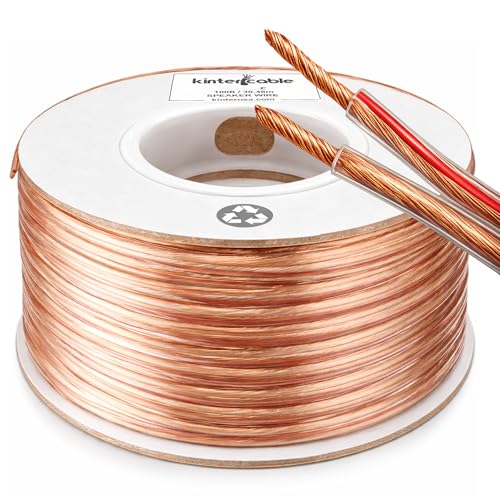
2. Kinter Cable 100ft 14-Gauge Audio Stereo Speaker Wire
A full 100 feet of flexible 14-gauge for a single-room job, with a spool that unwinds instead of tangling.
Where this Kinter spool pulls ahead is length for the tier: it delivers 100 feet of 14-gauge cable that runs a complete room, while the Elecan set on this list gives you 10 feet of pre-terminated cable for a desktop rig — a 10x gap in how far the wire reaches. If your job means pulling cable to rear surrounds on the far side of a room, that difference decides it before anything else.
The conductor is 117-strand copper-clad aluminum with a.15 outer diameter, wrapped in a soft PVC jacket marked with a red polarity stripe. The strand count is why it bends without fighting back, and it’s the kind of cable that lays flat rather than holding the curl from the spool. It ships on a recyclable dispenser spool, so you can pull what you need and store the rest without a bird’s nest.
The jacket is billed as indoor and outdoor capable, which is unusual at this level, but the aluminum core means you should still keep long-term exposure out of direct weather. Owners talk about unspooling it easily and cutting it to whatever length the job calls for, and one buyer reports it worked well with a pair of Bose 901 Series II speakers. It holds 4.5+ stars across 300+ ratings, with owners praising the easy unspooling and the soft jacket that lays flat.
The buying math: two conductors, 100 feet, on a dispenser spool — for a whole-room surround run this is the strongest length-to-cost read in the lineup.
The fair warning: the CCA core is honest about what it is; if you need oxygen-free copper for a damp location, spend the extra elsewhere.
The right spool when: you’re wiring four or five speakers across one room and want to cut exact lengths yourself.
Don’t grab it for: a permanent outdoor run where moisture will reach an aluminum core.
3. Elecan 14 AWG Speaker Cable 10 Feet
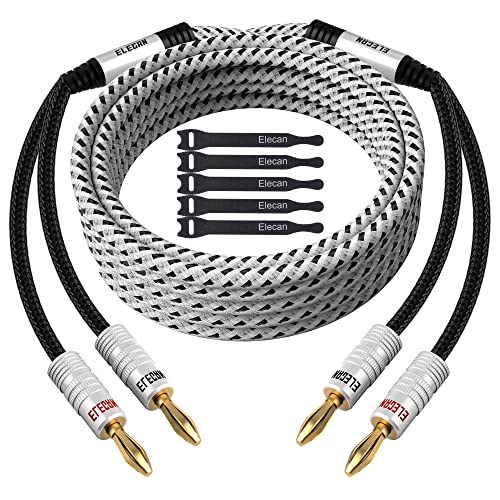
Ten feet of braided cable that arrives with the plugs already on, for people who never want to own a wire stripper.
The spec that sells this one is the connector: gold-plated banana-tip plugs on both ends, molded into a slim aluminum alloy shell with a net tail for strain relief. Banana plugs are the push-in connectors that seat straight into the back of a receiver or a speaker terminal, so this cable clicks into place with no stripping and no bare strands to short out. Both ends are male-to-male, so it runs receiver to speaker as a finished piece.
The conductor is stranded pure copper rather than copper-clad aluminum, and the braided nylon jacket is there to shrug off the twists and pulls of daily handling. CL2 rating is included too, which is unusual for a short pre-made cable. If you’re wiring speakers on a desk or bookshelf a few feet apart, ten finished feet is far more useful than a 100-foot spool you’ll spend an evening cutting. That’s the exact trade the Kinter spool makes in reverse — length over convenience.
What buyers line up behind is build quality, and the slim housing is a genuine practical plus because it slips into recessed openings where a bulky plug won’t. The honest caveat: plug fit is the recurring gripe here. Some barrels start loose, some users find the plugs sit too wide for certain receivers and speakers, and the ends take care when you re-route them. It rates 4.0+ stars, the lowest of the group, and loose or oversized banana plugs are the recurring complaint.
Where it shines: a pair of nearfield or desk speakers that live close together and get moved now and then — no tools, no stripping, straight in.
Who should pass: anyone with snug banana sockets or strict in-wall needs should buy a bare spool and terminate it to their own gear.
Buy it for: instant connection on short desktop or bookshelf runs where convenience beats yardage.
Skip the plugs if: your equipment has tight terminals — measure your socket first.
4. InstallGear 14 Gauge Speaker Wire 100 ft, 14 AWG
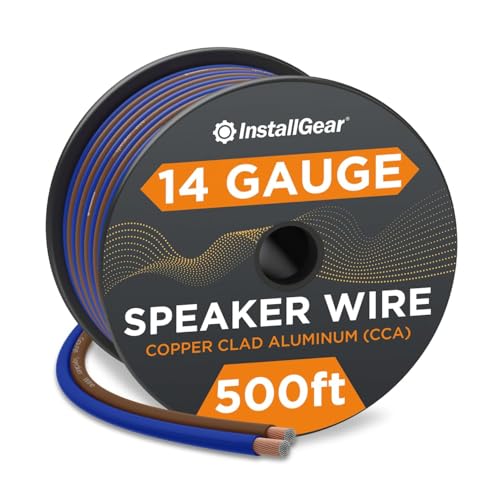
The blue-and-black spool with a jacket so soft it practically routes itself around a car interior.
InstallGear sells this as 100 feet of 14-gauge, and the number that defines it is the one on the jacket: a soft-touch PVC insulation designed with the installer in mind, flexible enough to snake through trim panels and low-memory enough to lie down where you put it. Two-color blue and black conductors give you polarity at a glance, and getting polarity backwards is the mistake that can stress your equipment.
Its reputation is built on the two things installers notice first — softness and low memory — and owners describe it as easy to run through a car’s interior and easy to work in open conduit. The frosted jacket also cleans up a messy harness; buyers talk about it taming a rat’s nest of previous wiring. It’s copper-clad aluminum, so the weight and price stay friendly, and the frosted blue/black look makes it easy to trace a run when several cables share one chase.
Buyers consistently praise the soft, low-memory jacket that runs flat and stays flat. A recurring note worth knowing before you buy is that some spools measure heavier than a strict 14 gauge when you look at the actual conductor thickness, which is fine for most runs but worth checking if you’re picky about the spec. The all-important other side: CCA in an open, dry location is fine, but keep it away from weather.
Why installers keep coming back
- Soft, low-memory jacket runs flat and stays flat after uncoiling
- Blue and black jacket makes polarity obvious in a crowded wire chase
- 100 feet is enough for a full car audio run or a surround setup
What to expect honestly
- Copper-clad aluminum core, not oxygen-free copper
- Some spools read a touch heavier than the stated gauge, so check the conductor if it matters to you
Made for: car audio runs and long flexible indoor jobs where you want the wire to bend your way.
Think twice for: in-wall or outdoor work — no CL2 rating and an aluminum core both point indoors.
5. KnuKonceptz Kord Kable 14 Gauge Speaker Wire 50 Feet
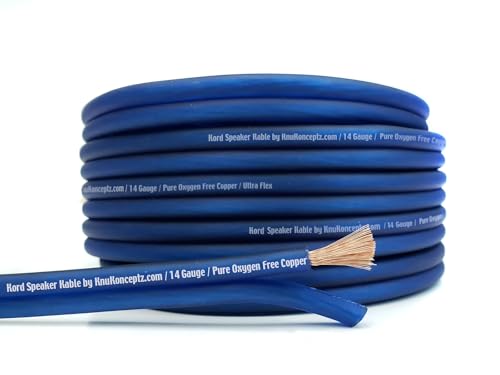
The spool that prints the specs on every foot, so you never take the seller’s word for it.
Here’s the detail that makes KnuKonceptz different: the wire material and gauge are printed directly onto the jacket of every foot. That’s a quiet confidence move, because it means you can read “OFC” and “14AWG” on the cable itself long after the box is gone. The conductor is oxygen-free copper at a stated minimum of 99.99% copper, which is the pure-copper route rather than the copper-clad aluminum used on cheaper spools. The spec that stands out in the numbers is the strand count — 189 strands in this 50-foot spool.
That high strand count is why it works like a soft rope. The Ultra Flex PVC jacket is billed as low-memory, so it lays flat immediately after you uncoil it and doesn’t kink or bind when you tuck it under a carpet edge or along a baseboard. Copper carries current with lower resistance than CCA, and the pitch here is a fuller frequency response because of it. At eight-by-eight millimeters in diameter, the cable has real body without being stiff.
Owners describe it as true copper 14 gauge, and the recurring practical tip is that because the copper is so soft, you’ll want to tin the tips or fit a terminator if you’re going bare into a terminal. That’s not a flaw, it’s a property of soft copper, and it’s the same reason it handles so well. It holds 4.5+ stars across 300+ ratings, with owners citing the soft, low-memory jacket and the printed gauge markings as the standout traits.
Best for the bare-wire purist: a 50-foot run in a dry room where you want the lowest resistance the spool can give you.
The honest limit: 50 feet is half the yardage of several spools here, so a whole-house job is not what this is sized for.
Choose it when: copper quality matters more than total length and you want the material named on the jacket itself.
Look at a 100-foot spool instead: if your run crosses more than one room.
6. Monoprice Speaker Wire 14AWG 50 Feet

Two conductors of high-purity bare copper, wrapped in a jacket that passes the wall-safety code.
The technical case for this Monoprice spool is simple: conductors made of high-purity oxygen-free bare copper, each one jacketed in color-coded PVC so polarity is obvious, all inside a jacket carrying the CL2 rating. CL2 is the fire-safety compliance that lets the cable go inside walls of residential buildings, so if your insurer or your electrician has questions, this answers them. The spool runs 50 feet with two conductors.
There’s an engineering argument buried in the pure-bare-copper construction too — keeping the load on your amplifier as close as possible to the impedance curve of your speakers. In plain terms, the receiver sees less of a fight on the way to the speaker, which is what a clean signal is made of. If you’re matching a published spec sheet for a whole-home install, this is the spool that reads like it was written for that spec.
It’s the least-reviewed option on the list, and the honest read is that the narrow 50-foot length and the production tier keep it a niche pick rather than a volume seller. Where it earns its place is the combination of true bare copper and the CL2 rating in one short spool, which is a harder combination to find than you’d think. If your wall run is short and your standards are high, this delivers the exact spec.
The precise choice: bare copper and CL2 in one spool, sized for a small in-wall job where 50 feet is enough.
The plain catch: half the yardage of the bigger spools, and the lighter owner feedback means you’re leaning on the spec sheet more than the crowd.
Perfect for: a short in-wall or in-ceiling run that needs to pass the wall-safety check with pure copper aboard.
Wrong pick if: you need long yardage for multi-room wiring.
7. Amazon Basics 14-Gauge Speaker Wire 100-Foot

One hundred feet of oxygen-free copper in a white jacket, sized for the surround system you keep putting off.
This is the mainstream choice — 100 feet of 14-gauge cable built from 99.9% oxygen-free copper with color-coded insulation for polarity, sold in a white jacket that disappears against trim and baseboard. It’s engineered for the normal case: a home theater receiver pushing audio to surround speakers or a set of in-room speakers, with conductors intended to carry an undistorted signal from amp to driver.
The value here is the copper-to-yardage ratio. You get oxygen-free copper across a full 100 feet and insulation that survives repeated handling while you route it, and the jacket is strong enough to take a few passes through a wall without splitting. That the box calls out a 9.5-volt rating tells you which applications it’s built for. It’s the straightforward, unglamorous wire that does the job.
The catch is in your hands, not the copper. This spool’s insulation runs thick, and a fair number of owners find it genuinely stubborn to strip without a proper tool, so budget for a decent stripper and a little patience. Thickness and flexibility are the split-personality aspects here — thick enough to feel substantial, stiff enough to resist tight bends. It still holds 4.5+ stars across 6,000+ ratings, so the thick jacket is a nuisance rather than a dealbreaker.
The case for the white spool
- 99.9% oxygen-free copper across a full 100 feet
- Insulated jacket handles repeated routing without splitting
- White color coding for clean polarity ID against light walls and trim
The real friction point
- Insulation is thick and hard to strip, so a good stripper is not optional
- Stiffer than a soft-touch jacket, which makes tight corners slower
The obvious choice for: a standard 5.1 or 7.1 surround setup where you want pure copper without hunting spec sheets.
Pack a stripper: the thick jacket fights bare hands — this is not cut-and-go wire.
8. Install Link 14 AWG Gauge Speaker Wire, 100 Feet, OFC

Oxygen-free copper across 100 feet in a frosted red-and-black jacket, built for both a trunk and a living room.
Install Link sells a double-conductor, 100-foot spool of 14-gauge stranded wire made from oxygen-free copper — refined copper with the oxygen pulled out, which is the material argument for lower resistance and a cleaner run to your speakers. The jacket is a soft, flexible “softflex” covering in frosted red and black that’s meant to strip easily and keep polarity readable while you work. It’s designed to serve both a home theater and a car audio build with the same spool.
What owners describe is a wire that doesn’t fight its own packaging. It lays down nicely out of the spool and doesn’t keep its shape, which is the property that separates a soft OFC cable from a stiff one when you’re threading it behind a dash or around a cabinet. Buyers also talk about feeling the difference in the weight of the copper when they pick up the spool compared with cheaper aluminum-core wire. It’s a solid pick when you’re splitting a job between a vehicle and a room.
The reason to pause is the price-to-yardage read — you’re paying for the oxygen-free copper and the 100-foot length, and there are cheaper copper-clad spools in this lineup if pure copper isn’t a requirement for your run. Install Link also skips the CL2 rating, so keep it out of the wall cavity. It holds 4.5+ stars across 200+ ratings, with owners citing the soft jacket and the genuine oxygen-free copper.
One spool, two jobs: the same 100 feet can wire a car door and a bookshelf pair, which is more than most spools here can claim honestly.
The trade: no CL2 rating, and you’re paying a copper premium for yardage you may not fully use.
Grab it if: you want one oxygen-free copper spool that handles a car audio install and a home theater setup.
Leave it if: the wire is going in a wall — it isn’t rated for that.
9. Monster XP 14 Gauge Speaker Wire 100ft, CCA Audio Cable

A 100-foot spool with a linked-polyethylene jacket, aimed squarely at long subwoofer and multi-room runs.
The jacket is the technical story here: linked polyethylene, abbreviated LPE, is the insulation material Monster uses to reduce signal loss while keeping the cable flexible enough to route through a wall or a car. It’s 14-gauge copper-clad aluminum with red and black polarity markings and a stranded construction that’s meant to work with banana plugs and standard speaker terminals. The 100-foot spool is sized for running across rooms or through a vehicle from one point to another.
Owners describe it as easy to pull through tight spaces, and the durability that comes from that is likely the more useful quality on a long run with several bends. The sound impressions go past the ordinary — better bass and better treble versus the older cable it replaced, in one account, and even at 100 feet the reproduction stayed excellent in another. Monster has a reputation for premium audio cabling, and the wire here is built to match that standard.
The honest trade is the conductor: it’s copper-clad aluminum, not pure copper, so in a damp space you’ll want to watch the terminations over time. What lands with buyers is quality — the most-praised aspect — and the cable suits a subwoofer or a multi-speaker setup where length matters more than material purity. It holds 4.5+ stars across 400+ ratings, with owners praising the easy pulls through tight spaces.
Built for the long haul
- 100 feet on one spool handles long subwoofer and multi-speaking runs
- Linked polyethylene jacket keeps signal loss down while staying flexible
- Works with banana plugs and standard speaker terminals
Know before you spool
- Copper-clad aluminum core, so keep terminations dry and check them over time
- Premium-brand price on a CCA conductor, while pure-copper spools sit in this same lineup
Well suited to: a subwoofer run or a room-to-room layout that needs every foot of 100 feet.
Consider the copper spools instead: if you’d rather have pure copper than a familiar brand name on a long run.
Know the Specs
Gauge (AWG) and what 14 means
Gauge is a thickness label, and the number runs backward: 14 AWG is thicker than 16 AWG and thinner than 12 AWG. Thicker wire offers less resistance to current flow, so more of your amplifier’s signal reaches the speaker. Fourteen-gauge is the common pick for typical room lengths, because it stays manageable to route while keeping resistance low enough that the run doesn’t become the weak link.
CL2 rating for in-wall cable
CL2 marks a cable as acceptable for installation inside the walls of a residential building, and it’s tied to fire-safety and insurance requirements. If a run goes behind drywall or above a ceiling, this is the rating to look for. Cable that stays in open air, under a rug, or in a car doesn’t carry that requirement.
OFC vs CCA conductor
Oxygen-free copper is refined to remove impurities and oxygen, giving high conductivity and lower resistance. Copper-clad aluminum puts a copper skin over an aluminum core, which saves weight and cost and stays flexible. Both work indoors; pure copper is the safer choice for long-term corrosion resistance in any damp location.
Polarity markings and foot markers
Red and black — or two-tone — conductors tell you which side is positive and which is negative. Getting that backwards can put strain on your gear. Foot markers printed along the jacket let you cut exact lengths for a long ceiling run without a tape measure, which saves real ladder time on a whole-room install.
Common Questions
Is 14 gauge speaker wire thick enough for a home theater?
What does CL2 rated mean, and do I need it?
Should I choose oxygen-free copper or copper-clad aluminum?
Will the GEARit 14 gauge wire work for ceiling speakers?
How do I know which speaker terminal is positive?
Can I use 14 gauge speaker wire for a car audio install?
Is the Elecan banana plug cable compatible with standard receivers?
Does the Monster XP work with banana plugs?
How much wire does one spool of 100 feet cover?
Why is pure bare copper better for a longer speaker run?
The Bottom Line
The 14 gauge speaker wire that works for the most people is the GEARit 14 Gauge In-Wall Speaker Wire, because it pairs the CL2 rating you actually need behind drywall with foot markers and polarity colors that make install day easy. If pure copper matters more to you than yardage, the KnuKonceptz Kord Kable prints its material on the jacket and lays dead flat. And for car audio or a long flexible indoor run, the InstallGear 14 Gauge has the soft-touch jacket that keeps you out of a wrestling match with your trim panels. Match the spool to where it will live and you’ll never touch it again.
How we choose
We do not accept paid placement. Every pick is matched to a real buyer and a real use-case; we do not hands-on test units.
Sources
Specifications: manufacturer listings and product documentation. Review insights: verified customer reviews, as of November 2026. Pricing: not shown on this page (it changes often); check the current price via the retailer link.
As an Amazon Associate, Tactical Gear Guy earns from qualifying purchases. This does not affect which products we feature.