Specs are compiled from manufacturer listings and verified buyer reviews and can change over time — please confirm the key details on the product page before buying.
Most 12 inch speakers disappoint because buyers chase big wattage numbers and ignore the two things that actually decide the result: whether the impedance (the electrical load, measured in ohms) matches your amp, and whether the cabinet or enclosure suits the driver. Get those right and even a modest-powered woofer hits clean and deep. Get them wrong and a 2,400-watt driver can sound thin. Below you get nine proven 12-inch drivers sorted by what each one genuinely does best — PA replacement, car bass, guitar tone, or midrange vocal punch.
This guide is built by comparing the manufacturers’ published specifications and the patterns across verified customer reviews, so you get each pick’s real strengths and trade-offs instead of marketing spin.
You will see which drivers are built for a sealed car box and which belong in a PA cabinet, plus the mounting depth, voice coil, and magnet specs that change how each one performs. The shortlist below narrows the field to genuinely capable 12 Inch Speakers.
Top Picks


How To Choose The Best 12 Inch Speakers
A 12-inch driver is only as good as the system around it. Before you compare wattage, match the impedance to your amp and confirm the driver physically fits your box or door cutout. Those two checks eliminate most bad purchases before you spend a thing.
Match Ohms To Your Amplifier First
Impedance is the electrical load the speaker presents to your amp, measured in ohms. A 4-ohm driver pulls more current than an 8-ohm one, so check that your amplifier is rated to run at that load. Wiring two dual-voice-coil subs together changes the final load too, so plan the wiring before you buy. If the numbers do not line up, the amp runs hot or shuts down.
RMS Power Beats The Peak Number
Peak wattage is a brief burst figure; RMS is the continuous power the driver handles day to day. A driver rated for high peak but modest RMS will not stay clean if you feed it constant heavy power. Match your amplifier’s RMS output to the speaker’s RMS rating, not its peak rating, for reliable output.
Confirm Mounting Depth And Enclosure Size
Mounting depth is how far the magnet sticks out behind the frame, and it decides whether the driver drops into a shallow door or behind a truck seat. The enclosure type matters just as much: a sealed box gives tighter, more accurate bass, while a vented box trades some accuracy for more output. A shallow-mount driver is the fix when space is the limiting factor.
Decide Between Sub, Woofer, And Midrange
A subwoofer is built to reproduce only low bass, a full-range woofer covers more of the musical range, and a midrange driver handles vocals and mid-bass for PA systems. Choosing the wrong type means you fight the driver’s design every day. Match the driver to the job and the rest of the build gets easier.
Side-by-Side Comparison
| Model | Best For | Nominal Size | Power Handling | Impedance | Amazon |
|---|---|---|---|---|---|
| Eminence SWAMPTHANG★ Best Overall | Guitar tone | 12 inches | 150 watts RMS | — | Amazon |
| Sound Town STLF-1270Best Value | PA and DJ replacement | 12 inches | 350W RMS | — | Amazon |
| Goldwood GW-212/8 (pair)Best Pair Deal | Cabinet rebuilds | 12 inches | 120W RMS / 240W Max each | 8 ohm | Amazon |
| Pioneer TS-A120D4 | Car bass depth | 12 inches | 1,500W max / 500W continuous | Dual voice coil | Amazon |
| Crunch CRW (pair) | Budget car setup | 12 inches | 800W max / 400W RMS | 4 ohm | Amazon |
| Rockville W12K6D4 V2 | Deep car bass | 12 inches | 2400W peak / 600W RMS | Dual 4 ohm | Amazon |
| Pioneer TS-A3000LS4 | Tight-space installs | 12 inches | 1500W max / 400W nominal | Single 4 ohm | Amazon |
| KICKER 48CWR122 | Clean smooth bass | 12 inches | — | Dual 2 ohm | Amazon |
| PRV Audio 12MR2000 | Pro midrange | 12 inches | 2000 watts | 8 ohm | Amazon |
Detailed Reviews
1. Eminence SWAMPTHANG 12-Inch Lead/Rhythm Guitar Speakers
Our pick — 4.5+★ from 200+ verified ratings; the strongest balance of quality and price.
The guitar driver that fattens a thin amp tone into something with real weight.
If your combo amp sounds small and thin, this is the fix. The SWAMPTHANG is a 12-inch American guitar speaker rated up to 150 watts RMS (the continuous power it can handle day to day), with a 59oz magnet — the heavy motor that gives the driver its punch. That combination is built for big bottom end, and the result you hear is a thick, chunky tone with sustain that holds a blues bend or a rock chord instead of collapsing.
What wins people over is the tone itself, and it is the thing this driver is known for across a huge share of feedback — the bass response fattens up an amp that sounded thin before, without needing a new amp. Touch sensitivity matters too: play soft and it stays clean; dig in and it growls. Eminence builds it in the USA, and it is tuned for Blues, Rock, and Jazz rather than metal chug.
The catch to plan around is weight — a 59oz magnet is a heavy motor, so the cab gets heavier in the corner. This is a guitar speaker, not a PA or car sub, so it belongs in a guitar cab and nowhere else. Buyers who wanted a drop-in punchier replacement for a tired factory speaker tend to be the happiest with it.
What earns the top spot
- 150W RMS handling and a 59oz magnet deliver thick, chunky tone with sustain
- Fattens a thin amp’s tone with a big bottom end
- Touch sensitive — clean when soft, aggressive when you dig in
- Made in the USA
What to weigh first
- The 59oz magnet adds real weight to a cabinet
- Guitar-only driver — not for PA, DJ, or car audio
Grab this for: a guitar cab that needs a bigger, thicker voice without buying a new amp.
Pass if: you need a PA or car subwoofer — this driver is voiced for guitar.
2. Sound Town STLF-1270 12″ Woofer
A budget PA replacement with a magnet that punches far above its price.
The number that stands out here is the 70-oz magnet, versus the 20oz magnet on the Goldwood pair further down this list. That heavier magnet gives the driver more motor strength, and the practical result is a solid, clean thump out of a pressed-steel 12-inch frame. The 3-inch voice coil (the wire coil that drives the cone) and 350W RMS power handling make it a genuine PA and DJ replacement driver.
Where it earns its place is in the wrecked-speaker rescue job. Owners run these in PA systems and monitor cabinets, and sound quality is the most-praised part of the feedback. Buyers report it working perfectly with a Yamaha amp, so if you are replacing a blown factory woofer in a working cab, this is a straightforward swap.
A fair caveat: it has no included enclosure or crossover, so you are buying a raw driver that assumes you know the cab it is going into. Check the cutout size against your old woofer before ordering, because a raw 12-inch frame needs a matching hole. For the money, it is a hard budget build to beat.
The real draw: a 70-oz magnet and 3-inch voice coil at a budget-driver level, giving a clean low thump for PA and DJ duty.
Know before you buy: it arrives as a bare driver, so confirm the mount hole and amp load match your cabinet.
The pick for: reviving a PA or DJ cabinet on a tight budget.
Not the one for: a first-time build with no cabinet to drop it into.
3. Goldwood Sound GW-212/8 12″ Woofers
Two matching 8-ohm woofers in one box — the smart buy for a stereo rebuild.
This listing is for two woofers, not one, and that pairing is the point: a stereo cab or a pair of standup speakers gets both sides replaced at once. Each driver handles 120 watts RMS and 240 watts max, runs at 8 ohms, and lists a 28–4000Hz frequency response with 88dB sensitivity (how loud it plays for a given amount of power). The 4.61-inch mounting depth and 11-inch cutout are worth checking against your cabinet before you commit.
Owners replacing tired factory drivers often get more low end than the originals delivered — better bass than the old speakers is the recurring theme. One owner ran them in a pair of 1980s stereo standup speakers — exactly the used-gear revival these are priced for. Sound quality is the most-praised part of the feedback by a wide margin.
The honest trade-off is that a 20oz magnet is the lightest motor in this round-up, and the lighter motor is why the bass punch is more modest than the heavier Sound Town above or the car subs below. For a gentle home or install cabinet that is fine. If you want door-rattling output, look at the car subs instead.
Strengths that fit the bill
- Two matched 8-ohm woofers included — replace both sides in one go
- Bass often outperforms the tired originals in older cabinets
- Vented pole piece and bumper plates for cooler running
- 11-inch cutout and 4.61-inch depth suit many standard cabs
Where it comes up short
- 20oz magnet is the lightest here, so low-end punch is modest
- Raw drivers — no enclosure or crossover included
Suits you when: a two-speaker cabinet needs both drivers refreshed and you want a matched pair.
Look past it if: you are chasing heavy car-audio thump rather than a clean replacement.
4. PIONEER A-Series TS-A120D4 12″ Subwoofer 1500W Max
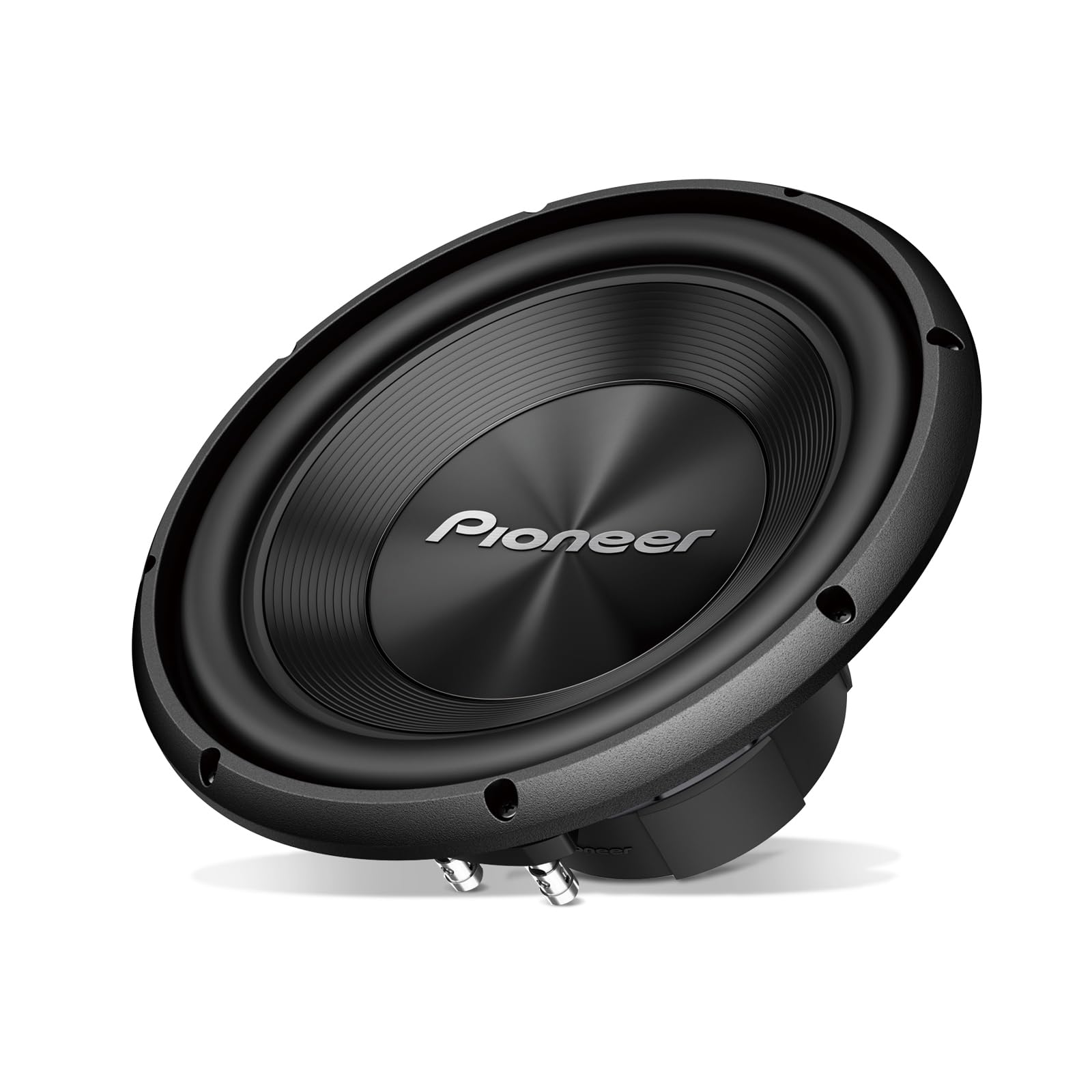
Car bass that goes low and stays controlled, thanks to a huge power ceiling.
Pioneer’s A-series 12 handles 1,500 watts max and 500 watts continuous, versus the Crunch pair’s 800 watts max and 400 watts RMS. That headroom is what lets the driver stay composed when a bass-heavy track hits. Extended dual voice coils (two separate windings that give you flexible wiring and greater cone travel) allow the long excursion that deep, dynamic bass needs, and the 20Hz–2.3kHz frequency response means it reaches deep into the sub-bass while still covering well up into the midrange.
Owners describe it as hitting hard, and the low-end drive is the reason people pick it. It drops into a car or truck enclosure and rewards a decent amplifier. The 77dB sensitivity figure means it wants a bit of real power to come alive, so plan for an amp that can feed it rather than a head unit alone.
The genuine limit to weigh is that this is a car-audio component and expects a sealed or vented sub box plus an amplifier to drive it — it is not a standalone cabinet speaker. If your system is not already set up for a sub, budget for the box and amp too. For anyone already wired for bass, this is one of the strongest value plays here.
Why it leads its price tier: 1,500W max and 500W continuous with an extended dual voice coil, versus the Crunch pair’s 800W max.
One thing to plan: at 77dB sensitivity it needs a real amplifier, not a head unit, to reach full output.
Pick it when: your car build already has a sub box and amp waiting for a strong driver.
Think twice if: you have no enclosure or amp — this driver needs both to do its job.
5. Crunch CRW 12 Inch Subwoofer Pair
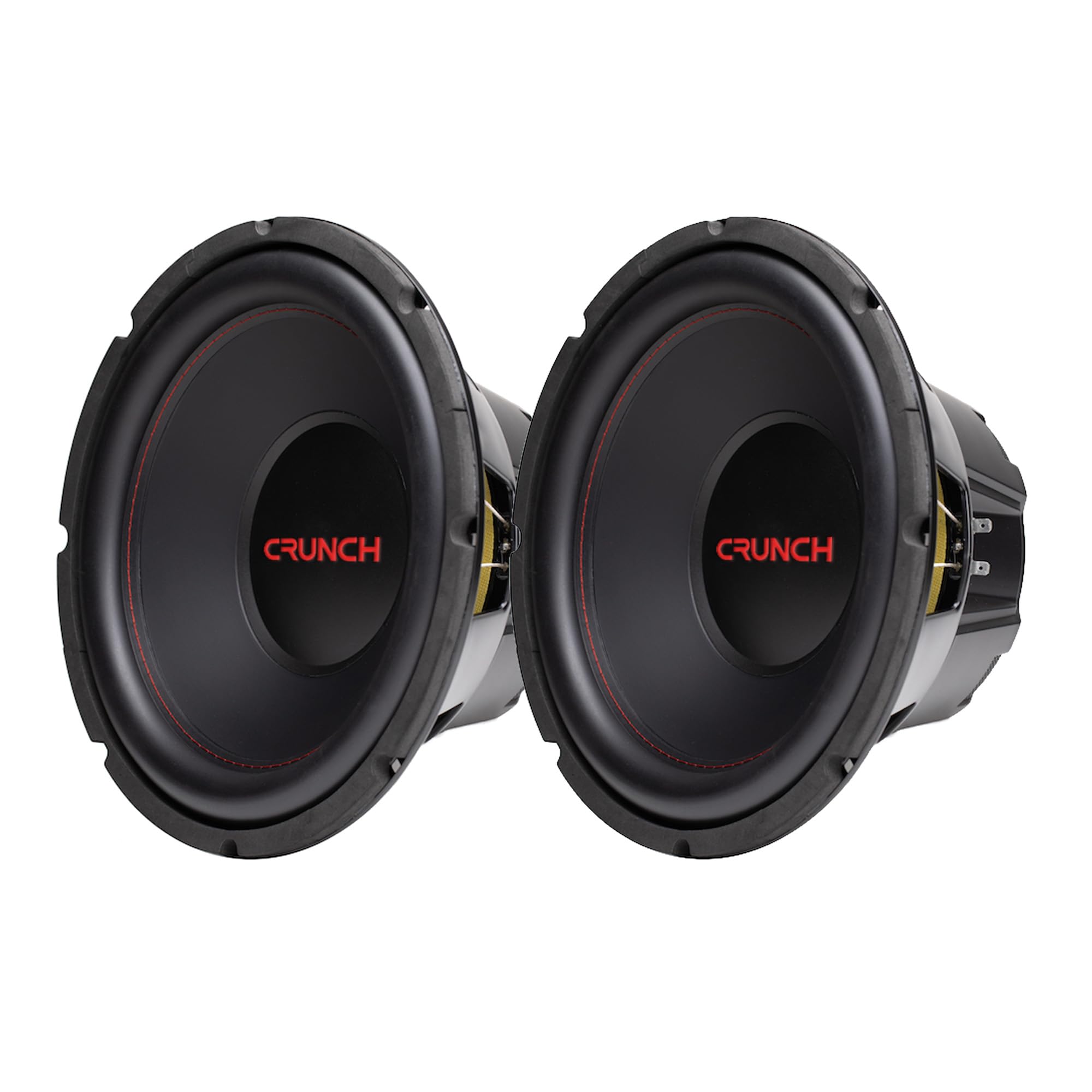
Two 12s for a whole car-audio upgrade — the entry ticket to real bass.
This is a two-pack, and that changes the math: you get both drivers for a starter-level outlay, rated 800 watts max and 400 watts RMS as a pair, at 4 ohms. The 2-inch dual voice coil and vented aluminum former (a heat-shedding coil former) are built to keep distortion down under power, and the spade terminals make wiring straightforward. These fit a small or medium sealed box or a large vented one, so they are flexible for a first build.
Where owners land is a mixed bag worth reading honestly. The low-end sound is the part people like — it delivers the volume a budget system was missing. But durability is the thing to size carefully: some units fail under light use, and the value and build impressions split. That makes the CRW a genuine fit question rather than a blanket recommendation.
The practical read: if you drive these modestly and keep the power within what 400W RMS suggests, they fill a car with bass for relatively little money. If you plan to hammer them with a big amp for hours, the higher-rated Pioneer TS-A120D4 above and the Rockville W12K6D4 V2 below are the safer long-haul picks. Buy them as a value starter set, not a competition build.
The appeal: a matched pair of 12-inch subs at a starter price, with clean low-end volume for the money.
The honest catch: durability is the most-discussed concern in the feedback — some units fail under light use, so keep power modest.
Best for: a first car system where budget leads and power stays moderate.
Not built for: feeding big watts for extended sessions — step up if you push hard.
6. Rockville W12K6D4 V2 12″ Subwoofer

The driving-around sub that takes heavy use and keeps hitting the low notes.
Here is the low-end brute of the group: 2400W peak and 600W RMS, CEA-rated (a standard that measures power honestly) for bass that stays clean at volume. The cast aluminum basket and fiber-reinforced non-pressed paper cone are built for high power and hard use, and the dual 4-ohm voice coils let you wire the load to suit your amp. The high-excursion cone reaches the very low notes that hip-hop and EDM live on.
What keeps people coming back is how well it survives the trunk. Build quality and durability are the leading themes in the feedback, alongside the ability to dig deep — buyers describe it as holding up to heavy use and performing well in ported boxes. The compact 12-inch design with a 5.75-inch mounting depth fits most car enclosures, which is a relief in tighter trunks.
One number to plan around: that 5.75-inch mounting depth is the deepest driver here, deeper than the Goldwood’s 4.61 inches, so measure your box before ordering. It also wants a proper amplifier to reach 600W RMS — a head unit alone will not get there. If your box has the room and your amp has the juice, this is the value leader for pounding bass.
Where it delivers
- 2400W peak / 600W RMS with honest CEA-rated power
- Holds up under heavy use — durability is a top theme in the feedback
- Dual 4-ohm coils give flexible wiring options
- Reaches very low bass notes for hip-hop and EDM
Numbers to plan around
- 5.75-inch mounting depth is the deepest here — measure your box first
- Needs a real amplifier to reach its 600W RMS rating
Reach for it when: you want maximum low-end output and your trunk has the depth for it.
Skip if: your box is shallow — this driver wants 5.75 inches of clearance.
7. PIONEER TS-A3000LS4 12″ Subwoofer

Deep bass in a slim body built for behind-the-seat and under-seat spots.
A 12-inch sub with only a 3.5-inch mounting depth (how far the magnet protrudes behind the frame) is the answer for anyone who has ever been told their truck or car has no room for bass. That shallow body fits behind or under seats where a full-depth driver simply will not go. It pairs 1500W max with 400W nominal power and a Glass-Fiber & Mica Reinforced IMPP cone (a stiff polypropylene cone that resists flexing) for detailed, deep bass from a slim package.
Owners confirm the fit is the real selling point — it drops behind the seat of a tight single cab and produces the deep tone people want. Sound quality and value both carry strong weight in the feedback. The single 4-ohm voice coil keeps wiring simple, and the glass-fiber cone keeps distortion low. Pioneer recommends a 0.8 cu. ft. sealed enclosure for it, so plan the box to that spec.
The honest caveat worth knowing: durability has come up in a mixed way, with a few reports of units failing relatively early. Most buyers have no trouble, but if you run high power constantly, keep an eye on the gain. For anyone swapping bass into a tight cab, the shallow-mount design is reason enough.
Why it fits tight builds: a 3.5-inch mounting depth lets a 12-inch sub go where full-depth drivers cannot — behind or under a seat.
What to watch: durability feedback is mixed, so keep power within recommendations and watch the gain.
The one for: a truck or compact car cab that has no room for a standard-depth sub.
Not for: a big enclosure where you have plenty of depth — a full-depth driver gives more output.
8. KICKER 48CWR122 CompR 12″ Subwoofer, DVC, 2-ohm

The sub built to last, with cooling and bracing that keep clean bass coming.
KICKER’s construction is the story here. It uses forced-air cooling that runs the motor 25% cooler (a maker figure for increased reliability), a rigid SoloKon cone with 360-degree bracing, a double-stacked magnet, and a stitched surround. That last detail — a surround stitched to the cone rim — is the kind of build choice aimed at holding together when you push the driver hard. It runs as a dual voice coil (DVC) 2-ohm unit for flexible wiring.
What owners value most is the KICKER build name, closely followed by the sound — clean, smooth low bass and mid-bass rather than one-note boom. It is a driver people say they would buy again, and the smooth mid-bass makes it feel musical rather than only loud. That balance suits someone who wants a finished-sounding system, not just maximum volume.
The trade-off to weigh is that this is a 2-ohm DVC driver tuned for a compatible amplifier, so wiring and amp matching take a little planning. There is also no official power rating in this listing’s specs, so match it to your amp’s output rather than chasing a number. Buy it for the build confidence and the clean tone.
The differentiator: forced-air cooling (a maker-stated 25% cooler) plus a stitched surround — build aimed at reliability under hard excursion.
Plan around: a 2-ohm DVC load needs a matching amplifier, so design the wiring before you install.
The fit for: a buyer who wants dependable, musical bass and confidence on build quality.
Less so for: someone after a one-note boom — this is tuned smooth, not thumpy.
9. PRV AUDIO 12 Inch Midrange Speaker 12MR2000 8 Ohm 2000 Watts

A vocal powerhouse built for PA stages and extreme car installs.
This is a midrange driver, not a sub — it is built to make vocals and mid-bass cut through a loud mix. The large 4-inch CCAW voice coil (a copper-clad aluminum wire winding) gives very high efficiency, so it plays loud without needing a huge amp. The extra-thick, stiff-yet-light cone stays linear all the way to 5.000kHz, which is why it suits two-way and three-way PA systems and stage monitors. A low mounting depth makes it drop into a monitor cab easily.
The build is meant to survive hard play: a resin-treated spider suspension resists failure under intense use, and a reinforced surround keeps geometry accurate when you push it. The motor sits on a reinforced cast aluminum frame for support. Owners describe it as loud and great sounding, and it has become a favorite in extreme car audio installs as well as PA duty.
Be honest about the job: this is a midrange, so it will not deliver deep subwoofer bass on its own — it wants to live in a multi-way system. It is an 8-ohm driver, so check it against your amp load. Buy it when the goal is loud, clear vocals, not trunk-rattling low end.
Why a PA builder picks it
- 4-inch CCAW voice coil for very high efficiency and volume
- Linear response up to 5.000kHz — strong vocal support
- Resin-treated spider and reinforced surround for hard play
- Low mounting depth suits stage monitors and tight installs
The limits to respect
- A midrange driver — it needs a multi-way system, not solo bass duty
- 8-ohm load requires checking against your amplifier
The right call for: PA builders and extreme car installs that need loud, clear vocals.
Wrong tool for: someone wanting deep subwoofer bass from one driver.
Know the Specs
Impedance And Ohm Matching
Impedance is the load a speaker puts on your amplifier, measured in ohms, and it has to match what the amp is rated for. A lower ohm number pulls more current, so an amp rated for 8 ohms can overheat on a 4-ohm driver. Dual voice coils add flexibility because you can wire them in different ways to land on a usable load.
RMS Versus Peak Power
RMS is the continuous power a driver handles for long stretches; peak is a brief burst it survives. The RMS number is the one to match to your amplifier’s output, because it reflects real, sustained loudness. A big peak figure with modest RMS will not stay clean if you feed it constant heavy power.
Magnet Weight And Voice Coil
The magnet is the motor that drives the cone, and a heavier magnet generally gives more control and punch; a 70-oz magnet is a bigger motor than a 20oz one. The voice coil is the wire winding on the moving former, and a larger coil — 3-inch or 4-inch — handles more power and runs cooler. Together they set how hard and how cleanly a driver plays.
Mounting Depth And Cutout
Mounting depth is how far the magnet reaches behind the frame and decides whether a driver seats in a shallow door or behind a truck seat. Cutout is the hole diameter the frame sits in; a 12-inch frame often needs an 11-inch cutout. Measure both against your enclosure before ordering, because no amount of power fixes a driver that will not physically fit.
Common Questions
Will a 12-inch speaker fit my existing cabinet?
What does 4-ohm versus 8-ohm mean for my amp?
Is RMS or peak wattage the number I should match?
What is the difference between a subwoofer and a midrange driver?
Do I need a sealed or vented enclosure for a 12-inch sub?
Can a car subwoofer work in a home or PA cabinet?
How much amplifier power do I need to drive a 12-inch sub?
Does a heavier magnet always mean better bass?
What is dual voice coil and why does it matter?
Will a raw speaker come with an enclosure or crossover?
The Bottom Line
For most people building a guitar cab or upgrading tone, the 12 inch speakers winner is the Eminence SWAMPTHANG because its 150W RMS rating and 59oz magnet deliver the thick, sustained tone that players chase. If you want maximum car thump from a single driver, grab the Rockville W12K6D4 V2 for its 600W RMS and deep-hitting cone. And for fitting bass into a tight truck cab, the shallow-mount Pioneer TS-A3000LS4 is the one to reach for. Whichever you choose, match the ohms and the mounting depth to your setup first, and you will get the most out of the money you spend.
How we choose
We do not accept paid placement. Every pick is matched to a real buyer and a real use-case; we do not hands-on test units.
Sources
Specifications: manufacturer listings and product documentation. Review insights: verified customer reviews. Pricing: not shown on this page (it changes often); check the current price via the retailer link.
As an Amazon Associate, Tactical Gear Guy earns from qualifying purchases. This does not affect which products we feature.