Specs are compiled from manufacturer listings and verified buyer reviews and can change over time — please confirm the key details on the product page before buying.
Your baby is pulling up on the coffee table and you need shoes that bend with those first wobbly steps, not stiff mini-sneakers that fight them. The short answer: buy the pair with a flexible forefoot, a wide toe box, and a strap that opens wide enough for a chubby foot. Colour, logo and shelf appeal come a distant second. The nine pairs below all clear that bar, and each one suits a slightly different little foot.
This guide is built by comparing the manufacturers’ published specifications and the patterns across verified customer reviews, so you get each pick’s real strengths and trade-offs instead of marketing spin.
You will see what each shoe does well, where it falls short, and how fitting actually works in practice. Sorting through the zapatos para bebe crowd gets a lot easier once you know which specs really matter for a beginner walker.
Top Picks


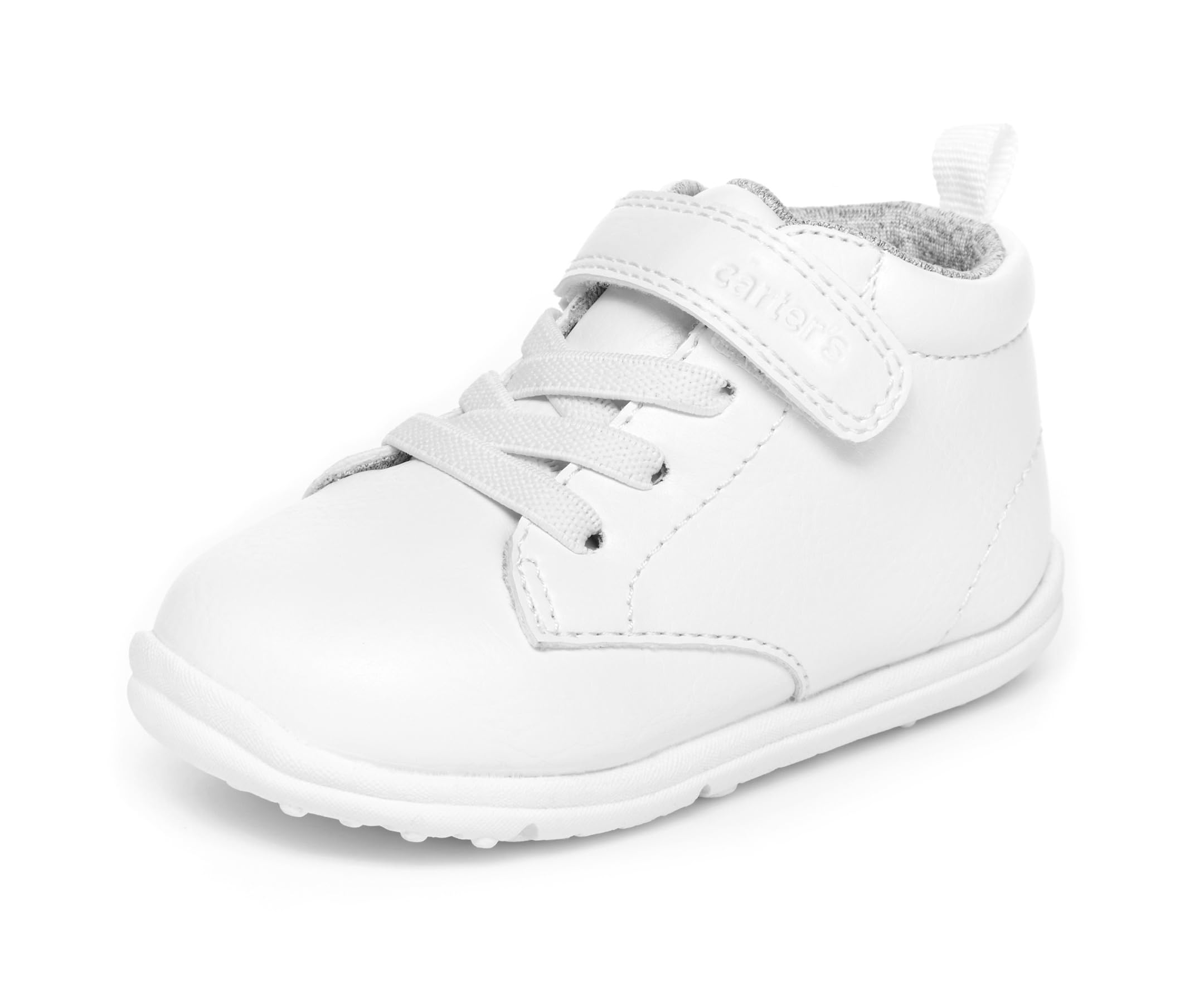
How To Choose The Best Zapatos Para Bebe
A baby shoe has one job in its first year of life: stay on the foot without getting in the way of walking. That sounds simple, and yet most of the pairs that get returned fail on one of two things — the sole is too stiff to bend, or the opening is too narrow to get a chubby foot inside. Get those two right and you have already won most of the battle.
Sole flexibility matters more than cushioning
Your baby learns to balance by feeling the floor through their feet. A sole that bends at the forefoot lets the toes push off naturally. That is why several makers describe their soles as flexible or zero-drop (meaning the heel and toe sit at the same height, with no raised heel). A rigid, thick sole turns the foot into a stiff block and makes balance harder. Squeeze the front of any pair you are considering — if it will not curl in your hand, it is not the right shoe for a beginner.
Width and opening: the chubby-foot problem
Baby feet are wide and padded, so a narrow opening is the number-one reason a shoe gets abandoned in the hallway. Look for a hook-and-loop strap (the velcro-style closure that peels open) or a stretchy elasticised opening, plus a toe box shaped like a foot rather than a pointed shoe. A wide opening lets you push the foot in rather than force it, and an adjustable strap lets you tighten the fit once the foot is seated.
Measure, do not guess
Sizing across these brands does not line up, and a baby foot can grow a size in a matter of weeks. Stand your child on a piece of paper, mark the longest toe and the heel, and compare that length against the maker’s own size chart in the product images. Several of these shoes already build in extra growing room in their sizing, so do not add your own margin on top — you will end up with a shoe that slips off.
Side-by-Side Comparison
| Model | Best For | Closure | Sole / Foot Shape | Cleaning | Amazon |
|---|---|---|---|---|---|
| Baby Shoes Infant Toddler Lightweight Sneakers★ Best Overall | Everyday first steps | Hook-and-loop strap | Flexible at the forefoot, mesh upper for wide feet | Hand wash; gentle machine cycle in a bag, air dry | Amazon |
| Baby Walking Shoes First Walkers SneakersEasiest On | Quick slip-on | Slip-on with stretchy ankle opening | Soft rubber sole with concave-convex anti-slip texture | Easy to wash | Amazon |
| Carter’s Charlie-pBest Ankle Support | Ankle support for new walkers | Hook & Loop | Lightweight, smooth lining | — | Amazon |
| Carter’s Kyle Sneaker | Versatile everyday sneaker | Slip-on | Lightweight, low-profile silhouette | — | Amazon |
| Stride Rite Kamila Mary Jane | Dressier outfits and new walkers | Slip-on | Sturdy bottom, mary jane shape | Washable materials | Amazon |
| Ten Little First Walker Shoes | Wide or chunky feet | Adjustable velcro strap | Zero-drop flexible sole, wide foot-shaped toe box, durable toe caps | Removable insoles for fit checks | Amazon |
| Minnetonka Suede Fringe Bootie | Cosy indoor and light outdoor wear | Lace tie / strap depending on style | Soft suede with flexible soft sole | Spot clean | Amazon |
| Robeez First Kicks | Barefoot-feel beginner shoes | Slip-on | Soft flexible sole, genuine leather upper | Spot clean with mild detergent | Amazon |
| New Balance 515 New-B | Active toddlers who scoot and step | Hook-and-loop closure | Flexible outsole, gentle cushioning | — | Amazon |
Detailed Reviews
1. Baby Shoes Infant Toddler Sneakers
Our pick — 4.5+★ from 300+ verified ratings; the strongest balance of quality and price.
The pair that bends exactly where a first step needs it to bend.
The spec that decides this one is where the sole flexes. It is deliberately flexible at the forefoot — the front section under the toes — so your baby’s foot rolls forward the way it does barefoot instead of clomping down flat. That single choice is why this pair suits the crawling-to-walking transition so well, and it is the reason it takes the top spot over the stiffer sneakers further down this list.
The fit story is built for awkward feet. The mesh upper plus the hook-and-loop strap — the velcro-style closure that peels open wide — spreads the opening enough to push a wider or chubbier toddler foot straight in. The white and cream mesh does show dirt, but the gum-coloured toe cap hides the worst of the scuffing, and a quick wipe after outdoor play keeps them presentable. Cleaning guidance is hand washing with a soft brush and mild detergent; if you must use a machine, a laundry bag on a gentle cycle and air dry only, never tumble dry.
What wins people over is the build. Quality is the thing buyers bring up more than anything else, and appearance runs a close second — the shoe looks like the photo rather than a cheaper cousin of it. The crowd data backs that up too: 4.5+ stars across 300+ ratings, which is the strongest satisfaction score in this whole group.
Where it earns its keep
- Forefoot flexes so tiny toes can push off naturally
- Wide-opening strap handles chubby and wider feet
- Gum toe cap hides the everyday scuffs
- Looks like the listing photo, not a lookalike
What to plan around
- Light-coloured mesh shows dirt and needs wiping down
- Hand washing is the recommended route; machine only on gentle in a bag and air dry
Reach for this if: you want one pair that handles the wobbly in-between stage without fighting your baby’s foot.
Look elsewhere if: you would rather toss shoes in the dryer — these need air drying.
2. Baby Walking Shoes Infant Toddler Sneakers
For the parent doing the one-handed shoe wrestle in a doorway.
If getting shoes on is your daily battle, this is the pair built around that problem. It skips the strap entirely and uses a slip-on design with a stretchy opening around the ankle, so the shoe stretches over the heel and settles into place. That is the whole idea, and it works — ease of use is far and away the thing buyers talk about most with this pair, and appearance is the runner-up.
Underneath, the sole is soft rubber with a concave and convex texture — raised bumps and dips that give grip and resist wear. The maker designed it to reduce slipping, and the shoe itself is described as soft and curved with a lightweight, breathable build. On a warm pavement afternoon that breathability is the difference between a foot that comes out clammy and one that comes out dry.
Here is the honest trade-off: no strap means no fine adjustment. A very narrow baby foot may feel looser in these than in a strapped shoe, while a chubby foot gets on easily. Parents also report they wash up easily, so a muddy park trip is not the end of them.
For a chubby foot, that trade-off works in your favour.
Best for the hurry-up mornings: stretched ankle opening, zero straps, on in a moment.
The compromise: no adjustable strap, so fitting relies on the stretch alone.
3. Carter’s baby-boys Charlie-p
The steadying hand of this list — built for the ankle, not the outfit.
Some babies need a little more hold around the ankle while they find their balance. The Charlie-p is the pair in this group that leans into that. It uses a hook-and-loop closure (a strap that peels open and presses back down), so you can tighten it around a wobbly ankle in one motion. Inside, a smooth lining means no seam rubs against a bare ankle. It is also lightweight enough that it does not drag a new walker down.
Fit is the spec that carries this shoe. Buyers bring up sizing more than any other point, and ankle support is the clear second — a sign that the extra hold around the ankle is doing real work rather than just looking supportive. Traction and flexibility round out the shortlist of things people notice.
The catch is sizing. Makers’ charts and real feet disagree on this one: some find it runs true and others find it runs large, so measure the foot rather than trusting the age range. The durability reports split the same way — some pairs come through a season of scrabbling, others show scuffing within a couple of weeks.
The support argument: if your baby is still reaching for furniture and needs a shoe that helps them feel planted, this one earns its place above the more cosmetic picks.
Pick it when: ankle hold and a seam-free lining are at the top of your list.
Check the size chart twice: the fit reports run in both directions, so a paper measurement is your friend.
4. Carter’s Baby-Boy’s Kyle Sneaker

A low, flat sneaker that lets a toddler feel the ground.
This is the plain-and-versatile option: a lightweight, low-profile sneaker with sporty styling that pairs with jeans, joggers or a romper without a second thought. Low-profile means the sole sits flat and close to the ground rather than lifted and chunky, which keeps the foot closer to the floor while your baby learns to step. It slips on rather than strapping on, so getting it on is a quick job.
Quality is what gets mentioned most about the Kyle, with appearance right behind it. People describe it as sturdy enough to give real support rather than collapsing under a wobbly step, and durable over the period a baby actually wears it. It is also described by owners as pretty inexpensive for what it is — a sensible everyday shoe rather than a dress-up one.
The one thing to watch is sizing. Some feet land true, and others find the shoe runs bigger than expected — so resist the urge to buy a size up pre-emptively. Unlike the Charlie-p above, there is no hook-and-loop strap to tighten things up if the fit is slightly off.
What holds up
- Low profile keeps the foot close to the floor
- Durable enough for daily wear
- Slips on without straps or fuss
- Versatile styling for any outfit
Where it needs care
- No strap to fine-tune the fit
- Runs large for some feet, so check the chart
The straightforward pick: a flat, sturdy sneaker that disappears into the wardrobe and just does the job.
The caveat: a bigger-than-expected fit on some feet — buy the measured size, not the hopeful one.
5. Stride Rite Kamila First Walker Shoe

The mary jane that goes to the party and survives the puddle after.
Most first-walker shoes are sneakers, and most of them look like it. The Kamila is the exception — a mary jane with a sturdy bottom, built for a baby who is actually learning to walk rather than just being carried in style. The bottom holds up to real wear and tear, so this is not a photo-opportunity shoe that falls apart on the second day.
Fit and comfort are the two things buyers bring up most, and ease of use is close behind. It is the kind of shoe that slips on without a wrestling match and then stays comfortable enough for a full outing. It also matches nearly everything in a small wardrobe, and the washable materials mean a dropped ice cream is a cleaning job, not a replacement.
One detail worth passing along: some parents say occupational therapists recommend these for foot development. Take that as a parent-to-parent note rather than a medical guarantee. If you want a shoe that works for a dress-and-tights day and still supports a staggering toddler, this is the pair on this list built for exactly that.
The dress-up problem solved: a party shoe that behaves like a walking shoe underneath, so you are not swapping pairs halfway through the day.
For the wardrobe that includes dresses: a real walking shoe in a dressier silhouette.
If you need zero fuss: it is still a slip-on, so a very narrow foot may want a strap instead.
6. Ten Little First Walker Baby Shoes
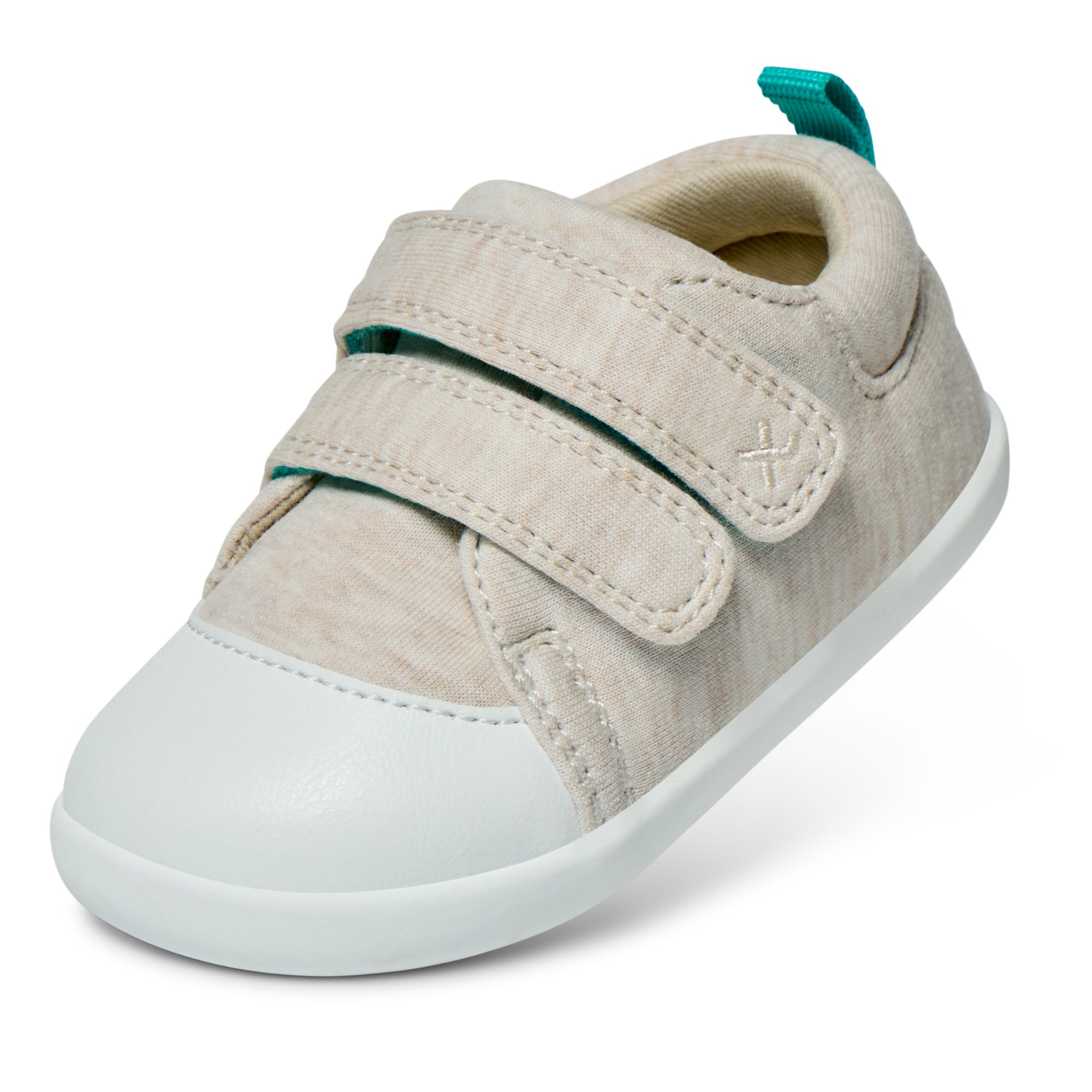
Built like a foot, not like a shoe — the wide-foot specialist.
The design brief here is a wide, foot-shaped toe box so little toes have room to splay instead of being pinched together. Combine that with a zero-drop sole — where heel and toe sit level, with no lifted heel — and flexible construction, and you get a shoe that lets the foot move the way it would barefoot. The wide opening makes getting it on simple, and the durable toe caps take the brunt of the crawling and scuffing.
Sizing is where this brand does something useful: their size guide already accounts for extra room, so you match the child’s measured foot length to their chart rather than adding growth room yourself. There is no separate width option, but the adjustable velcro strap tightens the fit and the shoe has been tested with a mix of foot shapes, wide and narrow included. The removable insoles double as a fit gauge — the longest toe should land inside the cheetah print line, and if it goes past that line, it is time to size up.
Quality is the headline for buyers, and the look and fit follow close behind. The honest sticking point is the velcro: durability of that strap is the most-mentioned negative, and it can fray and come apart with heavy use. The value question splits, too — some feel the price is fair for the design, others less so.
The wide-foot advantage
- Foot-shaped toe box gives toes room
- Zero-drop flexible sole for natural movement
- Removable insoles make fit checks simple
- Durable toe caps for crawling days
The honest limits
- Velcro strap is the weak point — it can fray
- Only one width, adjusted by strap rather than by size
Made for: chunky, wide feet that get pinched in standard sneakers.
Watch the strap: the velcro is the part that wears first, so check it regularly.
7. Minnetonka Suede Fringe Bootie (Infant/Toddler)
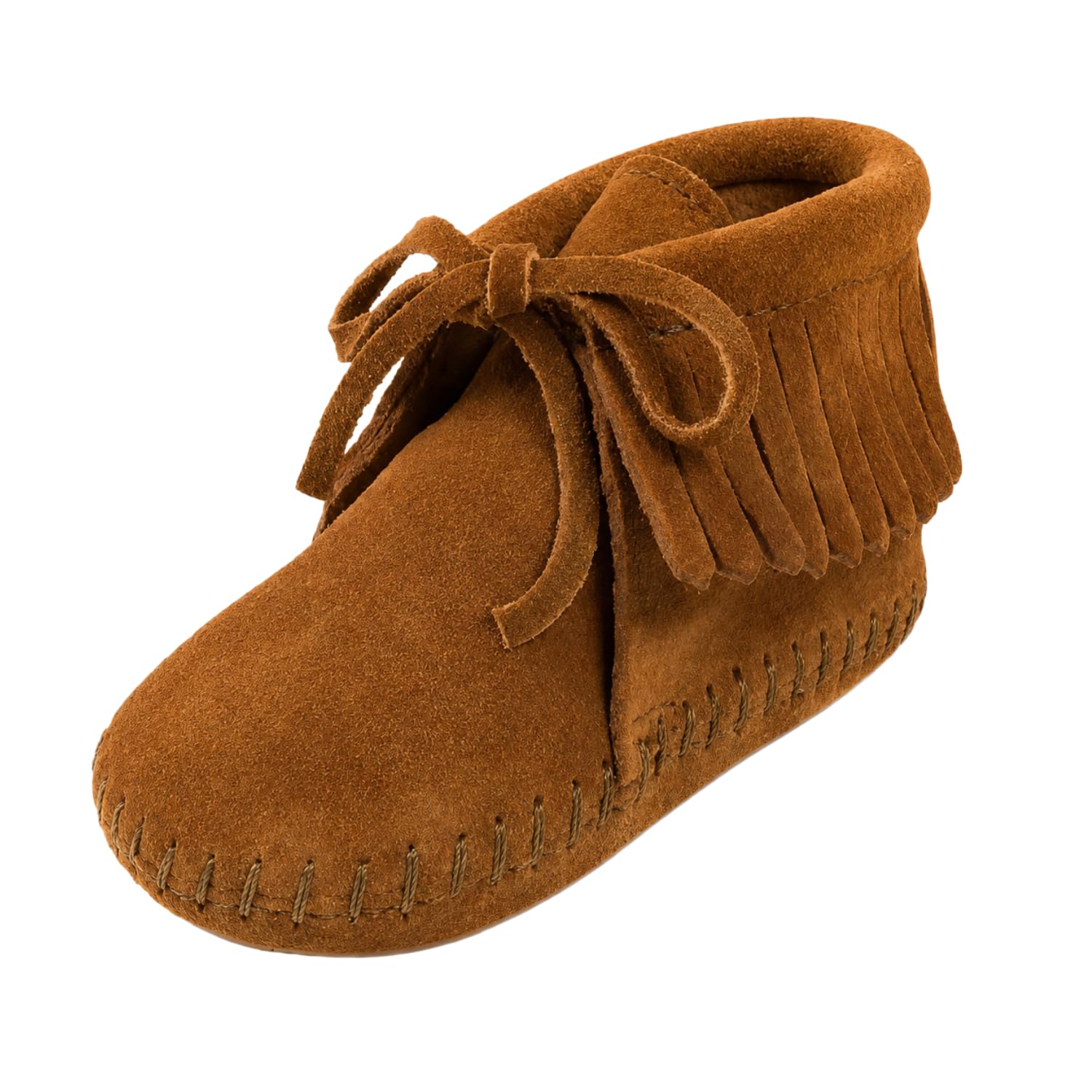
A soft suede moccasin for crawling, cruising, and looking adorable.
This one is a different animal from the sneakers above: a genuine suede upper with a plush pile lining, a cushioned insole and a soft, flexible sole. The fringe detail and hand-stitched styling make it the pair you reach for when you want the outfit to look put together. At 2.8 ounces on the scales, it is not something that drags a small foot down.
The fit runs generous on some styles — the front-strap and back-flap versions are noted as running half to a full size large, which gives a growing foot extra room to spread into. The elasticised or strap openings dependent on the style make getting them on straightforward. Be honest about where this bootie lives: it is built for indoor play and short outdoor strolls, and the maker notes that a softsole suede wears quickly on rough pavement.
Treat these as the cosy-at-home pair, not the park-and-pavement pair. That softness is the point of a moccasin, not a defect. Save it for the hallway, the garden and the car seat.
For the indoors-and-lawn life: a plush-lined suede bootie that feels like a slipper but has a slightly more supportive sole for the cruising stage.
When you want warmth and charm: soft suede, pile lining, and a flexible sole for indoor-and-light-outdoor wear.
Not for the pavement: the soft suede sole wears quickly on rough ground.
8. Robeez First Kicks Baby Shoes
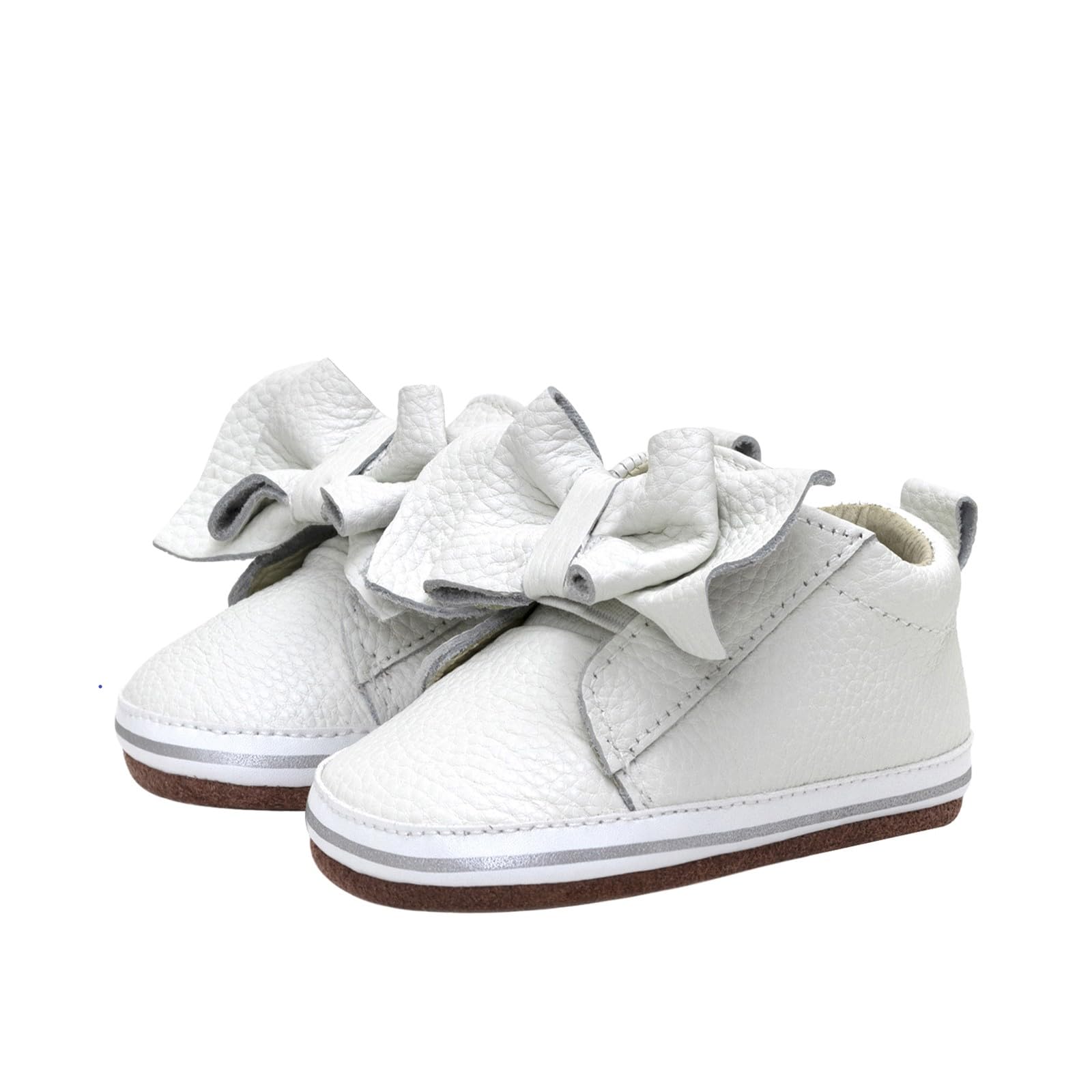
The closest thing here to walking barefoot with a sole attached.
The principle behind these is simple: barefoot is best for little feet, so make the shoe feel as much like barefoot as possible. The soft sole lets toes grip the ground, which the maker says helps balance and limits slipping, and the genuine leather upper gives a snug, sock-like hold. The seller carries the APMA Seal of Acceptance, the podiatric association’s stamp for products that support healthy foot development.
For sizing, the maker recommends going slightly larger so the baby has room to grow. Leather this soft works best with a spot clean and a damp cloth rather than a washing machine. And be clear on where they belong: most Robeez shoes are built for indoor use and light outdoor activity, not long pavement sessions.
What wins people over is the look and the build — appearance and quality are the two things buyers bring up most. The fit is more contested: some love it, others find the shoe too wide. A few pairs have come apart within a month, and value is questioned more here than on anything else on this list.
The barefoot case: genuine leather, a soft flexible sole, and a design built to let a tiny foot feel the floor.
Choose these if: you want the barefoot-style softness and a leather upper for indoor-and-light-outdoor days.
Think twice if: you want one shoe for the pavement — the soft leather wear and mixed durability reports make it a short-lived shoe for rough use.
9. New Balance Baby-Boys 515 New-b Hook & Loop
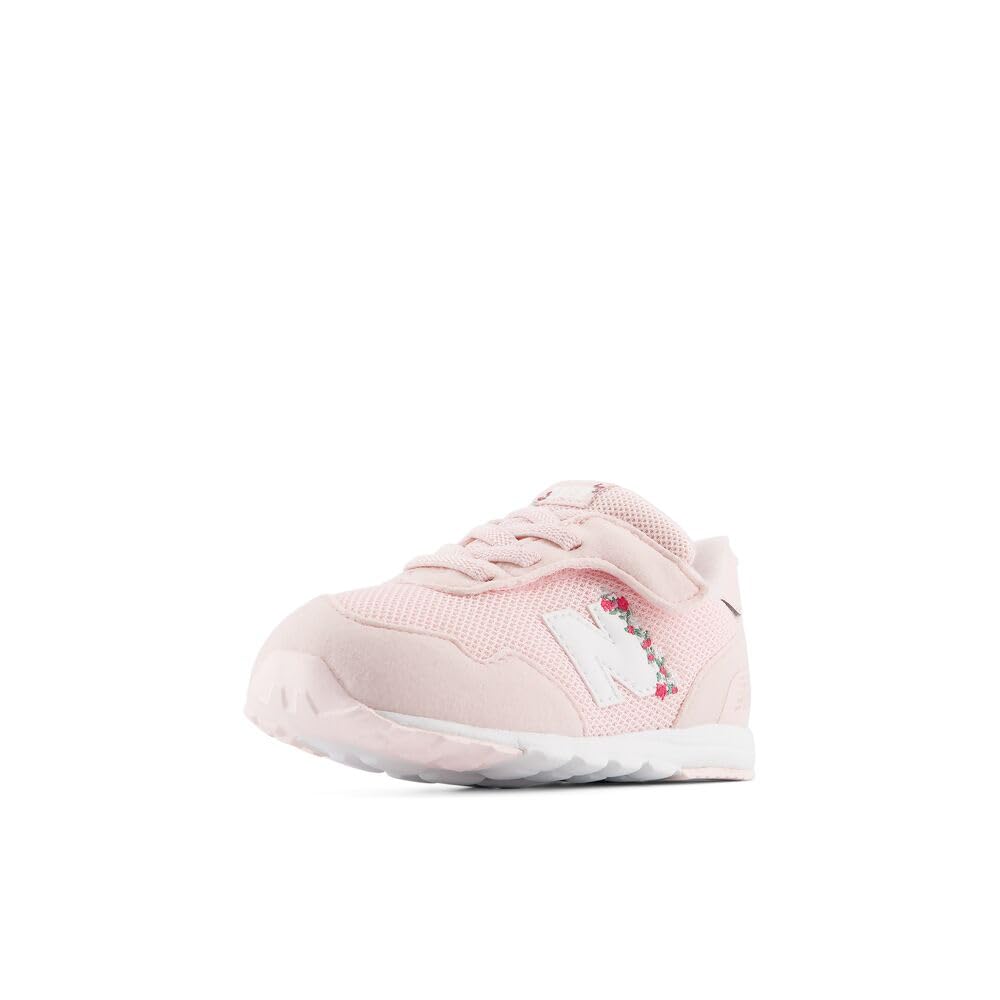
A scaled-down trainer for the toddler who never sits still.
This is the pair in the line-up with a proper sneaker pedigree behind it. The flexible outsole bends with tiny feet, the hook-and-loop closure peels open for a quick on-and-off, and gentle cushioning keeps the foot comfortable through a whole play session. The durable construction is designed to hold up to active toddler scooting and stepping rather than just a trip to the shops.
Buyers report the shoe looks exactly like the photos and is easy to get on, which tells you the styling and the closure both deliver. The sticking point is the velcro: strap durability is the most-mentioned negative on this pair, with reports of the closure failing and not staying put. There are also mixed reports on the sole — some find the shoe very durable, others mention the black rubber coming unglued from the sole.
That means it is a fair pick for a toddler who needs a sporty everyday trainer, but not the safest bet if you want a shoe that will survive a full season of hard outdoor play. Check the strap and sole on arrival, and keep the pair for everyday around-the-neighbourhood wear rather than rough terrain.
The sporty case
- Flexible outsole for natural foot movement
- Easy hook-and-loop closure
- Looks just like the photos
- Gentle cushioning for all-day comfort
The watch-list
- Velcro is the weak spot — it can fail
- Sole gluing is inconsistent, per some reports
- Not the shoe for rough or extended outdoor wear
The sporty option: a trainer-style first walker for the toddler who is already on the move.
Give it a check: inspect the strap and sole on arrival, since the velcro is where these wear first.
Know the Specs
Flexible forefoot and zero-drop sole
A sole that bends at the front lets the toes push off the way they do when your baby is barefoot. A zero-drop sole keeps the heel and toe at the same height with no raised heel, so the foot sits level. Both help a new walker feel the floor and find their balance. Squeeze the front of a shoe in your hand — if the sole is stiff, it will not bend with a step.
Wide toe box and hook-and-loop strap
A wide, foot-shaped toe box gives little toes room to splay instead of being pinched together. The hook-and-loop strap (the velcro-style closure that peels open and presses back down) then lets you tighten the fit once the foot is in. A wide opening plus an adjustable strap is what makes a shoe work for chubby or wider baby feet. A slip-on shoe relies on a stretchy opening instead, which is faster to put on but cannot be fine-tuned.
Breathable uppers and washing
Mesh and breathable fabric let air reach the foot, so it stays dry on a warm day. Light-coloured mesh does show dirt, so plan to wipe it down after outdoor play. Machine washing is not always the answer — some makers recommend hand washing with a mild detergent and air drying, which keeps the materials intact. Leather uppers are usually spot clean only, using a damp cloth.
Sizing and growing room
Baby shoe sizes differ from brand to brand, and a foot can grow in a matter of weeks. The reliable method is to stand the child’s foot on paper, mark the longest toe and the heel, and compare that length against that maker’s own chart. Some brands build extra room into their sizing already, so adding your own margin on top can leave the shoe slipping. At the walking stage, expect to size up periodically as the foot grows.
Common Questions
Can my baby wear these Zapatos Para Bebe outdoors?
How do I know when my baby has outgrown their shoes?
Are wide toe box shoes actually better for beginning walkers?
What does zero-drop mean on a baby shoe?
Can I machine wash baby shoes?
How long will a pair of baby shoes last?
Should I size up for growing room?
What type of closure is best for a baby who pulls shoes off?
Are soft-soled shoes good for first walkers?
The Bottom Line
For most families, the best of the zapatos para bebe is the Baby Shoes Infant Toddler Lightweight Sneakers. It flexes at the forefoot where a first step needs it, so your baby can push off instead of clomping. It also opens wide enough for chubby feet, and customers note it looks just like the photos. If you want a pair you can slide on in a doorway in seconds, reach for the Baby Walking Shoes First Walkers Sneakers. For a dressier shoe that still supports a new walker, the Stride Rite Kamila Mary Jane is your pair. And if your baby has wide, chunky feet that fight every standard sneaker, try the Ten Little First Walker Shoes — their wide toe box and zero-drop sole give those feet room to spread.
How we choose
We do not accept paid placement. Every pick is matched to a real buyer and a real use-case; we do not hands-on test units.
Sources
Specifications: manufacturer listings and product documentation. Review insights: verified customer reviews, as of November 2026. Pricing: not shown on this page (it changes often); check the current price via the retailer link.
As an Amazon Associate, Tactical Gear Guy earns from qualifying purchases. This does not affect which products we feature.