Specs are compiled from manufacturer listings and verified buyer reviews and can change over time — please confirm the key details on the product page before buying.
Most kids who quit paddle boarding quit on the first trip — not because they fell, but because the board under them was an adult deck that wobbled with every stroke. A board built for a child’s weight and reach changes that completely. This guide covers five inflatable boards where the size, the deck and the weight rating actually match a young paddler, so a kid can stand up, balance and paddle instead of clinging on.
This guide is built by comparing the manufacturers’ published specifications and the patterns across verified customer reviews, so you get each pick’s real strengths and trade-offs instead of marketing spin.
Kids outgrow boards fast, so the size you pick matters more than the label on the box. This list matches youth sizing by weight capacity suited to kids, so not every pick is the exact number you searched — the nearest same-type size does the same job. Below are the sizing rules that actually matter, plus best youth paddle board options for beginners, small paddlers and kids who want their own deck.
Top Picks


How To Choose The Best Youth Paddle Board
The classic mistake is buying an adult board and “letting them grow into it”. A board rated for 350 pounds floats a 60-pound child, but it also sits high, drifts in a breeze and takes a small paddler’s whole stroke just to turn. A wobbly, oversized deck frustrates a kid within a session. Size the board to the child’s weight and reach, and they stand up sooner.
Start With The Weight Rating, Not The Length
The maximum weight recommendation is the number that decides whether a board floats a child safely and steadily. A kid deck rated around 170 pounds gives a young paddler margin to stand, shift and even sit without dunking the rails. A board rated for 350 pounds or more is designed for a full-grown adult, so it will feel like a barge under a light child. Buy for the child’s current weight, not the paddler they’ll be in five years.
Deck Thickness In Inches Shapes Stability
Thickness is how tall the inflated board sits — a 6-inch board stands noticeably taller off the water than a 4-inch one. More thickness generally means a more rigid, more forgiving platform. Kids learning to stand do better on a deck that does not flex under a wobble. Just remember that a thicker board also catches more wind, which is worth knowing on a breezy lake day.
What Should Be In The Box
A youth board should arrive ready to paddle. Look for a paddle that adjusts down to a child’s height, a pump with a pressure gauge, an ankle leash and a carry backpack. Fins matter too — a single fin tracks straighter in a line, while a multi-fin setup holds a turn better. Every board below bundles its own kit, but the kits are not equal.
Side-by-Side Comparison
| Model | Best For | Max Weight | Length x Width | Thickness | Amazon |
|---|---|---|---|---|---|
| Roc Inflatable Stand Up Paddle Board 10′ 6″★ Best Overall | Mixed family use, kids and adults | 350 lb | 126″ x 33″ | 6 in | Amazon |
| iTAOSTAR Joyful Voyagers Panda CoastKid Favorite | Young kids who want their own deck | 180 lb | 8′ x 29″ | 4.7 in | Amazon |
| SKADDLES 10’6″ Inflatable SUP | Growing kids and sharing with parents | 450 lb | 126″ x 33.1″ | 5.91 in | Amazon |
| OWROMI Kids Stand Up Paddle Board | Budget first board for a child | 170 lb | 95″ x 30″ | — | Amazon |
| SANTASUP 8ft Panda Kids Board | Smallest riders and beginners | 170 lb | 96″ x 30″ | 4 in | Amazon |
Detailed Reviews
1. Roc Inflatable Stand Up Paddle Board
Our pick — 4.5+★ from 18,000+ verified ratings; the strongest balance of quality and price.
The board that keeps a whole family afloat — one deck, six inches of air, and 18,000+ owners behind it.
The crowd favorite here, and the numbers explain why: 4.5+ stars across 18,000+ owners. At 126 inches long, 33 inches wide and 6 inches thick, the Roc is a genuine adult-sized platform you can hand to a teen on a calm lake and expect them to stand up within a session. That 6 inches of thickness is the part that matters for confidence — it sits tall and firm, so the deck does not flex under a shifting foot.
Buyers praise the build quality first and the steadiness second, and both show up on the water rather than on the spec sheet. It inflates in roughly ten minutes and holds that pressure overnight — buyers report it holds air through the night and left no scratch on the deck, the wear that usually shows up first on a board shared between kids. The 350-pound weight limit means a child of any age sits well inside the safe zone, and a parent can hop on the same board afterward.
The catch is about size, not build. At 10’6″ and 33 inches wide this is a big, buoyant board, so a very small first-time paddler will find the stroke wide and the deck high — it is really a family board a kid grows into, not a dedicated child’s deck. The 3-year manufacturer’s warranty eases the wear worry. Around 8,500 mentions of quality in the reviews make it the most-praised thing about this board, and once you’ve paddled it, that tracks.
Why The Roc Earns The Top Slot
- 6 inches of thickness at 350 lb capacity — stable enough for a teen learning to stand
- Ten-minute inflation that holds pressure through the night
- 3-year manufacturer’s warranty for family-level wear
- Deck holds up without scratching, even on rocky launches
Where A Small Rider Feels The Stretch
- 33-inch width and 10’6″ length are adult-sized — little kids will feel the height
- Not a first board for a 6-year-old just starting out
Made for: families with teens and mixed ages who want one board that stays useful as the kids grow.
Look elsewhere if: your paddler is very young and light — a shorter kid deck will make the first summer far easier.
2. iTAOSTAR Joyful Voyagers Paddle Board with Full Accessories
An 8-foot cat-print deck at 29 inches wide — this one is actually built around a child, not shrunk from an adult board.
This board is drawn for a kid’s proportions: at 8′ x 29″ x 4.7″ and a 180-pound maximum weight, it fits a small paddler instead of overwhelming them. The 4.7-inch thickness keeps the deck low enough for short legs to swing up without wobbling, and the 29-inch width — narrower than the Roc above at 33 inches — is why it turns and tracks like a kid’s board rather than a barge. The cat artwork is what gets a reluctant kid to pick up the paddle.
You get a full kit in the box: an adjustable paddle with an aluminum alloy shaft and a fade-resistant, anti-slip grip, five removable fins (three central, two side), a double-action pump, a 360-degree swivel ankle leash with a quick release, a waterproof waist bag for a phone, a 120L backpack and a 10L dry bag. Fans report the pump fills it in 5 to 10 minutes and deflates it in 2 to 3, and the gauge reads psi (pounds per square inch, the pressure unit) properly once the deck is fully shaped. Stability holds up too — the deck stays flat when a kid climbs in and out at the shoreline, where most paddle sessions actually go wrong.
The honest trade-off: a few families find it heavier than they expected in the carry bag, so the walk from the car to the launch matters more than you’d think. The pump also takes some patience on the first read of the gauge. It’s a fine first board for a confident young rider, less so for a small child who will need a hand carrying the backpack down.
What it gets right: a real kid’s proportion at 8′ x 29″ x 4.7″, with a five-fin setup and a quick-release ankle leash — a complete kit with nothing missing on day one.
Honest note: weight is the recurring gripe; plan the walk to the water, and read the pump gauge carefully the first time.
Reach for this if: you have a young paddler ready for their own deck and you’d rather have every accessory in the bag on day one.
Skip the hassle of: buying fins, a leash and a dry bag separately — this kit covers the lot, though the loaded backpack is heavier than a small child can haul.
3. SKADDLES 10’6″ Inflatable Stand Up Paddle Board
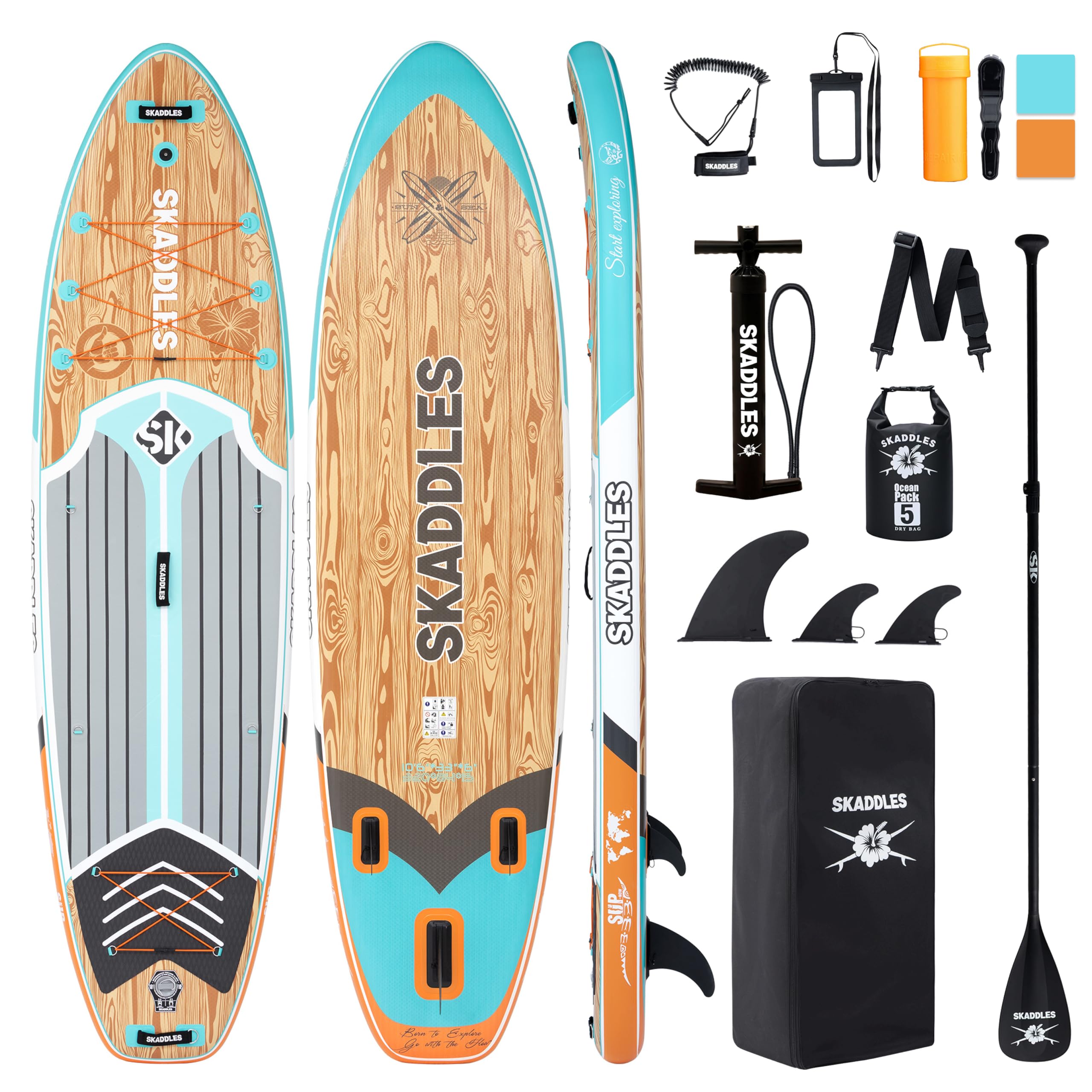
The highest weight ceiling on this list — a 450-pound board that a kid shares with a grown-up all afternoon.
If two people are ever on the water together, this is the pick. The SKADDLES is rated for 450 pounds, and at 126 inches long, 33.1 inches wide and 5.91 inches thick it’s a full-size platform — the widest and thickest combination here. That 450-pound figure is the number to note: it is the biggest capacity in this lineup by a wide gap, which means a teen plus a cooler plus a parent stepping on briefly is well within its range.
Quality is the thing buyers talk about most here, and the stability and inflation process follow close behind. It inflates in about ten minutes and holds pressure overnight. The 15 psi maximum is worth knowing — that’s how hard you can pump this board, and a firmer board is a stiffer one underfoot. The kit includes a high-efficiency manual pump, an adjustable paddle, an ankle leash, three detachable fins, a carry backpack and a waterproof phone bag. Multiple heavy-duty D-rings let you clip on a cooler, a seat or another board.
The trade-off is simply bulk. Where it wins is as a shared board that a child uses now and a parent uses later. The 3-year manufacturer’s warranty and 30-day return window back it up. It leads the Roc above on capacity, 450 pounds against 350 — a meaningful margin if you ever plan to bring an extra paddler or a dog along.
The Case For The SKADDLES
- 450 lb capacity — the highest ceiling here, room for a kid plus gear
- Three detachable fins plus D-rings for a cooler or seat
- 3-year warranty and 30-day return window
- Holds pressure overnight at 15 psi max
What To Plan Around
- 22.5 lb is heavy — a child will not carry this alone
- 10’6″ is more board than a small first-time paddler needs
Who it suits: a family that wants one board serving a kid now and a parent later, and who occasionally takes gear along.
Who should size down: a very small rider who would feel safer on a shorter, lighter deck.
4. OWROMI Kids Stand Up Paddle Board

A 95-inch board with a 170-pound ceiling — the simplest way to put a kid on water without buying an adult deck.
This one goes straight to the point: 95 inches long, 30 inches wide and rated for 170 pounds, which places it squarely in kid territory. The military-grade PVC build uses a double-layer rail — a second layer of material down the edges — so the board stays stiff when a child shifts weight. Beginner skill level is how it’s rated, and that fits: the board is designed for a first paddler who needs forgiveness more than speed.
The 170-pound rating gives a younger child plenty of margin while a shorter 95-inch length keeps the board nimble enough to turn with a small child’s stroke. The non-slip comfort deck is the piece that lets a kid gain footing without sliding. It inflates and deflates easily, rolls up for storage and travels in the included backpack, and the bundle includes a paddle, pump, backpack, foot rope, tail fin and a PVC repair kit. Since the OWROMI block carries no review summary, expect to judge on the spec sheet and the warranty — the hardware here is straightforward PVC and a single tail fin, so there is little to go wrong.
The honest limit: this board is rated for 80 kg, so it flips toward the small side once a growing kid approaches adult weight — a taller teen will outgrow it faster than the boards above. The carry bag is where the sizing help comes in; the board rolls compact enough for a trunk, which makes the budget commitment low-risk for a first season. It answers “can my kid paddle?” for a first season without the cost of an adult deck.
What it’s really for: a first board for a child who is just learning, at 95 inches and 170 pounds — small enough to control, sturdy enough for a starting paddler.
What to know: the 80 kg rating tops out as your child grows, so expect it to serve the younger years rather than follow them into their teens.
Best fit: a family testing whether paddle boarding sticks before committing to a larger board.
Think twice if: your child is already near adult size — the 170-pound ceiling and 95-inch length will feel small quickly.
5. SANTASUP Kids Inflatable Paddle Board 8ft

An 8-foot panda-print board at 4 inches thick — short, light and shaped for a child’s first summer on water.
At 96 inches long, 30 inches wide and 4 inches thick, this is the shortest, thinnest board here, and that is exactly the point. A 4-inch deck sits lower off the water than the Roc above at 6 inches, which short legs reach more easily and small hands paddle around with less effort. The panda design makes the board feel like the child’s own, not borrowed gear.
The build is drop-stitch PVC with a soft non-slip EVA deck pad, and the front and rear handles help a child carry and maneuver the board at the water’s edge. A multifunctional elastic bungee at the front holds a small bag or a water bottle. The 170-pound capacity means a child has room to grow within the board for a few seasons. The kit includes the inflatable paddle board, an ultra-light backpack, a pump, an ankle safety leash, one fin, a three-piece length-adjustable floating paddle and a repair kit — everything a child needs for a full day out.
What buyers praise most here is simply the fun factor, followed by the size — the panda pattern and the kid-scale dimensions make it an easy sell to a reluctant small paddler. The honest caveat is one fin, which tracks in a straight line but turns less sharply than a multi-fin setup, and being shorter at 96 inches means it is not a board a parent can paddle comfortably. It is built for children, with a 30-day return, a 60-day warranty on the board and a one-year warranty on the accessories.
A standout: 4-inch thickness and 96-inch length make this the most kid-scaled deck here, with a design a child actually wants to paddle.
The catch: one fin and a short deck mean it stays a children’s board — great for a kid, not for a parent to borrow.
Perfect for: the smallest riders, who need a low, short deck and a board that feels like their own.
Not for: family sharing — at 96 inches and 170 pounds it stays a kid-only board.
Know the Specs
Maximum Weight Recommendation
This is the most total weight a board is rated to float, including the paddler and any gear. For a child, aim well above their body weight — a 170-pound ceiling gives a young paddler real margin to stand and shift without the deck sinking under them. A higher figure like 350 or 450 pounds means the board is built for adults and a kid will feel oversized and high off the water on it. Pick the closest fit above your child’s weight and no more.
Thickness and Width in Inches
Thickness is how tall the inflated board stands; width is how much deck there is side to side. Together they decide stability. A 4-inch thickness keeps a board low and easy for short legs, while a 6-inch deck sits taller and feels stiffer underfoot. A 29- or 30-inch width turns easily for a small paddler, while a 33-inch width is more forgiving for a heavier rider. Match both to the child, not to the boat.
Inflation Pressure in PSI
PSI is pounds per square inch — how hard the board is pumped up. A firm board is a stiff board, and stiff boards track straighter and wobble less. Manufacturers list a maximum pressure, and a board inflated fully at that ceiling handles best. The pump that comes with each kit matters here; a hand pump with a working gauge makes hitting the target pressure far easier.
Fin Setup and Ankle Leash
Fins are the blades under the tail that keep the board tracking in a straight line. A single fin is simple and tracks well in a straight paddle; a three- or five-fin setup holds a turn better and adapts to different water. The ankle leash is the safety cord that keeps the board near a paddler who falls off. A quick-release, swivel leash is easier for a child to manage in the water.
Common Questions
How much weight does a youth paddle board need to hold for a child?
What is the difference between a kids paddle board and an adult paddle board?
How long does it take to inflate a youth paddle board?
Can a child carry a youth paddle board in the backpack alone?
How do I know what pressure to inflate a youth paddle board to?
Is a single fin or a multi-fin paddle board better for a child?
Should a child wear an ankle leash on a paddle board?
Will a youth paddle board fit and hold air in the trunk of a car?
How long does a kids paddle board warranty last?
Can two kids use the same youth paddle board?
The Bottom Line
For most families, the board worth buying is the Roc 10′ 6″ — 6 inches of thickness, a 350-pound rating and a 3-year warranty keep it useful as the kids grow into it. If your paddler is young enough to want their own deck right now, the iTAOSTAR Joyful Voyagers at 8′ x 29″ x 4.7″ gives you a complete kid-sized kit with five fins and a 120L backpack. And if you plan to share one board between a child and a parent with gear along, grab the SKADDLES with its 450-pound capacity and three fins. It’s the pick when one board has to serve a kid and a parent.
How we choose
We do not accept paid placement. Every pick is matched to a real buyer and a real use-case; we do not hands-on test units.
Sources
Specifications: manufacturer listings and product documentation. Review insights: verified customer reviews, as of November 2026. Pricing: not shown on this page (it changes often); check the current price via the retailer link.
As an Amazon Associate, Tactical Gear Guy earns from qualifying purchases. This does not affect which products we feature.