Specs are compiled from manufacturer listings and verified buyer reviews and can change over time — please confirm the key details on the product page before buying.
If your bookshelf speakers sound muddy and boomy, the problem is often the furniture they sit on, not the speakers themselves. A proper wood speaker stand lifts each speaker to ear level and decouples it from the floor, so the bass tightens up and the treble stops getting smeared. The eight pairs below cover every job — short desktop risers, 28-inch floor towers, and 36-inch models that put a tweeter right at seated ear height. Pick the height that matches your listening position, check the load rating against your speaker’s weight, and the rest is finish.
This guide is built by comparing the manufacturers’ published specifications and the patterns across verified customer reviews, so you get each pick’s real strengths and trade-offs instead of marketing spin.
Height is the first thing to nail down, because a stand that puts your tweeter below your ears wastes the speaker’s whole design. The second is the platform size — a top plate narrower than your speaker’s base lets it tip. Below you’ll find the wood speaker stands that get both of those right, plus the isolation details that quiet a boomy room.
Top Picks

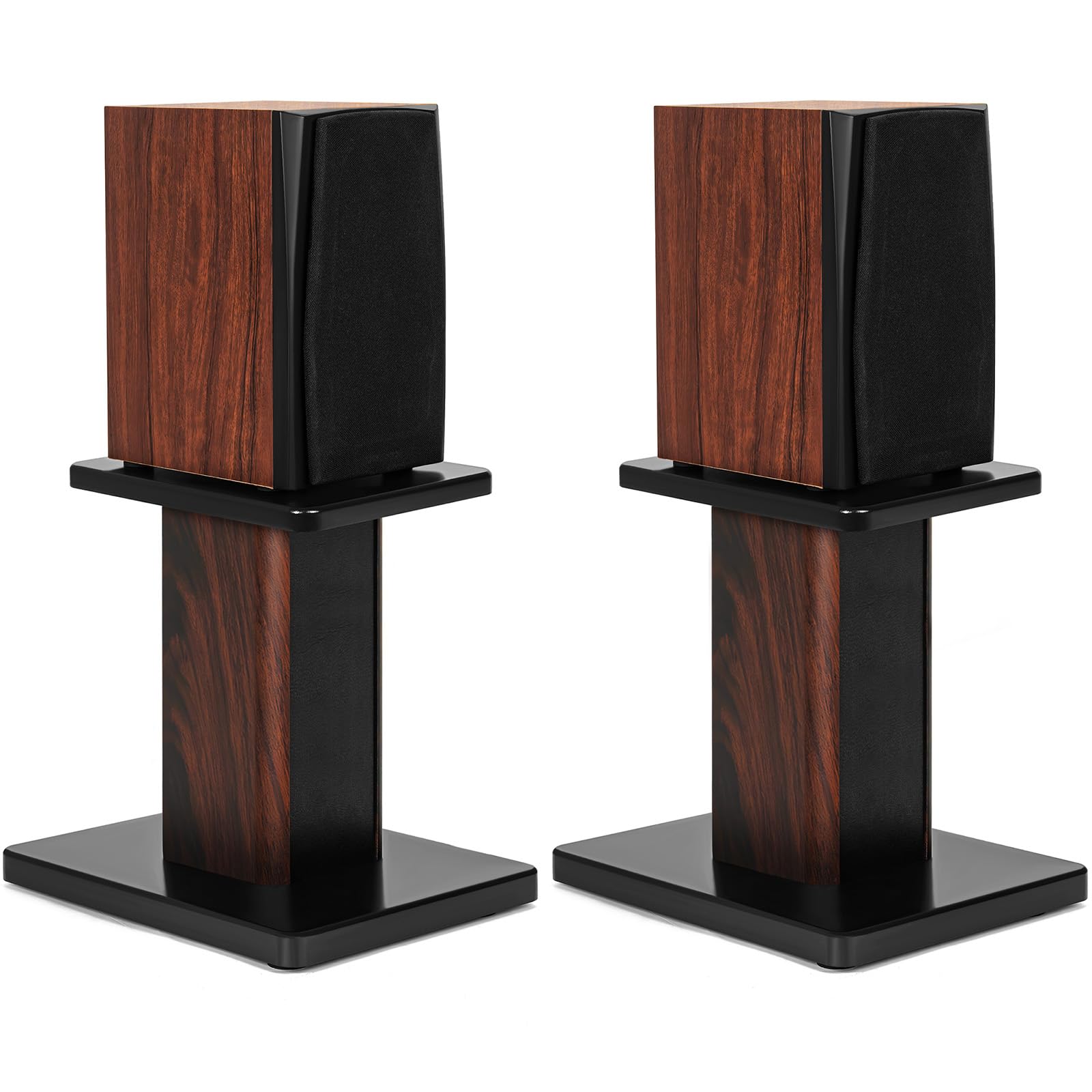
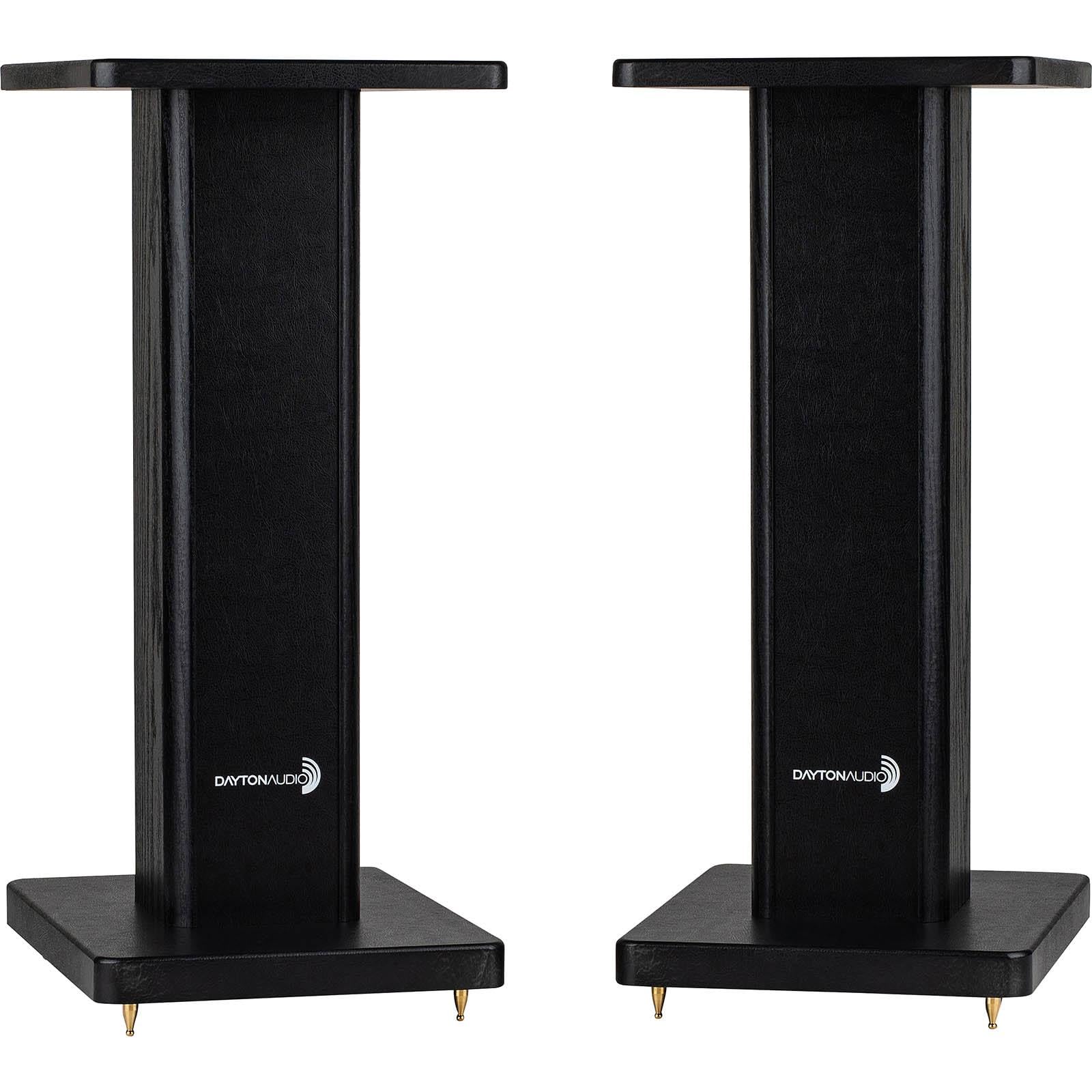
How To Choose The Best Wood Speaker Stands
Three numbers decide whether a stand works in your room: the height, the top plate size, and the load rating. Get those three right and the finish is just taste. Get the height wrong and you’ll spend months wondering why your speakers sound flat.
Match the height to where your ears actually sit
A stand’s job is to put the tweeter — the small high-frequency driver near the top of your speaker — roughly level with your ears when you’re seated. On a sofa, that’s usually somewhere between 24 and 36 inches off the floor. A short 11.8-inch riser is a desktop and shelf solution, not a living-room one. Measure from the floor to your ear in your normal listening chair before you order anything.
Check the top plate against your speaker’s footprint
Your speaker sits on a flat shelf called the top plate. If that plate is smaller than the speaker’s base, the cabinet overhangs and the whole thing feels tippy. Several stands here ship with two plate sizes — a narrow one for compact bookshelf cabinets and a wider one for larger monitors — so you fit the plate to the speaker, not the other way round.
Decide if you want hollow-fill or solid construction
A hollow stand can be filled with dry sand to add mass, which is a real advantage in a room with boomy bass. A solid MDF stand skips the filling step entirely and is heavy from the moment you assemble it. Both approaches tame vibration; they just ask different things of you on setup day.
Pick your floor interface: spikes or pads
Brass spikes are pointed feet designed to push through carpet and anchor the stand to the subfloor. Rubber spikes and soft pads protect hardwood and tile from scratches and add grip. Many of these stands include both, so you choose per room rather than per purchase.
Side-by-Side Comparison
| Model | Best For | Max Height | Load Capacity | Top Plates | Amazon |
|---|---|---|---|---|---|
| Rockville RHT28D★ Best Overall | All-round living-room pick | 28 inches | 60 lbs | Two sizes (9.25″ x 7.28″ and 9.25″ x 11.8″) | Amazon |
| IBVIVIC Pair-WoodBest Value | Desktops and shelves | 11.8 inches | 110 lbs | 7.3″W x 9.2″D | Amazon |
| Dayton Audio UniversalTop Performer | Anti-vibration clarity | — | 130 lbs | Two sizes (7.25″ x 9.25″ and 9″ x 11.75″) | Amazon |
| Monolith 24 Inch Cherry | Carpet floors and spikes | 24 inches | 50 lbs | — | Amazon |
| Rimous Height Adjustable | Dialing in exact ear height | 28 inches | 50 lbs | 12.2″ x 9.1″ base | Amazon |
| Eximus 290 Series Cedar | Real wood and hidden cables | 24.6 inches | 66 lbs | — | Amazon |
| Rockville SS28D | Heavy speakers, no sand needed | 28 inches | 100 lbs | Two plate sizes included | Amazon |
Detailed Reviews
1. Rockville RHT28D Speaker Stands
Our pick — 4.5+★ from 750+ verified ratings; the strongest balance of quality and price.
The 28-inch dark-wood stand that treats speaker placement as furniture, not plumbing.
Here’s the pair that solves the living-room problem for most people. It stands 28 inches tall, which puts a typical bookshelf tweeter right around seated ear height on a normal sofa. The body is medium density fiberboard — MDF, an engineered wood board that’s dense and stable — and that density is the whole point. A heavy, rigid cabinet resists the vibration your speakers push into it, so you hear the driver and not the stand.
This stand earns the top slot because it gives you two shelves, not one. You get a 9.25″ x 7.28″ plate for compact speakers and a 9.25″ x 11.8″ plate for larger ones, so a Klipsch-style monitor and a small satellite each get a properly matched shelf. Capacity tops out at 60 lbs per the spec sheet, which clears most bookshelf cabinets comfortably. The hollow body accepts dry sand if you want to add mass. Brass and rubber spikes plus EVA isolation pads ship in the box — the pads are soft foam squares that sit between speaker and plate to soak up vibration.
What wins people over is the finish. Dark wood grain over a furniture-grade painted coat reads as a real piece of furniture in a den rather than a studio bracket, and the paint resists chipping through normal handling. It’s the pick with the deepest owner satisfaction in this group — 4.5+ stars across 700+ ratings — and the assembly is genuinely quick with a Phillips screwdriver. The catch is the fill: if you do add sand, you’re moving a much heavier stand afterwards, so set it in place before you top it up.
What earns its keep
- 28-inch height lands at ear level for a normal sofa
- Two top plate sizes cover both small and large bookshelf speakers
- 60 lb capacity with a hollow body you can fill with sand
- Brass spikes, rubber spikes, EVA pads, cable ties and clips all included
Where it asks a little care
- Sand-filling makes it heavy to reposition, so place it first
- Painted MDF finish needs a soft cloth rather than an abrasive cleaner
Go for this one: your speakers sit on a sofa-height stand in a living room and you want the finish to look like furniture.
Think twice if: you want a solid pre-weighted body without the sand ritual — the SS28D below skips that step.
2. Pair-Wood Speaker Stands 11.8 inch
A short riser rated to hold a small adult, built for desks and media shelves.
An 11.8-inch stand is a specific tool. It’s for lifting a satellite or desktop monitor off a shelf so the driver isn’t firing into a wall, or for raising speakers either side of a TV cabinet. It is not a living-room floor stand, and the moment you accept that, this pair makes a lot of sense for the money. The MDF body is hollow so you can add dry sand, and the shell is rated to 110 lbs — comfortably the heaviest ceiling in this group short of the Dayton’s 130 lbs.
The tops and bases are deliberately different sizes. The top plate measures 7.3″ x 9.2″ and the base spreads to 9″ x 11.8″, which gives a wider footprint than the shelf above it. That’s a smart ratio: a broad base resists tipping when a cat or a vacuum cleaner nudges the stand.
Sturdiness is what people talk about most with these, and it tracks with the hardware. Owners run heavy Polk ES20 monitors on them without complaint, and the non-slip mats keep the footing solid on hardwood. The honest snag is alignment: the screw holes can take some patience to line up during assembly, so expect to hold a panel in place while you catch the first thread. Once built, it’s a quiet, tidy little platform for the money.
Height honesty: 11.8 inches is a desk and shelf number, not a floor number. Measure before you commit.
The build day note: bring patience to the hole alignment and a second pair of hands if you have them.
Made for: desktop setups, media shelves, and small satellites where 11.8 inches is exactly the lift you need.
Look elsewhere if: you’re outfitting a living room — you’ll want the 24-inch-or-taller stands further down.
3. Dayton Audio Universal Wood Speaker Stand Pair (20in Black)
The highest load rating here — a 130 lb ceiling that laughs at heavy studio monitors.
Nothing else on this list carries as much as the Dayton pair. At 130 lbs versus 50 lbs each for the Monolith and the Rimous, it is rated to carry more. That gap is the reason to pick it: if you’re running big, dense monitor cabinets, this is the stand that doesn’t flinch. The wood and leather finish adds a warmth you don’t get from painted MDF, and the interior can still be filled with sand for extra dampening if your room needs it.
Two top plate sizes come in the box — 7.25″ x 9.25″ and 9″ x 11.75″ — so you can match the plate to the speaker footprint rather than accepting whatever shelf the maker chose. Rubber feet are included for grip and isolation, which is the right call for hardwood and tile floors where spikes would dig in. Anti-vibration design is the core of the build, aimed squarely at keeping cabinet resonance out of the sound.
Know this trade-off before you order: this pair carries a five-year warranty, the longest coverage stated in this whole group, but the owner pool is smaller than the Rockville or Rimous stands. Fewer voices means less collective feedback to lean on. What’s there is strong, and the build speaks for itself. This is a confident pick for someone who already knows their speaker weights and isn’t guessing.
Standout strengths
- 130 lb capacity, the highest in this lineup
- Two top plate sizes for small and large cabinets
- Five-year warranty — the longest stated coverage here
- Rubber feet plus sand-fill option for dampening
Worth knowing
- A younger listing than the Rockville pairs, so fewer owner experiences to draw on
- 20-inch height may sit low for taller sofas
Built for: heavy monitor cabinets and anyone who wants the widest safety margin on load.
The caveat: a 20-inch height is a mid-point — measure your seated ear level to confirm it lands right.
4. Monolith Speaker Stands 24 Inch
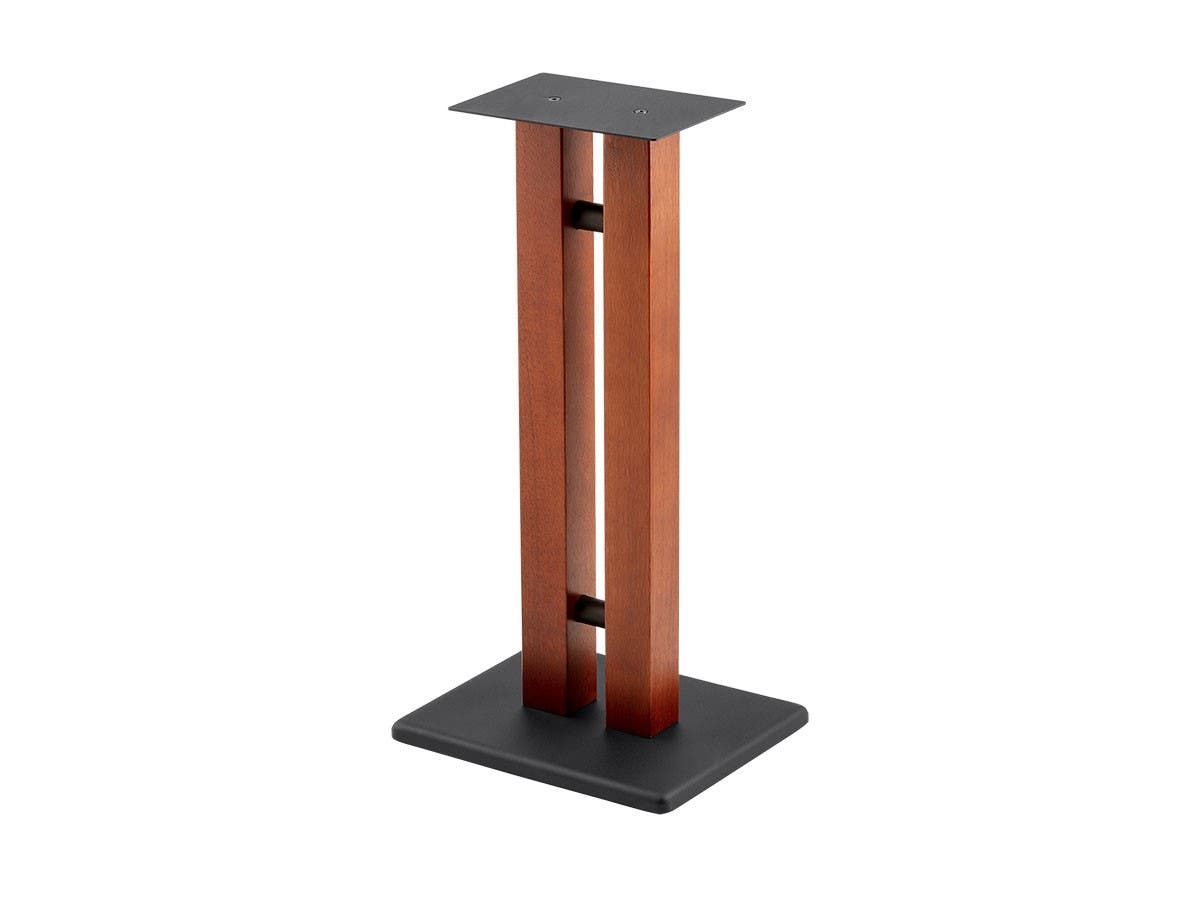
Cherry wood and adjustable spikes, aimed squarely at a carpeted living room.
If your listening room has carpet, spikes matter. This Monolith stands 24 inches tall and ships with adjustable spikes designed to pierce through carpet and reach the subfloor — which is exactly how you stop a stand from wobbling on deep pile. The cherry finish is scratch resistant and reads warm against a wood floor or a neutral rug, and four soft rubberized top pads protect the speaker’s base while adding a layer of isolation between cabinet and plate.
Capacity is 50 lbs, the same ceiling the Rimous pair carries. That’s plenty for typical bookshelf and home-theater speakers, but if you’re running dense studio monitors, the Dayton’s 130 lbs or the Rockville’s 100 lbs gives you more headroom. Build quality is what earns the most praise on this stand and the wood grain and stain quality hold up under close inspection — the grain is a genuine feature, not a printed wrap.
Value is the one place opinions split. Some see it as fair for a solid 24-inch cherry stand with adjustable spikes; others feel the money is steep once you factor in what’s included. It’s a fair debate and a personal one — if the cherry finish is what you actually want in the room, that’s a defensible spend. If you’re chasing maximum capacity per pound of stand, look at the Rockville or Dayton above and step away from the cherry.
The real-world win: adjustable spikes mean carpet installation goes smoothly, which is more than most stands here can claim outright.
Where the money is judged: the value question is the one that divides people, so buy for the cherry finish only if it’s the finish you’ll actually enjoy.
Reach for this if: you have carpet, a cherry-toned room, and bookshelf speakers under 50 lbs.
Skip the cherry splurge if: raw load capacity is the priority — the Dayton pair gives you far more.
5. Height Adjustable Speaker Stand Pair 18″-28″
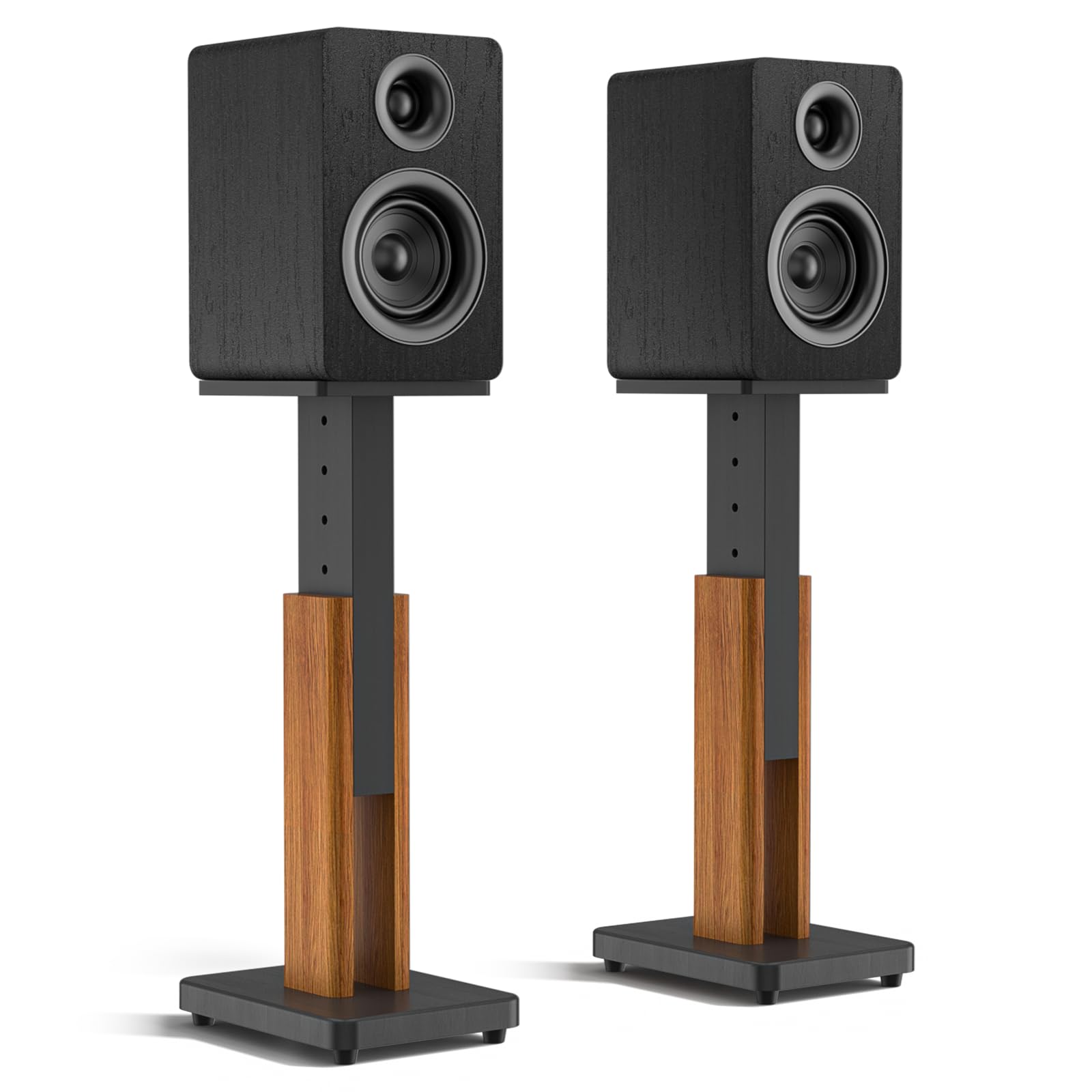
Dials from 18 to 28 inches — for the room where nobody can agree on ear height.
Adjustability is the entire reason this pair exists. Six settings run from 18 inches up to 28 inches, so you can ladder through 18, 20, 22, 24, 26 inch and 28 inch heights until the tweeter lands dead level with your ears — seated or standing. That’s 10 inches of travel, which is more range than any fixed stand here can offer. If your listening chair, desk, or sofa isn’t a standard height, this lifts you out of the guesswork.
A 12.2″ x 9.1″ base keeps the tall end of that range steady, so the stand stays planted instead of wobbling. Rubber foot pads adjust for tile, cement, and wood floors — handy on uneven surfaces that would rock a fixed stand. Load capacity is 50 lbs, so it suits most bookshelf and large bookshelf speakers rather than heavy studio cabinets. Cable clips are included to keep the runs tidy and off the floor.
What people like most is how it looks once built — the wood grain appearance is the biggest positive draw here — followed by how straightforward the assembly is. The mixed note is material feel: several buyers describe the wood as feeling on the cheaper side once it’s in their hands. That’s worth knowing if you’re expecting a furniture-grade hardwood. Functionally the stands do their job, the leveling feet get mentioned with approval, and a pair has held Klipsch Nines without complaint. For a room where height has to be tuned rather than assumed, the trade is worth it.
what separates it
- Six height settings spanning 18 to 28 inches
- 12.2″ x 9.1″ base for stability at full extension
- Adjustable rubber foot pads for uneven floors
- Cable clips included to keep cords off the ground
The compromise
- The wood material feels less substantial than the appearance suggests
- 50 lb capacity rules out heavy studio monitors
The pick for you if: your seating height is unusual and you’d rather tune than gamble.
Don’t expect: hardwood heft — treat the adjustable height as the feature you’re paying for.
6. 290 Series Speaker Floor Stands
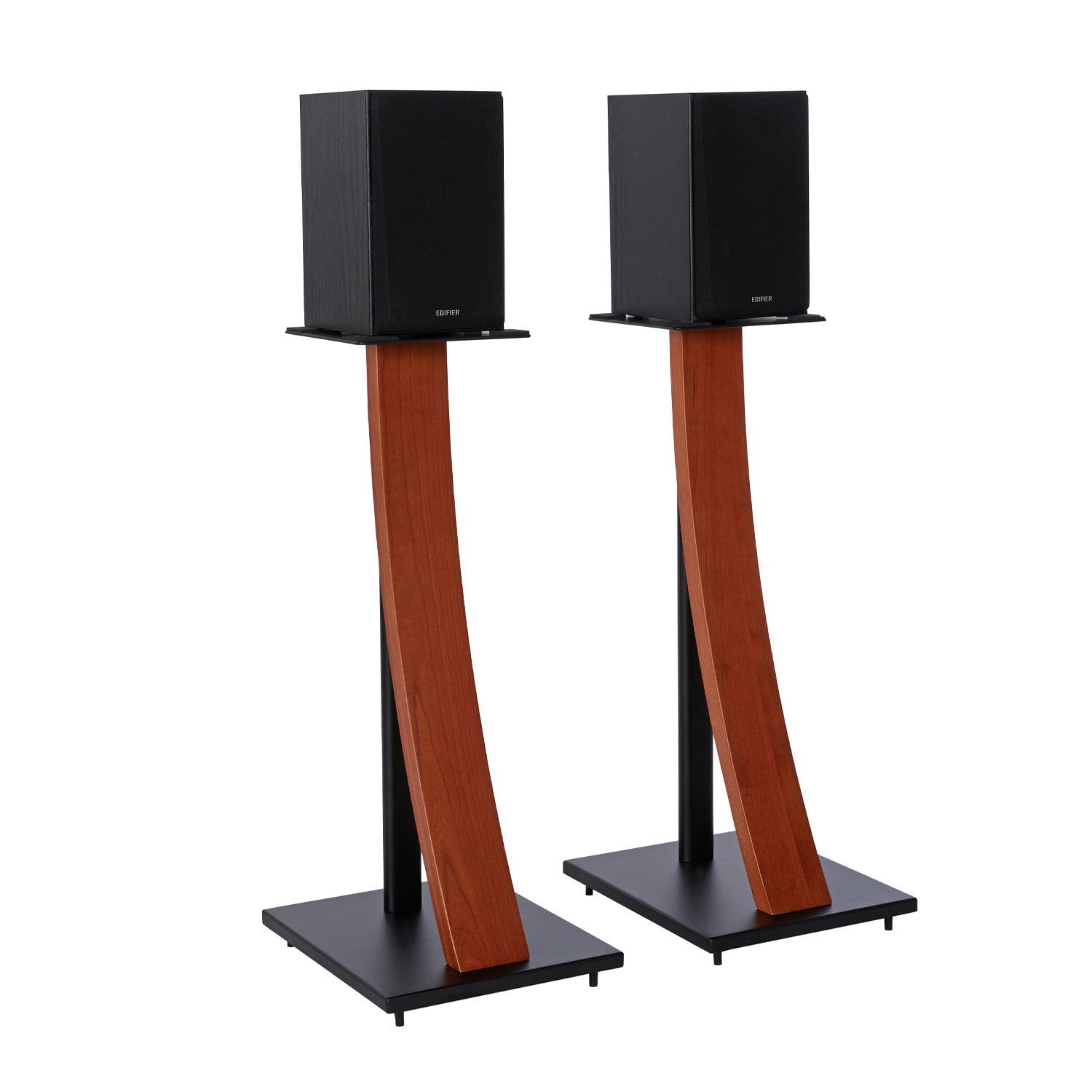
Real cedar, a curved slat design, and speaker cable that vanishes down the leg.
Most stands on this list are MDF with a wood-grain finish. This one is made from real wood, and you can feel the difference the moment you pick up a leg. It stands 24.6 inches tall — a hair over two feet, which suits a typical sofa or armchair — and the curved wood slat gives it a shape no painted MDF box can match. That design detail is a big part of why people choose it, and it’s earned: the curved slat is the sort of thing visitors notice.
The feature that holds up best over time isn’t cosmetic though. Your speaker cable runs down through the hollow leg, so the stands stay clean and the cord never trails across the floor. Floor spikes and soft grip plastic covers both ship, letting you anchor into carpet or protect a hard floor. Capacity is 66 lbs, which comfortably clears small and mid-size bookshelf speakers and gives you a little more headroom than the 50 lb stands here.
Build quality is the dominant impression and it’s well earned — the stands are sturdy, they support 30 lb speakers without a wobble, and the assembly is quick. Against the taller 28-inch Rockville RHT28D below, this cedar pair trades some height for material quality: 24.6 inches versus 28 inches, real wood versus painted MDF. That’s the honest height trade to weigh. Set against the build, most people won’t miss it in a normal-sized room.
Material over height: real wood construction and a 66 lb rating make this the finish-first pick for a mid-height room.
The measured trade: 24.6 inches sits below the 28-inch Rockville — worth checking against your ear level before you fall for the cedar.
Best match: a mid-height room where real wood and hidden cable routing matter more than reaching a full 36 inches.
Be sure about: the fixed 24.6-inch height — there’s no ladder adjustment here, so measure first.
7. Rockville SS28D Speaker Stands

Solid MDF, not hollow — 100 lbs of capacity with no sand bag in sight.
If the sand-filling ritual on the RHT28D sounds like a chore, this stand skips it. The body is solid MDF (a dense engineered wood) and designed to resist vibration without you adding a single grain of sand. Capacity is 100 lbs, which puts it well above the 50 and 60 lb stands here and level with the 36-inch SS36B. At 28 inches tall, it lands at the same ear-level balance as the RHT28D — but with a heavier, more rigid build.
The base spans 12.6″ x 10.23″, wider than almost anything else in this lineup, and a base that wide is what keeps a heavy speaker from tipping on carpet or hardwood. Two sets of top plates come included for different speaker sizes, along with brass spikes, rubber spikes, EVA isolation pads, cable clips, and cable ties. The glossy dark wood grain finish is the aesthetic pull, and it works — the stands read as furniture rather than hardware, which is the whole point of a wood pair.
What people rave about is the appearance and the sense of stability once assembled; the pair goes together in under half an hour from unboxing. The recurring gripe is installation, specifically holes that don’t line up cleanly on a few units — bring a little patience to the build and it settles. Since it’s solid rather than hollow, it’s also heavier to move than a fillable stand, so decide placement before you assemble. For a big speaker on a wide base, this is the solid-body choice.
Why it earns the slot
- 100 lb capacity from a solid MDF body — no sand required
- Wide 12.6″ x 10.23″ base for heavy speakers
- Two top plate sizes plus brass spikes, rubber spikes and EVA pads
- Glossy dark wood finish that reads as furniture
What to plan around
- Hole alignment can take patience on a few units during assembly
- Solid construction makes it heavier to reposition after the build
Made for: large, heavy bookshelf speakers and a room where you want mass without filling anything.
Expect a build session: give yourself a clear half hour and the assembly pays off.
Know the Specs
Load capacity (in pounds)
A stand’s load rating is the maximum speaker weight it’s designed to hold — 60 lbs on the Rockville RHT28D, 110 lbs on the IBVIVIC pair, 130 lbs on the Dayton. Always weigh your speaker before you choose, and remember that if you fill a hollow stand with sand, that sand counts toward the stand’s own mass, not the rated load of the speaker on top. Choose a stand with a rating comfortably above your speaker’s weight rather than matching it exactly.
Spikes versus isolation pads
Spikes are pointed feet designed to push through carpet and couple the stand to the subfloor, which stops wobble. Isolation pads are soft squares that sit between the top plate and the speaker, soaking up vibration before it travels into the cabinet. Brass spikes and rubber spikes serve different floors — brass bites into carpet, rubber grips and protects hardwood and tile. Many stands ship with both, which lets you match the footing to the room rather than the room to the stand.
Hollow-fill versus solid body
A hollow stand has an internal cavity you can pack with dry sand to add mass, which reduces resonance — good news for a room with boomy bass. A solid MDF stand skips the filling step and arrives heavy by design, which is simpler but harder to reposition once built. Neither is automatically better; hollow wins on tuneability, solid wins on set-and-done convenience.
Top plate size and speaker fit
Your speaker rests on a shelf called the top plate. If that plate is narrower than the cabinet’s base, the speaker overhangs and can tip. Look for a pair that ships with two plate sizes — a narrow option around 7″ deep and a wider option nearer 11.8″ — so you match the plate to your speaker’s actual footprint instead of hoping one size works.
Common Questions
What height speaker stand puts my tweeter at ear level?
Can I fill a hollow wood speaker stand with sand?
Do I need spikes or rubber pads on hardwood floors?
Will a 50 lb stand hold my heavy studio monitors?
What is the difference between the Rockville RHT28D and the SS28D?
Do these wood speaker stands come as a pair or single?
How do I hide the speaker cable behind the stand?
Can I use wood speaker stands for surround speakers as well as front speakers?
Does a wood stand sound different from a metal stand?
How long does it take to assemble a wood speaker stand pair?
The Bottom Line
For most living rooms, the wood speaker stands pick is the Rockville RHT28D — 28 inches of MDF that lands at ear level, two top plate sizes for different speakers, and a dark wood finish that looks like furniture. If your speakers are heavy and you’d rather skip the sand, the Rockville SS28D gives you a solid 100 lb body at the same height. And if your room needs a genuine three-foot lift, the Rockville SS36B is the one that gets you there. Buy the height your ears actually sit at, and the rest will follow.
How we choose
We do not accept paid placement. Every pick is matched to a real buyer and a real use-case; we do not hands-on test units.
Sources
Specifications: manufacturer listings and product documentation. Review insights: verified customer reviews, as of November 2026. Pricing: not shown on this page (it changes often); check the current price via the retailer link.
As an Amazon Associate, Tactical Gear Guy earns from qualifying purchases. This does not affect which products we feature.