Specs are compiled from manufacturer listings and verified buyer reviews and can change over time — please confirm the key details on the product page before buying.
If your grip gives out before your back does, the fix is a small, cheap tool you can use while watching TV. Wrist exercise equipment builds the forearms, wrists and fingers that let you hold heavier weight, open stubborn jars and last longer on a climbing wall. This guide sorts the rollers, grippers, therapy bars and gyro balls by what they actually do, so you can pick the one that matches your goal in about two minutes.
This guide is built by comparing the manufacturers’ published specifications and the patterns across verified customer reviews, so you get each pick’s real strengths and trade-offs instead of marketing spin.
Some tools load real weight plates, some squeeze a spring, and some spin a rotor in your palm — and each one trains your arm a different way. Below you’ll find the honest strengths and the real limits of every pick, so you can find the wrist exercise equipment that fits the way you actually train. The list runs from a 330-lb plate-loaded roller down to a palm-sized gyro ball you can spin at your desk.
Top Picks


How To Choose The Best Wrist Exercise Equipment
Start with the movement you want, not the product photo. Rollers build forearm size with slow, heavy tension. Grippers build crushing strength in the fingers and palm. Therapy bars work your wrist through a twist with light, steady resistance. Gyro balls spin a rotor you fight with your wrist alone. Pick the movement that matches your goal and the rest of the decision gets easy.
Load capacity tells you how far a roller will grow with you
A wrist roller is only as useful as the weight it can carry. The load pin is the metal post that holds the plates, and its rating sets your ceiling. Some pins are rated to 330 lbs, which means you can keep adding plates for years. Others top out at 130 lbs, which suits most lifters but leaves heavy powerlifters wanting more.
Match the plate size before you buy
Rollers come in two plate standards. One takes standard 1-inch plates, the kind that come in most home weight sets. The other takes 2-inch Olympic plates and includes a collar to lock them down. Check your existing plates first — a roller that does not fit what you own is a paperweight.
Resistance ranges: pounds, kilos and everything between
Grippers and adjustable handles list their resistance differently. Some quote pounds, some quote kilos, and some give a range like 5-100KG. A wide range means one tool can start easy and finish hard, which saves you buying three grippers as you get stronger. Narrow ranges are fine too — they just commit you to one level.
Side-by-Side Comparison
| Model | Best For | Load / Resistance | Type | Weight | Amazon |
|---|---|---|---|---|---|
| Yamyshine Forearm Wrist Roller Blaster★ Best Overall | Heavy plate-loaded forearm work | Up to 330 lbs, fits 1-inch plates | Wrist roller | 826 g | Amazon |
| MuscleForge Wrist Roller & Forearm StrengthenerClassic Roller | Classic roller on a slimmer budget | Up to 130 lbs (60 KG) | Wrist roller | 0.89 kg | Amazon |
| KEWAE Grip Strength Trainer Kit 6 PackMost Portable | Pocket-size finger and forearm work | 10–132 lbs adjustable | Grip kit | 0.47 kg | Amazon |
| FitBeast Flex Therapy Bar | Twist work for sore elbows | 10, 15, 25 LB bars | Therapy bar set | 1.08 kg | Amazon |
| Fitarc Forearm Wrist Strengthener | Olympic-plate wrist curls and rotation | Fits 2-inch plates, collar included | Wrist bar | 1.7 pounds | Amazon |
| Hiyoga Grip Strength Trainer | Tracking progress with a built-in counter | 5–100KG adjustable | Hand gripper | 6.56 ounces | Amazon |
| NSD Essential Crystal Spinner Gyro Ball | Desk-friendly wrist workout | Up to 15,000 RPM, 26.8 lbs resistance | Gyro ball | 8.64 ounces | Amazon |
| DICYWUDI Flex Therapy Bar and Grip Set | Four resistance levels in one set | 5, 10, 15, 25 LB bars | Therapy bar set | 1.25 kg | Amazon |
Detailed Reviews
1. Forearm Wrist Roller Blaster Exerciser by Yamyshine
Our pick — 4.5+★ from 800+ verified ratings; the strongest balance of quality and price.
A plate-loaded roller rated to 330 lbs, built to keep pace as your forearms grow.
The number that puts this roller on top is its 330-lb load rating. That is the metal loading pin that holds the weight plates, and it is rated to 330 lbs against the MuscleForge roller’s 130 lbs. You load plates, roll the strap up by turning the steel handle, then lower it slowly with your wrist alone. Beginners start light and add plates as the movement gets easy, so the same tool stays useful for years.
The handle pairs a steel pipe core with an EVA foam sleeve. EVA is a soft rubber-like foam, and it spreads the pressure on your palms so long sets hurt less. The nylon strap takes the weight without twisting. Buyers single out the headroom to add up to 100 lbs of extra weight. It fits all 1-inch standard plates, so most home weight sets slot straight on.
The catch is the grip. The foam sleeve earns the most feedback of any part of this roller, and it splits both ways — plenty of people find it comfortable, while a share of buyers report it sliding during heavy sets. That is a fit note, not a reason to walk away: if you plan to roll at very heavy loads, chalk your palms or grip slightly lower. Everyone else gets a comfortable, durable roller that is rated to carry a serious amount of iron.
What Moves the Needle
- 330-lb load rating handles long-term plate progression.
- EVA foam-over-steel handle eases hand fatigue.
- Durable nylon strap holds steady under heavy plates.
- Works with all 1-inch standard weight plates.
Where It Asks More of You
- Foam grip can slide during very heavy sets for some users.
- Weight plates are not included.
Reach for this if: you want one roller that grows with your strength from light rehab reps to heavy forearm work.
Keep shopping if: you own only 2-inch Olympic plates — this one is built for 1-inch standard plates.
2. MuscleForge Wrist Roller & Forearm Strengthener
A no-frills wrist roller with a 130-lb load pin and a non-slip foam grip.
The MuscleForge roller tops out at 130 lbs (60 KG) of additional load — that is the most its loading pin will hold. The Yamyshine above is rated to 330 lbs, so this one sits lower on the ceiling, though 130 lbs still covers most lifters. The 0.89 kg steel build feels solid in the hand. The foam non-slip grips stay put during reps, and the roller works your forearm flexors and extensors while pulling in your biceps and shoulder, too.
Where it shines is simplicity. You load plates, roll up, lower slow, repeat. It is the old-school forearm builder in a straightforward package, and the narrow 2.95-inch width keeps the strap tracking clean while you turn.
Buy this if you already own a set of standard plates and want a simple tool that does the job. The 130-lb pin is the honest limit — if you plan to climb toward a 200-plus-lb roll, the Yamyshine’s headroom is the safer buy.
Straightforward Strengths
- 130 lbs (60 KG) load capacity covers most daily training.
- Non-slip foam grips for a firm hold.
- Steel construction stays solid through heavy sets.
Know Before You Roll
- Lower load ceiling than the Best Overall pick.
- Weight plates sold separately.
Pick it when: you want a dependable wrist roller without paying for extra load headroom.
Look up if: your training targets very heavy plate rolls.
3. KEWAE Grip Strength Trainer Kit 6 Pack
A pocket-light 6-pack of silicone grip tools you can take to the office or the gym bag.
At 0.47 kg, this is the lightest kit on the list — the MuscleForge roller weighs notably more at 0.89 kg, so the KEWAE rides in a bag with barely a hint. The adjustable forearm gripper runs 10-132 lbs. A grey finger strengthener gives you 6.6, 8.8 and 11 lbs, a black one adds 13, 17 and 21 lbs, and a separate finger exerciser covers 4 lbs on each finger. A 30-lb hand strengthener and a 50-lb forearm ring round out the set.
The silicone handles stay comfortable and non-slip, and the adjustable range covers everyone from seniors working on flexibility to athletes chasing finger dexterity. Alternate the pieces and you can hit fingers, hands and forearms in one session without picking up a plate.
The thing to know before you buy is the durability question. Feedback on how long the pieces hold up splits both ways — some owners mention it holding up fine, while others mention it breaking within a short time. Given the kit is silicone and rubber over a spread of resistance loads, treat it as a light-duty mobile set. If you plan to squeeze at the top of the range every single day, it may be worth a sturdier gripper on the side.
Lightest-in-list build: 0.47 kg total makes it the easiest kit to keep with you.
The known trade-off: durability feedback is split — great as a light-duty mobile set, less suited to daily max-effort use.
Suits the traveler: anyone who wants a grip routine that lives in a backpack or desk drawer.
Skip for daily max: if you squeeze near the ceiling every day and want the longest lifespan.
4. FitBeast Flex Therapy Bar

Three flexible rubber bars at 10, 15 and 25 lbs that work your wrist through a twist.
This set hands you a progressive twist routine in three color-coded bars: Green at 10LB for light work, Blue at 15LB for medium, and Red at 25LB for heavy. You bend and twist the bar while holding it out, and the rubber pushes back through the whole arc. The maker bills it for tennis elbow, golfer’s elbow and tendonitis, and includes an exercise manual for a day-one routine.
What puts it ahead of a plain roller for rehab-style training is the twist mechanic. Where a roller loads your wrists through a grip and turn, these bars load them through flexing and twisting, which is the motion someone working a sore elbow wants. The durable non-slip rubber keeps a firm hold. Effectiveness and overall quality are the two traits the feedback praises most.
The honest note: flexible rubber bars bend, and they can stay slightly bent right after a hard session before slowly springing back. The maker calls that normal for the material, and feedback on flexibility and sturdiness splits both ways. If you want a rigid steel bar with zero give, this is not it. If you want three levels of twist resistance and a proper guide, it fits.
Why It Earns the Spot
- Three levels at 10LB, 15LB and 25LB for gradual progression.
- Twist motion hits elbow, wrist and forearm in one move.
- Includes an exercise manual for a ready-made routine.
- Non-slip rubber stays grippable through sweat.
Fair Warning
- Bars can stay slightly bent after use before slowly returning to shape.
- Sits at the higher end of the mid-range tier in build cost.
Best fit for: anyone who wants a guided, low-impact twist routine for wrist and elbow work.
Look elsewhere if: you want a rigid bar that never deforms.
5. Fitarc Forearm Wrist Strengthener
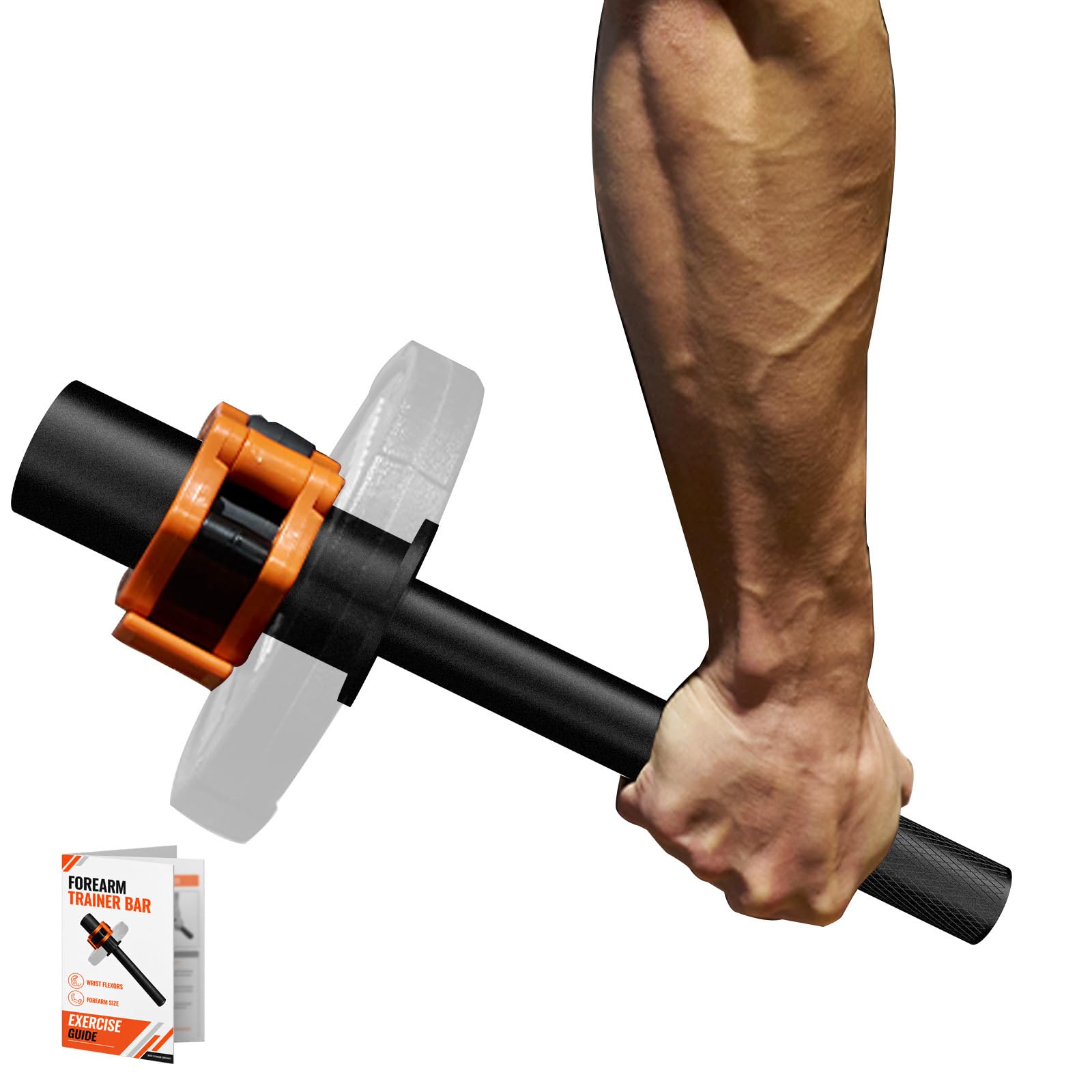
The one on this list built around 2-inch Olympic plates, with a collar to lock them down.
Here is the differentiator: this bar is built for 2-inch Olympic plates, not the 1-inch standard plates the rollers above use. The plate bar measures about 5cm / 2in across, so the plates seat with no wobble, and a barbell collar is included to hold them. If your home gym runs Olympic plates, this is the wrist tool you want. The 1.7-pound iron build sits solid in the hand.
The flex wrist bar covers supination and pronation (rotating your palm up and down) plus wrist curls, so one bar trains several angles. The maker ties its wrist-strengthening rotation work to lower injury risk during heavy lifting. The feedback calls it effective, sturdy and simple — and a common thread is that people use it while sitting or watching TV, so it hides in the day.
Two things to know. Olympic plates are not included, so you bring your own iron. And the workout is demanding — some owners feel a hard burn in the forearms, while others find it uncomfortable. That is the nature of wrist rotation under load. If you own Olympic plates and want a varied wrist station, this earns its place.
The plate-standard edge: built for 2-inch Olympic plates with a collar included, so it locks down and does not wobble.
The honest catch: plates not included, and the rotation motion is genuinely hard on the forearms at first.
The right call if: your home gym already runs Olympic plates and you want a varied wrist station.
Not for: anyone with only 1-inch standard plates or a low tolerance for forearm burn.
6. Hiyoga Grip Strength Trainer
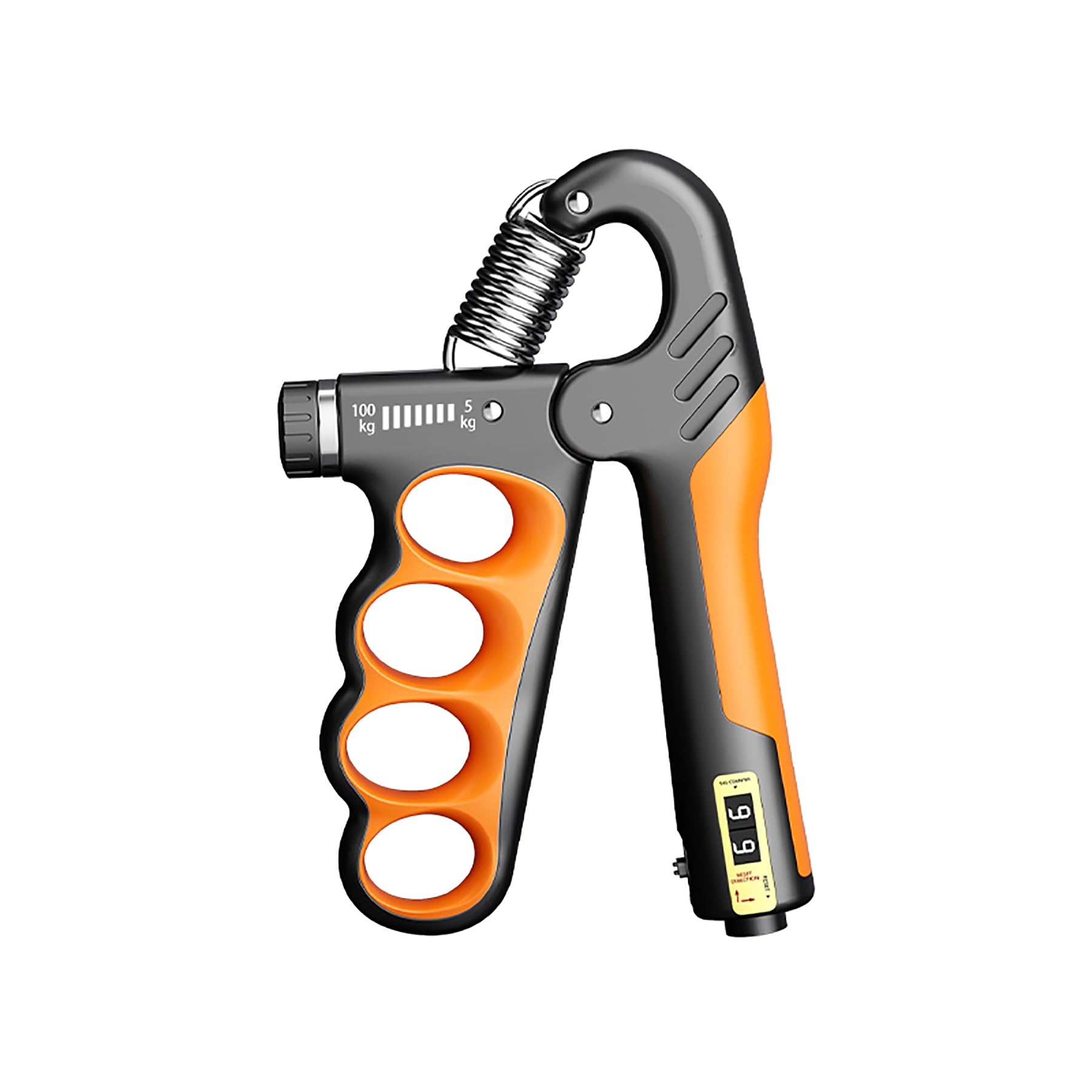
A gripper that counts your reps for you and dials from 5 to 100KG of squeeze.
The feature that sells this one is the built-in counter: it records the number of grips you take and resets with a twist of the button, so you can track sessions without a notebook. The resistance adjusts from 5-100KG, letting one tool cover a beginner’s first squeeze and a strong athlete’s tough set. A high-strength stainless steel spring handles the tension, and the thickened coil is designed to stay stable through each rep. The TPR handle (a soft, rubbery grip material) is built for anti-slip comfort across different hand sizes.
This one carries 4.0+ stars across 900+ ratings, and the numbers point to quality and adjustability as the two traits buyers care about most. Customers note steady grip and forearm gains over a few weeks and squeezing without pain. The counter gives you a tangible number to beat, which is more than most grippers offer.
The plastic body is the trade-off. Polypropylene is light and tough, but it will not feel like a machined metal gripper in the hand. If you want the premium hand-feel of steel, look at the plate-loaded options. If you want adjustable resistance and a rep counter in a compact grip trainer, this delivers both.
What Impresses
- Built-in counter tracks reps automatically, easy to reset.
- 5-100KG adjustable resistance suits all strength levels.
- Stainless steel spring resists rust and stays stable.
- TPR anti-slip handle fits a range of hand sizes.
The Small Print
- Polypropylene body lacks the feel of metal-on-metal grip tools.
- One gripper, so variety means a second device.
The pick for: anyone who wants to log reps and adjust resistance from one compact gripper.
Not ideal if: you prefer the heft and feel of a metal gripper over a plastic one.
7. NSD Essential Crystal Spinner Gyro Ball

A palm-sized rotor you spin up to 15,000 RPM with your wrist, no batteries inside.
You pull a string to get the rotor going, then fight its gyroscopic force with your wrist to keep it spinning. That pull-to-power design needs no batteries, and the spin reaches up to 15,000 RPM with over 26.8 lbs of gyroscopic resistance pushing back. The whole thing measures 2.76 inches across and weighs 8.64 ounces, so it disappears into a drawer or a jacket pocket and runs anywhere.
The build is a military-grade plastic shell around a zinc rotor and a stainless steel axle, and the maker says the inner tracks can be swapped to keep it running longer. The desk-worker crowd is the natural fit: you spin it during a call and your wrist works the whole time. As a compact forearm-trainer it has real charm, and the feedback praises how effective and versatile it is, plus how much people enjoy using it.
The string start is the honest cost. Feedback on ease of use splits both ways — some owners get it spinning in seconds, and some find it hard to start and keep up. The gyroscopic resistance demands some wrist control too, so brand-new users may need a session or two to find the rhythm. Once it clicks, it is the most fun device on this list to keep at a desk.
The fun factor: hidden in a compact ball is a rotor you fight with your wrist alone — no batteries, no weights, runs on your own pull.
The honest cost: the string start and gyroscopic resistance take some practice, and some owners find it fussy at first.
Made for: desk workers and travelers who want a wrist workout that fits in a pocket.
Think twice if: you want something you can use hard on the very first try with zero learning curve.
8. DICYWUDI Flex Therapy Bar and Grip Strength Trainers Set

Four color-coded bars, from 5LB extra-light to 25LB hard, for slow progressive twisting.
The set’s edge is range: four bars instead of three, so you get an easier starting point. Yellow runs 5LB extra light, Red 10LB light, Green 15LB medium, and Blue 25LB hard. Each bar is made from thermoplastic elastomers — a rubbery, springy material that flexes through the twist and holds a comfortable grip. Every bar is color coded, so you grab the right one without guessing. The maker’s intended routine is a few minutes a day.
This set sits at the top of the range because you get one more level than the FitBeast set, which means a gentler starting rung if 10LB feels like a lot. The twist motion works your elbow, wrist, forearm and hand throughout, and what buyers praise most is how much strengthening it delivers. The value angle holds up too — this is a full progressive set with four rungs to climb.
The trade-off is the same one that comes with any flexible therapy bar: it is a twist-and-bend tool, not a plate-loaded one. If your goal is to build raw crushing force with heavy iron, a wrist roller or gripper does that better. If you want four graduated levels for a wrist and elbow routine, this kit gives you a lower entry point than most.
The Case for It
- Four levels — 5, 10, 15 and 25 LB — for a gentler starting point.
- Color-coded bars make selection simple.
- Rubbery TPE material flexes steadily through the twist.
- Strong resistance-level variety across one set.
Worth Knowing
- A twisting tool, not a heavy-load roller — it will not build crushing force.
- Highest-tier build cost of the therapy sets here.
Go for this if: you want a four-level twist set with an extra-light starting rung.
Pass if: you want to load heavy plates — a roller does that job better.
Know the Specs
Load Capacity (Rollers)
A wrist roller’s load capacity is the most weight its loading pin will hold, and it sets how far you can progress. Some pins are rated to 330 lbs, others to 130 lbs. A higher rating costs nothing extra in effort but gives you more room to grow. If you lift heavy and want one roller for life, buy by the higher rating.
Plate Compatibility (1-Inch vs 2-Inch)
Rollers take either 1-inch standard plates or 2-inch Olympic plates. A 1-inch roller fits most home weight sets; a 2-inch roller matches a gym full of Olympic iron and usually ships with a collar to lock it. Match the roller to the plates you already own.
Resistance Range (Grippers)
Grippers list their resistance in pounds or kilos, sometimes as a range like 5-100KG. A wide range means one device can start easy and finish hard, so you avoid buying several grippers as you get stronger. Narrow ranges work, but they lock you to one level.
Resistance Levels (Therapy Bars)
Therapy bars come color coded by load, from 5LB extra light up to 25LB hard. More levels mean a gentler first step and a smoother climb. Twist-style bars carry light resistance on purpose — they are for slow, controlled work, not heavy loading.
Common Questions
Will a wrist roller work with the weight plates I already own?
How much weight can a wrist roller hold?
Is a gyro ball or a gripper better for wrist strength?
What do the resistance numbers on grippers actually mean?
Can I use wrist exercise equipment if my wrist is sore or recovering?
Do wrist rollers come with weight plates?
How much space do I need to use a wrist roller?
Is a flexible therapy bar or a plate-loaded roller better for elbow work?
The Bottom Line
The strongest all-round pick here is the Yamyshine Forearm Wrist Roller Blaster. Its 330-lb load rating gives you more headroom than the MuscleForge roller’s 130 lbs, the EVA foam handle makes long sets easier on the palms, and it takes the 1-inch plates most home gyms already own. If you want one tool that grows with your forearm strength, start there. If your home gym runs Olympic plates, the Fitarc Forearm Wrist Strengthener is the one built for those plates. And if your goal is a guided twist routine for a sore elbow, reach for the four-level DICYWUDI Flex Therapy Bar set.
How we choose
We do not accept paid placement. Every pick is matched to a real buyer and a real use-case; we do not hands-on test units.
Sources
Specifications: manufacturer listings and product documentation. Review insights: verified customer reviews, as of November 2026. Pricing: not shown on this page (it changes often); check the current price via the retailer link.
As an Amazon Associate, Tactical Gear Guy earns from qualifying purchases. This does not affect which products we feature.