Specs are compiled from manufacturer listings and verified buyer reviews and can change over time — please confirm the key details on the product page before buying.
Dropped passes rarely come down to bad hands. They come down to a palm that has gone slick, a wrist strap that slips, or a glove that was never sized for a kid in the first place. A youth receiver glove has one job: keep a spinning football stuck to small fingers for the half-second it takes to tuck it away. Every pick below does that job, and each one solves it a little differently. Some lean on a silicone palm (a sticky rubber grip surface), some on a snug cuff, and some on a breathable backhand that stops the sweat that kills tack (grip) in the fourth quarter.
This guide is built by comparing the manufacturers’ published specifications and the patterns across verified customer reviews, so you get each pick’s real strengths and trade-offs instead of marketing spin.
Fit comes first, then tack, then how the palm holds up through a season of practices. Below you will find nine youth options ranked by what actually decides a catch, and the full breakdown of the best youth wide receiver gloves for small hands and long seasons.
Top Picks


How To Choose The Best Youth Wide Receiver Gloves
A youth receiver glove is not a smaller adult glove. A kid’s hand is shorter through the palm and slimmer at the knuckles, so the two things that decide whether a pair works are fit and tack. Get those right and the catch takes care of itself. Get them wrong and you get a glove that twists on contact or a palm that slides across the laces.
Fit comes before anything else
A glove that fits snugly moves with the hand instead of around it, which is why a snug-fit or second-skin cut shows up so often on the pairs built for young players. Look for an adjustable hook-and-loop wrist strap — the velcro tab that cinches the cuff — because that is what stops the glove from rotating on a small wrist mid-play. Check the fingertips too. If there is a loose flap of fabric past the nail, the ball will catch it on contact.
What the palm material actually does
Most youth receiver gloves use a tacky silicone palm, and that is the layer doing the real work. Silicone stays grippy against a pebbled football surface, and it keeps working when hands get damp. Some gloves build the silicone into a one-piece panel; the Franklin Sports and TAQCHA gloves extend it over the thumb and forefinger. More coverage generally means more contact surface on the ball.
Why the back of the hand matters
A breathable backhand — mesh, spandex, or a light polyester panel — lets heat out so sweat does not pool inside the glove. Sweat is what dulls tack, so a glove that breathes tends to hold its grip longer into a game. It also keeps a young player from peeling the gloves off between series.
Match the glove to the position
Receivers live on their fingertips, so a snug, tack-heavy palm with good finger mobility is the priority. Running backs and defensive backs want the same grip but can trade a little fingertip feel for a more locked-in wrist. A glove built strictly as a receiver model is the safer starting point for a young wideout.
Side-by-Side Comparison
| Model | Best For | Palm Grip | Wrist Closure | Backhand | Amazon |
|---|---|---|---|---|---|
| AIGEVTURE Youth Receiver Gloves (Blue/Red)★ Best Overall | Best all-round pick | Adhesive tacky material | Adjustable hook and loop | Textured, breathable fabric | Amazon |
| HANDLANDY Youth Football GlovesTwo-Glove Value | Two-glove value | One-piece tacky silicone | Hook and loop | Quick-dry spandex | Amazon |
| AIGEVTURE Sticky Kids Gloves (Jet Black)Graphic Look | Graphic look | Textured adhesive tacky palm | Adjustable hook and loop | Mesh panels | Amazon |
| Franklin Sports Youth NCAA Receiver Gloves | Team-logos and costumes | One-piece tacky silicone | Contoured neoprene wrap-around | Lightweight polyester | Amazon |
| Repsters RPG1 Football Gloves | Adult-and-youth sizing | Enhanced sticky palm | Hook and loop | Breathable build | Amazon |
| Under Armour Boys F9 Nitro | Brand-name fit | — | — | — | Amazon |
| TAQCHA Pro Elite Tacky Grip | Season-long durability | Pro-grade silicone | Adjustable hook and loop | Flexible mesh | Amazon |
| adidas Adifast 3.0 Youth | Brand-name grip treatment | GripTack palm | No-snag hook and loop | Ergonomic pattern | Amazon |
Detailed Reviews
1. AIGEVTURE Youth Football Gloves
Our pick — 4.5+★ from 800+ verified ratings; the strongest balance of quality and price.
Sticky where it counts and sized for little hands — the pair that keeps the ball in a kid’s grip.
The palm is the reason this one sits at the top. AIGEVTURE builds it from an adhesive tacky material — a surface engineered to grab the pebbled leather of a football rather than glide over it. That is what turns a fingertip catch into a secured ball instead of a bobble. AIGEVTURE also claims the grip holds in all weather, so a damp Saturday morning does not turn the palm slick.
Fit is the second win. The gloves run on a hook-and-loop wrist strap — the adjustable velcro tab at the cuff — so you can cinch them down to a child’s wrist instead of accepting whatever the elastic gives you. The maker describes the cut as a second-skin fit, which matters on a receiver glove because a loose palm shifts on contact and throws off the catch point. A textured back panel and breathable fabric round it out so hands stay cooler in a long practice.
Where it needs honest framing is longevity. The build is polyester with reinforced stitching, and it holds up for a lot of young players, but the durability is the one part of the picture that splits rather than unites. For a growing kid who will outgrow the glove before the stitching reaches its limit, that is a non-issue. For a hard-charging player who wears the same pair every single day across a full season, buy a second pair as backup. The blue and red color scheme is also loud by design — bold superhero styling that some young players love and some coaches will tolerate at best.
Why it holds the top spot
- Adhesive tacky palm gives a firm grab in dry or damp conditions
- Adjustable hook-and-loop strap locks the cuff to a small wrist
- Textured breathable back keeps hands from overheating
- Second-skin cut keeps the palm where it belongs on contact
What to know before you buy
- Durability is the split issue — a daily-wear player may need a backup pair
- Bold superhero color scheme will not suit every team uniform
Built for: the young receiver who needs a reliable grab on every down, especially if a parent is squeezing the wrist strap down to size.
Second thought: one pair is not enough for a player who practices daily — plan for a spare.
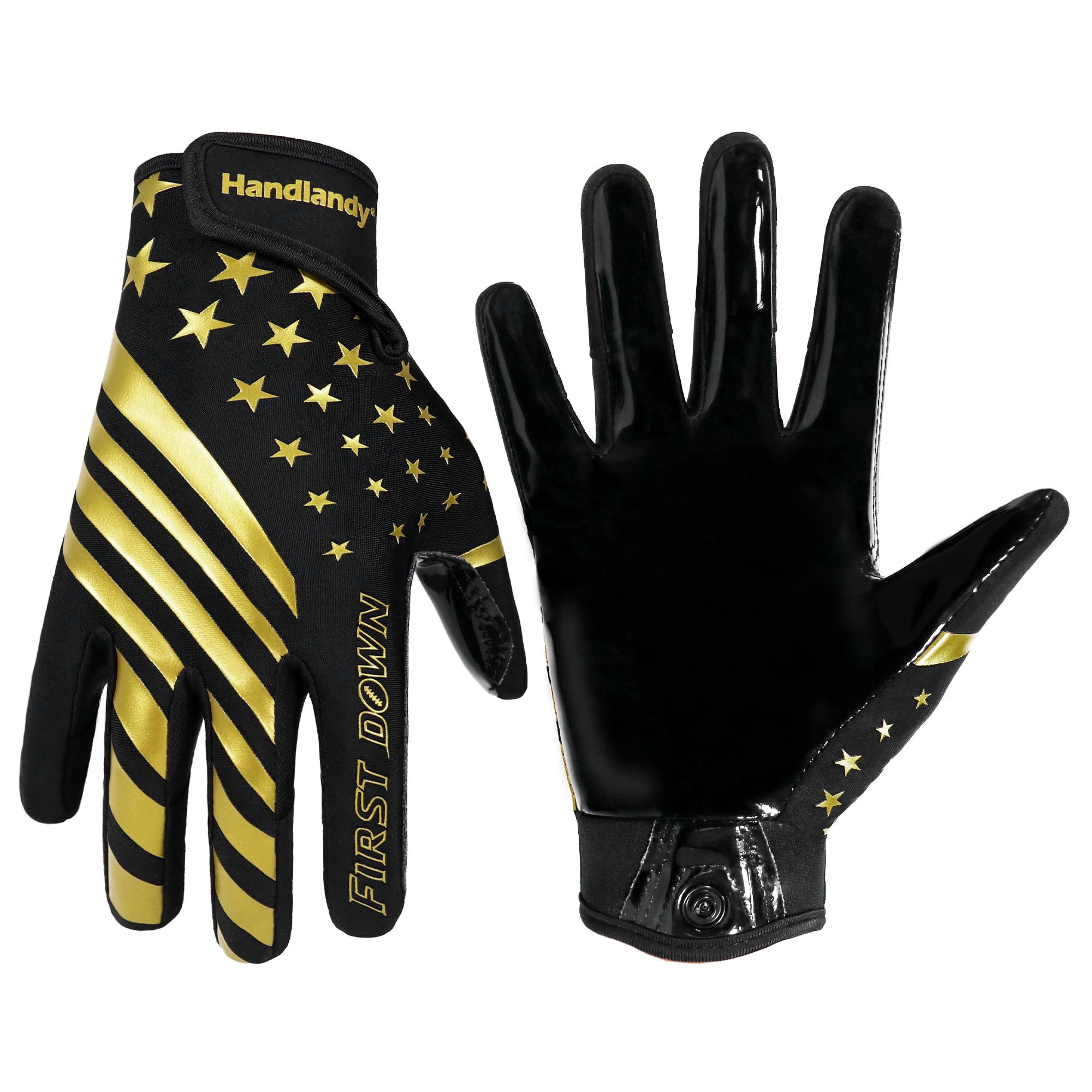
2. HANDLANDY Youth Football Gloves
One solid sheet of silicone across the palm — and you get more than one pair in the box.
HANDLANDY does something simple that works: it builds the palm from a one-piece tacky silicone panel instead of stitching several pieces together. One continuous surface means no seam to interrupt the grip at the exact spot where a football meets the hand. The spandex back is described as stretchable and quick-dry, so sweat moves off the hand rather than sitting against it.
Start with the size that matches your child’s normal glove. The listing is filed under a Youth-Medium size with an Adult Youth age range, and buyers generally report the fit as true to size for kids playing youth football. There is also a family angle here: the maker offers a range of sizes for kids and adults, so this pair works as a matching set for a parent and a young player running routes in the driveway. And unlike a single-glove box, you get a pair here for the same core build.
The honest caveat on this one is the palm tack over the long haul. Stickiness and durability are both areas where owners land on different sides — some gloves come from the start grabbing hard and stay that way, others go slick with heavy use. If your young player is in a fully padded hitting camp that grinds gloves into the turf, expect to replace sooner than you would on a practice-only pair. Keep them clean and out of the mud and they will reward you.
Where the money goes: a one-piece silicone palm and a stretch spandex back are the exact two features that make a youth receiver glove work, and HANDLANDY puts both on the table in a pair format.
The candid part: tack is a wear item here — treat the gloves as a season purchase, not a hand-me-down.
Worth the grab if: you want a true-to-size youth fit and a full silicone palm without hunting down a second glove.
Look past it if: your player grinds through heavy contact practices — the sticky surface will need refreshing before the season ends.
3. Youth Football Gloves Kids Receiver Gloves
Mesh on the back, tack on the palm, and loud graphics that make a young receiver easy to spot on the field.
The ventilation is what makes this pair worth a close look. AIGEVTURE runs high-quality mesh panels across the back of the hand, so the airflow you get is built into the structure of the glove rather than just the fabric weave. On a hot practice that keeps the palm from turning damp, and damp is what kills tack. The palm is a textured adhesive tacky surface that AIGEVTURE says holds grip even in wet conditions — exactly what a receiver faces once the season turns.
Where it differs from the lighter pick above is the wrist closure. This one uses an adjustable hook-and-loop strap (a velcro-style strap), so you can dial in the tightness to a child’s wrist rather than accepting an elastic fit. The cut is described as ergonomic and snug, which is the shape that keeps the palm from rolling on impact. This is not a featherweight glove — it has a little more substance to it, and it feels that way on a hand that is still growing.
The main honest concern here is the same one that runs through this whole glove category: durability. The construction is polyester with stitching meant to balance durability and comfort, and it holds up for most young players, but it is not a long-term glove that will survive multiple seasons of heavy use. The size designation is also a recurring theme in the feedback — sizing runs in the mixed column, so measure your child’s hand rather than guessing. The jet black colorway with vibrant graphics is the standout reason to choose it: a young player who wants to stand out on the field has a very strong option here.
The winning play: mesh panels plus an adhesive tacky palm give you airflow where it counts and grip that holds when the ball gets slick.
The coach’s note: measure before you order — sizing is a genuine variable on this model.
The right fit for: a young receiver who wants a showpiece glove with a vented back he won’t complain about in August heat.
Consider skipping if: you demand a multi-season glove — this is a replace-each-year build.
4. Franklin Sports Youth NCAA Football Receiver Gloves
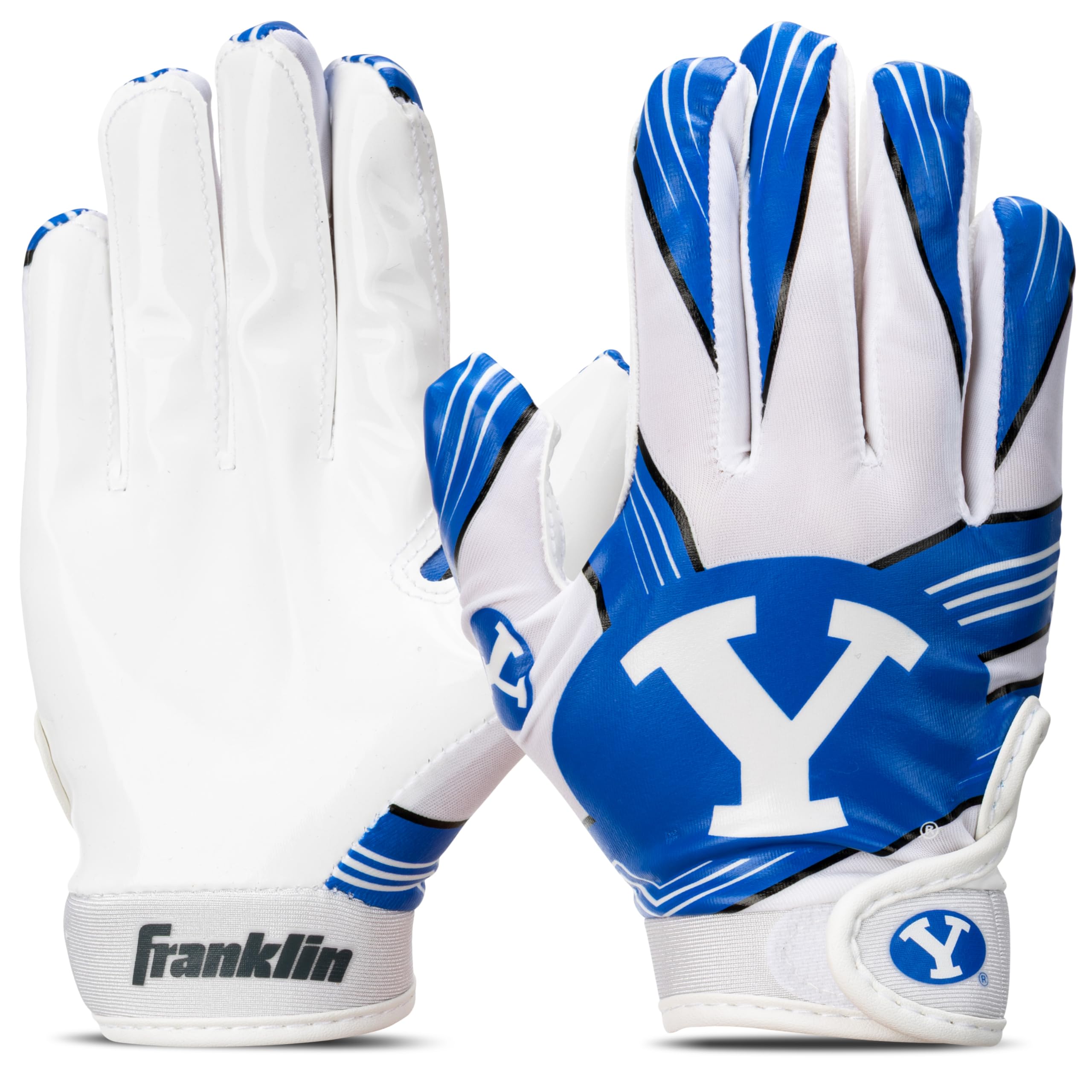
Official college team logos on a receiver glove — a tailgate and costume favorite that also catches footballs.
This is a Franklin Sports glove for a specific kind of young fan: the one who wants to wear his favorite college team’s colors to the backyard. Franklin says the logos and colors are the authentic team versions, so a BYU Cougars glove actually says BYU. The catching tech is no slouch either — a one-piece tacky silicone palm with coverage that extends over the thumb and forefinger, which puts more sticky real estate on the ball at the catch point.
Comfort on the cuff is where this one is engineered. Franklin uses a contoured neoprene wrap-around wrist closure — the soft rubber fit that hugs the wrist rather than pinching it with velcro. On a young player that is a meaningful comfort difference. The backhand is a lightweight polyester fabric meant to breathe and flex, so the finger motion is not choked by the glove. These are gloves built for game day, and Franklin itself says they work just as well at a tailgate, in the backyard, or as part of a costume.
You do need to get the size right here. Franklin makes this in youth, and the feedback is clear that the sizing is the one thing that splits — some young players find them spot-on, and a few find the fit off. Treat the size chart as important and measure the hand rather than assuming. On the catching side the grip and appearance both do the job, and the package is a two-glove pair. If you want a glove that plays well and doubles as a costume piece, this is a clean choice.
What makes it different: real college team logos plus an extended silicone palm over the thumb and forefinger, which gives a young receiver more tack on the ball.
The known variable: sizing is the point to be careful with — measure first.
The pick for: the young college football fan who wants his team colors on a glove that can actually catch a ball.
One thing to check: the size chart, because the fit is the one place Franklin splits opinion.
5. RPG1 Football Gloves

One glove for the whole family — adult and youth sizes in the same sticky build, so parent and child can match.
Repsters built this one to solve a family problem: buy the same glove in adult and youth sizes so a parent and a young receiver can work routes in the driveway with matching gear. The palm uses Repsters’ enhanced sticky technology for maximum grip and ball control, and the maker lists it for all skill positions, not just receivers. Reinforced stitching is the headline durability claim, with Repsters positioning these for tough practices, league games, and everyday training.
The color story is where this glove gets its personality. Emerald green is not a shy choice, and the feedback reflects that the color is one of the strong points of the design. The cuff runs on a hook-and-loop closure, plus Repsters adds a wrist support feature to the build and lists breathability in the construction. It is a full-featured package pointed at a young player who wants a glove that does more than just catch.
Being straight with you: durability is the split on this model. The stitching around the fourth and pinky fingers is the specific area called out as coming apart, and the velcro is reported as not holding as firmly as it should on a few pairs. A young player who practices lightly will likely be fine. A player in a full season of league games and daily reps should expect to keep an eye on the seams and treat the velcro gently. If elbow-to-elbow training is the plan, this glove is a riskier buy than the lighter pairs above.
Where it shines: a matching adult-and-youth build with an enhanced sticky palm and a wrist support feature — package the whole family in one style.
The real risk: stitching at the outer fingers and a weaker velcro hold are the two things to watch in heavy-use seasons.
The obvious match for: a family looking for a matching set, or a player who alternates between receiver and running back.
Hold off if: your player is in a daily practice grind — the outer-finger stitching and velcro are the weak links.
6. Under Armour Boys F9 Nitro Football Gloves

The brand-name glove in the group — a boys fit that plays well when you get the size right.
The F9 Nitro is the Under Armour entry in this lineup, filed under the boys department in a youth-oriented size. That is what this glove is: a branded option for a young player who wants the name on his hand, sold on the reputation of the brand rather than on an aggressive silicone spec sheet. The glove is generally reported as good quality with a great fit and impressive grip when the pair is right, and it carries a strong perceived value for a young receiver.
The caveat that dominates this glove is sizing. Under Armour’s own naming aside, buyers report that at least some of these run too small — so a parent who buys based on the label alone may end up with a glove that pinches. The other thing to plan for is durability, which is the mixed column on this model: some pairs hold up well through a season, and a few come apart on the first wear. That is not a universal problem, and most young players will get a good glove here, but the sizing plus the occasional early failure means you want to try before you commit to a size you cannot adjust out of.
The glove is a straightforward boys fit, so the Under Armour pattern is what you are paying for — brand consistency and a cut that feels like a real football glove. It does not have the adjustable wrist tech of some of the AIGEVTURE pairs or the extended palm coverage of the Franklin glove, but it earns its place for a young player whose family trusts the Under Armour line. Check the size chart and size up if your child is between sizes, and this one will do the job.
The brand case: a genuine Under Armour boys glove with a quality build, a great fit when the size is right, and a grip that holds through the season.
The sizing trap: these run small enough that the label alone is not enough — measure the hand and consider the next size up.
Best for: a young player whose family is settled on Under Armour and wants a brand-name boys glove that is comfortable and grippy.
The one risk: the sizing runs small, so buy with room rather than by the tag.
7. TAQCHA Football Gloves
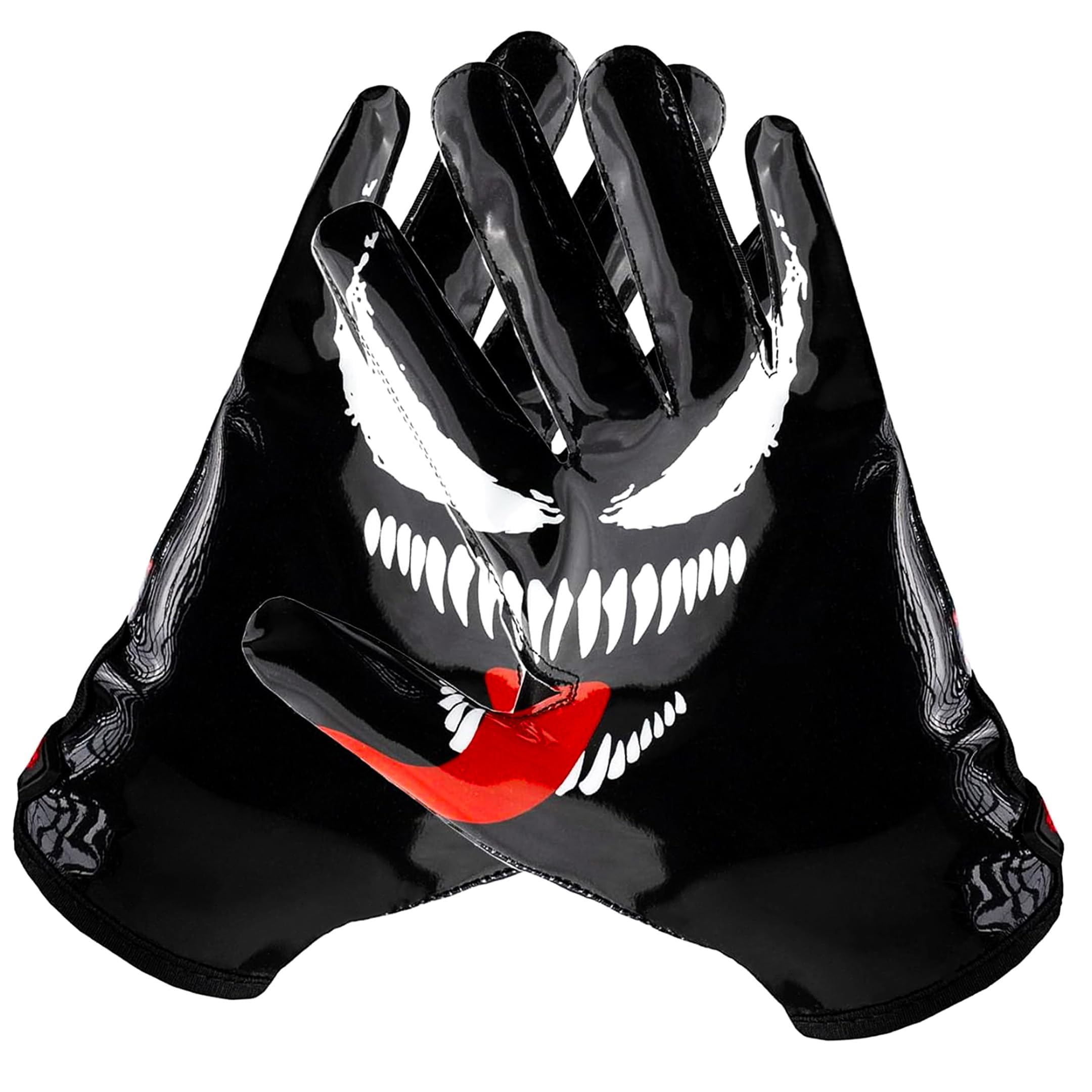
A pro-grade silicone palm and double-stitched seams — the glove built to last multiple seasons, not one.
TAQCHA names the durability play right on the label: reinforced double stitching and a build meant to stand up to daily practice, hard tackles, and a full game schedule. TAQCHA markets these as outlasting your cleats. The palm is pro-grade silicone that TAQCHA says locks onto the ball in rain, mud, sweat, or dry heat. For a receiver glove, that broad-weather claim is the thing that matters, because the back half of a season is rarely played on a dry field.
The palm coverage gets serious here: silicone extends to the thumb and forefinger, which puts the stickiest contact surface exactly where a young receiver’s hand meets the football. The backhand is a flexible mesh, so finger mobility stays intact for clean releases and sharp cuts. It weighs in at 1.92 ounces — light enough that the mesh build does not feel like a burden on a young hand. And the wrist runs an adjustable hook-and-loop closure, so a growing wrist gets a real cinch-down fit rather than a compromise.
Honest framing on this one: the silicone grip wears with heavy use, so treat the tack as something to maintain, not something permanent. The velcro closure is the specific piece that has drawn the most pushback, so be gentle with the tab when donning the gloves. TAQCHA also lists a wide size range running from youth to adult, so a single parent-and-child matching set is possible without hunting down a separate glove design. For a family, that is a real win.
The standout claim: double stitching plus a mesh back plus an extended silicone palm aimed at surviving multiple seasons — a genuine durability pitch for a category full of disposable builds.
Watch out for: the velcro tab — treat it gently or the closure will loosen ahead of the palm.
Reach for this if: the season ahead is long and your player does not want to switch gloves mid-year.
Skip if: you prefer the lightest possible feel — the mesh build weighs more than the featherweight picks above.
8. Adidas Adifast 3.0 Youth Football Receiver Glove

The branded glove at the top of this line — GripTack palm, box fingertips, and no-snag cuff.
The engineering story on the Adifast 3.0 starts at the fingertip. Adidas uses a box fingertip construction, a square-cut tip that does not pinch the ends of the fingers — the small discomfort a young receiver feels after a long practice in a pinched glove. The palm carries adidas’s exclusive GripTack treatment, which the brand claims delivers grip in all weather. The whole glove is built around an ergonomically designed pattern meant to mimic the natural movement of the hand.
The closure gets its own attention too: adidas uses a custom injection molded rubber tab with a no-snag hook-and-loop closure, so the cuff goes on cleanly without the velcro grabbing nearby fabric. That detail matters for a kid pulling gloves on alone between series. The material blend is listed as 55% polyester, 18% silicone, 11% spandex, 10% nylon, and 6% chloroprene rubber (a stretchy synthetic rubber) — a multi-material build rather than one fabric throughout, and the spandex and chloroprene rubber are the parts that add stretch to the fit.
The honest part is the sizing. The fit comes up as the mixed column on this one, with at least one report of fingers running a full inch too long — meaning a young receiver can end up with an oversized glove even in what looks like a youth size. The seams are also mixed on durability, so this is a glove with a strong brand identity but a real case for measuring before you buy. The upside: buyers credit the palm material with helping catch the ball better, the look is strong, and it is a good value for a branded glove. Match it to the right hand and it is a keeper.
The engineered detail: box fingertips and a no-snag molded rubber tab are the two touches that set this apart from the pack — a small-features win.
The sizing risk: fingers running long is a real report, so this one demands a hand measurement.
The right buyer: a young receiver whose family wants the adidas brand and the box fingertip comfort that comes with it.
Before ordering: measure the hand — the length is the one part that can go wrong.
Know the Specs
Palm tack — the silicone question
The palm material is what a young receiver actually feels on the ball. A tacky silicone palm grabs the pebbled surface of a football instead of sliding over it. One-piece silicone panels give a continuous grip with no seam to break the contact. Extended silicone over the thumb and forefinger puts more of the sticky surface directly on the ball at the catch point. When you read that a glove has “enhanced” or “pro-grade” sticky tech, the point behind the marketing is how much of the palm is silicone and whether it runs over the fingers.
Weight — why it matters on a young hand
A youth glove is only as useful as the player’s willingness to keep it on. A light glove is forgotten once the whistle blows, which is what you want from a young receiver. In this lineup, the lightest pairs run light enough that a kid forgets he is wearing them. Heavier, mesh-padded builds have their place — more material generally means more durability — but they can feel weighty on a small hand. If your player has complained about a heavy glove before, start at the lighter end and work up.
Wrist closure — velcro vs elastic
The wrist closure is what holds a glove to a hand that is still growing. A hook-and-loop strap (the velcro tab) gives you adjustable tension so a slim wrist still gets a firm fit. An elastic cuff pulls on and off easily but offers less adjustability. A contoured neoprene wrap-around is a softer, hug-style closure. On a young receiver, an adjustable hook-and-loop strap is generally the safest choice because it can be re-tightened as the glove loosens through a season.
Backhand fabric — the sweat question
Mesh, spandex, and lightweight polyester backhands all do the same job: let heat out so sweat does not pool against the palm. A breathable back tends to keep the glove’s tack usable longer into a game, because the tack fails when the inside of the glove gets damp. Spandex backs add stretch to the fit; mesh panels add airflow; polyester backhands add flex. None of these are a substitute for palm tack — they are the support structure that keeps the tack working.
Common Questions
Will a youth receiver glove actually fit a small kid’s hand?
Do sticky receiver gloves still work when it rains?
How long does a youth football glove usually last?
Does the back of the glove matter for grip?
Should I buy a receiver glove or an all-position glove?
Can I wash a sticky football glove?
What does an extended silicone palm actually do?
Does the wrist strap really matter for a young player?
Are more expensive youth gloves worth the extra money?
What size youth glove should I buy for a first-season player?
The Bottom Line
For most families, the youth wide receiver gloves winner is the AIGEVTURE Youth Football Gloves — a tacky adhesive palm, an adjustable hook-and-loop strap, and a breathable back that keeps a young receiver’s hands working through the whole game. If you want a full silicone palm you can put on today and a pair in the box, grab the HANDLANDY Youth Football Gloves; the one-piece silicone grip and quick-dry spandex back are exactly the two things a young catcher needs. For a light, low-fuss glove on a first-season player, the AIGEVTURE Snug Fit Junior pulls on without a strap and hits the 7-to-10-year-old range young players tend to need. Whichever way you go, the pick that actually fits your child’s hand this season is the one that wins — a glove with a real tacky palm and a cuff you can tighten will outcatch a fancier one that slides around.
How we choose
We do not accept paid placement. Every pick is matched to a real buyer and a real use-case; we do not hands-on test units.
Sources
Specifications: manufacturer listings and product documentation. Review insights: verified customer reviews, as of November 2026. Pricing: not shown on this page (it changes often); check the current price via the retailer link.
As an Amazon Associate, Tactical Gear Guy earns from qualifying purchases. This does not affect which products we feature.