Specs are compiled from manufacturer listings and verified buyer reviews and can change over time — please confirm the key details on the product page before buying.
Buying a first BMX helmet for a kid is mostly a question of weight and fit, not brand loyalty. A helmet that presses on a small neck gets left in the garage, and one that swims on the head slides out of position the moment your rider hits a dirt jump. The picks below are ranked by which helmet a kid will actually keep on for a full park session.
This guide is built by comparing the manufacturers’ published specifications and the patterns across verified customer reviews, so you get each pick’s real strengths and trade-offs instead of marketing spin.
You will see how DOT and ECE certifications (independent safety standards a helmet has passed) separate the motocross crossover lids from the skate-style shells, and why a 2.4-pound shell is not the same as a featherweight one. Here is the practical read on the best Youth BMX Helmet for your rider.
Top Picks

How To Choose The Best Youth BMX Helmet
Most parents start with an age range printed on the box and stop there. That is the wrong first move. Head circumference varies wildly between an 8-year-old and a 14-year-old, and a helmet that lifts or tilts is a helmet that cannot do its one job. Measure around the widest part of the head, just above the eyebrows, with a soft tape or a piece of string.
Measure the head before you read the age range
A proper fit means the shell sits level and does not rock when your kid shakes their head. The Bell Ollie fits heads measuring 54-58cm and is listed for youth ages 8-14, which shows how loose age ranges really are. The Natuway adjusts from 20.25-22.05 inches across roughly 3-12 years, so one shell covers a wide span of growing kids. Write the measurement down before you shop, then match it to the chart.
Decide whether your rider needs a chin bar
A full-face helmet guards the jaw and teeth when a rider goes over the bars on a dirt jump or rocks a tabletop at the park. A skate-style shell is lighter and easier to pull on, but leaves the face open. Full-face shells here range from 14 oz (the Natuway in full mode) to 2.4 pounds (the ILM), and that weight difference is what your kid feels after an hour. If your rider is mostly on flat paths and gentle skate bowls, a lighter half-shell is easier to live with.
Know which safety stamps are on the label
The stamp tells you which standard the helmet was built to pass. DOT means it meets Federal Motor Vehicle Safety Standard 218, a road-motorcycle standard. ECE22.06 is the European equivalent and is a tougher version than the older ECE22.05. CPSC is the US bicycle-helmet standard for ages 5 and older. A motocross crossover does not automatically make it a better BMX lid — it means it can take a harder single impact, which is why it tends to be heavier.
Look at what comes in the box
Several of these helmets ship as bundles with goggles, gloves, and a face mask. That matters for a first-time off-road rider because those accessories are what a full-face needs to keep dust and debris out of the eyes. If your kid already owns goggles, a bare helmet saves clutter. If they are starting fresh, a bundle covers the basics in one order.
Side-by-Side Comparison
| Model | Best For | Certification | Listed Weight | Fit Range | Amazon |
|---|---|---|---|---|---|
| ILM Youth ATV Helmet Z705★ Best Overall | All-round off-road starter | DOT & ECE22.06 | 2.4 lb (1.1 kg) | Youth sizing | Amazon |
| 1Storm Youth Motocross BundleBest Bundle Value | Goggle-and-glove bundle | DOT (FMVSS 218) | — | S, 49-50cm | Amazon |
| PZ PEZE Youth Sport Full-Face | Airflow on long rides | DOT (FMVSS 218) | 2.1 lb | YS to YXL chart | Amazon |
| CUTEY Kids Dirt Bike Helmet | Pink-themed 4-in-1 kit | DOT (FMVSS-218) | 2.3 lb | Youth boys and girls | Amazon |
| Bell Ollie Bike and Skate Helmet | Skate-park half-shell | CPSC & ASTM | 0.1 kg | 54-58cm, ages 8-14 | Amazon |
| Natuway Full Face Bike Helmet | Convertible full and half | CE & CPSC 16CFR&1203 | 14 oz full / 10 oz half | 20.25-22.05 in, 3-12 yrs | Amazon |
Detailed Reviews
1. ILM Youth ATV Helmet Kids Dirt Bike DOT ECE Z705
Our pick — 4.5+★ from 550+ verified ratings; the strongest balance of quality and price.
The dual-certified crossover that arrives with goggles, gloves, a mask, and a bag already packed.
Two stamps on one shell is unusual at this tier. The ILM Z705 carries both DOT FMVSS No. 218 and ECE22.06 certification, which means the manufacturer tested it against the US motorcycle standard and the tougher European version of it. A rider in your family gets the same single-impact protection ceiling whether the helmet heads to a dirt track, an ATV trail or a BMX park. The shell is ABS plastic over an EPS foam liner — ABS for the hard outer wall, EPS for the crushable foam that absorbs the hit.
Weight is where this one earns its place first. It lists at 2.4 pounds, which the maker says is 20% lighter than the same type of helmet and 40% lighter than an adult helmet. Treat those percentages as the company’s own claim and just note it is the heavier end of this group next to the 0.1 kg Bell Ollie — a hard-shell crossover simply carries more material than a skate lid. On a small rider’s neck, 2.4 pounds is fine for a 45-minute session and heavier on a full afternoon. The 1.1 kg spec and the 2.4 lb spec describe the same helmet.
What keeps people buying is the feel of the thing. Quality takes the top praise slot with 66 mentions, and fit sits right behind at 33. A quick-release buckle lets a kid get the helmet on and off without a parent fighting a double-D strap, and the removable sun visor adjusts so glare does not wash out the view. Ventilation comes from multiple vents plus removable cheek pads that pull sweat away from the face. Sizing is the one area buyers split on — some find it true to size, some say it runs too small, so measure the head and size up if you are on a boundary.
Where the Z705 earns the crown
- DOT and ECE22.06 certification on a single youth shell
- Bundle includes gloves, balaclava mask, UV-resistant goggles, and a storage bag
- Quick-release buckle gets it on fast without a strap fight
- Removable cheek pads and multiple vents for airflow
What to weigh before you click
- 2.4 pounds is the heaviest shell in this lineup for a small neck
- Sizing feedback is split, so head measurement is essential
Made for: the family buying one helmet to cover dirt bike, ATV, UTV, go-kart and BMX days without a second order.
Measure first: if your rider sits between two sizes, the split feedback on fit means going up is the safer call.
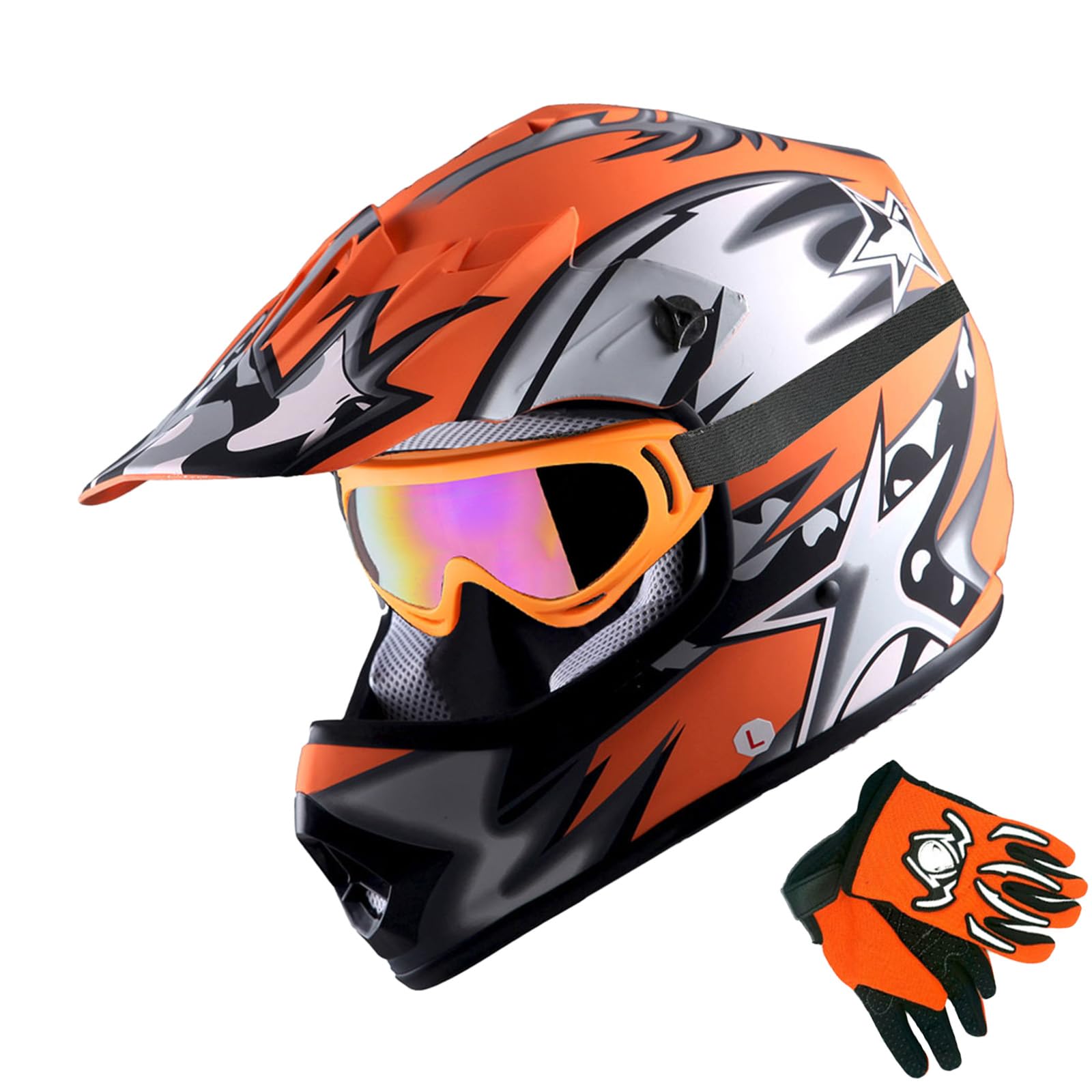
2. 1Storm Youth Motocross Helmet Matt Star Orange
Bright orange shell, matching goggles, matching gloves — one box and the outfit is done.
Colour is doing real work on this helmet. The glossy UV-protective finish in Star Orange stays vivid through sun exposure, and the matching glove and goggle set means the whole look arrives consistent. A kid who likes the look puts the gear on without a fight; one who doesn’t, doesn’t. The padded interior comes out for washing, which keeps the liner from turning sour after a dusty weekend at the track.
The size you are buying is genuinely small: the listing is a Small shell for heads at 49-50 CM (19.3 to 19.7 inches), with gloves at a 2.3-inch palm width. That is a narrow window, and it is worth checking against the measurement before you order. Certification is DOT to FMVSS 218, the federal motorcycle standard. The shell is a durable thermoplastic alloy built with an aerodynamic shape, so it cuts through wind rather than acting like a sail on faster downhill runs.
The reason this one sits high in the group is owner confidence. Quality leads the praise at 44 mentions, with fit close at 32 and value for money at 13 — a pattern that tells you the people who get the size right are happy campers. Parents describe full-face coverage keeping their kid protected on a four-wheeler, which is exactly the crash type a chin bar guards against. If the head measurement lines up, this is a complete off-road starter kit rather than a single helmet.
The bundle math: helmet, goggles and gloves land together with DOT certification, so you are not hunting down accessories separately for a first off-road season.
The narrow fit: Small covers 49-50cm only, so a bigger rider needs a different pickup in this list.
Reach for this if: your rider measures inside 49-50cm and you want the whole motocross look sorted in one order.
Look elsewhere if: the head tape lands above those numbers — step to the ILM or PZ PEZE for more sizing room.
3. PZ PEZE Youth Sport Full-Face Helmet for BMX and Off-Road

Fourteen vents and a smaller youth shell built from scratch instead of an over-padded adult lid.
Ventilation is the headline here. The aerodynamic shell carries 14 intake and exhaust ports, and a multi-density EPS liner runs cooling channels through the helmet so air actually moves instead of pooling. In summer heat, those 14 ports keep a kid from yanking the helmet off at the first water break. The chin bar gets premium EPS padding throughout for the forward impacts a BMX crash tends to produce.
Weight reads 2.1 lbs, and the outer shell is ABS plastic. Set that against the ILM at 2.4 pounds — the PZ PEZE is the lighter of the two full-face crossovers here, and that gap is what a tired neck notices late in the day. Certification is DOT to FMVSS-218, and the maker says each batch gets random quality checks. Treat that as their process claim, not a lab report you can verify.
The fit chart is the part to read twice. Youth Small runs 18-19 inches, Youth Medium 19-20, Youth Large 20-21, and Youth XL 21-22. The listing even tells you to go up a size when the measurement sits right on a boundary, which is honest advice you rarely see. It is a genuinely youth-shaped shell rather than a compromised adult helmet, and the liner pulls out for washing. Above everything, this is the one for a rider who runs hot and rides long.
Why the airflow stands out
- 14 intake and exhaust ports for real cross-helmet airflow
- 2.1 lbs — lighter than the 2.4 pound ILM crossover
- True youth shell with four sizes from YS to YXL
- Ships with goggles, gloves and a mask
What the chart warns you about
- You need an accurate head measurement — guessing across four sizes is a return risk
- DOT-only certification, so no ECE stamp alongside it
The honest verdict: the freshest airflow in this lineup, and the size chart gives you a clean path to the right shell.
Measure twice: four sizes reward precision — go a step up if your rider lands exactly on a boundary line.
4. CUTEY Kids Dirt Bike Helmet DOT Approved Full Face
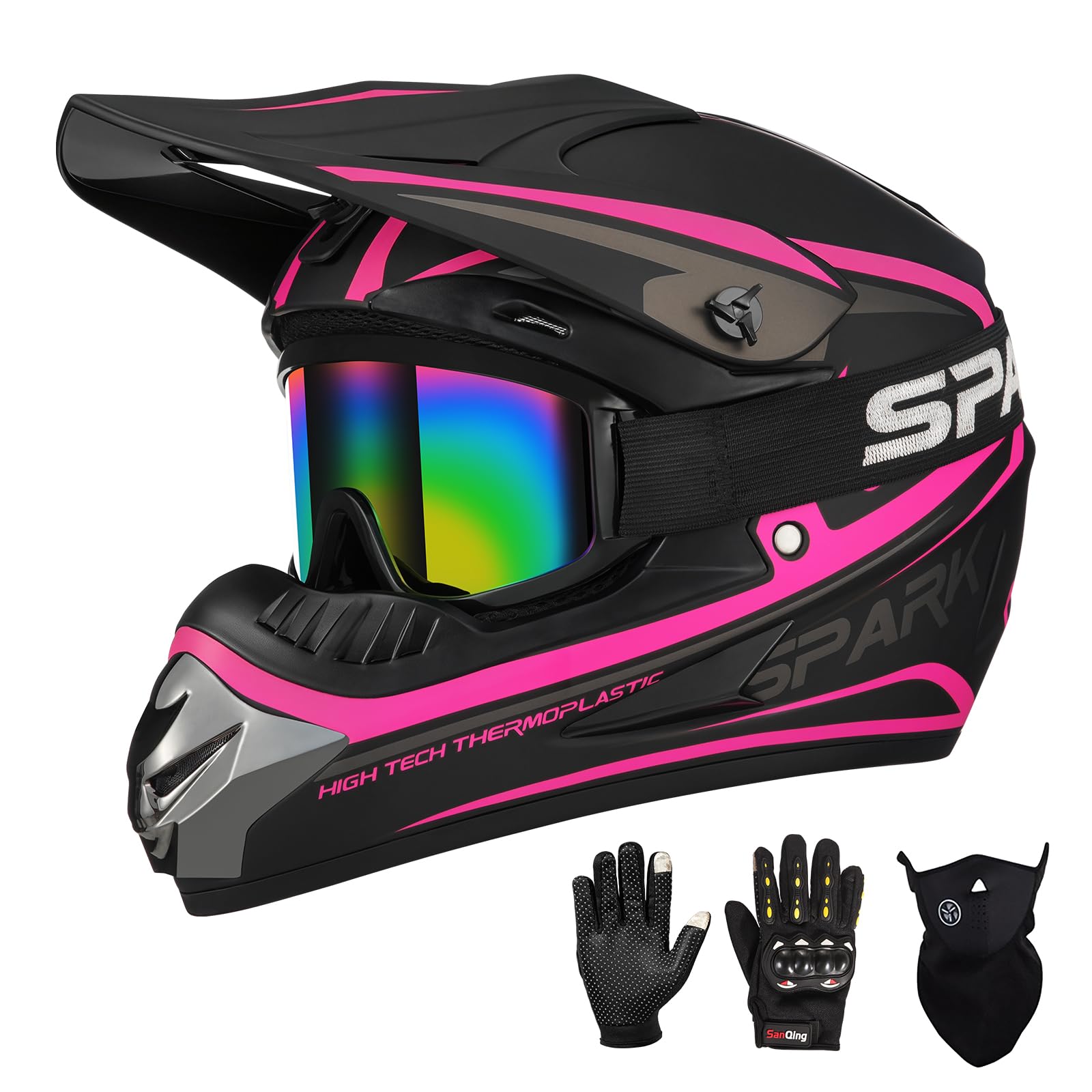
The pink full-face kit that gets a kid excited to put the helmet on without being asked.
The black-and-pink scheme gets a young rider to put the full-face on without being asked. The black and pink scheme lands with kids in a way a plain matte shell does not, and the 4-in-1 kit adds goggles, gloves and a face mask so the whole off-road outfit arrives together. The high-strength ABS shell and breathable EPS lining meet or exceed DOT and FMVSS-218 standards, so the safety side is not sacrificed for the styling.
The practical build details are child-friendly. A quick-release buckle on the adjustable chin strap lets a kid get the helmet on and off alone, and the washable lining keeps it fresh between rides. The detachable sun visor adjusts through an angle to block glare, then comes off entirely if your rider prefers a clear line of sight. Weight sits at 2.3 pounds, putting it between the 2.1 pound PZ PEZE and the 2.4 pound ILM in this lineup. Two vents handle airflow.
Fit lands well for smaller kids — parents describe a secure fit working nicely around the 5-6 year mark, and the quality of the build leads the praise at 38 mentions. The one honest caveat is sizing, which draws negative feedback and is worth taking seriously: measure the head and lean toward the larger size if your child is between two. Durability is mixed too, with the shell picking up scratches through normal use, so treat it as a rider that shows its miles.
The colour factor: a bright black-and-pink kit makes a young rider want the gear on, and the 4-in-1 bundle covers goggles, gloves and a mask in one go.
The sizing reality: fit is the weak spot — nail the measurement before ordering, because the shell itself is well made.
Best for: a smaller child, roughly in the 5-6 range, who will actually wear the helmet because the look is theirs.
Watch the chart: sizing is where feedback splits, so double-check the head tape and size up if in doubt.
5. Bell Ollie Bike and Skate Helmet for Child and Youth

At a listed 0.1 kg, this is the lid that barely registers once it’s on a head.
Weight is the whole story on the Ollie. It lists 0.1 kg against the ILM crossover’s 2.4 pounds — the lightest shell in this entire lineup by a wide margin, and the reason a kid forgets it is there during a long skate session. The ABS outer shell over an EPS liner is the classic hard-shell skate build, styled as a modern take on the classic BMX and skate shape. For park riding and pump-track laps, that lighter feel is genuinely easier to live with.
Certification is where you need to be clear-eyed. This meets the US CPSC standard for bicycle helmets for ages 5 and older, plus the ASTM standard for multi-impact skateboard helmets. That makes it a proper skate-park and bike-path helmet, not a motocross crossover. Bell lists it for youth ages 8-14 and heads measuring 54-58cm, and the listing is direct that head shapes vary even within an age range, so measure rather than guess. A loose shell slides out of position in a crash and stops protecting.
The fit feedback is the one thing to weigh honestly: sizing runs generous, and several owners found it larger than expected on the head. That is a mild nuisance rather than a flaw — you can dial it in with the right size — but it makes the 54-58cm measurement the most important number on the page. Quality and appearance carry the praise, with 10 and 5 mentions respectively. This is the everyday lid for a rider who is on bikes and skateboards, not a full-face for the dirt track.
Pick it for: a skate-park and bike-path rider who wants the lightest shell going, not a motocross crossover.
Skip the guesswork: sizing runs big, so trust the 54-58cm measurement over the age range on the box.
6. Natuway Toddler and Kids Full Face Bike Helmet for BMX
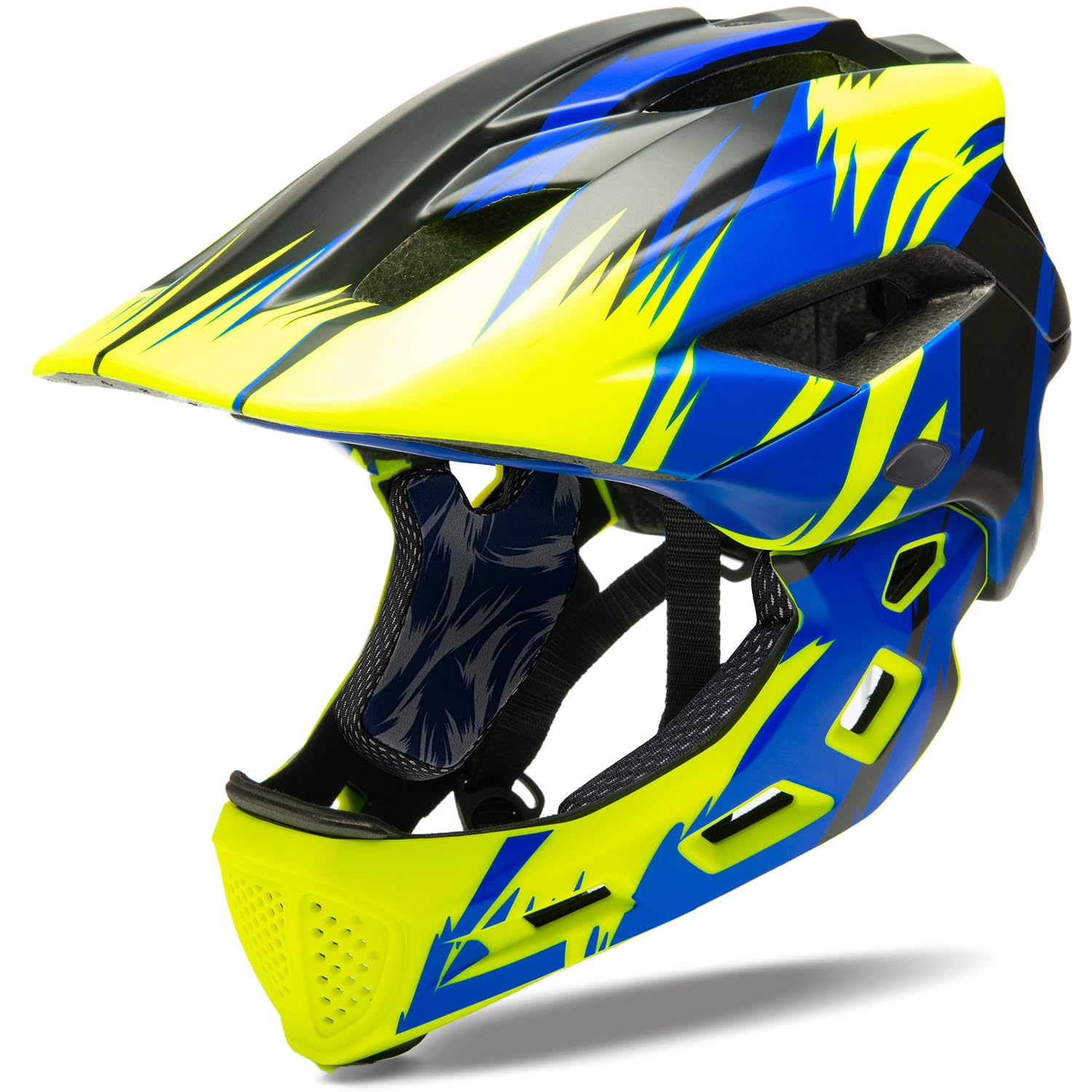
A chin bar that pops off with one click, turning a full-face into a half-shell mid-season.
Here is the idea that sets this helmet apart: the chin guard detaches with a push of two side buttons, so the full-face becomes a half-shell in seconds. That takes the helmet from about 14 oz in full mode down to about 10 oz in half mode — meaning the same helmet you send your kid out in for downhill BMX is the one they wear for a scooter lap around the block. It meets the CE and CPSC 16CFR&1203 physical testing standard and the CPSIA chemical testing standard, so both the impact and the materials side are covered.
The fit adjusts from 20.25 to 22.05 inches, roughly covering ages 3-12, and it moves vertically and horizontally through length-adjustable chin straps and a back buckle. That is a helmet that grows with a kid across several seasons instead of needing to be replaced each year. The IN MOLD construction bonds the polycarbonate shell to the high-density EPS foam for a light, shock-absorbed build, and both the soft inner padding and the extra liner set pull out for washing. Two face pads are included to cover the full face and neck.
The convertible chin bar is the dividing line in customer feedback — many love the full-face protection for a beginner on a balance bike, while the chin bar’s attachment is the trade-off some buyers notice. Quality leads the praise at 53 mentions and fit follows at 51, with lightweight and protection both drawing strong numbers. For a family whose kid is moving from a balance bike to a real bike, the ability to swap between full and half coverage makes this the most adaptable helmet here.
The growth play: a 20.25-22.05 inch adjustable range and a switchable chin bar mean one helmet stretches across years and riding styles.
The chin bar trade: the one-click switch is the feature buyers love and the one some find fiddly, so check it seats firmly each ride.
Ideal for: a rider moving up from a balance bike who needs full-face cover one day and a lighter half-shell the next.
Check the bar: seat the chin guard firmly every time — it is the one part that earns mixed feedback.
Know the Specs
Certification stamps and shell materials
DOT, ECE22.06, CPSC and ASTM are all independent safety standards a helmet has been built and tested to pass. DOT and ECE cover motorcycle and off-road single impacts and typically come with a heavier ABS shell over an EPS foam liner — ABS as the hard wall, EPS as the crushable foam that soaks up the hit. CPSC and ASTM are the bicycle and skateboard standards, and they tend to live on lighter hard-shell skate lids. A higher-weight full-face is not automatically safer for BMX; it means the shell is built to a harder impact and your kid carries more weight around their head.
Weight in pounds and ounces, and what it does to a neck
Helmet weight is a child-fit spec, not a spec-sheet flex. A rider carries the entire shell on their neck through every lap, so the difference between a listed 0.1 kg skate shell and a 2.4 pound full-face is something a kid feels within an hour. A lighter shell stays on for more laps before a kid asks to take it off. The counterweight is coverage: a full-face adds the chin bar and a heavier shell, which is why the convertible designs shave that weight down when the bar comes off.
Fit ranges in centimeters and inches
Every reliable size decision starts with a measurement around the widest part of the head, just above the eyebrows. Some helmets list a centimeter range (49-50cm on the 1Storm) and others list inches (20.25-22.05 on the Natuway, or 54-58cm on the Bell Ollie). Age ranges are only a rough guide because head sizes vary widely within the same age group. If the tape lands on a boundary, size up — several listings say this outright.
Ventilation and removable liners
Vent count and airflow matter for comfort in summer heat. The PZ PEZE runs 14 intake and exhaust ports, while the CUTEY runs 2 vents — both are legitimately different riding experiences. Removable, washable liners and cheek pads keep the sweat and dust out of the padding, and a quick-release chin buckle makes the helmet easy for a kid to handle alone. Vents and washable liners do not change the certification, but they decide whether the helmet stays on all session.
Common Questions
How do I measure my kid’s head for a youth BMX helmet?
Is a full-face BMX helmet too heavy for a child?
What is the difference between DOT and CPSC certification?
Can a full-face helmet be worn for skatepark BMX riding?
Is a convertible full-to-half helmet worth it for a growing kid?
How often should a youth BMX helmet be replaced?
Do I need goggles with a full-face BMX helmet?
Will a youth helmet fit my 14-year-old?
What is an EPS liner and why does it matter?
The Bottom Line
For most families, the youth bmx helmet that makes the most sense is the ILM Z705 — it is the only one in this group carrying both DOT and ECE22.06 certification, and it arrives as a complete kit with goggles, gloves, a mask and a bag. If your rider measures into a narrow Small shell and you want the colour-matched goggle and glove bundle, the 1Storm Star Orange is right there. And for a rider who wants the least weight on their neck, the Bell Ollie at a listed 0.1 kg is the lightest lid here, though it is a skate half-shell rather than a full-face crossover. Measure the head first, then pick the shell that matches it.
How we choose
We do not accept paid placement. Every pick is matched to a real buyer and a real use-case; we do not hands-on test units.
Sources
Specifications: manufacturer listings and product documentation. Review insights: verified customer reviews, as of November 2026. Pricing: not shown on this page (it changes often); check the current price via the retailer link.
As an Amazon Associate, Tactical Gear Guy earns from qualifying purchases. This does not affect which products we feature.