Specs are compiled from manufacturer listings and verified buyer reviews and can change over time — please confirm the key details on the product page before buying.
Most office chairs stop leaning back at a polite little tilt, which is exactly the problem when your lower back is screaming after hour six. A true zero-gravity desk chair reclines to 165° or 170° with a footrest raised, so your torso nears horizontal and your weight spreads off your lower spine. Below are six chairs that actually get you there, sorted by who each one genuinely suits.
This guide is built by comparing the manufacturers’ published specifications and the patterns across verified customer reviews, so you get each pick’s real strengths and trade-offs instead of marketing spin.
You will see how far each chair reclines, what it does with your lumbar spine, and where the honest limits sit. The point is to match a chair to your body and your workday, and this breakdown of the zero gravity desk chair covers the details that actually change how your back feels by five o’clock.
Top Picks
How To Choose The Best Zero Gravity Desk Chair
The phrase gets thrown around loosely, so start with the one number that defines it: how far the backrest actually goes. A chair that stops at 145° gives you a deep lean. One that reaches 165° or 170° drops your torso close to horizontal, the angle that unloads your lower spine instead of compressing it. Anything less is a recliner, not a zero-gravity seat.
Recline angle and the footrest that has to match it
Reclining without somewhere to put your legs just slides you forward on the seat. That is why every serious pick here pairs its recline with a footrest. Look at whether the footrest is retractable and how much surface it gives you — a small flap barely holds your heels, while a wide fold-out platform lets you actually rest your calves. The FLOW360 uses a three-fold hinge design for a larger supporting surface, and the FLEXISPOT pairs its 165° back with an extending footrest for a bed-like position.
Lumbar support: static pad or moving mechanism
A fixed foam pad pushes at one spot on your back no matter how you sit. A dynamic lumbar system moves with you as you recline, which matters once the backrest travels through a wide arc. The SIHOO uses a bionic dynamic lumbar mechanism that adapts across body shapes, and the FLOW360 tilts its lumbar support through the whole recline range. If you sit upright most of the day, a well-placed static pillow is fine; if you plan to work reclined, prioritize the moving kind.
Weight capacity, gas lift, and frame honesty
Weight capacity tells you about the frame and base, not just the seat. A chair rated to 400 lbs or 450 lbs uses heavier tubing and a sturdier star base, which means less wobble over years of daily use. The gas lift class matters too — a Class 4 lift is the sturdier tier. Check the frame material as well: metal frames hold up better than polypropylene under a heavy sitter who leans back hard.
Armrests, seat depth, and the small adjustments
Armrest adjustability sounds like a spec-sheet filler until your shoulders ache from reaching for a keyboard. Depth and height adjustment let you bring the arm close to your body and level with your desk, which takes strain off your neck and shoulders. Seat depth adjustment matters if you are tall or short — it decides whether the front edge digs into the back of your knees. These are the adjustments that quietly separate a chair you keep from one you resell.
Side-by-Side Comparison
| Model | Best For | Max Recline | Weight Capacity | Lumbar / Support | Amazon |
|---|---|---|---|---|---|
| Massage Office Chair 6-Point★ Best Overall | Big-and-tall buyers who want heat and massage | 160° | 400 lbs | Ergonomic contour, linked armrests | Amazon |
| LarkLeaves Office Chair with FootrestMost Adjustable Arms | Mesh lovers who want six-way arms | 145° | — | 2D adaptive lumbar, 3D headrest | Amazon |
| FLOW360 Ergonomic Mesh Chair | All-day sitters who want certified build | 150° | 330 lbs | Full-tilting lumbosacral system | Amazon |
| FLEXISPOT Multi-Task HC4 | Near-flat lounging between work blocks | 165° | — | Multi-use lumbar pillow | Amazon |
| COTYFLY Dual Motor Executive | Heavy users who want push-button recline | 170° | 450 lbs | Adjustable lumbar pillow, high back | Amazon |
| SIHOO Doro S300 | Buyers chasing premium coordinated support | — | — | Bionic dynamic lumbar, 6D arms | Amazon |
Detailed Reviews
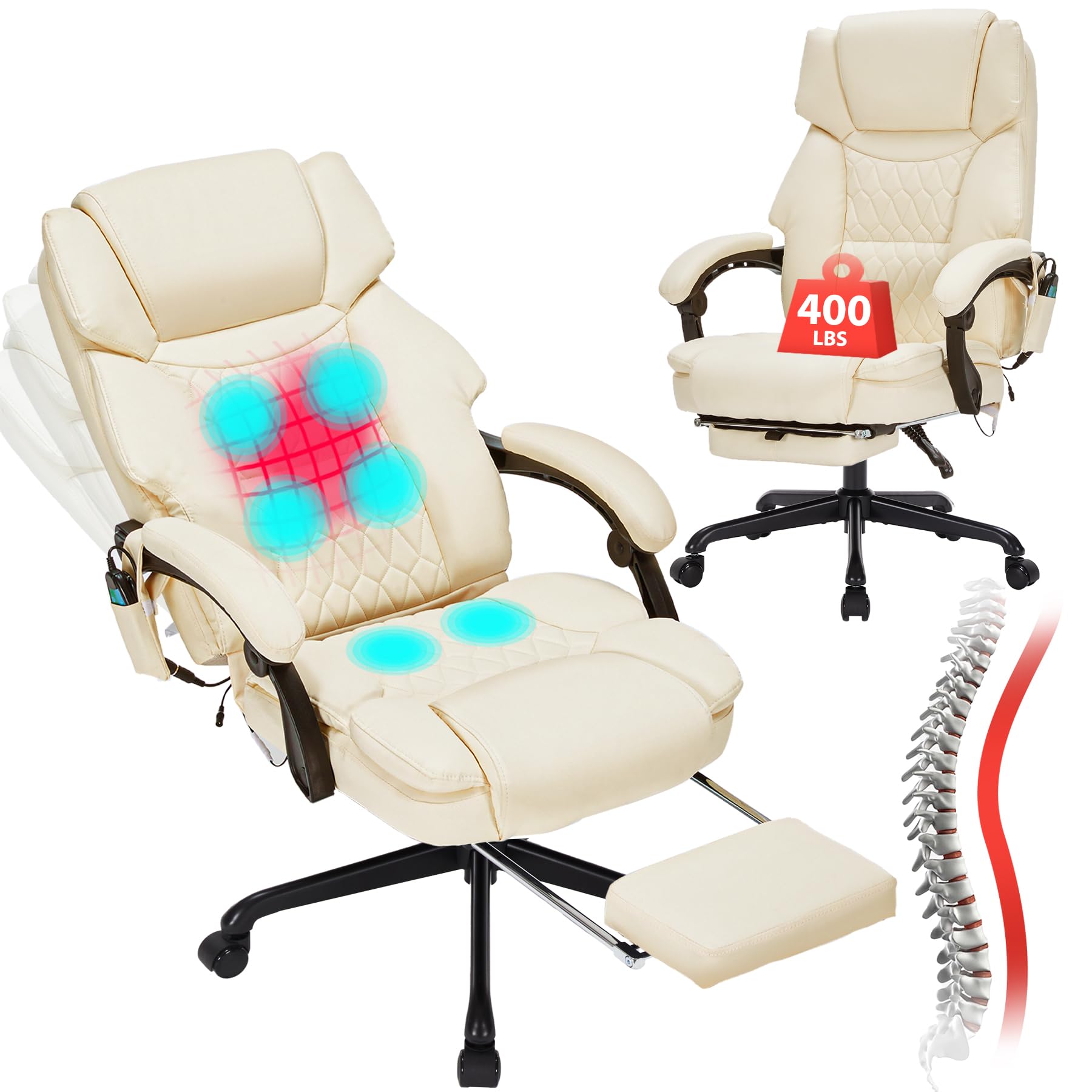
1. Massage Office Chair Foot Rest
Our pick — 4.0+★ from 700+ verified ratings; the strongest balance of quality and price.
Heat, massage, and a 400 lb frame in one recliner — and it tops this list on balance rather than gimmick alone.
Here is the chair for the person who wants the reclined rest position to do more than recline. Six vibration points run through three zones — your back, your lumbar region, and the seat — across five massage modes and two intensity levels. A back heating function holds at 120°F to soften tight muscles on a cold morning. It reclines from 90° all the way to 160°, and the footrest slides out to support your legs through that arc.
The frame side is where this one earns the top slot. The backrest is a wide 23.6 inches, giving broad shoulders somewhere to land instead of hanging over the edge. An SGS-certified gas lift handles the height, with 3” of travel, and the casters run quiet enough to slide across a wood floor without waking anyone downstairs. Assembly is designed for one person in about 15 minutes, and the linked armrests follow the backrest as it tilts, so your elbows stay supported the whole way down.
What wins people over is sheer presence — the wide seat and big frame dominate the praise, and comfort follows right behind it. The honest catch is sturdiness: the build has loyal fans and a few who found it softer than expected over time, so treat the heavy-use rating as the reason to buy and give it a careful assembly. One manufacturing note that matters: run every screw in about 60% of the way before you tighten anything down, then torque them all at the end. Do that and the frame sits square and quiet.
Where it pulls ahead
- 400 lb rated frame with a wide 23.6-inch backrest — real room for broad builds
- 6-point vibration massage across 3 zones with 5 modes and 2 intensities
- Back heating holds at 120°F to warm tight muscles during a work break
- Reclines 90° to 160° with a retractable footrest for the full rest position
The part to size up honestly
- Sturdiness divides opinion — some find it softer than the rating implies
- Assembly order matters: pre-thread every screw at 60% before final tightening
- PU leather traps more heat than a mesh back for hot rooms
Reach for this if: you carry a bigger build, want massage and heat built in, and prefer a padded leather feel over mesh.
Pass it by if: a breathable back is your priority — mesh models in this list breathe better in a warm room.
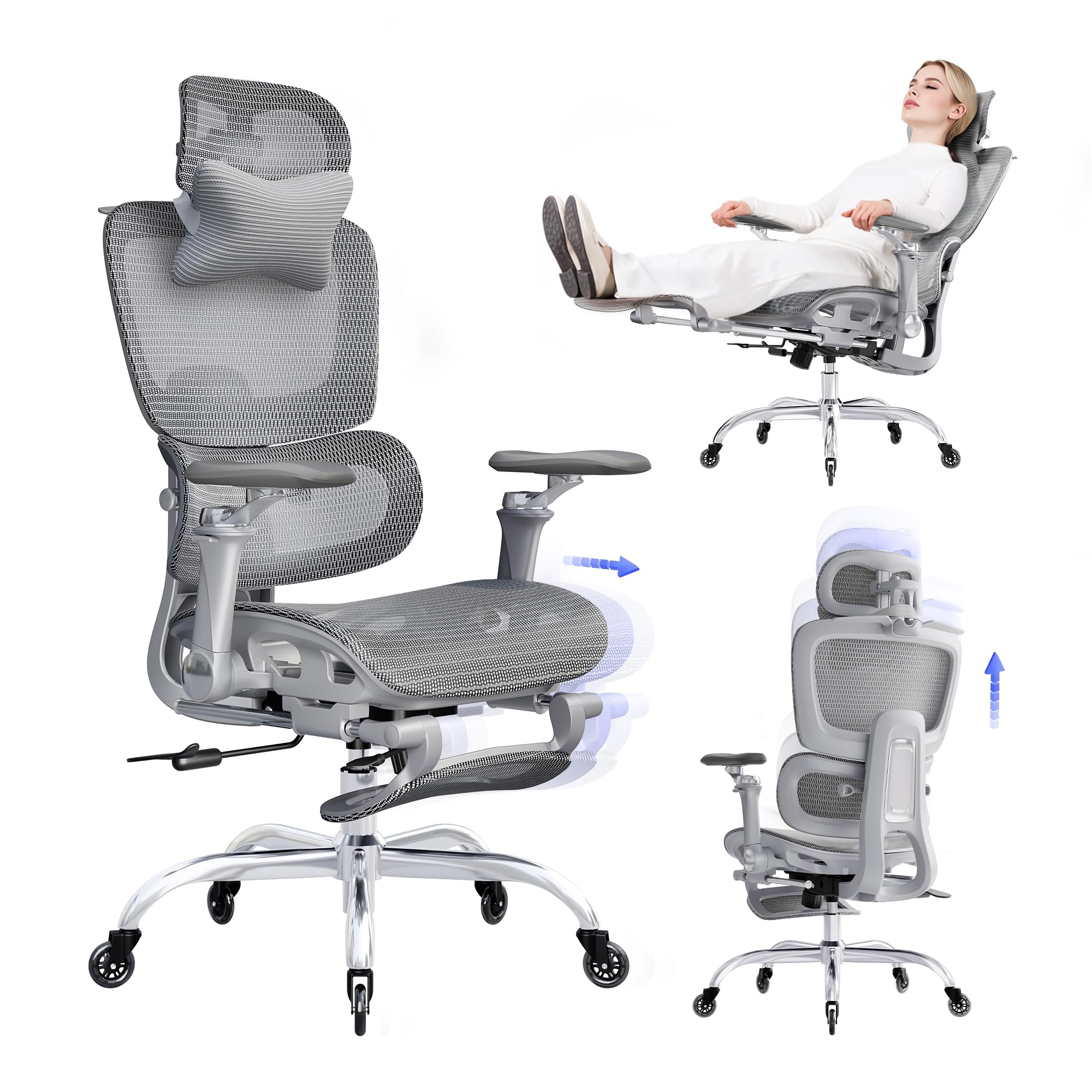
2. Office Chair Footrest 3D Headrest
Six-way armrests and a 3D headrest on a breathable mesh frame — for the sitter who tweaks every angle.
The LarkLeaves is built around adjustability as the headline. Its 6D armrests rotate on doubly pivoting pads and tilt, so you can swing them in for typing and out for reading without moving the chair. The 2D adaptive lumbar support rotates to follow the curve of your spine instead of pressing one spot, and a five-level height-adjustable backrest lets a tall user line the top edge up with their shoulders. A 3D headrest rounds it out, and there is even a coat hanger built into the back — a small detail that beats a jacket slung over the seat.
What it gives you instead is a full mesh build: headrest, back, and seat all use high-elasticity mesh that keeps air moving, which is the opposite of the leather on the top pick. The frame is polypropylene, and the rubber wheels roll quietly enough to protect hardwood from scratches and keep a shared room peaceful.
Your knees stop getting pinched, because the seat depth adjustment slides the front edge back so it sits behind them instead of digging in. That is the exact fit problem short and tall sitters report in fixed chairs. Add the five-level backrest height, and the chair fits a range of body heights instead of just one. Want a recliner that still works as a focused typing chair by day? This is the mesh answer. Just know the deepest rest position tops out at 145°.
Armrest verdict: the 6D arms are the most flexible in this list — depth, height, pivot, and width all move.
Fit note: the polypropylene frame and 145° limit mark it as a lighter-duty recliner than the metal-framed picks.
The right buy for: anyone who switches between focused typing and reclined reading all day and wants airflow.
Think twice if: you need a truly flat lounge — 145° is a lean, not a lie-down.
3. FLOW360 Ergonomic Mesh Office Chair

A patented full-tilting lumbar system that follows your spine from upright work to deep recline.
The FLOW360’s claim to fame is a patented full-tilting lumbar support that covers your lower spine, sacrum, and hips all the way from 90° upright through to a 150° recline. That is a different approach from a fixed pillow: the support travels with your back instead of staying put while you lean away. Comfort is the thing buyers talk about most, with back support right behind it, and the fit range is broad — it is engineered for sitters between 100 and 330 lbs, with a backrest 20.9 inches wide.
Your calves get real support from the footrest. A patented 3-fold hinge design opens into a platform the maker describes as three times larger than regular footrests, so you can rest your legs cross-legged or reclined. Build certifications are where this chair pulls ahead: it holds Red Dot, iF, and German Design awards, passes BIFMA X5.1 durability standards (a widely used office-chair safety and strength test), and uses a Class 4 explosion-proof gas lift — the sturdier lift tier you want under a heavy sitter who leans back hard.
Adjustability is thorough — 3D tilting headrest, upgraded 4D armrests, adjustable seat depth, and multi-level backrest height that fits users from 5′ to 6’5″. Two cushion versions exist, Mesh for breathability and Foam for a softer seat, so pick by how warm your room runs. The one honest divider is adjustability itself: it earns solid marks, but some find the range fiddly to dial in at first. And the 330 lb rating is lower than the Massage chair’s 400 lbs, so a very heavy sitter should weigh that carefully.
Back support, tested: the tilting lumbosacral system is the reason to buy — it tracks your spine through the entire recline.
The trade-off: lots of levers to learn, and a 330 lb ceiling rather than a big-and-tall rating.
Your chair if: you sit long hours and want certified build quality plus support that moves with you.
Look elsewhere if: you exceed 330 lbs — the massage chair higher up handles more weight.
4. FLEXISPOT Ergonomic Office Chair HC4
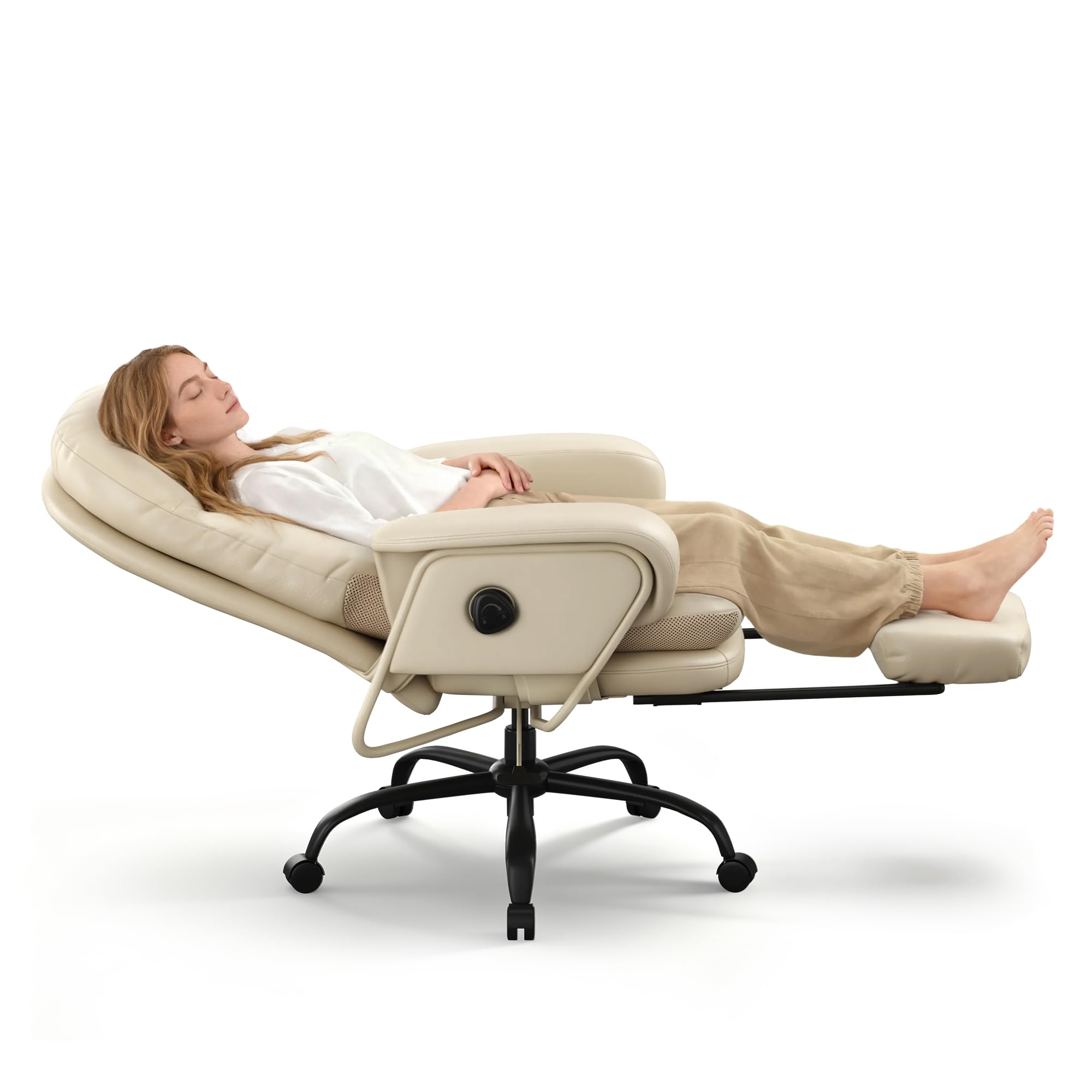
Extend the footrest, drop back to 165°, and your desk becomes a bed for twenty minutes.
If the goal is genuine near-flat lounging, the FLEXISPOT leans further than almost anything here. Four locked back angles let you choose 90°, 115°, 140°, or 165°, and the 165° setting with the footrest extended gives you a bed-like position from head to legs. That beats the LarkLeaves’ 145° by a clear margin — 165° versus 145° — because it lets your torso drop close to horizontal rather than stopping at a deep lean. Twin knobs on each side open up the backrest together, which keeps the motion controlled instead of dumping you backward.
The multi-use lumbar pillow pulls double duty: put it behind your lower back for working support, or move it up to cushion your head or neck in the reclined position. Upholstery comes in PU Leather, Cooling Air Leather, and Chenille, so you can pick for easy cleaning, breathability, or scratch resistance depending on your home. Material quality is the most-praised trait, and it arrives fully assembled — a real convenience when other chairs in this list need a screwdriver session.
The honest catch is firmness. Opinions split between those who find the seat supportive and those who want more give, so it leans toward a firmer sit — better if you like a stable, structured cushion and less so if you want plush. It also fits a specific footprint, so measure your desk gap before committing. For a chair that blends lounge comfort with work posture, the 4-angle lock and near-flat reach are the reasons it belongs in this conversation.
What makes it a lounge
- 165° recline with footrest extended for a bed-like position
- 4 lockable back angles — 90°, 115°, 140°, 165°
- Ships fully assembled, no build session needed
- Three upholstery choices including cooling air leather and chenille
What to keep in mind
- Seat firmness splits opinion — it sits on the firmer side
- Designed for indoor use in a fixed spot rather than rolling around a big office
Lean toward this if: you want the flattest rest position and don’t want to assemble anything.
Skip the flat stuff if: a plush, sink-in cushion is what your back wants.
5. COTYFLY Dual Motor Executive Office Chair
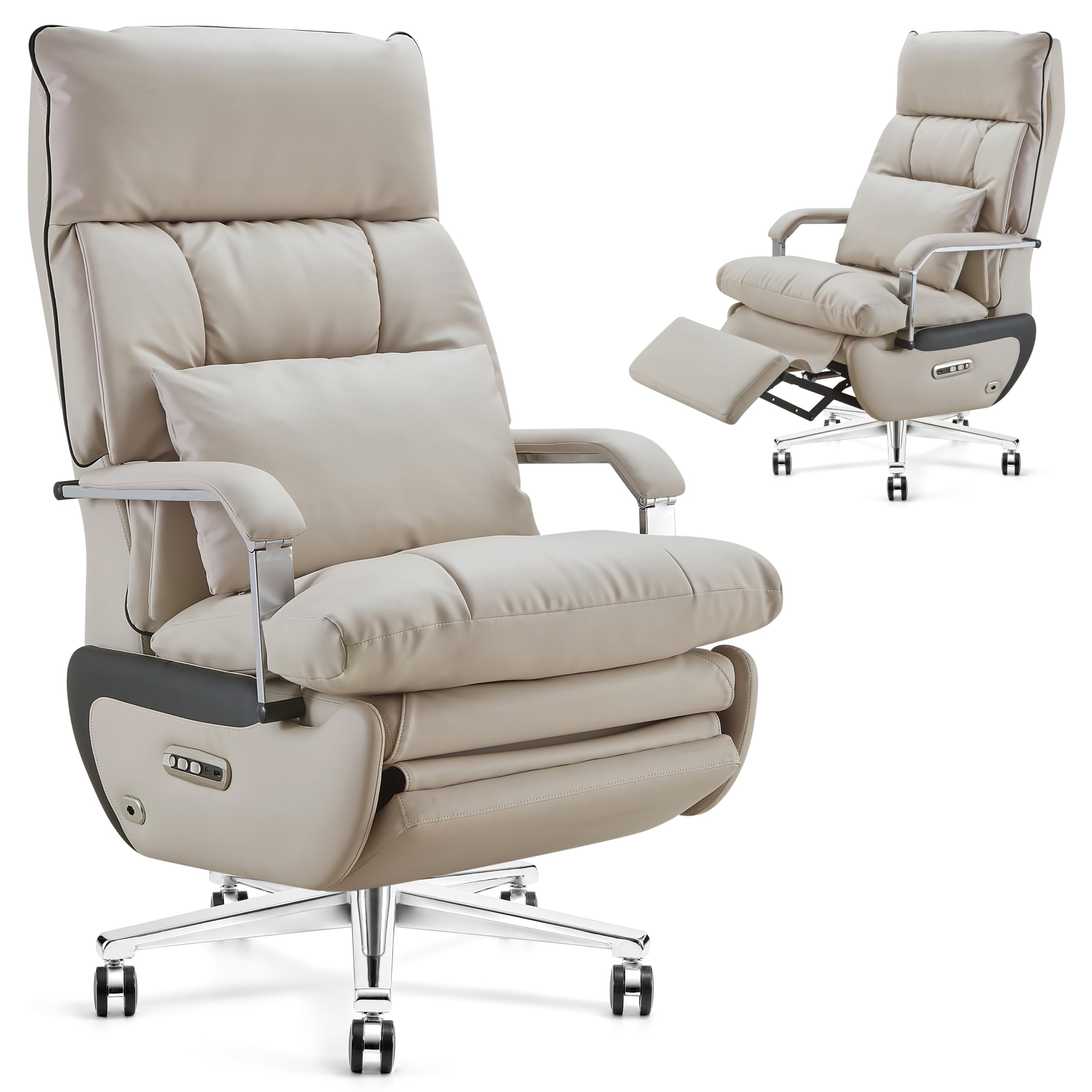
Push a button, go to 170°, and skip the lever-fumbling — a powered recline for heavy daily use.
This is the only chair here that reclines at the press of a button rather than a lever. Two independent motors carry the backrest from 90° upright to a 170° zero-gravity position and lock at any angle between, so you can drop into rest mode between calls without wrestling anything. A one-touch reset pulls the footrest and backrest back to upright in seconds, which is the feature that matters when a call comes in mid-recline.
The frame is built for larger sitters: a reinforced iron construction with a BIFMA-certified core mechanism rated to 450 lbs with zero wobble — 50 lbs above the Massage chair’s 400 lb rating. The backrest is a wide 32 inches, which tops the FLOW360’s 20.9-inch breadth by a wide margin and gives big builds real shoulder room. The extra-wide padded seat is sized for cross-legged sitting, and an adjustable lumbar pillow fills the gap between your lower back and the backrest. It is wrapped in leather, and the power system is cordless: a rechargeable 2000mAh battery runs the recliner for 300+ cycles per charge, so there is no cord trailing to a wall outlet.
Two charging ports — one USB-A and one Type-C — let you top up a phone, tablet, or earbuds straight from the seat, which turns the lounge position into a genuinely productive spot. Quality and comfort sit at the top of the praise, and sturdiness earns its own nod. The split is reclinability: some sitters want more range in the power travel than they got. If you want a hands-free zero-gravity recline built around a heavy frame, this delivers it.
Power, done right: dual motors to 170° with lock-anywhere and a one-touch reset back to work posture.
Worth knowing: the cordless 2000mAh battery is a rechargeable pack, so it needs plugging in periodically rather than wired power.
Built for: heavier users who want push-button recline and a wide, supportive leather seat.
Weigh the trade: the recline travel leaves a few wanting more, so test how deep it goes if a flat position is essential.
6. SIHOO Doro S300 Ergonomic Office Chair
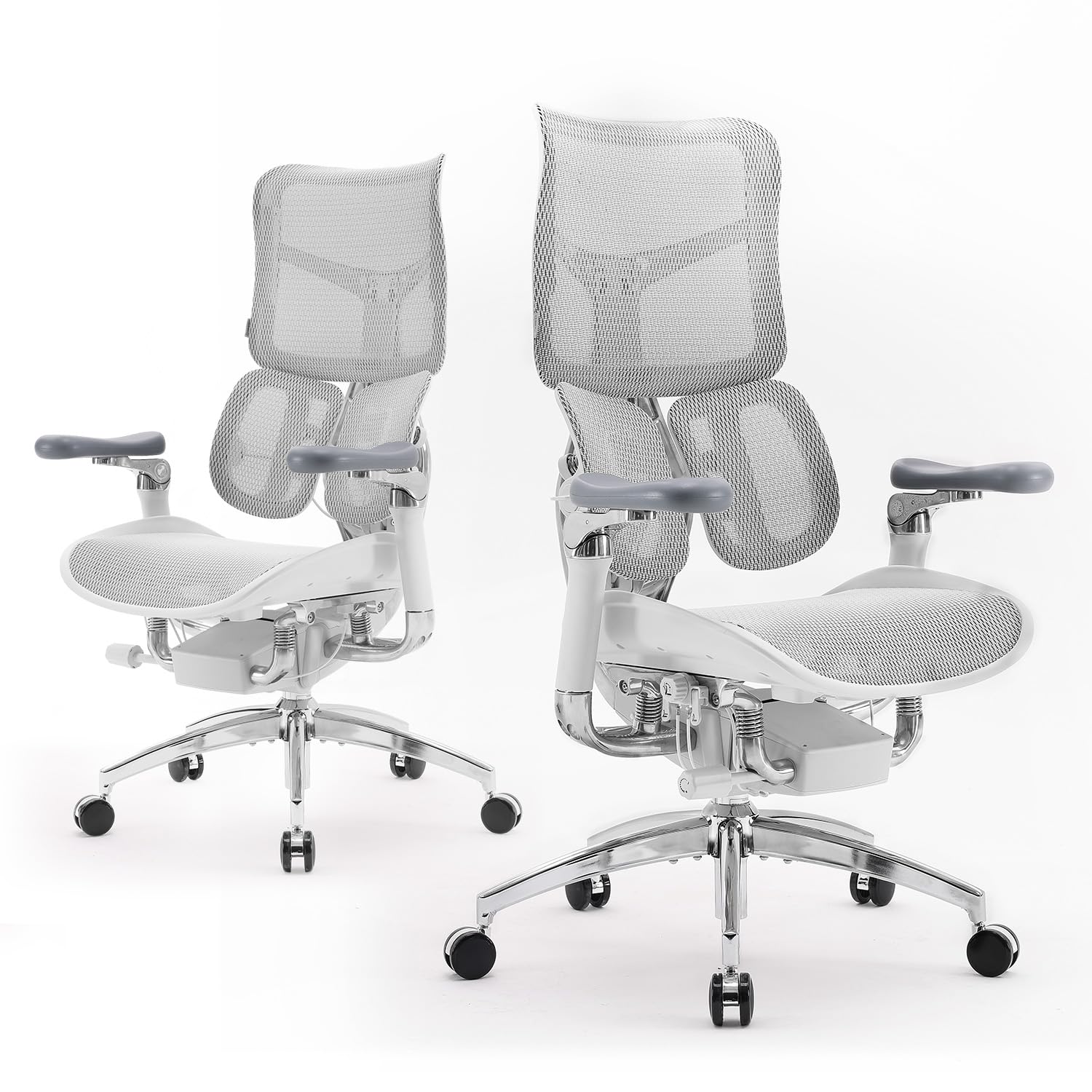
Aerospace-grade elastic plates and a 6D lumbar system — the engineering-heavy end of the category.
The SIHOO takes a different route to zero gravity than the recliners above. Rather than a lever and a footrest, it uses four-axis linkage: as you lean back, the chair captures your posture and spreads the pressure from your hips and back evenly across the seat. A set of elastic plates made of aerospace-grade material forms the mechanism, and a tension handle tunes their give to your body weight, which is how it produces its floating, near-weightless feel. A shock-absorbing suspension layer sits under the seat for a soft-ground sensation.
The lumbar system is bionic and dynamic, tracking the curve of your lower spine and adapting its shape across different body sizes rather than staying rigid. Its 6D coordinated armrests move in six directions and are the most articulated arms the maker offers, easing strain on your shoulders when you shift between tasks. A split-back design supports the upper and lower back separately, and it holds BIFMA and SGS certificates for build quality.
The catch is upfront: this is an investment-tier chair, and it leans on support engineering rather than a powered near-flat recline. If you want a true flat lounge with a footrest, the COTYFLY or FLEXISPOT serve that better. What the Doro S300 does instead is make ordinary upright sitting feel suspended, so if the bulk of your day is focused desk work rather than naps, the platform under you is the draw. Note the narrower 17.72-inch backrest — it is shaped for support, not for broad-shouldered width.
The engineering pitch: elastic-plate suspension tuned to your weight gives a floating support feel without a powered recline.
Fit check: the 17.72-inch backrest is narrower than the big-and-tall picks, and it isn’t built for a flat lounge.
Best matched to: desk workers who want suspended, adaptive support for the upright hours and value build certification.
Not your fit if: you want powered near-flat recline — this one supports working posture, not lie-down rest.
Know the Specs
Recline angle in degrees
This number decides whether a chair is a recliner or a true zero-gravity seat. A backrest that travels to 145° gives a deep lean for reading and typing. Reaching 160° to 170° drops your torso close to horizontal, taking weight off your lower spine. When you compare chairs, put the max angle next to the footrest design — the two have to work together to give you a real rest position.
Weight capacity and gas lift class
Capacity reflects the frame and base, not just the cushion. A chair rated to 400 or 450 lbs uses heavier tubing and a sturdier base, so it wobbles less over years of use. The gas lift — the gas-filled cylinder that raises and lowers the seat — has classes too, and a Class 4 lift is the sturdier tier for a heavy sitter. Check the frame material alongside: a metal frame holds up better than a plastic one under a hard leaner.
Lumbar support: static versus dynamic
Static support is a fixed pad that presses one spot. Dynamic support moves with your back as the chair reclines, covering more of your lower spine through the whole arc. If you sit upright all day, a good static pillow is enough. If you plan to work and rest in a reclined position, prioritize a system that tilts or adapts, because a fixed pad stops helping the moment you lean away from it.
Footrest size and type
The footrest keeps you from sliding forward when you lean back. A small flap only holds your heels; a wider fold-out platform lets you rest your calves in a cross-legged or reclined pose. Look at whether it retracts so it is out of the way when you are upright, and how much surface it gives you. On powered and near-flat chairs, the footrest is what turns a lean into a lie-down.
Armrest adjustability dimensions
More adjustment axes means you can bring your arms close to your body and level with your keyboard, which takes strain off your neck and shoulders. Depth, height, pivot, and width are the four that matter most. Six-way arms add rotation and tilt on top. For an all-day desk chair, armrest fit often determines whether your shoulders ache by evening.
Mesh versus PU leather
Mesh lets air move across your back and seat, so it stays cooler over long sittings. PU leather gives a padded, plush feel and wipes clean easily, but it traps more heat in a warm room. Which you pick depends on your climate and preferences: a breathable mesh build for a hot office, a leather build for a cooler room and a soft landing.
Common Questions
What actually makes a desk chair zero gravity?
Do I need a footrest for a reclining office chair?
How much weight can these zero gravity chairs hold?
Is a dynamic lumbar system better than a lumbar pillow?
Which is easier to live with, mesh or leather?
Can a powered recliner work without being plugged in constantly?
Do these chairs fit tall and heavy users?
How long does assembly take?
Can I sit cross-legged in a zero gravity chair?
The Bottom Line
For most buyers, the best zero gravity desk chair is the Massage Office Chair with Foot Rest 6 Points Vibration and Heat. It holds a 400 lb frame and a wide 23.6-inch backrest, reclines from 90° to 160°, and adds built-in massage and 120°F heat at a mid-range price. If a breathable mesh back and six-way armrests matter more to you, the LarkLeaves adjusts to more body heights. Want the flattest rest position? The FLEXISPOT hits 165° and arrives assembled. And a heavy user who wants push-button recline should look at the COTYFLY, which goes to 170° at 450 lbs with a cordless 2000mAh power pack (a rechargeable battery, so no cord to trip on). Match the angle, the weight rating, and the frame to your body — that is how you choose right.
How we choose
We do not accept paid placement. Every pick is matched to a real buyer and a real use-case; we do not hands-on test units.
Sources
Specifications: manufacturer listings and product documentation. Review insights: verified customer reviews, as of November 2026. Pricing: not shown on this page (it changes often); check the current price via the retailer link.
As an Amazon Associate, Tactical Gear Guy earns from qualifying purchases. This does not affect which products we feature.