Specs are compiled from manufacturer listings and verified buyer reviews and can change over time — please confirm the key details on the product page before buying.
A youth softball mitt has one job above all others: your daughter has to close it herself, on the first try, without fighting the leather. If she can squeeze it shut, she catches the ball; if she can’t, she flinches and the ball ends up on the dirt. That single squeeze is the first thing to check before anything else on the label.
This guide is built by comparing the manufacturers’ published specifications and the patterns across verified customer reviews, so you get each pick’s real strengths and trade-offs instead of marketing spin.
Below you’ll find eight youth gloves sorted by what they actually do well, from budget-friendly starters to premium leather built for travel ball. Every pick here is sized and patterned for a young fastpitch player, and the comparison below shows you how to choose the Best Youth Softball Mitts for your player without guessing.
Top Picks


How To Choose The Best Youth Softball Mitts
The mistake most parents make is buying a glove that looks right on the shelf but fights their kid’s hand for a month. A young player with weak grip strength and a stiff, adult-cut mitt will start catching with two hands out of desperation, and that habit is hard to unlearn. Choose for the squeeze first; size, web, and leather come after.
Start With Hand Orientation, Not Color
Get this wrong and the glove is unusable. A right-hand thrower wears the glove on the left hand; a left-hand thrower wears it on the right. Most listings spell this out directly, so read that line before you fall for a colorway. Get it wrong and the glove is unusable, no matter how well it fits.
Match the Break-In Level to Your Player’s Experience
A “ready-to-play” glove arrives mostly broken in from the factory and can be used in a game almost immediately, which is what you want for a first or second season. A “soft” glove is even more pliable from the start. A “stiff” glove holds its shape longer and gives a more solid pocket, but it needs real work — catch after catch — before a small hand can close it with confidence.
Know the Difference Between Fastpitch and Baseball Cuts
A fastpitch glove is built around a narrower hand opening and a pocket designed for a larger softball, so a young girl’s hand sits deeper and more secure inside it. A baseball glove on the same hand tends to feel loose and turns the pocket into a scoop rather than a trap. For a softball player, buy the fastpitch or youth softball pattern.
Size the Glove to Age and Position
Smaller gloves around 10 inches suit the youngest infielders because a shorter glove is easier to control and quicker to move. Larger patterns push toward the outfield, where extra reach helps track fly balls. If your player is still figuring out where she likes to play, a mid-size utility pattern is the safer choice than locking into one extreme.
Side-by-Side Comparison
| Model | Best For | Break-In Level | Glove Type | Web Pattern | Amazon |
|---|---|---|---|---|---|
| Rawlings Renegade Youth★ Best Overall | Catcher and first-base duty | Ready-to-Play (90% factory) | Catcher | 1-Piece Solid Web | Amazon |
| Franklin Field Master FastpitchBudget Champion | Budget-friendly first fastpitch glove | Ready-to-Play | Infield | — | Amazon |
| Rawlings Sure Catch YouthMost Forgiving | Beginners age 4 to 11 | Ready-to-Play | Baseball | Basket | Amazon |
| Easton Ghost Flex Youth | Entry-level infielders | Ready-to-Play | Tee Ball | H-Web (arched) | Amazon |
| Mizuno Prospect Finch Youth | Small hands that need easy closure | Soft | Softball | Modified Trapeze | Amazon |
| Mizuno 12.5″ Tartan Flex | Players age 10 to 12 | Stiff | Softball | Tartan Flex | Amazon |
| Mizuno MVP Prime Fastpitch | Serious travel-ball players | Stiff | Fastpitch | Trident | Amazon |
| Rawlings R9 Fastpitch | Youth contour fit in premium leather | Ready-to-Play | Utility | H-Web (Pro) | Amazon |
Detailed Reviews
1. Rawlings Renegade Youth Catcher’s Mitt
Our pick — 4.5+★ from 900+ verified ratings; the strongest balance of quality and price.
A catcher’s mitt that shows up already 90 percent broken in, so a young backstop can squat behind the plate on day one.
If your player has decided catcher is her position, this glove takes the hardest part of the learning curve off her hands. Rawlings builds it 90 percent broken in at the factory and leaves the remaining 10 percent to the player, so the leather is soft enough to squeeze but still molds around her hand over the first few weeks. It arrives at 16 ounces, squarely in the range you would expect for a padded catcher’s mitt at this level.
The protection is the real story for a young catcher taking pitches. A cushioned palm and padded index finger pads sit where the ball actually lands, so a hard-thrown fastball stings less through the leather. The palm is a leather shell rather than a synthetic, which is what holds the pocket’s shape through a full season of squatting and standing back up. That shape retention is the difference between a mitt that still presents a clean target in the last game and one that has gone floppy by midseason.
This pick earns the top spot on balance: price, protection, and instant usability. It is also the heaviest glove in this lineup at 16 ounces, versus 14.4 ounces for the Franklin Field Master below, and that 16-ounce figure reflects the extra padding a catcher’s position demands. Think twice if your player is still bouncing between positions, because a dedicated catcher’s mitt is a one-job tool.
What earns it the top spot
- Arrives 90 percent broken in at the factory with the last 10 percent left to the player
- Cushioned palm and padded index finger pads soften the sting of hard pitches
- Leather shell palm holds the pocket’s shape through a long season
- Built specifically for right-hand throwers, worn on the left hand
Where it asks a little care
- At 16 ounces it is the heaviest glove here, which a smaller frame may notice
- A dedicated catcher’s mitt is not a good fit for a utility player still trying positions
- Lace wear shows up on some units as the seasons stack up, so check the web knots now and then
Locked-in backstop: Buy this the moment your daughter calls herself a catcher — the padded palm and factory break-in make the position easier to learn.
Think twice if: She is still auditioning positions across the infield, because this is a single-purpose glove.
2. Franklin Sports Field Master Fastpitch Glove
The glove that proves you can get a proper fastpitch cut without paying for it in either money or break-in time.
Franklin designed this one around a narrower hand opening, which is exactly the detail that separates a fastpitch glove from a baseball glove. A young girl’s hand sits deeper and more stable inside that tighter entry point, and the adjustable wrist strap lets her cinch it down further as she grows into it. At 14.4 ounces it is the lightest glove in this comparison, and that matters for a player still building arm and wrist strength — a lighter glove is easier to control and less tiring over a doubleheader.
The material is a thick synthetic leather built to mimic real leather’s feel without the long break-in period. That is the honest trade-off: you get a hand-formed pocket and a responsive feel right away, but synthetic will not mold and darken the way full-grain leather does over years. For a first or second season, that trade is sensible, because the player likely outgrows the glove before the material matters.
What wins people over here is the value — a fastpitch-specific cut, an adjustable strap, and a ready-to-play pocket at a friendly price. The recurring note is on break-in and fit: some find it softens quickly, while others say it takes more work and runs a little small. If your player is between sizes or has larger hands for her age, size up and let the wrist strap handle the rest.
The strongest argument: a true fastpitch pattern at the entry-level tier, with the adjustable wrist strap doing real work for a growing hand.
The honest catch: synthetic leather will not age into a custom-molded pocket the way full-grain does, and the fit leans toward smaller hands.
Reach for this if: you want a lightweight, fastpitch-cut starter glove without stretching the budget.
Look elsewhere if: your player is already in travel ball and wants leather that will mold to her hand over multiple seasons.
3. Rawlings Sure Catch Youth Softball Glove
Built for the four-to-eleven crowd: a basket web and soft shell that close on the very first squeeze.
Rawlings aimed this glove at the youngest players on the field, and the Sure-Catch technology is the reason it works. The glove is designed to close as soon as a kid puts it on for the first time, which removes the frustrating month of fighting stiff leather that turns beginners off the sport. The basket web pattern is the most forgiving web shape for a learning player, because it forms a deep scoop that gathers a grounder rather than requiring a precise catch.
The build is an all-leather shell with padded finger linings, and the shell is soft rather than rock-stiff, which fits the beginner brief. The padded linings do double duty: they add comfort for a hand still getting used to the feel of a catch, and they help hold the shape as small hands work the glove. Catching ability tends to click faster with a glove like this because the player trusts the pocket and stops flinching.
What players and parents respond to most is the fit across a wide age span — the glove manages to work for a small first-grader and still suit a twelve-year-old. The soft shell is the source of that flexibility and also the one thing to watch: a soft glove will not hold a stiff, pro-style pocket forever. But for a first glove, that is the right compromise, not the wrong one.
Why beginners take to it: the Sure-Catch design gets the glove closing on the first try, and the basket web gives a wide, forgiving pocket for grounders.
Fair warning: the soft shell that makes it easy to close will not stay firm like a stiff leather mitt, so it is a starter glove, not a forever glove.
Built for first steps: the right call for a four-to-eleven-year-old picking up softball and needing a glove that cooperates immediately.
Step up instead if: she is already a confident fielder who wants a firmer pocket that holds its shape against harder swings.
4. Easton Ghost Flex Youth Softball Glove

The 10-inch youth fastpitch pattern with a flex notch that makes closing feel natural on the very first catch.
Easton built this glove specifically for the entry-level female athlete, and the 10-inch size tells you the intended position: infield. A shorter glove is quicker to maneuver for a young player learning to field grounders and turn double plays, and it keeps the pocket close to the body where the eyes track the ball easily. The design combines soft genuine pigskin leather with an embossed Hyperlite synthetic, which keeps the overall glove lightweight and easy to control.
The Flex Notch Closure System is the standout engineering detail. It is a hinge built into the glove that lets the leather fold shut along a designed crease, so a beginner does not have to force an unnatural bend. Pair that with the Lock Down adjustable wrist strap and the glove stays put on a growing hand. There is real value in a glove that arrives with a first-game feel, because a young player who catches successfully early stays in the sport.
Where this one leads the mid-pack is the combination of a soft, easy break-in and a firmer, more supportive feel than the very softest budget synthetics — the pigskin holds up while the synthetic keeps the weight down. The genuine excitement factor matters too: this is the kind of glove a young player reaches for because it looks and feels like real gear. Best if your player is a smaller infielder with a few seasons still ahead of her.
Why it climbs the list
- Flex Notch Closure System makes the glove easy to squeeze shut for a beginner
- Lightweight blend of pigskin leather and Hyperlite synthetic keeps control easy
- Lock Down wrist strap adjusts for a secure fit as the hand grows
- 10-inch arched H-Web suits an infielder who needs quick hands
The fine print
- The 10-inch size and H-web lean infield, so an outfielder may want more reach
- The blend construction will not develop a full-grain leather pocket over years
The infielder’s answer: a 10-inch fastpitch pattern with a flex hinge that lets a young player close it naturally from day one.
Bypass this if: your daughter plays the outfield or first base, where a longer grab-and-reach pattern makes more sense.
5. Mizuno Prospect Finch Youth Softball Glove
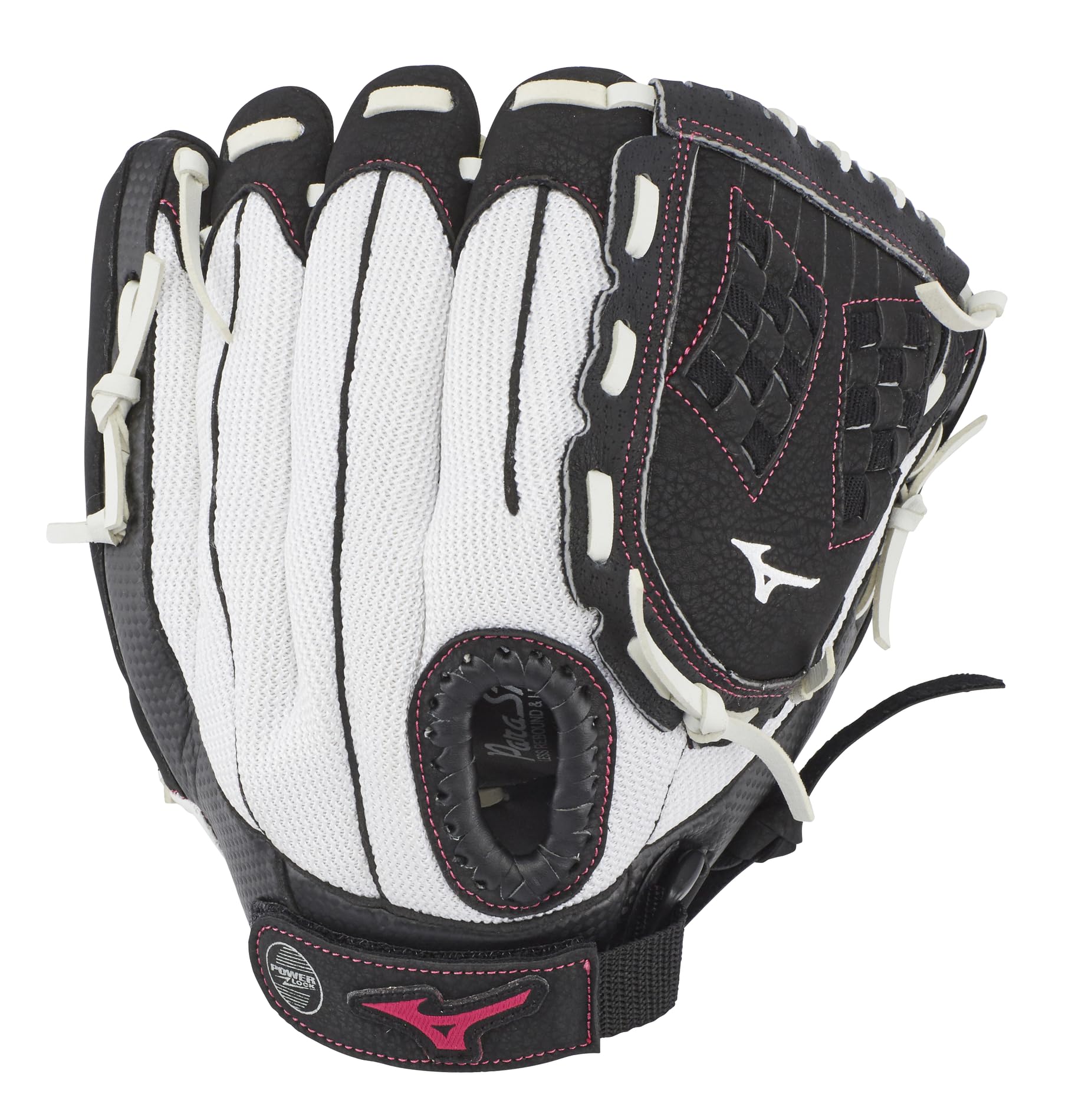
An 11-inch youth softball glove with butter-soft leather and an air mesh back, tuned for the smallest hands on the field.
Mizuno built the Prospect Finch around feedback from Jennie Finch, and the design reflects a player who needs a glove that closes without a struggle. A full-grain leather palm gives the durability, while the pigskin back and air mesh rear panel cut weight and add breathability. The result is a glove that opens and closes with a smooth amount of effort — not so stiff that a small hand can’t work it, not so floppy that it loses the pocket.
The PU (polyurethane, a synthetic leather) palm liner earns its keep: it keeps the inside of the glove comfortable and durable through repeated catches, so the feel stays consistent whether the player has been on the field for ten minutes or two hours. The modified trapeze web (a web shaped like a long triangle) adds flexibility along the closing axis, giving a young catcher and infielder plenty of pocket to work with. This is the glove for the player just getting comfortable with the sport — the entry-level softball athlete who needs confidence more than flash.
The honest trade-off is durability in the strings. Some players have had strings break after a couple of months of use, particularly with heavy practice reps, so it pays to treat the lacing kindly. The softness that makes the glove so welcoming is also a little less forgiving under hard, repeated contact. For a beginner or a player fitting a smaller hand, though, the easy closure more than earns its price.
The small-hand secret: butter-soft leather and air mesh make this the easiest glove to close on a compact hand, while the PU liner keeps the fit comfortable.
The fair caveat: string durability has been mixed with heavy use, so check the laces and re-tie as needed.
Made for smaller hands: the Prospect Finch suits the beginner infielder or young catcher who needs a glove that closes without effort.
Four seasons in: if your player is already putting heavy reps on a glove, the potential string wear may motivate you to look for something with tougher lacing.
6. Mizuno 12.5″ Ball Glove, Tartan Flex Web

A 12.5-inch fastpitch pattern engineered for the ages-ten-to-twelve player who is ready for stiffer, more supportive leather.
The first thing to understand about this glove is the break-in level: it is stiff, and the leather starts firm. That is not a flaw, it is a deliberate choice. Full-grain leather that arrives stiff will mold into a personal pocket over the first season and then hold the shape far longer than softer leather. For a player moving up from an entry-level glove, this is the natural next step — the moment when she starts to appreciate a firm, structured pocket instead of relying on softness to close it.
Mizuno’s engineering shows in the details: a thumb cut adds a hinge in the thumb area to increase flexibility and make closing easier, and a Less 2 Lacing design removes the last two lace loops on the web to add flex along the closing axis. The PU (polyurethane, a synthetic leather) power lock strap gives a simple, secure fit, and the Mzo lining wicks moisture away so the hand stays comfortable on a hot day. A Parashock palm pad absorbs the impact of repeated catches, which adds cushioning for a player fielding hard-hit balls.
This is the pick for a player who has already figured out that she loves the sport and is ready to upgrade to leather that will carry her through multiple seasons. The catch: it will not be game-ready in a week the way the ready-to-play gloves are. Give it real break-in time — glove oil, a ball in the pocket, a few catching sessions — and it will reward the effort. Best for a committed ten-to-twelve-year-old rather than a first-timer.
Built to last the seasons: full-grain leather that starts stiff and molds to the player’s hand, with a Parashock palm pad for hard catches and an Mzo liner that keeps the hand dry.
The catch: stiff from the box means it needs genuine break-in work before game day, which a first-year player may not want to invest.
The upgrade route: pick this when your ten-to-twelve-year-old is committed to fastpitch and ready for leather that holds its shape for multiple seasons.
Not for the impatient: a first-year player wanting immediate game readiness should choose a soft or ready-to-play glove instead.
7. Mizuno MVP Prime Fastpitch Softball Glove 12.5″

Professional-level lace and Bio Soft Leather in a 12.5-inch fastpitch pattern, for the player who has outgrown starter gear.
Start with the material, because that is what you’re paying for. Bio Soft Leather is a smooth professional-style hide with a balanced mix of oil and softness, giving a firm, controlled feel that serious players look for. The lace is the same durable material Mizuno puts in its professional-level gloves, so the strings that close the web are built to survive hard reps. For a player moving into travel-ball competition, those two details are the difference between a glove that lasts the season and one that needs re-lacing by midyear.
The center-pocket design places the pocket under the index finger, which creates the most versatile break-in — the glove naturally forms a pocket in the middle, so the player can work it to her style without it skewing one way. The Parashock plus palm pad adds impact absorption for less sting on hard catches, which matters when she is receiving pitches at speed. And the gender-engineered build means the hand opening and proportions are tuned for a female athlete rather than adapted from a men’s pattern.
The caveat is the break-in. It is rated stiff, and stiff professional-grade leather will ask for genuine work before it feels game-ready. That is the point of the stiff rating — the payoff is a glove that holds its structure through seasons, not weeks. This is the serious-player pick in this group, and for a young athlete who has settled into her position and wants gear that matches her commitment, the durability pays back over time.
Where the money goes
- Professional-level lace built to handle hard practice reps
- Bio Soft Leather gives a smooth, firm, controlled feel
- Center-pocket pattern breaks in evenly and works to the player’s preference
- Parashock plus palm pad reduces sting on hard catches
What it demands of you
- Stiff break-in requires real effort before it feels game-ready
- A serious glove for a serious player — overkill for a first-season beginner
Built for the committed player: this is the glove for a young athlete who wants professional-level lace and leather that will hold shape through a demanding travel season.
Hold off if: your player is in her first or second season and would rather have a glove she can use this week.
8. Rawlings R9 Fastpitch Softball Glove
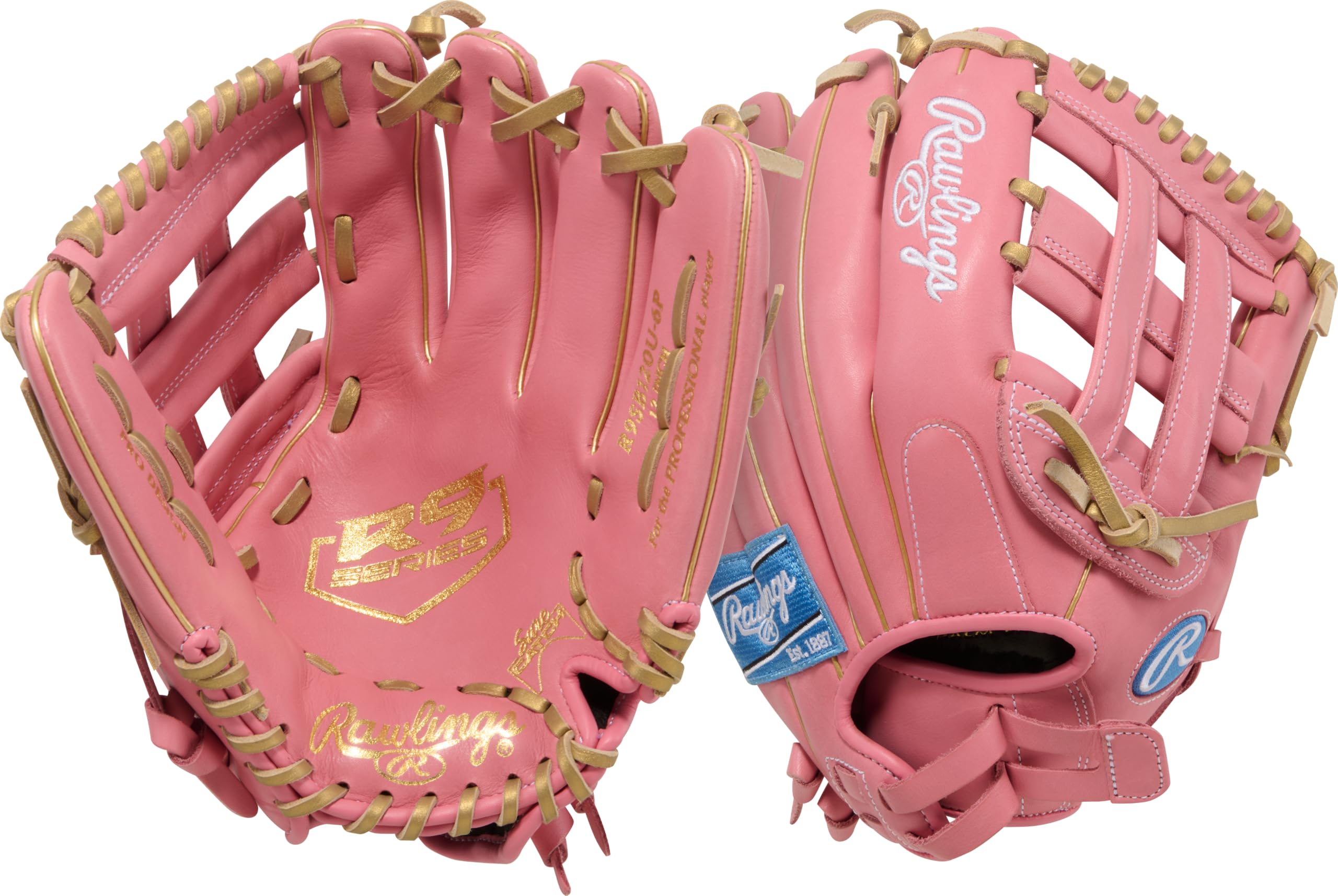
Premium full-grain leather with a youth contour fit — a narrower opening and adjustable pull-straps built around smaller hands.
The R9 is what happens when a premium glove is designed on purpose for a young player instead of shrunk down from an adult pattern. Rawlings builds it with a youth contour fit: a narrower hand opening and enhanced proportions that give a smaller hand more control inside the glove. The full-grain leather shell is the premium construction here, chosen for season-long durability and a dependable feel at every catch.
The fit system is where this glove separates itself. Adjustable pull-strap closures let the player fine-tune the tightness around her hand, so the glove stays locked on during a swing-and-miss reaction or a diving play. A leather-cushioned palm pad adds impact protection to cut sting and improve comfort on hard catches. And it carries a ready-to-play break-in level, so the premium leather does not arrive as a brick — the glove can get onto the field quickly.
That combination of premium full-grain leather and an easy break-in is unusual in this group, and it is what justifies the premium-tier placement. At 16 ounces it has real presence on the hand, which a smaller player will notice, and the 12-inch H-web pattern is a utility shape that plays across infield and outfield. The honest note: a few players have found the break-in takes real time despite the ready-to-play rating, and a handful have felt some palm discomfort early on. Give it a break-in period and most of that settles.
The premium argument: full-grain leather and a youth contour fit with adjustable pull-straps, combining durable construction with a fit that stays locked to the hand.
What to plan for: the 16-ounce weight and some early palm discomfort mean it is not the lightest or gentlest first glove for a very small player.
The premium fit play: ideal for the young player whose parents want a full-grain glove with a genuinely adjustable, small-hand-specific fit from day one.
Weigh the weight: a smaller or younger player may find the 16-ounce build too much glove at first.
Know the Specs
Break-In Level: Ready-to-Play, Soft, and Stiff
Break-in level tells you how much work a glove needs before it is game-ready. A “ready-to-play” glove arrives mostly broken in from the factory, so a young player can use it in a game almost immediately. A “soft” glove is even more pliable from the start, which is why it suits beginners who are still building grip strength. A “stiff” glove starts firm and molds over time into a personal pocket — the payoff is a glove that holds its shape far longer, but it takes real catching sessions and often some glove oil to get there. For a first or second season, ready-to-play or soft is the safer choice; for a committed player with multiple seasons ahead, stiff leather often pays back.
Fastpitch Pattern vs. Baseball Pattern
A fastpitch glove is built around a narrower hand opening and a pocket sized for a larger softball. That narrower entry point keeps a young girl’s hand deeper and more secure, which improves control on the catch. A baseball pattern on the same hand tends to feel loose and lets the pocket scoop rather than trap. If your player is throwing a softball, buy the fastpitch or youth softball pattern — the label on the listing tells you directly. The web type (basket, H-web, trapeze) affects how easily the glove closes and how much pocket it gives.
Common Questions
How do I know if my daughter needs a left-hand throw or right-hand throw glove?
What size softball glove should a 10-year-old girl wear?
Do youth softball gloves come ready to use from the start?
Is a fastpitch glove different from a regular baseball glove?
How long does a youth softball glove take to break in?
What is the difference between a basket web and an H-web?
Can a youth softball glove be adjusted as my daughter’s hand grows?
Should I buy a catcher’s mitt for a player who is just learning the position?
Will a heavier glove slow down a young player?
The Bottom Line
For most players, the strongest youth softball mitts pick in this group is the Rawlings Renegade, because it arrives 90 percent factory broken in with cushioned palm and finger padding — the right balance of instant usability and real protection for a young catcher taking hard pitches. If your player is an infielder who needs a glove that closes from day one, the Easton Ghost Flex earns the call with its flex hinge and 10-inch fastpitch pattern. And for a committed travel-ball player ready for premium leather and professional-level lace, the Mizuno MVP Prime Fastpitch is the glove that holds its shape through a demanding season.
How we choose
We do not accept paid placement. Every pick is matched to a real buyer and a real use-case; we do not hands-on test units.
Sources
Specifications: manufacturer listings and product documentation. Review insights: verified customer reviews, as of November 2026. Pricing: not shown on this page (it changes often); check the current price via the retailer link.
As an Amazon Associate, Tactical Gear Guy earns from qualifying purchases. This does not affect which products we feature.