Specs are compiled from manufacturer listings and verified buyer reviews and can change over time — please confirm the key details on the product page before buying.
Buy the rack before the plates, and buy the dumbbells before the bench. That order matters more than any brand name in a home gym, because a shaky squat rack or a pair of fixed dumbbells that eats half your floor space is what makes people stop training. This list covers eleven pieces that each solve a specific space-or-safety problem, from a dial-adjustable dumbbell set to a power cage rated for serious load.
This guide is built by comparing the manufacturers’ published specifications and the patterns across verified customer reviews, so you get each pick’s real strengths and trade-offs instead of marketing spin.
You will see which pieces hold up under load, which fold away, and which ones quietly force you to buy twice. Here is the honest breakdown of the best workout equipment for gym setups that have to fit a real room.
Top Picks

How To Choose The Best Workout Equipment for Gym
The first decision is not which machine to buy — it is how much floor you are willing to give up permanently. A power cage with a 61.6-inch length footprint becomes furniture, so measure the room before you read a single spec. Everything else follows from that number.
Weight capacity versus your actual ceiling
A rack rated to 2000 pounds (a maximum weight recommendation, meaning the load the frame is built to hold) is not a suggestion that you need that much. It is headroom — the gap between what the frame takes and what you will ever put on it. That gap is what stops a rack from walking across the floor mid-squat. If you squat heavy, buy a rack with far more capacity than your current working weight.
Footprint and folding, in plain terms
A wall-mounted cable station tucks flush against a wall and needs no floor anchors, which is why renters gravitate to it. A folding treadmill rolls away when the foot bar is pressed. A power tower does neither — it stands 84.9 inches tall and stays put. Decide whether you are buying something you can hide or something that becomes the room.
Adjustability you will actually use
Twelve backrest angles on a bench look impressive until you realize you use three. What matters is whether the adjustment is quick enough that you will switch mid-session. Tool-free attachment removal, dial-based weight changes, and quick-release pins are the difference between a machine that gets used and one that sits folded against the wall.
Side-by-Side Comparison
| Model | Best For | Max Weight Rating | Item Weight | Footprint / Form | Amazon |
|---|---|---|---|---|---|
| BowFlex SelectTech Dumbbells★ Best Overall | Replacing a whole dumbbell rack | 52.5 lb per dumbbell | 110.6 pounds | 16.9″L x 8.3″W trays | Amazon |
| MERACH Ab MachineBest for Core | Core work in a small room | 440 pounds | 24 pounds | Folds flat | Amazon |
| Pooboo Power TowerBest for Families | Bodyweight training for the family | 450 pounds | 60 pounds | 41.49″L x 43.5″W x 84.9″H | Amazon |
| GOIMU WM1 Wall Cable Station | Renters and tight garages | 300 pounds | 81.4 pounds | 24.8″W x 78.74″H, wall mounted | Amazon |
| CAP Olympic Bumper Plate Set | Floor-safe barbell lifting | 260 lb set | — | 2-inch center hole, 5 pairs | Amazon |
| JELENS S11 Power Cage | Heavy compound lifting at home | 2000 pounds | — | 57.48″D x 44.49″W x 82.6″H | Amazon |
| Sportsroyals Power Rack | Full-body training on a budget | 1200 pounds | 150 pounds | 59.6″D x 59.6″W x 82.6″H | Amazon |
| Keppi Bench3000 V2 | Leg isolation and pressing angles | 1200 pounds | 93 pounds | 59.5″D x 23.3″W x 45.3″H | Amazon |
| Mikolo Home Gym Pro Station | One machine for the whole body | 300 pounds | 300 pounds | 75″D x 36.3″W x 80″H | Amazon |
| NordicTrack T Series T6.5s | Indoor running and incline work | — | — | 55″ x 20″ deck, folds | Amazon |
| Speediance Gym Monster 2 | Digital resistance in an apartment | 300 kg | 125 kg | Folds to 2.69 ft² | Amazon |
Detailed Reviews
1. BowFlex Results Series SelectTech Dumbbells
Our pick — 4.5+★ from 300+ verified ratings; the strongest balance of quality and price.
Fifteen separate dumbbells collapse into two handles you twist.
If your training stall is one shelf in a spare room, this is the piece that makes everything else possible. One dial twist per handle moves each dumbbell from 5 to 52.5 pounds, replacing 15 fixed pairs with a single set. That space saving is why they take the top spot, backed by 4.5+ stars across 300+ ratings.
The comparison that matters is physical, not theoretical. The BowFlex set weighs 110.6 pounds total, against 24 pounds for the MERACH ab machine on this list — the difference between something you shift with one hand and something you plan around. That mass lives in the metal plates and the locking system, which is why the weights stay put between reps rather than rattling loose mid-lift. The ergonomic non-slip handle sits in alloy steel and rubber, and the storage trays keep the pair tidy between sessions.
What wins people over is the adjustment itself. Fifteen settings means a warm-up set and a working set happen without leaving the mat, and the metal-plate construction is what carries the extra load. Owners say the mid-set dial changes are what justify the price over a fixed rack. JRNY training on your phone or tablet comes free for 2 months, so there is guided programming from day one.
Dial weight fast
- 15 weight settings per dumbbell, from 5 to 52.5 pounds
- Replaces a full rack in a 16.9″L x 8.3″W footprint
- Locking system holds plates in place during reps
- Storage trays included, plus 2 free months of JRNY
Bulky storage footprint
- At 110.6 pounds the pair is not something you carry up stairs casually
- Dial changes take a moment between sets, unlike grabbing a fixed dumbbell
- Premium-tier spend compared with a single pair of hex dumbbells
Space-aware lifters: anyone training in a room where a dumbbell rack would take over the floor.
Prefer fixed bells: you only ever lift one weight and want zero setup between sets.
2. MERACH Ab Machine, Adjustable Ab Trainer
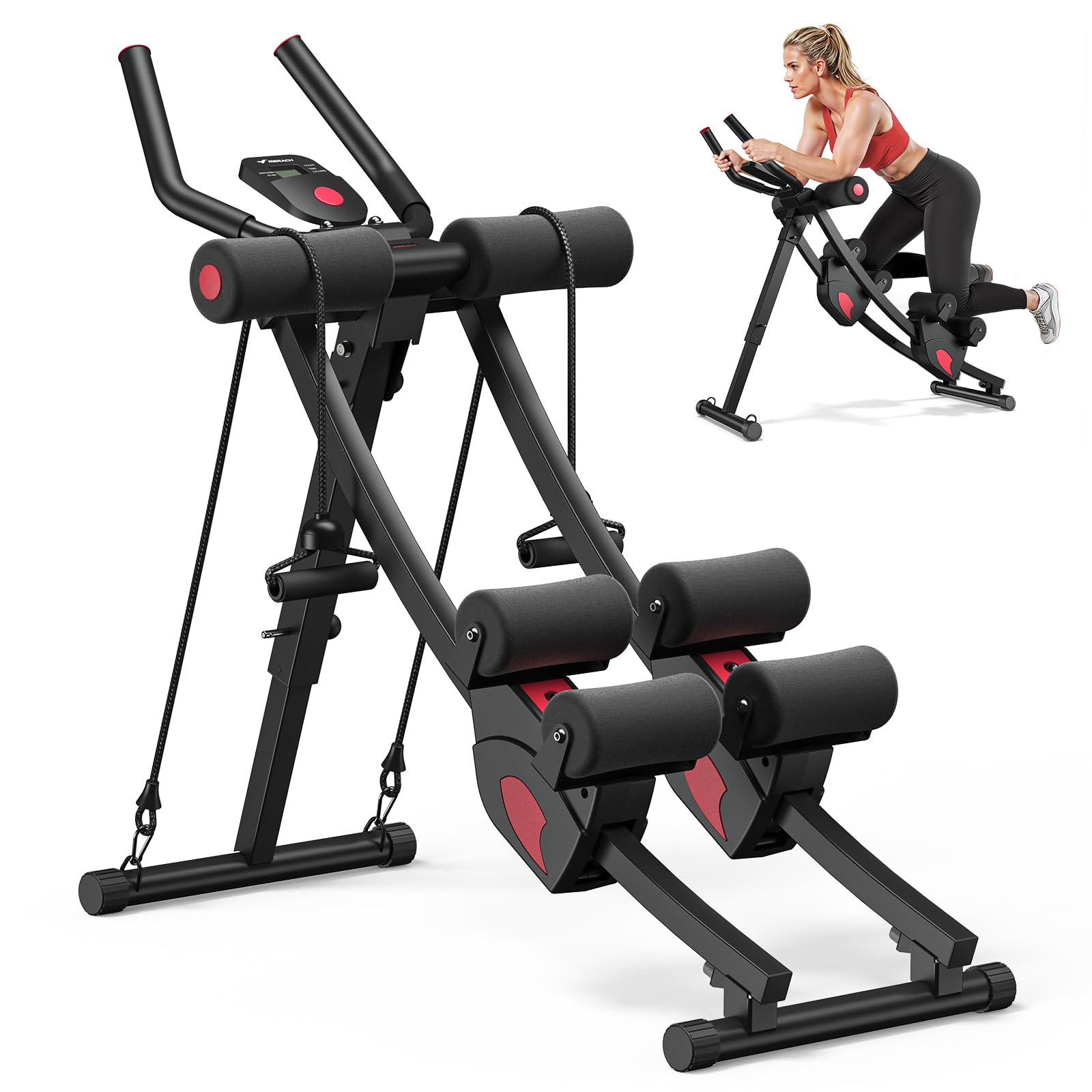
A 24-pound ab trainer that folds flat and still holds 440 pounds.
Core work is the first thing people skip at home, because crunches on a bare floor hurt and a full ab bench never fits. This machine answers that with a 110° curved track that follows the body’s natural arc. The split-track system lets you alternate sides to mimic a mountain-climb motion, which is a harder ask on your core than a symmetric crunch.
Assembly is the top-praised feature by a wide margin, with over a hundred owners calling it out. Sturdiness follows close behind, and the 440-pound capacity explains why: this is Alloy Steel holding far more than most folding trainers bother to. Four height adjustments cover the range from beginner to someone chasing endurance, and a built-in LCD tracks reps, time, and calories so a set has a score.
The trade-off is honest: some owners describe the build and durability as mixed rather than bulletproof, so treat it as a well-built folding machine rather than a commercial unit. The thick foam padding and non-slip handles do take the pressure off knees and elbows, which is the difference between finishing a set and stopping early. If floor space is the constraint, this folds down for storage after every session.
Compact ab trainer: at 24 pounds it is the lightest floor-standing piece here, and 110.6 pounds lighter than the BowFlex dumbbell set — you can move it one-handed before and after a workout.
Small floor space: you want targeted ab work without dedicating a corner of the room to it.
Tall users only: you need one machine that covers the whole body instead of the core.
3. Pooboo Pull Up Bar Power Tower Dip Station
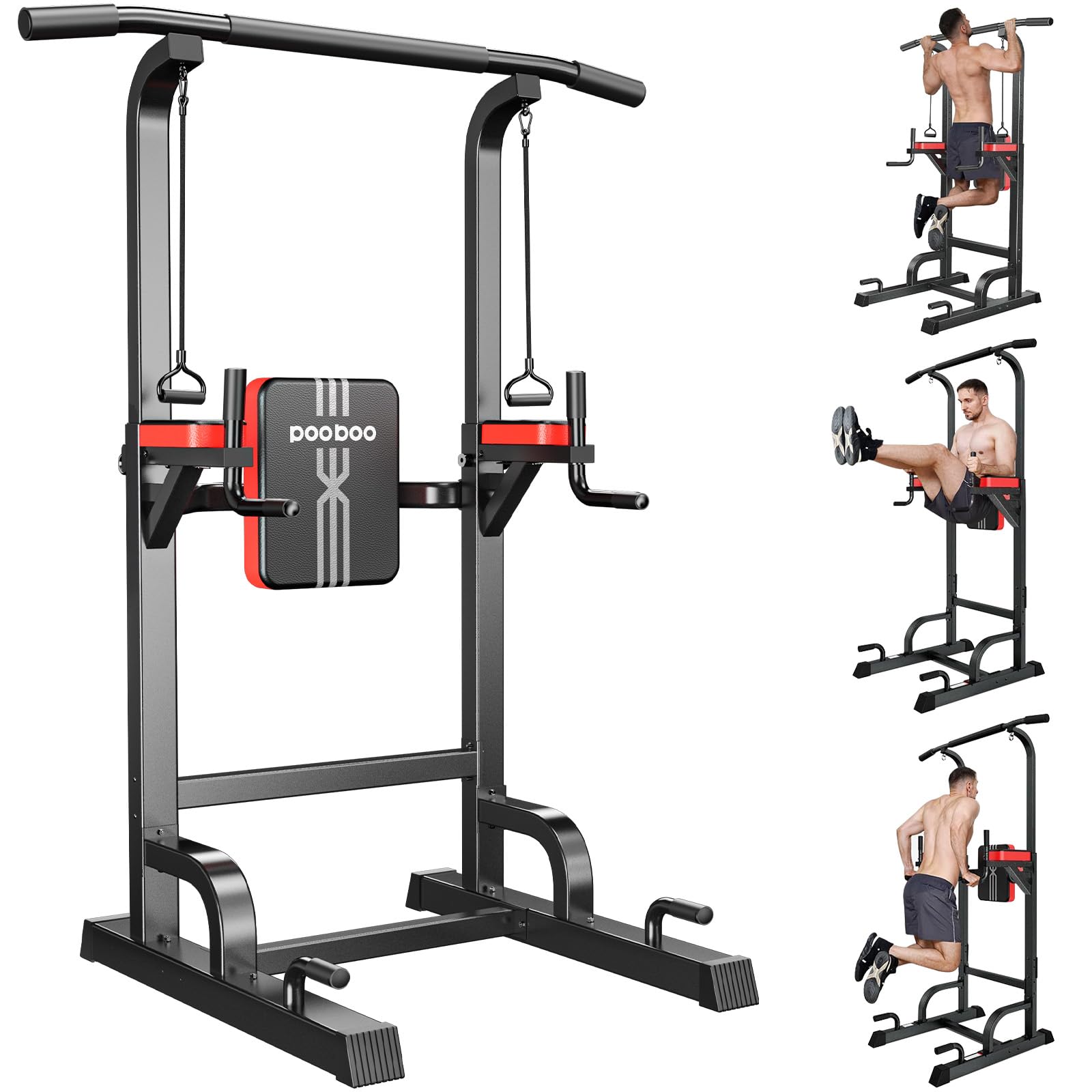
Eleven height settings span 71.4 to 84.9 inches, so the whole household trains.
Most home towers are built for one person’s height and everyone else adapts. This one runs 11 adjustable height levels from 71.4 inches to 84.9 inches, which is why it suits a family rather than a single lifter. The 7-position wide backrest adds support through dips and knee raises, and the max weight capacity is 450 pounds.
Stability comes from a 41.73-inch extended H-shaped base with four enlarged non-slip foot pads and safety locknuts that resist loosening during hard training. Frame quality is the top-praised feature here, with well over a hundred owners singling it out and assembly right behind. Assembly itself takes 10 to 20 minutes per the maker, though the fuller instruction sheet allows 30 to 60 minutes and recommends two people.
One honest note on the numbers: the listing shows a 450-pound capacity in the description and a 440-pound maximum weight recommendation in the spec panel. Either way this is built for bodyweight and moderate loading, not for racking a barbell. Included elastic resistance bands add variety, and the 12-month warranty covers the frame and support side of things. Note the 60-pound unit weight before you plan where it lands.
Garage gym builders: a household where a shorter and a taller person both want pull-ups and dips.
Renters with thin walls: you need a rack that carries loaded barbell work — this is a bodyweight station.
4. GOIMU WM1 Wall Mount Cable Station
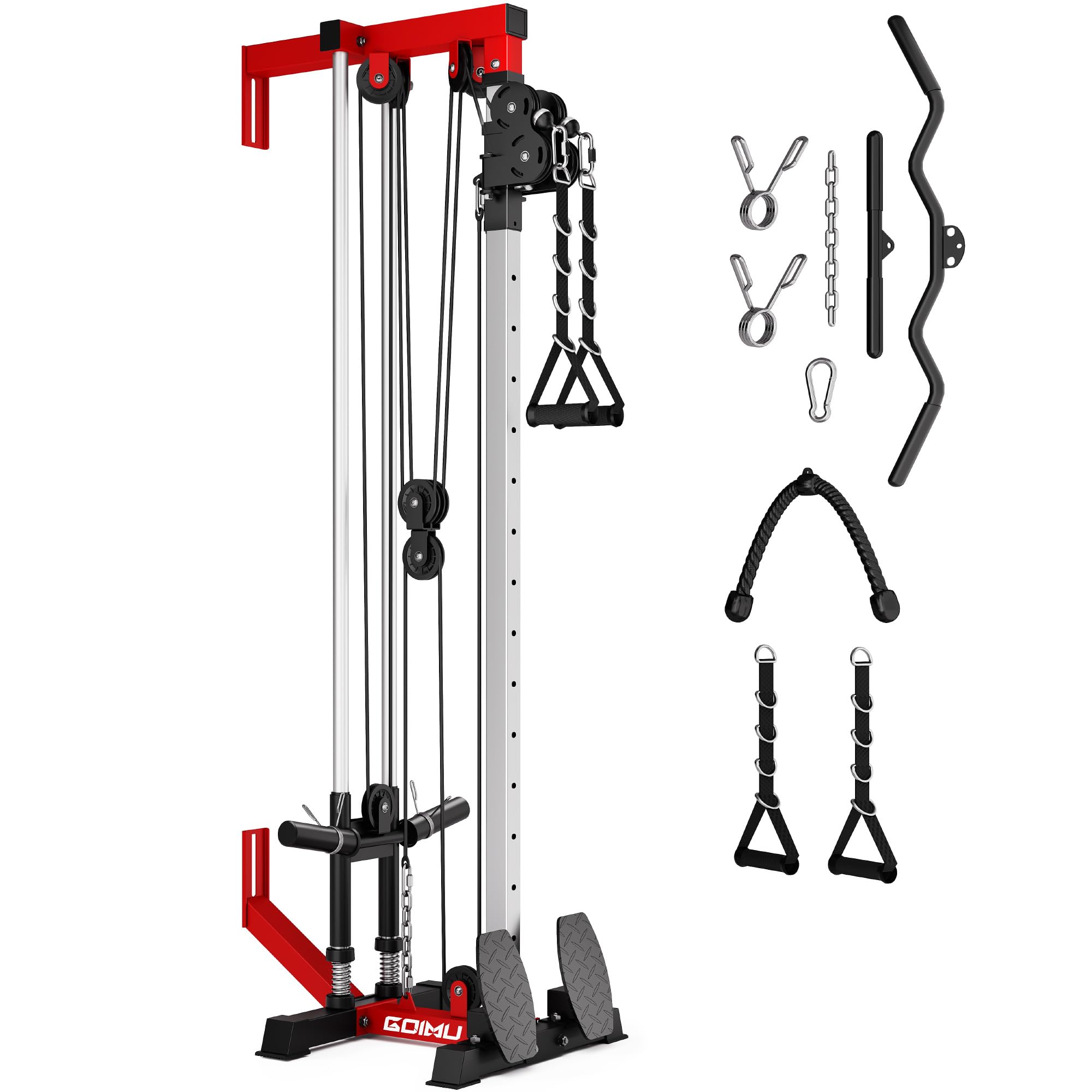
A cable crossover that hangs on the wall and leaves the floor free.
If you rent, or your garage is a garage rather than a gym, a wall-mounted station is the only cable setup that fits. This one tucks flush against concrete or masonry walls with no floor anchors, and the assembled frame measures 24.8 inches wide by 78.74 inches tall. It bundles lat pulldown, seated row, cable crossover, and single-arm row into that footprint.
The 300-pound maximum weight recommendation is the crucial spec here, and it is where this machine separates from the JELENS power cage above, which is rated to 2000 pounds. That is a 440-pound versus 300-pound gap in load ceiling — so treat this as a cable and pulley station for controlled resistance work, not a rack for heavy barbell squats. The 17-position height adjustment and dual independent pulleys cover the angle range for flys, pushdowns, and rows, and the SmartT adaptor switches between a 1:1 ratio for heavy lifts and a 2:1 ratio for lighter endurance sets.
Build quality is what owners highlight most, followed closely by assembly — instructions are clear and the industrial 14-gauge steel and wall-mounted bracket system keep the frame from swaying under load. Accessories come included: lat pulldown bar, cable bar, tricep rope, and two D-ring handles. The frame carries a lifetime warranty, with a 2-year warranty on the rest.
Saves floor room: this needs masonry or concrete — drywall alone will not carry 81.4 pounds of steel plus working load. Check your wall before ordering.
Wall-mounted setups: apartment and garage lifters who want cable work and cannot give up the floor.
Rental apartments: you plan heavy barbell squats inside it.
5. CAP 2-inch Olympic Bumper Plate Set

Rubber bumper plates that forgive a dropped deadlift on a concrete floor.
Bumper plates exist for one reason: so a missed lift does not crack your floor or your bar. This set brings pairs of 10, 15, 25, 35, and 45 pounds in a medium-bounce rubber blend that absorbs impact and lowers noise on controlled drops. Each plate has a 2-inch center hole that fits standard Olympic barbell sleeves.
Quality is the largest single praise category for this set, with the steel floating hub keeping plate loading smooth through repeated deadlifts, squats, and Olympic lifts. Weight accuracy and balanced feel on the bar both come up repeatedly as genuine wins.
Two real catches to know before ordering. First, the plates arrive greasy with a strong odor straight out of the packaging — plan a wipe-down and a day or two of airing out before your first session. Second, durability feedback is mixed, with the odd owner reporting a plate failing after one use; the medium-bounce rubber is built for controlled drops, not for repeated high drops from overhead. Grip feedback is equally split, so chalk helps.
Olympic bar owners: a home lifter who needs a full pair range in one order and will control the drop.
Need fractional plates: you plan to throw heavy plates from overhead on a regular basis.
6. JELENS S11 Power Cage with Lat Pulldown
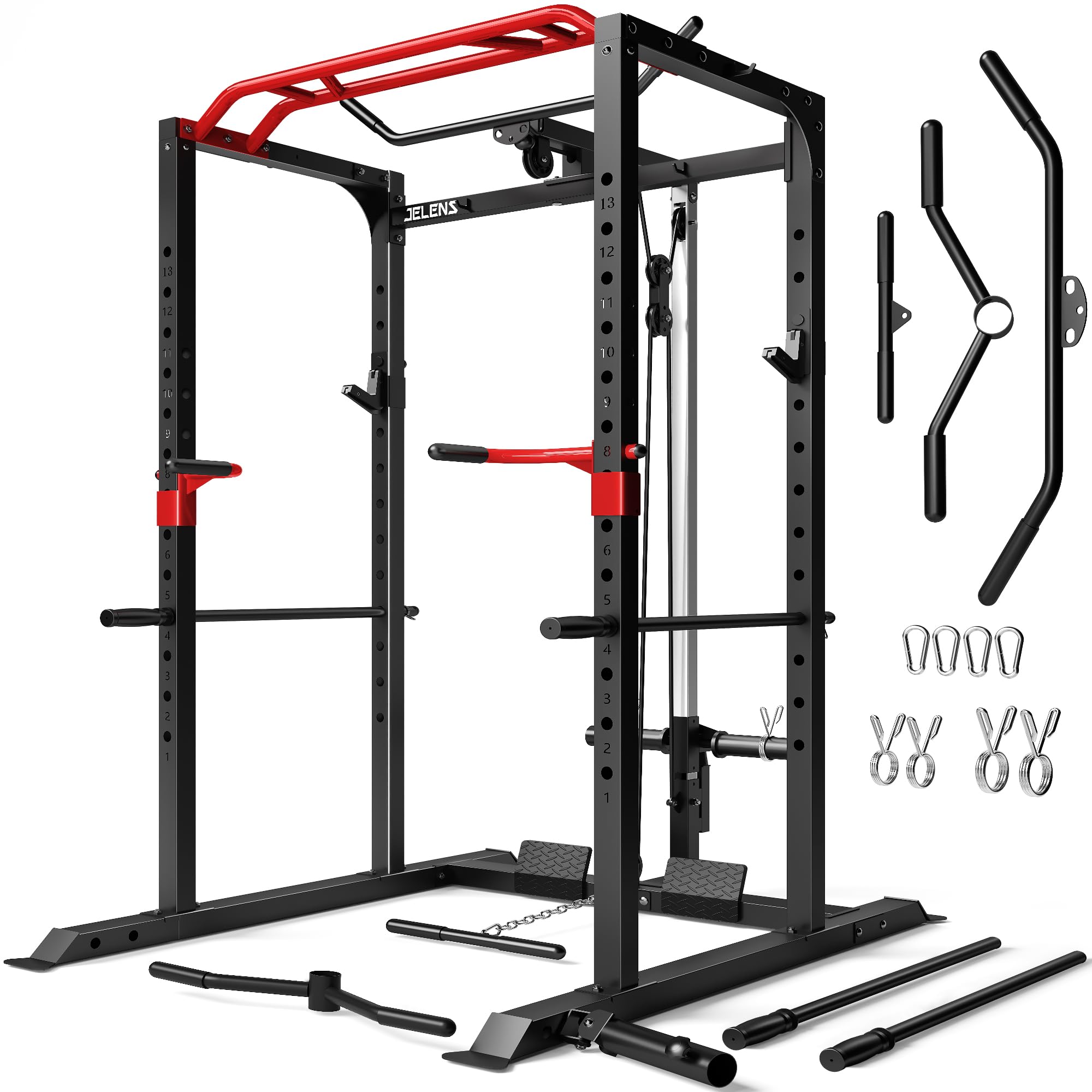
A 2000-pound power cage that folds a pulley system into the frame.
For someone planning to squat and bench heavy at home, the load ceiling is the whole conversation. This cage is rated to 2000 pounds — the highest maximum weight recommendation on this list, and well beyond what a home lifter will ever rack. The 50mm x 50mm heavy-duty steel pipes get a sandblasted finish for rust resistance, and 13 numbered height positions cover squats, benches, and rack pulls.
Frame quality is the top-praised feature by a clear margin, with assembly right behind it. The precision steel-shaft pulley runs an upper and lower pull-down system on a polished solid steel wire rope, cutting noise in a shared space. Accessories arrive complete: lat pull-down bar, cable bar, T-bar, two J-hooks, two safety rods, a 360° landmine, and four counterweight racks with clamps.
The honest note is adjustability. It is the one aspect where feedback swings negative — owners describe the position changes as more involved than the click-and-go style, so plan your sets rather than switching mid-session. The 57.48-inch depth also needs real clearance behind you, and the 1-year warranty is shorter than you might expect at this load rating. Mobility is another mixed area; this is a permanent fixture once built.
Full rack workouts: heavy barbell training is the main event and you want enormous headroom on the frame.
Low basement gyms: you train mostly with cables and dumbbells and just want one machine.
7. Sportsroyals Power Rack with Pulley System
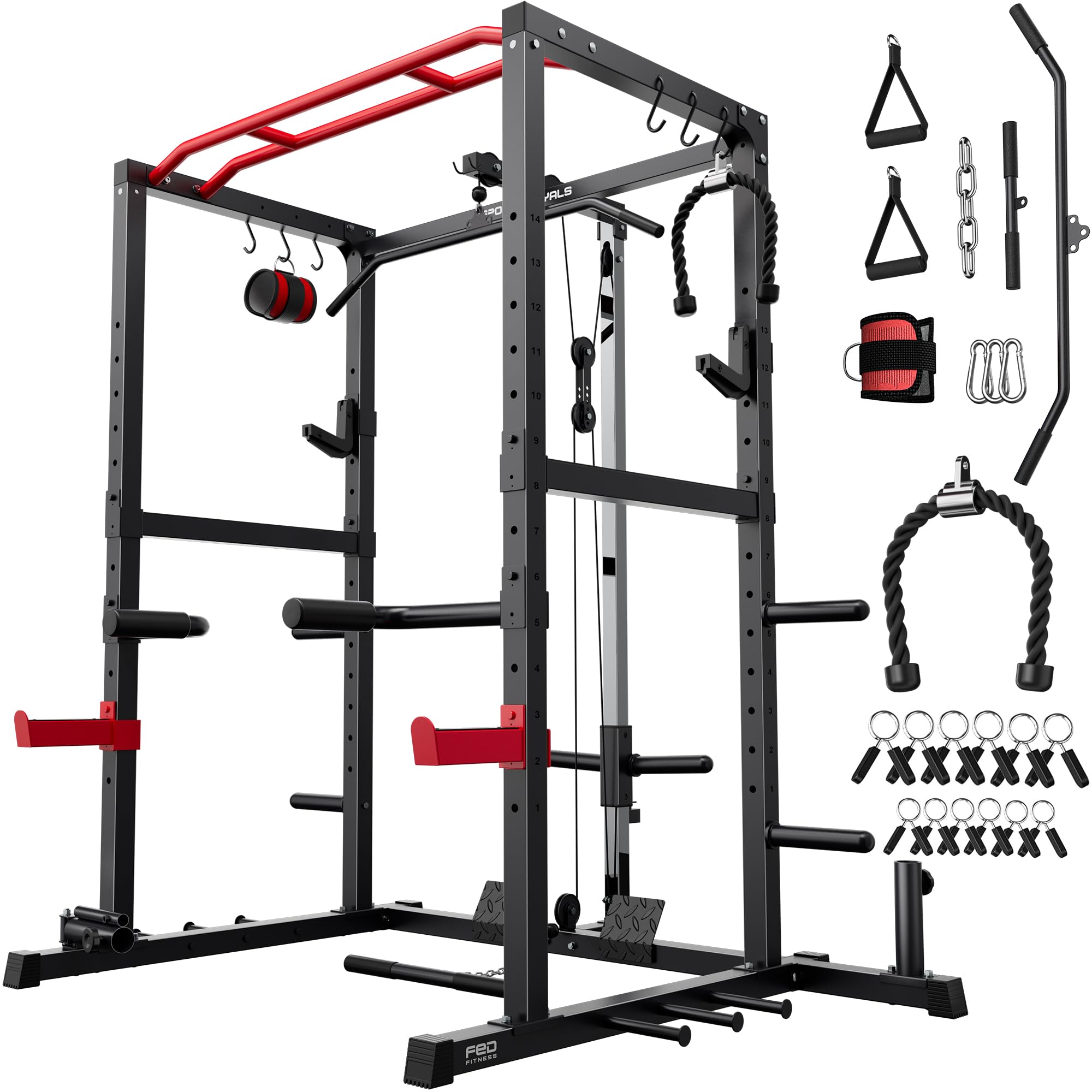
Thirteen accessories, one frame, and the value story owners point to first.
This is the power cage that comes closest to a full gym on delivery. Sportsroyals ships it with 13 separate attachments — rowing bar, four weight plate storage pegs, six band pegs, safety arms, lat pull-down bar, safety bar, J-hooks, dip stands, tricep rope, ankle strap, clamps, cable handles, wide and narrow pull-up frame, a 360° landmine, and a foot board. It carries a 1200-pound maximum weight recommendation on a 50mm x 50mm steel frame with 1.5mm wall thickness, and it weighs 150 pounds.
Value for money draws 185 mentions, the largest praise count for any aspect on any product in this lineup. Sturdiness follows at 158, with clear instructions rounding out the top three. The 14 adjustable height levels cover wide and narrow lat pull-downs, landmine work, seated rows, squats, deadlifts, and dips. The pulley system runs precision bearing pulleys on an electroplated telescopic pole with a PU-coated steel cable rated to hold up to 500 pounds.
The trade-off is wobble. Stability is a mixed category, so treat the frame as solid but not immovable — 1200 pounds of capacity isn’t the deepest margin on this list, and some owners note a bit of sway under heavy sets. Durability is likewise mixed, so watch the main cable over time. The 61.6″L x 56.0″W footprint needs genuine space, and setup asks for 2 to 3 people and arrives in 2 boxes that may land on different days.
Rack and cable users: someone who wants one machine, every attachment on day one, and the best value equation here.
Cable-only purists: heavy squatters may want the higher-rated JELENS above.
8. Keppi Fitness Functional Weight Bench Bench3000 V2
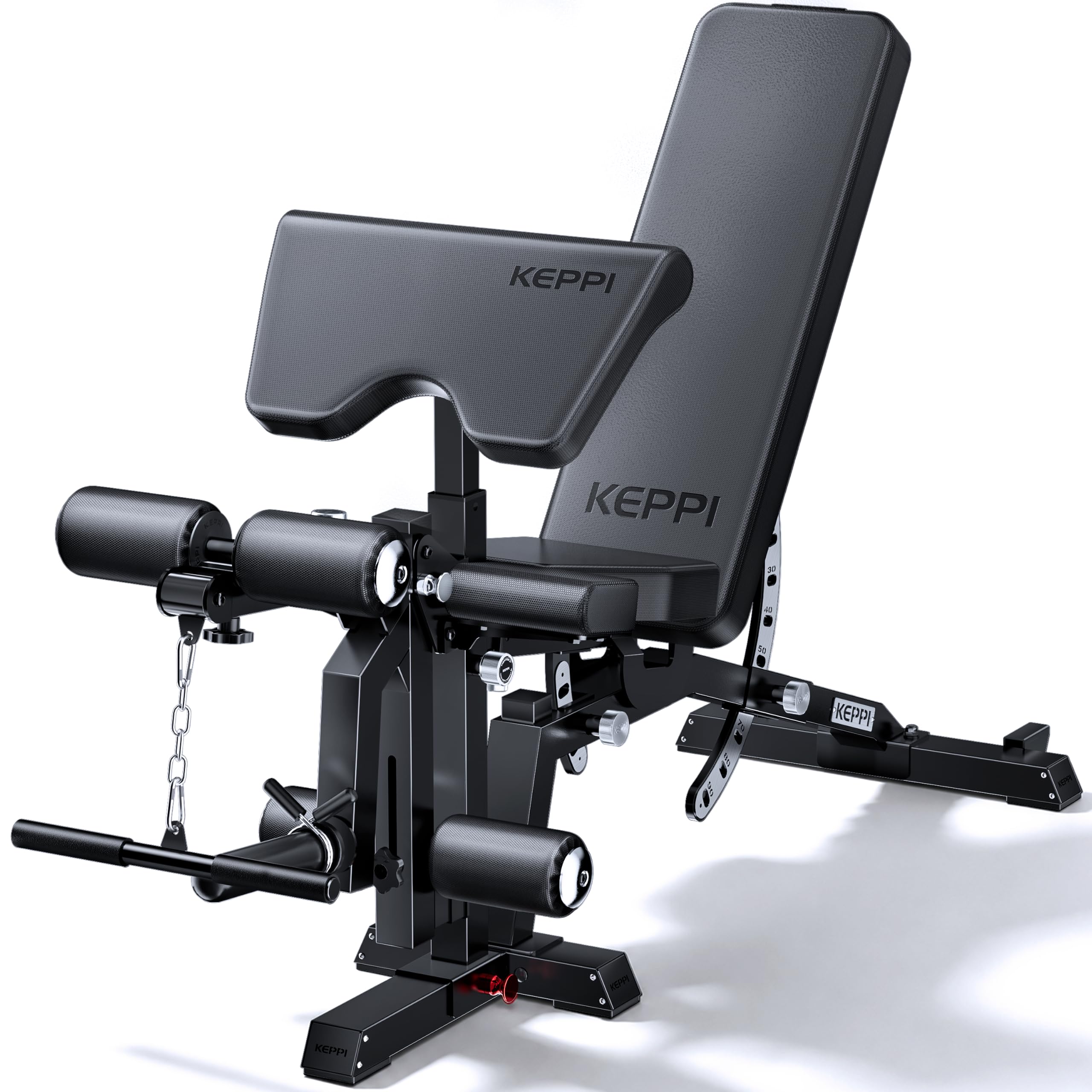
A 93-pound bench that turns into a leg-extension station in 30 seconds.
Most benches do one thing: you lie on them. This one adds a commercial-grade attachment that handles leg extensions, curls, and preacher work, and it converts back to a plain adjustable bench in 30 seconds via a magnetic pin and spring pin — no tools in the swap. The main frame is 8/16-gauge steel with aluminum alloy components and PVC upholstery, weighing 93 pounds, and rated to 1200 pounds in the flat position.
Build quality is by far the top praise for this bench — over 300 owners call it out, with sturdiness second at more than 250 and adjustability third. That last number tracks: 12 backrest angles from -20° to 90° plus 3 seat positions at 0°, 10°, and 20° cover flat, incline, decline, and upright, and the attachment adds 5 ROM angles, 5 arm-length settings, 5 preacher pad heights, and slot-adjustable top and bottom rollers. The 10° seat and oversized thigh pad hold you in place during leg work.
The single caveat is mobility and range of motion, which draws mixed feedback. The wheels and built-in weight peg do let you tilt and roll 93 pounds with one hand and stand it upright in 3.5 square feet, but some owners find the attachment’s travel tighter than expected. Try the ROM settings before you commit to a full leg session.
Adjustable back angles: 12 backrest positions and 3 seat positions means 36 distinct setups before you touch the attachment — more than any bench here by a wide distance.
Bench press variety: a lifter who wants pressing angles plus leg isolation without a second machine.
Need light portable bench: someone who wants a simple flat bench and nothing more.
9. Mikolo Home Gym Pro Station with 152LBS Weight Stack
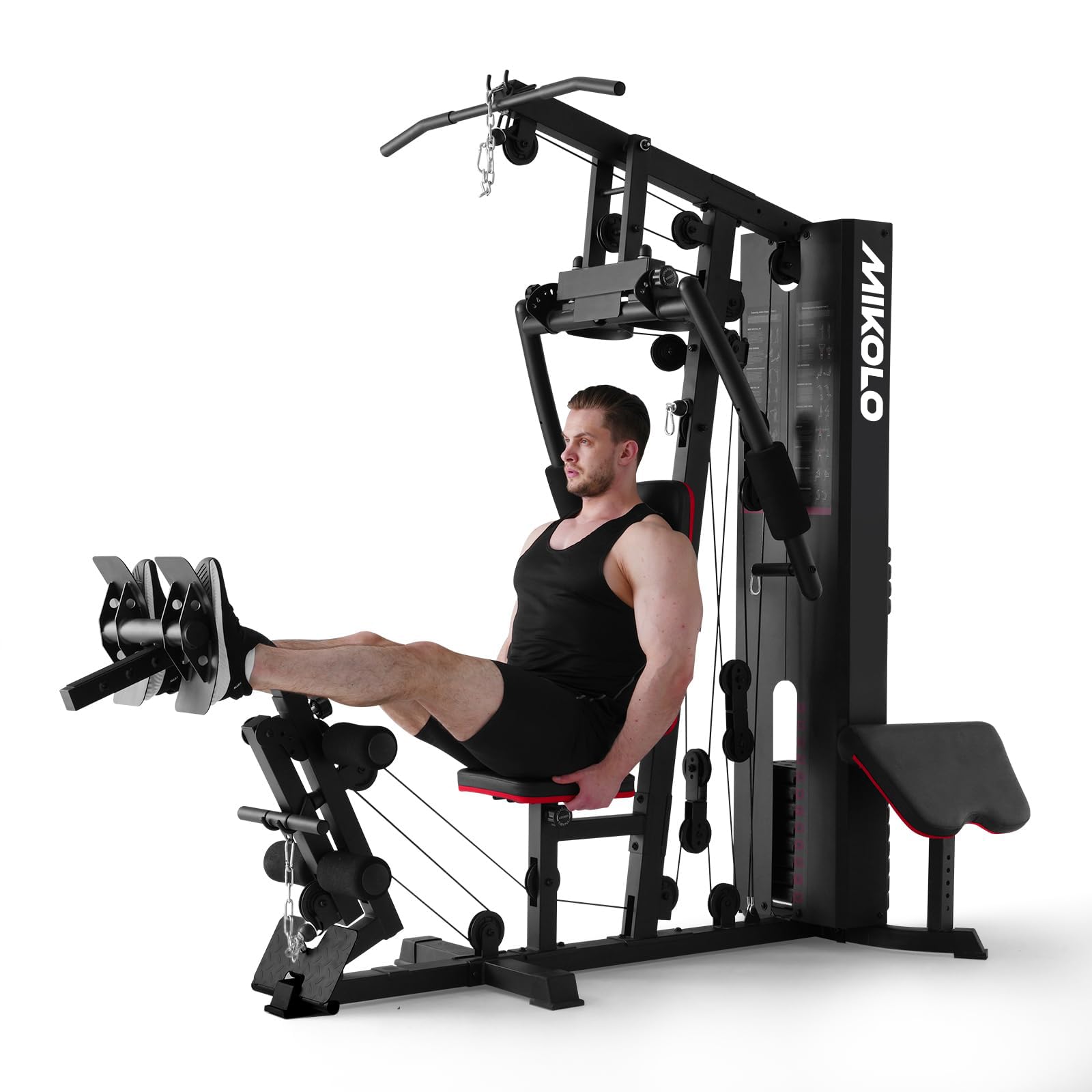
A 152-pound stack means you never load a plate again.
A selectorized machine replaces the whole plate-loading ritual with a pin. This one carries a 152-pound weight stack on 14-gauge steel with the counterweight block wrapped in a steel sheet for protection through long service. The single unit covers pec fly, lat pulldown, low row, chest press, leg extension, leg press, preacher curl, core training, calf training, seated row, and mid row — over 90 exercises by the maker’s count.
Sturdy structure and smooth cable action are the core experience here, and quality is the most-praised aspect by a wide margin, with value for money second. The high, mid, and low pulley system plus chest press, chest fly, and back extension all sit on the same frame, and multiple handles let you aim at specific muscle groups. A movement guide is included to seed new routines. The preacher curl pad and leg press accessories come off and on for quick changes, and the cable bar runs on professional bearings to reduce wrist stress.
Assembly is the split decision — some owners put it together without drama, others find it a project, so plan for a helper and a clear afternoon. Adjustability draws mixed notes too, mostly around dialing in the right starting position. At 300 pounds with a 75-inch depth, this needs a dedicated wall.
All-in-one starters: you want a full-body machine that swaps exercises in seconds, not minutes.
Tight studio spaces: you are short on floor depth or want barbell lifting.
10. NordicTrack T Series T6.5s Treadmill

A foldable treadmill that gives you a 20-inch deck and 10% incline.
Cardio is the piece most home gyms never buy because a treadmill is heavy and permanent, and this one splits that problem by folding. The frame folds and rolls away when a session ends, with a foot bar for assisted lowering. The running surface is a 55-inch by 20-inch deck, speeds run up to 10 MPH, and incline tops out at 10% for extra burn and more muscle recruitment.
Quality and value are the loudest categories by an enormous margin here — thousands of owners name each, and ease of use follows close behind. KeyFlex cushioning softens joint impact on daily walks and runs. The 5-inch LCD shows live stats, and iFIT membership brings over 10,000 workouts that auto-adjust the treadmill’s pace and terrain, plus ActivePulse heart-rate control and SmartAdjust that responds to your history. A 400-watt power draw keeps the motor inside a normal home circuit.
Assembly and noise are both mixed experiences — setup is not always quick, and the motor is audible, so a second-floor apartment needs care about timing. Reliability also draws split feedback over the long term. Treat this as a solid daily cardio machine with a service life that depends on how hard you run it, and plan the assembly as a two-person task.
Home cardio routines: walking and incline running are your cardio and you need the machine to disappear afterward.
Long-stride runners: you share a thin floor with neighbours below or want zero setup work.
11. Speediance Gym Monster 2 Smart Home Gym
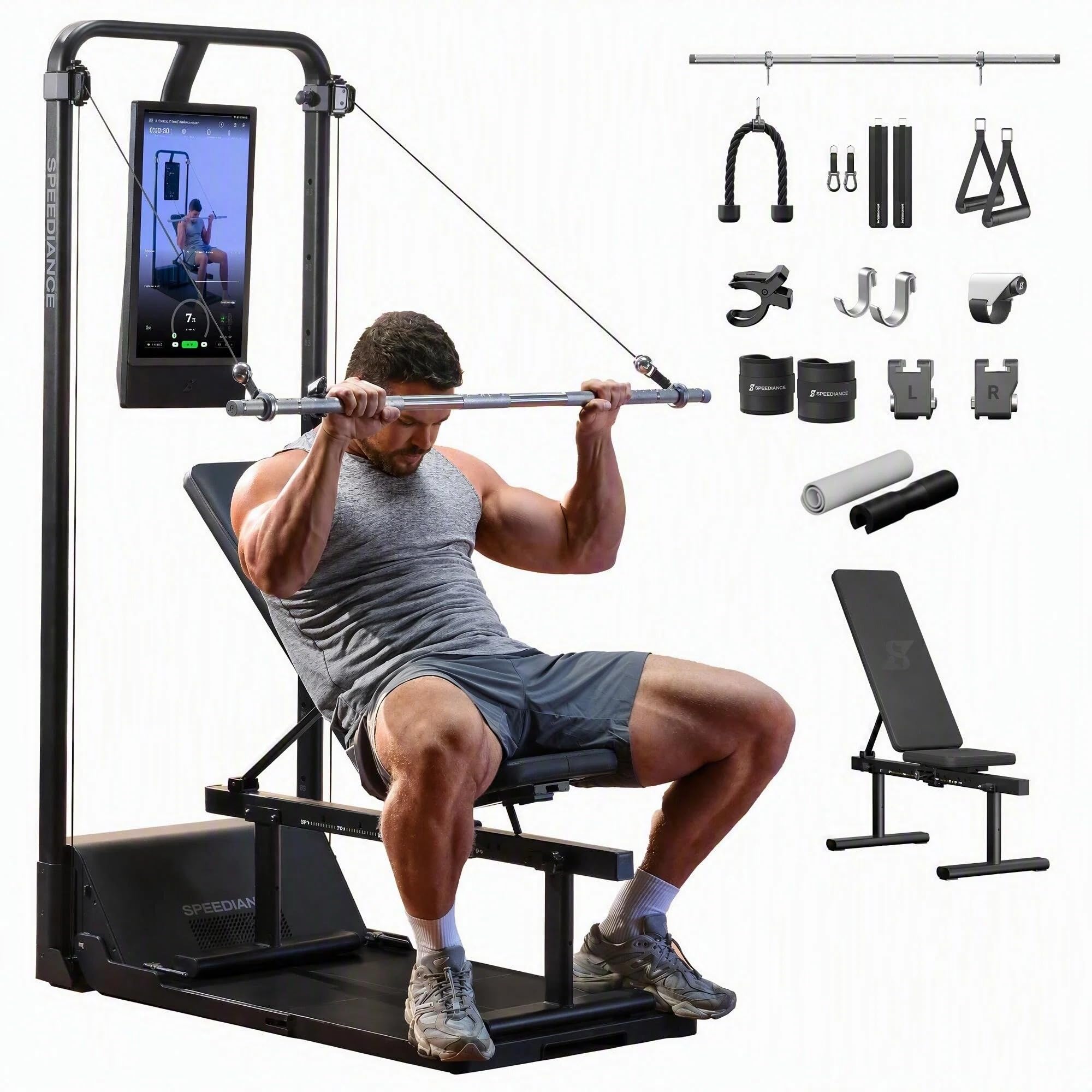
Digital resistance replaces the plate stack and folds into 2.69 square feet.
This is the piece that changes the math for apartment lifters. Dual 800W PMSM motors generate up to 220 pounds of smooth digital resistance, so there are no plates to stack and no weight to move around. It folds down to 0.25 square meters, or 2.69 square feet, and stands 72.83 inches tall when set up on a 48.03-inch width.
Quality is the most-praised aspect by a wide distance, with value for money second and versatility third. The built-in AI training system tracks performance in real time and suggests weight adjustments after each set, and the software library keeps expanding with 2-year main unit protection and 1-year accessory coverage. The Works Plus bundle covers the essentials in one box: adjustable bench, barbell hooks, tricep rope, handles, extender belt, Bluetooth ring and clip, ankle straps, adjustable barbell, neck pad, and a yoga mat.
What you give up is bar feel. Digital resistance loads smoothly but it is not a barbell on steel plates, so lifters chasing a competition-style squat will notice. This is a premium-tier machine, and the max weight recommendation of 300 kg hints at the frame’s ceiling rather than what the motors deliver. Set against the Mikolo’s 152-pound stack, the 220-pound digital ceiling is the larger of the two, but the resistance path is fundamentally different.
Motorized resistance: 220 pounds of digital resistance at a 2.69-square-foot storage footprint is the tightest space-to-load ratio on this list. The resistance type, not the number, is what separates it from plate-loaded gear.
Digital weight fans: you want a full cable-and-barbell range in a room too small for a cage, and you accept that the feel is digital.
Prefer free weights: a barbell and steel plates are non-negotiable.
Know the Specs
Maximum weight recommendation
This is the load ceiling the maker certifies for the frame — the total weight the structure is built to hold. It is not the same as your body weight, and on cages and towers it is a safety margin, not a target. A 2000-pound rack and a 300-pound cable station can both be well built; they just serve different jobs. Match the ceiling to the exercise, not to your ego.
Digital resistance vs. plate-loaded
Digital resistance on a smart machine uses motors to generate the load, so there is no plate stack to move. Plate-loaded gear runs on gravity — actual steel mass. Digital is more compact and adjusts in finer steps; plate-loaded gives a more traditional bar feel under heavy weight. Neither is better across the board; they are different tools.
Footprint in square feet
Footprint is the floor area a piece occupies when set up, and it is the spec that decides what fits in your room. A folding treadmill frees its floor between sessions; a power cage never does. Measure your room, subtract the clearance you need behind a rack, and match the machine to what is left — not to what looks good in a listing image.
Gauge and wall thickness
Lower gauge numbers mean thicker steel, and wall thickness in millimeters measures the pipe wall itself. Both matter for how much sway a frame has under load. A 14-gauge frame and a 50mm x 50mm pipe with 1.5mm wall are the sort of specs worth comparing side by side before you buy a cage.
Common Questions
Will a wall-mounted cable station work on drywall?
Do I need both a power cage and a bench?
How much floor space does a power cage really take?
Are adjustable dumbbells as good as fixed ones?
What is the difference between bumper plates and steel plates?
Can a folding treadmill fit in a small apartment?
What does 220 pounds of digital resistance actually feel like?
Is a 300-pound weight stack enough for home strength training?
How long does assembly take on a power tower or rack?
Can I train my whole body on one machine?
The Bottom Line
For most people setting up the best workout equipment for gym space at home, the winner is the BowFlex SelectTech Dumbbells — it covers 15 weight settings per handle in a footprint smaller than a doormat, and that alone keeps a small room trainable. If you want a rack and every attachment on day one, grab the Sportsroyals Power Rack and its 1200-pound capacity. And for a wall-hung cable setup that leaves the floor free in a rental, the GOIMU WM1 is the one to reach for. Pick one, build the habit, and add the second piece later — the stack grows faster than the room does.
How we choose
We do not accept paid placement. Every pick is matched to a real buyer and a real use-case; we do not hands-on test units.
Sources
Specifications: manufacturer listings and product documentation. Review insights: verified customer reviews, as of November 2026. Pricing: not shown on this page (it changes often); check the current price via the retailer link.
As an Amazon Associate, Tactical Gear Guy earns from qualifying purchases. This does not affect which products we feature.