Specs are compiled from manufacturer listings and verified buyer reviews and can change over time — please confirm the key details on the product page before buying.
Warm air pooling near your ceiling is wasted heat. The fix is a heat-powered fan that spins from the stove top alone: set it near the hottest part of the top plate and it pushes warm air out into the room. For most homes the fan to buy is the Caframo Ecofan Original. It moves up to 100 CFM (cubic feet per minute — a measure of how much air moves each minute), so a normal room gets stirred instead of stratified. It also starts on its own once the stove top reaches between 300F and 650F, so you never touch a switch. Below, you can match a fan to your stove, your room size, and whether you burn wood, propane, or pellets.
This guide is built by comparing the manufacturers’ published specifications and the patterns across verified customer reviews, so you get each pick’s real strengths and trade-offs instead of marketing spin.
You will see fans that sit on the stove top, fans that clamp onto the flue pipe, and one mains-powered blower built for specific stove brands. The goal is simple: pick the one whose mounting, airflow, and heat range fits your setup, so your wood stove blower fan actually moves warm air where you sit.
Top Picks


How To Choose The Best Wood Stove Blower Fan
Before you buy, check where the fan will physically sit. A stove-top fan rests flat on the hot plate and runs off that surface heat, so it needs a clear, level patch of steel. A flue-pipe fan clamps or magnetizes onto the chimney pipe instead. Get this wrong and the fan will not sit properly: a pipe-clamp fan will not work on a flat top, and a flat-top fan has nothing to grip on a pipe.
Match the fan to your stove’s heat range
Every heat-powered fan has a temperature window where it spins well and a ceiling where it needs protection. The Tomersun, for example, lists an optimal range of 392°F to 482°F (200°C to 250°C), so it works best on a steady mid-fire. It also warns against exceeding 572°F (300°C) to protect its thermoelectric module (the part that turns heat into electricity). If your stove runs hotter than a fan’s safe ceiling, look for one with a bimetallic safety strip — a small metal strip at the base that lifts the fan off the hot surface when things get too warm.
Understand what the CFM number means
CFM stands for cubic feet per minute, and it is the honest way to compare how much air a fan actually pushes. The Caframo Ecofan Original and the Ecofan Original both list 100 CFM, the Hongso blower lists 86 cfm, and the Thermoelectric pipe fan lists up to 180 cfm. A higher CFM figure means more air moved per minute, which matters most in a large or open-plan room where heat otherwise collects near the stove.
Consider your power situation
Heat-powered fans make their own electricity from the stove’s warmth, so they keep running during a power cut — a real advantage in a cabin or an off-grid setup. The one mains-powered pick here, the Hongso S31105 blower, runs on AC 120V at 60HZ and needs a socket, so it stops when the grid does. Decide up front if you want cord-free operation or the stronger push of a plug-in blower.
Side-by-Side Comparison
| Model | Best For | Airflow (CFM) | Power Source | Mounting | Amazon |
|---|---|---|---|---|---|
| Caframo Ecofan Original★ Best Overall | Overall best for most wood stoves | 100 CFM | Heat powered | Free-standing on stove top | Amazon |
| Thermoelectric 180CFM Magnetic Pipe FanPipe-Mount Power | Pipe-mounted airflow in big rooms | 180 cfm | Heat powered | Clip-on / magnetic | Amazon |
| Tomersun 16-Blade Dual MotorWide Coverage | Wide coverage in larger rooms | — | Heat powered (thermoelectric) | Freestanding | Amazon |
| HIDALIFE 6-Blade with Thermometer | Small stoves and inserts on a budget | — | Heat powered | Placed on top of the stove | Amazon |
| Sckee Buddy Heater Fan | Propane Buddy heaters and tents | — | Heat powered (thermoelectric) | Floor mount / bracket | Amazon |
| XTIMES 12-Blade Dual Motor | Heaters and stoves in one fan | — | Heat powered | Freestanding | Amazon |
| Hongso S31105 Blower | Replacement blower for specific stove brands | 86 cfm | AC 120V, 60HZ | Mounted (4 holes) | Amazon |
| BLFIRE Dual Motor with Thermometer | Low-heat and remote-cabin setups | — | Heat powered | No installation required | Amazon |
| Ecofan Original 100 CFM | Classic quiet performer with support | 100 cfm | Heat powered | Free-standing | Amazon |
Detailed Reviews
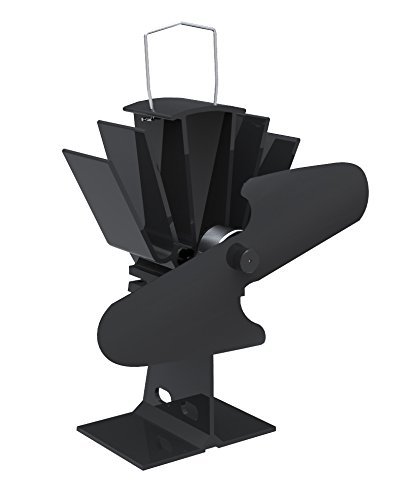
1. Caframo Ecofan Original Heat Powered Stove Fan
Our pick — 4.5+★ from 500+ verified ratings; the strongest balance of quality and price.
The two-blade classic that quietly pushes 100 CFM without ever touching a socket.
For a normal freestanding wood stove in a living room, this is the fan to start with. The Caframo Ecofan Original is a heat-powered fan (it makes its own electricity from the stove’s warmth, so no battery and no cord) rated to move up to 100 CFM. It works on surface temperatures from 300F to 650F, which covers the range most wood stoves run at through the evening. Set it on the flat top and it starts spinning once the steel warms up — no switch, no timer, nothing to forget.
It is the crowd favorite here, holding 4.5+ stars across 500+ ratings. It does the job it says it will, and it does it quietly. A fan that runs at a hum rather than a whine matters when the stove is in the same room you read or sleep in. It also burns less fuel because warm air is pushed into the room instead of pooling at the ceiling.
The honest catch is air movement. Plenty of people find it moves warm air nicely across a normal room; others find the push modest — a 100 CFM figure is real but not huge in an open-plan space. It is a 1.8-pound unit on a 4.5 x 8 x 10.75-inch frame, so it also wants a reasonably flat, level patch of stove top. This is a genuine fit question rather than a fault: in a big, draughty room, the pipe-mounted 180 cfm fan below will move more air.
What wins people over
- Rated 100 CFM of airflow from stove heat alone
- Works across a 300F to 650F surface temperature range
- Very quiet running, so it fades into the background
- Light at 1.8 pounds and simple to lift off and reposition
Where it asks for a little care
- Air movement is described as modest in larger or open rooms
- Needs a flat, level stove top to sit properly
- Two blades means a gentler push than multi-blade dual-motor fans
Reach for this if: you heat a standard living room with a flat-top wood stove and want quiet, cord-free air circulation.
Think twice if: your room is large and open — the 180 cfm pipe fan is built to move more air per minute.
2. Thermoelectric Wood Stove Blower 180CFM Magnetic Pipe Fan
A flue-pipe fan that moves up to 180 cfm and clamps onto the chimney instead of the stove top.
Here is the number that matters if air volume is your problem: up to 180 cfm. That is the strongest airflow figure on this list, and it comes from 7.1-inch aluminum blades — noticeably bigger than the 5-inch blades on the Tomersun, so each turn of the fan scoops a wider sweep of air. If your stove top is already crowded with a kettle and a thermometer, the clip-on magnetic mount also frees that surface up entirely.
The way it works is that the hotter the pipe, the faster it spins, because a thermoelectric module (a part that turns a heat difference into electricity) powers the motor from the flue’s warmth. It runs under 25dB, which is around a whisper, and it ships with a magnetic thermometer and a clamp for smooth pipes. Attach it 20cm to 50cm above the stove top on a flue pipe measuring 120mm to 150mm across for the best results.
Buyers report it performs well in a real working setup — one noting it worked effectively in a 12×12 wall tent — and that installation is straightforward. The fair warning is on airflow and noise: some setups hum along near-silently, others pick up a whine, and the 180 cfm rating depends on a good magnetic grip on a hot pipe. If your flue is smooth rather than magnetic, use the supplied black strap so the fan does not slip.
Who it is for: anyone with an exposed flue pipe who wants the biggest air move on this list and has no room left on the stove top.
The one thing to check first: measure your pipe diameter and confirm it is magnetic before you commit — the mount is the whole game with this design.
Best matched to: large rooms and open cabins where the stove top is already full.
Look elsewhere if: your flue is not magnetic and you would rather not fiddle with a strap.
3. Tomersun 16-Blade Dual Motor Heat Powered Stove Fan
Sixteen blades on two motors, built to spread heat across a room instead of one hot column.
Count the blades and you understand the pitch: 16 blades across two heads, against the 2 blades on the Caframo. The idea is wider, more even airflow so a large room does not end up with a warm patch by the stove and a cold corner by the door. It runs on a thermoelectric module that makes its own power from the heat, with no batteries and no cord, which suits a cabin, a tent, or an ice-fishing shelter as well as a home.
The included magnetic stove thermometer is the practical bit. It sticks to the stove pipe and lets you watch surface temperature in real time, so you can keep the fan inside its stated window of 392°F to 482°F (200°C to 250°C) and avoid pushing past 572°F (300°C). Staying in range is what protects the thermoelectric module and keeps the fan working for seasons rather than weeks. The body is aluminum with an electrophoretic coating to resist discoloration and loosening under heat.
What you trade for that blade count is simplicity. Two motors and 16 blades are more moving parts than a two-blade fan, and the freestanding base still wants a flat top. At 575 g it is light enough to move with one hand. Treat the thermometer as part of the routine rather than a gadget — it is the tool that tells you when your stove is running the fan too hot.
Why it earns a spot
- 16 blades and dual motors for broad airflow across a room
- Magnetic stove thermometer included to track surface temperature
- Zero electricity, so it keeps running in a power cut
- Light 575 g aluminum body with a heat-resistant coating
The honest limits
- Two motors and 16 blades mean more parts than a two-blade design
- Needs a flat top and watching to stay under 572°F (300°C)
- Freestanding only, so a pipe setup is out
Worth picking for: bigger rooms and off-grid spaces where you want heat spread wide, not pooled.
Skip the fuss if: you want the fewest possible moving parts on your stove.
4. Sckee Wood Stove Fan Compatible for Buddy Heater
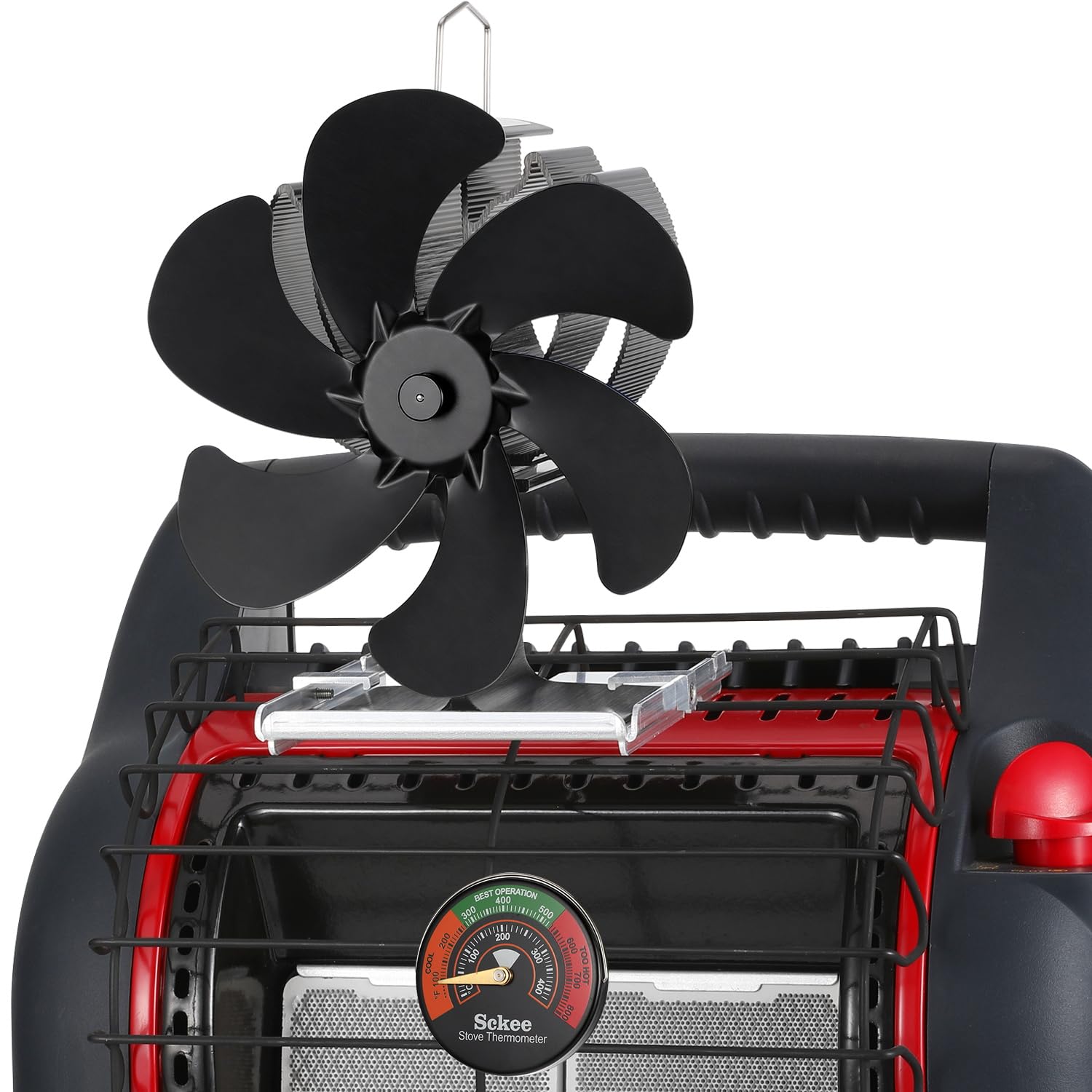
The fan that works on a wood stove and on a propane Buddy heater, thanks to a bracket.
Most fans on this list assume a wood stove. This one assumes you might also run a propane Buddy heater in a tent, a barn, or a workshop. The included bracket fixes it to the heater, and without the bracket it sits on the stove as normal — the most versatile pick if you heat more than one space with more than one fuel. Owners mention it moves heat around a room better than double-blade models and cuts the heat loss that otherwise gathers above the heater.
Safety comes from a bimetallic strip in the base: a small metal element that, once temperatures pass 644°F/340°C, lifts the front of the fan to shield the motor and the stirling engine set from the worst of the heat. A magnetic thermometer comes with it so you can watch the firebox temperature while it runs. Set-up is quick — a buyer noted the screws go into the metal plate in under a minute.
Where this fan asks patience is the mount. The sturdiness of the bracket is the part most worth a careful once-over when it arrives, since a fan that shifts position on a heater loses its aim. The aluminum body and powder-coated finish are built for indoor and outdoor use, and at 8 x 4 x 7 inches it is compact enough to pack for a tailgate or a winter fishing trip. Its strength is range of use; its trade is that a fixed bracket needs verifying on your specific heater.
Why campers and cabin owners like it: one fan that follows you between a wood stove at home and a Buddy heater in the field, with overheat protection built into the base.
One check before the trip: confirm the bracket sits firmly on your heater model — a wobbly mount undercuts everything else.
The pick for you when: you split your winter between a wood stove and a propane heater and want a single fan for both.
Not the one if: you only ever run a flat-top wood stove and would never use the bracket.
5. XTIMES 12 Blade Dual Motor Heat Powered Fireplace Fan
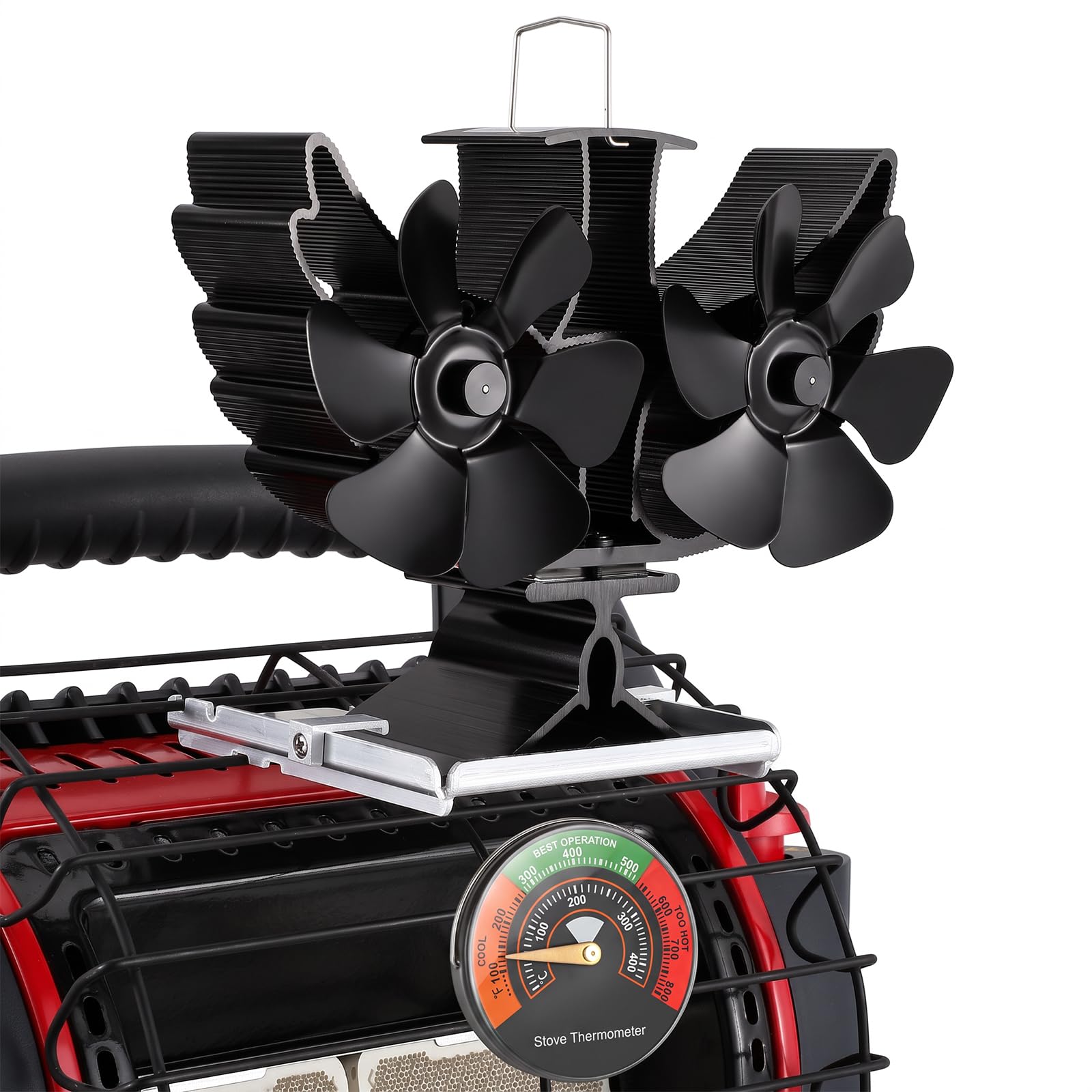
Twelve blades, two motors, and a bracket that lets it ride a heater as happily as a stove.
If you want a fan that handles both a wood stove and a heater without a second purchase, this is the middle path. Twelve blades on two motors are built for faster air circulation than a two-blade unit, and the heat-powered design means no battery and no cord — it makes its own electricity from the fire. The bracket included in the box lets the same fan be fixed to a heater, which is why it turns up in hunting blinds as well as front rooms.
You can sit beside it and forget it: it runs at a noise level under 25 decibels — roughly the sound of a quiet room — because the blade holder is the only moving part. The body is anodized aluminum, which resists rust and corrosion even when the fan is running hot. The base carries a bimetallic strip that lifts the edge of the fan slightly once it reaches its maximum operating temperature to protect the motor. A magnetic thermometer is in the box so you can keep an eye on the firebox.
The trade here is durability over the long haul: a handful of owners have found the unit does not hold up as hoped over repeated seasons, so treat it as a mid-range workhorse rather than a lifetime buy. The 12-blade count and dual motors do more work than a single-motor two-blade fan, but spreading air across a very large room still favors the bigger-bladed pipe fan. For a normal room and a heater-or-stove routine, it is a sensible middle pick.
What stands out
- 12 blades and dual motors for quicker heat spread
- Works on a heater or a wood stove via the included bracket
- Under 25 decibels, so it will not intrude on sleep or work
- Anodized aluminum body resists rust when hot
What to keep in mind
- Durability across many seasons draws mixed reports
- Wants a flat surface or a firm bracket to stay aimed
- Not the biggest air-mover in a very large open room
The right call for: homes that switch between a wood stove and a heater and want one quiet, cord-free fan for both.
The mismatch: if you expect a decade of hard use from one fan, set your expectations to mid-range.
6. Hongso S31105 Wood Stove Blower Fan 110V–120V

A mains-powered replacement blower for specific stove brands, with a knob to set the airflow.
This is the odd one out, and deliberately so. It does not sit on your stove top and it does not run on heat — it is a blower that mounts to the stove with four holes and runs on AC 120V at 60HZ. It moves 86 cfm and is aimed at people replacing the original blower in a GHP Group, Monessen, Majestic, Dutchwest Windsor, or CFM US Century plate steel stove. Check the model list before ordering, because this part is chosen by stove model, not by room size.
The control is a manual rotary knob with variable speed and no thermostat — you turn it to the airflow you want and leave it. The mounting pattern is four holes set 8 inches apart left to right and 4 3/4 inches apart top to bottom, on a body 9 inches long and 5 1/4 inches tall. The build is plastic-bladed and unfinished, which suits a hidden mounting position rather than a piece on show. Customers note it works well and fits properly, keeping heat moving in a cottage.
The honest caveats are noise and air volume: some find it very quiet, some note it grows noisier with use, and the airflow reads as generous to some and minimal to others. That is a fingerprint of a blower sized to a specific stove rather than a room. If your stove takes one of the listed model numbers, this is the exact replacement part; if it does not, no amount of knob-turning will make it fit.
The fit-first pick: bought to replace a failed factory blower on a listed stove model, this slots into the existing holes and puts airflow back under your control.
Run this check: match your stove’s exact model number to the compatible list — this blower is a parts match, not a universal add-on.
Made for: owners of a GHP, Monessen, Majestic, Dutchwest Windsor, or CFM US Century stove who need the correct replacement blower.
The wrong buy if: your stove is not on the list or you wanted a cord-free heat-powered fan.
7. BLFIRE Wood Stove Fan Heat Powered with Thermometer
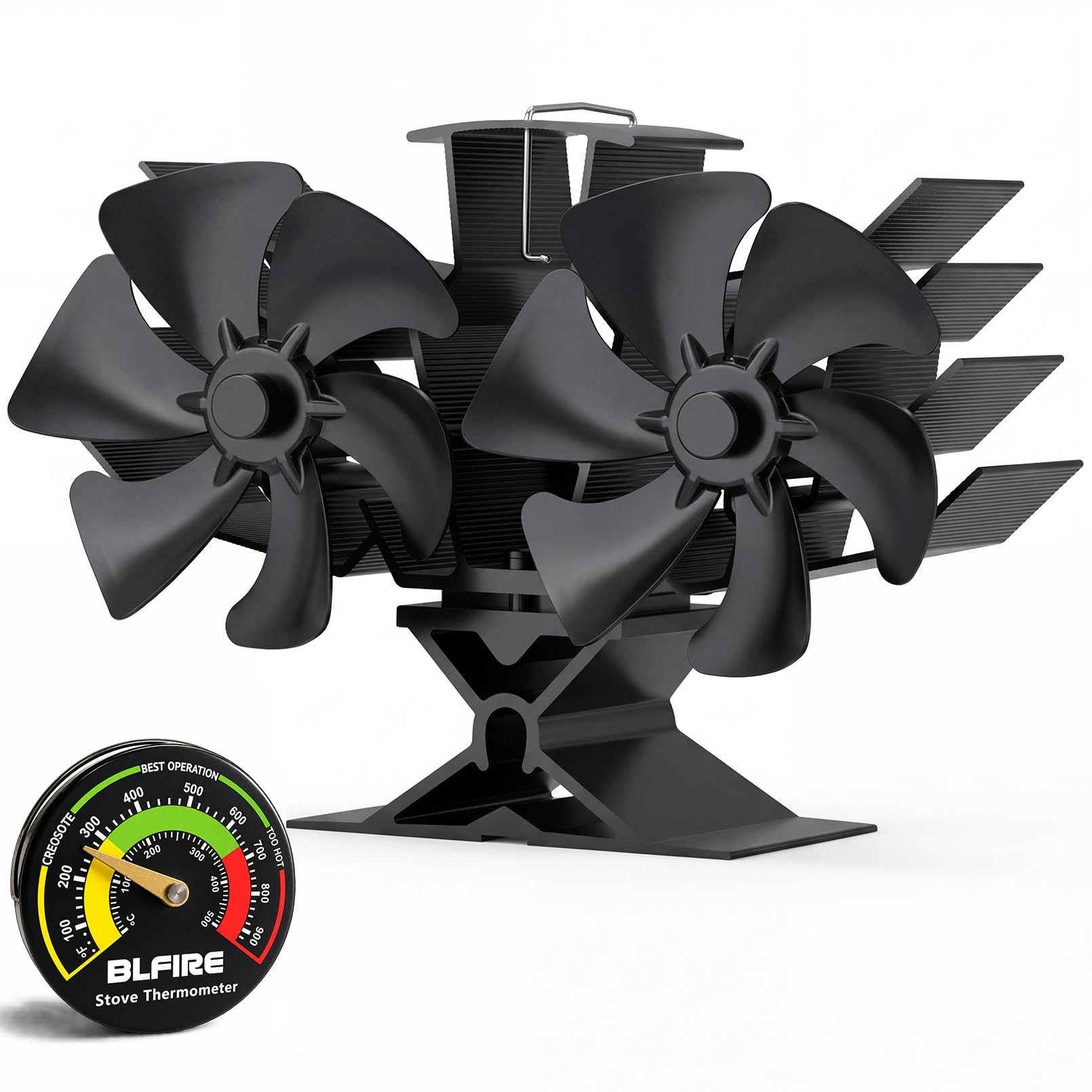
A dual-motor fan that keeps pushing warm air even when the fire is burning low.
Some fans need a roaring fire to get going. This one is noted for working well even at low heat settings and in remote cabins — exactly what you want on a mild evening when the stove is not cranked, or off-grid when you are stretching every log. It runs on heat alone, so a power cut changes nothing: the fan keeps moving air as long as there is warmth under it.
You get protection built in: the dual-motor design is paired with a temperature-sensing module at the base that lifts the fan slightly when things get too hot, keeping it off direct contact with a hot stove. A thermometer in the box lets you watch the fireplace temperature as you go. The noise level is listed at 20 dB, which is about as quiet as a fan gets. The aluminum body with a bracket makes it at home on a Buddy heater as well as a wood stove — useful for emergency heating, a propane tent heater, or a winter fishing shelter.
The catch to weigh is air volume. Warm-air movement is the most argued-about point on this fan: it moves heat effectively for some rooms and comes up light for others, so it suits a small-to-medium space better than an open-plan one. The size at 4.25 x 6.06 x 8.5 inches is compact, and it needs no installation beyond setting it in place. If your stove runs low and slow, that is where this fan shines.
The sells
- Works well at low heat settings and in remote cabins
- Listed 20 dB noise level, among the quietest here
- Temperature-sensing base lifts to prevent overheat damage
- Runs on heat alone through a power outage
The counters
- Air volume draws mixed opinions in larger rooms
- Better suited to small-to-medium spaces than open-plan
- No installation, so it must sit flat to stay aimed
The fit for: low-burning fires, cabins, and heaters where a gentle, silent push of warm air is enough.
Not enough if: your space is wide and open and you need maximum air moved.
8. HIDALIFE Wood Stove Fan with Thermometer, 6 Blades

A compact six-blade fan that starts spinning in about 30 seconds and weighs just 1.7 pounds.
Start with the weight: 1.7 pounds against the 1.8 pounds of the Caframo — a featherweight you can lift off the stove top with two fingers when you want to load more wood. It stands 7.9 inches tall on a 2.2 x 3.5-inch footprint, so it tucks onto a narrow stove top where a wider fan would not sit. The body is high-quality anodized aluminum, which is rust-proof and conducts heat well, so it warms up and starts work quickly.
Reviewers point out the fan is extremely quiet and starts spinning within 30 seconds, and one mentions it is perfect for a woodstove. It leans on the heat differential to power its motor — a thermoelectric effect, meaning the difference between the hot base and the cooler top drives the fan with no battery or plug. For a fireplace insert or a small stove, that quick, gentle start is the whole appeal: no switch to flip, no waiting for the room to warm up before the fan kicks in.
The honest trade-off is airflow. Heat spread is described as fairly even, but the raw air moved draws mixed notes in bigger rooms, and the small footprint with a touch control means it is best on a flat, narrow top plate. If you have a large open room and expect the fan to throw heat across it, look at the 180 cfm pipe fan above. For a compact stove or an insert and a modest space, this is the easy, light pick.
The quick-start angle: a 30-second spin-up and 1.7-pound body make it the least fussy fan to live with on a small stove.
Sized for inserts: the narrow 2.2 x 3.5-inch base fits where a wider fan crowds the top plate — measure before you commit.
Cool for: fireplace inserts, small stoves, and narrow tops that need a light, quick-starting fan.
Worth a pass if: your room is large and you need the biggest possible air push.
9. Ecofan Original Heat Powered Stove Fan 100 CFM

The Canadian-made original with FingerSafe blades, 100 cfm, and spare motors you can actually buy.
What separates this Ecofan from the cheaper heat-powered fans is longevity support. The maker lists replacement motors, a strong warranty, and a design and build in Canada that has been running since 1955. That matters in a category where motors give out — a fan you can repair outlasts one you throw away. It moves 100 cfm of air through a two-blade system built to minimize motor resistance, and it starts working at optimal wood stove temperatures so warmth spreads faster.
The blades are FingerSafe, which is a small but real comfort when you are adjusting a hot fan by hand. The larger 7.9-inch blades are what carry the push past the 100 cfm mark, and the classic black look sits comfortably on most stoves. It is free-standing, needs no cord, and runs on heat alone, so it keeps working through an outage. Shoppers say it starts quickly and the fan speed climbs as the stove gets hotter — a natural fit for the way a fire builds through the evening.
The trade is the same one the Caframo carries: two blades give a measured push rather than a rush. In a big open room you may find the spread gentle, and at the higher end of the price range you are paying for the Canadian build and the repair path rather than raw air volume. If you want a fan you can repair rather than replace, this is the one; if you want maximum air moved per minute, the 180 cfm pipe fan leads on that number.
The keeper: replacement motors and a long-standing Canadian build mean this is the fan you fix, not replace — unusual in heat-powered fans.
The honest limit: two blades and 100 cfm are a measured push, not a blast, so an open-plan room may want more.
Pick this when: you want a quiet, repairable fan with FingerSafe blades for a standard wood stove.
Not this one if: raw airflow in a big room is your priority over longevity.
Know the Specs
CFM (Cubic Feet Per Minute)
CFM measures how much air the fan moves each minute — it is the fairest way to compare fans. The Caframo Ecofan Original and the Ecofan Original both list 100 CFM, the Hongso blower lists 86 cfm, and the Thermoelectric pipe fan lists up to 180 cfm. A bigger room needs a bigger CFM number to feel a difference; a small insert can do with less. Remember the figure is a maximum, and the actual push depends on how hot your stove runs.
Operating Temperature Range
Heat-powered fans have a temperature window where they spin well and a ceiling they must stay under. The Caframo Ecofan Original works on 300F to 650F surfaces. The Tomersun lists an optimal range of 392°F to 482°F (200°C to 250°C) and warns against exceeding 572°F (300°C). Exceed a fan’s ceiling and you risk the thermoelectric module. That is why a magnetic thermometer and a bimetallic safety strip are worth having.
Common Questions
Do I need to plug a wood stove blower fan into a wall outlet?
Will a stove-top fan work on a flue pipe instead?
How hot does my stove need to get before the fan spins?
Does a wood stove blower fan actually save fuel?
What is the difference between a stove-top fan and a pipe blower?
Can I use a heat-powered fan on a propane Buddy heater?
Why does my fan lift off the stove when it gets hot?
How loud is a heat-powered wood stove fan in a quiet room?
Does blade count mean more airflow?
Can I leave a heat-powered fan on the stove overnight?
The Bottom Line
For most homes with a flat-top wood stove, the fan to buy is the Caframo Ecofan Original — a heat-powered fan rated to move 100 CFM, working across a 300F to 650F surface range, and quiet enough to live beside. It is also the crowd favorite, holding 4.5+ stars across 500+ ratings, and it wins people over by simply doing its job. If your stove top is full and you want the strongest air move, the Thermoelectric 180CFM pipe fan leads on airflow by a clear margin. And for campers splitting time between a wood stove and a propane Buddy heater, the Sckee Buddy Heater Fan is the one that travels with you.
How we choose
We do not accept paid placement. Every pick is matched to a real buyer and a real use-case; we do not hands-on test units.
Sources
Specifications: manufacturer listings and product documentation. Review insights: verified customer reviews, as of November 2026. Pricing: not shown on this page (it changes often); check the current price via the retailer link.
As an Amazon Associate, Tactical Gear Guy earns from qualifying purchases. This does not affect which products we feature.