Specs are compiled from manufacturer listings and verified buyer reviews and can change over time — please confirm the key details on the product page before buying.
Buying the wrong workout bike usually shows up in week three, not day one. The seat digs in, the pedals chatter loud enough to wake the house, or the console dies while you are mid-climb. This guide focuses on the one thing that keeps a bike in your living room past January: whether it actually fits your body and your home, not just the spec sheet.
This guide is built by comparing the manufacturers’ published specifications and the patterns across verified customer reviews, so you get each pick’s real strengths and trade-offs instead of marketing spin.
Resistance type, flywheel weight and adjustability decide whether a bike feels smooth or fights you every pedal stroke. I ranked nine home bikes by build, quietness and fit so you can pick the right one for your space and stride length and start riding sooner. These are the workout bikes for exercising that earn their floor space.
Top Picks

How To Choose The Best Workout Bikes for Exercising
The recipe for a bike you keep riding is boringly practical: it has to fit your leg length, sit steady under your weight, and stay quiet enough that you do not think twice about a 6 a.m. session. Get those three right and the resistance type and app extras become nice bonuses rather than deal-makers. Get them wrong and no amount of virtual courses will save the bike from becoming a clothes rack.
Match the inseam range, not the marketing photo
A bike fits when your leg reaches near-full extension at the bottom of the stroke. Recumbent and upright models list a seated leg range or a rider height band, and that band is the first thing to check. The MERACH recumbent, for example, states an extended seated leg length of 28.35 to 35.43 inches for riders roughly 5’2″ to 5’10”. If you sit outside the listed band, the seat post simply will not reach the right spot and your knees will pay for it.
Decide between magnetic and friction resistance
Magnetic resistance (magnets that move closer to the flywheel to add tension) tends to run quiet and need almost no upkeep. Friction bikes press a pad against the wheel, which can be cheaper to build but usually means more maintenance over time. For a shared living space, magnetic is the calmer choice.
Weigh the flywheel against your floor and your neighbors
A heavier flywheel (the spinning wheel that keeps momentum going) gives a smoother, more road-like pedal stroke. It also adds bulk and pounds, which matters if the bike lives upstairs or gets moved. A 25 lb wheel and a 44 lb wheel feel different underfoot, and the lighter one is easier to shift around a small room.
Side-by-Side Comparison
| Model | Best For | Resistance | Weight Capacity | Drive | Amazon |
|---|---|---|---|---|---|
| MERACH Recumbent S19★ Best Overall | Seniors and back-support riders | 8 levels | 330 pounds | Belt | Amazon |
| YPOO BC710Quietest Spin | Small apartments and app riders | 0-100% infinite | 300 pounds | Belt | Amazon |
| YOSUDA Exercise Bike 002Budget Crowd Favorite | First-time budget buyers | Friction pad | 300 pounds | Belt | Amazon |
| MERACH MR-S38 | App-driven interval training | 16 levels | 300 pounds | Belt | Amazon |
| Wenoker JC318 | Heavier riders and family use | 8 levels | 350 pounds | Belt | Amazon |
| Schwinn Fitness 130 | Program variety and Bluetooth | 16 levels | 300 pounds | Belt | Amazon |
| Sunny Health & Fitness | Studio-style heavy flywheel feel | Magnetic micro-adjust | 330 pounds | Belt | Amazon |
| Schwinn IC4 | App-class riders, high intensity | 100 magnetic levels | 330 pounds | Belt | Amazon |
| Peloton Bike+ | Screen-led guided training | Auto resistance | 297 pounds | Belt | Amazon |
Detailed Reviews
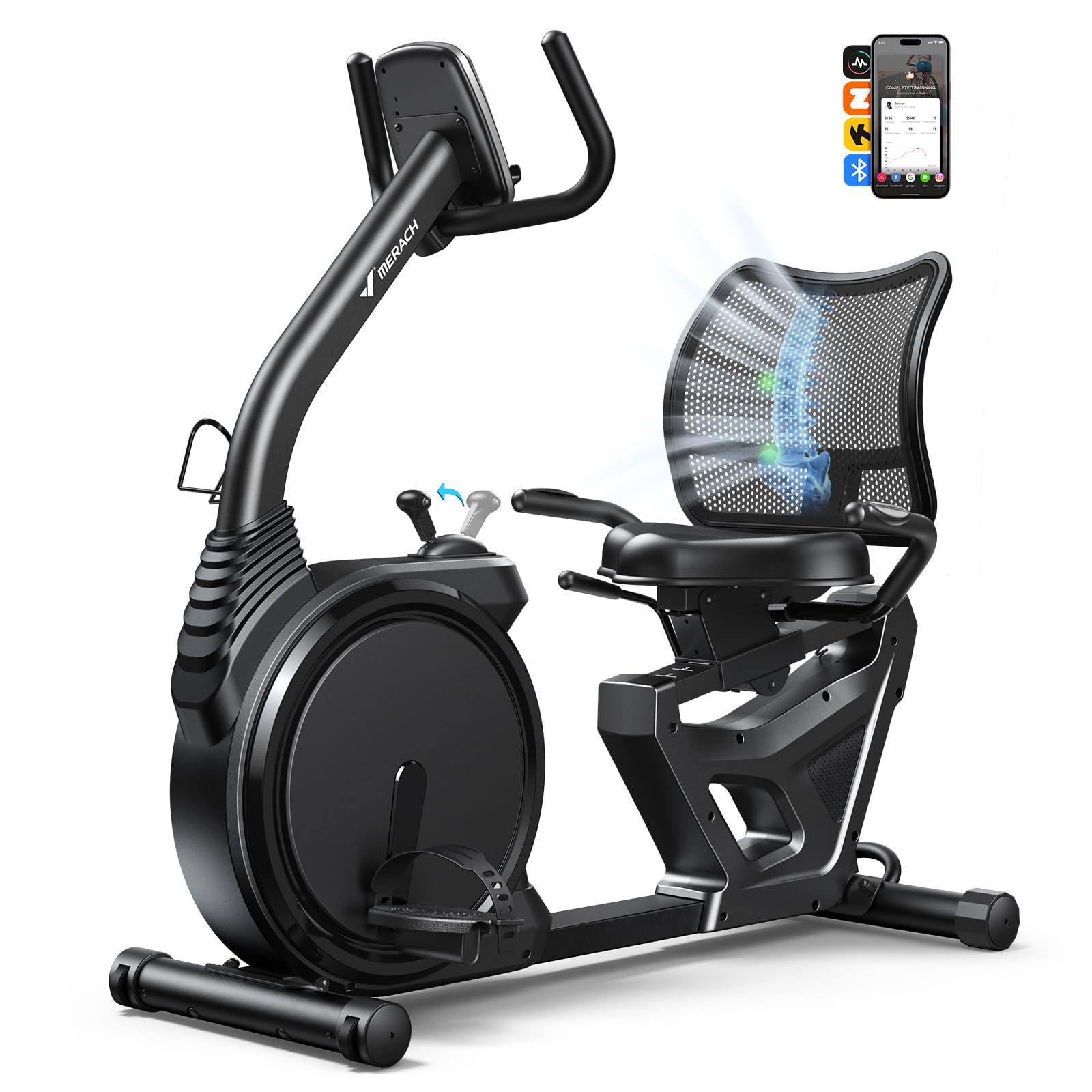
1. MERACH Recumbent Exercise Bikes for Home High-end
Our pick — 4.5+★ from 900+ verified ratings; the strongest balance of quality and price.
The recumbent that puts a backrest behind you and a lever under your hand.
Most home bikes ask you to hunch forward over the bars. This one is a recumbent, meaning you sit back in a wider seat with a mesh backrest supporting your spine while your legs reach forward to the pedals. The clean design win is a car-style lever on the handlebar that shifts through 8 resistance levels with one movement, so you are not reaching down between your knees mid-climb.
What wins people over is the build, and the numbers back the reputation: quality is the most-praised trait here, with assembly close behind. It arrives 80% pre-assembled, and the maker states setup takes about 30 minutes with the included video. It carries a 330 pound weight capacity and a 6.6 lb perimeter-weighted flywheel, which gives momentum without turning the bike into a tank.
The trade-off is honest: the seat adjustment leaves some riders colder than others, so tall or long-legged buyers should check the 28.35 to 35.43 inch extended seated leg range against their own measurements before ordering. It is also a long footprint at 48.03″D x 23.62″W x 46.46″H, so measure your floor. For anyone who wants to exercise without leaning over a race bar, this is the comfortable one.
What holds up in daily use
- Backrest and thicker seat make long sessions easier on your spine
- 8-level car-style lever shifts resistance without breaking your stroke
- 330 pound capacity and a 6.6 lb flywheel keep the ride grounded
- 80% pre-assembled with a video walkthrough
Where it asks you to check first
- Seat adjustability is the mixed note — long-leg riders may want more reach
- Nearly 85 pounds means it is not a bike you tuck behind a sofa
Reach for it when: you want recumbent support, a quiet belt drive and a setup that finishes in about half an hour.
Measure your inseam first: the seated leg range tops out at 35.43 inches, so very long legs will feel the limit.
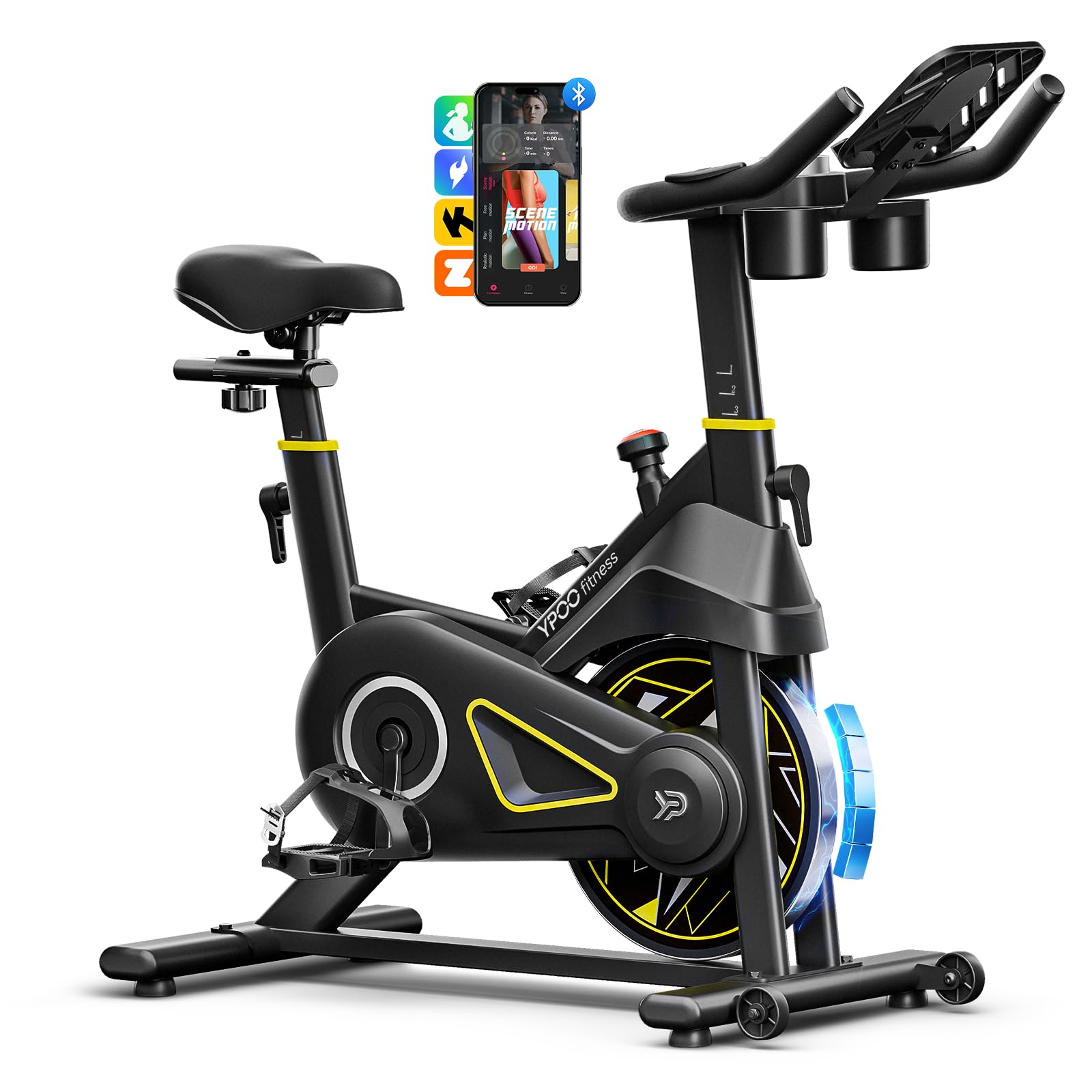
2. YPOO Exercise Bike 330LBS
Built for a shared wall and a sleeping neighbor: an under-25dB belt drive.
Few apartment riders think about decibels until the downstairs tenant starts tapping the ceiling. YPOO rates this bike under 25dB, roughly library-level while pedaling, thanks to the belt drive and magnetic resistance. The footprint is 32.9″D x 19.3″W x 44.5″H — noticeably shorter than the MERACH recumbent’s 48 inch depth, so it tucks into tighter rooms.
Resistance here is 0-100% infinite rather than stepped, so you can dial a tiny increase for a slow hill climb or a full push for sprints. The YPOOFIT app syncs courses and also works with KINOMAP and Zwift. Riders from 4’8″ to 6’1″ get a 4-way adjustable seat and height-adjustable handlebars, which covers most body types.
The catch: reliability gets mixed notes, with a small share of reports about the display quitting after a few months. It is worth understanding the warranty and support terms before you commit. Comfort and fit also draw some disagreement, so the oversized seat is a try-it-and-see detail. It arrives 80% pre-assembled, with about 30 minutes of setup left.
Why the apartment crowd likes it: the under-25dB rating and compact depth are exactly what a small shared space needs, and magnetic resistance keeps upkeep low.
The reliability question: the display has drawn mixed feedback, so treat the console as the part to watch and keep your support channel handy.
Choose it for: a quiet, compact spin bike that works with Zwift and KINOMAP without eating your floor.
Think twice if: you want proven long-term console reliability over app flexibility.
3. YOSUDA Exercise Bike
The orange workhorse that has logged more home gym hours than any bike on this list.
YOSUDA has been making home fitness gear for over 20 years and the review volume here tells its own story. With a 25 lb flywheel and a heavy-duty steel frame rated to 300 pounds, this bike is designed for the budget rider who wants a real spin feel without a premium sticker. The belt drive is quieter than a chain and the adjustable cage pedals keep your feet planted at speed.
You get straightforward comfort at this price: riders from 4 feet 8 inches to 6 feet 0 inches fit, thanks to a two-way handlebar (adjusts up and down) and a four-way padded seat (adjusts up, down, forward and back). The LCD (a small screen that shows your ride data) tracks your workout, and a tablet holder keeps entertainment on screen. The Smart App adds Bluetooth virtual riding and competitions, which is uncommon at this level.
The wrinkles: seat comfort and noise draw mixed notes, so expect to possibly add a seat cushion and to hear an occasional squeak. Assembly runs about 30 minutes with the online video, and the frame’s stability under high-effort intervals is the reason it stays in the rotation.
The value read: a 25 lb flywheel, belt drive and app support at the entry tier is genuinely hard to match, and the 300 pound rating covers most riders comfortably.
Quiet down the extras: a seat pad and a little lubrication go a long way, since seat comfort and squeaks are the recurring gripes.
Ideal for: first-time buyers who want a stable steel frame and app training without overspending.
Not for you if: you need a whisper-quiet ride and a plush seat straight from the box.
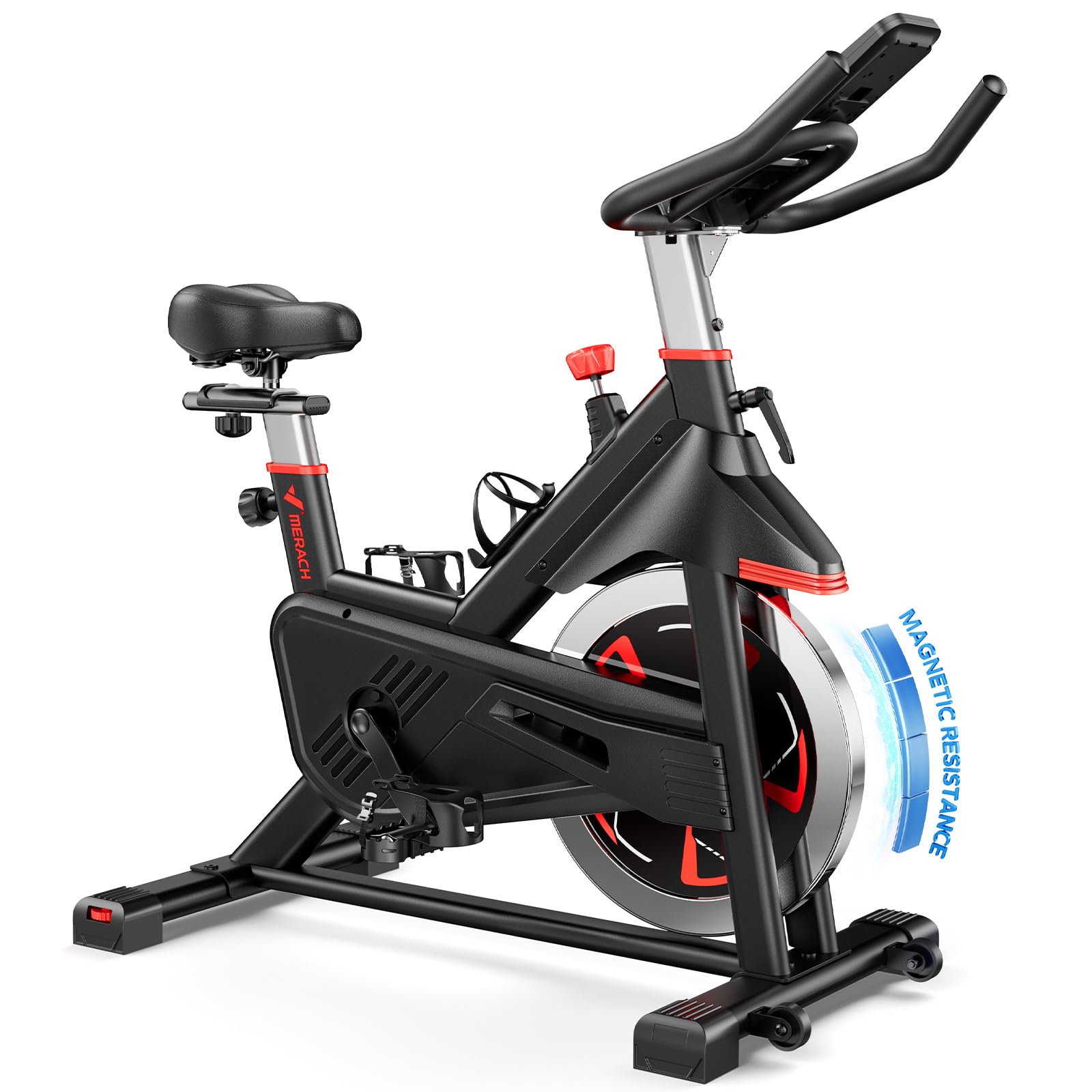
4. MERACH Magnetic Exercise Bike
Seated interval training with a dual-spring seat and app-synced resistance.
Here is a fact most riders miss: this bike carries 16 resistance levels, double the 8 on the MERACH recumbent above. The levels only show inside the Merach app, where the bike feeds real-time stats like resistance, distance and calories and can sync to Google Fit or Apple Health. If you ride by feel rather than by numbers, that setup matters; if you like a plain console, it may feel redundant.
The 0-100% infinite adjustment lets you dial any intensity between light spins and climbs, and the durable stainless steel dual-triangle frame holds 300 pounds for riders from 4’8″ to 6’2″. Performance is the strongest praise category for this model, with noise level a close second — MERACH rates it under 25 dB, so quiet comes standard. A high-density foam seat with dual-spring suspension helps when you are doing longer sessions.
Adjustability and Bluetooth connectivity get mixed notes, so the app experience may take a little patience at first. At 58 pounds and 44.9″D x 20.5″W x 47.2″H, it is a proper gym bike footprint, not a foldaway. The 12-month warranty softens the entry decision.
The interval case: 16 app-displayed resistance levels plus real-time metrics make structured intervals easier than guessing by feel.
Where it stumbles: Bluetooth and adjustability both draw mixed feedback, so expect a settling-in period with the app.
Pick this for: riders who like to track resistance and output inside an app while training in intervals.
Look past it if: you prefer a simple on-bike display without a phone in the loop.
5. Wenoker Magnetic Exercise Bike
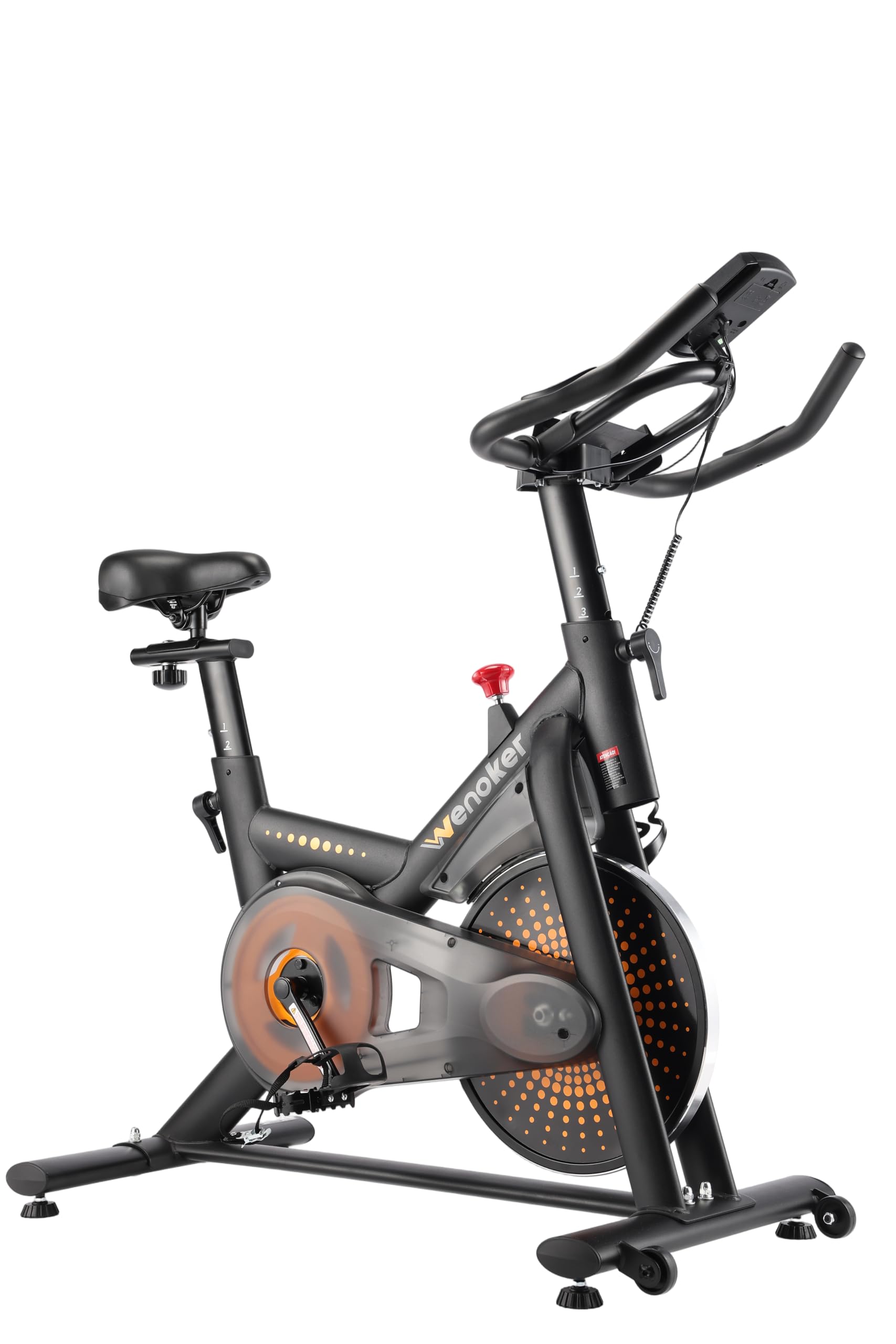
The load-bearing pick: a 350 pound frame that keeps steady through hard sprints.
Most home bikes rate 300 pounds. The Wenoker holds 350, which is the highest capacity on this list and a real difference for heavier riders or shared family use. The reinforced thickened steel multi-triangle support frame is built to dial out the shake and wobble that shows up when you stand and sprint or when a heavier rider settles in for a long steady session.
Fit comes courtesy of a 4-way adjustable padded seat and multi-angle adjustable handlebars, so multiple people in one household can each find their spot. The LCD tracks time, speed, distance and calories, and a tablet bracket plus water bottle holder keep you occupied. Eight resistance levels via a belt-driven magnetic system round out the ride feel.
Sturdiness and compact size both draw praise, and the mostly pre-assembled frame takes about 30 minutes to finish. The honest note: seat comfort and adjustability get mixed feedback, and at 62 pounds you will want two people for the initial placement. It is the sturdiest of the budget-leaning picks, and the review tone backs that in.
Why riders vouch for the build
- 350 pound capacity is the top figure in this lineup
- Multi-triangle steel frame is stable under sprint intervals
- Compact footprint fits a living room or home gym
- Arrives mostly pre-assembled, about 30 minutes to rideable
The honest asterisk
- Seat comfort and adjustability split opinion, so a cushion may help
Suits: heavier riders and families who want a rock-steady frame with the highest load rating here.
Consider skipping if: you want a plusher stock seat or finer resistance steps than eight levels.
6. Schwinn Fitness 130 Upright Bike
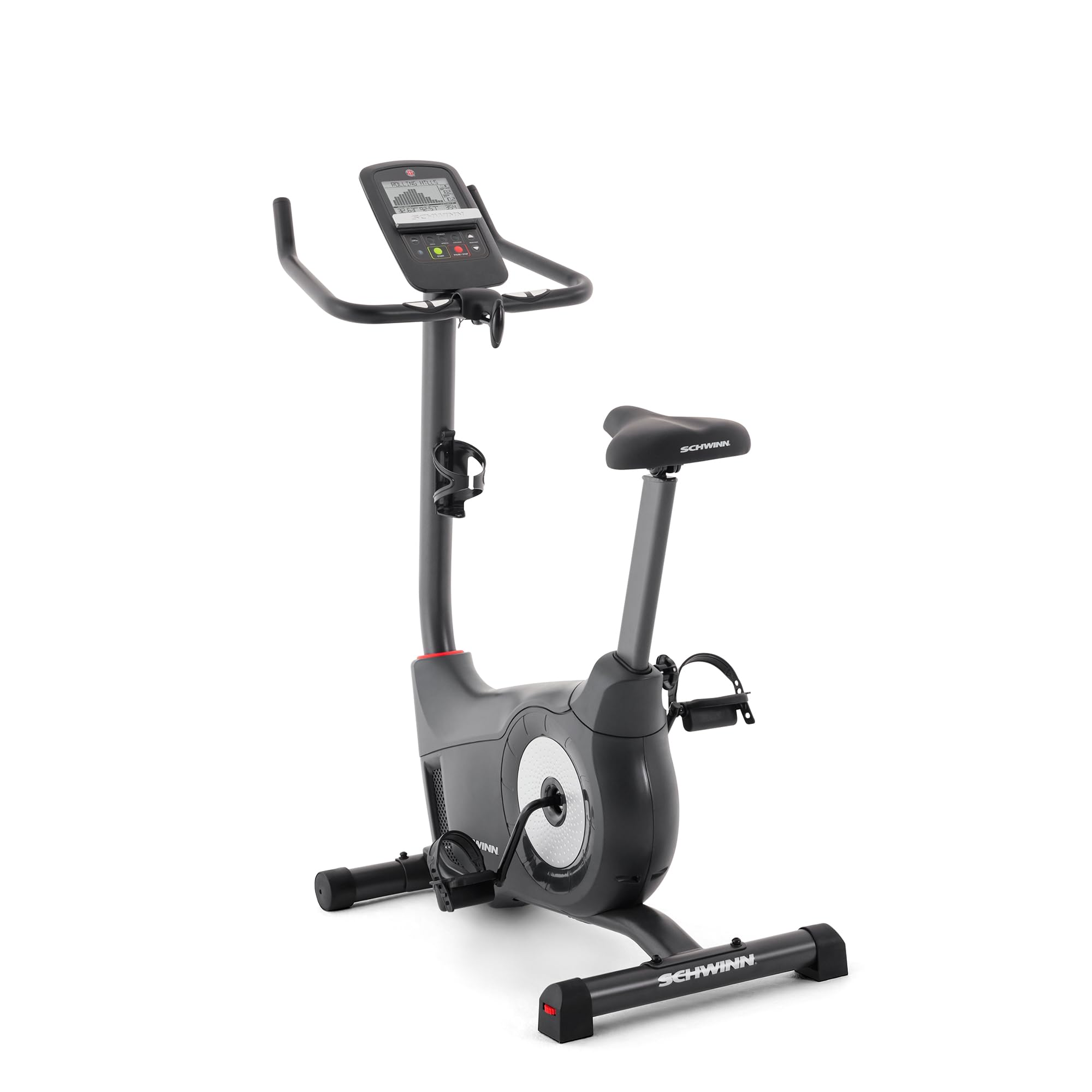
An upright bike that turns workouts into guided programs instead of guesswork.
The Schwinn 130 sits you upright over a 5.5″ LCD with 13 built-in workout programs, so you are not staring at a blank console wondering what to do. Magnetic resistance runs across 16 levels, and the telemetry heart rate plus grip-pulse sensors let you ride a heart rate program without a separate chest strap. Bluetooth syncs progress to popular tracking apps.
Effectiveness and value are the dominant positives here, with quiet operation close behind. The high-speed, high-inertia flywheel does a lot of the work behind that smooth, quiet ride, and the ergonomic grip heart rate is placed to keep your posture relaxed. Riders who want one bike that runs the session for them will feel the difference.
Console function is where the mood splits — some units work flawlessly, others show issues, so it is worth confirming the return window. Seat comfort also splits opinion, so a pad may be a small upgrade. Assembly is required with standard instructions and the footprint is 41.3″D x 21.4″W x 56.6″H, so check your ceiling height before you commit.
Program-first training: 13 programs and telemetry heart rate let the bike lead the session rather than you improvising.
The console caveat: functionality is the mixed note, so verify warranty and return options up front.
Best fit for: riders who follow structured programs and want built-in heart rate guidance on an upright bike.
Pause if: you want a bulletproof console or cannot accommodate a 56.6 inch tall frame.
7. Sunny Health & Fitness Exercise Bike

A 44 pound flywheel that carries momentum like a real studio bike.
The headline number is the flywheel: 44 pounds, which is far heavier than the 25 lb wheel on the YOSUDA and the 6.6 lb wheel on the MERACH recumbent. That mass is why the pedal stroke keeps rolling between pushes, so it feels more like riding outdoors than spinning a light wheel. The push-down emergency brake stops the wheel immediately, and the steel frame carries 330 pounds.
Magnetic resistance here replaces the strap-and-pad friction design and is virtually maintenance-free, with the tension adjusted by moving the magnets toward the flywheel. The belt drive keeps it smooth and silent, needs no oil and is lighter than a chain. The seat adjusts fore/aft and up/down for a claimed inseam range of 29 to 39 inches, which is one of the widest fits in this group.
The recurring gripe is the resistance adjuster: some riders find it hard to tighten the tension properly, so plan to dial it in carefully. At 135.6 pounds this is a heavy, planted bike that is not moving once it is placed. Riders who want that studio feel will find it right at home.
Momentum you can feel: the 44 lb flywheel is the heaviest on this list and gives the pedal stroke a rolling, road-like carry.
Dial in carefully: the resistance system draws mixed notes on ease of tightening, so expect a learning curve on tension.
Built for: riders chasing a heavy-flywheel, gym-style spin feel with a wide 29 to 39 inch inseam range.
Not the one if: you need something light or want silky resistance adjustments from day one.
8. Schwinn Fitness IC Indoor Cycling Bike Series

One hundred micro-adjustable steps of resistance and a set of dumbbells on board.
The dual-sided pedals take SPD clips on one side and toe cages on the other, so both cycling-shoe and sneaker riders are covered. A full-color backlit LCD tracks heart rate, speed, time, distance, calories and RPMs.
The bike is built to pair with Peloton and Zwift, and a JRNY Mobile-Only Membership comes free for 2 months to get you started. There are 200+ virtual courses with adaptive workouts, cradles holding a set of 3 lb dumbbells for off-bike strength work, a USB port to charge your tablet and transport wheels to move it. Quality is the strongest praise category by a wide margin, with the whisper-quiet flywheel close behind.
The real caveat is comfort — seat comfort draws mixed notes, so many riders add a pad or swap the saddle. At 112 pounds and 54.6″D x 30.7″W x 51.8″H, it takes up a genuine corner. Assembly is required and it pairs smoothly once built.
What makes it a class-chaser
- 100 magnetic resistance levels let you match instructor call-outs closely
- Dual-sided pedals cover both SPD clips and sneakers
- 3 lb dumbbell cradles and a USB port extend the session
- Whisper-quiet flywheel and a 330 pound frame
What you give up
- Seat comfort is mixed — plan for a pad or saddle swap
Made for: app-class riders who want fine resistance control, clip-in pedals and a stable frame.
Be ready for: a large footprint and a saddle that may need replacing for long rides.
9. Peloton Exercise Bikes

A 23.8″ screen that swivels 360 degrees and turns the bike into a full studio.
The Bike+ is the most screen-forward pick here, built around a 23.8″ Full HD swivel touchscreen that rotates a full 360 degrees. Auto resistance matches the instructor’s cues without you touching a knob, and the on-screen metrics show cadence, output and resistance in real time. The same screen moves off the bike for 15+ workout types like strength, yoga, Pilates and barre.
Setup is straightforward — one person can assemble it — and a Custom Workout Generator plans sessions around your goals and schedule. The Movement Tracking Camera powers a Live Rep Tracker so you focus on the movement rather than counting reps, and an integrated fan has three whisper-quiet settings. Bluetooth 5.2, USB-C charging and front-facing speakers round out the package.
Two things to know: the All-Access Membership open up the full content library and features across your Peloton hardware, so budget for that recurring cost. And the bike supports riders from 4’11” to 6’5″ up to 297 pounds, which is a narrower weight ceiling than several bikes here. At 187 pounds it plants itself firmly and stays put.
The screen does the coaching: 360-degree swivel plus auto resistance means you follow along without fumbling for resistance mid-class.
Mind the membership: full access to the class library and features runs on an All-Access Membership, so that is a real ongoing line item.
Right for: riders who want guided, screen-led training across cycling and off-bike workouts in one unit.
skip it if: you weigh more than 297 pounds or want a bike with no subscription tied to it.
Know the Specs
Flywheel weight (in pounds)
The flywheel is the heavy spinning wheel that keeps your pedals moving between pushes. A heavier wheel carries momentum, so the ride feels more like the road: the Sunny Health & Fitness uses a 44 lb flywheel. A lighter wheel spins up faster but feels less weighted underfoot: the YOSUDA uses 25 lb and the MERACH recumbent uses 6.6 lb. Weight also affects how heavy the whole bike is to move, so balance ride feel against if you need to relocate it.
Resistance type and levels
Resistance is what makes pedaling harder. Magnetic resistance moves magnets closer to the wheel and runs quiet with little upkeep; friction resistance presses a pad against the wheel and may need more attention. The number of steps matters for fine control: the Schwinn IC4 gives 100 micro-adjustable levels, the MERACH MR-S38 gives 16, and the Wenoker and MERACH recumbent give 8. More levels lets you nudge intensity in tiny increments instead of big jumps.
Weight capacity (in pounds)
Capacity tells you the maximum rider weight the frame is rated to hold, and it is a rough proxy for how much steel is in the build. The Wenoker rates highest here at 350 pounds, several bikes sit at 330, and a few top out at 300. If you share the bike with a larger member of the household or simply want a margin of safety, choose a higher rating — it usually means a beefier frame and steadier ride.
Inseam range and fit
Fit is set by the seat’s adjustable height and, on many bikes, its fore/aft position. A bike that lists a seated leg range or rider-height band is telling you who it can fit. The Sunny Health & Fitness covers a 29 to 39 inch inseam, the MERACH recumbent covers 28.35 to 35.43 inches, and the YPOO fits 4’8″ to 6’1″. Always compare against your actual measurement; the wrong range means knee strain or an unreachable pedal.
Common Questions
Is a magnetic resistance bike better than a friction pad bike for home use?
How do I know if a workout bike will fit my leg length?
Do I need a heavy flywheel for a good workout?
Will a spin bike disturb the neighbors in an apartment?
Is the Peloton Bike+ worth it compared with a standard spin bike?
Can I use clip-in cycling shoes on these home bikes?
How much assembly do these workout bikes require?
What weight capacity should I look for in a home exercise bike?
Do these bikes work with apps like Zwift and Peloton?
How long should a home workout bike last?
The Bottom Line
The workout bikes for exercising that earns the top spot for most people is the MERACH Recumbent S19 because its backrest, 8-level lever and 330 pound frame make long sessions easy on the spine. For riders chasing a studio feel with a heavy flywheel, the Schwinn IC4 leads on fine resistance control with 100 magnetic levels. If budget is the driver, the YOSUDA delivers a stable steel frame and app training at the entry tier. The recumbent is the pick for riders who want back support, a quiet belt drive and a 30-minute setup.
How we choose
We do not accept paid placement. Every pick is matched to a real buyer and a real use-case; we do not hands-on test units.
Sources
Specifications: manufacturer listings and product documentation. Review insights: verified customer reviews, as of November 2026. Pricing: not shown on this page (it changes often); check the current price via the retailer link.
As an Amazon Associate, Tactical Gear Guy earns from qualifying purchases. This does not affect which products we feature.