Specs are compiled from manufacturer listings and verified buyer reviews and can change over time — please confirm the key details on the product page before buying.
Stove pipe is the cheapest part of a wood stove setup and the one most likely to go wrong. A fixed-length connector means cutting steel in your living room. A pipe rated for the wrong clearance means your wall gets hot. A double-wall pipe and a single-wall pipe are not interchangeable, even when both say “6-inch” on the box. This guide sorts that out for you: which connectors telescope, which ones hold 18 inches of clearance, and which ones you should not put outside.
This guide is built by comparing the manufacturers’ published specifications and the patterns across verified customer reviews, so you get each pick’s real strengths and trade-offs instead of marketing spin.
You will see the difference between a stove connector and a chimney section, why gauge and wall count change everything, and where a telescoping length saves you a fabrication job. Here is the straight read on the wood stove pipe that actually fits your flue, your clearance and your install.
Top Picks


How To Choose The Best Wood Stove Pipe
Start with the distance, not the brand. Measure from the top of your stove collar to the bottom of your chimney connection. If that gap is somewhere between 18 and 30 inches on one install and 38 to 70 inches on another, only a telescoping pipe covers both without cutting. That one measurement prevents more wrong purchases than any spec on the box.
Single wall or double wall, and what clearance you actually have
A single-wall connector is one layer of steel and needs a minimum 18-inch clearance to combustible materials — walls, ceilings, wood mantles. A double-wall pipe carries an air gap between an inner liner and an outer casing, which cuts that required clearance dramatically. If your stove sits tight to a wall, single wall is the wrong choice no matter how good the steel is. Measure the gap between pipe and wall before you buy anything.
Steel gauge and seam construction decide how long it survives
Thicker sheet holds its round shape while you wrestle it into place, and a round pipe seats into the next section without gaps. Gauge numbers run backwards — a lower number is thicker steel. A laser-welded seam or a lock-seamed fitting keeps the joint tight so smoke goes up the flue instead of into the room. Die-formed ends mean you slide two sections together instead of crimping them by hand.
Where the pipe is allowed to go
A connector pipe links a stove to an approved chimney. It is not meant to pass through a wall or ceiling, and most are not built to sit outside in the weather. Look for a connector that states it connects to any brand of Class-A insulated chimney pipe, so your last joint is not a brand-locked dead end.
Side-by-Side Comparison
| Model | Best For | Wall Type | Length | Diameter | Amazon |
|---|---|---|---|---|---|
| DuraVent DuraBlack 6DBK-TL★ Best Overall | Tight wall builds | Single wall | 44–68 in telescoping | 6 in | Amazon |
| AllFuel HST 18″–30″ TelescopingBest Short Run | Short stove-to-chimney runs | Single wall | 18–30 in telescoping | 6 in | Amazon |
| DuraVent DuraBlack Stainless 48″Stainless Build | Corrosion resistance | Single wall | 48 in fixed | 6 in | Amazon |
| Yaocom 6″ Telescoping Pipe | Rigid budget install | Single wall | 18–30 in telescoping | 6 in | Amazon |
| Selkirk Metalbestos 266036 | Insulated chimney join | Double wall | 36 in fixed | 6 in inner / 6.5 in outer | Amazon |
| AllFuel HST 38″–70″ Telescoping | Tall ceiling runs | Single wall | 38–70 in telescoping | 6 in | Amazon |
| Rockford Chimney Supply 6in x 48in | Seam strength | Single wall | 48 in fixed | 6 in | Amazon |
| DuraVent DVL Double-Wall 6DVL-68TA | Close-clearance installs | Double wall | 40–68 in telescoping | 6 in | Amazon |
| Selkirk SureTemp 206148 | High-heat chimney venting | Double wall insulated | 48 in fixed | 6 in | Amazon |
Detailed Reviews
1. DuraVent DuraBlack 6DBK-TL Single Wall Telescoping Pipe
Our pick — 4.5+★ from 450+ verified ratings; the strongest balance of quality and price.
The connector that slides to fit instead of forcing you to cut steel in the living room.
This is the pick for the install where your stove-to-chimney gap lands somewhere awkward and you do not want a fabrication job. It stretches from 44 inches to 68 inches, so you dial in the exact height instead of buying three fixed sections and crimping the ends yourself. Die-formed fittings on both ends mean the male and female halves simply slide together for a drip-free joint.
The steel is listed as 0.02-inch alloy construction with a lock-seamed design, and at 7 pounds it is light enough to hold in one hand while you line up the flue. The 6-inch interior diameter is the common nominal size, and the maker calls for 18-inch clearance to combustibles — a number you need to check against your wall before ordering, not after. Ease of installation is the reputation this pipe carries, and the sliding two-section design is the reason: the sections pass each other smoothly so you are not fighting a friction fit.
Here is the honest part. Fit comes through as genuinely mixed, so measure your stove collar and chimney socket rather than trusting “6-inch” alone. And a few buyers report an odor on first burns — that fades. The 4.5+ star record across 400+ buyers on a limited-lifetime warranty tells you most people get a clean install out of it.
What earns it the top spot
- Telescopes across 44 to 68 inches, so you skip field cutting and crimping entirely.
- Die-formed male and female ends slide together for a drip-free seal.
- 0.02-inch alloy steel with a lock-seamed design holds its shape during fitting.
- Backed by a limited lifetime warranty.
Where you need to be careful
- Fit is the most-discussed mixed point — confirm your actual collar size first.
- 18-inch clearance to combustibles is required, so close wall builds are out.
- Expect a light first-burn smell that works its way out.
Buy this one if: your flue gap falls between 44 and 68 inches and you want it solved in one part.
Think twice if: your stove sits inside 18 inches of a combustible wall — you need a double-wall connector instead.
2. 18″ to 30″ Telescoping Pipe
Nine percent more steel than the usual 22 gauge, in a stubby length for short connectors.
Short runs are where fixed pipe gets annoying. This one covers 18 to 30 inches, so it handles the typical stove-to-chimney gap on a standard hearth without you cutting anything. The maker is clear that the pipe cannot be cut down — the telescoping action is the whole point, so order the range that brackets your measurement.
Where it separates from a bargain bin pipe is the wall: 21 gauge steel, which the listing describes as 9% thicker than 22 gauge and 27% thicker than 24 gauge. Those thicker walls keep the pipe round while you seat it, and a round pipe means a cleaner joint into your Class-A chimney. It also connects to any brand of Class-A insulated chimney pipe, so you are not locked into one manufacturer for the rest of the run. The high-temperature black paint should keep its finish rather than chipping at the seams.
Two limits to know. It is an indoor connector only — not for running through walls or ceilings, and not for outdoor exposure. And that same 18-inch clearance to combustibles applies here just as it does to the taller telescoping pipe above, so a tight corner install is not its job. It holds a 4.5+ star standing, the highest score in this group, on a smaller review base than the top pick.
The gauge argument: 21 gauge is the real selling point — thinner 24 gauge pipe dents and ovalizes while you are fitting it, and an oval pipe never seats right into the next section.
Fit note: it cannot be shortened, so if your measurement is under 18 inches this is the wrong part entirely.
Reach for this if: your connector gap sits under 30 inches and you want the thicker sheet without paying telescoping-length money.
Look elsewhere if: you need a run longer than 30 inches or any part of it outdoors.
3. DuraBlack Stainless Steel Single-Wall Stovepipe
A fixed 48-inch stainless connector for anyone tired of painted steel rusting out.
Stainless is the reason to pick this one over the black carbon steel connectors. The inner pipe is stainless for corrosion resistance, which matters in a damp basement or a stove that sits cold half the year. It is a single-wall interior connector built for joining a wood stove to a chimney — not a chimney section, and not for outdoor routing.
At 4.8 pounds it is far easier to hold overhead than the heavy telescoping pipe in this group, and the die-formed male and female ends slide together for a secure, drip-free joint without crimping. One number to write down: subtract an inch and a quarter from the listed length to get the real installed height, because the ends overlap. Plan the run around roughly that figure, not 48 flat. The 18-inch clearance to combustibles applies as it does to every single-wall pipe here.
Quality is what carries this pipe’s reputation — it is the thing buyers talk about most, and the stainless construction is the visible reason. Two honest notes: durability feedback splits between owners who say it holds up and those who had seams separate, and some find the cost hard to justify against painted steel. The 4.0+ star record across 300+ buyers suggests most installs go fine, but check the seams on arrival and you will know which camp you are in.
Why stainless: a stainless inner liner resists corrosion in a way painted carbon steel cannot, and it keeps the pipe looking clean rather than scorched.
The number that trips people: the installed length is shorter than the listed length because the ends overlap — measure your gap with that overlap in mind.
The right call for: a damp install or a stove that sits idle for months, where corrosion resistance beats a lower sticker.
Not for you if: you need an adjustable length — this pipe is fixed at 48 inches.
4. 1 Pcs 6″ Single Wall Stove Pipe 18″ to 30″ Telescoping Pipe
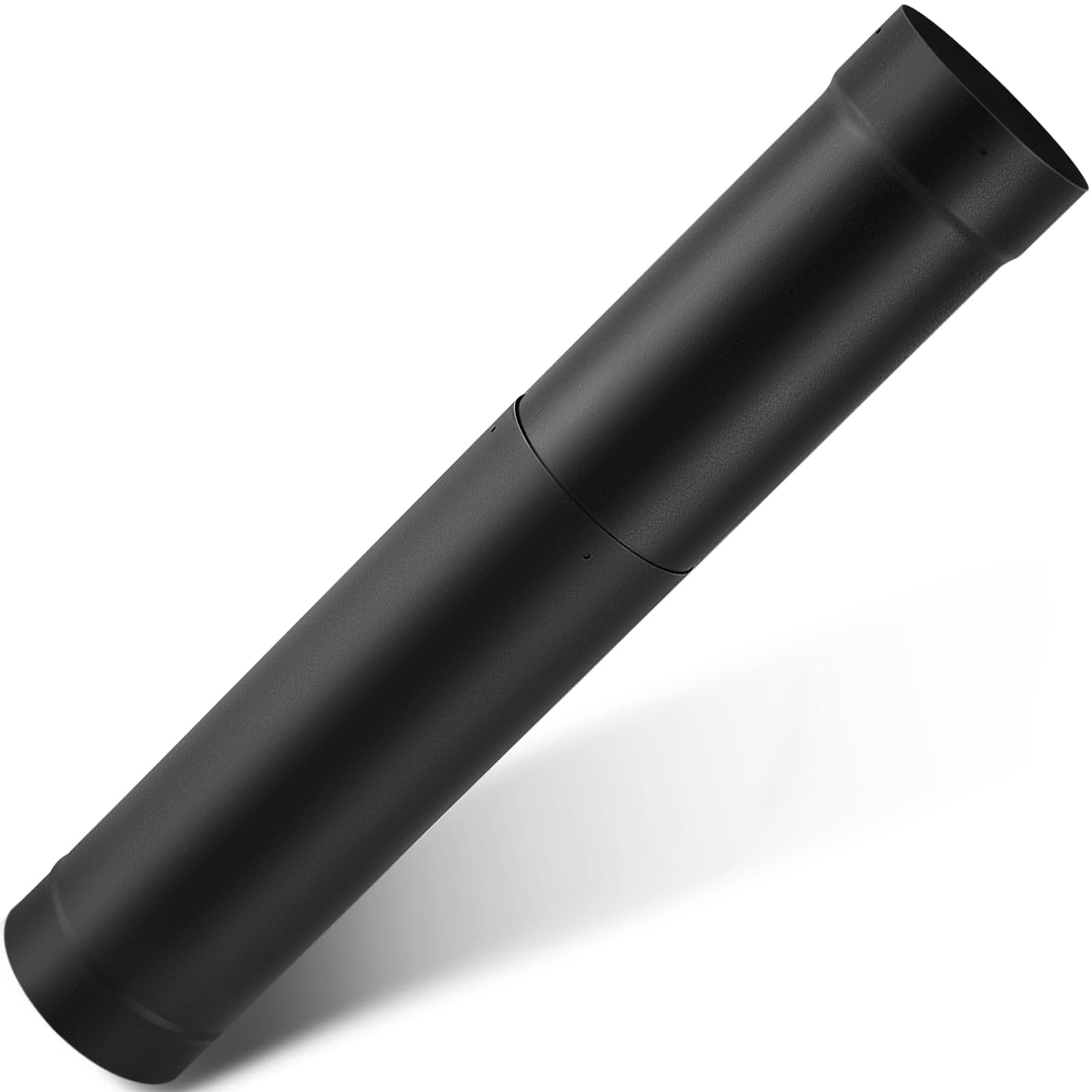
Heavy 21 gauge carbon steel in a short telescoping length, built to stay round while you fit it.
This pipe handles the same 18 to 30 inch gap as the AllFuel short run, and its argument is the same one: 21 gauge carbon steel instead of the thinner sheet most budget connectors use. The thicker wall keeps the pipe rigid and round during fitting, so the connector seats solidly into an exposed indoor wood stove install. At 5.58 pounds it stays manageable overhead.
The finish is heat-resistant black paint that resists scratches, chipping and peeling through handling and everyday use, which is the difference between a connector that looks new after a season and one that looks scuffed. It telescopes to bridge your stove outlet to the chimney connection without you cutting multiple fixed sections. The maker asks you to measure the stove collar, the upper connector and the available install height before you order — do that, because nominal 6 inch is not the same as your actual collar.
The recurring theme in the feedback is fit and quality landing where owners hoped, and the pipe does what a connector is supposed to: bridge a gap and pass smoke up the flue. The catch is the same as any single-wall connector — 18-inch clearance to combustibles, no wall or ceiling penetration, and no outdoor exposure. Owners consistently report the hookup going smoother than expected, which is the whole case for a telescoping part over a stack of fixed ones.
What the steel buys you: 21 gauge rigidity means the pipe does not ovalize in your hands, and a round pipe seals better against the next section.
Who should skip it: tight-clearance installs and anyone routing through a wall — those need a double-wall connector.
Go with it if: you have a standard indoor connector gap under 30 inches and want a rigid, coated part that keeps its look.
Pass if: your collar measures off nominal 6 inch — check that before you commit.
5. Selkirk Metalbestos 266036 Smoke Pipe

Two walls instead of one — the right shape when your stove cannot give up 18 inches.
This is where the article pivots. Every single-wall pipe above needs 18 inches of clearance to combustibles. This one is a double-wall system, with a black aluminized steel outer casing wrapped around a stainless steel inner liner. It connects a wood stove to an insulated chimney, and the two-wall build is what lets it sit closer to your wall than a bare steel pipe can.
The dimensions matter: 6-inch inner diameter, 6.5-inch outer diameter, 36-inch length, and three metal screws supplied so the joint locks down. At 7.6 pounds it carries more weight than a single-wall connector of the same length, because there is a second wall and an air gap inside it. The matte black finish keeps the run looking deliberate rather than raw.
Now the honest read. Value is the most-discussed point on this pipe, and the feedback genuinely divides — some owners consider it a good deal, others do not. If you have 18 inches to spare, a single-wall connector does the same job for less. Functionality and installation both come in clean, and the 4.0+ star record across 170+ buyers backs that up.
The double-wall case
- Double wall construction with a stainless inner liner and aluminized outer casing.
- 36-inch length with three metal screws supplied for a locked joint.
- Built specifically to join a wood stove to an insulated chimney.
- Matte black finish that suits a finished interior run.
The fair caveats
- Value feedback splits sharply — it is not the cheap route to a connector.
- The 6.5-inch outer diameter takes more physical room than the inner pipe suggests.
- Fixed 36-inch length, so short gaps need a different solution.
Choose it for: a close-clearance install where a single-wall pipe legally cannot go.
Skip it for: a roomy setup with full clearance, where the cheaper single-wall connectors do the same job.
6. 38″ to 70″ Telescoping Pipe

The long-reach version of the thick-wall telescoping connector, for high ceilings and tall gaps.
Same family as the short AllFuel run, stretched out: this one covers 38 to 70 inches, against the short version’s 18 to 30 inches. If your stove sits in a room with a high ceiling and a long climb to the chimney, that range turns a fabrication job into a slide. It cannot be cut down either — the telescoping action carries the whole fit.
The wall is 21 gauge steel, described as 9% thicker than 22 gauge and 27% thicker than 24 gauge, and it is painted with high-temperature black finish that should resist chipping and peeling. It connects to any brand of Class-A insulated chimney pipe, so the top of your run is not locked to one maker. The clearance rule is unchanged: 18 inches minimum to combustibles, no wall or ceiling penetration, no outdoor exposure.
Weight is the trade-off, and it is a big one. This pipe is listed at 15 pounds, against 4.8 pounds for the fixed stainless DuraBlack — so you are holding a genuinely heavier part overhead while you line up a long joint. The upside is quality: that is where the reputation sits, and owners describe a thicker wall than the norm and a durable build. The 4.5+ star record across a smaller owner base suggests the long reach works as intended for those who need it.
The reach story: 38 to 70 inches of telescoping covers gaps that no fixed 48-inch pipe and no short 18-to-30 can span — but it is the longest, heaviest option here.
The weight warning: at 15 pounds, plan for a second set of hands or a temporary support while you seat the top joint.
Your part if: your stove-to-chimney climb runs long and you want the thick-wall build across the whole span.
Not your part if: you are working solo overhead or your gap sits under 38 inches.
7. 6in x 48in Single Wall Black Stove Pipe

A welded seam is the quiet hero here — it keeps the pipe truly round so sections mate clean.
Most connector pipes are lock-seamed, meaning the steel is folded over itself where the two edges meet. This one is 100% laser resistance-welded along that seam, and the result is a pipe that stays truly round end to end. Round matters because a pipe that seats cleanly into the next section means a tight joint and less smoke slipping out at the coupling.
You get one pipe per order, 6 inches in outside diameter and 48 inches long, to connect your stove to the chimney. The steel is 0.030 cold-rolled 22 gauge (a standard thickness measure for stove pipe), which the maker describes as 60% thicker than most brands. Like every single-wall pipe in this guide, it needs 18 inches of clearance to combustibles (anything that can burn, like wood or drywall).
Quality is what the reputation rests on, with the well-formed flanges drawing specific praise. Where it gets mixed is fit — some installs click straight together, others take persuasion. Buyers also get installation support before and after the sale, which is unusual at this tier and useful if you are doing the job yourself for the first time. The 4.0+ star record across 130+ owners reflects a solid but imperfect fit story.
Where the extra steel goes: a 60% thickness claim over most brands is about surviving a bump and holding shape, not about looking heavy.
What to expect: flanges arrive well-formed, but mating to your existing pipe may still need a firm hand.
Best suited to: buyers who care about a welded seam and a clean round pipe over a bare-bones connector.
Think again if: your run needs adjustment — this is a fixed 48-inch length.
8. Duravent DVL Stovepipe

Six inches from the wall instead of eighteen — and it telescopes from 40 to 68 inches while doing it.
Read that clearance number twice. Single-wall pipe demands 18 inches to combustibles. This air-insulated double-wall connector cuts that to 6 inches for walls and 8 inches for ceilings, the tightest clearance of any connector pipe here. If your stove sits in a corner or a tight alcove, this is the part that makes the install possible, full stop.
It also telescopes from 40 inches to 68 inches with no field cutting or crimping, and the stainless steel inner wall is said to heat up fast and stay hot longer, which promotes a strong draft. The build is a.016-inch stainless inner wall inside a.018-inch galvanized, black-painted outer wall. It vents wood, oil, coal or gas appliances, so a multi-fuel setup is covered. At 8 pounds it lands between the light fixed pipes and the heavy long telescoping single-wall part.
Two things to plan around. Fit is the most-discussed mixed point — some owners get exactly the length they needed, others report the sections sticking, so test the slide before you mount it overhead. And durability feedback splits, with a few units arriving damaged in transit; inspect on delivery and you close that risk off. The 4.5+ star record across 170+ owners on a limited lifetime warranty is a solid footing for a part doing a genuinely harder job than a single-wall connector.
Why this one earns its tier
- 6 inches of clearance to walls and 8 to ceilings — the tightest here by a wide margin.
- Telescopes 40 to 68 inches with no cutting or crimping.
- Stainless inner wall designed to hold heat and support stronger draft.
- Vents wood, oil, coal or gas appliances — multi-fuel ready.
- Limited lifetime warranty.
What to watch on arrival
- Fit dividers the feedback — the sections can stick, so test the slide before mounting.
- A few arrive damaged in transit; inspect the box before you start the install.
This is the one if: your stove is boxed in close to a wall and a single-wall pipe cannot legally make the run.
Save it for later if: you have full clearance and only need a straightforward connector.
9. Selkirk SureTemp Chimney Pipe

A chimney section rather than a connector — built to take a 2,100-degree surge and pass smoke out.
This is a different animal from everything above. It is a double-wall insulated chimney vent for wood, coal, oil or gas appliances, UL-listed and tested to withstand surges up to 2,100 degrees Fahrenheit. It is 48 inches long with a stainless steel inner liner and a tough outer casing, and it vents smoke out of a house rather than acting as a simple stove-to-chimney connector.
At 11.7 kg the pipe is the heaviest item here, and that mass is the insulation and the outer casing doing their job. The nominal wall thickness is approximately 0.05 inches. The maker leans on a long safety heritage with UL-tested products, and for a chimney section — the part that vents a fire through a roof — that testing record is the spec that matters most. A locking band is included to hold the joint.
Be clear on the trade-off: durability is the sore spot, with multiple owners reporting pipes arriving dented or bent. That is a shipping-and-handling reality for a heavy steel cylinder, not a design flaw, but it means you open the box and inspect before you climb a ladder. Appearance and value also split opinion. Installed correctly, it is the piece that makes the whole vent system work.
The number that counts: tested to 2,100 degrees Fahrenheit and UL-listed — that is the difference between a chimney section and a connector pipe pretending to be one.
What can go wrong: damaged-on-arrival reports come up more than once, so inspect it before installation day.
The right purchase if: you need a genuine insulated chimney section to vent the fire out, not a mere connector.
Keep looking if: you only need the short indoor run from stove collar to chimney — cheaper single-wall connectors cover that.
Know the Specs
Single Wall vs Double Wall
A single-wall pipe is one layer of steel, and that simplicity is why it needs 18 inches of clearance to combustibles. A double-wall pipe sandwiches an air gap between an inner liner and an outer casing, which cuts the required clearance — the DuraVent DVL model here needs just 6 inches to walls and 8 to ceilings. If your stove sits close to anything that can burn, the double-wall version is the one built for that job.
Diameter and Telescoping Length
The 6-inch nominal diameter is the most common connector size, but nominal is not exact — measure your stove collar and chimney socket first. Telescoping lengths are the other spec that saves work: they slide to cover a range of gaps, from 18 to 30 inches on a short run up to 38 to 70 inches on a tall one. A telescoping pipe cannot usually be cut, so pick the length range that brackets your measurement.
Steel Gauge and Wall Thickness
Gauge runs backward: a lower number means thicker steel. Twenty-one gauge is described as 9% thicker than 22 gauge and 27% thicker than 24 gauge, and that extra thickness keeps a pipe round while you seat it. Look for welded or lock-seamed joints too — a round pipe with a tight seam mates cleanly and lets less smoke slip out at the coupling.
Connector Pipe vs Chimney Section
A connector pipe joins your stove to an approved chimney and is generally not meant to pass through a wall or ceiling. A Class-A insulated chimney section is built to vent the fire out of the building and is tested for high-heat surges — the Selkirk SureTemp here is UL-listed and tested up to 2,100 degrees Fahrenheit. Mixing up a connector and a chimney section is the costliest mistake in this category.
Common Questions
How much clearance does single-wall stove pipe need from a wall?
Can I run stove pipe through a wall or ceiling?
What is the difference between 21 gauge and 24 gauge stove pipe?
Why does my listed pipe length look wrong when installed?
Can a telescoping pipe be cut shorter?
Can I use a single-wall pipe outdoors?
Will a 6-inch stove pipe fit my stove?
How do I connect a stove pipe to a different brand of chimney?
What temperature rating matters on stove pipe?
Why does my new stove pipe smell on first use?
The Bottom Line
For most installs, start with the DuraVent DuraBlack 6DBK-TL. It telescopes from 44 to 68 inches and slides together at the ends, so you avoid cutting and crimping and get a joint that resists drips. If your gap is short, the AllFuel 18″ to 30″ Telescoping Pipe gives you a thicker 21 gauge wall in a compact run. And if your stove sits close to a wall, reach for the DuraVent DVL Double-Wall 6DVL-68TA: its 6-inch wall clearance is far tighter than any single-wall pipe allows. Settle the clearance first, then the length — in that order.
How we choose
We do not accept paid placement. Every pick is matched to a real buyer and a real use-case; we do not hands-on test units.
Sources
Specifications: manufacturer listings and product documentation. Review insights: verified customer reviews, as of November 2026. Pricing: not shown on this page (it changes often); check the current price via the retailer link.
As an Amazon Associate, Tactical Gear Guy earns from qualifying purchases. This does not affect which products we feature.