Specs are compiled from manufacturer listings and verified buyer reviews and can change over time — please confirm the key details on the product page before buying.
Your glue-up is only as good as the clamp holding it, and a joint that creeps open under pressure leaves a visible seam you cannot sand away. This guide sorts the bar clamps that actually hold their rated force from the ones that flex, slip, or quit halfway through a panel glue-up. You will see which clamps suit furniture assembly, which suit long edge joints, and which are best kept for small repairs.
This guide is built by comparing the manufacturers’ published specifications and the patterns across verified customer reviews, so you get each pick’s real strengths and trade-offs instead of marketing spin.
You need a clamp that holds a joint square and tight from the first squeeze to the last. Three specs decide the pick: clamping force, jaw opening, and throat depth past the bar edge. Below you will find the clamps worth owning, sorted by what they do best, so you can pick the right one for your bench.
Top Picks


How To Choose The Best Woodworking Bar Clamps
A bar clamp is a straight steel or iron rail with one fixed jaw and one sliding jaw, and you squeeze the two together to press wood flat while glue dries. The mistake most first-time buyers make is grabbing the longest, cheapest clamp on the shelf and expecting it to close a hard maple panel without bowing. Force, reach, and bar stiffness all have to match the job.
Match the clamping force to the wood you glue
Clamping force is measured in pounds, and a light clamp rated around 150 pounds is fine for small trim and thin stock. Once you move to thick hardwood edge joints, you want a clamp rated for several hundred pounds so the joint stays closed while the glue cures. A clamp that flexes under load lets the seam creep open, which is exactly what you are trying to prevent.
Check the throat depth before you buy
Throat depth is the distance from the bar to the tip of the jaw, and it decides how far into a panel or over an edge the clamp can reach. A shallow throat is fine for flat face gluing, but a deeper throat lets you clamp past a raised rail or a joint set back from the edge. If you build frames and cabinets, reach matters as much as force.
Decide between a trigger clamp and an F-style clamp
A one-handed trigger clamp lets you position and squeeze with the same hand, which is a real help when you are holding a board steady with the other. An F-style clamp with a threaded handle gives you finer, more deliberate pressure and is easier to leave set for a long cure. Many woodworkers keep both on the bench for different stages of a build.
Side-by-Side Comparison
| Model | Best For | Clamping Force | Jaw Opening | Throat Depth | Amazon |
|---|---|---|---|---|---|
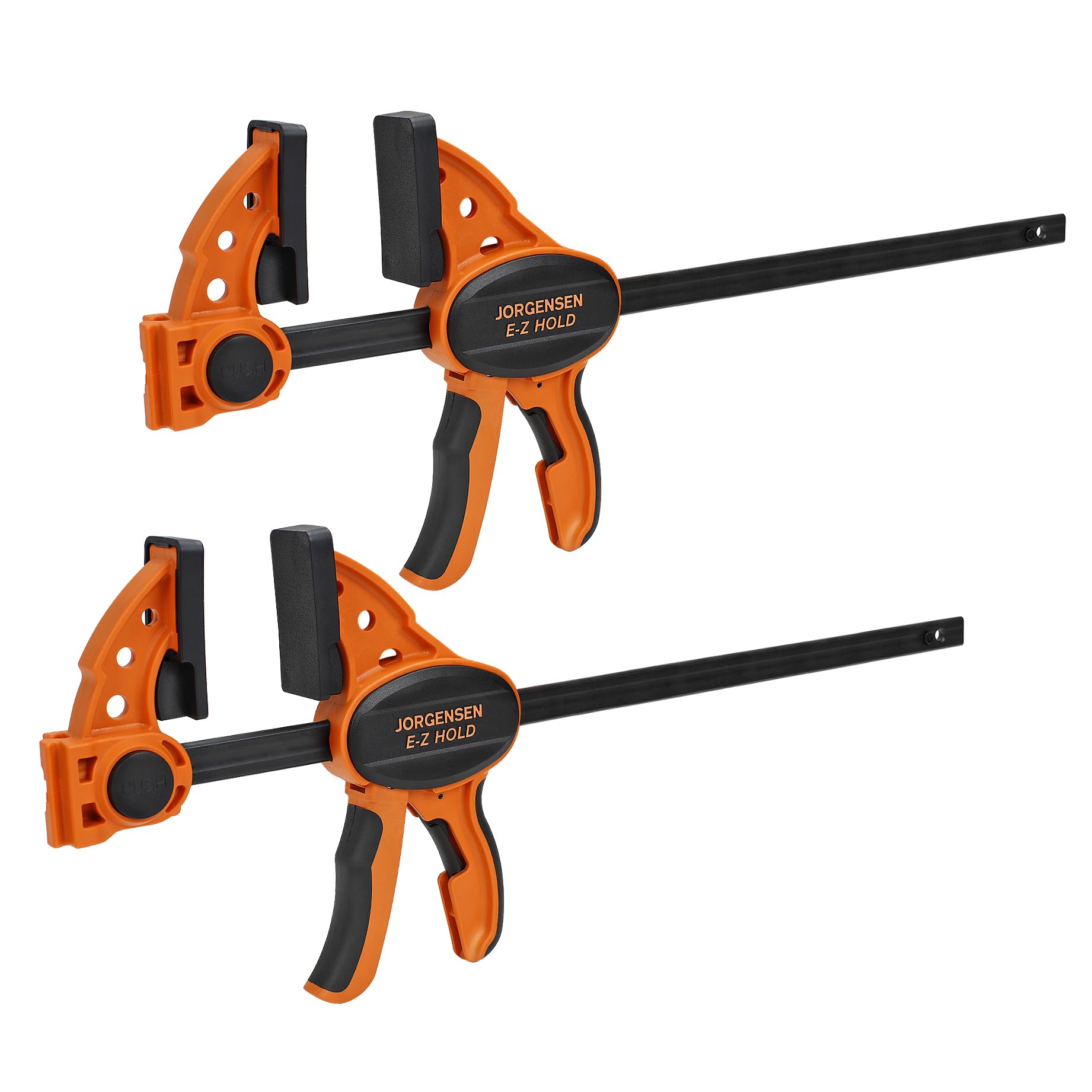
| JORGENSEN E-Z Hold 2-Pack 12″★ Best Overall | Everyday furniture glue-ups | 400 lbs | 12 in | — | Amazon |
| WEN CLR122 12-InchBudget Champion | Budget two-pack for light work | 150 lbs | 12 in | 2.3 in | Amazon |
| BESSEY EHKXL24 Trigger ClampTop Performer | Deep-reach one-handed work | 600 lbs | 24 in | 3.625 in | Amazon |
| Pony Jorgensen 3736 Steel Bar Clamp | Long edge joints | 600 lbs | 36 in | 2 in | Amazon |
| HORUSDY 6-Pack Wood Clamps | Mixed-size starter set | 150 lbs | 6 in and 12 in | — | Amazon |
| IRWIN QUICK-GRIP 12″ | Heavy one-handed hold | 600 lbs | 12 in | 3-5/8 in | Amazon |
| BESSEY GSCC4PK-C Clamp Set | F-style set with wood handles | 600 lb | 6 in and 12 in | — | Amazon |
| FASTORS 36 Inch 4-Pack | Big four-pack panel work | 600 lbs | 36 in | 2.5 in | Amazon |
| VEVOR 24″ Parallel Bar Clamp Set | High-force parallel clamping | 1500 lbs | 24 in | — | Amazon |
Detailed Reviews
1. JORGENSEN E-Z Hold 2-Pack 12″ Bar Clamps
Our pick — 4.5+★ from 950+ verified ratings; the strongest balance of quality and price.
A two-pack that squeezes to 400 pounds and still lets you work one-handed.
These are the clamps most home woodworkers end up reaching for first, and the reason is the 400 pounds of clamping force in a body you can still control with one hand. That force is enough to close a glued edge on oak or maple without the joint creeping, and the 12-inch jaw opening covers the bulk of furniture assembly and small carcass work. Squeeze the trigger, and the jaw slides to the board; release the lever, and it lets go clean.
What wins people over is the build quality — well over a hundred buyers single it out, and it shows in how the jaws meet the wood squarely rather than twisting. Two of these will also link together to make a longer bar, so a single pair can stretch to a wider glue-up without you buying a second size. The fixed jaw reverses to turn the clamp into a spreader, which is handy when you need to push a frame open rather than pull it closed. Protective pads sit between the jaw and the wood so a finished face does not come away dented.
The honest limit is force against length. The Pony Jorgensen below rates 600 pounds and reaches 36 inches of opening versus 12 inches for this clamp. So this pair suits furniture assembly, not long edge joints. One more thing worth flagging: at 12 inches, two clamps linked only get you so far, so plan a bigger bar for full-width tabletop work.
What earns its place on the bench
- 400 pounds of clamping force in a body light enough to place one-handed.
- Fixed jaw reverses so the clamp doubles as a spreader.
- Two clamps join to extend the bar for wider glue-ups.
- Protective pads guard finished faces from jaw marks.
Where it stops short
- The 12-inch opening is short next to a dedicated 36-inch bar clamp.
- Linked pairs still fall well short of a full-width tabletop glue-up.
Reach for this if: you are assembling furniture and want one-handed control with real force behind it.
Look elsewhere if: your projects are long edge joints that need a bar measured in feet, not inches.
2. WEN CLR122 12-Inch Steel Bar Clamps
Two clamps, two spreaders, and a reinforced steel bar for the price of one mid-range clamp.
If you are outfitting a bench from scratch and want several clamps without spending much, this two-pack does the job. Each clamp opens to 12 inches and rates at 150 pounds of force, which handles light glue-ups, jigs, and small repairs fine. Reverse the jaw and the same tool becomes a 17.25-inch spreader, so you are really getting two tools per clamp. The reinforced steel bar and quick-release latch keep the squeeze steady while you work.
The value here is hard to argue with — twenty buyers call it out directly, and the clamps themselves draw the most praise of anything about the tool. They work well one-handed, which matters when you are alone in the shop holding a board in place while trying to set pressure. The nylon-and-steel body keeps the weight down, so a pair does not drag your bench down or tire your wrist during a long session.
Here is the trade-off to weigh honestly: the force is 150 pounds, and the Pony Jorgensen 3736 below rates 600 pounds. So think of these as light-duty clamps that shine on trim, jigs, and quick holds, not as the pair you trust for a thick hardwood edge joint. And a few owners have had units come apart in use, so treat them gently and keep them off extreme loads. That is a fit note, not a reason to skip them — at this price, several on the bench is a smart start.
Straight read: a genuinely budget-friendly way to get two clamps and two spreaders onto your bench, rated 4.5+ out of 5 from hundreds of owners.
The honest catch: 150 pounds of force is light duty, and the bar is not built to be leaned on the way a 600-pound clamp is.
Smart buy for: the new woodworker who needs several clamps for small parts and light assemblies without a big outlay.
Skip if: you are clamping thick stock and need several hundred pounds of force to keep the seam shut.
3. BESSEY EHKXL24 Trigger Clamp Set
A deep 3.625-inch throat and 600 pounds of squeeze for clamping past raised edges.
This is the clamp for the job that keeps beating you — a joint set back from the edge, or a frame where the bar needs to reach past a raised rail. The 3.625-inch throat depth is the standout, and it laps the WEN CLR122’s 2.3-inch throat by a wide margin, so you get far more reach into the work. Pair that with 600 pounds of clamping force and a 24-inch opening, and it covers cabinet and frame work that a short clamp cannot touch.
The trigger action applies that force with surprisingly little effort in the hand, and the composite handle is shaped to sit comfortably through a long session. Converting from clamp to spreader takes no tools at all — push the button, release the jaw, and flip it around. The cold-drawn steel bar holds the jaws parallel as you clamp, so pressure stays even across the joint rather than pinching one corner. Soft jaw pads with V-grooves also hold round parts in place without marring them.
The one thing to plan around is that this ships as a single clamp, not a pair, so a glue-up that needs four corners means buying four. Quality is what owners talk about most, and it is clear in the fit of the jaws and the smooth trigger. If your projects are frames, cabinets, and set-back joints, this earns the bench space.
Where it wins: the deep 3.625-inch throat reaches joints that shallow clamps miss, with 600 pounds behind it.
What to bank on: one clamp per box, so budget your count to the job.
Best matched to: frame and cabinet work where you need depth of reach more than width of opening.
Not the one if: you are stocking a bench and need clamps in pairs from the start.
4. Pony Jorgensen 3736 Steel Bar Clamp, 36-Inch

Thirty-six inches of opening so a full-width panel glue-up stays closed.
When the joint runs the length of a tabletop, opening size decides everything. This clamp reaches 36 inches, versus 12 inches for the Jorgensen E-Z Hold pair above, which is enough to span a wide panel in one squeeze. It also carries 600 pounds of tensile strength, so it presses hard while it spans.
The F-style steel bar with a sliding jaw is easy to adjust, and the thick plastic protective pads keep finished faces free of jaw marks during a cure. For medium-duty hobby, home-shop, and DIY work, it slots in as the long clamp you keep on the wall for the big jobs. Functionality is the thing buyers appreciate most, and it shows in a tool that just gets on with the job without fuss.
Watch the bar under heavy pressure — it will bend when you lean on it hard, so it is best used for medium-duty clamping rather than maximum-force work. The handle has drawn some divided feedback too, with the plastic build not matching what some expected from the listing photo. Neither point makes it a bad clamp; it just means you reach for a stiffer bar under extreme load and this one when you need length.
Why long-joint work likes it
- 36-inch opening spans a full-width panel glue-up.
- 600 pounds of tensile strength presses while it spans.
- Thick plastic pads protect finished faces during a cure.
- Sliding jaw adjusts quickly between setups.
Keep in mind
- The bar flexes when you push it to heavy pressure.
- The plastic handle is not the wood one the photo suggests.
Pick this for: long edge joints and panels where the clamp has to span a full width.
Think again if: your main need is maximum force on short, thick stock.
5. HORUSDY 6-Pack Wood Clamps

Six clamps in mixed sizes — two 6-inch, two 12-inch, and two spring clamps.
A starter set solves a problem single clamps do not: having the right size on hand without hunting. This pack pairs two 6-inch bar clamps, two 12-inch bar clamps, and two 6-inch spring clamps, so one box covers a range of small jobs. That is six clamps against a two-pack like the Jorgensen E-Z Hold pair. For trim, jigs, and light assemblies, that spread of sizes is exactly what you want within reach.
The nylon body and hardened steel bar take knocks well, and the quick-change red button flips each F-clamp into a spreader without tools. The 6-inch clamps spread up to 11-9/64 inches and the 12-inch clamps up to 17-21/64 inches, giving you a few reach options from one set. Each clamp holds up to 150 pounds, and the non-slip pads grip the work firmly so small parts stay put. Owners find them handy specifically for smaller clamping jobs, and that is the lane they own.
Be clear-eyed about the 150-pound rating — that is light duty, well under the 600 pounds some clamps here carry. So this set is for the small stuff: glue-ups on trim, holding a jig, pinning a repair, and quick assembly. A few owners have found them less than rock-solid under harder loads, so keep them off thick hardwood edge joints and they will serve you well. For the money, six clamps in two bar sizes plus spring clamps is a practical way to fill out a bench.
Best use case: a beginner filling out a bench with several sizes of light-duty clamp in one purchase.
Worth knowing: 150 pounds caps these at light work, so save the heavy hardwood joints for a stronger bar.
Great fit for: small-shop tasks, trim, jigs, and repairs where a spread of sizes beats one strong clamp.
Not built for: thick stock that needs several hundred pounds of force to close.
6. IRWIN QUICK-GRIP One-Handed 12″ Bar Clamps

Full 600 pounds of one-handed force, held steady by an I-beam bar that resists flex.
This clamp keeps the bar straight while you squeeze, thanks to an I-beam bar (a bar shaped like a steel I, which resists bending far better than a flat strip). That means 600 pounds of one-handed force without the bar bowing away from the work. The throat depth is 3-5/8 inches, so it reaches in past an edge much like the BESSEY above, and the double-locking swivel jaws spread that force evenly across the joint.
Clamping strength is what owners rave about most, and you can feel why — the POWER LOCKS hold pressure and keep holding it while the glue sets. The adjustable foot lets the clamp stand upright on the bench, so you can load the wood with both hands instead of propping the clamp up. Swivel jaws and full-face pads come off when you need a different grip, and the quick-change button turns it into a spreader. It holds work down to a bench cleanly, which is exactly the kind of job this design was built for.
A few owners find it on the bulky side for the smallest jobs, so keep it for the work that needs real force rather than fiddly little holds. Note also that it ships as one clamp, so a four-corner glue-up means four purchases. For a heavy one-handed clamp that does not slip, it sits at the stronger end of what is here.
The heavy-duty case
- 600 pounds of one-handed force with an I-beam bar that resists bending.
- Adjustable foot lets the clamp stand while you load the wood.
- Double-locking swivel jaws spread pressure evenly across the joint.
- Converts to a spreader with a quick-change button.
The fine print
- Its bulk is a lot for tiny, delicate jobs.
- Sold as a single clamp, so large glue-ups need several.
Choose it for: heavy one-handed clamping where you need real force without the bar flexing away.
Pass if: you mostly do small, delicate holds where a slimmer clamp suits better.
7. BESSEY GSCC4PK-C F-Style Clamp Set

Four F-style clamps with wood handles and cast iron jaws for a controlled, deliberate squeeze.
If you prefer the feel of turning a handle to set pressure rather than squeezing a trigger, this four-pack delivers it. You get two 6-inch and two 12-inch F-style clamps, each with an ergonomic wooden handle and a serrated rail against cast iron jaws. The threaded handle lets you dial in pressure and leave it, which is exactly what a long glue cure wants. Rated for 600 pounds, they are built for medium-duty work where control matters as much as raw force.
Quality is what owners talk about most, and the cast iron jaws — powder-coated for durability — give the clamp a solid, planted feel. The replaceable pads with rubber ends protect surfaces from damage while the jaws bite in. It is the kind of set that sits on the bench for cabinet, frame, and furniture work where you want to set the hold and walk away.
The trade-off is speed: a threaded handle is slower to reposition than a one-handed trigger, so it is not the clamp for a fast assembly line of small parts. Some owners also find the setup a little less stable and slower to handle than a trigger clamp. Those are fit notes for a control-first woodworker, not flaws — if you want deliberate, settable pressure, this set is built for it.
What it does well: casts a controlled, settable hold with wood handles and cast iron jaws across two sizes.
The honest note: slower to reposition than a trigger clamp, so it trades speed for control.
Made for: the woodworker who likes to set pressure by hand and leave a cure undisturbed.
Not the fastest pick if: you need to reposition clamps quickly across many small assemblies.
8. FASTORS 36 Inch 4-Pack Bar Clamps

Four 36-inch clamps at 600 pounds — enough to span a full panel and hold it.
For a full-width glue-up you need length, force, and enough clamps to work across the panel. This set gives you four clamps, each opening to 36 inches and rated at 600 pounds, so you can spread pressure the whole way along a tabletop rather than clamping in two spots and hoping. The ductile iron body is built to take pressure without cracking, and precision grooves on both sides of the bar keep the jaw from sliding once it is set.
The handles are shaped to sit comfortably in the hand without slipping, and the tool moves and releases quickly to keep a glue-up on schedule. Owners rate these above the plastic-bodied alternatives they have used, which is what you want from a clamp that sees real assembly work. Think of it as a panel-work set: the four-clamp count is what makes it different from a single long bar.
The honest caveat is grip under load — a few owners have had the jaw slip during use, so set the jaw firmly before you crank the pressure. Against the Pony Jorgensen above, this set trades that single clamp’s long record for four long clamps in one box, which suits anyone building panels rather than one-offs. Buy it for the four-way coverage and the 36-inch reach, and set each jaw carefully before gluing.
Where the value sits: four 36-inch clamps at 600 pounds each, so a wide panel gets clamped across its full length.
The catch to know: some jaws slip under load, so set each one firmly before you add pressure.
The one for you if: you build panels and tabletop glue-ups that need four long clamps at once.
Look on if: you want a single long clamp with a long track record rather than a four-pack.
9. VEVOR 24″ Parallel Bar Clamp Set

A 1500-pound load limit and parallel jaws for the tightest fit you can set by hand.
On raw force, nothing here comes close. This set rates a 1500-pound load limit, and the parallel jaws clamp flat and square so a joint closes evenly instead of pinching at one corner. With a 24-inch jaw opening, it covers standard-sized stock and gives you room to adjust for precise positioning. When you need to lock a joint absolutely tight, this is the clamp with the numbers to do it.
The handle is molded from a high-strength plastic, and the slide bar is built from carbon structural steel to resist cracking under load. The extended rod adds operating range for different stock thicknesses, so it works across materials rather than one setup. Value is what owners appreciate most, with many seeing it as a budget-friendly stand-in for pricier parallel clamps. They are heavy, and owners note it — this is a clamp that anchors a glue-up rather than one you wave around.
The clamping ability gets some mixed feedback, so check the jaws seat square before you load them fully. And at that weight, this is a bench-station clamp, not one to carry around a site. If you need maximum force on a mirror-flat parallel jaw, though, few tools here can match it.
The high-force case
- A 1500-pound load limit, well beyond everything else in this guide.
- Parallel jaws hold a flat, even fit across the joint.
- 24-inch opening with an extended rod for thicker stock.
- Carbon steel bar built to resist cracking under load.
And the flip side
- Heavy enough that it stays on the bench rather than traveling.
- Clamping ability draws some mixed feedback, so seat the jaws carefully.
Top of the pile for: flat, high-force parallel clamping on standard-sized stock at the bench.
Not for carrying: the weight keeps it in the shop, so site work needs a lighter clamp.
Know the Specs
Clamping force (in pounds)
This is how hard the jaws squeeze the wood, measured in pounds. A light clamp rated around 150 pounds is fine for trim and small parts, while several hundred pounds closes a thick hardwood joint without it creeping. More force is not automatically better — it has to be paired with a stiff bar, or the bar bends before the joint closes.
Throat depth (in inches)
Throat depth is the clearance from the bar to the jaw tip, and it sets how far in past an edge a clamp can reach. A shallow throat handles flat face gluing; a deeper throat lets you clamp over a raised rail or a set-back joint. If your work is frames and cabinets, reach is as important as force.
Jaw opening (in inches)
Jaw opening is the widest span the clamp can bridge, so it decides which glue-ups the clamp can reach across at all. A short clamp is fine for furniture parts; a long clamp spans a tabletop in one go. Pick the opening to match your widest regular project, not your average one.
Clamp vs. spreader
Many bar clamps let you reverse the jaw to push two pieces apart instead of pulling them together, turning the clamp into a spreader. That earns its keep when you need to open a frame or hold a gap. Conversion can be as simple as pushing a button or flipping a jaw, depending on the model.
Common Questions
How much clamping force do I need for hardwood glue-ups?
What is the difference between an F-style clamp and a trigger clamp?
Can I link two bar clamps together to make a longer one?
Will a bar clamp damage the wood I am working on?
How do I turn a bar clamp into a spreader?
Why does my bar clamp slip under pressure?
What throat depth do I need for cabinet and frame work?
Are parallel clamps better than F-style clamps for glue-ups?
How many clamps should I own for a tabletop glue-up?
Do heavier bar clamps stay put better during a glue-up?
The Bottom Line
For most woodworkers, the winner in this lineup of woodworking bar clamps is the JORGENSEN E-Z Hold 2-Pack 12″ because it pairs 400 pounds of force with one-handed control and a clamp-to-spreader flip that covers everyday furniture assembly. If you need to reach past a raised edge, grab the BESSEY EHKXL24 for its 3.625-inch throat. And for long panel glue-ups, the Pony Jorgensen 3736 is the one to reach for with its 36-inch opening. Keep a short pair and a long bar on the bench, and match each clamp to the joint.
How we choose
We do not accept paid placement. Every pick is matched to a real buyer and a real use-case; we do not hands-on test units.
Sources
Specifications: manufacturer listings and product documentation. Review insights: verified customer reviews, as of November 2026. Pricing: not shown on this page (it changes often); check the current price via the retailer link.
As an Amazon Associate, Tactical Gear Guy earns from qualifying purchases. This does not affect which products we feature.