Specs are compiled from manufacturer listings and verified buyer reviews and can change over time — please confirm the key details on the product page before buying.
Here is the short answer: the IBF 60-inch fir desk is the one most people should buy. A genuine fir slab at 60 inches is rare at this price, and buyers consistently rate its quality at the top of the field. Every pick below uses a real timber slab top — no veneer (a thin wood-look layer) over particleboard, and no hollow-core filler dressed up to look like wood. What separates them is slab size, base style, weight capacity, and how much assembly you are willing to take on.
This guide is built by comparing the manufacturers’ published specifications and the patterns across verified customer reviews, so you get each pick’s real strengths and trade-offs instead of marketing spin.
Wood grain runs differently on every slab, so two desks of the same model never look identical. Colour, knots and edge contours shift from one board to the next, and that variance is the whole point. Below are wood slab desk picks matched to real rooms, budgets and assembly patience.
Top Picks

How To Choose The Best Wood Slab Desk
The single mistake most buyers make is judging a desk from a product photo. A photo shows the grain pattern of one specific board, and the board that lands at your door has its own knots, its own colour and its own edge contour. Choose based on the specs you can verify — species, slab thickness, dimensions and weight capacity — then accept the grain as a happy surprise.
Slab material: what the top is genuinely made of
The species printed in the listing tells you what kind of timber you are actually getting. Fir is a softer, lighter-toned wood with a straight grain and it typically weighs less than a hardwood slab of the same size. Pine carries warmer knots and more colour variation, while acacia brings darker, denser grain with bolder contrast. Softwoods like fir and pine are easier on the wallet and easier to move, while harder species resist dings better over years of daily typing and coffee cups.
A real slab shows the same grain on the front face and the edges, because the edge is the side of the same board. If a listing mentions MDF or particle board anywhere, walk away.
Desktop size and the workspace you actually need
A 47-inch top handles one monitor and a laptop with a little breathing room. Moving up to a 55-inch or 60-inch surface is what buys you a second display and a hot mug without clearing space first. The deepest desks here run 23.6 inches front-to-back, which leaves enough room behind the keyboard for a monitor arm. The narrowest sits at 18 inches, so measure your monitor stand before you commit — that depth suits writing, not a sprawling dual-screen setup.
Load capacity and wobble control
Weight capacity numbers tell you how much the base can hold on top of the slab’s own weight. A frame rated to 300 pounds or 330 pounds will shrug off a monitor, a printer and a stack of books. What stops a desk wobbling is the leg design. K-shaped legs, Z-shaped legs, sled legs and pipe frames each brace the desk differently. Four adjustable leveling feet are the quiet hero on any uneven floor — they twist out to compensate for a sloping floorboard so you are not wedging cardboard under a leg.
Side-by-Side Comparison
| Model | Best For | Desktop Size | Top Material | Load Capacity | Amazon |
|---|---|---|---|---|---|
| IBF 60 Inch Fir Desk★ Best Overall | Most buyers | 60 x 23.6 in | Fir wood | 300 lb | Amazon |
| wangbochuan 47″ Live Edge DeskCompact Pick | Compact gaming corner | 47 x 23.2 in | Solid wood | — | Amazon |
| TUP THE URBAN PORT Live Edge DeskTop Contender | Writing nook with storage | 51 x 18 in | Acacia wood | 330 lb | Amazon |
| tiedingdingjiaju 70in Executive Desk | Executive and dining use | 70 in wide | Solid pine | — | Amazon |
| SRLWerks Industrial Pipe Desk | Rustic character seekers | — | White cedar and pine | — | Amazon |
| Sihtengxxhongs 55 Inch Pine Desk | Dual-monitor workstations | 55 in wide | Solid pine | — | Amazon |
| QZYJKJ 55 Inch Wide Desk | Uneven floors | 55 in wide | Solid wood | — | Amazon |
| SXXjiaju 71 Inch Live Edge Desk | Big multi-monitor setups | 71 in wide | Solid wood | — | Amazon |
Detailed Reviews
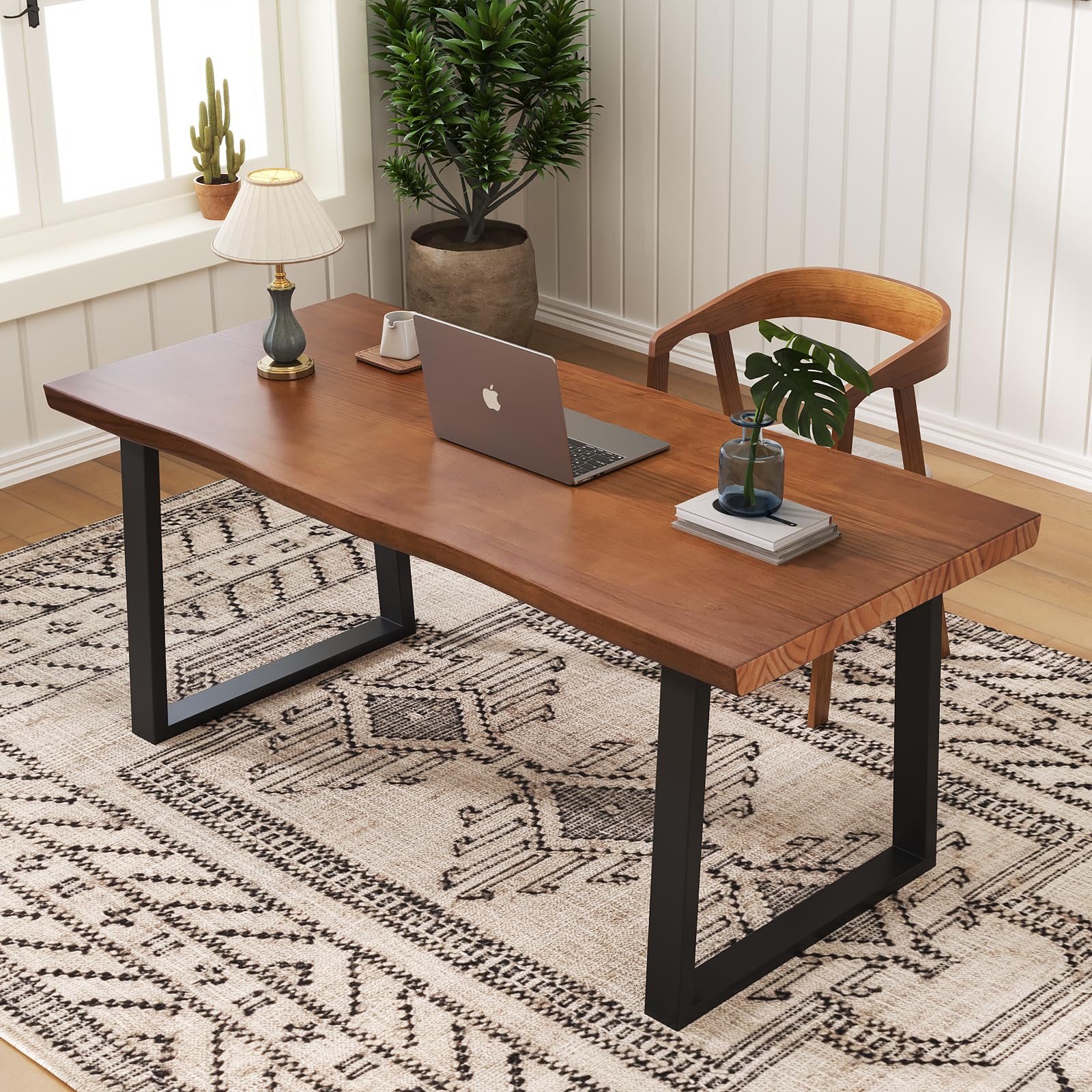
1. IBF 60 Inch Solid Wood Fir Computer Desk
Our pick — 4.0+★ from 200+ verified ratings; the strongest balance of quality and price.
A genuine fir slab wide enough for two people, held up by legs rated to 300 pounds.
You get the roomiest surface in this guide’s mid-tier: the top measures 60 inches wide by 23.6 inches deep. That is enough to seat two people side by side on a single desk, or one person with a monitor, a laptop and a notebook all laid out flat. The frame is rated to support up to 300 pounds, so a monitor, a printer and a shelf of reference books sit on it without sag.
Fir is a softwood, so it keeps the desktop comparatively light for its size — one reason buyers describe it as easy to handle during assembly. The K-shaped metal legs splay outward to brace the desk against side-to-side sway, which is the motion you notice most when you are typing fast or standing up from the chair. The natural wood finish leaves the grain visible rather than buried under a heavy stain.
Here is the honest catch. Some buyers confirm the top is real wood, others read the grain differently and leave unconvinced. That disagreement is about expectation, not a defect — a thin fir slab with straight grain looks plainer than a knotty pine board, and it can feel lighter than people picture when they hear “solid wood”. If you want a heavy, dark, knot-forward slab, look at the acacia and pine picks further down. Otherwise, the quality here is what wins people over most, followed by how it looks in the room.
The case for the IBF
- 60 inches of fir slab, so dual monitors and a laptop share the surface without crowding.
- 300-pound load rating on K-shaped metal legs that resist side-to-side sway.
- Labeled parts, hardware and tools ship in the box, so assembly needs no extra trip.
- Environmentally friendly real wood top that shows its grain instead of hiding it.
Where it gives ground
- Fir is a softwood, so the surface marks more easily than a dense hardwood.
- Not everyone reads the top as solid wood on arrival; expectations vary.
The default choice: a bright, open home office where two people share one desk or one person spreads out across three screens.
Know before you buy: fir dents under a dropped stapler, so use a mat under anything metal.
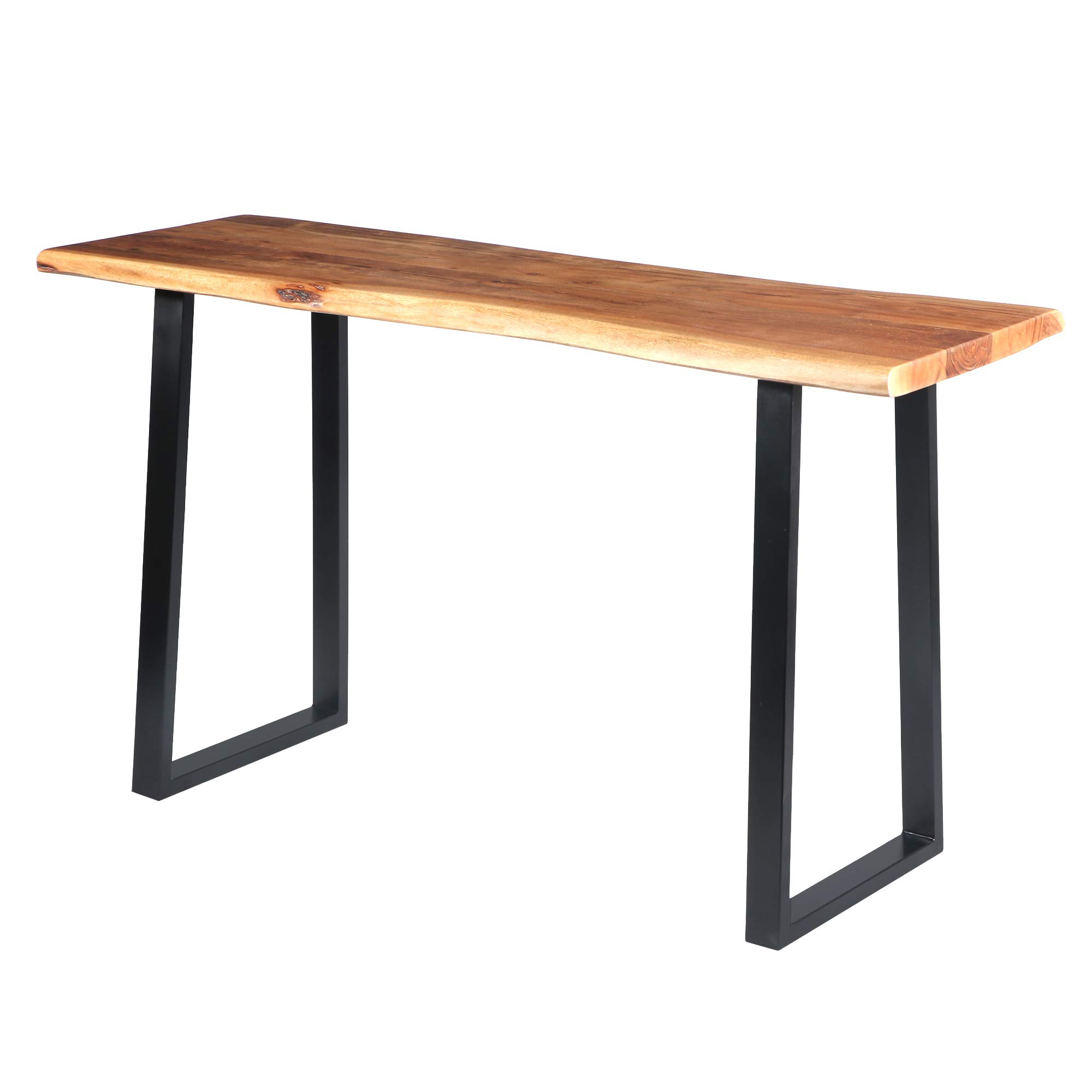
2. wangbochuan 47″ Solid Wood Live Edge Gaming Desk
The dark, rustic slab that fits a bedroom wall — 47 inches wide and 23.2 inches deep.
This one is for the room that cannot spare floor space. At 47 inches wide versus the 60-inch IBF above, that is the difference between a desk that dominates a small bedroom and one that tucks against the wall. The 23.2-inch depth holds a monitor, a keyboard and a coffee mug without feeling pinched.
The dark brown finish against black iron legs reads vintage-industrial rather than bright and airy. Its standout is the live edge silhouette — the factory leaves the slab’s natural contour and grain intact, so no two units come out identical. Every desk in that style carries its own knots and its own edge shape, which is the point rather than a flaw.
The trade-off sits in the base. Black metal legs give it a firm stance, but the whole thing weighs in at 35 pounds — light enough to move single-handed, and also light enough that a hard shove against a monitor arm will shift it. Anchor it against a wall if you have kids or a big dog. A clean, characterful slab for the footprint, with no veneer hiding beneath the finish.
Footprint win: 47 x 23.2 inches is the smart match for a spare-room office or a gaming corner that has to share space with a bed or a shelf.
Choose it when space is the constraint: a narrow room where a 60-inch top would block a doorway or a closet.
Pass if: you run a triple-monitor array — this surface runs 47 inches wide and expects one desk, one user.
3. TUP THE URBAN PORT Industrial Wooden Live Edge Desk
An acacia slab on welded sled legs, rated to hold 330 pounds.
Acacia is a dense hardwood, and that density shows up in the spec sheet — the top is a solid timber slab rather than a thin veneer over a composite core. The welded sled-leg base is rated to 330 pounds, the heaviest capacity printed anywhere in this round-up. 330 pounds on a welded frame means this desk does not move when you lean on it.
The depth is the catch, and it is worth stating plainly. At 18 inches front-to-back this is the narrowest top here, versus 23.6 inches on the 60-inch fir desk. That difference is a monitor that sits closer to your face, so pair it with a slim stand or a wall mount rather than a deep desktop arm. Where the depth helps is legroom and floor space: 51 inches wide and 18 deep slots neatly into a hallway nook or a writing corner.
One detail buyers will appreciate: metal sled legs come secured with floor protectors, so they slide rather than scrape across hardwood. The acacia grain runs dark and knotty, and the manufacturer is upfront that colour, finish and knots vary from unit to unit. Treat the photo as a mood board, not a promise. Expect assembly — the desk ships needing it, with instructions included.
The slab verdict: A solid acacia top on a welded sled base is the sturdiest top-and-frame pairing of the smaller desks here, and the 51-inch width keeps a real writing surface without eating the room.
The honest limit is that 18-inch depth. If you use a big curved monitor on a deep stand, you will want the extra front-to-back room the fir desk offers. For a laptop-and-notebook writer or a clean console, the acacia slab here is the more interesting piece of furniture.
Reach for this if: you want one slab with real heft and you work off a laptop with a wallpaper-thin footprint.
Look elsewhere if: your monitor stand needs the front-to-back room this desk does not have.
4. tiedingdingjiaju Solid Wood Executive Desk, 70in
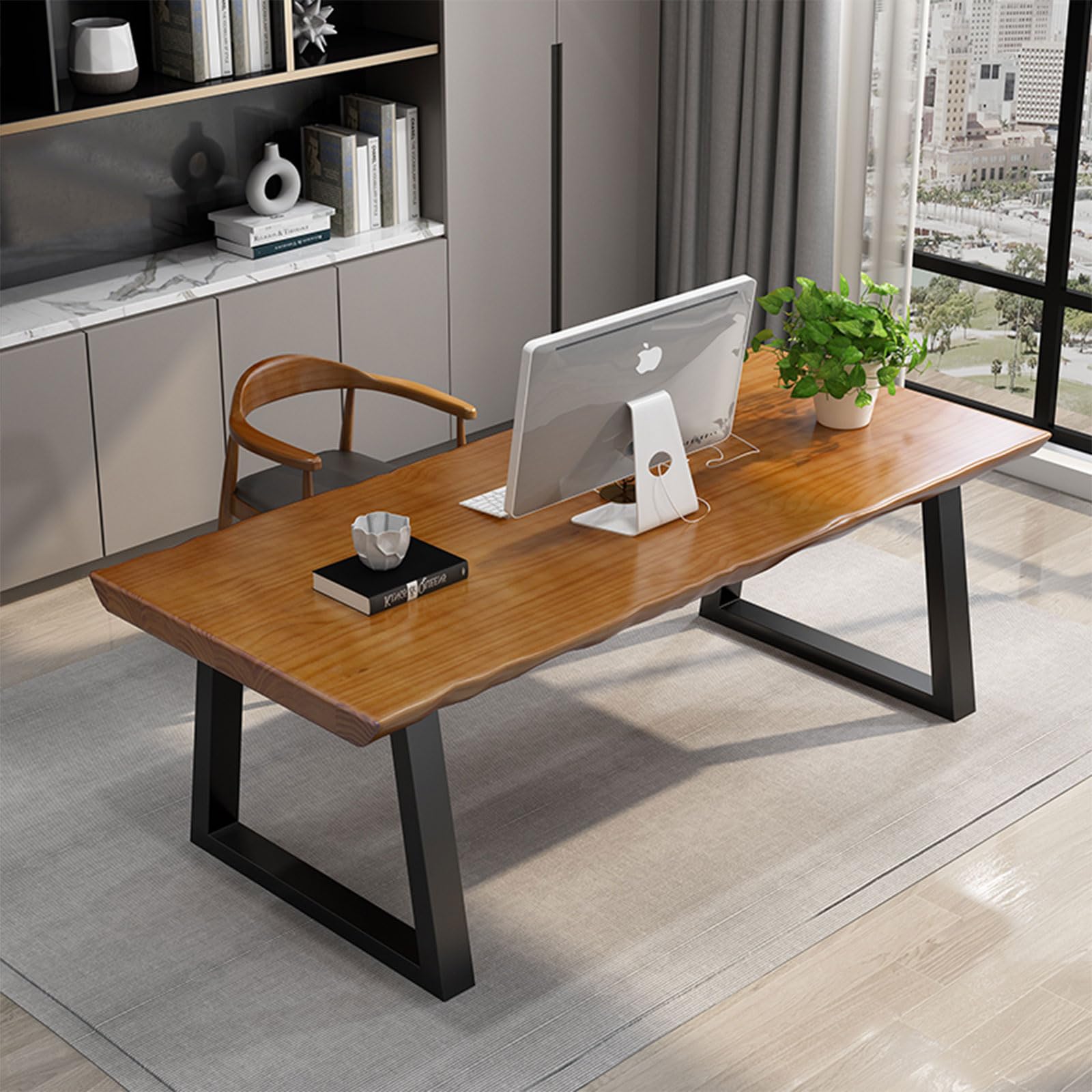
A 70-inch pine slab that flips between executive desk and dining table.
Want the widest surface in this guide? This is it. At 70 inches across versus the 47-inch live edge pick, the pine top is wide enough to seat two people comfortably for dinner, then clear the plates and set up two monitors. The light brown lacquered finish (a clear protective coating) keeps the grain readable while adding a coat that wipes clean after a meal or a work session.
This is a hybrid piece built for rooms that do double duty. An apartment with no separate dining table can use it as both. The black metal legs keep the design modern and minimal, so it sits just as naturally in a home office as it does in a dining nook. Buyers report the quality lands better than expected and that assembly goes smoothly.
The honest trade-off: the lacquered pine surface and the “portable” label sit a little awkwardly together — a 70-inch slab is not something you move casually, and the coating benefits from padded feet under anything you set down. It is the right desk for someone who wants one big timber surface serving two jobs, not a wall-flower writing table.
Why it earns its width
- 70 inches wide, the broadest top in this round-up — two people, two jobs, one surface.
- Lacquered pine wipes clean, so dining duty does not leave sticky rings behind.
- Black metal legs keep a modern look that suits a home office or a meeting table.
- Assembly draws praise for going together without headaches.
The honest caveats
- 70 inches of pine is heavy furniture — plan your room layout before it lands.
- No drawer in the build, so paper storage is a separate purchase.
One surface, two lives: ideal for an apartment where the desk and the dinner table are the same piece of furniture.
Think twice if: you want drawers built in — this frame carries none.
5. SRLWerks Industrial Pipe & Live Edge Top Table

Hand-built in Mississippi from northern white cedar and white pine, with black steel pipe legs.
If you want a reproduction of a photo, this is the wrong desk. If you want a piece nobody else owns, this hand-built cedar-and-pine slab is it. A family-owned shop in Amory, Mississippi builds each unit from northern white cedar and white pine, and the finish ships unfinished, so the slab arrives raw rather than sealed. Every top carries the character of the boards the shop cut on the day.
The silhouette is a rich wood top over a black steel sled frame of powder-coated pipe. That pipe base opens up legroom underneath, which matters if you like to stretch out or use a footrest. Assembling it is billed as a one-person job with a short step count and detailed instructions — no A-through-W confusion.
The realistic expectation to set: an unfinished top is meant to be finished by you, or left raw and accepted with its texture. Left bare, it takes stains from coffee rings and pen marks. Over time and with a little oil, it develops a deeper tone than it has on day one. The look earns the most praise here, and buyers rate the value they got very highly.
For the maker-minded: an unfinished cedar and pine slab means you control the finish — seal it the day it arrives and you get a warm, one-of-a-kind surface; leave it bare and it will absorb whatever you spill.
The pick for one-of-a-kind: a cabin, a loft or a home office where a hand-built American piece earns its spot against machine-made furniture.
Only if you accept the raw surface: this slab has no factory finish, so budget a weekend to seal it yourself.
6. Sihtengxxhongs 55 Inch Real Pine Live Edge Desk

A 55-inch pine slab stamped from real timber, not MDF or particle board.
The 55-inch surface is the size most people land on after a 47-inch top starts feeling crowded. Two monitors and a laptop fit across it with room to spare, and the listing describes that spread as suitable for professionals, students, remote workers and gamers. Solid pine rather than MDF or particle board means the grain runs through the slab rather than being printed on a thin skin.
Sturdiness is the thing buyers talk about first, and appearance comes right behind it. Industrial-grade steel legs with a thick solid wood top is the construction that earns that reaction. Assembly draws praise for going together predictably, with instructions in the box.
The one point to weigh honestly is value. That split usually tracks how the live edge and grain land in person versus the listing photo — natural variation cuts both ways. What is not in doubt is the raw build: real pine, a steel frame, and a surface sized for a genuinely busy desk.
Build read: a pine slab on industrial steel legs at 55 inches is the sensible middle ground between a cramped writing desk and an executive statement piece.
Best fit: a two-monitor desk setup where the pine warmth has to hold its own against black office equipment.
Fair warning: natural grain and edge shape vary from board to board, so judge the species, not the photo.
7. QZYJKJ 55 Inch Wide Solid Wood Desk

Four adjustable feet that level the desk on a wonky floor and protect the boards underneath.
Old houses have sloped floors, and most desks answer with a matchbook under one leg. This desk answers with four adjustable leveling feet threaded into the metal legs. They twist out to bring the top flat on an uneven surface, and each one carries a non-slip pad so the desk does not scratch hardwood, tile or laminate when you slide it.
The 55-inch wide solid wood top over a metal frame brings load-bearing capacity that handles a heavy monitor and a full desk’s worth of gear without complaint. Sturdiness is the trait buyers name most, with the look close behind — the natural curved edge gives it a softer outline than a plain rectangular slab. The water-based coating is described as clear, non-toxic and long-lasting, which suits a shared homework-and-work table.
Worth knowing: the surface is scratch-resistant but not scratch-proof, so keep box cutters and keys off it. Buyers also note a damaged top can arrive through shipping, and the seller’s stated answer is a free replacement on contact.
What the leveling feet buy you
- Four adjustable feet flat-foot the desk on any sloped or uneven floor.
- Non-slip pads protect hardwood, tile and laminate from scratches.
- Water-based coating on a 55-inch solid wood top over a metal frame.
- Natural curved edge softens the look against a flat rectangular desktop.
Details to plan around
- Scratch-resistant rather than scratch-proof — protect it from sharp edges.
- Top can arrive damaged from shipping; the seller offers a replacement on contact.
Worth it when the floor is not level: an older home with sloped boards where wobble would otherwise rule out a solid slab desk.
Not for you if: you demand a deep sealed finish — this is an industrial-style slab, not a lacquered executive surface.
8. SXXjiaju Solid Wood 71 Inch Live Edge Desk
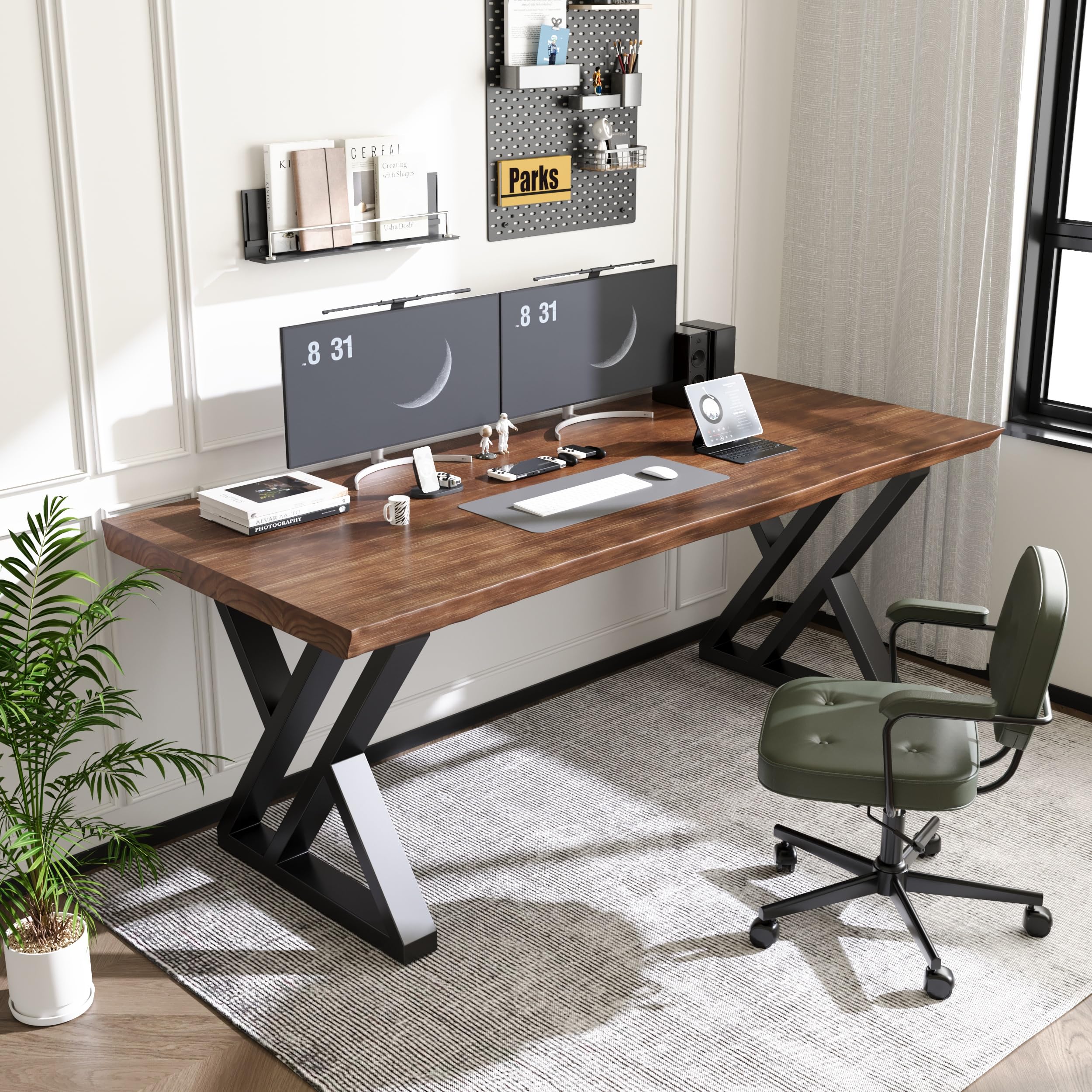
The 71-inch live edge slab for dual workstations, thick Z-legs underneath.
This is the desk you buy when the surface is the whole point. A 71-inch top carries a dual-monitor array, a second laptop, or two people working at once — the listing pitches it as a fit for multi-monitor setups, dual workstations and sprawling creative projects. At the widest end of this guide, alongside the 70-inch executive pine desk, it is nearly identical in width and a different animal in style.
Two details do the heavy lifting. The top is thickened solid wood with a live edge that keeps the board’s natural contours instead of squaring them off. The legs are thick Z-shape metal, a bracing design that resists racking — the twisting motion you get on a long, wide desk that carries weight only in the middle. There are four adjustable foot pads on the bottom as well, so the desk stays steady on a floor that is not perfectly flat.
Assembly is where this one stands out, because the leg-to-top connection is described as just 6 screws. That takes minutes, not an afternoon. Quality and sturdiness exceed expectations in the buyer consensus, and the polished varnished finish earns attention. Colour and grain vary naturally from slab to slab. Size, on the other hand, draws mixed feelings — some buyers find the span exactly right and others are surprised by the width when it lands. Measure the wall before you commit to 71 inches.
The big-surface read: if your current desk runs out of room at two monitors, a 71-inch thickened slab on Z-braced legs is the most direct fix in this round-up.
The one for wide workstations: a video-editing or dual-monitor setup where a 55-inch desk would already be at its limit.
Bring a tape measure: 71 inches of desktop is a lot of wall, and the span surprises buyers more than the finish does.
Know the Specs
Slab Species And Thickness
Species tells you how the top will age under everyday use. Fir and pine are softer softwoods, so they take dents from dropped metal and show coffee rings faster than a dense hardwood. Acacia is denser and resists dings better. Thickness is the other half of the story: an acacia slab feels heavier and more solid than a thin pine board, and it holds its shape better over years. When a listing says veneer or MDF, that is not a slab — the grain is a printed skin over a composite core, and you will notice the difference when it chips.
Live Edge And Natural Variation
Live edge means the factory keeps the tree’s natural outer contour instead of cutting the side into a straight line. Each slab then carries its own knots, colour, and edge shape, so no two desks are identical. That variation is the character some buyers pay for and the surprise others get when the slab differs from the photo. If you want a predictable look, a straight-cut slab or a lacquered finish is the safer bet. If you want a desk no one else in the house owns, live edge delivers it.
Load Capacity And Base Design
Load capacity is the total weight the frame can carry on top of the slab’s own weight. A ratio of 300 to 330 pounds handles a monitor, a printer, and a book stack without sag. Leg style is what stops wobble: K-shape, Z-shape, sled and pipe frames each brace the desk against a different direction of force. Four adjustable leveling feet let you flatten a desk on a sloped or uneven floor so it does not rock every time you lean on it.
Desktop Depth And Working Posture
Depth is the spec buyers check least and regret most. A 23.6-inch-deep top leaves room for a monitor at arm’s length plus a keyboard in front of it. An 18-inch top pulls everything closer, which is fine for a laptop and a notebook but cramped for a deep monitor stand. Measure from the wall to where you sit and subtract at least a hand-width of clearance for your knees. Width gets the attention, but depth decides whether the desk feels comfortable after a full workday.
Common Questions
Will a wood slab desk warp in a humid room?
How much assembly does a solid wood slab desk actually need?
Is a live edge top harder to clean than a straight-edged desk?
What weight can a wood slab desk safely hold?
Can a wood slab desk be used as a dining table too?
How do I stop a slab desk wobbling on an uneven floor?
Is fir or pine better for a home office desk?
What size desk do I need for two monitors?
Does an unfinished wood desktop need sealing?
What happens if the wood slab arrives damaged?
The Bottom Line
For most people, the wood slab desk to buy is the IBF 60-inch fir desk — a genuine fir slab, 60 inches of surface, and 300 pounds of load capacity all in one mid-tier package. It is the pick that gets the material right and the price within reach. If you want that deep, dense acacia slab with a 330-pound frame in a smaller footprint, the TUP THE URBAN PORT live edge desk is the one to reach for. And if two monitors and a laptop have outgrown your current desk, the SXXjiaju 71-inch live edge desk gives you the room. Owners mention that sturdiness and grain settle the decision more than any finish sample, so pick the species that suits your room and buy once.
How we choose
We do not accept paid placement. Every pick is matched to a real buyer and a real use-case; we do not hands-on test units.
Sources
Specifications: manufacturer listings and product documentation. Review insights: verified customer reviews. Pricing: not shown on this page (it changes often); check the current price via the retailer link.
As an Amazon Associate, Tactical Gear Guy earns from qualifying purchases. This does not affect which products we feature.