Specs are compiled from manufacturer listings and verified buyer reviews and can change over time — please confirm the key details on the product page before buying.
A weighted vest is only useful if it stays put while you move. The moment it bounces on a sprint or slides during push-ups, you stop training and start fiddling with straps. The right vest does two things well: it holds its weight tight against your torso, and it lets you change that weight as your strength grows. Fabric, pockets and reflective strips are detail around those two jobs. Below are nine vests sorted by what each one does best, so you can match one to your training.
This guide is built by comparing the manufacturers’ published specifications and the patterns across verified customer reviews, so you get each pick’s real strengths and trade-offs instead of marketing spin.
Start with the weight system, because that decides whether a vest stays useful after a month. A fixed 20 lb shell feels great in week one and useless by month six. Removable iron blocks or sandbags let you add resistance in steps, so the same vest carries you from recovery walks to heavy rucking. Here is how each weight system works in practice, and which workout vest for men fits which type of training.
Top Picks


How To Choose The Best Workout Vest for Men
The mistake most guys make is buying the heaviest vest they can find on day one. A 40 lb shell sounds serious until your shoulders are raw after two sessions and the vest ends up in a closet. Buy for the weight you’ll actually train at next month, not the weight that impresses you today.
Decide your weight system first
A fixed-weight vest locks you into one load forever. An adjustable vest with removable iron blocks or sandbags lets you drop resistance on recovery days and push it on heavy days. If you want one vest to last years, buy adjustable — every pick here that scales does it with removable blocks.
Look hard at how the weight is held down
Loose weight is the whole problem. Iron blocks or plates need interior retention straps or tight pockets so they don’t shift when you go from standing to a burpee. A wide waist belt and hook-and-loop shoulder straps add a second layer of hold. Vests with only a single chest buckle tend to ride up during sprints.
Match the weight range to your training
Walking and posture work suits a light load. Rucking, calisthenics and CrossFit-style circuits want more headroom. A vest that starts near 3 lb and climbs in small steps is right for beginners and rehab-style walking. A vest that goes toward 35 lb or 65 lb is built for people already training hard.
Check the fabric and shoulder padding
Sweat and abrasion kill cheap vests fast. Heavier nylon like 600D or 1200D Oxford resists scuffing and wipes clean. Padded shoulders matter more than most buyers expect — the load hangs from your shoulders, and thin straps dig in on long rucks.
Side-by-Side Comparison
| Model | Best For | Weight Range | Closure | Material | Amazon |
|---|---|---|---|---|---|
| CROSS101 Adjustable Weighted Vest★ Best Overall | All-round strength and CrossFit | 20 lb (up to 140 lb family) | Hook | Nylon | Amazon |
| Feyachi Adjustable Weighted VestBest for Beginners | Light-load walking and cardio | 3–12 lb | Buckle | Metal, Nylon | Amazon |
| RUNmax Adjustable Weighted VestBest for Sprints | Sprints and burpees | 20 lb (up to 150 lb family) | Hook and Loop | Nylon | Amazon |
| MSPORTS Weighted Vest Premium | Tactical-style home training | 11–65 lb | Double Ring | Cast Iron, Polyester | Amazon |
| ZELUS Weighted Vest | Home treadmill and cycling work | 23 lb | Hook and Loop | Foam, Iron, Nylon | Amazon |
| BAGAIL Weighted Vest | Rucking and outdoor walking | 2–40 lb (by size) | Buckle | 1200D Oxford Nylon | Amazon |
| Polyfit Fortify Weighted Vest | Plate-based training | Up to 40 lb | Hook and Loop | 600D Nylon | Amazon |
| MVRK Weighted Vest | Heavy rucking and HIIT | 35 lb (0–35 lb scale) | Buckle | Nylon | Amazon |
| HANZO Weighted Vest | Calisthenics and bodyweight work | 25 lb (by size) | Hook and Loop | Nylon | Amazon |
Detailed Reviews
1. CROSS101 Adjustable Weighted Vest
Our pick — 4.5+★ from 750+ verified ratings; the strongest balance of quality and price.
An adjustable vest that arrives with its weights already inside, ready to train.
The CROSS101 is the pick here that shows up complete. The 20 lb vest ships with every weight included, so you’re not hunting for plates or sandbags to make it usable. Weights can be pulled out in all models, which means the vest grows with you instead of locking you into one load. The hook closure and nylon shell keep it simple and durable, and the camouflage finish won’t read as a plain grey gym accessory.
The weight is the thing. Every review hinged on it — the 21 lb build (a 10% heavier carry than the BAGAIL’s 30 lb option in the listing weight data) reads as a solid load for strength days but manageable for walking days. Build quality holds up as the crowd favorite: the shell and stitching handle CrossFit-style circuits without the vest going sloppy. Comfort and fit both land well, and that’s the pair most likely to send a vest back — this one stays put.
The honest caveat is durability. Some vests in this family rip within the first 10 uses, and that’s the one recurring complaint. Treat it as a strength-session tool rather than an everyday beater, and it earns its keep. It wins people over on quality first, comfort second — a rare pairing when most vests pick one.
Why it earns the crown
- Arrives with all weights included — nothing extra to buy
- Removable weights let you dial the load up or down
- Hook closure and nylon shell hold up under CrossFit-style circuits
- Shoulder pads cushion the hang point on long sessions
- Camouflage finish separates it from plain gym gear
Where it shows its limits
- Durability is the weak spot — some units tear within the first stretch of use
- Hook closure needs a firm press to stay locked
- Camouflage won’t suit everyone’s gym aesthetic
Reach for this if: you want a complete, ready-to-train adjustable vest for strength and conditioning work.
Look elsewhere if: you need a vest that survives daily abuse — this one rewards careful handling.
2. Feyachi Adjustable Weighted Vest
A gentle starter vest that begins near nothing and climbs in small steps.
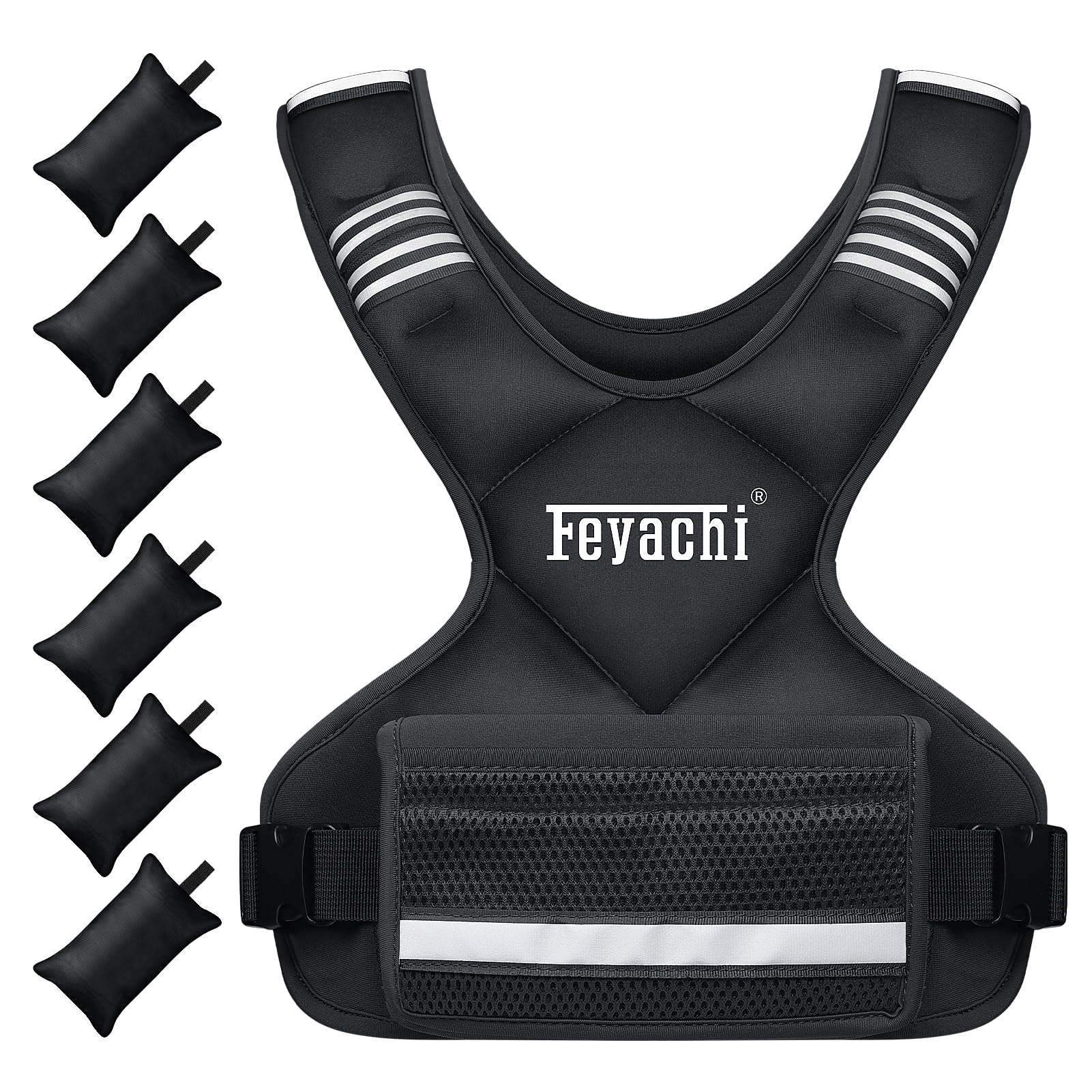
If you’re stepping into weighted training for the first time, starting heavy is a mistake. This Feyachi vest starts at 3 lb and climbs to 12 lb using six 1.5 lb removable iron sandbags — so you can add resistance in small steps instead of jumping straight to a full shell. The neoprene shell stays soft against the body, and the reflective strips on the front, shoulders and back keep you visible on early-morning walks or evening runs.
The X-type design spreads weight evenly across the torso, which is why it doesn’t bounce when you’re walking or cycling. The hook-and-loop fasteners lock it down for most body types, and the roomy front pocket holds keys or a phone so nothing jingles through your session. It’s a vest built for cardio, posture and light strength work — not heavy rucking.
If you want to push beyond 12 lb later, you’ll need a bigger vest. For the first six months of graded resistance, this pairs with a beginner schedule almost perfectly.
What lands well: The 3 lb starting load is the smallest on this list — a genuine on-ramp for anyone coming off an injury layoff or starting from scratch. The neoprene shell and reflective strips make it a natural walking companion, and the front pocket earns its place on shorter sessions.
The real ceiling: Twelve pounds is the maximum adjustable load here. Once you’re comfortable at the top, you’ll graduate to a heavier vest. Buy it knowing that, not expecting it to carry you years.
Most comfortable first step: someone new to weighted training, or walking for posture and cardio.
Skip the upgrade path: if you already train above 12 lb with any regularity.
3. RUNmax Adjustable Weighted Vest
The vest that stays locked down when you’re moving fast.
Bouncing is the killer of weighted sprints. The RUNmax answers that directly: the hook-and-loop straps, the shoulder pads and the adjustable weight distribution keep it glued to the torso when you shift from a sprint to a burpee. Reviewers call out the stability specifically — no bounce, no readjusting — which is the whole point of wearing weight while you move fast. It ships with all weights included and the shoulder pad option is on this model, so the hang point is cushioned.
At 21 lb listed (compared with the CROSS101’s 23 lb build, close enough to swap depending on how you load it), this is a solid mid-weight vest for strength training, CrossFit and general conditioning. The weight itself is the star — buyers praise the ability to load it up or pull weights out, and the nylon shell handles regular circuit work. Comfort and fit both land positive across a big sample, with the shoulder pads doing the heavy lifting on long sessions.
The one question worth asking before you buy: durability here is rated positive overall, but like any hook-and-loop vest the straps need a firm press. If you’re rough with closures or leave it crumpled in a bag, expect the hook side to wear. That’s a fit issue, not a defect — press it flat and it holds.
What buyers report
- No bounce during sprints and burpees
- Shoulder pads stay comfortable through long sessions
- Straps stay put without constant readjusting
- Loads adjust in quick steps with removable weights
- Solid nylon shell handles regular conditioning work
What to plan around
- Hook-and-loop straps demand a firm press
- Heavier loads compress the shoulder padding
- Not a vest for people who want plate-style loading
Built for fast movers: sprint intervals, burpees and CrossFit circuits where staying put matters most.
Not for plate purists: if you’d rather load iron plates than sandbags, the Polyfit is the better match.
4. MSPORTS Weighted Vest Premium – Adjustable 11–65 lb
Sixty-five pounds of removable resistance from a single shell.
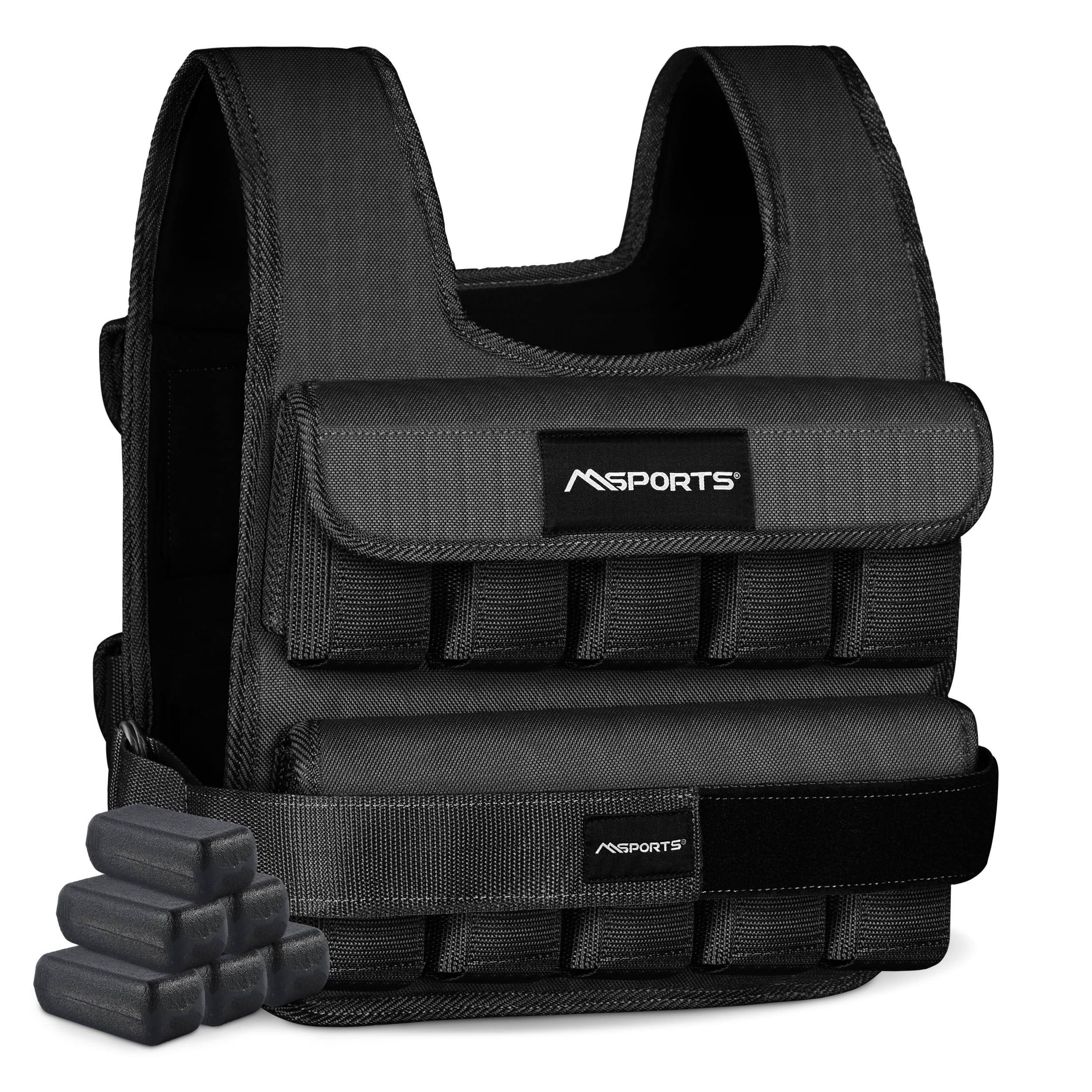
The MSPORTS gives you the broadest load range on this list — from 11 lb up to 65 lb with removable weight packs. That’s the kind of range that carries you from a starter walk to full rucking without buying a second vest. The cast iron and polyester shell is tear-resistant, and the double-ring closure plus hook-and-loop straps and adjustable hip belt keep the load from sliding. A digital workout guide comes included if you want programming to follow.
The weight system is what sells it. The tactical-style cut is popular for home workouts and functional fitness, and the cast iron packs let you push closer to that 65 lb ceiling when you’re ready. Reflective detailing helps if you ruck outdoors, and the sweat-resistant shell wipes down quickly after a session.
The honest note: ease of use splits opinion. Some vests go on in one motion; this one involves threading the double-ring closure and aligning the velcro, which takes a couple more seconds. Learn the order once and it’s fine. The bigger reality is that 65 lb is a lot of weight for a non-plate vest — start low and build.
The load range story: 11 lb to 65 lb is a bigger spread than any other vest here. The cast iron packs stay compact, so the shell doesn’t balloon when you’re pushing heavy.
What to plan for: The double-ring closure is fussier than a simple buckle. If you’re the kind of person who wants to throw the vest on in three seconds, this isn’t that.
The broadest range: lifters and tactical-style trainers who want one vest to span beginner to heavy loads.
Not the quick on-off: if fast strap-up matters more than maximum weight headroom.
5. ZELUS Weighted Vest

Treadmill and cycling weight from a shell built for the home gym.
If your weighted training happens indoors on a treadmill or bike, the ZELUS makes a strong case. The 23 lb shell ships with adjustable iron weights, so you can trim load for a cycling session and add it back for a strength day. The reinforced nylon and foam-padded shoulder straps carry the weight through long sessions without digging in, and the hook-and-loop straps let you dial in a snug fit whether you’re a beginner or a seasoned lifter.
Where this vest earns trust is comfort. Owners say their hips and lower back don’t hurt while wearing it, and it holds up across yoga, kickboxing, jogging and cycling work — the kind of low-impact variety a home routine demands. The reflective strips on the front, shoulders and back help if you take it outdoors on walks, and the sandbag-style weights adjust in steps, so you’re not stuck with a fixed load.
The catch is sizing. Several owners say it fits nicely, but a handful find it too big for a woman’s frame. If you’re smaller-framed, check the fit before committing — the shell is built to a broad one-size pattern. Men looking for a no-nonsense indoor vest will find this one of the standout options for the home gym.
Why it works indoors
- 23 lb shell with adjustable iron weights
- Foam-padded shoulder straps stay comfortable
- Hips and lower back don’t feel the load through walks
- Handles yoga, kickboxing, jogging and cycling
- Reflective strips for outdoor visibility
Where it needs care
- One-size shell runs large for smaller frames
- Fixed 23 lb maximum means no growth beyond that
- Sandbag weights need re-seating occasionally
Best home-gym companion: treadmill walking, cycling and low-impact circuits indoors.
Smaller frames, look first: the one-size shell has been called too big by some buyers.
6. BAGAIL Weighted Vest Men, 20lb/30lb/40lb Adjustable
Rucking fabric, iron blocks, and a warranty that backs the sweat.
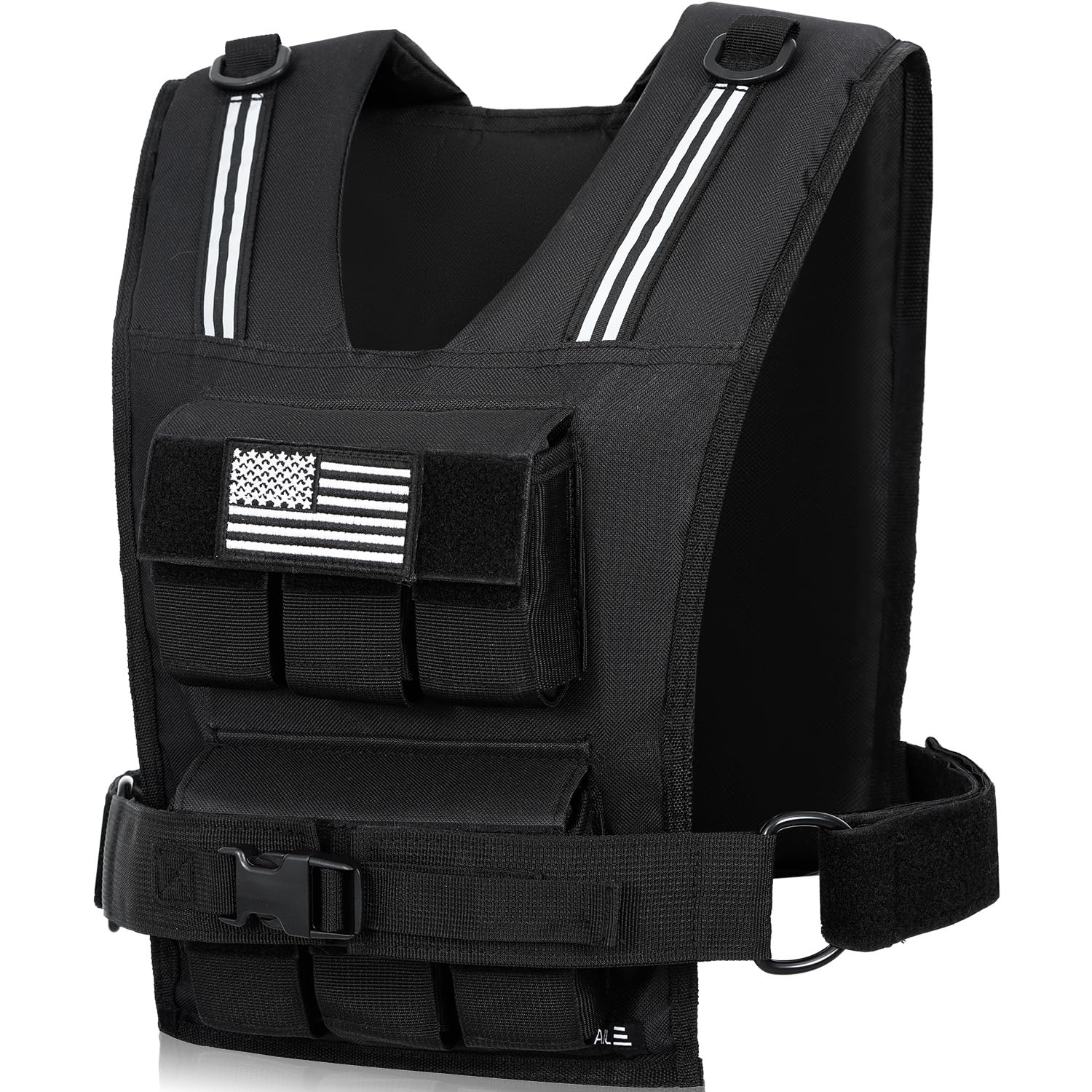
The BAGAIL survives hard outdoor use, and its shell is the toughest on this list. The 1200D Oxford nylon weave (a heavy, tightly woven fabric rated 1200 denier, a measure of thread thickness) resists scuffs better than the lighter shells here, and it’s washable, so a sweaty ruck doesn’t ruin it. Rust-resistant 2.5 lb iron blocks let you step the load up or down in small increments, so you can add weight as you get stronger. The vest comes sized to 20, 30 or 40 lb depending on which model you pick — the 30 lb version is what you’re seeing here.
Versatility is what wins people over. The extra-thick shoulder pads, adjustable waist belt, wide velcro straps and safety buckles handle the load across walking, running, rucking, HIIT and calisthenics. The detachable logo is a nice touch for anyone who doesn’t want a billboard on their chest, and the reflective strips on the front and back handle low-light training. Backed by an 18-month warranty, which is a longer safety net than most of its peers.
That’s the trade for the load headroom. For most men doing rucking and mixed outdoor training, it’s a solid long-term pick.
Built for the outdoors: 1200D Oxford nylon and washable construction make this the most weather-and-sweat-ready vest here.
The honest weight note: The 30 lb version is heavier than it reads. If you want to keep climbing toward 40 lb, budget for shoulder fatigue on long rucks.
Best for ruckers: outdoor walking, running and rucking where fabric durability matters.
Not for minimalists: if you want the lightest possible vest, this one carries real weight before you add anything.
7. Polyfit Fortify Weighted Vest – Workout Vest for Men & Women

A plate-style vest for lifters who already own iron plates.
The Polyfit is a different animal — it takes standard weight plates rather than sandbags or iron blocks. Two pockets, one front and one back, each hold up to 20 lb, with a 40 lb total capacity and a fit for plates up to 13″ x 11″. That means if you already own weight plates, this vest makes them wearable. Interior straps lock plates tight, so the vest stays bounce-free through runs, rucks and bodyweight work.
The 600D nylon shell is lighter than the 1200D Oxford on the BAGAIL, which gives you more freedom of movement on bodyweight workouts and strength training. Padded shoulder straps and breathable mesh help with heat on longer sessions, and the waistband plus chest pockets hold small essentials. Adjustable shoulder straps and a stretch waist belt with hook-and-loop closure make it quick to get on and off.
Here’s the thing you have to plan around: weight plates are sold separately. If you don’t own plates that fit 13″ x 11″ pockets, that’s an extra purchase before the vest is usable. For lifters with a plate setup already on hand, this is the most versatile vest on the list.
For the plate lifter
- Two pockets at up to 20 lb each for 40 lb total
- Interior straps lock plates bounce-free
- 600D nylon keeps freedom of movement high
- Padded straps and mesh handle heat on long sessions
- Easy on-off with stretch waist belt
The catch worth knowing
- Plates sold separately — not usable from the start
- Limited to plates up to 13″ x 11″
- Maxes at 40 lb capacity
Best for plate owners: if you already own weight plates, this turns them into wearable resistance.
Not for the plate-free: if you don’t own plates, add them to the cost before choosing this one.
8. MVRK Weighted Vest Men 15lbs/25lbs/35lbs/45lbs/65lbs/100lbs

A compact heavy hitter that scales from bare shell to 35 lb of iron.
The MVRK is built for people who train hard and don’t want a bulky shell. That’s why the design is compact: 16 iron weights — eight in front, eight in back — are each around 2.18 lb, so you can go from zero resistance to 35 lb and back without the vest ballooning. The compact cut is specifically engineered to keep your range of motion open during calisthenics, HIIT and the kind of sessions where a bulky vest would get in the way.
What wins trust here is construction. Reinforced stitching sits at every stress point, the heavy-duty buckles are rated for maximum load, and sweat-resistant materials hold up through long rucks and hard training. Owners say it doesn’t irritate the neck even at heavier loads, and the adjustable system is easy to get on and off. The bundle includes every weight, so it’s ready to train when it arrives.
The one thing to know: at 35 lb max, this vest sits below the MSPORTS and BAGAIL in headroom. If you need to push past 35 lb for rucking work, one of those is a better match. If your ceiling is heavy calisthenics and HIIT, this compact design is the sharper tool.
Compact and loaded: 16 removable iron blocks scale the vest from nothing to 35 lb without adding bulk. The reinforced stitching and load-rated buckles are built for punishment.
Where it caps out: 35 lb is the ceiling. Beyond that, you’re shopping in a different weight class.
Best compact heavy lifter: calisthenics, HIIT and rucking where bulk gets in the way.
Skip if you need more: if your training climbs past 35 lb regularly.
9. HANZO Weighted Vest for Men & Women 25lbs
A 1000D nylon vest built for pull-ups, dips and disciplined repetition.
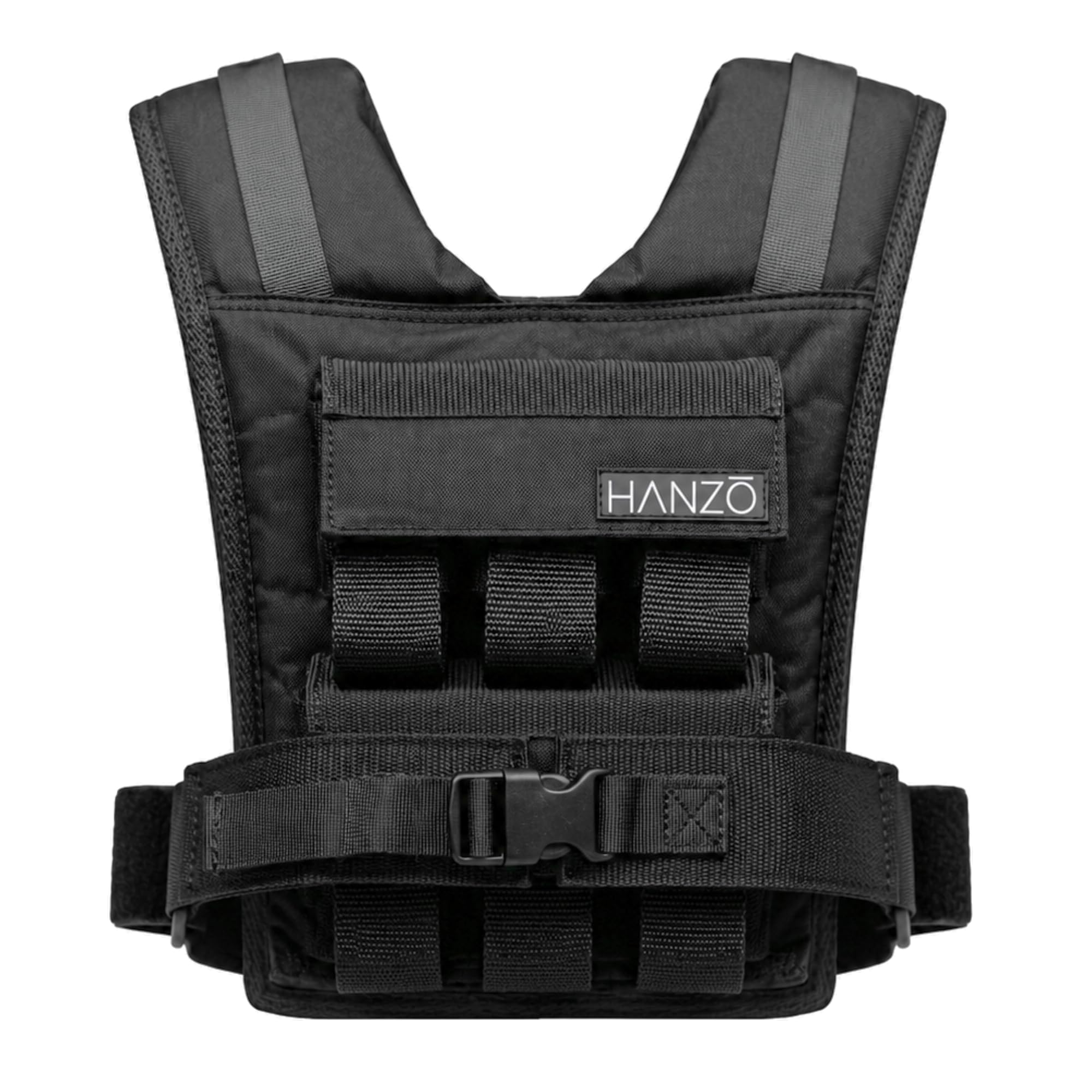
The HANZO carries up to 25 lb of adjustable resistance in a 1000D Oxford nylon shell — heavier fabric than the 600D Polyfit uses, which buys you abrasion resistance through repeated training sessions. The weights are removable, so you can step the load down on recovery days and up for heavy pull-up or dip work. Double-padded shoulders and a balanced profile are meant to keep the vest from shifting mid-set, so your focus stays on the rep in front of you.
It shines on bodyweight movements. Owners say it doesn’t chafe, which is the right test for a vest used in hanging and dipping positions. The adjustable weight system lets you change the load in 2 lb steps, and the vest goes on and off easily. The reinforced stitching and heavy-duty nylon are there for the long haul, not the first month.
The thing to plan around: 25 lb is a moderate ceiling. If your training pushes toward heavy rucking or loaded carries, you’ll outgrow the HANZO quickly. For pull-ups, push-ups, dips, squats and conditioning work, it’s a well-built companion that sits comfortably and stays out of your way.
What it does well
- 1000D Oxford nylon resists abrasion from repeated work
- Double-padded shoulders handle hanging movements
- No chafing reported by owners
- Adjusts in 2 lb steps
- Full weight brick set included
What to expect
- 25 lb ceiling limits heavy rucking use
- Not a plate-loading system
- Heavier shell than some — less breathable in hot rooms
Built for reps: pull-ups, dips and bodyweight conditioning where stability matters most.
Look past it if: you’re rucking heavy or pushing past 25 lb.
Know the Specs
Weight range and removable weights
The weight range is the number of pounds the vest can hold — from a low starting load to its ceiling. A vest that starts near 3 lb suits a beginner or someone easing back into training. A vest that climbs toward 35 lb or 65 lb suits a seasoned lifter or rucker. Removable iron blocks or sandbags let you step the load up or down, which is what keeps a vest useful as your strength changes.
Closure type and bounce control
The closure is how the vest sits on the body. Hook-and-loop straps are fast and adjustable, and they hold well when pressed firmly. Buckles and double-ring closures take a moment longer to thread but can sit more securely at heavier loads. A wide waist belt plus shoulder straps is the setup that actually prevents bounce — one buckle alone tends to ride up when you shift into a sprint.
Fabric weight — 600D vs 1000D vs 1200D Oxford nylon
The “D” number is how dense the nylon weave is, measured in denier (a unit of fiber thickness). Higher denier means a heavier, more abrasion-resistant fabric. A 600D shell is lighter and more flexible, which helps with range of motion. A 1200D or 1000D shell is tougher and handles sweat and scuffing better. For heavy rucking or daily use, heavier fabric wins; for calisthenics and movement, lighter wins.
Plate loading vs iron blocks vs sandbags
There are three ways a vest holds weight. Iron blocks or sandbags are included with the vest and are simple to swap. Weight plates are flat slabs you slide into pockets and lock down with interior straps — great if you already own plates, but they’re sold separately. Plates and blocks stay put better than loose sandbags, but sandbags adjust in finer steps. Match the system to what you already own.
Common Questions
Will a weighted vest fit a larger chest or broad shoulders?
What is the difference between a weighted vest and a rucking vest?
How do I stop my weighted vest from bouncing during sprints?
Can I wash a weighted vest?
Is 20 lb a good starting weight for a weighted vest?
Do weighted vests work for pull-ups and dips?
What is the difference between iron blocks and sandbags in a weighted vest?
How much weight should a weighted vest hold for rucking?
Will a weighted vest work for women as well as men?
Can a weighted vest damage your shoulders?
The Bottom Line
For most men, the workout vest for men winner is the CROSS101 because it arrives complete with all weights, adjusts from a solid working load, and holds up through CrossFit-style circuits — the broadest all-round option here. If you want a gentler on-ramp, the Feyachi starts near 3 lb and climbs in small steps. For rucking and outdoor training, grab the BAGAIL — that 1200D Oxford shell and washable build make it the toughest vest on the list. And for heavy, compact work, the MVRK packs 35 lb of iron into a shell that won’t get in your way.
How we choose
We do not accept paid placement. Every pick is matched to a real buyer and a real use-case; we do not hands-on test units.
Sources
Specifications: manufacturer listings and product documentation. Review insights: verified customer reviews, as of November 2026. Pricing: not shown on this page (it changes often); check the current price via the retailer link.
As an Amazon Associate, Tactical Gear Guy earns from qualifying purchases. This does not affect which products we feature.