Specs are compiled from manufacturer listings and verified buyer reviews and can change over time — please confirm the key details on the product page before buying.
You want clean shavings on your first pass, not a fight with the tool. The simplest route is a Japanese pull-stroke plane (a kanna, which cuts as you pull it toward you) with a laminated steel blade (steel layers bonded to a hard cutting edge) and a white oak body. You tune it by tapping the blade with a hammer instead of turning a screw. Pulling toward you is why these planes leave glassy surfaces while Western push planes fight you. Every pick below has a real wooden body, from a compact block plane for trim work to a wide smoothing plane for full boards.
This guide is built by comparing the manufacturers’ published specifications and the patterns across verified customer reviews, so you get each pick’s real strengths and trade-offs instead of marketing spin.
A wooden plane rewards patience over power, so the blade steel and body wood matter far more than any badge on the box. This breakdown of wooden hand planes covers blade width, body wood, and setup style so you can match one to the work on your bench.
Top Picks


How To Choose The Best Wooden Hand Planes
Buying a wooden plane is not like buying a power tool you plug in and forget. The body is timber, the blade is steel, and the two are held together by fit and friction rather than a dial. Three things decide whether the plane works for you: blade width, body wood, and whether you will learn hammer-tap setup.
Match blade width to the job, not to the biggest number
A narrow blade in the 30 mm range is a detail tool. It chamfers edges, cleans up small parts, and suits trim work where a full-size plane will not fit. A wide blade in the 50 mm to 65 mm range is a surface tool. It flattens panels and leaves long, continuous shavings across a board. If you buy wide when you mostly chamfer, you will be fighting the tool’s size on every cut. If you buy narrow when you need to smooth a tabletop, you will be there all afternoon.
Understand the pull stroke before you commit
A Japanese kanna is drawn toward your body, not pushed away. Pulling lets you apply even pressure across the whole stroke, which is why these planes feel more controlled than a Western push plane of similar size. The trade-off is muscle memory. If your hands are trained to push, the first few sessions feel backwards, and you should plan on scrap wood rather than your good stock.
Decide between replaceable blades and sharpening stones
Traditional planes hand you a high carbon steel blade you maintain on a whetstone. A replaceable-blade design lets you swap in a fresh edge and skip the stone entirely. Neither route is better on its own. The stone route costs you a learning curve and rewards you with a blade you can tune to your own preference. The swap route costs you ongoing blade purchases and rewards you with zero sharpening time. Pick the one whose trade-off you can live with on every project.
Side-by-Side Comparison
| Model | Best For | Blade Width | Cutting Width | Body Wood | Amazon |
|---|---|---|---|---|---|
| KAKURI Japanese Hand Plane 42mm★ Best Overall | All-round first wooden plane | 42 mm | 36 mm | White oak | Amazon |
| KAKURI 30mm Replaceable BladeSharpest Stock Edge | Beginners who skip sharpening | 30 mm | 23 mm | White oak | Amazon |
| SUIZAN Kanna 2″ Double Blade | Flattening and smoothing boards | 50 mm | 43 mm | Oak | Amazon |
| Daikichi Japanese Kanna 58mm | Wide shavings on larger panels | 58 mm | 58 mm | Alloy steel base | Amazon |
| Senkichi Flat Plane 65mm | Widest surface cuts on a budget | 65 mm | 65 mm | Oak | Amazon |
Detailed Reviews
1. KAKURI Japanese Hand Plane 42mm
Our pick — 4.5+★ from 550+ verified ratings; the strongest balance of quality and price.
A 42 mm laminated blade in a white oak body, small enough for trim and sure enough for a tabletop
This is the pick that lets you try a real Japanese kanna without betting a whole tool budget on one. The 42 mm blade width translates to a 36 mm cutting width — wide enough that you are actually smoothing a surface, not just scratching at one. The body is natural Japanese white oak, the same durable timber used in far more expensive planes, and the whole tool weighs 11.9 ounces so it stays controllable during long, detail-heavy passes. If you are stepping up from sandpaper and a block of scrap, this is the natural first stop, and it is the crowd favorite with 4.5+ stars across 500+ ratings on Amazon.
What wins people over is how the blade arrives. It is Japanese high carbon steel, laminated with soft iron and hand-sharpened by the maker, so it is slicing shavings from the first stroke rather than the fifth. That lamination is the part worth understanding: the hard steel gives you the edge, and the soft iron backing gives you a blade that sharpens more easily and holds together longer. The two-blade structure with a chipbreaker is the other quiet advantage. It breaks the shaving as it lifts so the wood fibers are less likely to tear out, which is the difference between a glossy finish and a fuzzy one on figured stock.
The catch, and there is a real one, is adjustment. There are no screws to dial in blade depth here — you tap the blade with a hammer to set it, and that method divides opinion sharply. Setup is also a step most people underestimate: the chipbreaker needs to sit close to the cutting edge, or the shaving jams under it and the plane stops dead mid-stroke. Learn that fit before you put it to good wood and this tool becomes second nature. Skip that step and you will spend an evening confused.
Why This One Earns The Top Slot
- 36 mm cutting width with a 42 mm blade — genuine surface smoothing, not just edge chamfering
- Laminated Japanese high carbon steel blade, hand-sharpened and ready on arrival
- White oak body built for durability and a smooth running sole
- Two-blade structure with chipbreaker cuts down on torn wood on difficult grain
- 11.9 ounces — light enough to control through long detail passes
What You Should Know Going In
- No adjustment screws — blade depth is set by tapping, which takes practice
- The chipbreaker has to be fitted close to the edge or shavings jam
- Pull-stroke technique feels backwards at first if you learned on a Western plane
Reach for this if: you want one wooden plane that handles chamfering, edge clean-up, and modest surface work without a steep tool cost.
Look elsewhere if: you refuse to learn hammer-tap adjustment — the 30 mm KAKURI below swaps blades instead and removes that step entirely.
2. KAKURI Japanese Hand Plane 30mm
The plane for anyone who wants sharp edges without ever learning to sharpen
Here is the cleanest answer to the single biggest objection people have about wooden planes: the whetstone. This KAKURI uses a replaceable blade system, so when the edge dulls you swap the blade rather than work it back on a stone. That is a meaningful shortcut for a first-time buyer, and it is why a plane this small makes sense as a starter. Blade width is 30 mm with a 23 mm cutting width, which is detail territory — chamfers, small parts, the tight corners a bigger plane cannot reach.
Your wrist does less work here, because the white oak body weighs just 9 ounces — the lightest plane in this group. Pulling a 9 ounce tool through a long chamfer feels very different from dragging a two-pounder. Setup is also quicker than a traditional kanna: the chipbreaker (the metal cap that stiffens the blade and breaks up shavings) clicks onto the main blade, so you skip fine-tuning the gap between them — the fiddliest part of Japanese plane setup. And the 6.1 inch body slips into a toolbox or an apron pocket without eating your whole kit.
The honest limit is scope. At 23 mm of cutting width this is not a surface-smoothing plane, and expecting it to flatten a board will leave you disappointed. It is also the narrowest blade here — the Senkichi below runs 65 mm, more than twice the width. Think of this as the plane you reach for after the big one has done its work, chasing edges and cleaning joinery. Buy it as a detail tool and it earns its place in the roll.
The sharpening shortcut: swapping a blade instead of working a stone is a real time saver, especially for beginners. The 30 mm blade with a 23 mm cut handles chamfering and small-part work, and the chipbreaker’s click-on design removes the gap-setting chore traditional planes put in front of you.
The size reality: 6.1 inches long and 9 ounces light means this travels well and controls easily, but it will not smooth a wide panel. Match it to detail work and it will not disappoint.
Suits you best when: sharpening a blade is the hurdle stopping you from trying a wooden plane at all.
Think twice if: your bench is mostly wide panels — you want blade width in the 50 mm range or above for that.
3. SUIZAN Kanna Japanese Wood Planer 2″
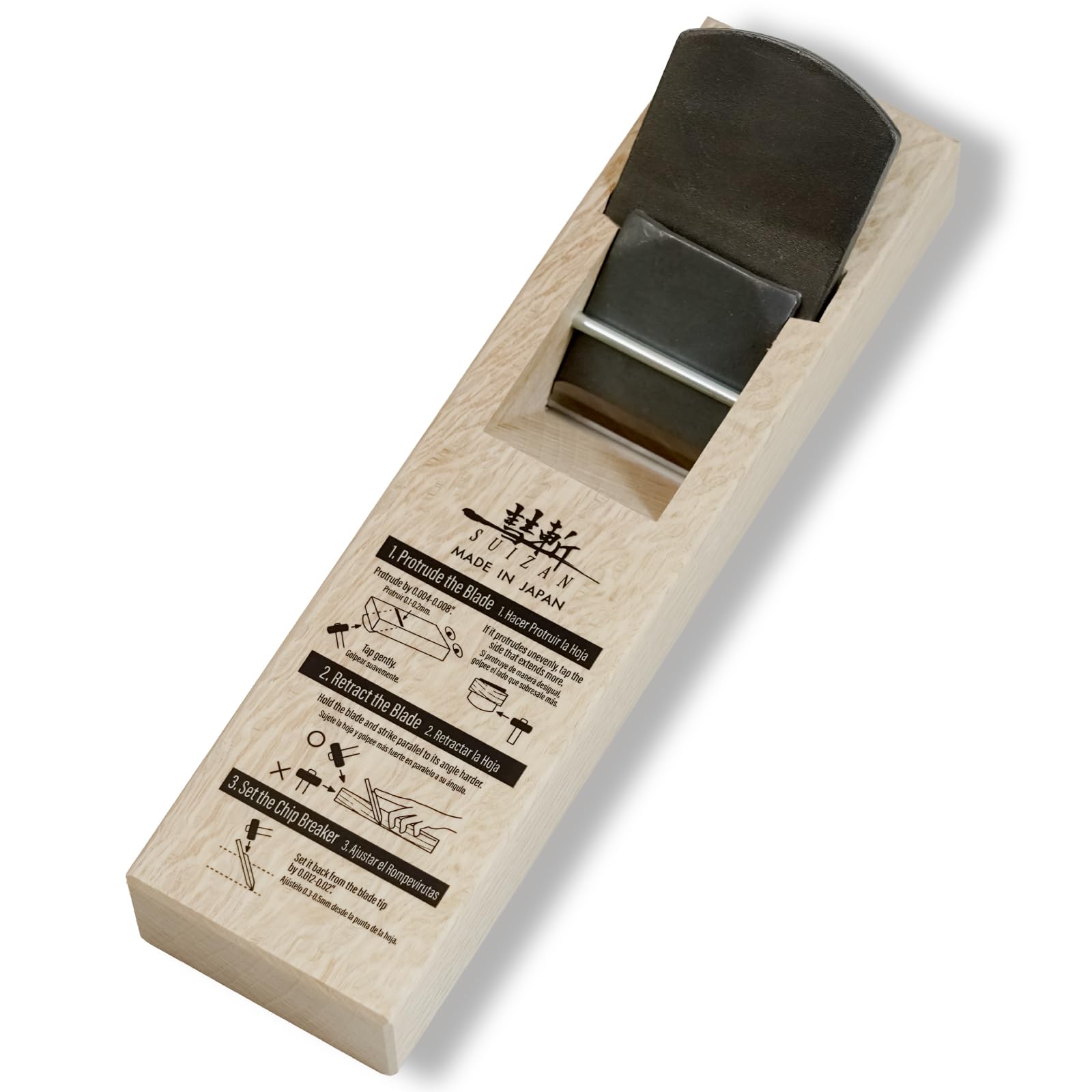
A genuine bench-length kanna that glides through both hard and soft wood
Where the little KAKURIs are detail tools, this SUIZAN is a working bench plane. The blade is 50 mm wide with a 43 mm cutting width, and the oak body stretches 9.45 inches long. That length plus the 22.9 ounce weight gives you the mass and the reference surface to actually flatten a board in a straight, continuous stroke rather than a series of choppy nibbles. It is the pick here if your idea of planing is smoothing a tabletop, not tidying a chamfer.
The blade is Japanese steel, and the double-blade setup pairs it with a metal chip breaker to control tear-out on difficult grain. What people consistently find is that it arrives genuinely sharp and sets up quickly — owners describe it gliding smoothly across both hard and soft wood and leaving very smooth, flat finishes. That reputation for an easy first session matters, because a plane that fights you on setup gets left in the drawer. Making it swing worth the cost: the SUIZAN is made in Japan and needs no power, so the whole cost of a smooth surface is six minutes of your own effort.
Two things to know. The first is that setup is by tapping, not turning — there are no adjusting screws, and if you over-hit the blade you will need to back it off by tapping the body. The second is sharpening: you maintain the edge on a whetstone, which puts this on the traditional side of the swap-or-sharpen line. Neither is a flaw. They are the conditions of owning a real kanna, and they are worth accepting for the quality of cut.
What Makes It A Worker
- 43 mm cutting width on a 50 mm blade — real surface coverage for panels and boards
- 9.45 inch oak body gives a long reference for flat, continuous strokes
- Double-blade design with metal chip breaker controls tear-out
- Smooth on both hard and soft wood with a very flat finish
- Made in Japan and fully hand-powered
The Conditions Of Ownership
- No adjusting screws — blade depth is set by tapping with a hammer
- You will maintain the edge on a whetstone yourself
- At 22.9 ounces it is the heaviest handling load in the first three picks
Your plane if: you are flattening and smoothing boards and want a long body plus a 43 mm cut to do it.
Not your plane if: you want a box-pocket tool for chamfering — its 9.45 inch length works against you in tight spots.
4. Daikichi Japanese Kanna Plane 58mm

A full 58 mm bite of steel for anyone chasing long, translucent shavings
The number that defines this plane is the cut, not the blade. Daikichi lists a 58 millimeter cutting width — the widest full cut in this group short of the Senkichi. If your work involves larger panels and you want the finish done in fewer passes, that width is the whole argument. It is the kind of plane that turns a rough board into a smooth one in a way a 23 mm detail plane simply cannot. The blade is durable steel, positioned by the maker as producing a clean, accurate cut, and that 58 mm edge is what you are buying.
What you get for the trade is quality that shows up in hand. This is a plane people describe as great quality with no flaws, sharp enough to pull beautiful shavings even out of Birdseye Maple — a heavily figured wood that punishes a dull edge. That is not a forgiving test. Sharpness and overall quality are what owners talk about most, and the tool is generally treated as well worth the effort it asks for. If you have been sanding a curly or birdseye panel and watching the grain fuzz over, a properly sharp wide plane is the fix.
The honest note is that a 1.8 pound plane with a 58 mm blade is more tool to manage than a compact block plane. It wants deliberate, even pull strokes, and it wants a sharp edge to do its best work. Setup follows the usual Japanese pattern of tapping the blade rather than turning a screw, so budget a session on scrap before you commit it to finished stock. Get past that and the wide cut does the talking.
The wide-cut case: 58 mm of cutting width is the reason to buy it, and it handles figured woods like Birdseye Maple without the grain tearing out, which is the true test of a sharp plane.
The mass to manage: at 1.8 pounds it needs steady, deliberate strokes, and it is dialed in by tapping the blade rather than turning a screw.
Go here when: you are surfacing wide, difficult panels and want maximum width per stroke.
Weigh it against: the Senkichi below, which cuts 65 mm wide — even more coverage if width is all you are after.
5. Senkichi Flat Plane with Base Blade Width 2.6 inches (65 mm)

The 65 mm monster — widest blade here, and priced like it is not
There is no plane in this group wider than this one. The Senkichi carries a 65 mm blade and a 65 mm cutting width, against 43 mm on the SUIZAN, and it is 10.83 inches long and 3.23 inches wide against the 30 mm KAKURI’s 6.1 and 1.6. That is a genuinely bigger tool in every direction, and the extra width is what covers a board in fewer strokes when you are flattening pine shelving or a workbench top.
You get a wide, easy-to-maintain edge: carbon tool steel in an oak body, designed by the maker to resharpen easily. That matters at this width, because a 65 mm edge is more steel to keep sharp than a 30 mm one. Buyers report it arrives extremely sharp and throws paper-thin shavings on the very first pass, with crisp results noted on pine boards. Value is the story — a full-width smoothing plane at this kind of money is rare, and owners say they are surprised at how good it is for what they paid. Reviewers talk about function and shaving quality, and the plane does what it claims on real lumber.
Be realistic about the body. Build quality and durability draw mixed notes, and this is a plane you treat with some care rather than a metal-bodied brute. The blade is forgiving to sharpen, which helps, but dropping a 10.83 inch plane with a 65 mm wide blade onto a concrete floor is not a mistake you want to test. Setup is straightforward — the comparison notes call it easy to set up — and that is the main thing a first-timer needs.
The Case For The Senkichi
- 65 mm blade and 65 mm cut — the widest in this group by a clear margin
- 10.83 inches long and 3.23 inches wide, a full-size body for surface work
- Carbon tool steel blade designed to resharpen easily
- Paper-thin shavings on the first pass with crisp results on pine
- Easy to set up, which is what a newcomer most needs
The Build Reality
- Build quality and durability draw mixed notes — handle with care
- A 65 mm edge is more steel to maintain than a narrow blade
- Its size works against it on small parts and tight joints
Pick it for: widest surface coverage per stroke, especially on softwoods like pine.
Think about instead: the Daikichi’s 58 mm or the SUIZAN’s 43 mm if you want a sturdier-feeling body or a shorter tool.
Know the Specs
Blade Width vs. Cutting Width
Blade width is the full span of steel; cutting width is the narrower slice that actually touches wood. On the KAKURI 42 mm, the blade is 42 mm and the cut is 36 mm — the difference is the small allowance the body takes up at each side. Always judge surface coverage by the cutting width, because that is the number of millimeters of board you finish per pass. A plane with a wider cut flattens a panel faster, but it is also more tool to control in tight spots.
Laminated Steel and Why It Matters
A laminated blade welds a hard high carbon steel edge to a softer iron backing. The hard layer gives you the sharp cutting edge; the soft layer adds strength so the brittle steel does not chip, and it makes the whole blade simpler to bring back on a whetstone. It is the difference between a blade you can maintain for years and one that feels like a chore. The Aogami Blue Steel #2 blade on the KAKURI Professional is the highest grade of laminated steel in this group.
Tap-Set vs. Screw-Adjust
Most Japanese kanna have no adjustment screws. You set blade protrusion by tapping the top of the blade with a hammer, then tap the body to retract it if you go too far. It sounds crude, but the tap method gives you very fine control once your hand learns it. Western-style planes let you turn a screw, which is quicker to learn but coarser to fine-tune. If you want the screw-free version of tuning without the hammer, the KAKURI 30 mm replaceable-blade plane swaps blades instead.
The Chipbreaker’s Job
A chipbreaker is a second piece of steel that sits just ahead of the cutting edge. As the blade lifts a shaving, the chipbreaker bends it over so the wood fibers are cut cleanly instead of torn. Set it close to the edge and you get a smoother surface on figured wood. Set it too far back and shavings jam under it, which stops the plane mid-stroke. On the KAKURI 30 mm the chipbreaker clicks onto the blade, removing the gap-setting step entirely — a genuine convenience for a newcomer.
Common Questions
Is a Japanese wooden plane better than a Western metal plane?
Do I have to sharpen a wooden hand plane blade myself?
What blade width should I start with?
Why does my shaving keep jamming under the chipbreaker?
How do I set the blade depth without adjusting screws?
Can a wooden hand plane handle hard woods like maple?
What is Aogami Blue Steel #2 and does it matter?
Is the replaceable blade system on the KAKURI 30 mm as good as a traditional blade?
Does a wooden plane body warp or crack over time?
How long does a wooden hand plane last?
The Bottom Line
Most buyers should start with the KAKURI Japanese Hand Plane 42mm, the best wooden hand plane for a first buy. Its 42 mm blade takes a 36 mm cut, so it handles both detail work and surface work, and it arrives hand-sharpened and ready. Want to skip sharpening entirely? Take the KAKURI 30 mm replaceable-blade plane. For the widest cut on large panels, reach for the Senkichi 65 mm flat plane.
Match the plane to the work on your bench. Mostly trim and joinery? The compact KAKURIs serve you better than a wide smoothing plane. Flattening boards? The SUIZAN, Daikichi, Senkichi, and KAKURI Professional each give you more cut width and a longer body for it. The KAKURI 42 mm takes the top spot on proven craftsmanship plus an accessible price — the craft-heavy value that makes it a sensible first wooden plane, not the last one you will ever buy.
How we choose
We do not accept paid placement. Every pick is matched to a real buyer and a real use-case; we do not hands-on test units.
Sources
Specifications: manufacturer listings and product documentation. Review insights: verified customer reviews, as of November 2026. Pricing: not shown on this page (it changes often); check the current price via the retailer link.
As an Amazon Associate, Tactical Gear Guy earns from qualifying purchases. This does not affect which products we feature.