Specs are compiled from manufacturer listings and verified buyer reviews and can change over time — please confirm the key details on the product page before buying.
If you keep a small bird, the wrong cage shows its flaws fast. A gap can be wide enough for your bird to squeeze through. A pull-out tray can let your bird slip out mid-clean. Fir wood can turn into splinters under a beak within months. Every pick below uses real wood in the frame or body, and each one fixes a different part of that problem. Start with the Yaheetech 40 Inch if you want the safest everyday cage for small birds. Go bigger if you house birds that need flight room.
This guide is built by comparing the manufacturers’ published specifications and the patterns across verified customer reviews, so you get each pick’s real strengths and trade-offs instead of marketing spin.
Each pick below is matched to a bird size, a bar spacing and a cleaning setup.
Top Picks

How To Choose The Best Wooden Bird Cage
The cage you pick has to do two jobs at once: keep a small bird safely inside, and survive a beak that never stops testing the walls. Wood looks warmer than an all-wire cage, but fir gives way to a strong beak, so match the frame to your species.
Match the bar spacing to your bird’s body
Bar spacing is the gap between the wires, and it is the number that decides whether your bird stays in. A gap of 0.4 inches or less suits budgies, canaries, finches and lovebirds. Anything near 0.5 inches is fine for slightly larger bodies but risky for the smallest finches. Measure your bird’s head width if you are unsure — a bird can pass through any gap wider than that.
Check what stops an escape during cleaning
The best wooden cages here put a wire mesh layer directly above the pull-out tray. That mesh separates droppings from your birds and, more importantly, blocks the opening when you slide the tray out. Without that layer, a curious bird can drop straight through the tray slot.
Decide indoor versus outdoor before you buy
An asphalt roof and waterproof paint are what let a wooden aviary sit outside through rain. If the cage stays in your living room, you are paying for weather protection you will not use, and a smaller, simpler cage will do the same job. Decide whether the cage lives indoors or outdoors before you pay for an asphalt roof.
Side-by-Side Comparison
| Model | Best For | Bar Spacing | Dimensions (L x W x H) | Weight | Amazon |
|---|---|---|---|---|---|
| Yaheetech 40 Inch Open-Top★ Best Overall | Small birds indoors | 0.4 inches | 18″ x 18″ x 40″ | 13.8 pounds | Amazon |
| Aivituvin Outdoor Aviary with PerchOutdoor Aviary Pick | Outdoor parakeet housing | 0.5 inches | 28.3″ x 26.8″ x 70.8″ | 61 pounds | Amazon |
| Aivituvin Dove Cage with Pull-Out Tray | Cockatiels and doves | 0.5 inches | 32.7″ x 30.9″ x 70.8″ | 57 pounds | Amazon |
| GUTINNEEN Outdoor Aviary with Play Stand | Multiple birds, indoor or out | — | 28.3″ x 26.8″ x 70.8″ | 56.8 pounds | Amazon |
| Ketive 65in Flight Aviary | Vertical flight room | 0.47 inches | 33.8″ x 18.9″ x 65.4″ | 30 pounds | Amazon |
| PawHut 44″ Hexagon Canopy | Large outdoor walk-in | 0.25 inches | 59″ x 59″ x 69.75″ | 38.5 pounds | Amazon |
Detailed Reviews
1. Yaheetech 40 Inch Bird Cage
Our pick — 4.5+★ from 600+ verified ratings; the strongest balance of quality and price.
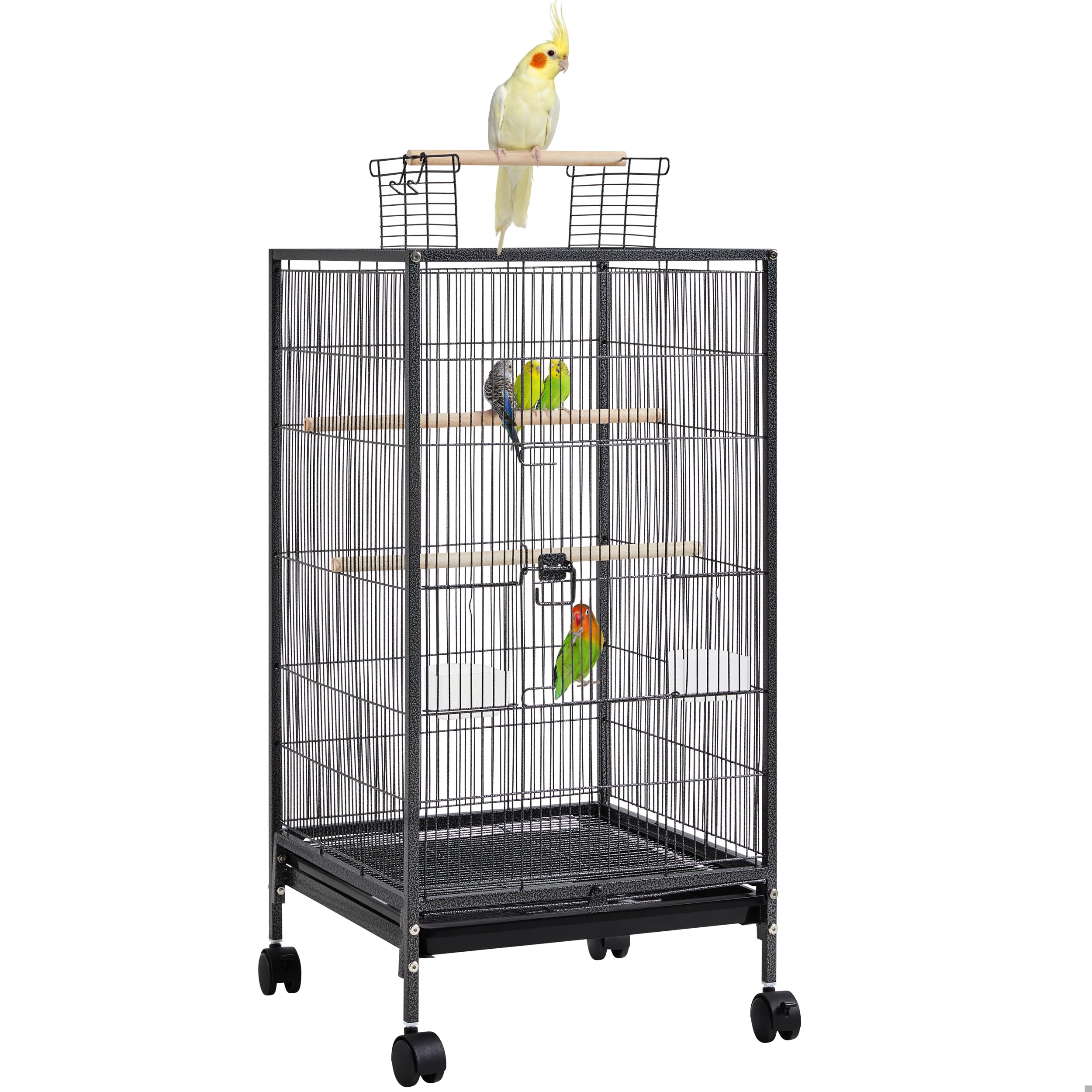
The rooftop flips open into a play perch, so your bird leaves the cage without leaving your side.
The gap between bars is the first thing to check on any wooden bird cage, and this Yaheetech runs 0.4 inches — tight enough that budgies, canaries, finches, parakeets and lovebirds cannot squeeze a head through. The cage body measures 18 inches long, 18 inches wide and 28 inches tall, with the open top and stand bringing the whole thing to 40 inches high. That footprint fits a living-room corner without swallowing the room. It weighs 13.8 pounds, which is why the four 360° casters actually work — you can push it onto a sunny patio and lock two of the wheels so it stays put.
The open-top design is the reason this one takes the top spot. Flip the lid and the included wooden dowel becomes a perch above the cage, giving your bird a spot to sit and socialize while the mesh below stays shut. The rest of the daily routine is handled by two feeding doors you can refill without opening the main door, plus a pull-out metal grate and slide-out tray that keep droppings away from feet. What wins people over, though, is how solid the whole thing feels for the weight — the frame earns far more comment than anything else about this cage, and durability runs a close second. At 13.8 pounds, the frame still feels solid rather than flimsy.
The catch is size, and it is worth being blunt about it. This is a small-bird cage, full stop — cockatiels fit, but anything approaching parrot size will feel cramped and may test the wire. Think twice if you are housing a macaw or a large conure. For one small bird or a bonded pair indoors, the 0.4-inch spacing, casters and slide-out tray cover safety, mobility and cleaning together.
What earns it the top slot
- 0.4-inch bar spacing keeps small species contained and stops escapes
- Open top turns into an extra play perch with the included wooden dowel
- 13.8 pounds on four 360° casters, two with brakes, so it rolls room to room
- Two feeding doors let you refill without disturbing birds or risking an escape
Where it stops
- Built for small birds — a cramped fit for parrot-sized species
- 18 x 18 inches of floor space limits how many birds it can house
Grab this one: for a single small bird or a pair of budgies, finches or lovebirds in a home that wants a cage it can move.
Look elsewhere: if your bird is parrot-sized, because the 18-inch footprint leaves too little room to turn around.
2. Aivituvin Large Wooden Bird Aviary
A 61-pound wooden aviary that stands over five feet tall and rolls wherever the weather is better.
Start with the weight: 61 pounds is more than four times the Yaheetech above at 13.8 pounds, and that bulk is the point — this is a piece of garden furniture as much as a bird cage. The frame is natural wood wrapped in heavy-duty galvanized wire mesh with openings of 1/2 inch by 1/2 inch, and an asphalt roof keeps rain off. Galvanized means the wire carries a zinc coating that resists rust, so a wet British or coastal garden does not eat it alive. Lockable casters sit under the base so you can wheel the whole structure around the yard without lifting it.
The dimensions read 28.3 inches long, 26.8 inches wide and 70.8 inches tall, giving vertical space that suits climbing species better than long-bodied ones. Note the gap size is 0.5 inches — a touch wider than the Yaheetech’s 0.4 inches, about a quarter more — so the tiniest finches deserve a second look before you commit. Three doors (two large, one small for feeding) and the included rest box, two perches and ladder round out the kit. Roominess is the thing buyers talk about most, and the look of the natural wood runs a close second.
Here is the honest trade-off. The structure earns plenty of praise for size and appearance, but sturdiness and durability split opinion, and some buyers report the wood cracking over time. That is the nature of fir-built outdoor aviaries — weather and a determined beak both take a toll. Assemble it squarely and keep it under cover, and the fir frame lasts longer.
The real draw: 70.8 inches of height outdoors with an asphalt roof, wire openings of 1/2″ x 1/2″, and wheels so you are not dragging 61 pounds across the lawn.
The follow-up question: how long will fir survive outside? Reviews split on that, so sheltering the cage and checking the roof seal each season is the sensible habit.
Reach for this if: your birds live outdoors or on a covered porch and you want height, an asphalt roof and wheels in one package.
Think twice if: you keep the smallest finch species, since 0.5-inch spacing is wider than the tightest cages here.
3. Aivituvin Parakeet Cage

Solid fir wood, three doors and a nest box — a roomy aviary for cockatiels, doves and pigeons.
This is the wider sibling of the Aivituvin above, and the extra floor space is measurable. It measures 32.7 inches long, 30.9 inches wide and 70.8 inches tall, against the 28.3 by 26.8 inches of its sister cage, and it weighs 57 pounds. The frame is solid fir wood with a waterproof asphalt roof, painted with a finish the maker describes as non-toxic to animals. The wire is heavy-duty galvanized mesh with 1/2″ x 1/2″ openings, and the gap between bars is 0.5 inches — suited to cockatiels, doves, pigeons, budgies, lovebirds and quails rather than the smallest finches.
The cleaning system is the bit that earns its keep. A thicker plastic tray slides out from either the back or the front, and a removable wire-netting layer sits above it to separate droppings from your birds. That mesh also blocks the tray opening, so a bird cannot drop out while you are cleaning. Beyond the two large front doors and one small feeding door, you get a nest box, two perches and a ladder, which saves you hunting for accessories separately. What buyers praise most is the build quality of the wood, with straightforward assembly a close second — the pre-drilled screw holes do their job.
The honest note is value. Plenty of people call it fair for what you get; others find it on the high side for fir wood. Durability also divides opinion, since an outdoor wooden structure and a chewing bird are not natural allies. For doves or a pair of cockatiels, the 32.7 by 30.9-inch floor and dual pull-out tray justify the price.
Where it wins: 32.7 x 30.9 inches of floor space, a tray that pulls out from both ends, and a nest box, two perches and a ladder in the box.
What to weigh: the 0.5-inch bar spacing and fir construction make it a good fit for medium birds, less so for the smallest finches or a heavy chewer.
Best matched to: doves, pigeons and cockatiels that need more floor space than a compact cage can give.
Pass on it if: you keep tiny finches, where that 0.5-inch gap is looser than you want.
4. GUTINNEEN Wooden Bird Cage on Wheels

The one that shows up with a play stand, ramp, nest and feeder already in the box.
Space is what this cage sells, and it backs that up with a measured footprint of 32.7 inches long, 30.9 inches wide and 70.8 inches tall at 56.8 pounds. The maker rates it for more than two small to medium birds at once, which puts it in a different class from the compact Yaheetech. Four sturdy stainless steel wheels mean you can move the whole aviary between indoors and out without a second pair of hands, and the asphalt roof shrugs off rain. Stainless steel matters here — it resists rust far better than plain coated wheels when the cage lives outside.
What sets this cage apart from its Aivituvin rivals is the accessory bundle. You get two perches, a standing ramp, a small nest and a wood feeder included, so your birds can settle in without a separate shopping trip. The middle front door is a smaller feeding door, which the maker designed with children in mind. Two large front doors open wide so you can reach in. Above the thick slide-out tray sits a wire mesh layer that keeps birds in while you clean and helps shield them from predators outside.
What buyers talk about more than anything is the room inside — the sheer size is the headline. The trade-off is bird size suitability: the wire and the protection level split opinion, and some say it is not the right cage for a parrot. A determined large parrot can work at any wooden aviary, so treat the “more than 2 birds” guidance as applying to small and medium species rather than big beaks.
Why it stands out
- Comes with two perches, a ramp, a nest and a wood feeder — no extra buys needed
- Stainless steel wheels resist rust better than coated ones outdoors
- 32.7 x 30.9 x 70.8 inches, rated for more than two small to medium birds
- Wire mesh above the tray stops escapes during cleaning and blocks predators
Worth knowing first
- Wire strength draws mixed feedback — not built for a large parrot’s beak
- Child-designed feeding door is a nice touch, but the main access is still two large doors
It suits you if: you want a multi-bird aviary that arrives ready — perches, ramp, nest and feeder already included.
Keep looking if: you keep a large parrot, since the wire and protection level are rated for smaller species.
5. Ketive 65in Bird Aviary

Built tall and narrow so finches and budgies can fly up and down, not just hop sideways.
The shape is the story here. This Ketive measures 33.8 inches long, 18.9 inches wide and 65.4 inches tall — noticeably more height than width, which is what you want if your birds fly vertically rather than running along a floor. Compare it to the Aivituvin at 28.3 by 26.8 inches and you get a taller, slimmer profile that slips into a narrow garden spot or a hallway corner. It weighs 30 pounds, light enough for the braked casters to move with a push and then lock solid.
The tray is the standout. Ketive upgraded to a metal sliding tray instead of the plastic trays most fir aviaries use. A metal tray does not crack or sag the way thin plastic can. Above it sits a removable metal wire mesh that separates droppings and blocks the opening when you pull the tray out. The frame is solid fir wood with a waterproof asphalt roof, painted with a finish the maker describes as non-toxic to animals. The mesh openings are 0.47″ x 0.47″ — tight enough for the cockatiels, budgerigars, conures, lovebirds, zebra finches and canaries the maker lists. You also get three removable rolling stands, a ramp, a nest and a wood feeder.
One thing the manufacturer says outright is worth repeating: birds chew wood, and this aviary has no dedicated chewing area, so damage over time is likely unless you supply toys to redirect the beak. Assembly is labeled and illustrated, but reviews divide on whether it is easy or tricky. What people respond to most is the overall quality and the look, which the maker built to suit a modern garden.
The measured edge: 65.4 inches of height on a 33.8-inch footprint with a metal, not plastic, sliding tray — the tray alone outlasts thinner rivals.
The plain caution: no built-in chew area means you must add wooden toys, or the fir frame will take the brunt of a bored beak.
Made for: finches, budgies and conures that need vertical flight room and a tray that holds up to daily scraping.
Not the pick for: heavy chewers you cannot keep supplied with toys, since the fir frame is fair game.
6. PawHut 44″ Hexagon Covered Canopy Bird Cage with Stand

A hexagonal walk-around aviary with a canopy roof, sized more like garden furniture than a cage.
This cage gives you the biggest wooden footprint on this list: 59 inches long, 59 inches wide and 69.75 inches tall, at 38.5 pounds. That spread lets several birds walk around and fully extend their wings, with room for multiple perches, food bowls and toys inside. The hexagon shape and composite asphalt roof give it a look buyers consistently describe as bigger and better than they pictured. At 59 by 59 inches, it reads as a garden structure rather than a cage tucked in a corner.
The wire is the detail to study closely. PawHut covers the frame with 0.31-inch spaced metal wire, which is far and away the tightest gap on this list and the safest for the smallest birds — nothing on this page comes close for finch-sized bodies. Two extra-large front doors make feeding and reaching in simple, and a latching door adds a second layer of security that keeps your birds in and predators out. The water-resistant composite asphalt roof, baseboard and finish are built to take on the elements outdoors.
The honest catch: PawHut states plainly that it is not suited to strong parrots such as an Alexandrine Parakeet or a Ring-necked Parakeet, because their beaks can break through lightweight fir. Assembly is required, and putting a hexagon together tends to test patience — the alignment is the part that trips people up. Budget a slow afternoon for it.
The case for the hexagon
- 0.31-inch wire spacing — the tightest here, safest for the smallest birds
- 59 x 59 x 69.75 inches gives several birds room to walk and flap
- Latching door plus two extra-large front doors for security and easy feeding
- Water-resistant composite asphalt roof, baseboard and finish for outdoor duty
The catch to respect
- Not built for strong parrots — the maker rules out the toughest beaks
- Assembly is required and hexagon alignment takes patience
Choose it when: you want the widest walk-around space here and the tightest wire for tiny birds.
Rule it out for: strong parrots, which the maker explicitly says this fir frame cannot hold.
Know the Specs
Bar spacing (the escape gap)
Bar spacing is the distance between two wires, and it is the number that keeps a small bird safe. A tight gap like 0.31 inches or 0.4 inches stops even a finch or canary from pushing a head through, while a wider 0.5-inch gap suits cockatiels and doves but leaves the smallest species vulnerable. Always check bar spacing before cage size — a spacious cage with the wrong gap still lets your bird out.
Pull-out tray and wire mesh layer
The pull-out tray is what makes daily cleaning quick, sliding out to catch droppings. The wire mesh layer above it is what keeps your birds inside while the tray is out and separates them from their own mess. Without that mesh, the tray opening becomes a gap your bird can drop through, so treat both parts as one cleaning system when you compare cages.
Fir wood, galvanized wire and coatings
Most of these aviaries use fir wood for the frame, which is lightweight and weathers reasonably. Galvanized wire carries a zinc coating that resists rust, so it holds up better outdoors. Paints described as non-toxic to animals matter because birds peck at everything. Fir is not indestructible, though — a determined beak will work at it, so plan for chew toys and check the frame regularly.
Casters and the weight they carry
Casters are the small wheels on the base, and they only help if the cage is light enough to roll. A 13.8-pound cage moves easily on 360° casters, while a 61-pound aviary needs sturdy lockable wheels to go anywhere. Brakes are the quiet hero — two locking casters let you push the cage to a sunny spot and then fix it in place so it does not drift.
Common Questions
How do I know the bar spacing is safe for my bird?
Will a wooden bird cage survive outdoors in rain?
Can my bird escape while I pull out the cleaning tray?
Which wooden cage suits a cockatiel?
Is a tighter bar spacing always better?
Will wood survive a parrot that chews constantly?
Do I need the wheels, or can I use the stand only?
How many birds fit in each of these cages?
Is the pull-out tray easy to clean on a metal versus plastic version?
Can I use an outdoor wooden aviary indoors?
The Bottom Line
For most people choosing a wooden bird cage, the Yaheetech 40 Inch Open-Top is the safe call. It gives you 0.4-inch spacing, 13.8 pounds on lockable casters and an open top that doubles as a play perch, all in one small-bird cage. If you need an outdoor aviary with height and weather protection, reach for the GUTINNEEN. It rolls on stainless steel wheels and arrives with a play stand, ramp, nest and feeder included. And for the safest cage around tiny birds, the PawHut hexagon offers the widest walk-around space here at 0.31-inch wire spacing that nothing else on this page matches.
How we choose
We do not accept paid placement. Every pick is matched to a real buyer and a real use-case; we do not hands-on test units.
Sources
Specifications: manufacturer listings and product documentation. Review insights: verified customer reviews, as of November 2026. Pricing: not shown on this page (it changes often); check the current price via the retailer link.
As an Amazon Associate, Tactical Gear Guy earns from qualifying purchases. This does not affect which products we feature.