Specs are compiled from manufacturer listings and verified buyer reviews and can change over time — please confirm the key details on the product page before buying.
You want more games installed without deleting one to make room for the next. That is the whole job of an Xbox Storage Expansion Card, and only a card that seats in the console’s expansion slot runs Xbox Series X|S games directly. The trick is that these cards come in very different capacities, and capacity is what decides how many titles stay parked on your drive. Pick the right capacity and you stop juggling installs. Pick too small and you are back to uninstalling blockbusters.
This guide is built by comparing the manufacturers’ published specifications and the patterns across verified customer reviews, so you get each pick’s real strengths and trade-offs instead of marketing spin.
Below you will find three cards that plug straight into the expansion slot, sized and priced for different libraries. The goal is simple: match the card to the way you actually play, and this breakdown of the xbox storage expansion card options will show you which one earns the slot.
Top Picks
How To Choose The Best Xbox Storage Expansion Card
Start with the slot, not the spec sheet. An Xbox Series X|S has one dedicated expansion port around the back, and the card that fits it is a small proprietary cartridge — not a bare M.2 stick and not a USB hard drive. Buy the wrong shape and it simply will not seat. Buy the right shape and the console reads it like extra internal storage, which is why these cards are the only add-on that runs current-generation games without compromise.
Capacity is the decision you actually make
Every card here shares the same slot and the same job, so the real fork in the road is how much room you get. Capacity is written in terabytes (TB) or gigabytes (GB), where 1TB is 1,000GB and 2TB is double that. More capacity means fewer deletions and more games sitting ready to launch. The generous 2TB cards carry far more headroom than a 512GB or 1TB card, and that headroom is what keeps a big library playable without housekeeping.
Speed and Quick Resume, in plain words
NVMe is the type of storage chip inside these cards — think of it as the fast lane that lets data move quickly enough for the console to treat the card like its own drive. Xbox Velocity Architecture is Microsoft’s name for how the console streams that data, so a card built to match it keeps load times and Quick Resume working as normal. Quick Resume is the feature that freezes several games at once so you can jump between them, and it only behaves properly when the card is fast enough to keep up.
Licensing, reliability, and the honest trade-offs
An officially licensed card has Microsoft’s blessing to run Series X|S games from the slot, which is worth knowing before you buy. Beyond licensing, look at how owners describe reliability and whether the card keeps working after console system updates. That last point matters: a card that loses compatibility with an update becomes a paperweight, so it belongs in your thinking. Also weigh value — expansion cards have never been cheap, and the bigger capacities carry the biggest bills.
Side-by-Side Comparison
| Model | Best For | Capacity | Interface | Format | Amazon |
|---|---|---|---|---|---|
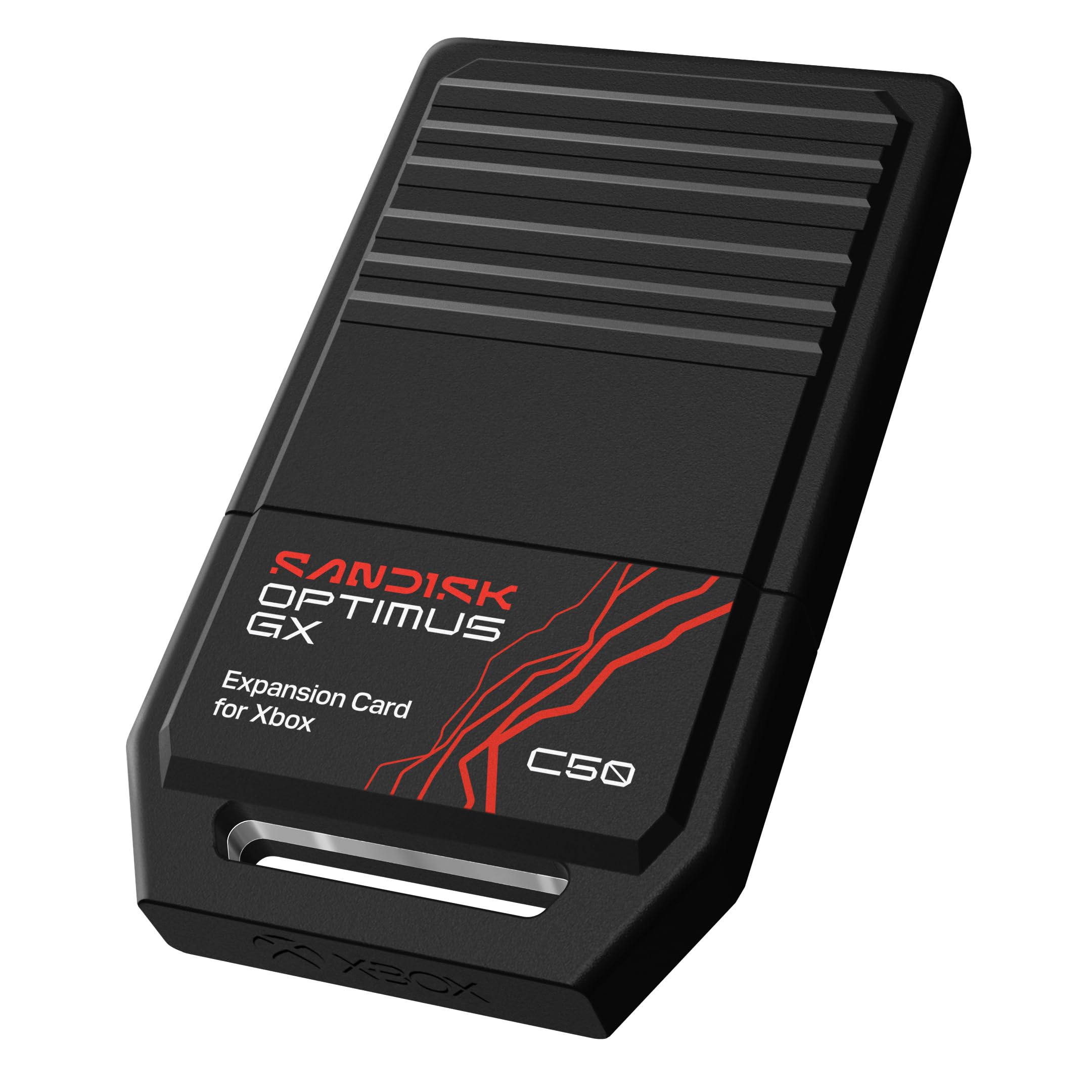
| Sandisk 2TB Optimus GX C50 Storage Expansion Card for Xbox★ Best Overall | Big libraries and no deleting | 2 TB | NVMe | Xbox Expansion Slot | Amazon |
| Xbox Series X|S Storage Expansion Card 1TB | Slim, sturdy all-aluminum build | 1 TB | NVMe | M2 / 0.3 inch thick | Amazon |
| 512GB Expansion Card for Xbox Series X|S NVMe SSD Storage | Budget-friendly starter card | 512 GB | PCI-X | All-aluminum enclosure | Amazon |
Detailed Reviews
1. Sandisk 2TB Optimus GX C50 Storage Expansion Card for Xbox
Our pick — 4.5+★ from 100+ verified ratings; the strongest balance of quality and price.
Double the room of the 1TB cards, and licensed to run your whole Series X|S library.
If your console keeps nagging you to free up space, this card answers it with headroom. It holds 2 TB of storage — twice the room of the 1 TB Tianken card below — which SanDisk says is space for up to 50 more games. That headroom is what separates a full drive from a library you can browse without uninstalling anything. It is officially licensed for Xbox Series X|S, so it seats in the expansion slot and behaves like native storage, not a workaround.
The speed side is deliberate rather than flashy. It is an NVMe drive (the fast storage chip type) built to match Xbox Velocity Architecture, Microsoft’s data-streaming setup, so games play directly from the card with low latency — the delay between pressing a button and seeing it happen. Quick Resume works too, letting you freeze several games and hop between them without losing progress. Owners describe it as plug and play and super fast, and the thing that wins people over most is the build quality — the card feels like a proper piece of hardware, not a flimsy adapter.
Here is the catch, and it is the one every buyer hits: these cards are pricey, and the 2 TB version carries the biggest headline cost of the group. That premium is what you pay to stop juggling installs. If your library is small, the 512GB card costs less and you will not miss the extra room. If you keep a dozen big games installed at once, the room here is what you are paying for. It holds a 4.5+ star rating across a growing pool of owners, and price is the recurring complaint in those reviews.
What earns it the slot
- 2 TB of room — twice the capacity of the 1 TB Tianken pick below
- Official Xbox Series X|S licensing for native-slot play
- NVMe speed matched to Velocity Architecture, so Quick Resume behaves
- Plug-and-play install with no software to set up
Where it stings
- The premium tier price is the loudest complaint in the reviews
- More capacity than a casual player will ever fill
Buy it if: you keep a large library installed and want zero deletion chores — the 2 TB headroom does that job outright.
Think twice if: you rotate a handful of games; the price premium buys room you may never use.
2. Xbox Series X|S Storage Expansion Card 1TB

A 0.3-inch aluminum cartridge for players who want a sturdy 1TB card and a fair price.
At 0.3 inch thick, this is the slimmest card in the group, and the all-aluminum shell is built to resist scratches and shed heat. That thinness is not cosmetic — it slides into the expansion slot cleanly and sits flush. It holds 1 TB, half the room of the SanDisk above, so you get a serious library but not unlimited space. For most players that is the sensible middle ground: big enough to keep the games you return to, small enough to keep the cost sane.
It is an NVMe drive, the same fast chip type as the others, and Tianken says it plays Xbox Series X|S titles directly from the card without sacrificing graphics, latency, frame rates, or load times. Plug and play means no software install — you seat it and the console reads it. The card also carries a shock-resistant rating and a multi-compatibility design, which matters if the console gets bumped or moved around the room. Owners consistently land on one word for it: performance.
The honest part is reliability. This pick’s overall score sits lower than the SanDisk’s, and the most-discussed topic in its reviews is whether the card keeps working over time — some love it, and there are notes about one giving out after a month. A subset of buyers also say the usable space fell short of the advertised 1 TB. Neither is universal, but neither is imaginary. If you want the safest bet on a long-lived card, the 2 TB SanDisk is the stronger call; if you want a slim, tough 1 TB card at a mid-range price and can accept that gamble, this one delivers on speed and build.
What holds up: the 0.3-inch aluminum body, NVMe speed, and plug-and-play install are all real, and shallow enough to seat without fuss.
The gamble: reliability and advertised capacity are the two things reviewers most often question, so buy this one expecting to lean on the warranty.
Reach for this if: you want a slim, aluminum 1 TB card and value matters more than a bulletproof track record.
Look elsewhere if: you cannot tolerate any risk of an early failure — the SanDisk is the steadier choice.
3. 512GB Expansion Card for Xbox Series X|S NVMe SSD Storage

The entry ticket to slot expansion — 512GB of fast storage for a lighter library.
Not everyone needs two terabytes. If you play a few titles at a time and mostly delete as you go, this 512GB card gives you the same slot fit and the same fast chip without the huge outlay. It is the lowest-capacity card here, so think of it as one full shelf rather than a whole wall. HWAYO says it delivers the same performance as the console’s internal storage, which is the important bit — a game launched from this card should feel no slower than one launched from the drive inside the console.
The enclosure is all aluminum, and the maker points to heat dissipation as the reason — a cooler card holds its speed better during long sessions. It plays Series X|S games straight from the slot, and HWAYO lists capacities from 512GB up to 2TB, so this is the small end of a family rather than a one-off. Setup takes seconds: seat it, and the console sees it. What wins buyers over is performance — it does the same job as the expensive cards, just with less room.
The catch is simply space. Half a terabyte fills fast with modern games, and once it is full you are back to deciding what to delete. It is also the lowest-rated of the three, with a mixed-to-positive spread where value is the thing people talk about most in a good way. That is the fair read: this is not the card for a sprawling library, it is the card for someone who wants slot expansion without the premium bill. Pick it for a starter setup and you will be pleased; pick it for a hundred-game collection and you will run out of room.
The case for the small card
- Same slot fit and NVMe speed as the bigger cards
- All-aluminum body built for heat dissipation
- Connects in seconds with no software step
- Lands as the value pick of the three
The realistic limits
- 512GB fills quickly with large modern titles
- Lowest score of this group, with value drawing the most comment
Go here first if: you keep a small library and want slot expansion without the premium-tier cost.
Step up instead if: you already juggle a dozen games — the 2 TB SanDisk is the one built for that.
Know the Specs
Capacity in TB and GB
Capacity is the headline number, and it is the one that decides how often you delete a game. TB stands for terabyte and GB for gigabyte, with 1TB equal to 1,000GB. A 2TB card holds double a 1TB card, and a 512GB card holds roughly half of a 1TB one. More capacity means more titles installed and ready to launch. The SanDisk’s 2 TB sits at the top here, the Tianken’s 1 TB in the middle, and the HWAYO’s 512GB at the entry end.
NVMe and the expansion slot
NVMe is the storage chip standard inside these cards — a fast interface built to feed data quickly enough that the console treats the card like its own drive. The Xbox expansion slot is the proprietary port these cartridges are shaped for, which is why a USB external drive or a bare M.2 stick will not work the same way. A card built for the slot runs Series X|S games directly, while a USB drive is limited to older titles. That fit is the first thing to check before anything else.
Quick Resume and load times
Quick Resume is the console feature that freezes several games at once and lets you swap between them without reloading. It only behaves properly when the card can keep up, which is why speed matters as much as capacity. All three cards here use NVMe internals and are made to match internal-storage performance, so Quick Resume and load times should feel the same as playing from the console’s own drive. If a card were slower, you would feel it as a longer wait at launch.
Build and heat dissipation
Heat is the quiet enemy of any storage chip — get it too warm and speed can slip during long sessions. That is why the Tianken and HWAYO cards both lean on an all-aluminum enclosure: metal pulls heat away from the internals better than plastic. The SanDisk leans on its official licensing and matched architecture for the same reassurance. None of these need extra cooling from you; the shell does the work. A sturdier enclosure also protects the card from scrapes and bumps.
Common Questions
Can I use a USB external drive instead of an expansion card?
Will the 2TB SanDisk card work on both Xbox Series X and Series S?
How many games can a 2TB card hold compared with a 512GB card?
Is an officially licensed card better than an unlicensed one?
Why do some reviews mention a card failing after a month?
Does an expansion card slow down load times compared with internal storage?
Can I install the card myself, or does it need a technician?
Do I need to move my games onto the card, or do they go there automatically?
Is an all-aluminum card worth choosing over a plastic one?
What happens if a console system update stops the card working?
The Bottom Line
For most players, the xbox storage expansion card winner is the Sandisk 2TB Optimus GX C50 Storage Expansion Card for Xbox, because 2 TB of licensed, Velocity-matched storage means you stop deleting games and start browsing a full library. If you would rather keep the spend down and want a slim, aluminum 1 TB card, the Tianken 1TB Expansion SSD has the build and the speed, with reliability the thing you accept as a trade-off. And for a small library where slot fit matters more than room, the 512GB HWAYO Expansion Card is the budget-friendly entry point. Buy the capacity that matches your library today — that single choice is what saves you a drawer full of deleted save files.
How we choose
We do not accept paid placement. Every pick is matched to a real buyer and a real use-case; we do not hands-on test units.
Sources
Specifications: manufacturer listings and product documentation. Review insights: verified customer reviews, as of November 2026. Pricing: not shown on this page (it changes often); check the current price via the retailer link.
As an Amazon Associate, Tactical Gear Guy earns from qualifying purchases. This does not affect which products we feature.