Specs are compiled from manufacturer listings and verified buyer reviews and can change over time — please confirm the key details on the product page before buying.
Most boots quietly tilt you forward. Even a few millimetres of heel lift shifts load from your calf onto your knee and lower back over a long day. A zero drop boot puts your heel and the ball of your foot at the same height, so you stand the way you would barefoot. That level platform is the whole point of these boots — and the reason your calves complain for the first week. Below you will find the eight pairs worth your money, sorted by what each one actually does well.
This guide is built by comparing the manufacturers’ published specifications and the patterns across verified customer reviews, so you get each pick’s real strengths and trade-offs instead of marketing spin.
A level heel sounds simple until you realise it changes everything about how a boot wears in, so the picks below are grouped by terrain and season rather than by brand name. You will see exactly which pair handles wet winter pavement and which one is built for dry trail miles, which is the whole point of this zero drop boots breakdown.
Top Picks


How To Choose The Best Zero Drop Boots
The first thing to get straight: a zero drop boot is not a soft boot. Drop measures heel height versus forefoot height, and 0 mm means they sit level. Cushion is a separate number entirely. A boot can be zero drop and still have a thick sole, or zero drop with almost nothing under you. Decide which of those you want before you look at anything else, because it is the choice you cannot undo.
Work out how much ground feel you actually want
A thin, flexible sole lets your foot read the surface — useful on uneven trail, less fun on sharp gravel or a long day of pavement. The African Ranger and the Vivobarefoot Tracker sit at the flexible end. The Altra Lone Peak 9 Waterproof Mid runs a 25 mm stack, which is still 0 mm drop but with real material under your arch. If you are coming off a conventional hiking boot, the cushioned zero drop option is the easier transition.
Check the toe box, not just the length
A zero drop boot only works if your toes can actually spread when you push off. Several picks here are built on a foot-shaped last, which means the widest part of the boot sits at the ball of your foot rather than tapering in. Buy your normal length and let the width do the work. Sizing up to chase width tends to leave your heel sliding, which is the opposite of what you want on a descent.
Decide if you need a waterproof membrane
A waterproof membrane keeps water out and traps sweat in. On a cold, wet commute that trade is worth it. On a warm-weather hike it can leave your feet clammy by mid-morning. One pick here deliberately drops the membrane to stay breathable in wet conditions. Be honest about where you walk most, and pick accordingly.
Side-by-Side Comparison
| Model | Best For | Drop | Upper | Terrain Focus | Amazon |
|---|---|---|---|---|---|
| Jim Green African Ranger Barefoot★ Best Overall | Leather work and hiking | 0 mm (level sole) | Full grain leather | Mixed work and trail | Amazon |
| Merrell Men’s Wrapt Mid WaterproofBest for All-Day Trail | All-day comfort on trail | 0 mm (zero-drop hybrid) | Waterproof | Trail and everyday | Amazon |
| Xero Shoes Denver IIBest Leather Casual | Three-season leather wear | 0 mm (barefoot platform) | Leather with microfiber lining | Indoor and off-road | Amazon |
| Vivobarefoot Tracker Leather | Maximum ground feel | 0 mm (barefoot sole) | Leather, no membrane | All terrain, wet and dry | Amazon |
| Altra Lone Peak 9 Waterproof Mid | Cushioned trail support | 0 mm (25 mm stack) | Recycled polyester mesh, waterproof | Rugged trail | Amazon |
| Merrell Women’s Wrapt Mid Waterproof | Women’s trail pick | 0 mm (zero-drop hybrid) | Waterproof | Trail and everyday | Amazon |
| Hike Footwear HF Winter Boot | Cold-weather walking | 0 mm (zero drop) | Winter upper, wide toe box | Winter walks and commute | Amazon |
| HIKE Footwear Caspar Pro Winter | Budget winter barefoot | 0 mm (minimalist platform) | Winter upper, non-slip | Winter pavement and trail | Amazon |
Detailed Reviews
1. Jim Green Men’s Barefoot African Ranger Boot
Our pick — 4.5+★ from 300+ verified ratings; the strongest balance of quality and price.
Full-grain leather, a level sole, and a toe box your little toe will notice.
If you want one pair to do farm work, trail miles and a pub lunch without changing shoes, this is the one. The upper is full grain leather — the top layer of the hide, not a split or a synthetic — and it is built to take a scuff and keep going. Underneath sits a thin, flexible sole that bends with your foot rather than resisting it, so you get the ground feel the barefoot design is aiming for. The toe area runs wide enough that your big toe and your pinkie can spread out instead of pressing against the sides.
What people tend to notice first is not the drop at all — it is how the leather looks and how solid the boot feels in the hand. The pattern across the reviews is consistent: owners keep describing the leather as beautiful and the construction as sturdy, and they keep coming back to that barefoot sensation underfoot. That matters, because a zero drop boot has to feel right through the whole sole, not just at the heel. If the sole felt dead, the level heel would be a gimmick. Here it does not.
The honest catch is break-in. Full grain leather this thick takes time to mould to your foot, and the thin sole means you feel every stone on a gravelled driveway for the first while. That is the leather and thin sole working as designed, not a fault — but if you want day-one softness, the Merrell Wrapt Mid below is the gentler entry point. At 4.5+ stars across 300+ owners, this is the crowd favourite for a reason.
What earns it the top spot
- Full grain leather upper that takes wear instead of showing it
- Genuinely flexible sole — it bends and twists with your foot
- Wide toe area lets your toes splay on push-off
- Level heel-to-toe platform with no raised heel to tilt you forward
- Water resistant finish handles damp grass and light rain
What to know before you buy
- Thick leather needs a real break-in period before it softens
- Thin sole transmits sharp stones underfoot
- Not a fully waterproof membrane boot for standing water
Buy this if: you want a leather boot that works as hard as you do and you are willing to give it a couple of weeks to fit.
Look elsewhere if: you need plush cushioning straight from the start or you walk mostly on sharp gravel.
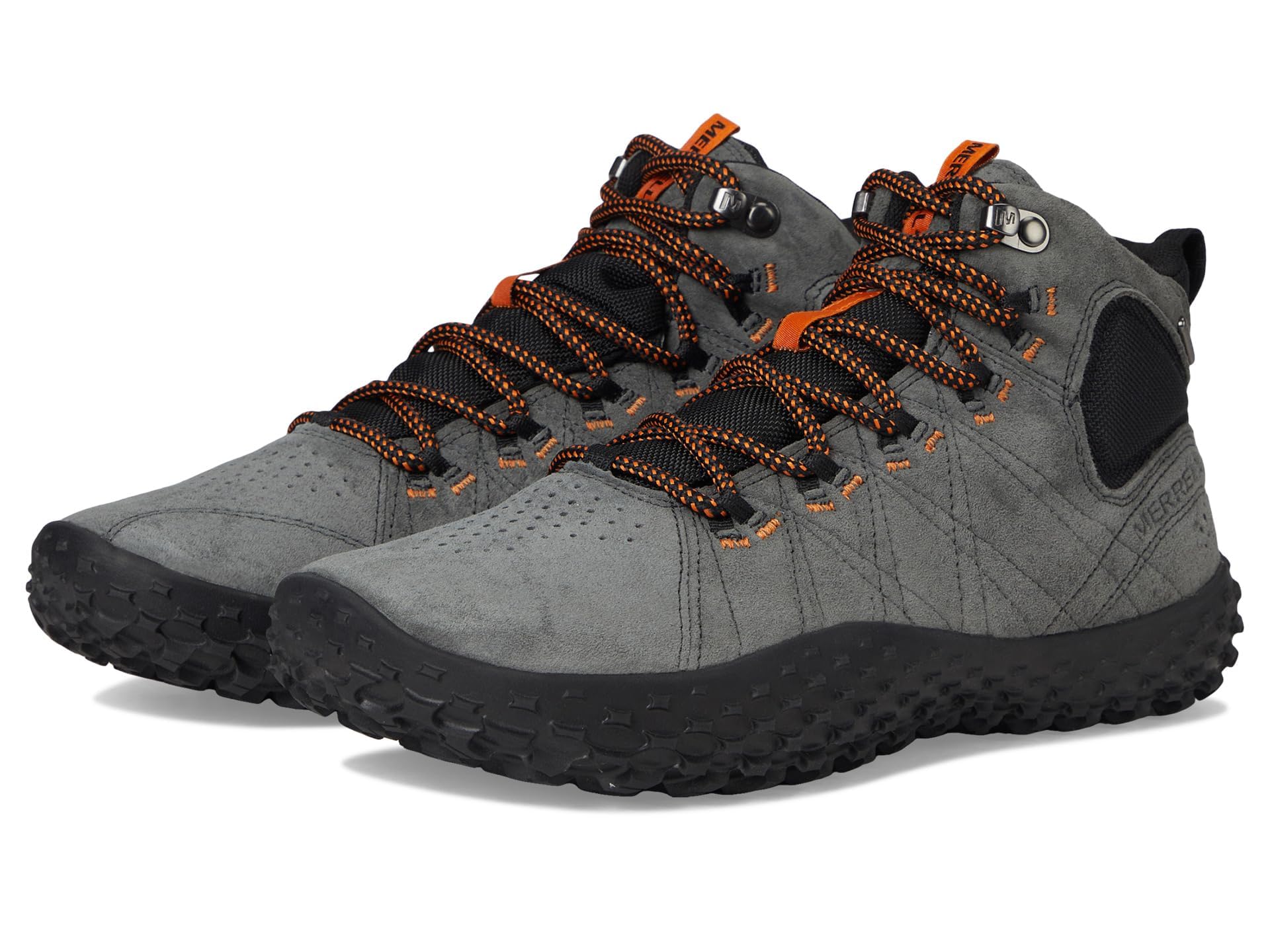
2. Merrell Men’s Wrapt Mid Waterproof
The zero drop boot for people who are on their feet for a full shift.
Merrell built this on the same last as their barefoot line, then wrapped it around an aggressive rubber sole and a waterproof upper. The result is a hybrid: your heel and forefoot still sit level, but there is actual rubber between you and the ground. On a long shift of standing or walking, that level platform is what keeps your feet from fighting a raised heel all day.
Quality is the thing that wins people over here — it is the trait owners bring up most often by a wide margin, and comfort runs right behind it. The specific compliment that keeps surfacing is about fatigue: feet that do not ache after a shift, legs that feel less tired at the end of the day. Traction and water resistance both get their own steady stream of approval, and the styling gets compared to a much more expensive sneaker more than once. For a boot that has to be worn eight hours straight, that is the right set of strengths.
The trade-off is that this is not the most minimal boot on the list. If you want to feel every contour of the trail, the thin-soled picks will give you more of that. The Wrapt Mid is the one to choose when you want the level heel without giving up protection. It also holds a higher score than the women’s version of the same boot — 4.3 against 4.1 — so if you are shopping for a partner, that gap is worth knowing.
Where it lands: a level-heel boot with enough sole under it to survive a full workday on concrete, then handle a weekend trail without complaint.
The balancing act: you give up some ground feel in exchange for the cushioning and the rubber grip, and that is a fair trade for most people.
Reach for it when: your boots are workwear first and trail gear second.
Pass it over when: you are chasing maximum barefoot sensation and want the thinnest sole you can get.
3. Xero Shoes Men’s Denver II Hiking Boots
A leather boot you can wear from the office to the trailhead without changing.
Xero took a best-selling boot and tuned it for three seasons rather than one. The microfiber lining is the clever part — warm enough on a cold morning, not stifling on a mild afternoon. Around the collar there is soft leather lining, and the tongue is padded, so the boot feels broken-in from the start rather than needing a week of blisters to get there. A capable outsole means it handles off-road ground, not just pavement.
Buyers report comfort as the clear strength, and no blister story stands out in the reviews. Material quality is the second thing people keep praising — it reads as a flexible leather boot rather than a stiff hiking shell. Fit and durability split both ways: plenty find it great and long-lasting, while a portion report laces that will not stay tied and worry about how many seasons they will get. Traction is the weaker side, with slippery footing coming up as a real point.
So treat this as a lifestyle-leaning zero drop boot with trail capability, not a scrambler. For city miles, dog walks and light paths it is a genuinely good-looking, comfortable choice. If your routes involve wet rock or steep mud, the MaxTrac outsole on the Altra further down is the more sure-footed answer.
The case for the Denver II
- Three-season microfiber lining stays comfortable across temperature swings
- Soft leather collar and padded tongue mean almost no break-in
- Flexible leather upper that moves with your foot
- Smart enough for everyday wear, capable enough for light trail
Where it gives ground
- Slippery footing is the recurring complaint on wet or loose ground
- Laces work loose for some wearers
- Long-term durability draws divided opinion
The right call for: a zero drop boot that has to look presentable and feel easy from day one.
Think twice if: your walking happens on wet rock, steep mud, or anything where grip is the deciding factor.
4. Vivobarefoot Men’s Tracker Leather All Terrain Hiking Boot

The purest barefoot hike here — and the one that asks the most of your feet.
Vivobarefoot rebuilt this boot around a reengineered leather upper and a new All Terrain sole, and made one decision that separates it from everything else on this list: they took the waterproof membrane out. That sounds like a downgrade until you understand the reasoning. A membrane blocks water both ways, so sweat stays in. Removing it makes the boot more breathable and more comfortable, while the leather and sole still handle wet ground. If your feet run hot, that is a meaningful improvement.
Owners describe the feel in terms of space — feet that do not feel cramped, legs that do not feel fatigued after a long walk. Quality is what gets praised most, with comfort close behind and the overall fit drawing steady approval. This is a boot that asks you to walk properly rather than letting you heel-strike and coast, so the foot does more work and, for a lot of people, that is exactly the point.
Here is where honesty matters. This is the lowest-scoring boot in the group, and the durability conversation is genuinely split — some pairs hold up beautifully, while the sole coming apart has been a real issue for a portion of buyers. The price also sits at the premium end for what is a deliberately minimal boot. Buy it because you want maximum ground feel and breathability on dry and damp trails. If you need a waterproof barrier for sustained wet weather, the Altra or the Merrell is the safer bet.
The barefoot purist’s pick: a 0 mm platform with a leather upper that lets air move, built for people who want their feet to do the walking.
What you are accepting: the membrane-free design means it breathes, but it is not a barrier against standing water, and sole longevity is the question mark.
Made for: hikers who prioritise ground feel and breathability above everything else.
Not the one for: anyone who needs a guaranteed waterproof barrier or wants a boot to last many hard seasons without question.
5. Altra Men’s Lone Peak 9 Waterproof Mid Hiking Shoe

Level heel, roomy toes, and 25 mm of foam — the easy way into zero drop.
If you are coming off a conventional hiking boot and the idea of a paper-thin sole makes you wince, start here. The Lone Peak 9 Waterproof Mid keeps the 0 mm drop — heel and forefoot at the same height — but runs a 25 mm stack height, meaning there is a full 25 mm of material under you. You get the level platform without feeling every pebble. The midsole uses Altra’s EGO foam, and the upper is a waterproof recycled polyester mesh with a no-sew overlay and a molded heel collar for a snug fit.
Underfoot there is a MaxTrac outsole built for grip and durability across terrain, plus a Stoneguard insert that shields your foot from rocks and debris while staying flexible. The wide toe box lets your toes spread and your midfoot stay supported on long descents. Quality is the trait that gets the most praise, with the fit right behind it — people notice the room up front and the lighter weight for a mid-cut boot.
The caveats are worth knowing. Water resistance splits both ways: some walk through puddles dry, others report wet feet. There is also a report of the toe lining peeling back, and the colour arriving darker than the black shown. None of that is unusual for a membrane boot that has to breathe. What you are really buying is the cushioned route into zero drop, and on that it delivers.
Why the transition crowd loves it
- 0 mm drop paired with a 25 mm stack for real cushioning
- Wide toe box keeps your midfoot supported on descents
- MaxTrac outsole for grip across mixed terrain
- Stoneguard insert shields against rocks and debris
- Waterproof membrane and molded heel collar for a snug fit
The honest fine print
- Water resistance results vary from pair to pair
- Toe lining has peeled back on at least one pair
- The colour can arrive darker than advertised
Choose it for: a first zero drop boot where you still want cushioning and ankle coverage.
Skip the switch if: you already hike in minimal soles and want to feel the trail directly.
6. Merrell Women’s Wrapt Mid Waterproof Hiking Boots

The women’s cut of Merrell’s zero-drop hybrid, with a sole that bites into trail.
This is the same design brief as the men’s Wrapt Mid above — barefoot-collection fit, zero drop, an aggressive rubber sole shaped to mimic the human foot — built on a women’s last. Comfort is the standout, and it is not close: it is the trait that comes up far more than any other, with appearance, light weight and value all drawing their own steady approval. The boot reads as grippy and trail-capable, and the waterproof build means a wet path does not end the walk.
Fit is the part to pay attention to, because it splits. Some wearers love the wide toe box and the ankle support; others find it narrow and not true to size. That is a real fork in the road, not a defect — a boot this shaped either matches your foot or it does not, and the only way to know is to try it. Arch support draws a similar mixed response. If you have a wider forefoot, this is likely a very good match. If you normally size up for width, consider it carefully.
One comparison worth naming: this women’s version scores lower than the men’s Wrapt Mid — 4.1 against 4.3 — which suggests the women’s last is the trickier fit of the two. That is a fit story, not a quality story, and the comfort praise is just as strong here.
What it brings: a zero-drop, waterproof trail boot with a grippy rubber sole and a wide toe box for those it fits.
The one variable: sizing runs inconsistent, so treat the fit as something to verify rather than assume.
Suits you if: you want a women’s zero drop boot with real trail grip and a roomy forefoot.
Check the sizing first if: your feet run narrow or you usually need to size up for width.
7. Hike Footwear HF Winter Barefoot Boots

Winter warmth on a level sole, for people who refuse to give up barefoot feel in the cold.
Hike took their regular barefoot model and winterised it — same natural-stride platform, same wide toe box, with cold-weather features layered on top. The pitch is straightforward: you keep the flexibility and the ground feel of a barefoot boot while your feet stay warm on a winter walk or a cold commute. It is unisex, so one design serves the whole household.
Fit is what people bring up most often, and it lands positive — this is a boot that tends to match the size you order. Comfort follows close behind, with warmth, foot support and light weight each getting consistent nods. The support angle is the interesting one: people describe feeling more stable and more balanced in these, which is what a wide, level platform is supposed to do. A zero drop winter boot should give you the natural stride without frozen toes, and this one does.
Where it sits honestly: this is a walking boot, not a mountaineering boot. Warmth is a winter feature, not an arctic-grade claim, and there is no membrane spec to lean on for deep slush. For cold-weather errands, winter dog walks and a daily commute it does the job well. At 4.0+ stars it is one of the better-scoring pairs in this group.
The winter angle: a wide, level platform with warmth built in, so the barefoot feel survives the cold months.
Its natural limit: warmth is a winter-walking feature rather than an extreme-cold specification.
Worth it if: you want a warm, level-heel boot for cold walks and the daily commute.
Not built for: deep snow, sustained slush, or anyone wanting a boot rated for severe conditions.
8. HIKE Footwear Caspar Pro Winter Barefoot Boots

The entry-level winter barefoot pick — non-slip sole, warm lining, minimal fuss.
This is the boot to look at if you want to try a minimalist winter shoe without committing much. It is built as a non-slip minimalist winter boot, with a design that keeps your heel and forefoot level and lets your toes spread. The maker frames it around natural foot posture and all-day comfort, which is the same promise every barefoot boot makes — the difference here is the price tier.
Owners describe excellent warmth and comfort, and the barefoot feel comes through clearly. The standout observation is range: these are boots people walk long distances in during very cold weather and come back happy. Light weight gets its own consistent mention, and for a winter boot that matters — a heavy snow boot tires your legs out well before your feet give up.
The honest read is that this is a budget winter boot, and the 4.0+ star score reflects it — solid, but not the best in the group. It is the right first step if you are barefoot-curious and want to test the idea over a winter before spending more. If you already know the fit works for you, the HF Winter Boot above is the higher-scoring option.
The value play: a warm, lightweight winter boot on a level platform, at the entry end of the market.
Set expectations here: this is a first-pair boot, and the finish and longevity reflect the tier.
Pick it up if: you want to test barefoot winter wear without a big outlay.
Step up instead if: you already know you love the fit and want the better-scoring version of the same idea.
Know the Specs
Heel-to-Toe Drop (0 mm)
Drop is the height difference between your heel and the ball of your foot. A conventional boot often raises the heel, which tips you forward and shortens the work your calf does. At 0 mm, your foot sits level, the way it does barefoot. Expect your calves and Achilles to feel it for the first week or two while they adjust to a longer range of motion. That adjustment is normal, and it is why you break a zero drop boot in gradually rather than wearing it for a ten-mile hike on day one.
Stack Height and Ground Feel
Stack height is how much material sits between your foot and the ground. A low stack gives you ground feel — you can read the surface through the sole, which helps on uneven trail. A higher stack, like the 25 mm on the Altra, cushions impacts and protects against sharp rocks. Neither is better; they suit different feet and different terrain. If you are new to zero drop, a mid stack is the gentler transition, while a thin sole rewards people who want a direct connection to the ground.
Wide Toe Box and Foot-Shaped Last
A last is the foot-shaped mould a boot is built around. A foot-shaped last keeps the widest point at the ball of your foot, so your toes can spread when you push off. That spreading is what gives you stability on uneven ground. It also means a zero drop boot should fit snug at the heel and roomy at the toes — if both ends are tight, you have the wrong size, not the wrong boot.
Membrane vs Membrane-Free Uppers
A waterproof membrane is a thin barrier that stops water getting in. It also slows sweat getting out, so your feet can feel clammy on a warm day. A membrane-free leather upper like the Vivobarefoot Tracker breathes better and stays comfortable in the wet, but it will not hold back standing water. Match the choice to your weather: wet and cold favours a membrane, warm and damp favours breathability.
Common Questions
How long does it take to get used to zero drop boots?
Are zero drop boots good for plantar fasciitis?
Should I size up in a wide toe box boot?
Do zero drop boots have any arch support?
Is a zero drop boot the same as a barefoot boot?
Can I wear zero drop boots for work on concrete all day?
How do I keep leather zero drop boots waterproof?
Do zero drop boots work for wide feet?
Can I resole a barefoot leather boot?
The Bottom Line
For most people, the best zero drop boots pick is the Jim Green African Ranger Barefoot — full grain leather, a genuinely flexible sole and a toe box that lets your foot behave like a foot. It is the pair that still earns its place after the novelty of the drop wears off.
If your boots are workwear and you are on concrete all day, the Merrell Men’s Wrapt Mid Waterproof is the more comfortable answer, and the women’s version is the equivalent for a narrower foot. Coming off a conventional hiking boot and want cushioning? The Altra Lone Peak 9 Waterproof Mid gives you the level platform without the harsh ground feel. And if winter is the problem you are solving, the Hike HF Winter Boot keeps the barefoot stride warm at a fair price.
How we choose
We do not accept paid placement. Every pick is matched to a real buyer and a real use-case; we do not hands-on test units.
Sources
Specifications: manufacturer listings and product documentation. Review insights: verified customer reviews, as of November 2026. Pricing: not shown on this page (it changes often); check the current price via the retailer link.
As an Amazon Associate, Tactical Gear Guy earns from qualifying purchases. This does not affect which products we feature.