Specs are compiled from manufacturer listings and verified buyer reviews and can change over time — please confirm the key details on the product page before buying.
If you have ever spent a whole evening coaxing a loose, knotty hank into something a needle can actually pull from, you already know why a yarn winder earns its place in the craft bag. The short answer: most knitters are best served by a hand-cranked winder that clamps to a table and turns a messy skein into a tidy, center-pull cake in a couple of minutes. The picks below cover that job at every level, from a budget clip-on unit to a handcrafted wooden winder with its own swift.
This guide is built by comparing the manufacturers’ published specifications and the patterns across verified customer reviews, so you get each pick’s real strengths and trade-offs instead of marketing spin.
A winder is a simple machine, but clamp thickness, cake capacity, and tension control decide whether your yarn feeds cleanly or snags mid-row. Below you will find the real differences in table clamp thickness, cake capacity in ounces, and how each one holds its tension. That is the short version of what separates a good pick from a frustrating one when you shop for the best yarn winder for knitting.
Top Picks


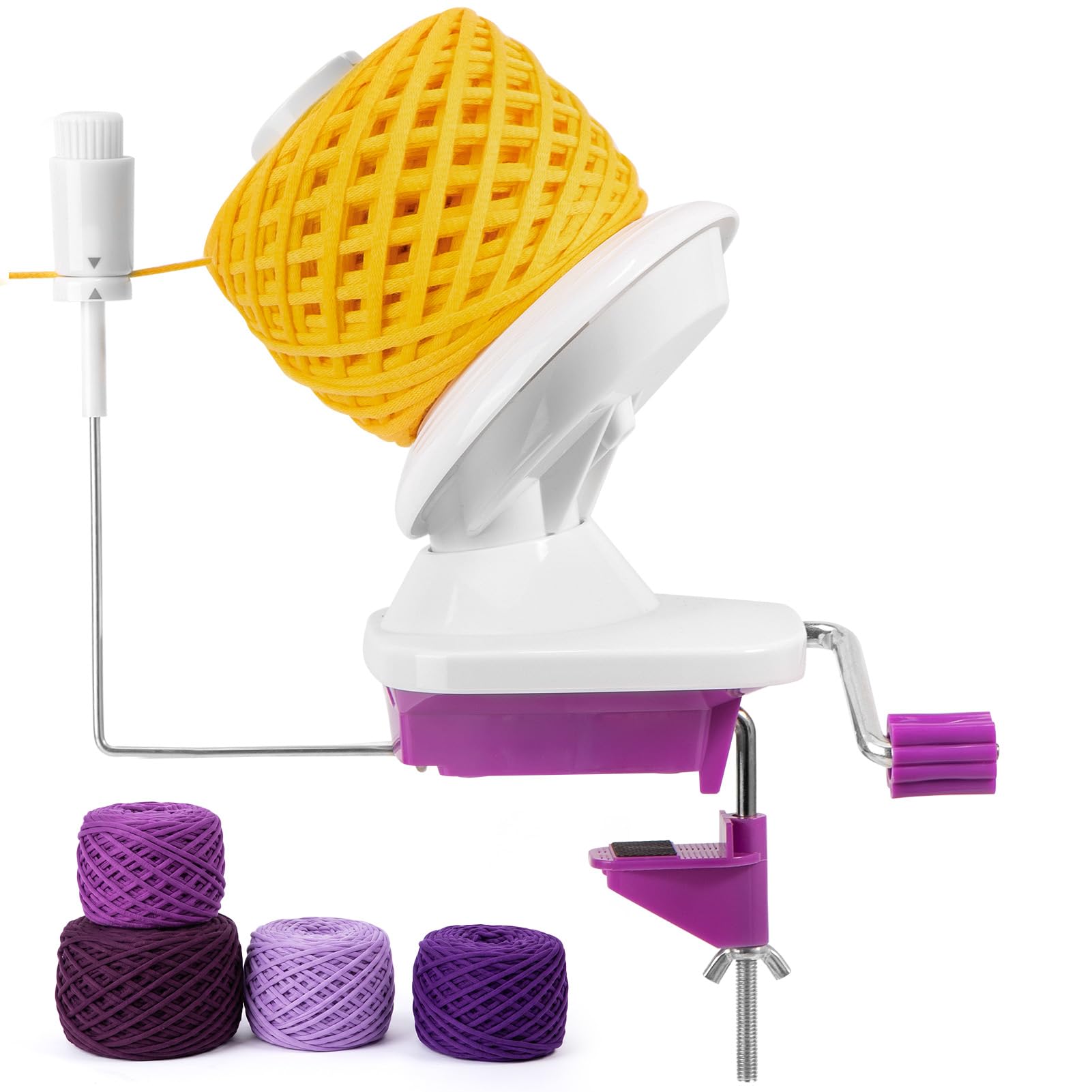
How To Choose The Best Yarn Winder for Knitting
A fresh hank arrives as a long loop of loose yarn, and knitting straight from it gives you snarls, uneven tension, and a lap full of knots. A winder pulls that loop onto a spindle under steady tension and lays it into a cake you can pull from the center. Four things decide whether a given winder does that well for your yarn.
Clamp fit and table thickness
A hand-cranked winder holds itself on your table with a clamp, and every clamp has a maximum thickness it can bite. Some models top out around 1-1/2 inches, others reach closer to 1-3/4 inches, and one winder here is built for tables under 2 inches. Measure your table or counter edge before you buy, because a clamp that will not close on your surface makes the whole tool useless to you.
Cake capacity in ounces
Capacity is the amount of yarn a single cake can hold, measured in ounces. A 4-ounce winder handles standard sock and DK skeins fine. If you work with bulky weight or buy large hanks, look for a winder that lists 7 ounces or more, because an overfilled spindle gives you a cake that bulges and collapses. Match the capacity to the yarn weight you actually knit with most.
Tension control and the yarn guide
An adjustable tension spring or a separate yarn guide is what keeps a cake compact and even instead of loose. This matters most with slippery or fine yarns, where slack lets the strands cross and tangle as you wind. A guide also frees one hand, so you can crank steadily and let the tool feed the yarn at a consistent rate.
Build material and how it holds up
Plastic winders are light and budget-friendly, while metal bases and nylon gears add stiffness. Wooden models feel solid but cost more and are heavier to move around. Whatever the material, the moving parts take the stress of every crank, so check that the arm and gears feel firm rather than floppy before you commit.
Side-by-Side Comparison
| Model | Best For | Max Cake Capacity | Clamp / Table Fit | Build Material | Amazon |
|---|---|---|---|---|---|
| Knit Picks Yarn Ball Winder★ Best Overall | Most knitters | — | Clamps to table edge | Plastic | Amazon |
| Adhafera Yarn Winder with GuideHands-Free Helper | Hands-free winding | Under 4 oz | Tables under 2 inches | ABS plastic | Amazon |
| Caydo Manual Yarn WinderBest Tension Control | Tight, even cakes | 4–7 oz | Up to 1-1/2 inches | — | Amazon |
| Stanwood Needlecraft YBW-B | Simple center-pull balls | 4 oz | Clamps to table edge | Plastic | Amazon |
| INMAKER Yarn Winder | Large cakes | Up to 10 oz | Up to 1-3/4 inches | Metal base, nylon gears | Amazon |
| Stanwood Needlecraft YBW-M | Premium hand-cranked | 7 oz | Tool-less clamp | — | Amazon |
| Olikraft Large Capacity Metal Winder | Bulky yarn | Up to 10 oz | Clamps to table edge | Stainless steel | Amazon |
| Handcrafted Rosewood Winder & Swift | Heirloom look | 8–12 oz | Free-standing base | Solid rosewood | Amazon |
Detailed Reviews
1. Knit Picks Yarn Ball Winder
Our pick — 4.5+★ from 7,000+ verified ratings; the strongest balance of quality and price.
The one most knitters land on first, and for good reason: it just winds.
This hand-operated model clamps on, winds, and gets out of the way so you can get back to your needles. It weighs 11.36 ounces, so it lifts off the shelf with one hand and clamps onto your table edge. The crank turns a loose hank into a tidy ball of pull thread in roughly the time it takes to set up a project row. At 25.4 centimeters long, it is compact enough to live in a craft drawer without hogging the space.
What wins people over is how little fuss there is: owners consistently report setup in about two minutes, then straight into winding. That ease is the headline here, and it is why this pick carries the highest score on the list — 4.5+ stars across 7,000+ ratings. The Knit Picks Yarn Ball Winder is the crowd favorite, and the counted praise for straightforward use and value backs that up rather than any single flashy feature.
The catch is durability. The plastic body draws mixed feedback, with some owners reporting that it comes apart during use, so treat the crank arm gently and do not force a jammed skein. It is compatible with knitting needles in US size 8 and a 4-millimeter metric size, which covers most everyday work. If you want a tool you crank hard every single day, a metal-based winder further down is the sturdier bet.
What earns it the top spot
- Setup runs about two minutes, so you spend your time knitting rather than fiddling
- Weighs 11.36 ounces, light enough to move from table to shelf easily
- Handles everyday US size 8 and 4-millimeter needle projects without complaint
- The friendliest learning curve for a first-time winder owner
Where it asks for care
- The plastic build draws mixed feedback, with some reports of it coming apart in use
- Crank it steadily and gently, especially with a stubborn skein
Reach for this if: you want the simplest, most trusted starting winder and mostly knit standard-weight yarn.
Look elsewhere if: you plan to crank hard every day and want a metal-based body for the long haul.
2. Adhafera Yarn Winder
The one that feeds the yarn for you, so both hands stay free.
Here is the winder for anyone who has tried to hold a skein steady with one hand while cranking with the other and ended up with a lopsided cake. This model pairs the winder with a yarn guide, so you thread the yarn through first and the tool keeps the tension for you. With the guide holding tension, winding becomes a one-handed job: you crank while your other hand stays free.
It clamps onto any table under 2 inches thick, which is a wider bite than most winders in this list and gives you more surfaces to choose from. The plastic body is durable ABS, and the maker backs it with a 1-year warranty. Winding capacity tops out under 4 ounces, so it suits standard sock and DK skeins rather than big bulky hanks. A low-noise design keeps the cranking quiet, which matters if you wind while others are in the room.
The honest trade-off is capacity. Under 4 ounces means you will split a large bulky skein into two cakes instead of one, so if you work mostly with heavy yarn look at the bigger picks. This winder has a modest review base so far, which is worth knowing before you weigh it against a long-track-record model. For everyday sock and DK projects with the guide doing the tension work, it is a smart little addition to the craft table.
Who it is built for: knitters and crocheters who want the yarn guide to handle tension and free up a hand, on tables up to 2 inches thick.
Go for it if: the hands-free yarn guide and the wide 2-inch clamp fit solve a real nuisance for you.
Pass if: your stash is mostly bulky weight and you would rather have a 7-ounce or larger cake.
3. Caydo Manual Yarn Winder
A tension spring that keeps your cake compact without your second hand.
Loose, uneven winding is the classic complaint about hand winders, and this one attacks it head-on with an adjustable tension spring. You set the spring to the yarn you are using, and it pulls the strand in tight so the cake comes out firm and even instead of sloppy. That frees your left hand entirely — no more holding the skein while you crank. The maker lists capacity from 4 to 7 ounces, and it handles yarn diameters under 8 millimeters, so it covers everything from delicate lace to bulky weight.
Setup is genuinely beginner-friendly: clamp it to a surface up to 1-1/2 inches thick, twist on the spindle, position the guide arm, and start cranking. No complicated assembly, and a full-color instruction manual walks you through the first run. It weighs 13.2 ounces — noticeably heavier than the 7-ounce Stanwood YBW-M below, which explains the more planted feel on the table. At 6.88 x 6.88 x 4.84 inches it stays compact on a crowded craft surface.
You get tidy, even cakes in under four minutes, according to buyers who report it turns loose yarns into nice balls. The adjustable spring (a tension dial that controls how tightly the yarn winds) is the key feature here, and it is what earns this winder a place for tight, consistent cakes. One thing to note for the long haul: a spring that is over-tightened on a stubborn bulky yarn strains the winding action, so dial it in gradually. For a knitter who cares about tight, stackable cakes, this is a strong value pick.
The real difference: the adjustable tension spring and arms-length guide let you crank one-handed and still land a compact, even cake from lace weight through bulky.
The honest limit: capacity tops at 7 ounces and the clamp stops at 1-1/2 inches of table thickness, so a thick butcher-block island edge or a very large bulky hank will not suit it.
Your pick if: tight, consistent cakes on standard and bulky yarns matter more to you than raw capacity.
Not your pick if: you need a clamp for a surface thicker than 1-1/2 inches.
4. Stanwood Needlecraft YBW-B Yarn Ball Winder

The no-frills 4-ounce workhorse for sock and DK skeins.
This is a straightforward hand-operated winder in white plastic that makes center-pull balls up to 4 ounces. The maker notes sturdy construction and smooth edges, and that the wire arm of each unit is tested to stay up firmly once pulled out. It is compatible with crochet hooks in US sizes G-6 and H-8, which covers a wide range of everyday crochet work. At 4 ounces and a light plastic build, it suits a first winder or a spare for the travel bag.
The quality and functionality are what earn it its standing, and it is the kind of tool you set up once and leave on the table. That said, stability is the recurring gripe — the metal yarn holder has a reputation for not staying put, and the wire arm can flop rather than hold firm. A firm, level table edge helps, and seating the clamp fully before you crank makes a real difference. Expect to make friends with that arm as you learn its habits.
Durability draws mixed feedback too, with some units breaking during first use, and value lands somewhere between loyal fans and skeptics. Those caveats are fair to know going in, but they sit against a solid core of owners who find it works well as intended. For 4-ounce sock and DK skeins, this one is a steady, familiar choice that has been in craft rooms for years.
What it does well: makes clean center-pull balls up to 4 ounces and fits a range of G-6 and H-8 crochet hooks.
What to watch: the wire arm and metal yarn holder are known for not staying put, so seat the clamp firmly and expect to nudge the arm as you go.
Worth it for: sock and DK knitters who want a simple 4-ounce winder and will manage a slightly willful wire arm.
Think twice if: you want a rock-steady arm that holds its position without fuss.
5. INMAKER Yarn Winder

Ten ounces per cake, so your bulky skeins never need splitting.
If your stash leans toward big hanks and bulky weight, capacity is the number that matters, and this one delivers up to 10 ounces per winding. At 11.22 x 7.48 x 11.81 inches, it is substantially larger in footprint than the Caydo winder, which sits at 6.88 x 6.88 x 4.84 inches. That larger body is the reason it handles the big cakes that smaller winders have to split. Assembly is a three-step job, and it clamps to any tabletop up to 1-3/4 inches thick.
Under the hood, a strong metal base pairs with wear-resistant nylon gears, and rubber padding on the base keeps your tabletop free of scratches. The improved yarn guide pulls messy tangles into compact, neat cakes that store easily. It weighs 2.97 pounds, so this is a winder you set in place rather than tote around. For anyone who winds a lot and hates stopping to re-split a skein, the capacity alone justifies a look.
What keeps coming through is how solid and easy it is to assemble, right down to a toddler helping operate it. Fit draws mixed opinions, so check that your tabletop is within the 1-3/4-inch clamp range before you commit. A user on the larger side of cakes will feel the benefit most. Knitters with an ever-growing pile of big hanks get the most out of this one.
Why bulky-yarn knitters like it
- Up to 10 ounces per cake, so large hanks fit in a single winding
- Metal base with nylon gears adds stiffness to every crank
- Rubber padding protects your tabletop from scratches
- Three-step assembly, with a clamp for tabletops up to 1-3/4 inches
What to check first
- At 2.97 pounds it is not a portable pick, so plan a fixed spot for it
- Fit draws mixed opinions, so confirm your tabletop is within the clamp range
Built for: knitters who work with big hanks and want a full 10-ounce cake without splitting.
Not ideal if: you want a lightweight winder to carry between rooms or to a knitting group.
6. Stanwood Needlecraft YBW-M Yarn Ball Winder

Seven ounces of cake and a tool-less setup that skips the fiddling.
You unfold it and start cranking without hunting for an Allen key, thanks to the complete shroud (a full cover that protects the gears) and tool-less setup on Stanwood’s step-up model. The 7-ounce capacity sits right between the 4-ounce YBW-B in this guide and the bigger 10-ounce winders, so it handles a fat DK or worsted skein in one go. It is compatible with knitting needles in US size 7 and a 4.5-millimeter metric size, plus crochet hooks from US size 2 to 19. It weighs just 7 ounces, making it the lightest serious winder on this list.
The comparison that jumps out: this YBW-M weighs 7 ounces against the Caydo’s 13.2 ounces, so it is far easier to pick up and move to another table. Owners describe a tool that winds a 3.5-ounce hank in about 3 minutes and fits a very large amount of yarn into one cake. The quality and functionality are what win people over, and the wipe-clean shroud keeps the gears covered. The full shroud keeps the gears covered and clean, a clear step up from the open YBW-B.
Durability is the one mixed note, so treat the crank arm with ordinary care rather than forcing a stubborn skein. The item thickness is 1.75 inches, which sets the clamp width you can expect. It is hand wash only for care, which is straightforward enough. Overall this is the model for someone who wants the Stanwood feel with more cake room and a cleaner setup than the entry-level version.
The upgrade that matters: a complete shroud and tool-less setup, plus 7-ounce capacity and a 7-ounce weight that beats the Caydo’s 13.2 ounces for handling.
Best matched to: a knitter who wants a covered mechanism, tool-free setup, and a 7-ounce cake without going to jumbo size.
The trade-off: durability lands as mixed, so gentle, steady cranking keeps it happiest.
7. Olikraft Large Capacity Metal Yarn Ball Winder
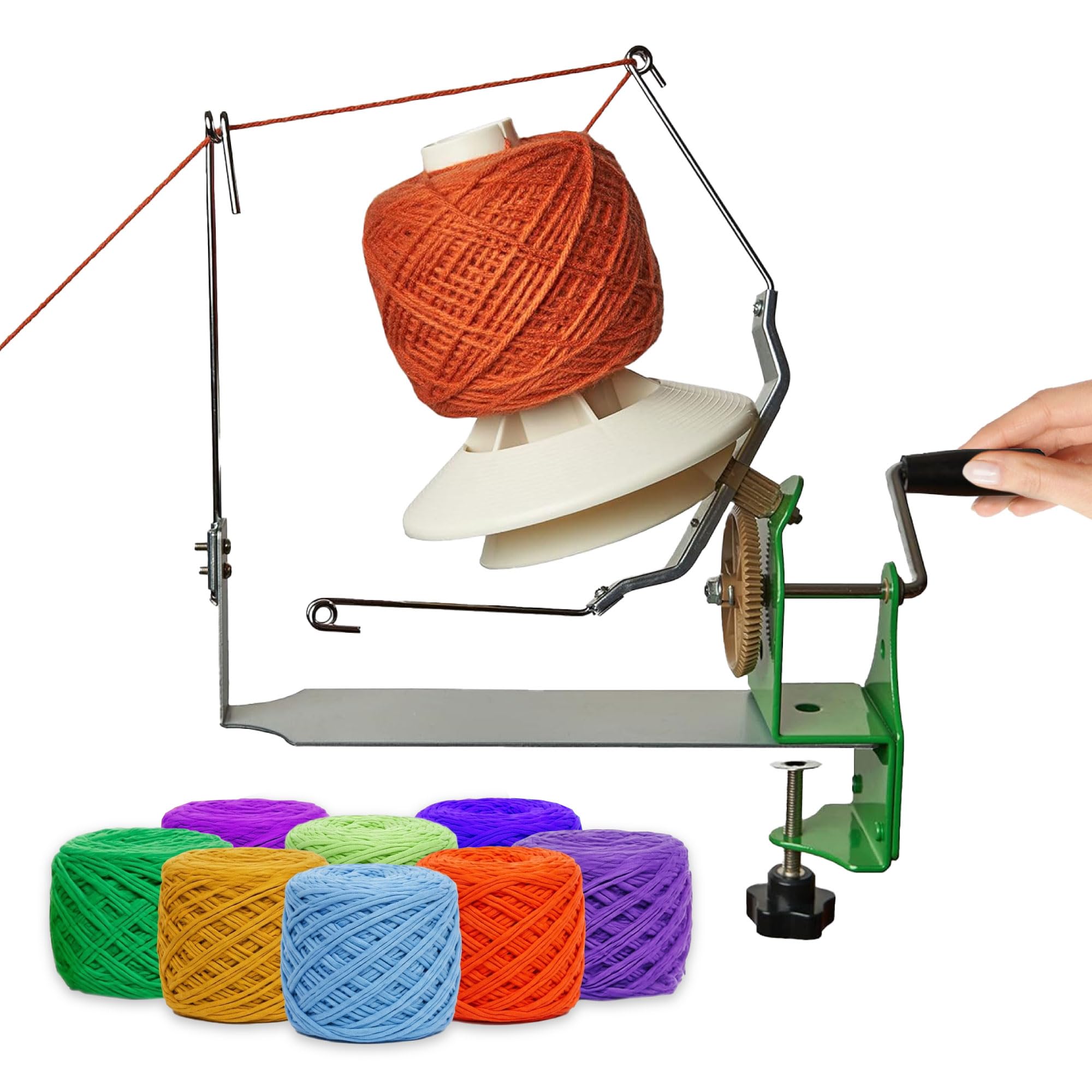
A stainless steel winder that doubles as a spinner and spooler.
Want the stiffness of metal without a wooden price tag? This hand-operated winder is built from stainless steel and winds up to 10 ounces into tangle-free balls. It doubles as a spinner and spooler, so it earns its place beyond plain cake-making. It weighs 1.43 kilograms, which gives it a planted, substantial feel — a metal body holds steady where a light plastic one can wander. With a 10-ounce capacity and a stainless steel body, it is built for winding large projects in one pass.
Capacity is the second-biggest draw here, with room for bulky yarn and room to spare. Owners note it handles jumbo cakes well and gives solid value. What earns it its standing is quality, with capacity close behind, so the build and the cake size both pull their weight. Rubber-free metal is not the whole story — the sturdy feel is what gives it the confidence to take on a big hank without complaint.
The friction is in durability and assembly. Some report it breaking quickly, and the assembly instructions can feel counterintuitive, so set it up patiently on your first run. It is heavier than the plastic winders at 1.43 kilograms, so expect a fixed spot rather than a carry-around tool. For knitters who wind big skeins often and want a metal body, the trade-offs land in the right place.
Why the metal body earns its keep
- Stainless steel construction gives a stiff, planted feel on the table
- Winds up to 10 ounces into tangle-free balls for larger projects
- Doubles as a spinner and spooler, so it works beyond one job
- Quality and capacity are the two things that stand out most
The honest friction
- Durability draws mixed reports, with some saying it breaks quickly
- Assembly instructions can feel counterintuitive, so take your time
- At 1.43 kilograms it is a stay-put tool rather than a portable one
The right call for: bulky-yarn knitters who want stainless steel, a 10-ounce cake, and a spinner-spooler combo.
Read the fine print if: assembly patience is short or you want to carry the winder room to room.
8. Handcrafted Wooden Yarn Winder

The one that looks like furniture and takes on the biggest 8-12 oz skeins.
This is the winder you leave out as decor. It is handcrafted from solid rosewood, and every unit carries its own grain pattern, so no two are quite alike. The integrated swift holds the yarn under consistent tension, and the smoothly rotating base keeps winding free of tangles. It is built for 8 to 12 ounces of yarn, which puts it in a bigger league than the 4-ounce and 7-ounce winders here. It weighs 14.1 ounces and comes ready to use with no assembly.
The heavy-duty design is intended to stay firmly in place, with a sturdy base and smooth gears meant to keep vibration down during a winding session. It measures 15.35 x 7.09 x 7.09 inches, so it takes up more surface than a compact plastic model — think of it as a small piece of furniture for your craft space. For a fiber artist working through hefty bulk skeins, that footprint is a fair exchange for the room it gives your cakes.
Worth being honest here: this pick carries the lowest rating of the group, at 3.5+ stars from a smaller pool of owners than most of the others. That is a genuine consideration if you weigh reliability heavily and want a long track record. But for the right buyer — someone who wants a beautiful, stable wooden tool and winds big skeins often — it stands alone in look and capacity. If a wood winder that handles 8 to 12 ounces is what you have been holding out for, this is the one that fits.
The draw: solid rosewood with a unique grain, an integrated swift for even tension, and 8 to 12 ounces of capacity with no assembly required.
The caveat: it carries the lowest score on this list from a smaller owner pool, so weigh that against the look and the jumbo capacity.
Choose it for: the knitter who wants a beautiful wooden winder and routinely winds 8 to 12-ounce skeins.
Look at the others if: a long track record of reliability matters more to you than the wood and the big skeins.
Know the Specs
Max cake capacity in ounces
This is how much yarn one cake can hold, measured in ounces. A 4-ounce winder handles sock and DK skeins, a 7-ounce model covers worsted and larger hanks, and a 10-ounce winder takes on bulky projects without splitting. Match the number to the yarn weight you reach for most; an overfilled spindle gives you a bulging cake that can collapse as you knit.
Clamp and table thickness
A hand-cranked winder grips your table with a clamp that has a maximum thickness it can bite. Some stop at 1-1/2 inches, others reach 1-3/4 inches, and one model here fits tables under 2 inches. Measure the edge you plan to use, because a clamp that will not close leaves the tool sitting idle. A free-standing wooden base, like the rosewood model, sidesteps the clamp question entirely.
Tension control and yarn guide
An adjustable tension spring or a separate yarn guide keeps the strand feeding evenly, so the cake comes out compact rather than loose. It also frees one hand, letting you crank at a steady rate and lean on the tool for the tension. For slippery or fine yarns, that steady feed is what prevents the strands from crossing and tangling as you wind.
Center-pull versus a plain ball
A center-pull cake lets you knit from the inside out, so the yarn unwinds from the middle without the whole cake tumbling across the floor. That steady feed keeps your tension even across a long row. A plain ball rolls and picks up fuzz from the table, which is why most knitters prefer the center-pull shape a winder makes.
Common Questions
Will a yarn winder clamp onto my kitchen table if it has a thick edge?
How much yarn can a winder hold in one cake?
What is the difference between a yarn winder and a swift?
Will a winder work with bulky yarn and large hanks?
How long does it take to wind a single skein?
Can a yarn winder make cakes for both knitting and crochet?
Do I need to assemble a yarn winder before using it?
Is a metal yarn winder more durable than a plastic one?
Will a winder stay put while I crank, or will it scoot across the table?
Can I travel with a yarn winder to a knitting group or class?
The Bottom Line
The safest starting point in this list is the Knit Picks Yarn Ball Winder. It has the highest score of the group, the biggest owner base behind it, and a setup that takes about two minutes — so the smart buy here is the one the widest range of knitters already trust. Though the budget-friendly Adhafera and Caydo carry respectable ratings too, the Knit Picks holds the higher overall mark, and the counted praise for straightforward use and value is why it lands on top.
If tight, compact cakes on both standard and bulky yarns are your priority, the tension spring on the Caydo Manual Yarn Winder does that job well. And if you work through big 10-ounce hanks and want a stainless steel body, reach for the Olikraft Large Capacity Metal Winder.
How we choose
We do not accept paid placement. Every pick is matched to a real buyer and a real use-case; we do not hands-on test units.
Sources
Specifications: manufacturer listings and product documentation. Review insights: verified customer reviews, as of November 2026. Pricing: not shown on this page (it changes often); check the current price via the retailer link.
As an Amazon Associate, Tactical Gear Guy earns from qualifying purchases. This does not affect which products we feature.