Specs are compiled from manufacturer listings and verified buyer reviews and can change over time — please confirm the key details on the product page before buying.
If your factory door speakers turn every vocal into a smear of noise, the fix is a matched woofer and tweeter set — a pair built to split the low notes from the high ones instead of asking one cone to do both badly. The short answer: buy the Timpano bundle if you want a full mid-and-tweet upgrade, or the Rockford Fosgate R165-S if you want a true component set with a separate tweeter you can aim. Everything below sorts the rest by what you actually drive and how much amplifier you already own.
This guide is built by comparing the manufacturers’ published specifications and the patterns across verified customer reviews, so you get each pick’s real strengths and trade-offs instead of marketing spin.
Driver size, impedance, and sensitivity decide how much bass you get and how hard your amp has to work. The picks below cover every budget tier, and this breakdown of the woofer and tweeter options explains which pairing suits your vehicle and amplifier.
Top Picks


How To Choose The Best Woofer and Tweeter Set
The hard part of buying speakers is not picking a brand — it is matching the driver to the hole in your door and the power coming out of your dash. Get those two things wrong and even a well-built pair will underwhelm. Nail them and a modest set will sound better than the premium one that does not fit.
Measure the cutout before you fall in love with a driver
Your factory speaker sits in a hole that only accepts certain diameters. A 6.5-inch woofer needs roughly a 6.5-inch opening, while a 4-inch driver drops into far tighter dash and door spots. The Warzone WZ40PTi lists a 3.74-inch cutout diameter and a 1.66-inch mounting depth — those two figures decide whether it slips into a compact factory location or not. Pull the old speaker and measure the opening and the depth behind it before ordering anything.
Match impedance and sensitivity to the power you have
Impedance, measured in ohms, is the electrical load the speaker presents to your amplifier or head unit. All the multi-driver picks here are rated at 4 ohms, which pairs with the vast majority of car head units and amps. Sensitivity, measured in decibels, tells you how loud the speaker gets from a given amount of power — a higher number means less amplifier work for the same volume. The Orion XTR65.SC rates 87 dB and the Warzone WZ40PTi rates 90dB, so the Warzone asks less of a stock head unit to reach the same loudness.
Decide whether the tweeter needs to be separate
A component set gives you a woofer and a tweeter as separate pieces, so you can aim the high frequencies at your ears instead of firing them at your knees. A coaxial set bolts the tweeter onto the woofer, which is quicker to install but locks the tweeter to the woofer’s position. The Rockford Fosgate R165-S gives you two 1-inch tweeters that can be flush, surface, or angle mounted — real flexibility if your vehicle has a spot up high for them.
Side-by-Side Comparison
| Model | Best For | Woofer Size | Power Handling | Impedance | Amazon |
|---|---|---|---|---|---|
| Timpano TPT-MR6-4 + TPT-ST2 Bundle★ Best Overall | Loud midrange builds | 6.5-inch | 1600W bundle | 4 Ohm | Amazon |
| Warzone WZ40PTiCompact Pick | Compact 4-inch spots | 4-inch | 350W max / 80W RMS | 4 Ohm | Amazon |
| Kenwood KFC-6966RBudget Bass | 6×9 rear deck bass | 6×9-inch | 400W peak / 45W RMS | 4 Ohm | Amazon |
| Rockford Fosgate Prime R165-S | Separate tweeter placement | 6.5-inch | 80W peak / 40W RMS | — | Amazon |
| Rockford Fosgate Prime R152-S | Tighter door openings | 5.25-inch | 80W peak / 40W RMS | — | Amazon |
| DS18 PRO-GM6.4PK | Pro-style car/truck systems | 6-inch | 480W max / 140W RMS | 4 Ohm | Amazon |
| ORION Cobalt CB65C | DIY installs | 6.5-inch | 280W peak / 70W RMS | 4 Ohm | Amazon |
| ORION XTR65.SC | Higher-power builds | 6.5-inch | 340W max / 85W RMS | 4 Ohm | Amazon |
| Alpine S2-S65C | Hi-Res factory replacements | 6.5-inch | 240W peak / 80W RMS | — | Amazon |
Detailed Reviews
1. Timpano 1600 Watts Bundle
Our pick — 4.5+★ from 300+ verified ratings; the strongest balance of quality and price.
A four-piece bundle that gives you the whole front stage — two midranges and two chrome super tweeters.
Most buyers in this space end up shopping for mids and highs separately and hoping they blend. This bundle takes that guesswork away: two 6.5-inch midrange speakers and two super tweeters arrive together, each pair built to cover its own slice of the sound. The mids run from 160 – 9,500 Hz — the range where vocals and guitar live — so the midrange driver carries the bulk of what you actually notice while driving.
The practical win is the shallow steel basket. At only 2.2″ of mounting depth, these drop into door panels where a deeper driver would foul the window glass or the door frame. That is the number to check against your own vehicle before ordering. The midrange cones use a high strength ferrite magnet, and the set is rated at 4 Ohm, so it plays with common car amplifiers without a rewire.
What wins people over here is the sound quality, with the tweeters giving noticeably more top-end output than expected in this tier. Quadrant counts put sound quality and build quality well ahead of everything else owners talk about, and the tone reads warm and full rather than thin. For an all-in bundle, that combination is harder to find than the specs suggest.
What this bundle does well
- Complete front stage: two 6.5-inch mids plus two super tweeters in one box
- 2.2″ mounting depth clears tight door panels
- 160 – 9,500 Hz midrange range keeps vocals forward
- 4 Ohm rating works with common car amps
Where it asks something of you
- You need an amplifier and some wiring expertise to get the most from a 1600W bundle
- The midrange tops out at 9,500 Hz, so the super tweeters must carry the very top end
Best fit: anyone building a loud, vocal-forward front stage in a truck or car with shallow door pods.
Think twice if: you want a bolt-in factory replacement with no amp — a self-contained component set makes more sense.
2. Warzone WZ40PTi 4-Inch Super Coaxial Car Speakers
The 4-inch problem-solver for dash corners and doors where nothing bigger will physically go.
Not every vehicle has room for a 6.5-inch driver. A 4-inch woofer fits a far smaller opening, and the WZ40PTi lists a 3.74-inch cutout diameter, 1.66-inch mounting depth, and 2.18-inch overall height. That last figure is what clears a shallow dash or a door skin with little room behind it. The trade-off is bass — a 4-inch cone moves less air than a 6.5-inch one, and this set’s response starts at 100Hz, so the deep low end belongs to a separate subwoofer.
Where it does earn its place is efficiency. At 90dB sensitivity and 4-ohm nominal impedance, it needs less amplifier power to reach a given volume than a low-sensitivity driver would. That makes it a smart match for a stock head unit that does not have much to give. A 2-way layout pairs a glass fiber woofer cone with a 44mm PEI dome tweeter and a 5kHz crossover point, so the tweeter only takes over up top and the woofer handles the rest cleanly.
For reference on range, the Kenwood below reaches down to 35Hz while this Warzone set begins at 100Hz — a real difference in how much low end you hear. Owners describe the sound as landing right about where they expected, and the value story holds together at a smaller driver size. If you have a compact factory location and no subwoofer, the low end is the honest limit.
The efficiency argument: 90dB sensitivity on 4 ohms means this driver plays loud off modest power — the practical reason to pick it over a thirstier 4-inch option when your amplification is fixed.
Reach for this if: your door or dash simply will not accept a bigger driver and you need volume without adding an amp.
Look elsewhere if: you want bass from your door speakers — pair it with a subwoofer or step up to a 6×9.
3. Kenwood KFC-6966R Road Series 6″x9″ 3-Way Coaxial Speakers
An oval 6×9 that digs down to 35Hz and puts real thump in a rear deck.
If bass on a budget is the goal, driver size does most of the work. The KFC-6966R is a 9-inch oval — the largest driver in this lineup — and its frequency response runs from 35Hz to 20kHz. Compare that to the 4-inch Warzone above, which starts at 100Hz, and the gap in low-end reach is plain. That is why rear-deck 6×9 upgrades are the classic move for adding weight to your music without a subwoofer box.
The 3-way layout adds a dedicated tweeter and a mid on top of the polypropylene woofer, and the whole set is rated 400W peak with 45W RMS at 4-ohm impedance. It is a component of sorts, with cloth woofer cones and electro-dynamic tweeters, plus grilles over the drivers. Nominal power of 45W RMS means a stock head unit will drive it, though a small amp wakes it up.
Sound quality is the star here, with build quality close behind in what owners talk about most. You can genuinely feel the bass through the seat in a well-installed rear deck, and the price-to-noise ratio is why this pair keeps showing up in budget builds. Fit and power do draw mixed feedback — a few owners found their model-specific opening fought them and some wanted more output. Check your vehicle’s rear deck dimensions before committing.
Where it shines: 35Hz extension from an oval driver is the cheapest path to door-rattling bass in this list.
The catch to size: a 9-inch oval only fits where the vehicle was built for 6x9s, so measure the rear deck opening first.
Pick it for: a rear-deck bass boost where 6×9 openings already exist.
Pass if: your vehicle uses round drivers only — this oval will not drop in.
4. Rockford Fosgate Prime R165-S

Two 6.5-inch woofers and two 1-inch tweeters you can aim wherever the highs need to go.
This is the set to choose when your vehicle actually has a spot up high for a tweeter. The kit pairs two 6.5-inch midrange woofers with grilles against two separate 1-inch Mylar balanced dome tweeters. Those tweeters mount flush, on the surface, or at an angle — so you can point them at the driver’s seat instead of firing highs into the footwell. That aiming flexibility is the whole reason to buy a component set over a coaxial.
The woofer cones use Mica injected polypropylene for extended frequency response, and the in-line crossovers simplify install by keeping the wire runs short. Power is modest on paper — 40 watts RMS and 80 watts peak — which suits the factory-replacement role this system is meant for. It is built for direct OEM installation and carries a full 1-year warranty.
Sound quality is the overwhelming theme in what owners discuss, with build quality close behind and price-to-performance highly rated too. These do the factory-replacement job cleanly, and the tone comes across as rich rather than harsh. Fit and speaker size draw occasional mixed notes, so confirm your door opening before you count on a drop-in. If you want a 6.5-inch component set that drops into the stock location, start here.
Reasons this set makes shortlists
- Separate 1-inch tweeters mount flush, surface, or angled
- In-line crossovers shorten install time
- Mica injected polypropylene cones extend the midrange
- Full 1-year warranty on the system
What to weigh first
- 40W RMS is modest — a big amplifier build will want more headroom
- Tweeter placement means extra work versus a coaxial drop-in
Best for the tinkerer: an owner willing to run tweeter wire and aim the highs for a bigger stage.
Not the easy one: if you want two wires and done, a coaxial set installs faster.
5. Rockford Fosgate Prime R152-S

The smaller sibling for vehicles that want 6.5-inch sound from a 5.25-inch opening.
Some doors and kick panels measure closer to 5.25 inches, and forcing a bigger driver leaves gaps or modifications. This system uses 5.25-inch midrange drivers paired with the same separate 1-inch Mylar balanced dome tweeters as the R165-S above. It runs the same 40 watts RMS and 80 watts peak, the same Mica injected polypropylene cone, and the same in-line crossovers. The only real difference is the woofer diameter — and that changes how much bass surface area you have.
Because the cone is smaller, expect slightly less low-end weight than the 6.5-inch system. The upside is a driver that actually fits where the bigger one will not, with direct OEM installation and a 1-year warranty. Tweeter mounting stays flexible — flush, surface, or angle — so you keep the aiming benefit that makes a component set worth the extra wiring.
Owners describe crisp mids and highs, and the value angle comes up far more than faults. Functionality draws some mixed opinion, so verify fitment and wiring on your specific vehicle rather than assuming a universal drop-in. If your opening is truly 5.25 inches, this is the smaller-framed twin of the R165-S.
The honest read: identical electricals to the R165-S in a smaller frame — you gain fitment and give up a little bass surface.
Choose it if: a 5.25-inch cutout is your hard limit and you still want a separate, aimable tweeter.
Rule it out if: your doors accept 6.5-inch drivers — take the bigger cone instead.
6. DS18 PRO-GM6.4PK Mid and High Complete Package

A four-piece package built to project — 6-inch midranges and 1-inch aluminum bullet tweeters.
The spec that orders this one: the PRO-GM6.4 midrange takes 480W of max power and 140W RMS at 4 ohms, and the paired PRO-TW120 ferrite tweeter takes 200 watts RMS and 300 watts max at 4 ohms with a built-in capacitor filter. That is a lot of headroom, and it is meant for a system with a real amplifier behind it. If you are running off a stock head unit, you are buying capability you cannot use.
The package bundles two 6-inch midrange loudspeakers and two 1-inch aluminum super bullet tweeters with built-in crossover. Those tweeters are the standout — they project high frequencies with a bite that cuts through road noise and wind. If you sing along, the vocal sits out front rather than buried under the bass.
What owners zero in on is how tight and crisp the highs come across, and the build quality reads substantial rather than cheap. Installation draws praise for being easy, and the heavy-duty feel is noted far more than any complaint. Reliability and durability do draw a few mixed notes — flimsy spade terminals came up — so treat the connections gently and crimp them well during install.
Why loud-system builders like it
- 140W RMS on the midrange and 200W RMS on the tweeter
- Four pieces — two mids, two bullet tweeters — in one package
- Built-in crossover and capacitor filter simplify wiring
- Highs project cleanly over road noise
The trade-offs to know
- Demands a capable amplifier; a stock head unit will not do it justice
- Spade terminals reward careful crimping during installation
The system to power up: an amplified truck or car build that needs the highs to project past road noise.
Skip the pairing if: you are staying on head-unit power — you will pay for 140W RMS you never feed.
7. ORION Cobalt CB65C 6.5″ 2-Way Component Speaker System

DIY-friendly 6.5-inch set that covers down to 70Hz with marked connections and a universal fit.
The number that sells this one is 70Hz — the low edge of its 70Hz-20kHz frequency response. That is a touch lower than the 4-inch Warzone’s 100Hz floor, so you get more usable midbass from a 6.5-inch driver without reaching for a subwoofer. Power sits at 280W peak and 70W RMS on 4-ohm impedance, and 88 dB sensitivity means it does not need a huge amp to get loud.
The build leans durable — a Butyl Rubber Surround and a precision polypropylene cone, both chosen to hold up over time and keep distortion down. The tweeter mounts either surface or flush, so you get some aiming choice here too. Connections are clearly marked and the driver is a universal fit, which is why it appeals to first-time installers working in a driveway.
Owners describe enhanced midbass and clear vocals, and installation is one of the things talked about most favorably. The design does what a component set should — separate woofer for the low end, dedicated tweeter for the highs. Value draws genuinely mixed opinions, so weigh what you get against the price rather than assuming a bargain. If you want a smoother, more forgiving install experience, this set is built around that.
Why first-timers reach for it: marked connections, a universal fit, and a 70Hz floor add up to fewer surprises during your first door-speaker swap.
Best entry point: a beginner installing their first component set who wants forgiving connections and real midbass.
Less compelling if: you are chasing the most watts — the XTR below offers more RMS at a similar driver size.
8. ORION XTR65.SC 6.5″ 2-Way Component Speaker System
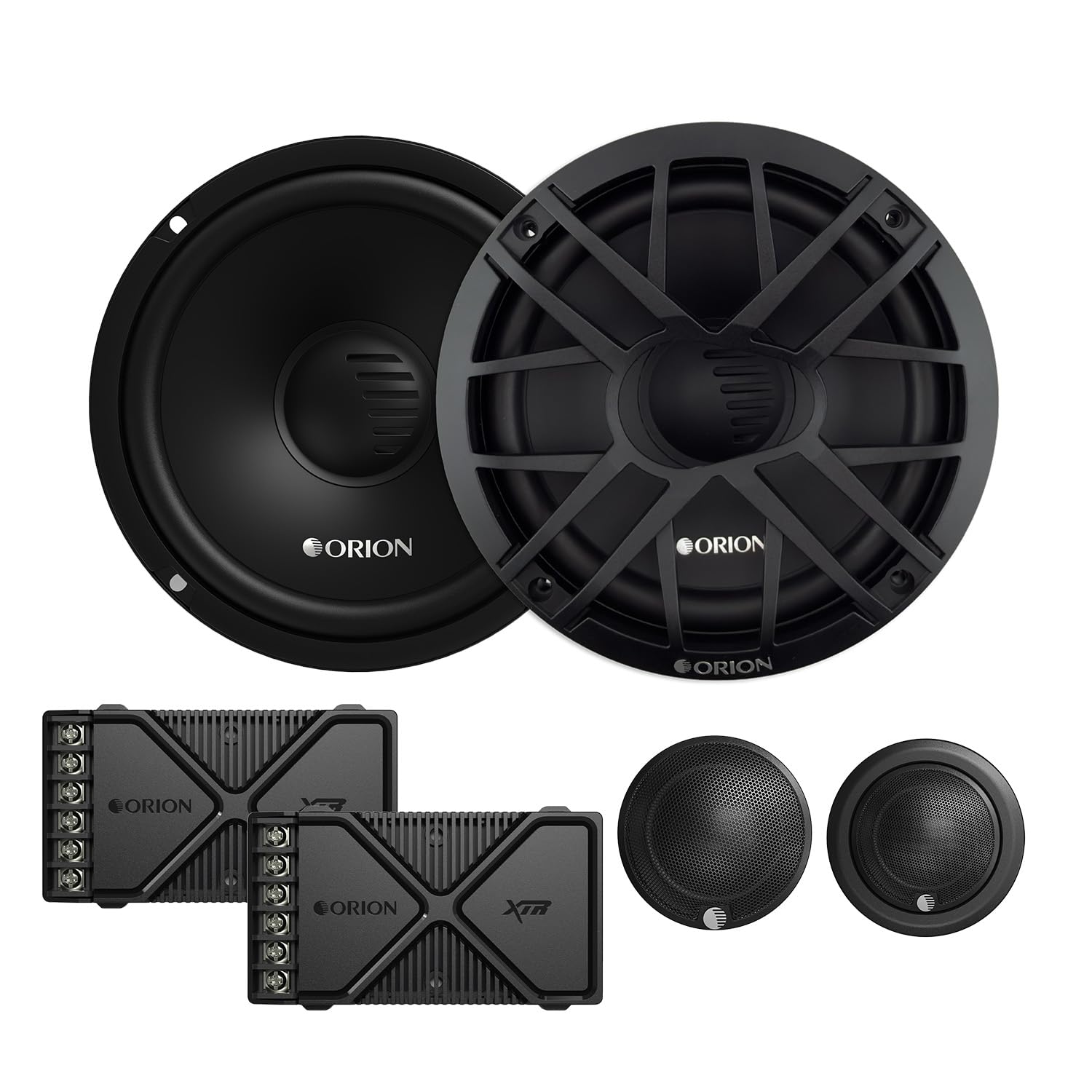
More RMS headroom than its Cobalt sibling, in the same 6.5-inch footprint.
If you already own an amplifier, the XTR65.SC answers the wattage question better than the CB65C above. It carries an RMS rating of 85W against the Cobalt’s 70W, and 340W of maximum power on 4-ohm impedance. That extra headroom matters when you turn the dial up on a sunny drive and want the woofer to hold together rather than compress. A Butyl Rubber Surround and polypropylene cone do the durability and distortion work.
Sensitivity is 87 dB, a bit lower than the Cobalt’s 88 dB — meaning this one asks slightly more of your amp to hit the same loudness. The frequency response of 75Hz-20kHz starts a hair higher than the CB65C’s 70Hz, so the deepest reach favors the Cobalt by a whisker. Neither figure is dramatic, but if low-end extension is your priority, that is the honest order.
What people say about the sound is the strongest thing going for it: crisp and clear comes up repeatedly, and buyers feel it earns its keep. Its 85W RMS rating and crisp high-frequency presentation are why it tops this lineup. If you want the higher RMS rating of the two Orion sets for an amplified system, this is the one.
What buys it the top score
- 85W RMS and 340W max — more headroom than the CB65C
- Butyl rubber surround and polypropylene cone
- Crisp, clear sound is the repeated theme from owners
- Same 4-ohm, 6.5-inch fitment as the Cobalt
What to keep in mind
- 87 dB sensitivity asks a touch more of your amplifier
- 75Hz low edge reaches marginally less deep than the 70Hz Cobalt
For the driven system: an amplified 6.5-inch build where 85W RMS of headroom is the deciding spec.
Overkill if: your head unit is the only power source — the efficiency edge of the Cobalt serves you better.
9. Alpine S2-S65C

The only Hi-Res Audio Certified set here, reaching 40kHz with an OEM-fitment design.
The headline figure is 40kHz — the top of the range this set reproduces, and the reason it carries Hi-Res Audio Certification. That is well above what most car audio can even feed it, but it signals a speaker tuned for detail rather than just volume. Power is 240W peak and 80W RMS, with 1-inch tweeters that use a threaded removable housing for flexible mounting.
The cone blends Poly Propylene, Glass Fiber, and Mica for a lightweight, high-output, low-distortion build. Alpine’s High Amplitude Multi-Roll surround allows maximum cone movement, which is where the bass notes come from. OEM fitment design and in-line crossovers keep the install simple in a factory location, and the included grille (KTE-S65G) is sold separately if you want to protect the driver.
The upgrade story is the one owners respond to — these replace stock speakers and deliver a marked lift in clarity. Functionality works well, but volume draws mixed notes: a few point out that this set really wants amplification to come alive. Mounting also splits opinion, though many report an easy install. If you have an amp or plan to add one and want a factory-fit Hi-Res set, this is the thoughtful choice.
Where the certification earns its keep: 40kHz extension and a lightweight composite cone make this the detail-first set of the group — for ears and systems that can feed it.
The real caveat: the review pages show volume needs help, so plan for an amplifier if you want this set to sing.
Best for the detail chaser: a factory-fit upgrade where Hi-Res Audio Certification and a 40kHz top end are the priorities.
Hold off if: you have no amplifier planned — the volume headroom needs a power source to show itself.
Know the Specs
RMS vs Peak Power
Peak power is a brief maximum the speaker can survive; RMS is the power it can take continuously. A set rated 400W peak but 45W RMS, like the Kenwood, is a ~45W speaker in daily use. Match your amplifier’s continuous output to the RMS number, not the peak — that is the figure that keeps the driver alive and undistorted.
Frequency Response
Frequency response is the range of notes a driver can reproduce, from lowest to highest. A set that reaches down to 35Hz, like the Kenwood, plays deep bass, while one starting at 100Hz, like the Warzone, leaves the deepest lows to a subwoofer. The gap between those two numbers decides whether your doors deliver thump or just vocals.
Impedance
Impedance in ohms is the electrical load the speaker puts on your amp or head unit. A 4-ohm rating, shared by most sets here, matches the widest range of car gear. Mismatching the load can starve the amp or push it too hard, so match your amplifier’s rated ohm load to the speaker’s.
Sensitivity
Sensitivity in decibels is how loud the speaker gets from a given amount of power. The Warzone’s 90dB means it plays loud on modest power, while the Orion XTR’s 87 dB needs a bit more. A higher number suits stock head units; a lower number is fine if you own a strong amplifier.
Common Questions
Do I need an amplifier to run a component speaker set?
What is the difference between a component set and a coaxial speaker?
Which woofer size gives the most bass?
Will a 6.5-inch speaker fit where my stock one is?
What does 4-ohm impedance mean for my car audio system?
How do I match the tweeter level to the woofer?
Can these speakers run off a factory head unit or do they need an amplifier?
What does Hi-Res Audio Certification on a car speaker actually mean for driving?
How long should a component speaker set last in a car?
Do the woofers and tweeters in a component set include crossovers?
The Bottom Line
For most buyers, the woofer and tweeter winner is the Timpano bundle because it hands you two 6.5-inch midranges and two super tweeters in one box, with a 2.2-inch mounting depth that clears most door panels. If you want a separate, aimable tweeter in a stock-location 6.5-inch set, grab the Rockford Fosgate Prime R165-S. And for a compact dash or door slot that nothing bigger will fit, the Warzone WZ40PTi is the one to reach for. Measure your cutout and match your amplifier’s RMS output to the set you pick, and any of these will beat the factory speakers.
How we choose
We do not accept paid placement. Every pick is matched to a real buyer and a real use-case; we do not hands-on test units.
Sources
Specifications: manufacturer listings and product documentation. Review insights: verified customer reviews, as of November 2026. Pricing: not shown on this page (it changes often); check the current price via the retailer link.
As an Amazon Associate, Tactical Gear Guy earns from qualifying purchases. This does not affect which products we feature.