Specs are compiled from manufacturer listings and verified buyer reviews and can change over time — please confirm the key details on the product page before buying.
If you want one straight answer: the AKMAX Down Mummy Sleeping Bag is the pick most cold-weather campers should start with, because it pairs a -13°F to 23°F rating with genuine goose down and a 4.9-pound carry weight that still fits a backpack. This list treats 0°F / -18°C comfort-or-lower bags as zero-degree picks, so a bag rated to that class qualifies even if the badge reads a few degrees off. Some picks carry a -11°F or -13°F limit instead of a flat 0°F, but each is a cold-weather down bag built for the same sub-freezing nights.
This guide is built by comparing the manufacturers’ published specifications and the patterns across verified customer reviews, so you get each pick’s real strengths and trade-offs instead of marketing spin.
Below are seven down bags sorted by what they do best on a frosty night, from a 2.6-pound wearable bag to a 4.9-pound sub-zero mummy, so you can match fill power and packed size to your trip. This breakdown of the zero degree down sleeping bag covers warmth ratings, fill power, packed weight, and the fit traps that catch first-time buyers.
Top Picks

How To Choose The Best Zero Degree Down Sleeping Bag
The first trap for a cold-weather buyer is believing every “0°F” badge sits on the same warmth. A bag rated by its limit (the lowest temperature a warm sleeper can survive) runs colder than one rated by comfort (the temperature an average sleeper actually rests at). When you compare a zero degree down sleeping bag, read which number the brand prints before you trust the badge.
Read the temperature rating, not the marketing word
A bag sold as a “winter” or “cold weather” bag can carry a comfort rating anywhere from 18°F down toward 0°F and below. The bags here range from a -13°F to 23°F extreme-cold mummy down to a 20°F to 0°F comfort range, so match the number to your coldest expected night, not the season name on the box. If you sleep cold, add margin — pick a bag whose rating sits below the temperature you expect to wake up in.
Fill power decides warmth per ounce
Fill power (a measure of how much space one ounce of down lofts into, which is how it traps warm air) is the single best predictor of warmth-to-weight. A 600 FP bag and a 680 FP bag can warm you similarly, but the higher-loft down does it with less bulk in your pack. For a zero degree down sleeping bag, higher fill power usually means a smaller stuff sack on the same trip.
Match the cut to how you sleep
A mummy cut hugs the body and traps heat with less air to warm, which is why most sub-zero bags use it. A semi-rectangular or widened bag gives your knees and shoulders room but asks more of the insulation. If you roll around at night, extra shoulder width can matter more than a few degrees of rating; if you sleep still, the mummy wins on warmth per ounce.
Side-by-Side Comparison
| Model | Best For | Temp Rating | Weight | Fill Power / Fill | Amazon |
|---|---|---|---|---|---|
| AKMAX Down Mummy★ Best Overall | Deep winter camping | -13°F to 23°F | 4.9 lb | Goose down | Amazon |
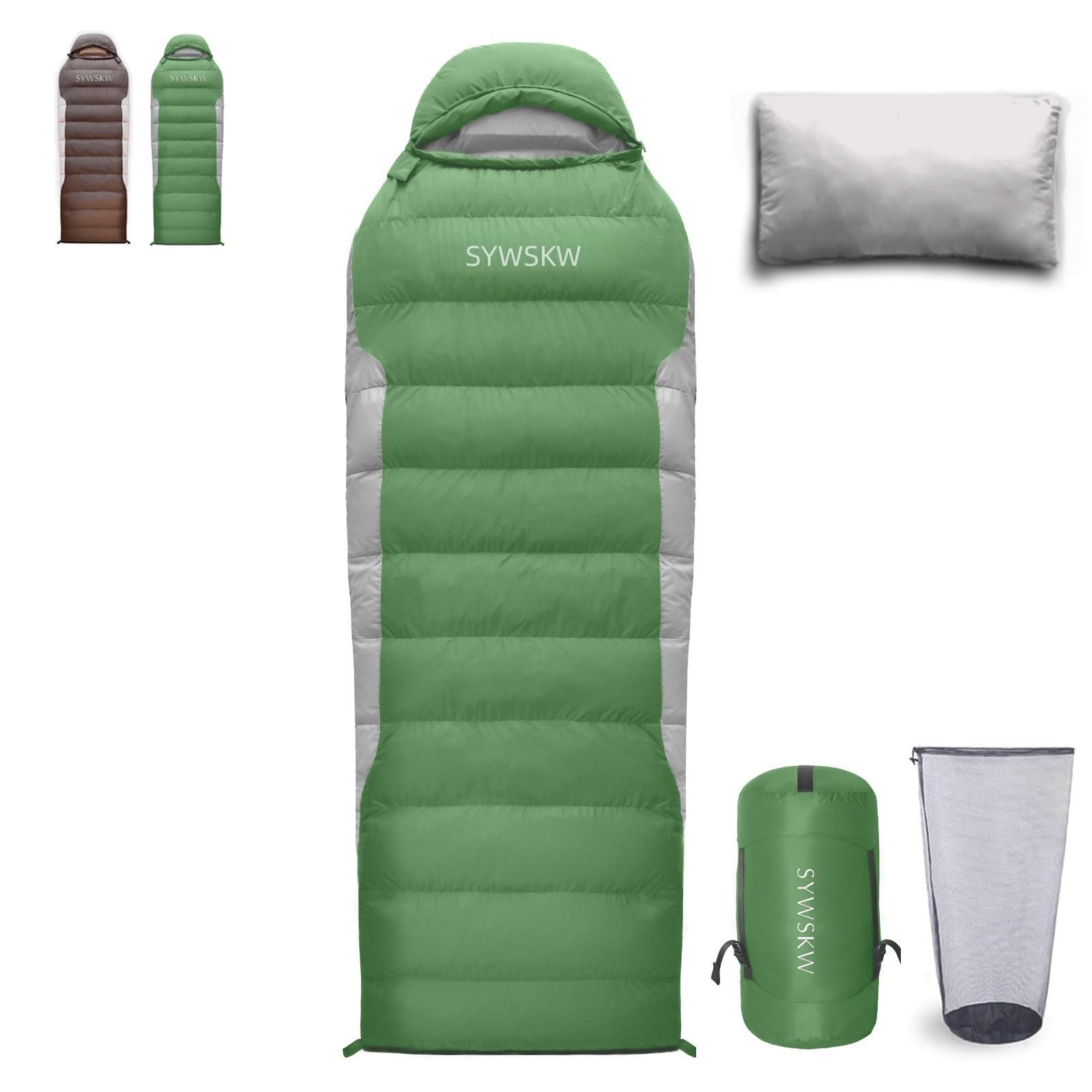
| SYWSKW Down with PillowBest for Couples | Couples and family camping | 0°F / 15°F / 32°F | 2.99 lb | 680 FP RDS down | Amazon |
| QEZER 600 FP Ultralight | Spacious trail camping | Comfort 18°F–32°F, limit 10°F | 3.7 lb | 600 FP duck down | Amazon |
| QEZER 650 FP 0 Degree | Cold-weather backpacking | -11°F to 18°F | 3.5 lb | 650 FP duck down | Amazon |
| BUERTS XXL 4 Season | Big-and-tall cold sleepers | 20°F to 0°F comfort | 3.68 lb | 680 FP RDS down | Amazon |
| Kelty Cosmic 0 | Backcountry veterans | 0°F class | — | 550 FP DriDown | Amazon |
Detailed Reviews
1. AKMAX Down Mummy Sleeping Bag
Our pick — 4.5+★ from 70+ verified ratings; the strongest balance of quality and price.
The deep-winter mummy that goes fuller on warmth than on grams.
Where this bag earns its spot at the top is the temperature band itself: a -13°F to 23°F range, which is the widest cold end on this list. That span is what you want when a January trip can swing from a mild evening to a hard freeze overnight — the same bag covers both. The fill is goose down, and the shell is water-resistant nylon that still breathes, so trapped moisture can escape instead of chilling you. Sized at 82.7 inches long and 25 inches wide, it keeps the snug mummy cut that leaves less dead air for your body to heat.
Here is the honest trade: it weighs 4.9 pounds, which is the heaviest carry on this list. Against the OMVMO arm-hole bag at 2.6 pounds, that is a real difference on a long approach, so this is a bag for base camps and cold-weather trips where warmth outranks grams. The upside is that the extra bulk buys you that -13°F floor. The heat-trapping mummy shape and the compressible design both come through where it counts — the bag stuffs down into a pack rather than forcing you to strap it outside.
What wins people over is the sizing and the comfort, and the buyer feedback lands almost entirely on those two things. Owners find it comfortable and well-sized, which matters because a mummy that pinches your shoulders is a cold night no matter the rating. The 76-inch maximum height recommendation means taller sleepers should measure before they commit. For a cold-weather camper who wants one bag that handles genuine sub-zero nights without stepping into premium territory, this is the balance point.
What earns it the top spot
- -13°F to 23°F range — the broadest cold coverage here
- Goose down fill with a water-resistant, breathable nylon shell
- Compressible mummy design packs down for backpacking
- Comfort and sizing draw the most praise from owners
Where it asks something back
- 4.9 pounds is the heaviest carry in this lineup
- 76-inch max height — tall sleepers need to measure first
- Snug 25-inch width suits still sleepers more than restless ones
Best for: cold-weather campers who want a true sub-zero rating and will trade carry weight for it.
Think twice if: you are counting ounces on a fast alpine push — the lighter bags below fit that trip better.
2. Down Sleeping Bag with Pillow
The camp bed that already has your pillow sewn in.
Two bags zip together into one double here, and the 680 FP RDS down is the warmth engine underneath. RDS means the down is traceably sourced, and 680 fill power is high-loft down that traps more warm air per ounce than a 550 or 600 FP bag. Packed, it compresses to 7.08 in by 11.80 in and 7.08 in by 13.78 in depending on the fill weight you choose, and the total weight sits at 2.38 lb and 2.99 lb. That makes it one of the lighter carries in this group even before you compare it to the 4.9-pound AKMAX.
Shoulder width is where it stands out. The widened 32.28-inch shoulder design — 86.6 in by 32.28 in overall — gives you more room than the 25-inch-wide AKMAX, and it is longer than that bag at 86.61 inches versus 82.7 inches. If you are broad-shouldered or just hate feeling pinned, that extra span matters on a cold night. The integrated 80g detachable pillow is a small thing that saves you packing a separate one, and the reflective drawcords help you find the bag in low light.
Sizing is what buyers rate most highly, and it is easy to see why with a shoulder span that wide. The one catch worth knowing: the bag ships compressed, so lay it out at least half an hour before bed to let the down recover its loft — skip that and it sleeps thinner than its rating. There is also a version ladder to sort through: the 1.1 lb filling model suits 3-4 seasons, while the 1.76 lb and 2.65 lb versions step up to true winter use. Pick the fill weight that matches your coldest night and this doubles as a couple’s bag or a solo one.
The warmth-per-ounce read: 680 FP down and a sub-3-pound carry make this a strong through-hiker’s choice, and the zip-together double feature stretches a pair of bags into one shared bed.
The part to plan around: that half-hour loft recovery before first use is not optional — treat it as part of setup, not a suggestion.
Pick this if: you camp as a couple or want a wide, pillow-included bag that still packs light.
Pass if: you want a single fixed rating — this one comes in several fill weights, so you have to choose deliberately.
3. Down Sleeping Bag 600 FP RDS

A roomy semi-rectangular bag for sleepers who hate feeling sealed in.
Start with the shape, because that is the whole point here. The semi-rectangular cut spans 30.71 in by 86.61 in, which gives your knees and feet room a tight mummy does not. It is filled with 2.2 lbs of 600 FP premium duck down, rated to a comfort temperature of 18°F-32°F with a limit of 10°F. The double zipper design blocks cold air at the seam, and there is added chest insulation for extra warmth where it counts. At 3.68 pounds and a 14.96″ x 7.48″ pack size, it carries lighter than the AKMAX’s 4.9 pounds.
Warmth is the thing people call out most about this bag, and the construction backs that up. The foot zipper lets you vent your feet when you run hot, and two of these bags combine into a double for shared trips. The 400T 20D high-density nylon shell resists tearing and sheds moisture, and the dense stitching is there to keep the down from leaking through the seams. The 86.61-inch maximum height recommendation means it fits a tall sleeper comfortably rather than ending at the shoulders.
The honest caveat is the zipper. Owner feedback on the zipper quality is mixed, so treat the slider gently and keep the fabric clear of the teeth when you close it. That is a use-and-care note rather than a reason to skip the bag — the warmth and the space are what most people are buying. For a camper who wants room to move and a genuine 18°F-32°F comfort range, this is a sensible trail companion.
Room-to-move factor: 30.71 inches of width and a ventable foot zipper make this the pick for restless or warm sleepers who need air.
Keep an eye on: that mixed zipper feedback means a little care when zipping keeps this bag trouble-free.
Reach for this if: you want a spacious, semi-rectangular down bag with a real 18°F-32°F comfort range.
Look elsewhere if: you need the deepest sub-zero rating — this one is built for cold, not extreme cold.
4. 0 Degree Down Sleeping Bag
The true zero-degree bag that still finds room in a pack.
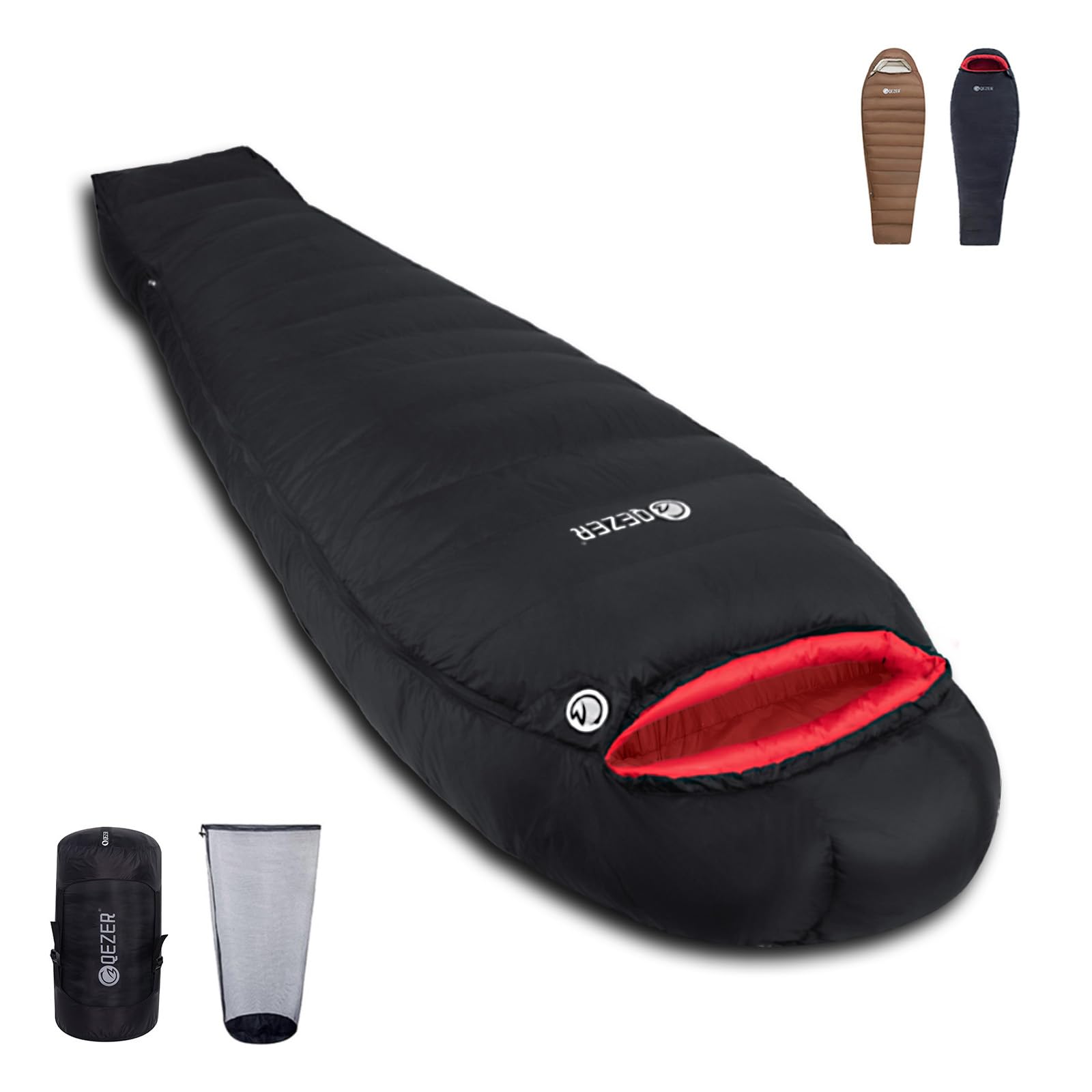
If the keyword you searched was literal — a real 0°F bag — this is the one that puts the number front and center. It is filled with 2.86 lbs of 650 FP premium white duck down and rated to keep you warm between -11°F and 18°F. Vertical baffles (chambers that hold the down in place and stop it sliding to one end) sharpen the heat retention, and a windshield design at the zipper blocks air from leaking in at the seam. The inner and outer 400T nylon fabric keeps you comfortable in damp conditions. At a 17.32″×8.66″ pack size and 4.1-pound package weight, it still slots into a backpack.
This bag out-warms most of the list and the buyer experience matches the spec sheet. It is a big, roomy build at 88.58 inches long and 32.28 inches wide — wider than the AKMAX’s 25-inch cut and one of the more generous widths here — and the saddle-shaped neck is shaped to wrap and seal against heat loss. The ergonomic footbox gives your feet a proper space instead of a cold pinch point. Warmth is what buyers praise most, and the quality of the build follows right behind it.
The trade-off a careful buyer should hear: durability and the zipper both draw some negative feedback from a minority of owners, so a little care with the slider and the seams will serve you well. That is the honest edge to a bag whose warmth draws most of the praise. Keep it in the included mesh storage bag or hang it in a closet between trips — long-term compression flattens the down and costs you warmth.
The warmth story: 650 FP down, vertical baffles, and a -11°F to 18°F rating put this near the top of the list for a true zero-degree bag.
The follow-up question: with the value here being so strong, the occasional zipper or durability note is the one thing to keep an eye on.
This is the pick if: you want a genuine 0°F-class bag with the warmth and size buyers notice.
skip it if: you demand expedition-grade zipper hardware — a small number of owners flagged that here.
5. Cold Weather Down Backpacking Sleeping Bag XXL
The XXL cut that finally gives a broad sleeper room to sprawl.
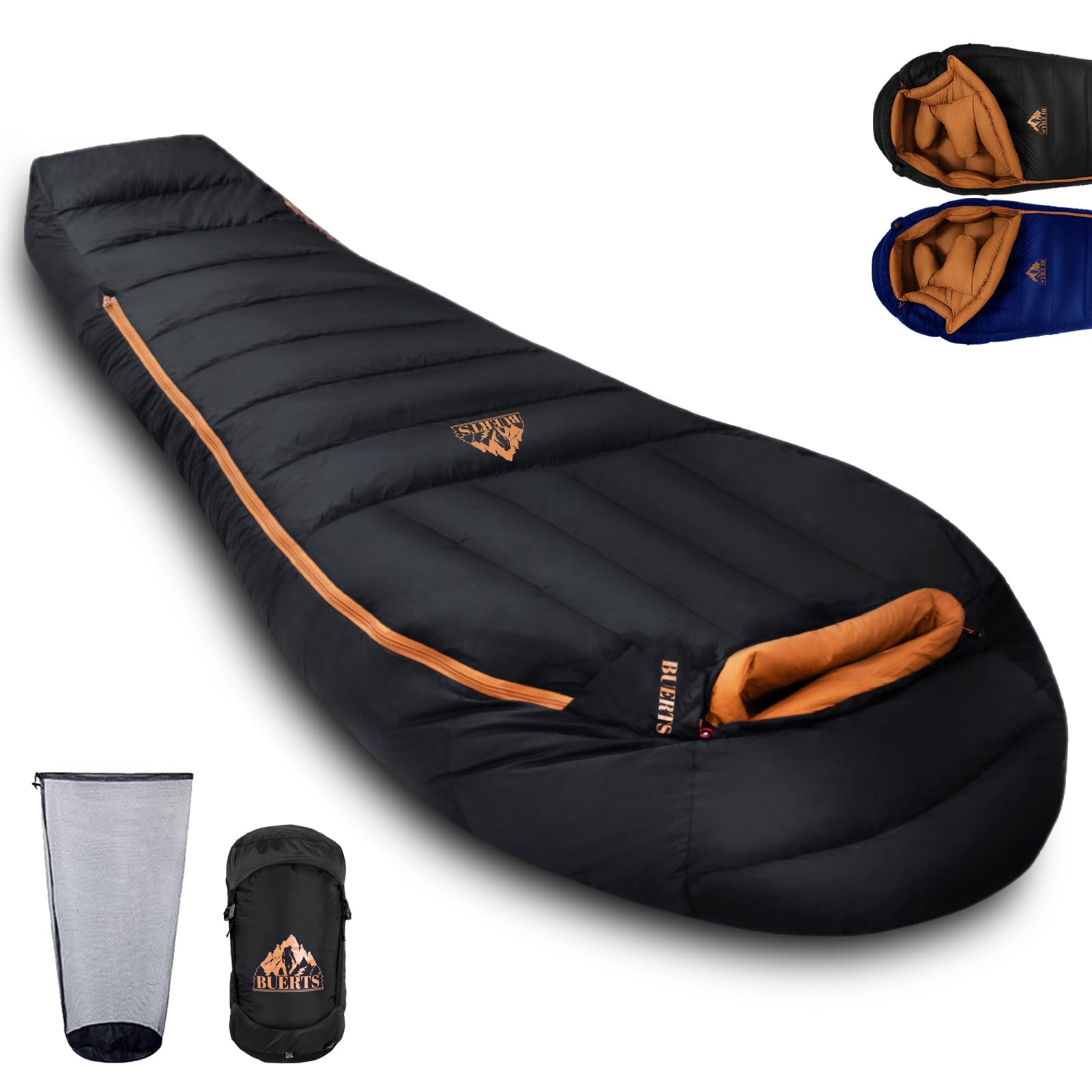
Width is the reason this bag exists. It measures 88.5 x 34.6 inches in use — the widest cut in this lineup by the spec sheet — with widened shoulders, sides, and foot area so you can actually move. Underneath that space sits 2.43 lbs of RDS-certified traceable down at 680 fill power, rated to a comfort range of 20°F to 0°F. The saddle-shaped neckline wraps in snug to lock heat, and the 400T 20D nylon shell is water-repellent, windproof, and anti-static. It packs down to 15.3 x 7.8 inches in the included stuff sack and weighs only 3.68 pounds.
Comfort and build hold up to the sales copy, and the warmth is the trait that gets noticed most. Buyers find it comfortable and well-made, and while one voice noted it does not reach -35 degrees, that is well below its stated 20°F to 0°F comfort range — read the rating honestly and it does its job. Details like an inner pocket for your phone and a foot mesh pocket for clothes keep small things organized, and high-quality zippers let you zip it to another BUERTS bag for a double-wide setup on a couples’ trip.
Measure the trade-off against the QEZER 650 FP above: this bag gives you more room but a 20°F to 0°F comfort range rather than that bag’s -11°F to 18°F. So this is the one for a big-and-tall camper who values sprawl over the deepest cold rating. It is also the largest fit here at an 88-inch maximum height recommendation, so a tall sleeper is well served.
The sprawl advantage: 34.6 inches of width and 680 FP RDS down is a rare pairing of space and warmth-to-weight.
Read the rating honestly: 20°F to 0°F comfort means this is a cold-weather bag, not a deep-winter expedition one — trust the number on the box.
Best matched to: broad or tall sleepers who need 34.6 inches of width and a real 680 FP down fill.
Not ideal if: your trip is a hard deep-winter push — you will want the colder-rated bags above.
6. Kelty Cosmic 0 Down Mummy Sleeping Bag

A veteran brand’s zero-degree mummy, built on a trapezoid-baffle trick.
Kelty has been making outdoor gear since 1952, and this is its do-it-all 0°F-class mummy. The clever bit is the trapezoidal baffle construction — heat chambers shaped like angled strips that help the bag hold warmth instead of letting it leak through straight seams. The fill is 550 fill Kelty-treated DriDown, a water-resistant duck down that dries more easily and stays warm when it gets damp. Two sliding, locking zippers with an anti-snag draft tube let you unzip from the bottom to stick a foot out and self-regulate heat, and a zippered internal stash pocket holds a phone or headlamp. The inner and outer dimensions run 72″L x 26″W, with a 6-foot maximum height recommendation.
Quality and comfort are where this bag lands its reputation, and the 20D nylon shell with poly-taffeta lining backs that up. Owners of a mummy bag often expect to feel pinched; here the fit gets mixed notes — some find it not too constrictive, while the size and weight draw a mix of views too. The inner pocket, the locking dual zippers, and the draft tube are all the sort of small features that make a bag comfortable rather than merely warm. It is a Colorado-designed bag from a brand with real backcountry history.
Here is where it sits honestly against the pack: at 550 FP it is the lowest fill power on this list, so for the same warmth it lofts more bulk than the 680 FP bags above. It also has the tightest dimensions at 72 by 26 inches, which suits a shorter, slimmer sleeper. The upside is DriDown’s damp-weather behavior and the trapezoid baffles that stretch its warmth. For a backcountry camper who wants a proven mummy that handles wet conditions, this is the veteran’s choice.
Why it holds its price
- Trapezoidal baffles designed to reduce heat loss
- 550 FP DriDown stays warm when damp and dries easily
- Dual locking zippers with anti-snag draft tube for foot-out venting
- Kelty has built outdoor gear since 1952
The tight-fit trade
- 550 FP is the lowest fill power here — more bulk for the warmth
- 72 x 26 inches is the tightest cut on this list
- Size, fit, and weight all draw mixed owner views
Go Kelty if: you trust a long-established brand and want DriDown’s damp-weather warmth in a mummy.
Rethink it if: you want maximum room or the loftiest down — the wider, higher-FP bags above suit you better.
Know the Specs
Temperature Rating
A bag’s rating comes as either a comfort number (the temperature an average sleeper rests at) or a limit number (the lowest a warm sleeper can survive). A comfort rating of 20°F to 0°F, as on the BUERTS, is not the same as a limit rating, so compare like with like. If you sleep cold, buy a bag whose rating sits below the coldest night you expect. A -13°F to 23°F bag like the AKMAX carries margin for a hard freeze; an 18°F-32°F comfort bag like the QEZER 600 FP is a cold-weather pick, not an extreme-cold one.
Fill Power
Fill power measures how many cubic inches one ounce of down lofts to, so a 680 FP bag traps the same warmth with less down — and less packed bulk — than a 550 FP bag. Higher numbers mean more loft per ounce, so a warmer bag at a lower weight. On this list fill power runs from 550 FP (the Kelty) up to 680 FP (the SYWSKW and BUERTS), with 600 and 650 FP bags in between. Two bags rated for the same temperature can differ widely in packed bulk because of fill power, so if pack space is tight, higher FP is your friend.
Down vs. Down Fiber
Down is the fluffy under-plumage that traps the most warmth for its weight, and it is what most of these bags use. Down fiber, as in the OMVMO, is a shorter-strand down product that stays breathable and light while asking a little less of your wallet. Both breathe better and pack smaller than a synthetic bag of the same warmth. Whichever you choose, store it uncompressed — a mesh bag or a hanging closet keeps the loft alive.
Packed Weight and Size
On a backpacking trip, every ounce counts, and the range here is wide. The OMVMO at 2.6 pounds and the SYWSKW at 2.99 pounds suit a long approach, while the AKMAX at 4.9 pounds is a base-camp bag. Packed size matters just as much: a 14.96″ x 7.48″ stuff sack or a 15.3 x 7.8 inch compression bag slides into a pack more easily than a bulkier roll. Match both to how far you carry the bag, not just how cold the night gets.
Common Questions
Is a 0°F down sleeping bag warm enough for winter camping?
What does fill power mean on a down sleeping bag?
Can two of these sleeping bags zip together into a double?
How do I store a down sleeping bag between trips?
Is a mummy bag or a rectangular bag warmer?
Do these bags work for tall sleepers?
Will a down sleeping bag keep me warm if it gets damp?
What is RDS down and does it matter?
How much does carry weight actually matter in a down bag?
Can I use a down sleeping bag indoors or as a blanket?
The Bottom Line
For most cold-weather campers, the zero degree down sleeping bag winner is the AKMAX Down Mummy because its -13°F to 23°F range covers a hard freeze, its goose down fill traps heat, and the compressible mummy build still fits a pack. If you want the most precise true-zero bag with the warmth buyers notice most, grab the QEZER 650 FP 0 Degree at -11°F to 18°F. And for a broad or tall sleeper who needs room to sprawl, the BUERTS XXL gives you 34.6 inches of width and 680 FP RDS down. Whichever you choose, pick a rating below your coldest expected night and store the bag uncompressed in a mesh sack or on a hanger — that pairing keeps the down lofty and the bag warm trip after trip.
How we choose
We do not accept paid placement. Every pick is matched to a real buyer and a real use-case; we do not hands-on test units.
Sources
Specifications: manufacturer listings and product documentation. Review insights: verified customer reviews, as of November 2026. Pricing: not shown on this page (it changes often); check the current price via the retailer link.
As an Amazon Associate, Tactical Gear Guy earns from qualifying purchases. This does not affect which products we feature.