Specs are compiled from manufacturer listings and verified buyer reviews and can change over time — please confirm the key details on the product page before buying.
The real question here is stability. A free-standing tower’s stability depends on its base, while a wall-mounted bar is fixed to the wall. The picks below cover the whole range — free-standing towers, wall-mounted bars, and a pulley-equipped station — so you can match the mount to your wall and your floor space.
This guide is built by comparing the manufacturers’ published specifications and the patterns across verified customer reviews, so you get each pick’s real strengths and trade-offs instead of marketing spin.
You will see how height range, weight capacity, and mounting type differ across each unit, plus the trade-offs owners actually live with. The comparison table below lists all nine picks side by side.
Top Picks


How To Choose The Best Workout Pull-Up Equipment
The first fork in the road is where the thing lives: bolted to a wall or standing on its own feet. That choice decides whether you drill four anchors or give up six square feet of floor.
Free-standing towers versus wall-mounted bars
A tower takes up floor space but needs no drilling, so you can shift it between the garage and the spare room. A wall-mounted bar uses no floor area at all, and once it is bolted into solid concrete or a stud, it simply does not budge. The catch is commitment: a wall bar follows the wall, so measure your clear space before you drill.
Weight capacity is a frame rating, not a promise of stillness
A 330-pound rating and a 700-pound rating both describe what the steel is built to hold. Neither tells you how much the tower rocks during a kipping pull-up. Look instead for the base design — an extended H-shaped base, a widened triangular frame, or suction-cup feet — because that is what keeps the unit planted while you load it.
Height adjustment decides who else in the house can use it
More height levels mean a shorter teen and a taller adult can both find a comfortable bar position. Some towers go as low as 57.68 inches and as high as 84.9 inches across 11 levels, which covers most of a family. A bar locked at one height fits one person and forces everyone else to reach or hunch.
Grip layout and the muscle groups you actually train
A straight bar gives you pull-ups and chin-ups. Multi-grip layouts add neutral and wide positions, which shift the load between your lats, biceps, and shoulders. If finger and forearm strength matter for climbing or martial arts, a bar with ball-finger grips opens training most straight bars cannot touch.
Side-by-Side Comparison
| Model | Best For | Weight Capacity | Height Levels | Mount Type | Amazon |
|---|---|---|---|---|---|
| Pooboo Pull Up Bar Power Tower★ Best Overall | All-around home gym | 450 pounds | 11 levels | Free-standing | Amazon |
| Kipika Wall Mounted Doorway BarBest Grip Variety | Grip variety and finger strength | 440 pounds | — | Wall mount | Amazon |
| DONIUZ Power TowerBest Value Tower | Budget-friendly full-body station | 330 pounds | 8 levels | Free-standing | Amazon |
| Luckyone Multifunctional Wall Bar | Compact wall-mounted dip station | 440 pounds | — | Wall mount | Amazon |
| BARWING Pull Up Bar Station | Small spaces with a backrest | 400 pounds | 14 levels | Free-standing | Amazon |
| Titan Fitness Adjustable Wall Bar | Garage gyms and ring work | 400 pounds | — | Wall mount | Amazon |
| LIONSCOOL Pulley System Bar | Cable and pulley training | 450 pounds | — | Wall mount | Amazon |
| WATBKHE Foldable Power Tower | Folding it away after training | 700 pounds | 8 levels | Free-standing | Amazon |
| DOBESTS Foldable Power Tower | Stability first, storage second | 700 pounds | 8 levels | Free-standing | Amazon |
Detailed Reviews
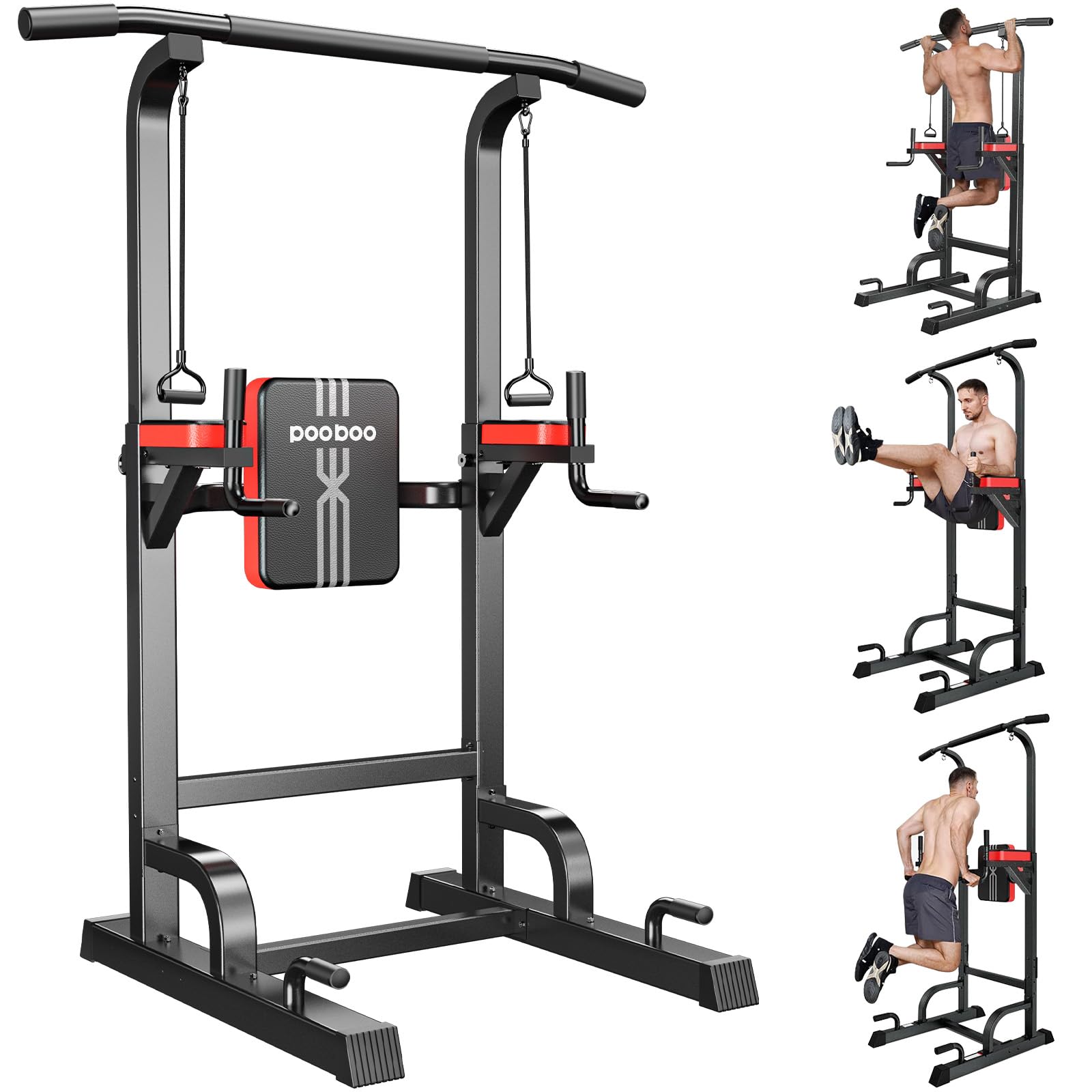
1. Pull Up Bar Power Tower Dip Station
Our pick — 4.5+★ from 250+ verified ratings; the strongest balance of quality and price.
Eleven height settings and a seven-position backrest make this the family tower to beat.
The number that earns this one the top spot is 11 — the count of height levels, running from 71.4″ up to 84.9″. That range means a short teenager and a tall adult can both set the bar at a comfortable pulling height instead of compromising. The 7-position wide backrest then supports you during dips and knee raises, which is the part most towers treat as an afterthought.
What wins people over here is how quickly it goes together. Assembly is the most-discussed topic in the feedback by a wide margin, and the consensus is that labeled parts and clear instructions get you from box to bar inside the stated 10–20 minutes. That is unusually fast for a 60-pound steel tower, and it is the difference between a workout this weekend and a box in the corner.
The frame carries a 450-pound maximum weight rating, and the 41.73″ extended H-shaped base spreads that load across four enlarged non-slip foot pads. Safety locknuts keep the bolts from working loose during hard sets. Against the DONIUZ tower below, this unit is rated for more weight — 450 pounds versus 330 — and adds backrest support the DONIUZ does not list.
One honest note: the maximum weight recommendation in the spec sheet reads 440 pounds, and the marketing line says 450. Treat the lower figure as your working limit if you are near it. Elastic resistance bands come in the box too, which gives you a warm-up option without buying anything extra.
What Earns The Crown
- 11 height levels from 71.4″ to 84.9″ fit a whole household
- Fast assembly — labeled parts and clear instructions
- 7-position backrest adds support during dips and raises
- Extended 41.73″ H-shaped base with four non-slip foot pads
Where It Asks Patience
- 60 pounds of steel means it takes up real floor space
- Two capacity figures appear in the listing — 440 and 450 pounds
Made for: a household where several people of different heights will share one tower.
Look elsewhere if: you have no floor footprint to spare and need the bar to live on a wall.
2. Kipika Wall Mounted Doorway Pull Up Bar
Five grip positions on one bar, including a ball-finger hold you will not find on most wall bars.
If your training includes climbing or martial arts, the ball-finger grip here is the reason to look. It lets you load your fingers and forearms directly — a strength angle a plain straight bar cannot reach. The other four positions (wide, narrow, neutral, and hammer) let you shift the work between lats, biceps, and shoulders without changing equipment.
At 3″ tall and 40″ wide, this is a compact unit that bolts to a wall or wood beam and clears the floor entirely. The 6″ wall-to-bar spacing is a practical detail: it gives you enough room for a full range of motion, so your chest can travel toward the bar instead of stopping short. The tubing is 1 3/10″ steel with a 6-hole mounting design for extra rigidity, and buyers report it holds up to 175 pounds comfortably.
Foam grips run the length of the bar to keep blisters and calluses off your palms during high-volume sets. You can also hang resistance bands, straps, or ropes from it to build your own station. The trade-off is the one all wall bars share: it goes where the wall goes, and it stays there.
The honest read: this is a specialist’s bar. Grip variety and finger training are its whole pitch, and the 440-pound steel rating backs the build. If you mainly want plain pull-ups and dips, a cheaper straight bar does that job fine.
Reach for this if: you want to train grip and finger strength alongside standard pull-ups.
Think twice if: your gym time is purely pull-ups and chin-ups — the extra grip hardware is cost you will not use.
3. DONIUZ Power Tower Pull Up Bar
A budget tower that covers pull-ups, dips, and leg raises without asking much floor space.
Quality is the thing this tower is known for in the feedback, and it lands alongside quick assembly and fair value. The steel construction handles pull-ups, dips, and vertical knee raises in one footprint, with 8 adjustable height settings that span 70.07″ to 82.7″ so most of the family can find a workable bar height.
Where it gets honest is the base. It uses a widened, splayed anti-roll-over base with larger suction cups underneath, and it is rated to 330 pounds. The suction cups want a flat concrete floor — carpets are a no-go, and the manufacturer says so directly. That is the same weight rating as the Power Tower from the top of this list, but this one tops out 120 pounds lower, so it suits lighter-to-average lifters rather than heavy loading.
Stability during a set is the split in the feedback: some owners find it planted and others notice it shift. Setting it on a hard, level surface and re-tightening the screws after assembly is the fix most report. Assembly tools and detailed instructions come in the box, which keeps the setup afternoon short.
Why It Earns Its Place
- 8 height levels from 70.07″ to 82.7″ for mixed-height users
- Full-body station for pull-ups, dips, and knee raises
- Assembly tools and detailed instructions included
Set It Up Right
- Suction-cup base needs a flat concrete floor, not carpet
- 330-pound rating puts a ceiling on heavier training loads
Suits: a first home tower for a lighter or average-weight lifter on a tight budget.
Pass if: you train heavy or your only floor is carpet — the base needs firm, flat ground.
4. Multifunctional Wall Mounted Pull Up Bar

Steel hooks, non-slip grips, and a five-minute build before you even touch a drill.
At 23 pounds this bar is light enough to hang on a single wall and sturdy enough to carry a 440-pound rating. It handles pull-ups, chin-ups, dips, leg raises, and even boxing work off the same frame, which is a lot of training modes for one 37.4″ x 30.3″ piece of gear. Four steel hooks and high-density non-slip grips keep your hands locked in.
The mounting story is what you must plan for. It ships with eight concrete anchors — each 2.75 inches — and needs a hammer plus a drill with a 15/32-inch bit to seat them. Solid concrete, solid red brick, and solid tile walls are the right surfaces. Hollow brick, honeycomb brick, drywall, and sandwich panel are all off the list. Sturdiness is the trait it is known for, and the anchors are the reason why.
Instructions and the wall-attachment step are the two places where experiences divide. Plan on reading the manual twice and checking your wall type before you drill. Once it is up, the assembly itself is a roughly five-minute job.
Bottom line: a solid, low-profile wall bar that performs best when you respect its wall requirements. The steel quality and sturdiness justify its mid-range slot.
Best for: a concrete or solid-brick wall with room for a compact dip station.
Skip if: your walls are drywall or hollow brick — this bar is not built for them.
5. BARWING Pull Up Bar Station, Power Tower with 3D Backrest

Fourteen height settings squeezed into a footprint of just 6.28 square feet.
Most towers make you choose between floor space and adjustability. This one tries to give you both: 14 height settings that run from 57.68 to 80.71 inches, packed into a base that measures 6.28 square feet. That low end is the lowest in this lineup, which matters if a teenager or a shorter adult shares the equipment.
The frame is 60mm heavy-duty steel tubing rated to 400 pounds, with an H-shaped base and four suction cups for grip on hardwood and tile. High-density foam padding covers the grips to soften wrist and elbow load, and the non-slip surface holds when your hands get sweaty late in a set. The 3D backrest adds support the bare-bones towers skip.
What the feedback keeps returning to is how functional it is for pull-ups, chin-ups, chest, tricep, abs, and back work. Stability is the split: plenty of owners call it stable enough for daily use, while dipping is where some notice a wobble. Keep the suction cups clean and seated and it behaves best. Assembly runs around 20 minutes on the guided manual.
What Stands Out
- 14 height levels — the widest range here, from 57.68″ to 80.71″
- 6.28 sq ft footprint suits apartments and small rooms
- 3D backrest and high-density foam grips for comfort
What to Watch
- 400-pound rating is below the 700-pound foldables further down
- Dips are where some owners notice movement
Go for it if: floor space is tight and multiple heights need to share one tower.
Consider the foldables instead if: heavier dipping work is your priority over a tucked-away footprint.
6. Titan Fitness Adjustable Depth 52″ Wall Mounted Pull Up Bar
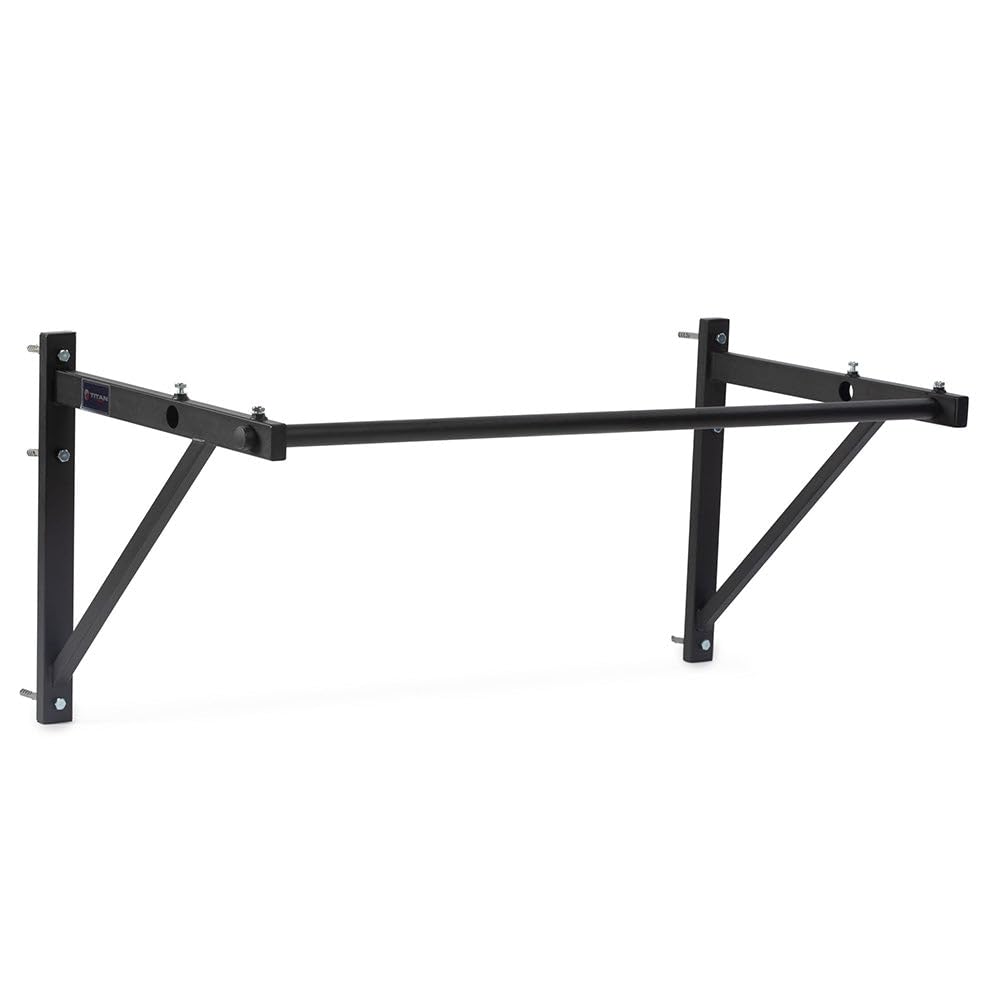
A 50-inch bar with two mounting depths, built to disappear into a garage wall.
Eleven-gauge steel is thicker stock than most home bars use, and it shows in the 400-pound rating and the 20-pound shipping weight. The 50-inch bar has a 32mm smooth, powder-coated grip that runs wide enough for a full wide-grip pull-up. Quality and sturdiness are the two traits the feedback keeps coming back to.
The adjustable-depth design is what separates it. You pick either a 14-inch or 22-inch wall offset depending on whether your space is compact or you need clearance for rings and swinging movements. The same bar can serve as a dedicated pull-up station or a ring mount, and you can daisy-chain multiple units to build a longer wall system.
Installation is straightforward on wood studs or concrete, with mounting hardware in the box. It is designed for standard 16-inch stud spacing but stretches to setups up to 50 inches apart. Owners mention it handles 275 pounds without issue, and the wide bar is a frequent point of praise for wide-grip work. One note in the feedback mentions hole-alignment trouble on a particular unit — check your studs are true before drilling.
Garage-ready: the thick steel and wide grip make it a workhorse, and the dual-depth mount is a real advantage for ring training. Measure studs first; that is where the alignment gripes come from.
Ideal for: a garage or concrete wall that can take a wide, deep-mount bar.
Not for: someone who wants portability or has no solid wall to bolt into.
7. LIONSCOOL Wall Mounted Pull Up Bar Pulley

A pull-up bar that moonlights as a cable machine, thanks to two built-in swivel pulleys.
This is the only pick in the lineup where the bar itself is half the story. The integrated pulley system pairs two swivel pulleys with two PVC-encased cables, two 1-inch loading pins with 11 inches of loadable length, a straight bar, a tricep rope, and two cable handles. That turns one wall unit into lat pulldowns, tricep pushdowns, and cable flyes.
The bar side is no slouch either. It is 48 inches wide with multiple grip positions — wide, close, and neutral — and 1.2 MM standard diamond knurling that stays secure when your palms get sweaty. Heavy-gauge steel with black powder coating gives corrosion resistance, and the assembly holds 450 pounds on a solid wall. A pair of wall templates and a 48-inch span guide come in the box for drilling.
Cement or solid brick is the recommended wall. Drywall needs additional wooden boards for support, so plan for that if your wall is hollow. The 2-year warranty is the longest coverage in this group, and mounting is described as straightforward with clear instructions. The one caveat in the feedback is anchor size — the provided concrete anchors are not universally loved, so a set of quality anchors is a reasonable upgrade.
The Case for the Pulley
- Built-in pulley system adds lat pulldowns and cable flyes
- 48″ bar with 1.2 MM diamond knurling for sweaty hands
- 2-year warranty — the longest in this lineup
Before You Mount
- Needs cement or solid brick; drywall requires added boards
- The supplied concrete anchors draw mixed feedback
The one to buy if: you want cable-style exercises without a separate cable machine.
Rewind if: you only want plain pull-ups — the pulley hardware is wasted on you.
8. WATBKHE Foldable Power Tower Pull Up Dip Station
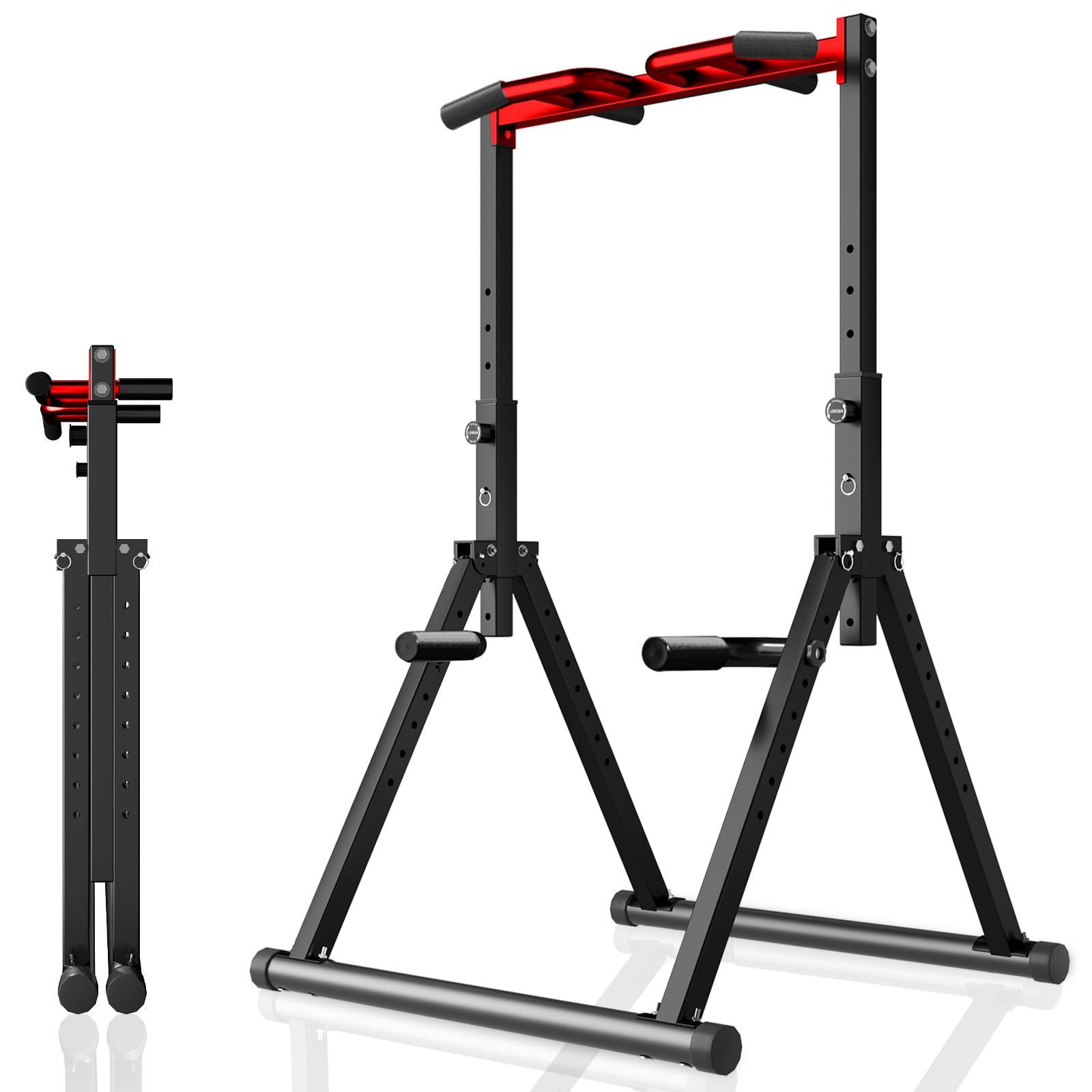
A 700-pound-rated tower that folds to 6.3 inches wide and tucks behind a door.
This tower’s standout is a triangular support frame instead of the usual H-shape, and it claims a 700-pound weight capacity off a 2mm-thickened steel tube frame. That thicker tubing is a structural choice aimed at keeping the unit from bending under load. Folded, it measures 45.7″ long by 6.3″ wide by 61.4″ high, so it slides behind a door or under a bed between sessions.
Sturdiness is what owners talk about most, followed closely by build quality, and folding it away is a genuine draw for anyone sharing a living room with their gym. The 39.4-inch working width gives you room for dips and inverted rows without banging your shoulders on the frame. Handles and base both carry an anti-slip finish.
Height adjustment deserves a caveat. There are 8 holes on the levers plus 8 more on the lower support frames, but adjustability is one of the mixed notes in the feedback — set your height before you load the bar. Assembly runs about 30 minutes with the included tools and a video.
Space-saving verdict: the folding trick and the 700-pound rating are the headline, and the triangle frame earns the stability praise. Just plan your height setting first, since you will not want to fiddle with it mid-workout.
Pick this when: the tower has to vanish after each session and you still want a heavy rating.
Hold off if: you want to change height often — the adjustability is the weaker link here.
9. DOBESTS Power Tower Pull Up Bar
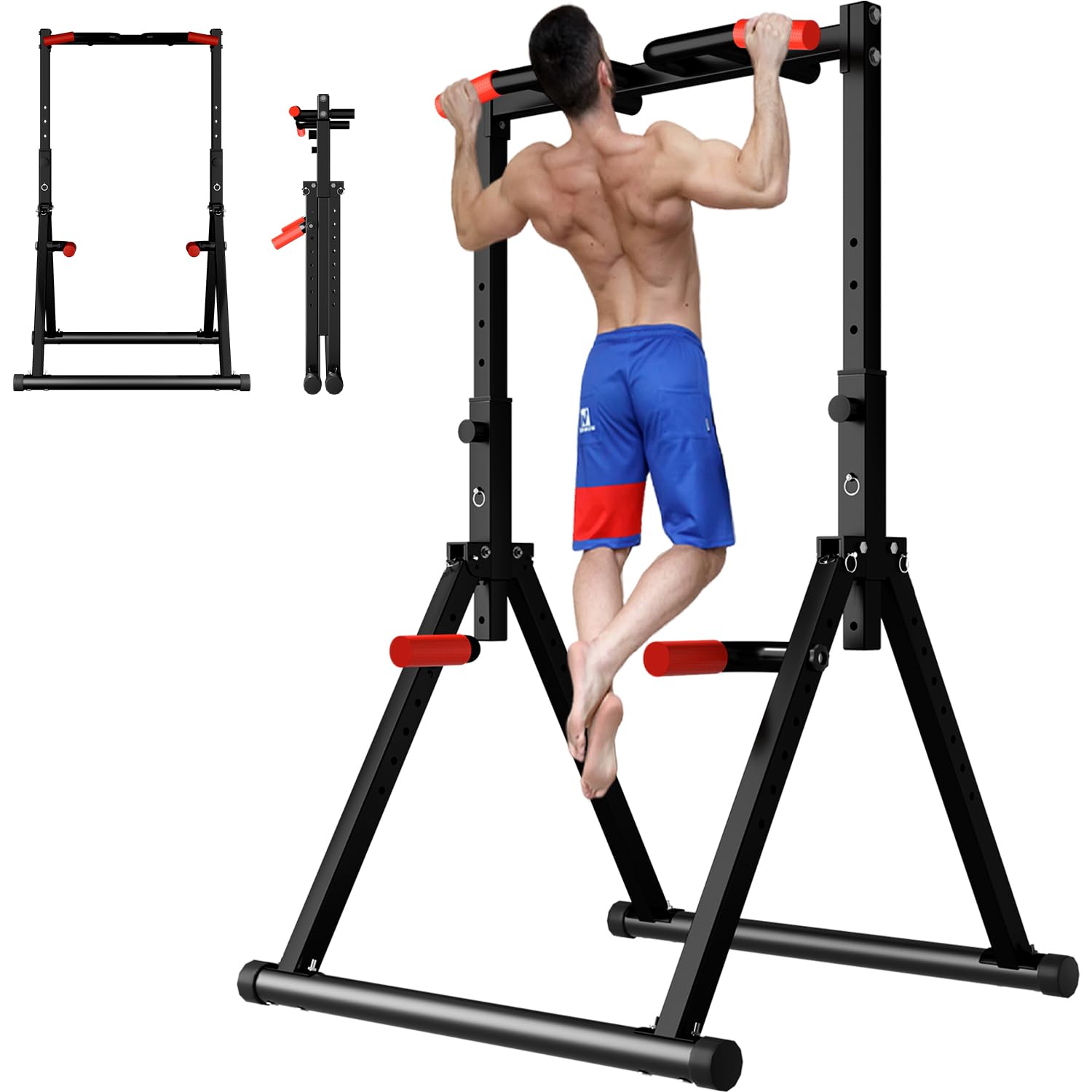
Stability is the whole pitch — a widened triangular frame that stays planted without rocking.
Between the two foldables here, this one is the more planted of the pair. Stability is the first thing owners bring up, and the widened triangular support frame is the reason. It carries the same 700-pound weight capacity as the WATBKHE tower, and it folds for storage between sessions. Rubber handles keep the grip comfortable across pull-ups, chin-ups, dips, and knee raises.
The 8-level adjustable height handles different users and training routines, and folding it down makes it easy to store or move around the house. Assembly is easy by consensus, and the value is a recurring point in the feedback. Use it on a flat surface and check all bolts before each session — a habit worth keeping with any free-standing tower.
Size is the split. Some find the fold compact enough to tuck away easily, while others find it a little big for a tight room. At 45.7 inches wide, check your door widths and storage gap before you commit. That is the only real compromise; everything else lines up with its 4.0+ star standing.
What Keeps It Planted
- 700-pound capacity on a widened triangular frame
- Folds down for storage and moving between rooms
- Easy assembly and 8 height levels
The Trade-Off
- 45.7″ width is a squeeze in small rooms for some owners
- Supplied tools are basic — a solid wrench speeds assembly
Reach for it if: stability and a high weight rating matter more than tucking the unit into a corner.
Measure first if: your room is small — the folded frame still needs a spot to sit.
Know the Specs
Weight Capacity Ratings
The number tells you what the frame is engineered to support, not how much it will rock during a set. A 330-pound rating and a 700-pound rating can both feel solid or shaky depending on the base. Match the rating to the heaviest person who will use it, and treat the base design as the real stability clue.
Adjustable Height Levels
Height levels decide who else can share the equipment. More levels mean a shorter teen and a taller adult can each find a comfortable bar position. Fewer levels are fine for one user but limit a family. Look for the lowest and highest settings, not just the count, since those extremes are what actually fit people of different sizes.
Mount Type: Wall or Free-Standing
A wall-mounted bar uses zero floor area but needs a solid surface — concrete, solid brick, or studs. A free-standing tower goes anywhere but takes footprint and can shift. Choose by your room and your walls before anything else, because the wrong mount is the one mistake you cannot undo.
Grip Layouts
A straight bar covers pull-ups and chin-ups. Multi-grip layouts add wide, narrow, and neutral positions to shift which muscles do the work. Ball-finger grips train the fingers and forearms for climbing and grip sports. Pick the grip layout your training actually uses, not the one with the most positions.
Common Questions
Will a free-standing power tower wobble during pull-ups?
What wall do I need for a wall-mounted pull-up bar?
Is a 330-pound weight capacity enough for me?
Do I need a backrest on a power tower?
How long does assembly take?
Can I use a pull-up bar for dips and leg raises too?
What is a ball-finger grip good for?
How does a pulley system change a pull-up bar?
Can I fold a power tower and store it away between workouts?
Should I put a pull-up tower on carpet or a hard floor?
The Bottom Line
For most homes, the workout pull-up equipment that wins is the Pooboo Power Tower — 11 height levels, a 7-position backrest, and assembly that owners finish in a workout-length window. If floor space is your fight, the BARWING Station packs 14 height settings into 6.28 square feet. And when you want cable-style training from one wall unit, the LIONSCOOL Pulley Bar is the one to reach for. Whichever fits your room, pick the frame that matches your wall and your heaviest lift — the ratings are a ceiling, not a guarantee of stillness.
How we choose
We do not accept paid placement. Every pick is matched to a real buyer and a real use-case; we do not hands-on test units.
Sources
Specifications: manufacturer listings and product documentation. Review insights: verified customer reviews, as of November 2026. Pricing: not shown on this page (it changes often); check the current price via the retailer link.
As an Amazon Associate, Tactical Gear Guy earns from qualifying purchases. This does not affect which products we feature.