Specs are compiled from manufacturer listings and verified buyer reviews and can change over time — please confirm the key details on the product page before buying.
Answer first: a tumbling composter is the right call for most backyards, because you turn a handle instead of a pitchfork. The FCMP Outdoor IM2000 is the pick for most people — 4.5+ stars across 18,000+ owners — with a 22.5-gallon drum that finishes a batch in as little as two weeks when the mix is right. If you generate mountains of leaves and clippings instead of kitchen scraps, a big stationary bin makes more sense. This guide splits the difference for you.
This guide is built by comparing the manufacturers’ published specifications and the patterns across verified customer reviews, so you get each pick’s real strengths and trade-offs instead of marketing spin.
Your whole purchase depends on one question: do you want to crank a drum or fork a pile? Those are the two big families of yard waste compost bin, and they behave differently. Below you get both, sorted by what each does best, so you can stop scrolling and start composting.
Top Picks


How To Choose The Best Yard Waste Compost Bin
Start with what you are actually throwing away. Kitchen scraps, coffee grounds, and a few grass clippings suit a tumbling drum you can crank a few times a week. Heaps of autumn leaves, hedge trimmings, and garden cleanup suit a large stationary bin you load with a fork.
Tumbler or stationary box
A tumbler rotates the whole chamber, so the waste mixes itself and gets far more oxygen than a still pile. That is why the drum models quote results in weeks rather than months. A stationary box sits on the ground, holds much more, and lets worms and drainage do part of the work — but you turn it by hand.
Match the gallons to your waste volume
Capacity is the number that decides how often you fill up. A 22.5-gallon drum handles a household’s kitchen scraps comfortably. A 120-gallon box swallows a season of leaves, and a 300-gallon bin is for a big yard that produces serious volume.
The small parts that decide daily happiness
Look at the door, the lid, and the vents. A door that swings clear makes emptying finished compost quick, and a lid that latches shut keeps raccoons out. Vents and aeration holes feed oxygen to the microbes, which is the whole engine of the process.
Side-by-Side Comparison
| Model | Best For | Type | Capacity | Material | Amazon |
|---|---|---|---|---|---|
| FCMP Outdoor IM2000★ Best Overall | Most backyards | Tumbling drum | 22.5 gallons | Recycled polypropylene | Amazon |
| 43 Gallon Dual Chamber TumblerContinuous Batch Pick | Continuous batches | Dual-chamber tumbler | 43 gallons | BPA-free PP + alloy steel | Amazon |
| Hourleey 43 Gallon TumblerBest Spinner | Easy spinning | Dual-chamber tumbler | 43 gallons | Plastic | Amazon |
| Marcytop 45 Gallon Tumbler | Big dual batches | Dual-chamber tumbler | 45 gallons | Polypropylene | Amazon |
| FCMP Outdoor 37 Gallon Roto | Single-chamber simplicity | Single-chamber tumbler | 37 gallons | Plastic | Amazon |
| Greenes Fence Cedar Composter | Looks and drainage | Stationary box | 173.92 gallons | North American cedar | Amazon |
| VIVOSUN 300 Gallon Bin | Huge volume, tight budget | Stationary expandable | 300 gallons | HDPE | Amazon |
| Goplus 80 Gallon Bin | Beginner setup | Stationary box | 80 gallons | Polypropylene | Amazon |
| JupiterForce 120 Gallon | Year-round loading | Stationary box | 120 gallons | Polypropylene | Amazon |
Detailed Reviews
1. FCMP Outdoor IM2000 Tumbling Composter
Our pick — 4.5+★ from 18,500+ verified ratings; the strongest balance of quality and price.
The drum you crank instead of dig — and the one most beginners should own.
You get a 22.5-gallon chamber (about 3 cubic feet inside) that holds a steady supply of kitchen scraps and clippings without asking you to own a pitchfork. Close the door, give it five or six turns every two or three days, and the deep fins inside tumble the mix so oxygen reaches all of it. In hot, sunny conditions with a balanced mix, the maker says compost can finish in as little as two weeks. That is a real turnaround for a unit that barely takes up space on a patio.
What wins people over is how little drama the daily routine involves. The large opening and removable door make loading scraps and scooping out finished compost a two-minute job. Deep fins double as handholds, so gripping the drum to spin it feels secure even when your hands are muddy. The body is 100% post-consumer recycled, UV-inhibited, BPA-free polypropylene, which is the maker’s way of saying it will not chalk out in sunlight. Owners run these through wet seasons and report the shell holding up, and at 17.2 pounds one person can shift it around the yard.
The honest limit: 22.5 gallons is small next to the big stationary boxes further down this list. The VIVOSUN holds 300 gallons against this drum’s 22.5 — a 13.3x gap — so if fall cleanup dumps a mountain of leaves on you, a tumbler will fill fast. The finish time also depends on you keeping the green-and-brown mix balanced and turning it on schedule. Skip the schedule and it just sits there.
What earns the top spot
- Five or six turns every two to three days does the mixing — no fork, no digging
- Can finish in as little as two weeks in hot sun with a good mix
- Removable door and wide opening make loading and emptying quick
- Recycled, UV-inhibited polypropylene shell built for outdoor sun
Where it stops short
- 22.5 gallons is modest — heavy leaf volume fills it quickly
- Fast results depend on you turning it on a regular schedule
Reach for this if: you want quick batches from kitchen scraps and light yard waste without owning a fork.
Think twice if: your autumn leaf pile is measured in truckloads — the stationary big-box picks below swallow far more.
2. 43 Gallon Compost Tumbler Dual Chamber
Two separate chambers mean one side cures while the other keeps taking scraps.
The 43-gallon body splits into two chambers, and that split is the entire reason to buy it. You fill one side, let it finish, and keep adding fresh waste to the other without interrupting the batch that is already curing. That gives you an uninterrupted flow of finished compost instead of the stop-start rhythm of a single drum. A 360-degree tumbling design means you simply rotate the bin rather than digging in by hand, and the deep baffles on the eight panels keep it spinning smoothly.
Aeration holes and deep fins work the way the better tumblers do — oxygen gets mixed through the whole load and clumps break apart fast. The black body absorbs UV light, which helps warm the pile and push the process along. The frame is alloy steel with a high-grade coating to resist corrosion, and the main body is BPA-free PP that holds up in sun. Assembly runs about 15 minutes if you follow the coded parts and step-by-step instructions.
Plan for assembly time: this one takes more bolts than the snap-together boxes here, so budget a patient half hour and a screwdriver rather than a quick five minutes. At 24.3 pounds it is also 7.1 pounds heavier than the FCMP IM2000, which is the price of the second chamber and the steel frame — manageable, but you will notice it when you drag it to a new spot.
The dual-chamber payoff: you never have to choose between curing compost and adding today’s scraps, and 43 gallons across two sides keeps both going at once.
Budget the buildup: the many screws make assembly slower than the clip-together bins, so plan for it rather than fighting it in the rain.
Pick this one if: you want a steady supply and refuse to pause one batch to start the next.
Not for you if: you want to skip the toolkit — the screw-heavy build is the trade-off.
3. Hourleey 43 Gallon Dual Chamber Tumbler
Dual chambers with sliding doors, built around a spin that stays smooth.
This 43-gallon tumbler takes the two-chamber idea and leans hard into how it turns. Deep flaps on the panels and grooves in the barrel combine so the drum rotates easily even when it is loaded, and buyers consistently describe it as spinning freely. Aeration holes and deep fins push oxygen through the mix and break down clumps to speed things along. The large openings and removable door make both loading scraps and pulling finished compost a simple job.
Two individual chambers let one side finish while the other takes fresh waste, so rotation generates a continuous flow of compost instead of one batch at a time. The build pairs a high-grade metal frame with a plastic body rated for corrosion and weather resistance, so it stays outside without fuss. At 21.7 pounds it is light enough for most people to reposition on their own. Owners run it through rain and cold and report the plastic body and metal frame holding up.
Know the size before you commit: two 43-gallon chambers sound huge, but split in half each side holds roughly what a modest single drum does. It also still relies on you cranking it regularly for best results — no tumbler does the work sitting still. For a dual-chamber unit that spins this easily, though, it is squarely in the fight.
What stands out: the spin. Deep flaps and grooves make the barrel rotate smoothly under a full load, so the twice-weekly turns never turn into a wrestling match.
The fine print: the 43 gallons are split across two chambers, so plan your batches around half of that per side.
Best matched to: anyone who wants continuous two-sided batches and cares most about an easy crank.
Look elsewhere if: you want one giant single volume rather than two moderate ones.
4. Marcytop 45 Gallon Dual Chamber Tumbler
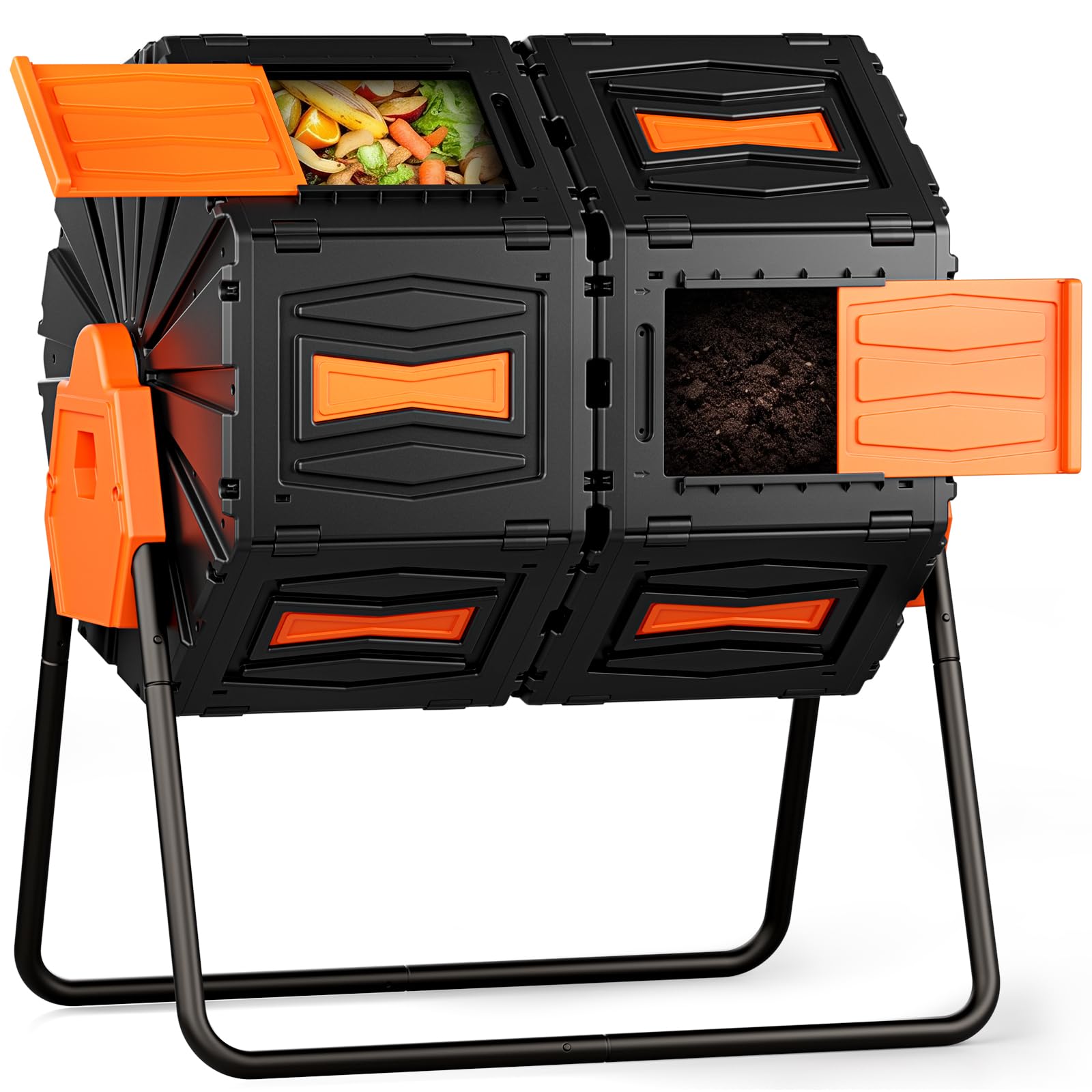
Forty-five gallons split into two 22.5-gallon chambers, on a frame that will not rock.
At 45 gallons across two separate 22.5-gallon chambers, this is the largest tumbling drum on the list. You start a fresh batch in one side while the other is still cooking, which is the whole point of a dual-chamber design. The body is extra-thick brand-new polypropylene, and the frame is powder-coated steel that resists corrosion and keeps the drum from rocking even mid-spin. Aeration holes and deep fins on each panel break up waste and pull oxygen through, which is what actually drives decomposition.
Assembly runs about 30 minutes and uses buckles plus fewer screws, so it comes together without a fight. The large openings and removable door make adding scraps and pulling finished compost easy. The routine is simple: load green and brown waste, then turn it five or six times every few days. Owners describe the build as solid and the loading as generous, and the orange door is easy to spot from across the yard.
Here is the divide: some people find the drum easy to turn and others find it stiff once it is full, so how strong you are matters with this one. It is the heaviest tumbler here at 24.3 pounds, too — solid, but not the one you carry around the garden. Thirty minutes of assembly is also longer than the snap-together boxes.
Reasons it earns the premium tier
- 45 gallons total across two 22.5-gallon chambers — the biggest tumbler here
- Powder-coated steel frame stays steady while you rotate it
- Buckles and fewer screws cut assembly to about 30 minutes
- Extra-thick polypropylene body resists sun and corrosion
Fair warning before you buy
- A full drum can be stiff to spin for some owners — strength matters
- At 24.3 pounds it is the heaviest tumbling unit on this list
Go for it if: you want maximum tumbler volume and a frame that holds steady through every turn.
Give it a pass if: you need the lightest drum to haul around — this one stays put.
5. FCMP Outdoor 37 Gallon Roto Tumbling Composter

One big chamber, no doors to juggle, and the same two-week claim as its little sibling.
The FCMP Roto trades the two-chamber crowding for one clean 37-gallon drum, and that single chamber boost the space you can actually fill. Aeration holes and deep fins break up clumps inside so oxygen reaches the whole load, and the deep fins double as an ergonomic grip when you spin it. The maker puts results at as little as two weeks with five or six turns every two to three days. The opening is wide and the door comes off entirely, so loading and emptying stay simple.
This is the bigger brother to the IM2000 up top, and the jump is real: 37 gallons against 22.5 gives you meaningfully more room per batch. Buyers report the 37-gallon drum spins easily and takes a full bucket of compostables in one load. The shell is UV-inhibited recycled polypropylene that will not degrade in sunlight, and it is listed as contact safe. Reviewers single out sturdiness and build quality, and the frame sits settled in the yard.
The one recurring gripe is the sliding lid. Some find it easy to open, others find it stiff enough to fight — a small annoyance, not a deal-wrecker, but worth knowing before you commit. Beyond that it is a straightforward single-chamber drum with no second side to manage.
Where the value sits: one oversized chamber means every gallon works for you instead of being split, and the shell shrugs off sun year after year.
Handle the lid gently: the sliding door can fight you on opening, so keep it clean and seated rather than forcing it.
The right fit for: someone who wants one simple drum and more room per batch than the smaller IM2000 gives.
Meet it with patience if: you dislike fiddly lids — the sliding door is the one thing to test mentally before buying.
6. Greenes Fence Premium Cedar Wood Composter

The one that looks like garden furniture and drains like it, too.
Built from 3/4-inch-thick, sanded North American cedar boards and made in the USA, this is the only wooden bin on the list — and the only one that improves how the yard looks. It holds 173.92 gallons, which dwarfs every tumbler here, and it drains excess moisture better than the drums, so a wet pile does not turn to sludge. Assembly needs just a mallet. The kit includes four posts, 24 boards, and 40 spacers, and the whole thing sits square at 36 by 36 by 31 inches.
What stands out is how easy the routine stays: add new material at the top, pull finished compost out, and let the open slat design breathe. Because it is expandable into a two- or three-bin system with Greenes add-on kits, you can grow it as your garden does. Owners note the cedar looks better in a tidy yard than black plastic and expect it to last for years outdoors. With assembly and quality as the top things people rave about, it earns its spot as the premium wooden option.
The trade-off is turnaround speed. Wooden bins cure slower than tumbling drums — the drums quote weeks, this leans on worms and time — so you are choosing looks and capacity over fast batches. The cedar also shows splintering on the ends of corner pieces over time, which is the natural cost of a real wood build rather than a fault to fear.
Why it earns its keep: 173.92 gallons of capacity, better moisture drainage than any drum, and a cedar build that dresses up the garden instead of hiding in a corner.
The real cost of wood: expect slower curing than a tumbler and a little splintering at the corner ends down the line — sand it and move on.
Choose cedar if: you want a big, good-looking bin with great drainage and you are not chasing two-week finishes.
Keep shopping if: you want fast turning-based batches — this rewards patience over cranking.
7. VIVOSUN 300 Gallon Outdoor Compost Bin

Three hundred gallons you can shrink or grow — for the yard that never stops producing.
Compost bin max capacity of 300 gallons makes this the second-largest bin here, and it lives outside as a stationary cylinder rather than a drum. The clever part is that you adjust its size to match your actual waste — dial it smaller and you reduce the fermentation frequency, or build it out to swallow a season of leaves. The HDPE (high-density polyethylene) shell resists corrosion and weathering, so it stands up to bad weather without complaint. Holes around the wall let air circulate through the load, and better airflow means faster breakdown of leaves, grass clippings, cardboard, coffee grounds, and kitchen waste.
Setup uses five anchor bars and 10 connecting buckles, so you size it as you build it. Best of all, once a batch finishes you can disassemble it and rebuild wherever you want to compost next — the empty-bin flexibility no fixed box gives you. Free garden gloves come in the box to keep your hands clean. Owners praise the sheer room for leaves and garden waste, and the 50.4-by-50.4-by-35.4-inch footprint holds volume no tumbler here can match.
Weigh the catch honestly: at 300 gallons against 22.5 for the IM2000 — a 13.3x gap — this is a volume machine, not a fast one. There is no tumbling, so turning it means using a fork, and its wide-open build gives owners some stability concerns in wind and on uneven ground. You are trading easy cranking for raw capacity.
The headline: a 300-gallon bin that resizes to your waste and comes apart to move — versus 22.5 gallons in the drum up top, this one is about sheer room.
Where it asks for care: no tumbling means you turn it by hand, and the broad footprint needs a level spot to feel secure.
Built for: big yards with heavy leaf and garden waste that want maximum capacity and long stretches between fills.
Steer clear if: you want to avoid hand-turning — the drums above mix themselves.
8. Goplus 80 Gallon Outdoor Composting Box

No screws, no tools — four sides, a lid, and you are composting.
Eighty gallons in a 23.5-by-23-by-32-inch box, and the setup is the calling card: no tools, no screws, just four sides and the lid snapped together with detailed instructions. Assembly is the thing everyone raves about, which tells you it really is that quick. You open the large lid, load waste, and in 6–8 weeks (less in hot summer) you pull rich soil out the bottom door. Twelve vents on each side increase contact with oxygen and push fermentation along. The BPA-free, ultraviolet-inhibited PP body is built to hold heat and regulate moisture while resisting weather.
There is a grounding design with no shelf at the bottom, which lets liquid fertilizer flow into the soil and lets worms reach the interior — a genuine advantage a tumbler cannot offer. Because it holds 80 gallons, you fill it far less often than a small drum, and the top-load, bottom-empty flow means you never pull everything out to reach the finished material. For a first bin, this is the low-friction pick: sit it down, fill it, wait, harvest.
The build quality is solid for the price, but durability and lid function come in for some mixed notes — the lid is the weak point to treat kindly. It is also a stationary box, so turning the pile by hand is still part of the routine. Neither erases how painless the start-up is.
What makes it the easy entry
- Snap-together build with no tools or screws — done in minutes
- 80 gallons cuts how often you refill compared to a small tumbler
- Grounding design lets liquid drain and worms reach the pile
- Bottom door lets you harvest finished compost without emptying the box
Trim the expectations
- The lid is the one part to handle with care — it draws mixed notes
- Stationary box means hand-turning, not cranking
The smooth start: perfect if you want the simplest possible setup and a big box you load from the top.
Look past it if: you want the self-mixing ease of a drum — this one wants a fork now and then.
9. JupiterForce 120 Gallon Large Compost Bin

A 120-gallon box that loads from the top and empties out the sliding bottom door.
The 120-gallon (450-liter) capacity is the draw here, and it lets you compost all year without a mid-season overflow. Made from BPA-free polypropylene rated for frost and rain, it stays out through every season. Each side carries four vents for air circulation, which pulls oxygen into the pile and shortens the composting cycle. Load new waste from the top lid, then collect fertile soil from the sliding bottom door when it is ready — and the closed lid keeps small animals out.
Setup asks for no tools: follow the instructions and lock it into place in four simple steps. Owners rate the build quality highly and say 120 gallons holds a full year of compost and soil. It looks tidy in the yard, and at 24 pounds it is manageable to set in place. The top-load, bottom-harvest flow means you rarely disturb the batch that is still working.
Two things to weigh. The lid does not stay hinged well, so you will be reseating it or holding it while you load. And the sturdiness gets talked about both ways, so inspect the panels on arrival. Neither is a reason to walk away — just go in with eyes open on a big, simple box.
What lands the value: 120 gallons at 450 liters means a full year of waste fits, with top-loading and a bottom door that keep harvesting tidy.
The recurring niggle: the lid is loose in its hinge and wants a hand while you load — live with it or brace it.
Great for: households that want a full year of capacity and a clean top-load, bottom-harvest routine.
Think hard if: a loose lid would drive you up the wall — that is the honest weak point.
Know the Specs
Capacity in gallons
Capacity tells you how much waste the bin holds before you need to empty or pause. A 22.5-gallon tumbler suits a household’s kitchen scraps, while a 120-gallon or 300-gallon box swallows leaves and garden cleanup. Bigger means less frequent filling, but also more physical turning if it is the stationary kind.
Tumbling vs stationary
A tumbler rotates the whole chamber, mixing in far more oxygen than a still pile — that is why the drums quote weeks-long finishes. A stationary box holds more and sits on the ground so worms and drainage help, but you turn it with a fork. Pick a tumbler for speed and a box for volume.
Aeration holes and fins
Aeration holes let oxygen reach the microbes that break waste down, and deep fins tumble the clumps so nothing stays compacted. More airflow and better mixing mean faster decomposition. This is the mechanical heart of any good composter.
Material matters
UV-inhibited polypropylene and HDPE resist sun and weather, while cedar boards drain better and look warmer but cure slower. BPA-free plastic keeps the finished compost clean, and a coated steel frame keeps a tumbler steady through years of spinning.
Common Questions
Will a tumbling composter work for autumn leaves?
How long until I get finished compost?
Do I have to turn a stationary compost bin by hand?
What is the difference between a dual-chamber and single-chamber tumbler?
Will the lid keep raccoons and other animals out?
Does a wooden cedar bin drain better than a plastic tumbler?
How much space does one of these take up in the yard?
Can I move or expand a stationary compost bin later?
Do I need to add water or keep it in sun?
What is the smallest bin that still handles kitchen scraps?
The Bottom Line
For most yards, the yard waste compost bin winner is the FCMP Outdoor IM2000 — a 22.5-gallon drum that finishes batches in as little as two weeks with five or six turns every few days. If you want a continuous flow instead of one batch at a time, the 43 Gallon Dual Chamber Tumbler keeps one side curing while the other takes scraps. And when your yard buries you in leaves, the VIVOSUN 300 Gallon Bin swallows a season of waste that no drum could hold.
How we choose
We do not accept paid placement. Every pick is matched to a real buyer and a real use-case; we do not hands-on test units.
Sources
Specifications: manufacturer listings and product documentation. Review insights: verified customer reviews, as of November 2026. Pricing: not shown on this page (it changes often); check the current price via the retailer link.
As an Amazon Associate, Tactical Gear Guy earns from qualifying purchases. This does not affect which products we feature.