Specs are compiled from manufacturer listings and verified buyer reviews and can change over time — please confirm the key details on the product page before buying.
You want a router that holds its speed through a cut and leaves a clean edge — nothing more complicated than that. The nine tools below range from a cordless fixed-base unit you can carry to a job site to a three-base kit that covers every routing job in a workshop. One of them, the DEWALT DCW600B, is the crowd favorite at 4.5+ stars across 10,000+ owners, and it earns that score by being small, cordless, and still strong enough for 1/4″ bits.
This guide is built by comparing the manufacturers’ published specifications and the patterns across verified customer reviews, so you get each pick’s real strengths and trade-offs instead of marketing spin.
The picks below are grouped by strength: cordless freedom, plunge depth control, or raw horsepower. Each entry below names the job it handles best — cabinet-door shaping, laminate trimming, or deep plunge cuts — so you buy for the work, not the motor size.
This guide covers nine routers, comparing the specs and trade-offs that decide which one fits your work.
Top Picks


How To Choose The Best Wood Router Tool
The first decision is not power or brand — it is fixed base or plunge base. A fixed-base router (the motor stays locked at one height, adjusted by a ring or knob) is what most people picture for edge work, trimming, and router-table mounting. A plunge router (the motor sits on springs and drops into the work on command) lets you lower the bit into the middle of a board, which is what you need for grooves, mortises, and stopped cuts.
Match the base type to the cuts you actually make
If your work is trimming laminate, rounding over edges, or running bits along the outside of a workpiece, a fixed base is the lighter, faster setup. If you need to start a cut in the middle of a panel — a dado that stops short of the end, a hinge-mortise pocket — a plunge base earns its keep. A few of the picks here include both bases, which covers both situations without buying two tools.
Understand horsepower and amperage before you compare
Horsepower and amperage are how manufacturers rate the motor’s strength. Bigger numbers hold speed better through thick hardwood, while smaller numbers are fine for trim, softwood, and shallow passes. Keep one rule in mind: the harder the wood and the deeper the pass, the more you want a motor that will not bog down mid-cut. A slow, steady pass at the right feed rate almost always beats forcing a shallow-powered tool through a deep groove.
Collet size changes your bit options
The collet is the collar that grips the bit shank. A 1/4″ collet accepts the smaller bits most hobby and trim work uses, while a 1/2″ collet holds larger-shank bits with more grip and less vibration on heavy cuts. Several routers reviewed here include both collet sizes, so you are not limited when you go to buy bits later.
Variable speed and soft start matter more than you think
Variable speed lets you dial the RPM down to match the material and the bit diameter. Soft start ramps the motor up gradually instead of slamming it on at full speed, which keeps the tool from twisting in your hands at start-up. In daily use, soft start keeps a 15 A router from twisting out of your hands at switch-on, and variable speed keeps a large bit from burning hardwood.
Side-by-Side Comparison
| Model | Best For | Base Type | Max Speed | Power Source | Amazon |
|---|---|---|---|---|---|
| DEWALT DCW600B★ Best Overall | Cordless edge work anywhere | Fixed | 25500 rpm | 20V Battery | Amazon |
| CRAFTSMAN CMCW400BTop Performer | Trim routing with torque | Fixed | 30000 rpm | V20 Battery | Amazon |
| WORKPRO W125226AEMost Versatile | First router, fixed plus plunge | Fixed & Plunge | 30000 rpm | Corded, 6.5 A | Amazon |
| Bosch 1617EVS | Router table workhorse | Fixed | 25000 rpm | Corded, 12 A | Amazon |
| Makita RP1800 | Deep plunge cuts in hard stock | Plunge | 22000 rpm | Corded, 15 A | Amazon |
| DEWALT DW618B3 | Three bases, one motor kit | Fixed, Plunge, D-handle | 24000 rpm | Corded, 12 A | Amazon |
| Bosch MRP23EVS | Precise plunge depth control | Plunge | 25000 rpm | Corded, 15 A | Amazon |
| Routech RT-004 | Budget entry into plunge routing | Plunge | 21000 rpm | Corded, 15 A | Amazon |
| RYOBI PCL424B | Light-duty task routing | Fixed | 30000 rpm | 18V Battery | Amazon |
Detailed Reviews
1. DEWALT 20V Max XR Cordless Router, Brushless (DCW600B)
Our pick — 4.5+★ from 10,500+ verified ratings; the strongest balance of quality and price.
The cordless router that makes you stop dragging an extension cord around the shop.
This is the pick for anyone whose routing happens on the end of a board, on a stair rail, or anywhere a cord becomes a fight. It runs on DEWALT’s 20V lithium-ion battery and spins up to 25500 rpm — a variable-speed dial lets you dial that down so a small-diameter bit does not burn the edge. The brushless motor is the key upgrade here: brushless motors run cooler and last longer than brushed ones, and this one keeps full-time electronic feedback so the bit stays at speed while you are clearing a cut.
What wins people over is the build. Quality is the thing owners keep coming back to, and it is the reason this unit ranks first here rather than the cheaper cordless options below. The 4.2-pound body is easy to hold with one hand for edge work, and a depth-adjustment ring lets you set bit height in a few twists instead of stuffing around with shims. Dual LEDs light the cut line when you are working in a dim corner, and an electronic brake slows the motor after you shut it off so you are not waiting on a spinning bit.
The honest catch: it is a bare tool, so the battery and charger are not in the box. If you already run DEWALT 20V tools, that is no problem at all. If you do not, factor the battery into your decision — a corded router of similar size will cost you less upfront because the motor alone is the whole tool. It also spins at 25500 rpm max against the CRAFTSMAN’s 30000 rpm, so for very small trimming bits the CRAFTSMAN has the higher ceiling.
brushless power dense
- Brushless motor with full-time electronic feedback holds speed through a cut.
- 25500 rpm max and a variable-speed dial you can match to the bit.
- 4.2-pound body with dual LEDs and a depth ring that sets fast.
- No cord means the router goes wherever the board is.
bare tool only
- Bare tool — battery and charger sold separately.
- Lower top speed than the 30000 rpm CRAFTSMAN.
- Corded routers in this lineup give you more motor for the money.
pros trust it: you already own DEWALT 20V batteries and want edge routing without a cord.
need batteries: you have no 20V battery on hand and want a single purchase that works from the start.
2. CRAFTSMAN V20 Cordless Fixed Base Router (CMCW400B)
A cordless trim router that pushes its speed ceiling higher than most corded tools here.
For trim work, edging, and light grooving on a job site, this CRAFTSMAN solves the cord problem without giving up speed. The variable-speed dial runs from 16000 to 30000 rpm — a broad range that lets you pick slow speeds for larger bits and full speed for fine trim. Compare that ceiling to the DEWALT DCW600B’s 25500 rpm and the CRAFTSMAN actually reaches higher top speed, which matters when you are running a small bit through a softwood edge and want a clean pass.
This pick earns its spot with a brushless motor (a motor with no carbon brushes to wear out), which the brand rates for greater performance and longer runtime than a brushed equivalent. The depth-adjustment knob makes bit height changes fast, so you spend less time fiddling and more time cutting. An LED lights the work area, so you can see your line in a dim shop. The box includes an edge guide and a dust port adapter — the edge guide is the useful bit, since it keeps the bit a set distance from a board’s edge for consistent trim cuts. The 4.1-pound body is easy to maneuver, and torque stays steady through edging without bogging down.
The caveat is the same one that hits every cordless router on this list: bare tool only, so the V20 battery is not included. If you already own CRAFTSMAN V20 batteries, this is a natural fit. If you do not, budget for a battery and charger, because the tool alone will not spin. The 2 A amperage figure is a battery-draw rating, so do not compare it directly against the 12 A and 15 A corded routers here — those figures are measured differently.
usable speed dial: 16000 to 30000 rpm covers slow hogging out and fast trim passes in one dial, which is more range than several pricier fixed-base units.
battery sold apart: the tool is bare, so the real cost depends on whether V20 batteries already live in your shop.
home shop fit: you want cordless trim routing with the highest speed ceiling in this lineup.
want corded: you need a plunge base — this is a fixed-base-only tool.
3. WORKPRO 6.5 Amp Compact Router Combo Kit
Two bases, six bits, and two collet sizes in one box — the starter kit that covers the most ground.
Buying your first router and unsure if you need a fixed or plunge base? This kit settles it by giving you both, so you do not have to guess before you buy. The 6.5 A motor runs a six-speed dial from 12000 to 30000 rpm — a speed range that lets you slow things down for a wide bit and speed up for a trim pass.
The accessory bundle is where this kit earns its keep. You get 6 router bits, a fixed base and plunge base, 1/4″ and 3/8″ collet cones, a straight guide, two template guides, a trimming guide, two wrenches, two dust collectors, and a guide holder. That is enough to start grooving, trimming, and pattern-cutting without a second shopping trip. The rack-and-pinion depth knob gives precise height changes, and the transparent dust hood keeps chips off the cut line while letting you see it.
What to know before you buy: the 4.0+ star rating here is the lowest on this list, and it is a fair reflection that this is a value-tier kit rather than a shop-grade tool. For around-the-house jobs and lighter cabinetry, it does the work. For daily production routing, the Bosch and DEWALT corded units below are built to take more punishment. But if you want to learn routing with both bases and a pile of accessories already included, this is the most complete starting point in the lineup.
first router buy: a first-time router buyer who wants fixed and plunge capability plus bits in one purchase.
heavy duty work: you route every day and need long-term shop durability over accessory count.
4. Bosch 1617EVS 2.25 HP Electronic Fixed-Base Router

The router table regular — a 12 A fixed base with the depth control serious woodworkers expect.
The Bosch 1617EVS is the router people mount under a table and leave there. A 12 A motor runs 2.25 HP, and that puts it on a very different footing from the 2 A CRAFTSMAN above — the Bosch draws six times the current, because it is a corded tool built to hold speed under load rather than rely on a battery. The variable-speed dial covers 8000 to 25000 rpm, and Bosch’s Constant Response circuitry keeps the RPM steady even when the bit meets hard grain, so cuts stay clean in tough wood.
Precision is the reason this pick keeps its spot. Microfine bit-depth adjustment lets you move the bit in fine increments instead of guessing, and the threaded three-hole base pattern mounts quickly and securely to a router table. The 2-inch sub-base opening makes loading templates easier, and the dust-sealed power switch protects the internals from the fine dust that kills lesser routers. Rounded hardwood handles give a secure grip, and the one-piece armature shaft reduces vibration for a smoother cut.
Two honest notes. First, this is a fixed-base tool — for plunge routing you need a plunge base or a dedicated plunge router like the Makita or Bosch MRP23EVS below. Second, mounting is the one thing to check before you buy: it fits some router tables perfectly and has compatibility issues with others, so confirm your table’s base pattern matches the threaded three-hole mount. Match the mount and this becomes the anchor of a workshop; mismatch it and you will be drilling adapter holes.
table mount favorite: microfine depth adjustment plus Constant Response speed control means the bit stays where you set it and the motor stays at the speed you chose, even in a long pass.
check plate fit: base-pattern compatibility is the deciding factor here, not power.
router table pick: a router table owner who wants a fixed base that mounts securely and adjusts in fine increments.
handheld only: your work centers on plunge cuts — this base will not drop the bit into the middle of a board.
5. Makita RP1800 3-1/4 HP Plunge Router

Built for routing that starts in the middle of a board and goes deep.
When the cut has to begin inside a panel — a stopped dado, a mortise, a deep groove — this is the tool that does it without a base change. The 15 A motor turns at 22000 rpm, and the plunge depth capacity reaches 0″ to 2-3/4″ so you can drop the bit into thick stock in stages. Linear ball bearings carry the plunge action, which is how a plunge router stays smooth instead of binding as it travels down.
The controls are what make it precise. A quick-release plunge depth adjustment works with micro control, and the three preset depth stops let you hit the same depth repeatedly without re-measuring. The oversized ball bearing construction is built for longer tool life, and the metal body takes drops and knocks that would crack a plastic-bodied unit. Functionality is the thing that earns its reputation — this router handles a variety of tasks well and cuts through tough grades of wood without complaint. One thing owners single out: the long depth adjustment screw gives you fine control over the full plunge range.
The trade-off: the switch locking mechanism is the one mixed note, and it is worth knowing since you will engage it every time you use the tool. Heavy at 6 kg, this is also not a router you hold overhead for long. It is a bench tool, meant to sit on a board under controlled hands. If your routing is edging and trimming, a fixed-base unit is the lighter, handier choice. If it is deep plunge work in hardwood, this tool is built for exactly that.
deep cut torque
- 0″ to 2-3/4″ plunge depth capacity for thick stock.
- Linear ball bearings keep the plunge action smooth.
- Three preset depth stops plus micro control for repeat cuts.
- Metal construction built for shop life.
heavy and tall
- At 6 kg it is heavy for handheld overhead or awkward work.
- The switch locking mechanism is the recurring weak note.
- Plunge-only — no fixed-base edge trimming.
big timber jobs: your work is stopped dados, mortises, and deep grooves in hardwood.
trim work: you want a light handheld router for quick edge trim.
6. DEWALT Fixed/Plunge Base Kit, 12-Amp, 2-1/4-HP (DW618B3)

One motor, three bases, and a kit box — the do-everything corded setup for a full shop.
The DW618B3 is what you buy when you do not want to choose between fixed and plunge. The 12 A, 2-1/4 HP motor has full-feedback electronic variable speed from 8000 to 24000 rpm and soft start to tame the jolt at start-up. Swap the motor pack between the fixed base, the plunge base, and the D-handle base and you cover edge work, deep plunge cuts, and the trigger-control grip in one kit.
Precision shows up in the details. The microfine depth adjustment ring moves in 1/64-inch increments and adjusts vertically to keep the switch and cordset in the same place, so your hand position stays consistent. A tool-free steel motor cam lock makes base changes quick and solid. The integral through-the-column dust collection captures 95% of the dust and keeps the bit visible, which is rare for a router with this much going on. The quick-release motor latches let you pull the motor pack for bit and base changes without fuss, and the D-handle’s trigger switch has a lock-on feature for long passes.
The one tension here is durability, and it is the thing to weigh honestly. This kit is the most complete multi-base setup on the list, and everything fits neatly in the carrying case. But the longevity is the area that draws the most divided feedback — some of these kits run for years, while a few did not make it a month. That does not make it a bad buy, but it does mean you should keep your receipt and register the warranty. If you want a single corded kit that covers every base type, this is the most complete answer here.
full base set: a workshop that wants fixed, plunge, and D-handle capability without buying three tools.
base already owned: if you want the most dependable single motor, the Bosch 1617EVS has the longer track record for table work.
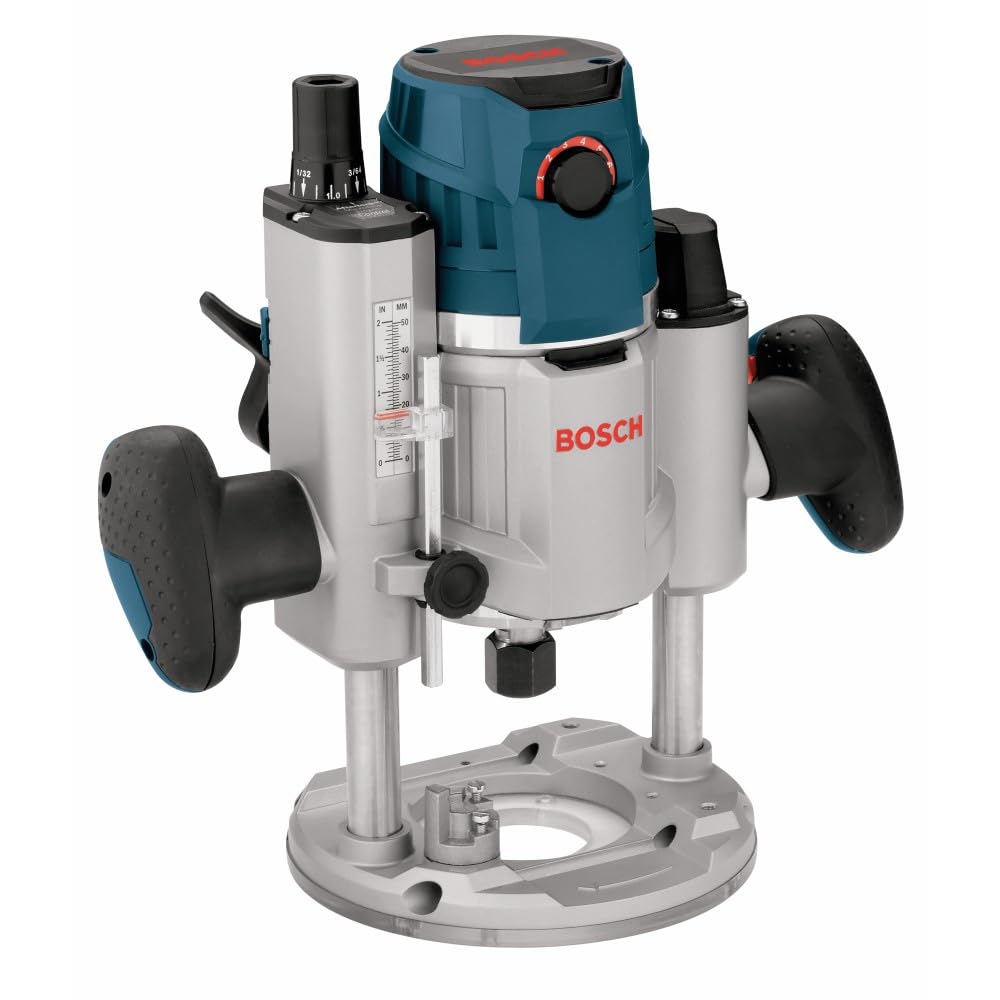
7. Bosch MRP23EVS 2.3 HP Electronic Plunge Base Router
A plunge router where the depth setting is the star, not just the motor.
If plunging is the main thing you do, the MRP23EVS puts its engineering into the depth controls. Bosch’s Afterlock microfine bit-depth adjustment lets you set the depth precisely at any plunge setting, and the variable-speed dial matches the speed to the material. The 15 A motor produces 10000 to 25000 rpm at 2.3 HP max, and Constant Response circuitry holds a steady speed across the whole cut, so the bit does not wander when it hits a knot.
What earns its reputation is the adjustability — owners keep coming back to the micro adjustment for the plunge depth lock. The trigger control sits on the handle for one-handed control, an always-on LED keeps the bit area lit, and a cord swivel keeps the cord out of the way as you move around the work. The smooth plunge action, spring-lock plunge lever, and depth rod all work together to make repeat plunge cuts land where you want them. The kit includes both 1/4″ and 1/2″ self-releasing collets plus the wrenches you need.
The thing to know: the plunge mechanism is the mixed note here. It is smooth for most, but it can stiffen over time and get harder to move. Keep the columns clean and it stays smooth. At 16 pounds this is a heavy tool — it lives on a bench, not in a handsaw-style one-handed grip. If your work is plunging grooves and mortises with a light hand on the depth, this is a strong Bosch rival to the Makita above.
plunge depth control: the Afterlock microfine adjustment at any plunge setting is the feature that keeps this router in the daily rotation for grooving and mortising.
chips fill column: the plunge action earns mixed notes for stiffness over time, so maintenance on the plunge rods is worth doing.
plunge routing pick: plunge routing where depth accuracy matters more than portability.
fixed base need: you need to carry the router into awkward places — 16 pounds will wear you out.
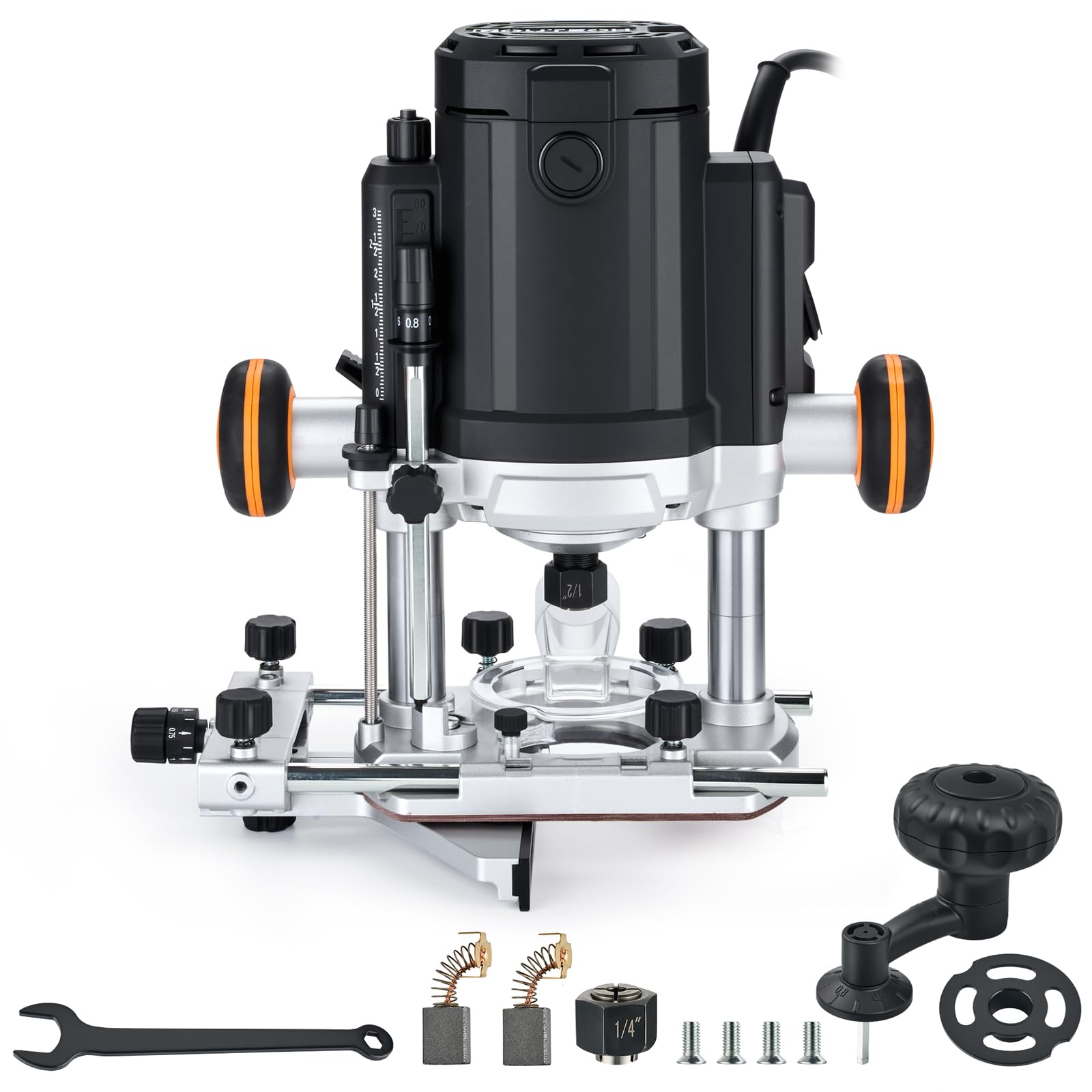
8. Routech RT-004 Plunge Router, 3.25HP/2400W
A budget entry into table-compatible plunge routing with a big motor and a soft start.
A 15 A motor with 3.25 HP rating and speeds from 8000 to 21000 rpm — this is a plunge router designed to do the job a bigger brand does, at a lower price tier. It has electronic speed control to keep a chosen speed steady through tough material, and a soft start that ramps up gradually instead of jerking the tool when the switch goes on. Six speeds are dialed in to match the bit to the job, which is what keeps burn marks off the edge.
what separates it is that it is built for both handheld and table-mounted use. You can adjust the bit height from above the table, which is the feature you actually feel in daily use — it saves you reaching under the table every time you change depth. The 7-inch base diameter gives a stable footprint, so the tool sits steady on the work. The two 1/2″ and 1/4″ collets (the sleeves that grip the bit shank) let you choose between heavier-shank bits and the smaller bits most people already own. It comes with a two-year manufacturer warranty, which is note at this price point.
The thing to understand: this has a short review history compared with the Bosch and Makita plunge routers here, so the durability record is less established. It is a value-tier tool that carries a big motor rating and the right feature list, and for a shop that is building up plunge capability or adding a second router to a table, the price-to-feature ratio is the appeal. If you route professionally and need a tool with a decade of proven use behind it, spend up. If you need plunge capability and want to start, this is a reasonable way in.
budget big power: a home shop that wants a table-compatible plunge router without paying premium-brand prices.
want brand service: you need a long-proven durability record — the Makita and Bosch plunge routers have that history.
9. RYOBI ONE+ 18V Cordless Compact Fixed Base Router (PCL424B)

The lightest way into cordless routing — if your work stays light and your expectations match.
At 2.9 pounds, this is the lightest router on the list — and it is 45% lighter than the DEWALT DCW600B at 4.2 pounds. That matters if you are routing shelf edges, trimming panels, or holding the tool in one hand for a long run. It runs on any Ryobi 18V ONE+ battery (not included), spins 20000 to 30000 rpm with a variable-speed dial, and reaches 30000 rpm at the top end — 18% higher than the DEWALT’s 25500 rpm. The micro depth dial and quick-release lever make height changes fast, and a dust port and LED keep the cut visible and the chips out of the way.
The trade-off is durability, and it is the thing to know before you buy. The durability feedback is mixed, with buyers reporting: “The durability receives mixed feedback, with several customers reporting it broke after two months of use.” That is the one honest caution on this pick. Functionality is what it does well — it works expertly for light tasks and handles home projects that most people pick up a router for. It is not a production tool.
So think of it as a light-duty companion. If you own Ryobi 18V batteries and want to trim an edge without dragging a cord, it will do that job. If you are routing cabinet doors every weekend or cutting deep grooves in hardwood, this is not the tool for that — a corded router with a bigger motor will hold up longer. The 30-day limited warranty is short, so if you buy it, put it to work quickly and check it over while the coverage is fresh.
ryobi owners pick: you are already on the Ryobi 18V platform and need light edge trim work.
corded power fan: you need a router that takes daily production use — the durability record is mixed.
Know the Specs
Fixed vs. Plunge Base
A fixed base locks the motor at one height and adjusts with a ring or knob — best for edge trimming and table mounting. A plunge base lets the motor drop on springs so you can start a cut in the middle of a board, which is what mortises and stopped dados need. Kits with both bases, like the WORKPRO and DEWALT DW618B3, cover both jobs in one tool.
Amperage and Horsepower
These rate the motor’s strength. A 15 A corded motor (Makita RP1800, Bosch MRP23EVS, Routech RT-004) holds speed through deep cuts in hardwood, while smaller motors suit trim and light grooving. Note that a battery tool’s amp figure is a battery-draw number, not the same measurement as a corded router’s 12 A or 15 A rating.
Variable Speed Range
Variable speed lets you match RPM to the bit and material. The wider the range, the more versatility — the CRAFTSMAN reaches 30000 rpm, the Bosch 1617EVS starts as low as 8000 rpm. Slow speeds are for large-diameter bits and hard stock; high speeds suit small bits and softwood trim.
Collet Size
The collet grips the bit shank. A 1/4″ collet takes the smaller bits most trim work uses, while a 1/2″ collet holds larger-shank bits with more grip and less chatter on heavy cuts. The DEWALT DW618B3, Bosch 1617EVS, Bosch MRP23EVS, and Routech RT-004 include both collet sizes, so your bit options are not limited.
Common Questions
Is a fixed-base or plunge router better for a beginner?
Will a 1/4-inch bit work in a router with a 1/2-inch collet?
Does a cordless router have enough power for hardwood?
What does soft start actually do on a router?
Can I mount the Bosch 1617EVS in a router table?
How deep can a plunge router cut in one pass?
Do I need a variable speed dial on a router?
What is the difference between the DEWALT DCW600B and the CRAFTSMAN CMCW400B?
Is a fixed-base router enough for cutting grooves in cabinet work?
The Bottom Line
For most people, the wood router tool that earns the nod is the DEWALT DCW600B because it balances cordless freedom, a brushless motor, and a compact 4.2-pound body that handles 1/4″ bits with dual LEDs lighting the cut. If you already run the Ryobi battery platform and just need light trim duty, RYOBI PCL424B is the lightest way in at 2.9 pounds. And if plunge routing is where your work lives, the Makita RP1800 gives you 0″ to 2-3/4″ of plunge depth with three preset stops, while the Bosch 1617EVS remains the router-table anchor for a fixed base.
Whichever you pick, the choice depends on one question: are you trimming edges and mounting in a table, or plunging a bit into the middle of a board?
How we choose
We do not accept paid placement. Every pick is matched to a real buyer and a real use-case; we do not hands-on test units.
Sources
Specifications: manufacturer listings and product documentation. Review insights: verified customer reviews, as of November 2026. Pricing: not shown on this page (it changes often); check the current price via the retailer link.
As an Amazon Associate, Tactical Gear Guy earns from qualifying purchases. This does not affect which products we feature.