Specs are compiled from manufacturer listings and verified buyer reviews and can change over time — please confirm the key details on the product page before buying.
You want firewood split without wrecking your shoulders, and the honest answer is that handle length matters more than head weight for most people. A 36-inch axe gives you the swing speed to pop medium logs apart in one hit, while a short hatchet is for kindling and camp chores only. Below you will find the pick that suits your log size, your height, and how many cords you actually process in a season.
This guide is built by comparing the manufacturers’ published specifications and the patterns across verified customer reviews, so you get each pick’s real strengths and trade-offs instead of marketing spin.
Head weight, handle length, and blade grind decide how a splitter behaves on the block, not the paint job. This breakdown of the wood splitter axe market pairs every spec with the job it actually does.
Top Picks

How To Choose The Best Wood Splitter Axe
Buying a splitter is mostly a matchmaking job: your height, your typical log diameter, and how much wood you process each year do more to pick the tool than any brand logo. Match all three and the axe swings like an extension of your arm. Miss them and every round turns into a fight.
Handle length decides your swing, so match it to your height and your log pile
A 36-inch handle gives you a longer arc and more leverage, and it keeps the head away from your shins on the follow-through. That length is why taller users and anyone working big rounds gravitate to a full-size splitter. A 13-inch or 14.2-inch hatchet is a different animal — it is for kindling, camp wood, and small stuff you can brace on a block.
Head weight versus total weight
Head weight is the steel forging alone; total weight includes the handle and is what your shoulders actually carry swing after swing. A 6-pound head on a fiberglass handle can land at 8.4 pounds in your hands, and that mass does the splitting while you steer. A lighter head on a long handle trades raw force for speed, which is why it can still pop medium logs apart without exhausting you.
Blade grind and coating stop the head sticking
A convex bevel is a rounded, spreading edge profile that pushes wood apart and then releases more easily than a flat-ground wedge. A low-friction coating on the blade adds to that release and guards against rust. If you fight a stuck head on every round, the grind and the coating matter more than a shaving-sharp edge.
Steel hardness tells you how long the edge lasts
Hardness is measured on the HRC scale, which grades how well steel resists wear and impact. Splitting heads sit in a practical band so the edge survives knots without chipping. A harder forging holds an edge longer; too hard and it becomes brittle against a buried knot.
Side-by-Side Comparison
| Model | Best For | Head Weight | Overall Length | Total Weight | Amazon |
|---|---|---|---|---|---|
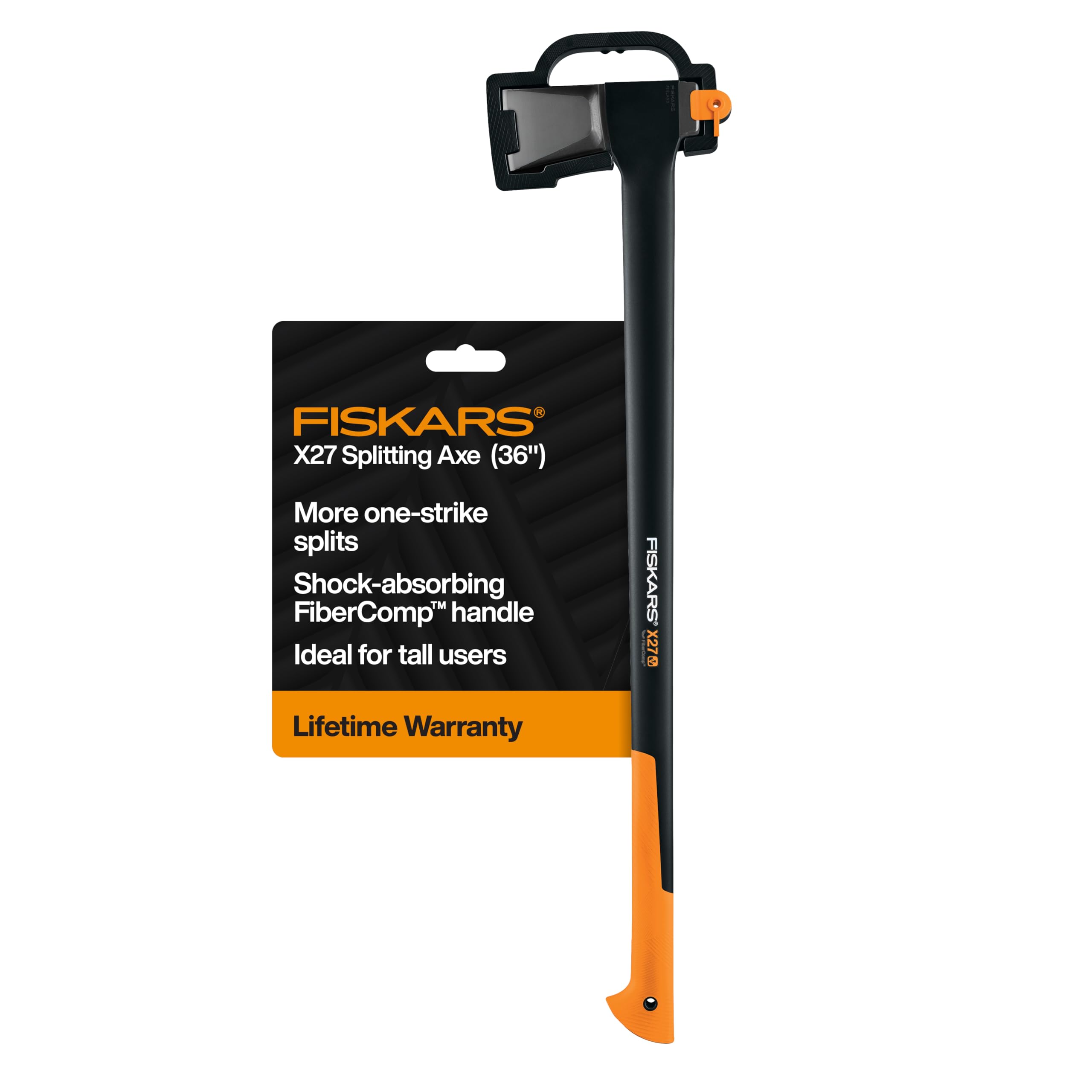
| Fiskars X27 Super Splitting Axe 36″★ Best Overall | All-round firewood splitting | 4.3 lbs | 36″ | 6.3 lbs | Amazon |
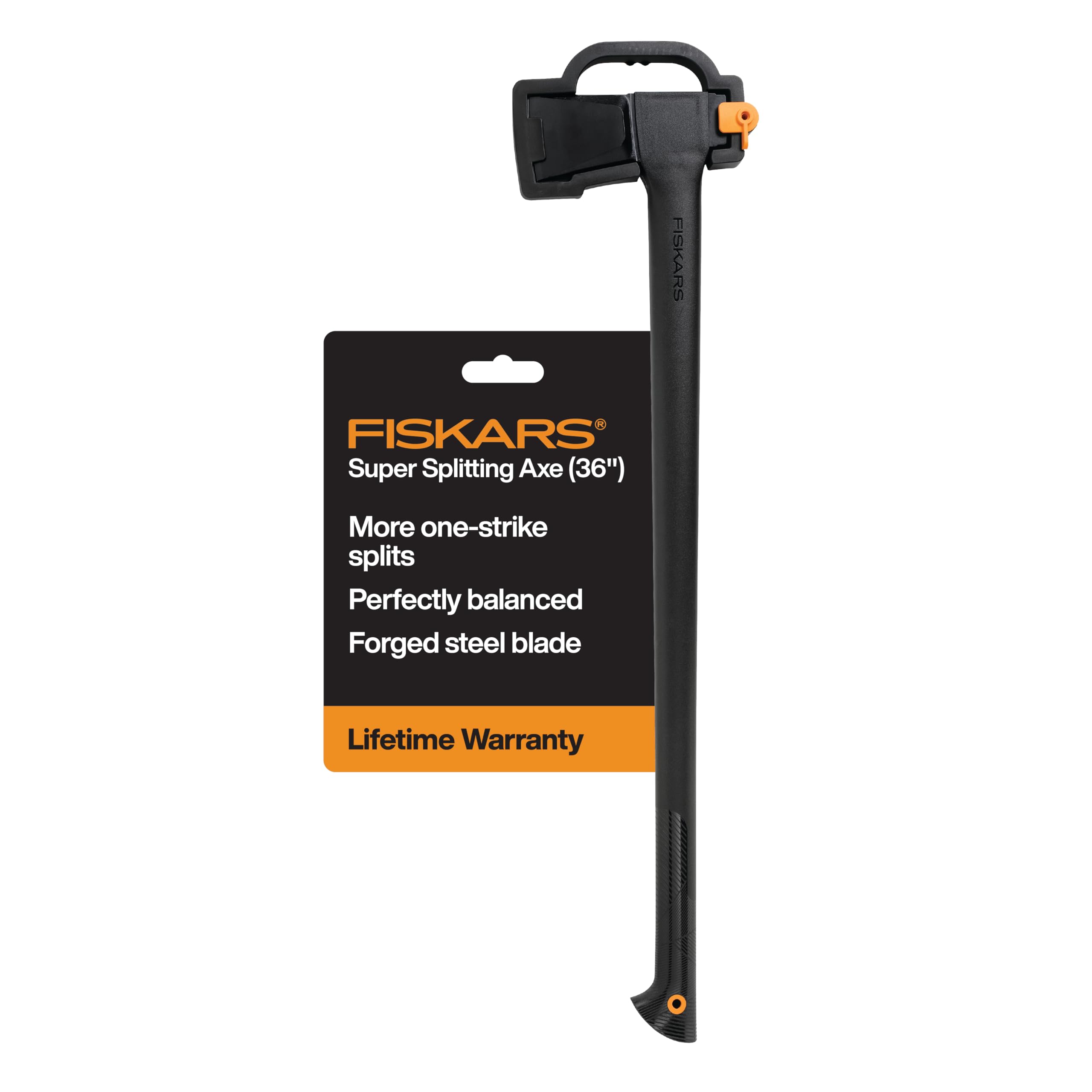
| Fiskars A-Series Super Splitting Axe 36″Top Performer | Taller users, medium to large logs | — | 37.75″ | 6 lbs | Amazon |
| Husqvarna Wood Splitting Axe S2800Best Handle | Large firewood, premium build | 5 lbs | 27.6″ | 6.2 lbs | Amazon |
| Estwing 6 lb Wood Splitting Maul | Big logs and stubborn wood | 6 lbs | 36″ | 8.4 lbs | Amazon |
| Hooyman Splitting Maul | Wet-weather grip and wedge use | — | 36″ | 8 lbs | Amazon |
| Toolzeen 36″ Splitting Maul | Budget camp and yard work | 4.4 lbs | 36.5″ | — | Amazon |
| WICING Camping Hatchet 14.2″ | Kindling and camping | — | 14.2″ | 2 lbs | Amazon |
| Fiskars X13 Ultralight Hiking Axe | Backpacking and camp chores | — | 13″ | — | Amazon |
Detailed Reviews
1. Fiskars X27 Super Splitting Axe 36″
Our pick — 4.5+★ from 9,000+ verified ratings; the strongest balance of quality and price.
The do-everything splitter that turns a cord of firewood into a weekend job.
A 4.3-pound head on a 36-inch handle is the core of the X27, and that pairing is the reason it earns the top spot. The long handle builds swing speed, so the head arrives with force behind it instead of relying on sheer mass. The forged steel blade uses a beveled convex grind, a rounded spreading edge that pushes the round open and then lets go. That grind is why the head does not fight you every time it buries itself in a log.
The handle is where the comfort comes from. It is built with a shock-absorbing construction and a textured non-slip grip, so the vibration from a hard hit stays out of your palms. Total weight comes to 6.3 pounds, which is light enough to keep swinging for a long session. Compare that to the Estwing maul at 8.4 pounds. The X27’s blade also carries a low-friction treatment so it slides out of wet wood rather than gripping it.
What wins people over here is how decisively the head works — logs come apart rather than needing a second or third strike. The thing to know before you buy is that this axe rewards a deliberate swing on a solid block; it is not the tool for splitting on soft ground or loose dirt. Expect it to arrive sharp enough to work straight away, and expect to touch up the edge with a file over a season of hard use.
Where it earns the crown
- 36-inch handle builds real swing speed for one-strike splits
- 4.3-pound head keeps total weight at 6.3 pounds
- Convex bevel and low-friction blade release easily from wet wood
- Shock-absorbing handle with textured non-slip grip
The honest read
- Wants a solid block underneath — soft or uneven ground wastes the swing
- The edge needs occasional filing to stay sharp through heavy knots
Reach for this if: you process real firewood and want the lightest full-size splitter that still breaks medium to large rounds in one hit.
Think twice if: your pile is short logs on a bare lawn — a compact hatchet suits that work better.
2. Fiskars A-Series Super Splitting Axe 36″
Built long for tall frames, with a handle that soaks up the sting of a hard hit.
If you stand tall over the chopping block, the reach on this one solves a problem the shorter tools can’t. It measures 37.75 inches overall, longer than the X27’s 36 inches, and that extra span adds leverage for a taller body. The tune weight distribution carries the head through the round instead of stalling halfway. It also weighs in at 6 pounds total, so it is no heavier in hand than the shorter X27.
The FiberComp handle is the standout: a lightweight, shock-absorbing composite the maker says is stronger than steel for resisting overstrike damage. The insert-molded head reduces loosening over a season of hard swings. A convex bevel blade with a low-friction coating helps it power through medium to large logs and then release, so you spend less time prying a buried head free. Splitting performance is the aspect owners praise most, and the ergonomic shape keeps the vibration from stinging.
The counterweight to all that is durability at the edge — some users report the blade getting chipped or damaged with hard use on knotty wood. Treat it as a tool that rewards clean, square hits on a sound block and asks for an occasional touch-up on the edge. For the height it adds and the cushion in the handle, that is a fair ask.
Swing feel: the shock-absorbing FiberComp handle and 37.75-inch overall length put the force where you aim it without thumping your palms.
Edge upkeep: the convex blade stays sharp in steady use, but knots and off-square strikes are what chip it — so line up each blow.
The right call for: taller users splitting medium to large logs who want a long reach and a forgiving handle.
Pass it by if: you chop a lot of brutal knotty hardwood and want a heavier forged head instead.
3. Husqvarna Wood Splitting Axe S2800
A shorter, denser splitter that hits above its length on larger firewood.
The S2800 asks a different bargain than the long 36-inch tools. It runs a 27.6-inch overall length with a 5-pound steel head, and the maker points to perfect balance and weight distribution as the design goal. Total weight sits at 6.2 pounds, so it stays swingable for long stretches. A shorter handle gives a tighter, more controlled arc — useful when you want accuracy on the block rather than maximum reach.
The head carries a coating to improve cutting, and the fiberglass composite handle gives a stable grip through a full session. It comes with a sheath and a lifetime warranty, which suits a tool you plan to keep on the woodpile for years. Sturdiness is the trait these owners value most, with durability close behind, and the balance is what lets you swing long without wearing out. If your rounds run large, the coated head delivers more bite than the compact hatchets ever could.
The catch to know is the length itself — at 27.6 inches you get less leverage than a full 36-inch axe, so tall users may feel like they are reaching down into the swing. It shines most for the person who wants a dense, well-balanced head over a long lever. For medium-to-large firewood and a build that feels planted in the hand, this is a quietly strong choice.
Balance over reach: a 5-pound coated head on a 27.6-inch fiberglass handle gives a compact, controlled swing at 6.2 pounds total.
The fit question: shorter users will love the tight arc; taller users may miss the leverage of a 36-inch handle.
Choose it when: you want a well-balanced, sturdily built splitter for larger firewood and prefer control over maximum reach.
Consider the longer axes if: you are tall and want every inch of leverage on the biggest rounds.
4. Estwing 6 lb Wood Splitting Maul, 36-Inch Fiberglass Handle

A forged workhorse built to crack giant rounds without flinching.
Estwing’s 6-pound maul goes straight at the hardest rounds with a forged head hardened to 50–55 HRC. That hardness range is a measure of how well the steel resists wear and impact, so the edge holds up to repeated blows on stubborn wood. The head design is shaped to generate greater force, which is exactly what you want when a big log refuses to give. The head weight itself is 6 pounds, matching the Fiskars maul, but the Estwing carries that mass on a 36-inch handle.
The handle is a dual-injection build infused with over 70% fiberglass, made for strength and a long service life. Total weight is 8.4 pounds, slightly lighter than the 8.6-pound Fiskars Pro. That is a real difference on a long session — the Estwing gives you a full-size maul with a modest weight break. It also covers more than firewood: the maker lists chopping, trimming, cutting, splitting, and shaping wood for yard and home tasks.
What the tool does best is handle the giant logs that stop everything else, and the hardened forged head keeps its edge through demanding use. The honest limit is the weight — at 8.4 pounds it is a two-handed effort built for shorter, forceful sessions. If your woodpile is big and tough, this 6-pound maul earns its keep.
What makes it split
- 6-pound forged head hardened to 50–55 HRC
- Dual-injection handle infused with over 70% fiberglass
- 36-inch length for powerful, reaching swings
- 8.4 pounds total — a touch lighter than the Fiskars maul
Worth knowing
- Full maul weight demands strong arms for extended splitting
- More tool than a soft-firewood job needs
Pick this for: big, stubborn logs and a forged head that keeps its edge under repeated impact.
Look elsewhere if: you want a splitter you can swing comfortably for hours without fatigue.
5. Hooyman Splitting Maul, 36″

The handle grips tighter the wetter it gets — the woodpile-and-drizzle tool.
Rain and sweat make axe handles dangerous, and Hooyman answers that with a no-slip H-Grip that turns tacky when wet. That is the feature you notice on a damp evening when every other handle gets slick. The 36-inch build runs 8 pounds total, so it carries useful heft into the swing. The head is 1045 high-strength forged steel with a convex grind and an HRC of 45–60, a broad hardness range aimed at holding an edge through impact.
There is a flat poll on the back for starting cracks or driving a wedge, plus the V-shaped head for splitting — two jobs in one tool for anyone working up big rounds. The handle is interlocked and epoxy sealed into the eye, with a solid fiberglass core for strength. It also comes with a limited lifetime warranty. What this tool does well is stay planted in your hands and give you a way to chase a wedge when a round is really stuck.
The honest edge to this one is sharpness out of the block — some users find the blade needs work before it bites the way they expect. Durability reports land mixed, and the head can jam in some wood, so a clean, square hit still matters. Treat the initial edge as something to finish yourself, and the wet-grip handle and flat poll make it a practical, sturdy tool in real conditions.
Grip in bad weather: the H-Grip turns tacky when wet, so a sweaty or rain-soaked hand still holds the handle.
Two jobs in one: a flat poll for starting cracks and driving a wedge complements the V-shaped splitting head.
Suits you if: you split outdoors in wet conditions and want a handle that stays secure plus a poll for wedge work.
skip it if: you want a factory edge that is fully ready on arrival without any touch-up.
6. Toolzeen 36″ Splitting Maul

An entry-priced 36-inch splitter with a wing-shaped head and a friendly price.
The Toolzeen lands as the budget route into a full-size splitter, giving you a 36.5-inch overall length with a 4.4-pound head. The convex wing grind on the blade is shaped to deliver more one-strike splits, and the forged Grade-A carbon steel is heat treated with hardened cutting edges. The big V wedge head at the front is what forces the round apart.
The handle is a 36-inch lightweight fiberglass-composite build with an ergonomic TPR shock-absorbing anti-slip grip. TPR is a rubbery grip material that resists slipping and takes some of the sting out of the swing. The blade can be resharpened with a file, which keeps it working over time. It arrives with a sheath, and the package is aimed at campers and backyard firewood alike. On splitting performance it punches well above its entry-level standing — the head does the primary job without drama.
There is a durability caution worth hearing before you buy. Multiple users report the handle breaking within a couple of months of hard use, and sharpness gets mixed notes from the start. If you process cords every season, spend up for a tool built to take the beating.
The value case: 36.5 inches of reach and a 4.4-pound wing-grind head give genuine one-strike splitting at the entry tier.
The durability caution: handles have broken under heavy use and the factory edge is hit-or-miss, so treat it as a light-to-moderate splitter.
Best entry point: a first splitter for a modest firewood pile, camp wood, or occasional yard work.
Step up instead if: you split cords of hardwood every season and need the handle to survive it.
7. WICING Camping Hatchet, 14.2-Inch

A compact dual-wedge hatchet for kindling, campfires, and survival kits.
Not everyone needs a 36-inch maul, and this 14.2-inch hatchet serves the other job — kindling and camp wood you can split in one hand. It weighs 2 pounds total, so it packs easily and swings with a flick of the wrist. Compare that to the Estwing maul at 8.4 pounds and you can see the entire point: this is a go-anywhere tool, not a woodpile workhorse. The dual wedge head is built to increase splitting force while preventing the head from getting stuck, which is the frustration that plagues short axes.
The head is 1065 high manganese steel with a hardness rating of 53–56 HRC that the maker says withstands heavy use. The handle is hickory, a dense natural wood that gives a traditional feel in the hand. It comes with a snap-on leather sheath and a sharpening stone, so you can maintain the edge in the field. Quality is the strongest theme around this hatchet, with sharpness close behind, and the edge arrives ready to split small hardwood.
Value draws split opinions as a budget-tier tool, so weigh what you plan to put it through before you buy. A dual wedge is happiest on straight-grained kindling and small rounds — it is not the tool for a 20-inch oak round. For campfires, trail work, and splitting small stuff at the fire pit, this hatchet does the compact job well.
Reasons it earns a spot
- Dual wedge head boosts force and resists getting stuck
- 2 pounds total packs easily for camping and survival kits
- 1065 manganese steel head rated 53–56 HRC
- Ships with a leather sheath and a sharpening stone
Where its limits sit
- 14.2-inch length caps it to kindling and small rounds
- Entry-tier value leaves some buyers wanting more tool for the money
The tool for: campfires, kindling, and a compact axe that lives in a pack or truck bed.
Not the tool for: splitting large rounds or processing a full cord of firewood.
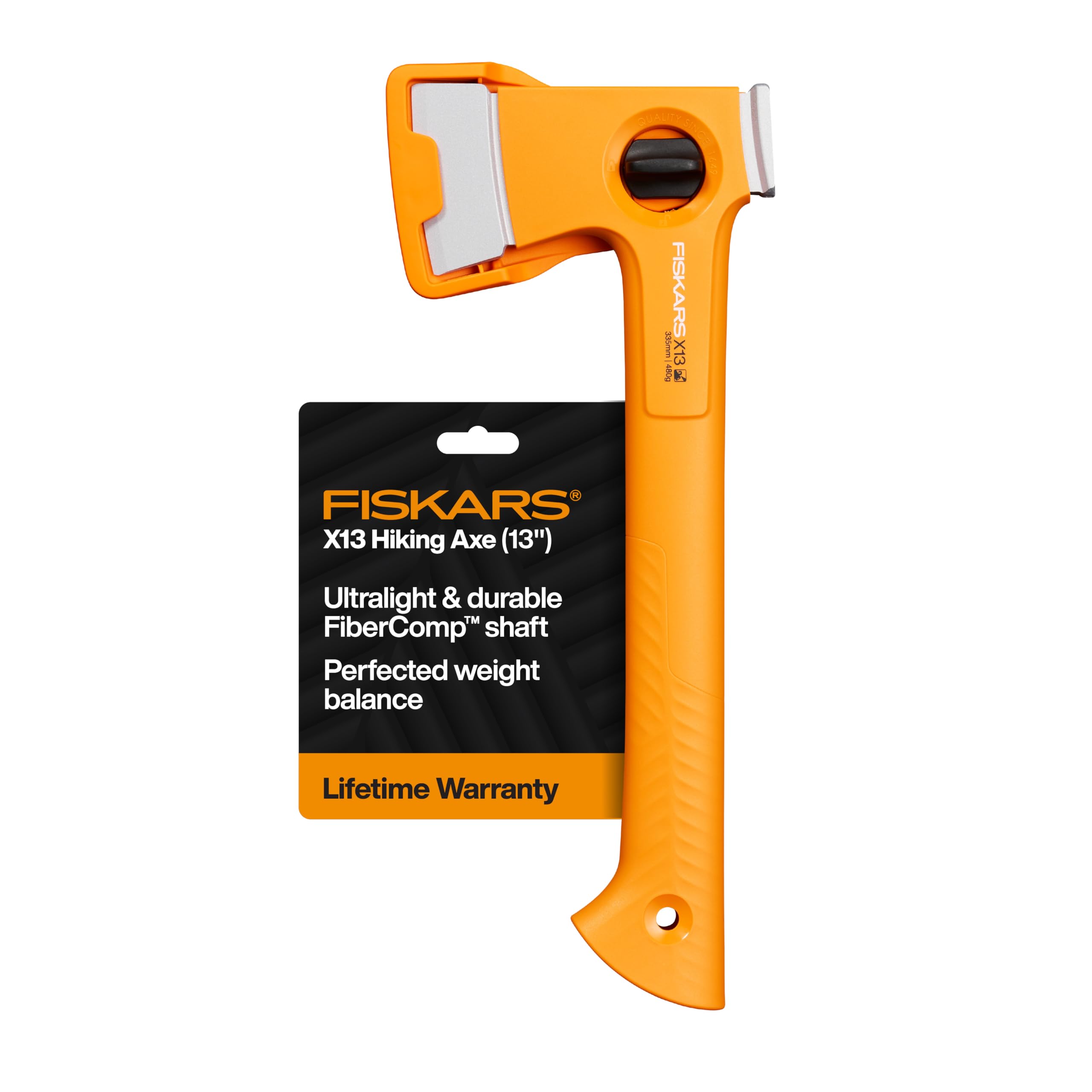
8. Fiskars X13 Ultralight Hiking Axe 13″
Thirteen inches of forged steel that disappears into a hiking pack.
This is the lightest tool here by a wide margin, and that is exactly its purpose. Fiskars states the design is 15% lighter than other compact X-series axes, and its 13-inch overall length stows easily in a pack. The forged steel blade uses a proprietary blade-grinding process for a sharper edge and cleaner cuts, and the double-hardened steel is made to hold its edge longer. It is sized for backpacking and car camping rather than the woodpile.
The bright orange FiberComp handle is easy to spot if you set it down in the brush, and a striking end on the butt lets you drive tent stakes without grabbing a hammer. The low-friction coating glides through wood and guards against rust, while the insert-molded head reduces loosening and overstrike breakage. A sheath with a belt loop and a locking mechanism keeps it secure on the trail. Quality is the strongest thing about it, with its lightweight build right behind.
The blade sharpness draws mixed notes — some find it sharp from the start, others find it needs work, though it can be sharpened further. Size is the honest limit: 13 inches is a camp and kindling tool, not something you would swing at a large round. For backpackers who want a real chopper that adds little pack weight, this fills the role neatly.
Trail-ready design: a 13-inch forged blade, striking end for tent stakes, and a belt-loop sheath make it a genuine camp tool.
Sharpness caveat: the factory edge draws mixed notes, so plan to finish it to your taste.
Fits the backpacker: a light, stowable chopper for camp chores, tent stakes, and small kindling on the trail.
Wrong tool if: you need to split actual firewood rounds at home — that calls for a full-size axe.
Know the Specs
Head weight
Head weight is the steel forging alone, and it is the number that decides how hard the axe hits. A 6-pound head carries real force into a dense round, while a 4.3-pound head leans on speed instead. Note that head weight is not what your arms carry — total weight includes the handle too.
Overall length
Length sets your swing arc and your leverage. A 36-inch handle builds speed over a long arc and keeps the head off your shins, which is why taller users favor it. A 13-inch or 14.2-inch tool is for kindling and camp work, where a tight, controlled stroke beats a big lever.
Blade grind and coating
A convex bevel is a rounded, spreading edge that pushes wood apart and releases more easily than a flat grind. A low-friction coating adds to that release and guards against rust. Together they decide whether the head glides out of wet wood or sticks tight on every round.
Steel hardness (HRC)
HRC grades how well steel resists wear and impact. A splitting head in a practical hardness band holds its edge through knots without turning brittle. Too soft and it dulls quickly; too hard and it can chip on a buried knot.
Handle material
Fiberglass and composite handles absorb shock and resist overstrike damage, while hickory gives a dense natural feel. What matters most is how the head is fixed — an insert-molded or epoxy-sealed head resists loosening over a long season.
Total weight
Total weight is what your shoulders actually lift swing after swing. A 6-pound head on a fiberglass handle can land at 8.4 or 8.6 pounds, and that is the number that tells you whether you can go for hours or need short, forceful sessions.
Common Questions
Is a splitting axe better than a maul for firewood?
What handle length should I choose?
Will a wood splitter axe get stuck in the log?
Do I need a maul or a hatchet for kindling?
How do I keep the blade sharp?
What does HRC mean on an axe head?
Is fiberglass stronger than a wooden handle?
Can a splitting axe double as a wedge driver?
How much does a full-size splitter weigh in the hand?
Do these tools come with a sheath or warranty?
The Bottom Line
For most people settling a woodpile, the wood splitter axe that gets the job done with the least strain is the Fiskars X27 Super Splitting Axe 36″ — a 4.3-pound head on a 36-inch handle, backed by a lifetime warranty and a shock-absorbing grip. If the wood in front of you is dense oak or hickory, reach for the Fiskars Pro IsoCore 6 lb Splitting Maul and let its mass and shock control do the breaking. And for campfires and kindling rather than a full cord, the 2-pound WICING Camping Hatchet is the compact companion worth keeping in the pack.
For a buyer who splits real firewood and wants a tool that lasts, the X27 remains the sensible place to start.
How we choose
We do not accept paid placement. Every pick is matched to a real buyer and a real use-case; we do not hands-on test units.
Sources
Specifications: manufacturer listings and product documentation. Review insights: verified customer reviews, as of November 2026. Pricing: not shown on this page (it changes often); check the current price via the retailer link.
As an Amazon Associate, Tactical Gear Guy earns from qualifying purchases. This does not affect which products we feature.