Specs are compiled from manufacturer listings and verified buyer reviews and can change over time — please confirm the key details on the product page before buying.
Your kid’s helmet has to do two things before anything else matters: pass the NOCSAE standard (the safety test every catcher’s mask must meet) and actually fit your kid’s head. The paint job, the brand name, and the vent count come second. The top pick here is the Rawlings Velo 2.0, at 4.5+ stars across 200+ ratings, because it covers all three bases: junior hat sizing of 6 1/2″ to 7″, an impact-resistant cage, and a three-way adjustable back plate you can tighten as your catcher grows.
This guide is built by comparing the manufacturers’ published specifications and the patterns across verified customer reviews, so you get each pick’s real strengths and trade-offs instead of marketing spin.
Below you’ll find eight catcher’s helmets and sets, each one checked against the same standard. Every helmet below is judged in the same order: face protection first, skull fit second, then comfort through a full game in the heat.
Top Picks


How To Choose The Best Youth Baseball Catchers Helmet
A catcher’s helmet protects the most vulnerable part of a player’s body while they are crouched directly behind a bat swinging at 70-plus mph. Four specs decide whether a youth catcher’s helmet works: the NOCSAE label, hat size range, cage style, and pad adjustability.
The NOCSAE label is the starting point, not the finish line
NOCSAE is the National Operating Committee on Standards for Athletic Equipment — a nonprofit that sets the impact-testing standard for sports helmets. A helmet that “meets NOCSAE standard” has passed a baseline ball-impact test. Several helmets on this list carry that label, including the Rawlings Players Series, Renegade 2.0, Easton Elite X, Mizuno G4, Easton Black Magic 3.0, and All-Star S7. Treat the label as the minimum bar: every helmet that will actually go behind the plate in a sanctioned game should carry it.
Hat sizing is the fit number that matters most
Catcher’s helmets are sized by hat size, expressed in inches of head circumference typically written as a range like 6 1/2″ – 7″. That is roughly the same measurement a hat shop would take. A helmet that is too loose shifts and blocks vision when the catcher turns; one that is too tight presses on the forehead and causes headaches by the third inning. Measure the player’s head with a soft tape across the widest part (just above the ears) and match it to the range on the box.
Cage style affects what your catcher can see
The cage is the steel or composite frame in front of the face. A conventional vertical-bar cage works fine, but an I-Bar design — two horizontal bars with a single vertical support — creates wider openings for peripheral vision. Wider openings let a catcher pick up a pitch tailing off the plate without turning the head. If your catcher is tracking wild pitches or blocking in the dirt, an I-Bar or a wide-viewport mask makes a real difference.
Cheek pads, chin cups, and adjustability
The back plate and chin strap handle adjustment. A three-way adjustable back plate lets you tune the fit vertically and horizontally, which is why it keeps working as the player grows. An ergonomic chin cup or upgraded chin pad distributes pressure across the jaw instead of one spot. Removable, washable pads are a practical bonus — catcher’s gear gets sweaty quickly, and being able to pull the forehead and chin pads out and hand-wash them saves the whole helmet.
Side-by-Side Comparison
| Model | Best For | Hat Size Range | Weight | Standard | Amazon |
|---|---|---|---|---|---|
| Rawlings Velo 2.0 Catcher’s Helmet★ Best Overall | Overall youth pick | 6 1/2″ – 7″ (Junior) | 1.23 kg | — | Amazon |
| Easton Elite X Catchers HelmetWashable Pads | Washable-pad convenience | 6 1/2″ – 7 1/8″ (Small) | — | NOCSAE | Amazon |
| Mizuno G4 Youth SamuraiSenior Build | High-volume youth pick | Youth | 1.36 kg | NOCSAE | Amazon |
| All-Star S7 Catching Helmet | Premium vision | 7 – 7 1/2 (Adult) | 3.4 lb | NOCSAE | Amazon |
| Easton Black Magic 3.0 Youth Set | Full gear in one box | 6 1/8″ – 7″ (helmet) | 3 lb (set) | NOCSAE | Amazon |
| Rawlings Players Series | Entry-level budget | 6 1/2″ – 7″ | 1.8 lb | NOCSAE | Amazon |
Detailed Reviews
1. Rawlings Velo 2.0 Catcher’s Helmet
Our pick — 4.5+★ from 200+ verified ratings; the strongest balance of quality and price.
The junior-sized hockey-style helmet that gets the fit, the cage, and the cooling right at once.
The Velo 2.0 earns its spot with the cage: an impact-resistant mask built to take blocks and foul balls. Foul tips off the mask are the most common way a catcher’s helmet fails early, and this one is built for exactly that. It fits junior hat sizes from 6 1/2″ to 7″ and weighs 1.23 kg, so your catcher can wear it all game without a sore neck. The shell measures 14.5 x 9 x 8 inches, so it slides into a standard gear bag without eating the whole thing.
The fit story is where this pick pulls ahead. A three-way adjustable back plate and a redesigned chin strap let you custom-set the helmet, and the moisture-wicking liner plus ventilation slots keep air moving through the shell during summer games. What wins people over is the overall build quality — owners talk most about how solidly it is put together — followed closely by how precisely it fits. The shell also fits over a cap, so players who wear one behind the plate can leave it on. Durability and value show up repeatedly in the feedback too.
The honest catch is vision. Some catchers find the view through the mask less open than they expected, so if your player relies heavily on peripheral tracking or has a strong preference for an I-Bar cage, this might not be their favorite view. That said, several owners note the visibility is good — it is a matter of preference, not a defect. At 4.5+ stars, the Velo 2.0 is the pick for families who want proven fit and cooling without going to the top of the price ladder.
What earns the top spot
- Three-way adjustable back plate and redesigned chin strap for a custom fit
- Moisture-wicking liner plus ventilation slots for hot summer games
- Impact-resistant cage built to handle blocks and foul balls
- Junior sizing (6 1/2″ – 7″) and a design that accommodates a cap underneath
Where it wobbles
- Vision feedback is mixed — some catchers want a wider viewport
- Not an I-Bar cage, so players who prefer that layout should look at the All-Star S7
Reach for this if: your catcher is a junior-size youth player who needs an adjustable fit and cooling that lasts all nine innings.
Think twice if: your player strongly prefers an I-Bar cage layout — the viewport here is conventional.
2. Easton Elite X Catchers Helmet
Washable forehead and chin pads make this the cleanest helmet in the dugout by August.
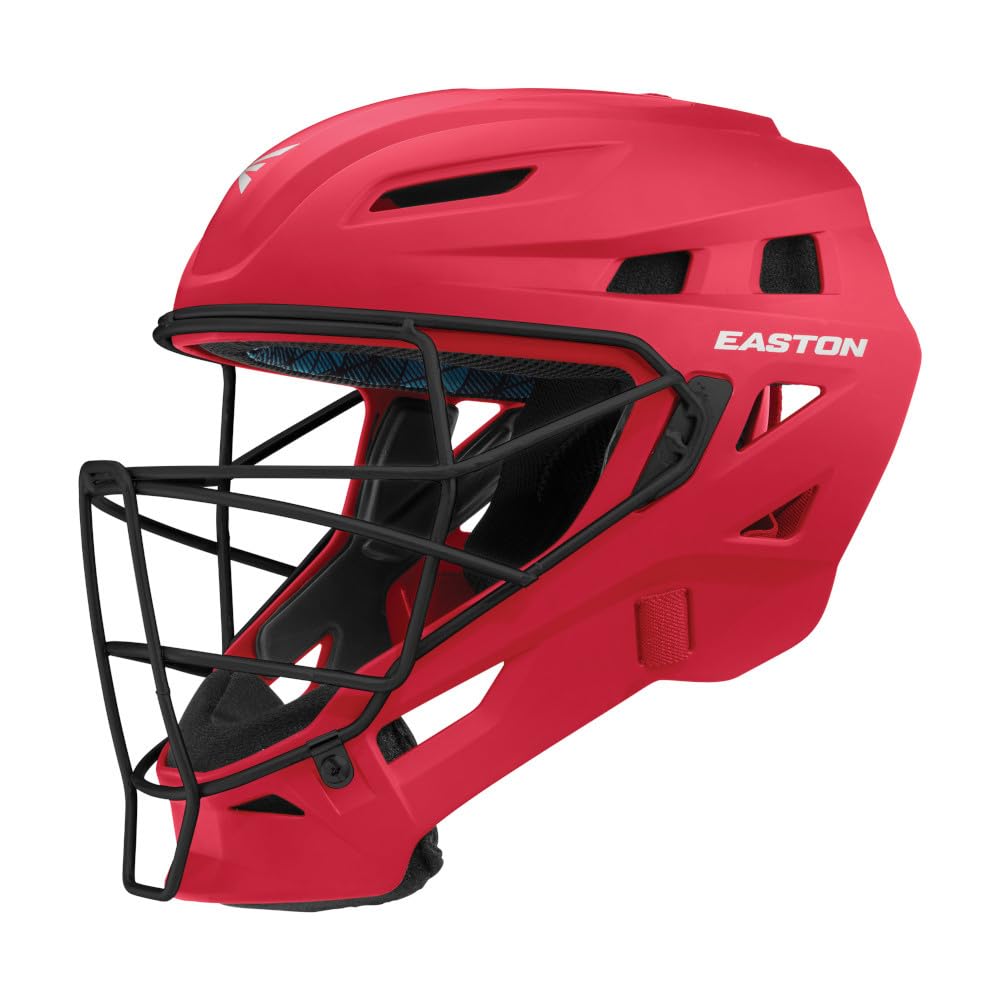
If your catcher has ever handed you a helmet so rank you had to keep it in the garage, the Elite X solves the problem directly: the forehead and chin pads are removable and washable. That is the feature that sets this one apart in a category of otherwise similar honeycomb shells. The rest of the build backs it up. An ABS thermoplastic shell with a black steel cage handles the impacts behind the plate, and it meets the NOCSAE standard for all levels of play. Shell size runs Small, covering 6 1/2″ to 7 1/8″ hat size.
Cooling gets real thought here. Strategic air vents channel heat out of the shell, and the interior pads wrap in plush padding with breathable air mesh and a moisture-wicking fabric — that is the layer nearest the skin that pulls sweat away. Vented shell plus moisture-wicking mesh is what keeps a catcher from overheating in a July doubleheader. The extra-wide rear top strap adds locked-in adjustment, and the ergonomic chin cup distributes pressure where the jaw actually sits.
Quality is the thing buyers bring up most, and the pattern is consistent: owners pick this over other brands and like the fit once the adjustable straps are dialed in. The interior is soft enough that comfort shows up as a repeated note. Fit satisfaction is the second most-discussed theme. If you want the easiest helmet to keep fresh, this is the pick — and at 4.5+ stars with a real NOCSAE label, the quality and protection parts check out.
Best clean-up habit: removable forehead and chin pads mean a hand-wash is a five-minute job between games.
Fit note: the rear strap takes a few minutes to dial in, but the extra-wide design holds once set.
Pick it for: the catcher whose helmet lives in a hot car and needs pads that come out and go back in easily.
Skip over it if: you need a Senior-size helmet for an older teen — the Elite X here runs Small (6 1/2″ to 7 1/8″).
3. Rawlings Renegade 2.0 Catcher’s Helmet
The most-discussed youth helmet on the list, with 3-layer EVA foam and a steel-framed mask.
More families have put the Mizuno G4 on a kid’s head than any other helmet here. Its defining feature is 3-layer EVA foam padding — EVA is the closed-cell foam used in helmet liners to soak up impact — plus a steel-framed mask rated for maximum protection and a ventilation system that lets heat out. It meets the NOCSAE standard.
Fit is what wins people over: the G4 accommodates glasses and ponytails, which matters for young catchers with either. Comfort comes next in the feedback, then value for money, then protection and appearance. The lightweight build is one of its advertised strengths, and owners generally confirm it. Here is the honest trade-off: buyers report the back pads work loose over weeks of hard use, and a few owners say the interior can start to detach after about six weeks of play. That is not a dealbreaker, since the shell still protects, but if your catcher is hard on gear, check the pad seating every few weeks.
Ease of use and weight get mixed reviews, which is worth naming plainly rather than glossing over. With 700+ ratings and 4.0+ stars, the G4 is the crowd-favorite youth shell on this list, and the value case is clear at this price tier. Buy this one if you want the most-reviewed youth catcher helmet and are willing to keep an eye on the interior pads.
The case for the G4
- 3-layer EVA foam padding and a steel-framed mask
- Fit accommodates glasses and ponytails
- Strategic ventilation system for hot-weather breathability
- Meets NOCSAE standard and weighs 1.36 kg
The honest caveats
- Back pads can work loose over weeks of hard use — check the seating periodically
- Ease of use and weight have mixed feedback
Best for: families who want the most-reviewed youth shell and are comfortable with a quick pad check every few weeks.
Worth noting: the interior pads have a history of loosening — if your catcher is rough on gear, a different helmet may hold up longer.
4. All-Star S7 Catching Helmet

A premium shell built around an I-Bar cage and a machine-washable liner for the serious catcher.
If a wide field of view is your catcher’s priority, look here. The S7’s defining feature is the I-Bar Vision steel cage — two horizontal bars with a single vertical support that opens up the sightlines. Peripheral vision is what owners praise in this helmet, and it shows up in the feedback list among the top themes. That wider viewport lets a catcher see a pitch tailing outside the zone and pick up a wild pitch in the dirt sooner. The shell is a high-impact-resistant ABS plastic, and it meets the NOCSAE standard.
The S7 in this listing is the Adult version, fitting head sizes 7 to 7 1/2. That is a full-adult range, so it fits a high-school or adult catcher rather than a small youth player. The machine-washable liner is a practical bonus — same idea as the Easton Elite X’s removable pads, but here the whole liner can go in the wash. The shell measures 18 x 10 x 10 inches and weighs in at 3.4 pounds, so it is a substantial helmet compared with the 1.23-kg Velo 2.0.
The comfort story is genuinely strong: owners describe it as extremely comfortable, and one parent noted their child no longer complains of headaches due to the pads. Protection aspects rank high in the feedback, and quality comes up as the most-praised attribute overall. The one honest variance is weight — some find it lightweight, others call it heavy. This is a premium-tier helmet for the catcher who wants the widest view behind the plate; the weight is the trade-off to weigh against that vision, and this listing is Adult-size, not youth.
The view: an I-Bar Vision steel cage opens up the sightlines, and peripheral vision gets steady praise in the feedback.
The compromise: at 3.4 pounds, weight is the trade-off — some find it light, others call it heavy.
Reach for it if: your catcher is size 7 to 7 1/2 and wants the widest field of view from an I-Bar cage.
Pass it over if: you need youth sizing — this listing is Adult fit, 7 to 7 1/2.
5. Easton Black Magic 3.0 Youth Catcher Gear Set
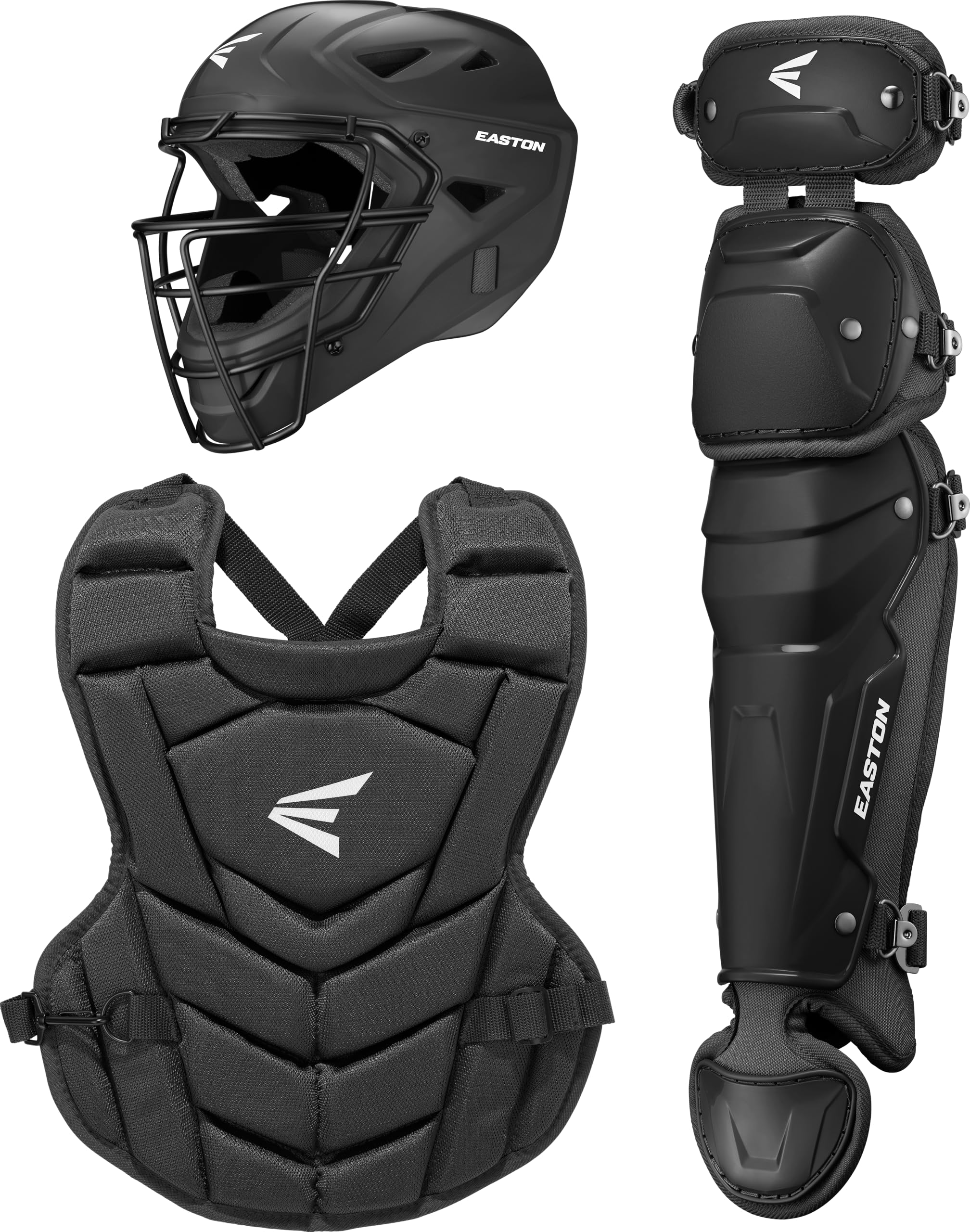
One box, three pieces of youth gear, sized for ages 6-9 or 9-12 and ready for opening day.
This is the only piece in the list that is a set rather than a standalone helmet — and for a family outfitting a catcher from scratch, that is the fastest route to the field. The Black Magic 3.0 ships with three pieces: an ergonomic catcher’s helmet with a high-tensile steel mask and centered viewport, a padded chest protector sized 12 1/2″, and articulated leg guards sized 11 1/2″. The whole set weighs 3 pounds, and it comes in two youth sizes — Youth Medium for ages 6-9 or Youth Large for ages 9-12. The helmet is NOCSAE certified for all levels of play.
The helmet covers a 6 1/8″ to 7″ hat size with a 19 3/8″ to 22″ head circumference, which overlaps cleanly with the junior-range helmets in the list. The chest protector is padded to resist bunching and keep coverage up, and the leg guards are contoured and flexible to move with the catcher’s stance. Quality is what buyers praise most, and the fit lands well for a range of young players — the feedback specifically mentions a perfect fit for a long and lean 9-year-old.
The honest caveat is size. The chest protector is smaller than it looks in photos, and some owners find the size does not match the impression the listing gives. The protection aspect has mixed feedback too — some say it protects well, some want more. If your player is at the tall or older end of the 6-9 band, consider the Youth Large. Otherwise the Black Magic 3.0 is a sensible single-box buy at 4.0+ stars for a family that wants to outfit the position once.
Value in one box: helmet, chest protector, and leg guards together, sized for ages 6-9 or 9-12.
Size reality check: the chest protector runs smaller than the photos suggest — size up if your player is tall for their age.
Made for: the family outfitting a first-time catcher who needs helmet, chest protector, and leg guards without piecing them together.
Check first if: your player is at the top of the age band and tall — the Youth Large is the safer fit.
6. Rawlings Players Series Catcher’s Helmet

A budget-first youth catcher’s helmet that covers the NOCSAE basics for a young player.
For a first-year catcher or a player who just needs a compliant helmet that fits, the Players Series is the sensible entry. It is a Cool-Flo hockey-style catcher’s helmet in a 6 1/2″ to 7″ fit — the same hat-size range as the Velo 2.0. It meets the NOCSAE standard, has a high-strength cage rated for increased impact resistance, and an ABS plastic shell. The interior uses Pro Dri padding, and the listed weight is 1.8 pounds.
The strength of this helmet is that it delivers the essentials — protection and fit — without overspending. Owners consistently report a snug fit and good protection. For a Little League catcher, a snug fit is the thing that keeps the helmet from shifting when a pitch comes in tight. The Cool-Flo name points to the interior design, and at 1.8 pounds it is light enough that a smaller player will not feel weighed down by the shell.
Durability is the real caveat: the interior padding can start separating and the top strap can come loose after repeated use. If your player will catch only one season, that may not matter. If your catcher plans to stay behind the plate for years, the upgraded cages and liners in the Velo 2.0 or the Elite X are the better long-term buy. At 4.5+ stars, the Players Series fits the rec-league starter who needs the basics done well and nothing more.
Good for a young starter: NOCSAE certification, a snug 6 1/2″ to 7″ fit, and a Cool-Flo interior at 1.8 pounds.
Know going in: the padding and top strap have a history of loosening over time, so this is a one-season helmet for most players.
Best for: a first-year Little League catcher who needs a compliant, snug-fitting helmet for the season.
Skip past it if: your player is planning to catch multiple seasons — a longer-lasting shell is a better fit.
Know the Specs
Hat Size Range
Getting the fit right starts with one measurement: your player’s hat size, given in inches of head circumference. The Rawlings Velo 2.0 covers 6 1/2″ to 7″, the Easton Elite X runs Small at 6 1/2″ to 7 1/8″, and the All-Star S7 is Adult at 7 to 7 1/2″. Match your player’s head to that range: too loose and the helmet shifts and blocks vision, too tight and it causes pressure headaches. The Easton Black Magic 3.0 lists both the hat size (6 1/8″ to 7″) and the matching head circumference (19 3/8″ to 22″), the easiest spec to check against a tape measure.
NOCSAE Standard
NOCSAE is the National Operating Committee on Standards for Athletic Equipment — it sets the impact test that sports helmets pass to be considered safe for play. “Meets NOCSAE standard” appears on the Players Series, the Renegade 2.0 in both sizes, the Easton Elite X, the Mizuno G4, the Easton Black Magic 3.0 set, and the All-Star S7. Treat it as the baseline for any catcher’s helmet going behind the plate. A helmet without that label is not one you want on a player’s head during a game.
Cage Design and Vision
The cage is the frame of steel or composite in front of the face. A conventional vertical-bar cage is the norm; an I-Bar design like the All-Star S7 uses two horizontal bars and a single vertical support to open up the viewport. Peripheral vision matters because the catcher is tracking the ball and the bat at the same time. If your player has ever complained that the mask blocks their view when a pitch tails away, an I-Bar cage is worth the step up.
Padding Material and Washability
Interior padding handles comfort and impact distribution. The Mizuno G4 uses 3-layer EVA foam (a closed-cell foam); the Easton Elite X uses plush wrapped padding with breathable air mesh; the Rawlings Players Series uses Pro Dri foam. Washability is a real consideration — the Easton Elite X has removable forehead and chin pads, and the All-Star S7 has a machine-washable liner. Catcher gear gets sweaty fast, so a helmet you can pull the pads out of is a helmet you will not have to replace for smell.
Common Questions
What is the difference between a catcher’s helmet and a batting helmet?
How do I know if a catcher’s helmet meets NOCSAE standards?
How do I measure a youth player’s head for a catcher’s helmet?
Is an I-Bar cage better than a standard cage for youth catchers?
Can I wash the inside of a catcher’s helmet?
What size catcher’s helmet should a 10-year-old wear?
Is a full catcher’s gear set better than buying a helmet alone?
Why do catcher’s helmets need a bigger back plate than batting helmets?
What does the weight of a catcher’s helmet actually feel like on a kid?
Do the interior pads on a catcher’s helmet come loose over time?
The Bottom Line
For most youth catchers, the youth baseball catchers helmet to buy first is the Rawlings Velo 2.0: it gets the fit, the cage, and the cooling right at once, and it fits a cap underneath for players who like one. If keeping the padding fresh is your priority, the Easton Elite X has removable, washable pads. If you are outfitting a first-time catcher with nothing yet, the Easton Black Magic 3.0 set gives you helmet, chest protector, and leg guards in one purchase — just size up if your player is tall for their age. One honest nudge: the helmet that wins over the most families here is the Mizuno G4 at 4.0+ stars across a very large reviewer base, but if you can spend a step up, the Velo 2.0’s higher rating and adjustable fit are the ones most likely to keep a young catcher comfortable through every inning.
How we choose
We do not accept paid placement. Every pick is matched to a real buyer and a real use-case; we do not hands-on test units.
Sources
Specifications: manufacturer listings and product documentation. Review insights: verified customer reviews, as of November 2026. Pricing: not shown on this page (it changes often); check the current price via the retailer link.
As an Amazon Associate, Tactical Gear Guy earns from qualifying purchases. This does not affect which products we feature.