Specs are compiled from manufacturer listings and verified buyer reviews and can change over time — please confirm the key details on the product page before buying.
If your speakers hiss, hum, or sound thin at the bottom end, the cable between your amp and your drivers is the cheapest thing to fix first. This guide sorts the nine cables worth your money by what they actually do for a home stereo or studio rack. You get thick enough copper to carry current, plugs that stay tight in the binding post (the screw terminal on the back of a speaker), and shielding (a metal wrap that blocks electrical noise) that keeps mains noise out of your music.
This guide is built by comparing the manufacturers’ published specifications and the patterns across verified customer reviews, so you get each pick’s real strengths and trade-offs instead of marketing spin.
The picks below split into speaker cable, balanced XLR, and RCA interconnects because those three jobs have different priorities, and buying the wrong one wastes money fast. Here are the worlds cables that earn a place in a real system instead of just a spec sheet.
Top Picks


How To Choose The Best Worlds Cables
Start with the connector on the back of your gear, not with the cable. A binding post takes banana plugs, a studio interface takes XLR, and a turntable or preamp takes RCA — and no amount of copper quality fixes the wrong plug. Once the connector type is settled, the wire gauge and the shield decide how much of your music actually arrives.
Match the gauge to the run length
Gauge is written as AWG, and a lower number means thicker copper that carries current with less resistance. Short runs between an amp and a bookshelf speaker are forgiving. Long runs across a room, or big speakers that pull real power, want heavier wire — 12 AWG and thicker is the safe side of that line. A thin 16 AWG cable is fine for a 10-foot reach to a surround channel and simply not built for a full-range floorstander.
Understand what OFC and shielding buy you
Oxygen-free copper is copper refined to remove oxygen, which is what makes a bare conductor corrode and turn green over the years. Less corrosion means the resistance stays closer to where it started, so an OFC cable keeps its performance instead of drifting. Shielding is the other half: a braided or spiral wrap around the conductors intercepts hum and radio frequency interference before it reaches the signal.
Decide between banana plugs and bare wire
Banana plugs are the spring-loaded tips that push into a binding post hole. They save you from stripping and twisting bare wire, they keep polarity obvious with red and black or red and blue bodies, and they make swapping a speaker a ten-second job. The trade-off is that new plugs can fit tight the first few insertions before the spring settles.
Side-by-Side Comparison
| Model | Best For | Gauge | Length (per cable) | Connector | Amazon |
|---|---|---|---|---|---|
| Nakamichi 24k Gold Banana Plugs + 12 AWG OFC★ Best Overall | Whole-home speaker runs | 12 AWG | 15 feet | Banana | Amazon |
| WORLDS BEST CABLES 6 Ft Ultimate 9 AWGTop Performer | High-end floorstanders | 9 AWG | 6 feet | 4mm Banana | Amazon |
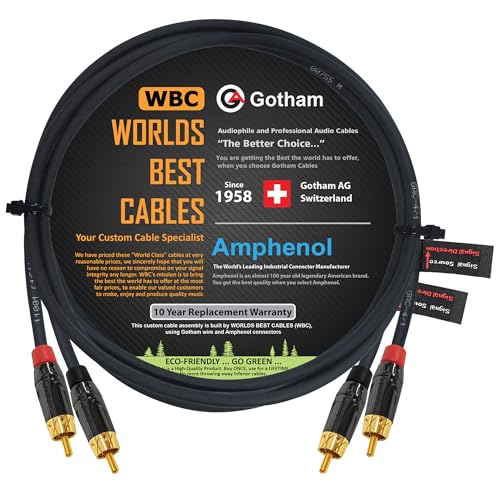
| Gotham GAC-4/1 Star-Quad RCA PairQuietest Signal | Noisy rooms and long RCA runs | — | 3 feet | RCA | Amazon |
| WBC-PRO-LOCAP RCA Pair 2.5 Ft | Turntables and preamps | 22 AWG | 2.5 feet | RCA | Amazon |
| WBC-PRO-LOCAP RCA Pair 1.5 Ft | Tight shelf spaces | 22 AWG | 1.5 feet | RCA | Amazon |
| WBC-GOLD-LOCAP-SPKR 12 AWG Pair | First audiophile speaker upgrade | 12 AWG | 10 feet | Banana | Amazon |
| WBC-PRO-Quad Star-Quad XLR Pair | Studio and live mics | 21 AWG | 3 feet | XLR | Amazon |
| AutCreation 14 AWG OFC with Banana Plugs | Desktop and surround setups | 14 AWG | 4.92 feet | Banana | Amazon |
| HiFind 16 AWG Tinned Copper 2-Pack | Bi-wire and indoor-outdoor runs | 16 AWG | 10 feet | Banana | Amazon |
Detailed Reviews
1. Nakamichi 24k Gold Plated Banana Plugs
Our pick — 4.5+★ from 650+ verified ratings; the strongest balance of quality and price.
Fifteen feet of 12 AWG copper that reaches the far corner of the room without thinning out.
Nakamichi’s kit does the job most people actually need from a speaker cable: a long run of thick, high-purity wire with the plugs already soldered on. You get a 15-foot dual-conductor length of 12 AWG copper, certified by SGS to be 99.9% oxygen-free, and four banana plugs — two pairs — in the box. That is enough to run one speaker properly across a wide room rather than stretching a short cable and hoping.
For length, this is in a different class from the AutCreation pair: 15 feet versus 4.92 feet per cable.
What wins people over here is the build. The dominant theme across the feedback is simply how well-made the cable feels, with sound quality a clear second. The copper plugs are gold-plated from bottom to tip rather than just coated on the outside, so they resist the tarnish that slowly dulls a cheaper connector. The interior PVC jacket is CL2 rated and flame retardant, which matters if you are fishing cable through a wall cavity. A 3-year warranty backs the whole assembly.
The catch is the cosmetics and the fit. Owners describe the black mesh jacket as ugly, and the gray outer piece and the collars take some fumbling the first time you seat them in a binding post. Neither affects the sound. Plan on one awkward install, then leave them alone.
What earns the top spot
- 15 feet per run solves wide-room speaker placement in one purchase
- 12 AWG oxygen-free copper keeps resistance low on a longer reach
- 24k gold plating from base to tip resists tarnish over time
- CL2-rated flame-retardant jacket suits in-wall routing
Where it asks for patience
- The black mesh jacket is not a pretty look
- The collars and gray outer piece need fiddling on first insertion
Buy this if: your speakers sit far from the amp and you want the termination work already done for you.
Look elsewhere if: you need a short, tidy jumper for a desktop shelf.
2. WORLDS BEST CABLES 9 AWG Speaker Cable Pair
Nine-gauge copper in a tweed jacket — the heaviest wire here, built for power-hungry floorstanders.
Two thousand six hundred eighty-eight strands of 99.99% ultra-pure oxygen-free copper, each 0.08mm, feed each 9 AWG conductor. That is an enormous amount of copper for a 6-foot cable, and it is the reason this pair moves current into a demanding speaker without the resistance that saps bass. The braided tweed jacket is hand applied and the embroidered labeling is hand stitched — a detail you will either love or ignore.
Compare it to the Gotham RCA pair at 3 feet and the length difference is obvious, but the real contrast is purpose. This is speaker-level cable for the last few feet between a power amp and a large cabinet, not an interconnect. The Eminence banana plugs are 24K gold plated at 3 microns, in the standard 4mm diameter, with fully insulated bodies so nothing shorts if a plug slips. The plug shafts are reinforced specifically to handle a cable this thick.
The value story is what carries this pick. Value for money is the aspect owners talk about most, with quality a close second, and that reflects the reality that a handcrafted tweed-wrapped pair at this build level undercuts the boutique brands noticeably. Bass extension comes up repeatedly as the audible change. Soldering runs through WBC’s 4% silver blend and nitrogen-assisted process, and the four fabric connector pouches and gift box are reusable.
The honest trade-off: nine-gauge copper is stiff and heavy, so this cable does not want to bend around tight corners or disappear behind a baseboard. It also only spans 6 feet, which is fine for a rack sitting between two speakers and short for anything else.
The match: a dedicated two-channel rig with large speakers and a rack placed close by.
The mismatch: a long wall-to-wall run, where 6 feet runs out and the Nakamichi’s 15 feet does not.
3. Gotham GAC-4/1 RCA Cable Pair
Double-shielded Swiss star-quad built to swallow hum in a room full of gear.
The GAC-4/1 uses linear crystal oxygen-free copper wrapped in two shields at 100% coverage each, and Gotham rates the radio-frequency rejection at over 130dB at 25 kHz. In plain terms, that is a cable designed for the noisy end of the problem — a stack of amps, a router, dimmers, and long RCA runs picking up a buzz that follows the volume knob. The star-quad twist cancels interference by geometry rather than by bulk alone.
The pair is directional and terminated with Amphenol ACPL plugs, which have a black chrome body, gold-plated brass contacts, and a colored rubber grommet for strain relief. Each cable is 3 feet, soldered with the same 4% silver blend WBC uses across its custom work. Gotham has been building cable in Switzerland since 1958, and this is the assembly that leans hardest on shielding rather than length or gauge.
Sound quality is what the feedback centers on, with tightened, deeper bass and no hiss or distortion the recurring theme, and value second. Owners say the improvement shows up on the first track, with no burn-in needed. That fits the two-shield build: cutting noise is audible immediately.
Why it earns a slot
- Two 100% coverage shields plus star-quad geometry for stubborn hum
- RF rejection rated over 130dB at 25 kHz
- Amphenol ACPL gold-plated brass contacts with a strain-relief grommet
What to plan around
- 3 feet is short — this suits a shelf stack, not a spread-out rack
- The directional marking means you must fit it the right way round
Reach for it when: you can hear a buzz that tracks the volume and you have already tried moving the cable.
Pass it by when: your components sit far apart and 3 feet cannot bridge them.
4. WBC-PRO-LOCAP Low-Capacitance RCA Cable Pair, 2.5 Foot

Low capacitance is the number that matters when a turntable needs to keep its treble intact.
Fourteen picofarads per foot is the spec to know here — capacitance, the electrical property that rolls off high frequencies on a low-output source like a moving-magnet cartridge. Lower is better in that job, and WBC builds this cable around it. The conductor is 22 AWG 99.99% oxygen-free copper made of 65 extra-fine 0.08mm strands, wrapped in a dense spiral shield covering over 97% and a UV-protected polyester braid.
The shield is rated for runs over 100 feet, so the noise floor holds up even on this 2.5-foot pair. That makes it a strong phono-stage-to-amp or preamp-to-power-amp link where runs are short but noise pickup is the enemy. Amphenol ACPR gold-plated brass RCA plugs in red and white handle the termination, with rubber grommets for strain relief.
Quality is the aspect owners mention most, with value right behind it, and the sound-quality notes lean toward tighter treble and clean detail. The pair is 2.5 feet per channel, a small step up from the 1.5-foot version WBC also sells — that extra foot is the difference between a cramped shelf and a comfortable one.
Who this fits: a turntable owner with a short, tidy shelf who wants the phono signal kept clean without paying boutique prices.
Where it stops: 2.5 feet will not stretch across a component stack with any slack, so measure your reach before you commit.
The vinyl answer: phono-stage and preamp links where low capacitance preserves the top end.
The wrong job: bridging gear more than a shelf-width apart.
5. WBC-PRO-LOCAP Low-Capacitance RCA Cable Pair, 1.5 Foot

The tidy half-metre that keeps a stacked rack from turning into a spaghetti nest.
Same cable as the longer LOCAP, cut to 1.5 feet per channel. That makes it the right pick when your preamp sits directly above the power amp or the DAC lives next to the receiver, and a longer cable would just coil into a mess behind the shelf. The electrical spec is identical: 14pF/ft capacitance, a 22 AWG 99.99% oxygen-free copper core of 65 fine 0.08mm strands, and a spiral shield covering over 97%.
The UV-protected polyester braid and coaxial build resist sunlight damage if the cable runs past a window. Amphenol ACPR RCA plugs with gold-plated brass contacts close it out, and the rubber grommets give the cable something to flex against instead of stressing the solder joint.
Quality leads the feedback here by a clear margin, with value money second and compatibility third, including turntable connections called out directly. Buyers report clearer treble, the expected result of low capacitance on a phono or line-level signal. If you already know you want short, this is the version to order.
The one limit worth stating: 1.5 feet is genuinely short. Check the gap between your two jacks with a tape before you buy, because there is almost no slack in this pair.
For the tight stack: preamp, DAC, and amp sitting inches apart.
Not for the spread rack: any gap that needs more reach than a half-metre.
6. WORLDS BEST CABLES WBC-GOLD-LOCAP-SPKR Speaker Cable Pair

A dumbbell-shaped 12 AWG cable pair built to make your first real speaker cable upgrade count.
The design detail that separates this pair is the expanded dumbbell layout: two 12 AWG conductors held apart rather than pinched together. WBC claims that spacing gives it the lowest capacitance and inductance of any speaker cable in its price range. The pair uses 588 strands of 99.99% oxygen-free copper at 0.12mm each, split between the two cores, under a flexible PVC-blend jacket.
Eminence 24K gold-plated banana plugs at 3 microns in standard 4mm diameter do the termination, with fully insulated bodies to prevent a short and a reinforced shaft for the heavy gauge. Each cable is 10 feet, sold for a left and a right channel. It is the pair that most cleanly bridges entry-level and affordable-audiophile territory.
Owners talk about quality first and value second, with sound quality third and fit mentioned on the tail — including one setup driving Denon AVR and DIY high-SPL horn speakers without trouble. Bass and overall clarity are the recurring mentions. Ten feet is a comfortable span for speakers on either side of a TV or a rack.
Strengths that carry the pick
- Dumbbell spacing lowers capacitance and inductance on a 12 AWG pair
- 588 fine strands of 99.99% OFC copper in a tough flexible jacket
- 10 feet per channel plus Eminence gold banana plugs
What the buyer should know
- Listed for indoor use, so it is not the pick for a patio run
- The pair is one left and one right — not a two-room kit
the balance: a first serious speaker cable for a two-speaker stereo or home-theater setup. It gives you solid copper and secure plugs without overspending.
Where it is not enough: very long runs or multi-zone wiring that needs more pairs.
7. WBC-PRO-Quad Star-Quad XLR Cable Pair with Amphenol Plugs
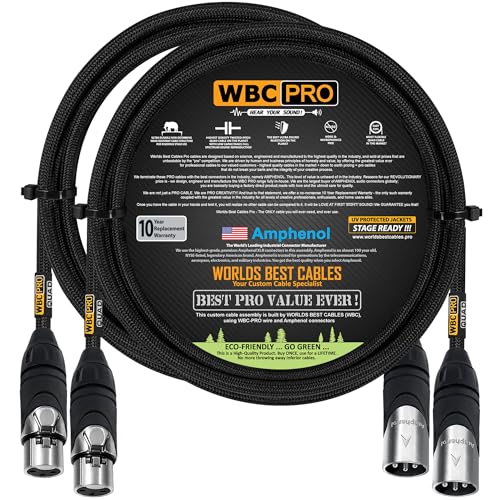
Four copper cores and a dense shield — the cable for a mic that has to stay silent on a loud stage.
Star-quad means four conductors arranged in a cross pattern, and it is the geometry that cancels hum in a balanced line. This pair uses four 0.08mm fine-stranded 99.99% oxygen-free copper cores totaling 21 AWG, wrapped in a braided shield rated above 98% coverage under a UV-protected jacket. Combined, the design suppresses the electromagnetic and radio interference a stage or studio throws at a cable. WBC builds it in-house and positions it against the industry standards like Mogami 2534 and Canare L-4E6S.
Termination is the other half of the value. Amphenol’s AX3M and AX3F connectors use a satin nickel zinc diecast shell, silver-plated contacts, and machined contacts on the male — not the stamped contacts that show up on cheap plugs. Each cable is 3 feet, male-to-female, soldered with the same 4% silver blend.
Compare the gauge to the Nakamichi at 12 AWG and the roles separate fast: 21 AWG is a balanced signal cable, not a speaker cable, and the lighter gauge is correct for a microphone line. The build is backed by the ratings pattern — quality is what the feedback centers on, and value follows close behind. If you are running a mic into an interface in the same room as a computer and a monitor, this is the cable that keeps the take clean.
The trade-off: a 3-foot run is short, which suits a desk or a live board but not a studio floor where the performer stands well back from the interface. Buy the length your session actually needs.
Pick it for: mic and balanced-line runs where hum rejection is the priority.
skip it if: you need a long cable to a distant mic — 3 feet will not reach.
8. AutCreation 14 AWG Speaker Cable

One pair, eight plugs, and enough 14 AWG copper to get a stereo running today.
AutCreation’s package is the practical starter kit. You get one pair of cables, each 4.92 feet, with 8 banana plugs in total — two at each end — in color-coded red and blue so polarity is unmistakable. The wire is 14 AWG stranded 99.9% oxygen-free copper, and the plugs are gold plated to resist corrosion over the years.
The length is where this pair parts ways with the Nakamichi: 4.92 feet versus its 15-foot run. If your amp and speakers sit close, this is the tidy choice. If they do not, the reach runs out quickly.
Owners mention quality comes up most in the feedback, with value for money second and sound quality third. One reviewer notes a hand-clap test sounds distinct, and the cables look and feel like a far pricier set. The honest gripe is plug fit: new plugs can need a firmer push or a small squeeze with pliers before they seat sweetly. That settles after the first few insertions.
The obvious fit: a desktop or surround setup where the run is short and the budget is tight.
The stretch point: long-room runs, where the 4.92-foot length simply runs out.
9. HiFind 16 AWG Speaker Cable 2-Pack

Bent 90-degree tips that slide into a crowded receiver back panel without a fight.
The angled banana tip is the reason to choose this pair. A straight plug jams against the wall when a receiver is pushed into a cabinet; a 90-degree tip rotates in from the side. HiFind terminates both ends in gold-plated banana plugs and gives you a 10-foot, 16 AWG tinned copper cable per side, in a two-pack. Tinned copper means each strand carries a thin coating, a practical defense against corrosion in humid rooms or a covered outdoor run, and the UL CL3 rating supports in-wall and outdoor use.
Color coding keeps polarity clear — red tip positive, white tip negative — and the soft-touch jacket is built for bi-wire and bi-amp setups without cutting and crimping your own ends. The plugs are designed for a tight, stable grip, which means firm seating on new binding posts. The maker’s own instruction is a gentle twist during insertion and removal, and that is the right way to seat them.
Owners value the convenience most — it beats making your own terminations by hand — and the solid wire gauge comes up alongside it. Build quality and appearance draw positive notes. At 10 feet, it spans a surround channel or a bookshelf pair with room to spare, and a 2-year warranty covers any quality issue.
The one trade-off: 16 AWG is lighter copper than the 12 AWG pairs here, so it is best suited to shorter runs and surround speakers rather than a long feed to a power-hungry floorstander.
The right call for: a receiver wedged in a cabinet, a surround speaker, or a bi-wire setup on a budget.
The wrong call for: a long run to a large full-range speaker that wants heavier copper.
Know the Specs
Gauge (AWG)
AWG stands for American Wire Gauge, and a lower number means a thicker copper conductor. Thicker copper carries more current with less resistance, which is what a speaker cable needs on a long run or a demanding speaker. The Nakamichi and WBC-GOLD pairs use 12 AWG, the AutCreation uses 14 AWG, the HiFind uses 16 AWG, and the WBC Ultimate steps all the way up to 9 AWG. In general, shorter runs to a surround channel tolerate thinner wire, and long runs or big full-range cabinets benefit from thicker copper.
OFC and Tinned Copper
OFC means oxygen-free copper, copper refined to strip out the oxygen that makes a bare conductor corrode and turn green. Less corrosion means the resistance stays where it started, so the cable keeps performing over the years. Tinned copper takes the same idea a step differently — a thin coating on each strand resists moisture, which is why a tinned 16 AWG pair suits indoor-outdoor use. Both are honest ways to protect a conductor. Neither is a magic sound upgrade on its own.
Star-Quad and Shield Coverage
A star-quad cable arranges four conductors in a cross pattern so the fields they carry cancel each other out, which is why balanced XLR uses it. Shield coverage describes how much of the cable’s length is wrapped in metal — over 98% on the WBC-PRO-Quad XLR and over 97% on the WBC-PRO-LOCAP RCA. Higher coverage intercepts more hum and radio interference. In a room full of gear, that shielding decides whether you hear the music or the noise floor.
Capacitance in picofarads per foot
Capacitance is the electrical property that rolls off high frequencies, especially on a low-output signal like a phono cartridge. It is measured in picofarads per foot, and lower is better for that job — WBC rates its LOCAP cable at 14pF/ft. A high-capacitance cable on a turntable can dull the treble. On a speaker run, capacitance and inductance both matter, which is why the WBC-GOLD pair spaces its two conductors apart in a dumbbell layout.
Common Questions
Will banana plugs fit my receiver’s binding posts?
How much louder is 12 AWG than 16 AWG?
What is star-quad and why does an XLR use it?
Do gold-plated plugs actually make a difference?
Will a low-capacitance RCA cable improve my turntable?
Can I use speaker cable outdoors or in a wall?
Is an XLR cable the same as a speaker cable?
How long should a speaker cable be for my room?
Why do new banana plugs feel tight the first time?
Does a longer speaker cable hurt sound quality?
The Bottom Line
For most systems, the worlds cables winner is the Nakamichi 24k Gold Banana Plug set. Its 15-foot run of 12 AWG (American Wire Gauge, a thickness measure where lower numbers mean thicker copper) 99.9% oxygen-free copper reaches across a room, so you can place speakers where they sound best. The 3-year warranty backs the assembly, and the plugs arrive already soldered, so you just plug them in. If your priority is a short phono or preamp link with treble intact, the WBC-PRO-LOCAP 2.5-foot RCA pair at 14pF/ft (picofarads per foot, a low capacitance that keeps high frequencies clear) is the cleaner answer. For a studio mic line that has to stay quiet, reach for the WBC-PRO-Quad XLR pair and let its star-quad shield (four conductors twisted to cancel interference) do the work. The honest nudge: the Nakamichi has the widest following of any speaker cable here by a real margin, and its rating reflects that. Buy the length and connector type your room demands, not the fanciest jacket.
How we choose
We do not accept paid placement. Every pick is matched to a real buyer and a real use-case; we do not hands-on test units.
Sources
Specifications: manufacturer listings and product documentation. Review insights: verified customer reviews, as of November 2026. Pricing: not shown on this page (it changes often); check the current price via the retailer link.
As an Amazon Associate, Tactical Gear Guy earns from qualifying purchases. This does not affect which products we feature.